JAPAN National Profile 2020-2021
←
→
Page content transcription
If your browser does not render page correctly, please read the page content below
National Profile
      JAPAN

     2020-2021
Table of contents

Dear Exchangees, ............................................................................................................................... 3
ICYE JAPAN Staff................................................................................................................................ 3
ICYE JAPAN Mission Statement ......................................................................................................... 4
ICYE JAPAN Office Information .......................................................................................................... 4
Who should apply/who we can’t accept? ............................................................................................ 5
Facts about Japan ............................................................................................................................... 6
Language............................................................................................................................................ 11
Very Basic Japanese ......................................................................................................................... 12
Japanese Perceptions ....................................................................................................................... 13
ICYE PROGRAMS ............................................................................................................................ 15
Money ................................................................................................................................................ 18
Preparing for Japan ........................................................................................................................... 19
ICYE JAPAN Annual Schedule ......................................................................................................... 22
ICYE JAPAN Rules and Regulations ................................................................................................ 23

                                                                           2
Dear Exchangees,

We hope that you are just as excited about coming to Japan through the ICYE Program as we are
to have you here!

Living in another culture is quite different from visiting. It takes more commitment to adapt to a new
environment. It is not easy, but with effort, time, and patience comes the reward of a deeper
understanding of different people, ways of life and cultures.

This “National Profile of Japan 2020-2021” in your hands is a brief introduction to our country and
introduces you to some of the things you can expect from your year here. It also includes very
important information on our expectations of you throughout the program. It will help you get started
preparing for your year with us as well.

Looking forward to meeting you!

Sincerely,
ICYE JAPAN Office

                                         ICYE JAPAN Staff

              Shigeru Murano                     Rina Matayoshi                    Seiko Kurose
              Board chairman                   Program Coordinator              Incoming Coordinator
              & Office staff (Finance)   Outgoing, STePs Incoming coordinator

                                              Board Members

                                                        3
ICYE JAPAN Mission Statement

Mission: Provide the opportunity to have interests in others and the world
Vision: Exchange your life~Have an experience that dramatically changes your life and
your view
Goal: Realization of the world peace through mutual understanding

          ICYE Japan is a member of the International Cultural Youth Exchange Federation and
shares the goals and objectives of our fellow committees. We provide a place for Inter Cultural
Exchange and Understanding through volunteer work. Our aim is to break through the many
barriers that separate people and to find a common ground on which we may live together in this
world. We believe that all people are basically equal, regardless of ethnicity, religion,
social/economic power and gender. We endeavor for the realization of cultural, religious, social,
economic and individual freedom.

                       ICYE JAPAN Office Information

Office Hour                10:00am – 18:00pm from Tuesday to Saturday(closed on every 5th
                           Saturday and a following day of the national holiday on Monday)
Address                    1-7-21-901 Kita-Shinjuku, Shinjuku-ku, Tokyo, Japan

TEL/FAX                    +81-(0)3-5389-5041

Office staff               3 full-time employees and a part-time worker
                           (There are many voluntary staff like board members and returnees.
Founded                    1958

History                    The Japan Committee of the ICYE Federation was founded in 1958 by
                           the National Council of Churches in Japan and joined the ICYE
                           program in 1959.
                           Tokyo YMCA organized the program from 1983, in April 2002, ICYE
                           JAPAN became an independent organization and was certified as a
                           Non Profit Organization (NPO) by the Tokyo Metropolitan Government
                           on August 30, 2002.

                                                4
Who should apply/who we can’t accept?
           ICYE Japan offers exchangees the opportunity to experience Japanese culture
   through voluntary service, but it is up to each exchangee to make an effort to reach a
   deeper understanding during his/her exchange period. Our program is designed for
   individuals who have a keen interest in learning about Japan and are willing to adapt to
   the Japanese lifestyle.
           Exchangees should be prepared to live with people and to stay in their social
   work placements and do voluntary work. This does not provide the same kind of
   freedom that you usually have when you are on vacation, but will allow you to
   experience a part of Japan that vacationers will not.
           The most important thing to remember is to remain flexible, even if others are
   not, and try not to judge what is right or wrong about cultural differences. By
   keeping a positive attitude instead of worrying about what you don’t like, you are bound
   to have a good time here.

            Even though ICYE JAPAN is open minded and diverse, Japanese society is
   still somewhat conservative. For this reason, we sometimes decide NOT to proceed to
   host a volunteer who has;
   - Big Tattoo on your body (see the photo below)
   - Piecing on your face (only ears are acceptable)
   - Unnaturally colored hair
   This is because although our culture is gradually changing, Japanese tend to have
   negative impressions towards you if you have such an appearance. You would be
   perceived as “negative” foreigners because of it. In Japan, these cause problems when
   trying to be included in society for many people, even if he/she is Japanese.
   So please understand this Japanese custom and if you already have any of the
   appearances listed, please do not add to it until a decision has been reached. Please
   ask us if you are unsure and want to know if your appearance is acceptable in Japan.

                                   Examples of unexpected appearance

                                       Too much piercing on your
Big   Tattoos   (especially   on
                                       face or other body parts (Only
your arms, face, neck, hands                                            Unnaturally colored hair
                                       ears are acceptable)
and/or places that are obvious                                          ( Red, pink, blue , etc …)
to others)                                           5
Facts about Japan

As an archipelago spanning over 3,000
kilometers from north to south, Japan
                                                           CHINA
consists of four main islands: Hokkaido,
Honshu, Kyushu and Shikoku. It does not
                                                                                   Hokkaido
share direct borders with any country but is
surrounded by two great seas, the Pacific                   Sea of Japan
Ocean to the east and the Sea of Japan to
the west.                                                                      Honshu
                                                   KOREA

                                                                                  Tokyo

                                                                   Shikoku
                                                   Kyushu                    Pacific Ocean

Land Area               About 378,000km2
Population              Approximately 127 million people
Language                Japanese
Capital                 Tokyo
Currency                Yen (¥) [116 yen = approximately 1 Euro(November 2016)]
Time lag                UTC+9 (no summer time)

Climate        The climate varies greatly from region to region, from the subtropical
               Okinawa in the south to the cool Hokkaido in the north. It is also very
               different depending on the season.

               Summer: Lasts from June to early
               September. It rains frequently during the first
               two summer months and the temperature is
               usually cool at this time. Once the rainfall
               decreases, temperatures range from 25C to
               35C with considerable humidity. The
               typhoon season is in September.

                                            Autumn: Lasts from Late September to
                                            November. It can be a mixture of hot and
                                            cool days at first, but once it begins the
                                            humidity decreases and it becomes
                                            pleasantly cool as the leaves turn yellow,
                                            red and purple. General temperatures
                                            range from 15C to 25C in Tokyo.
                                           6
Winter: Lasts from December to February.
            Dry air, cool winds and frequent snow in the
            north with an average temperature of 6.6C.
            However in Tokyo, it occasionally drops as
            low as -4C. Hokkaido and areas of the Japan
            near the sea have a lot of snow in winter, but
            not so much in the south and around Tokyo.

                                             Spring: Lasts from March to May. This is
                                             the season of plums, cherry blossoms
                                             and new beginnings. April 1st marks the
                                             commencement of the academic and
                                             financial year in society.

Geography   Japan is mostly rugged and mountainous, with many dormant
            volcanoes and a few active ones. Earthquakes occur about 1500 times
            each year, although they are mostly tremors that can only be sensed
            by seismographs. Japan is a safe country in the percentage of crime
            base, but there are many dangerous natural disasters such as sudden
            tsunamis and floods, typhoons, huge earth slides and so on.

Religion    It was thought that there are 8,000,000 Gods in Japan and this belief
            became today’s “Shintoism” a long time ago. Today, most Japanese
            tend to think they are not religious, but our life and culture is still
            affected by Shintoism and Buddism..
            Shintoism 50.2%, Buddhism 44.3%. Christianity 0.7% Other 4.8%
                    * Religious freedom is protected by the national constitution.

Political    Japan is a constitutional monarchy with a parliamentary government.
system      The Diet (parliament) is the highest state power and consists of the
            House of Councilors and the House of Representatives.
            All Japanese citizens above the age of twenty have the right to vote.

                             Mr. Shinzo Abe, is the current prime minister
                             (November 2016) and belongs to the Liberal
                             Democratic Party.

                                         7
Judicial        Supreme Court (the Chief Justice is appointed by the Emperor after
Branch         designation by the cabinet; all other Justices are appointed by the
               cabinet)

Economy        Government-industry cooperation, a strong work ethic, mastery of high
               technology, and a comparatively small defense allocation (1% of GDP)
               has helped the country advance with extraordinary haste to the rank of
               the third most powerful developed economy in the world.

The Imperial   The members of the Imperial family do not have any political power,
family         but act as figureheads for the country. The monarchy is hereditary.
                The Enthronement Ceremony for the present Heisei Emperor, Akihito,
                was held on November 12, 1990. The imperial throne has long been
                exclusive to male heirs, but the birth of Princess Aiko to the Crown
                Prince Naruhito and Crown Princess Masako in 2001 has initiated
                debate over an amendment in the national constitution to allow a
                female to inherit the monarchy in the future.

                                         8
History of Japan
The following is a general overview of Japan’s history and culture. Since it does not
cover issues in depth, please refer to books and websites for more information.

    Ancient Times                Middle Ages             Premodern               Modern            Contemporary Age

 (Kofun, Asuka, Nara,       (Kamakura, Muromachi,   (Azuchimomoyama, Edo   (Meiji, Taisho, Showa   (Showa, Heisei Era)
      Heian Era)                Sengoku era)                Era)                    Era)
                                                                                                       AD. 1945 -
     -AD. 1185                AD. 1185 - 1590          AD. 1573 – 1868       AD. 1868 - 1945

 Period             Name                                         Description
 -300 BC            Jomon      The early Japanese were gatherers, hunters and fishermen.
                               The introduction of rice agriculture begins the development of a social
 300BC
                    Yayoi      hierarchy and hundreds of small countries that started to unify into larger
 -300AD
                               countries.
                               300 Japan is for the first time more or less united. Large tombs (kofun)
 300-538            Kofun
                               were built for the deceased leaders.
                               538/552 Introduction of Buddhism.
 538-710            Asuka      604 Prince Shotoku's Constitution of seventeen articles is promulgated.
                               645 The Taika reform is introduced. The Fujiwara era starts.
                               710 Nara becomes the first permanent capital.
 710-784            Nara
                               784 The capital moves to Nagaoka.
                               794 The capital moves to Heian (Kyoto).
                               1016 Fujiwara Michinaga becomes regent.
                               1159 The Taira clan under Taira Kiyomori takes over the power after the
794-1185            Heian      Heiji war.
                               1175 The Buddhist Jodo sect (Pure land sect) is introduced.
                               1180-85 In the Gempei War, the Minamoto clan puts an end to Taira
                               supremacy.
                               1191 The Zen sect is introduced.
                               1192 Minamoto Yoritomo is appointed shogun and establishes the
                               Kamakura government.
                               1221 The Jokyu Disturbance ends a struggle between Kamakura and
1192-1333      Kamakura        Kyoto resulting in the supremacy of the Hojo regents in Kamakura.
                               1232 A legal code, the Joei Shikimoku, is promulgated.
                               1274 and 1281 The Mongols try to invade Japan twice, but fail mainly
                               because of bad weather conditions.
                               1333 The Kamakura bakufu falls.
                    1334 Kemmu restoration: the emperor restores power over Japan.
                    1336 Ashikaga Takauji captures Kyoto.
                    1337 The emperor flees and establishes the Southern court in Yoshino.
                    1338 Takauji establishes the Muromachi government and a second
                    emperor in Kyoto (Northern court).
1338-1573 Muromachi
                    1392 Unification of the Southern and Northern courts.
                    1467-1477 Onin war.
                    1542 Portuguese introduce firearms and Christianity to Japan.
                    1568 Nobunaga enters Kyoto.
                    1573 The Muromachi Bakufu falls.

                                                           9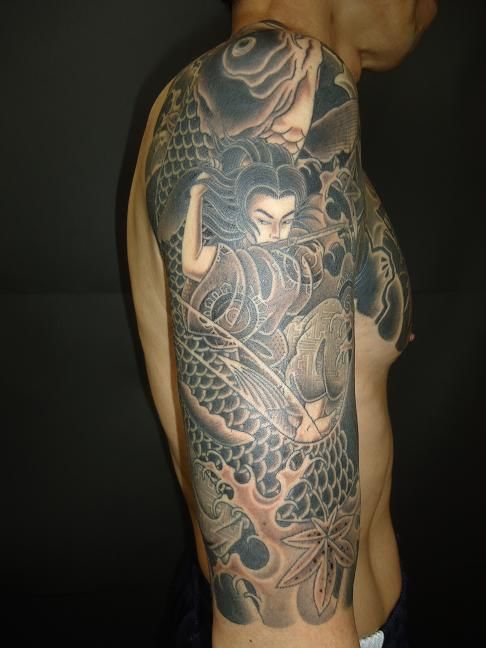
1575 The Takeda clan is defeated in the battle of Nagashino.
                   1582 Nobunaga is murdered and succeeded by Toyotomi Hideyoshi.
                   1588 Hideyoshi confiscates the weapons of farmers and religious
           Azuchi  institutions in the "Sword Hunt".
1573-1603
          Momoyama 1590 Japan is reunited after the fall of Odawara (Hojo).
                   1592-98 Unsuccessful invasion of Korea.
                   1598 Death of Hideyoshi.
                   1600 Tokugawa Ieyasu defeats his rivals in the battle of Sekigahara.
                        1603 Ieyasu is appointed shogun and establishes the Tokugawa
                        government in Edo (Tokyo).
                        1614 Ieyasu intensifies persecution of Christianity.
                        1615 The Toyotomi clan is destroyed after Ieyasu captures Osaka
                        Castle.
  1603 -
               Edo      1639 Almost complete isolation of Japan from the rest of the world.
   1867
                        1688-1703 Genroku era: popular culture flourishes.
                        1792 The Russians unsuccessfuly try to establish trade relations with
                        Japan.
                        1854 Commodore Matthew Perry forces the Japanese government to
                        open a limited number of ports for trade.
                        1868 Meiji restoration.
                        1872 First railway line between Tokyo and Yokohama.
                        1889 The Meiji Constitution is promulgated.
1868-1912     Meiji     1894-95 Sino-Japanese War.
                        1904-05 Russo-Japanese War.
                        1910 Annexation of Korea.
                        1912 Death of emperor Meiji.
                        1914-18 Japan joins allied forces in WW1.
1912-1926    Taisho
                        1923 The Great Kanto Earthquake devastates Tokyo and Yokohama.
                        1931 Manchurian Incident.
                        1937 Second Sino-Japanese War starts.
                        1941 Pacific War starts.
                        1945 Japan surrenders after two atomic bombs are dropped over
                              Hiroshima and Nagasaki.
1926-1989    Showa
                        1946 The new constitution is promulgated.
                        1952 The Allied Occupation of Japan ends.
                        1956 Japan becomes member of the UN.
                        1972 Normalization of relations to China.
                        1973 Oil crisis.
                        1995 The Great Hanshin Earthquake hits Kobe.
  1989-       Heisei          Sarin Gas attack in the Tokyo subway by AUM sect.
                        2011 Great East Japan Earthquake

Japanese Culture
Japanese history is evident throughout its culture, art forms, and attitudes. Many
traditions are derived from Chinese culture but flowered into unique styles and
perceptions over the centuries. Examples include the Noh theatre, the tea ceremony,
and ikebana flower arrangements. Japanese art forms developed during the Shogun
period, and the kabuki theatre and ukiyo-e painting originated in the Edo Period.

                                                10
Language
Japanese (Nihongo) is the official language.
The standard form is spoken on the news, taught in schools, and used
in newspapers, while each region has its own dialect. There are three
different forms of the written language, which are combined to create
the modern Japanese language:
Kanji: Chinese characters. Approximately 2,000 characters.
Hiragana: A simplified form of kanji that is used to spell Japanese
words that do not have kanji equivalents, such as prefixes, suffixes,
prepositions, etc. Contains 51 characters.
Katakana: An even more simplified form of hiragana that is typically
used to spell foreign words. Contains 51 characters.
* English is taught as the first foreign language from junior high school in
public schools. Many private schools begin earlier and/or teach other
languages, such as French. English in Japanese schools mostly focuses on
grammar
Please practice reading and writing Hiragana and Katakana as a
minimum before coming to Japan.
あ ア A い イ I う ウ U え エ E お オ O
か カ KA き キ KI く ク KU け ケ KE こ コ KO
さ サ SA し シ SI す ス SU せ セ SE そ ソ SO
た タ TA ち チ CHI つ ツ TSU て テ TE と ト TO
な ナ NA に ニ NI ぬ ヌ NU ね ネ NE の ノ NO
は ハ HA ひ ヒ HI ふ フ HU へ ヘ HE ほ ホ HO
ま マ MA み ミ MI む ム MU め メ ME も モ MO
や ヤ YA ゆ ユ YU よ ヨ YO
ら ラ RA り リ RI る ル RU れ レ RE ろ ロ RO
わ ワ WA を ヲ WO
ん ン N
※ Please remember at least “Hiragana” before you come to Japan,
basic Japanese (or at least studying Japanese Experience)is
required in most of our project.
11Very Basic Japanese
Good morning Ohayou Gozaimasu
Good afternoon Konnishiwa
Good evening Konbanwa
Good night Oyasumi nasai
Thank you Arigatou Gozaimasu
You are Welcome Douitashimashite
I’m sorry Gomennasai
No problem Daijobu desu
Excuse me Sumimasen
Yes/No Hai/iie
Please Onegaishimasu
See you Sayounara
Nice to meet you Hazimemashite/
Yoroshiku Onegai Shimasu
My name is ~ Watashi no Namae wa ~ desu
I’m ~ years old ~ sai desu
I’m from ~ ~ kara Kimashita
I don’t know Japanese Nihongo wa Wakarimasen
I like ~ Watashi wa ~ ga Sukidesu
I don’t like ~ Watashi wa ~ ga Sukideha arimasen
It tastes good Oishii desu
I’m having fun Tanoshii desu
I’m tired Tsukareteimasu
Where is ~ ? ~ wa Dokodesuka?
How much is ~ ? ~ wa Ikura desuka?
I’m not feeling so well Guai ga warui desu
12Japanese Perceptions
Japan is an island and had closed to other countries for a long time. It made the very
unique and different culture from other parts of the world. At the same time, they have
roughly half the population of the United States in a land area about the size of Finland
or the state of California. Given these crowded conditions, in addition to a
long-standing culture of aesthetic formality, precise, detailed rules of etiquette dictate
the Japanese way of life.
In order to live in Japan, you must always be thinking of others.「和」(harmony) is
very important in the Japanese society. Over generations, people have developed a
strong feeling of membership of a group, for example as a member of a family, school,
company, or village, and prefer to live that way. If they leave the group, they cannot
have a normal life because their social system and rules were formed for existence
within the group. This idea is the cause of a lot of Japanese habits or manners. The
avoid doing things that may make someone uncomfortable, even if they really want to
do it or they think it is right.
Japan is a country that is open to foreign influence. In this modern age, this is
demonstrated by the wide range of non-Japanese cuisine, movies, books, music and
sports available. Contemporary culture has also incorporated many foreign aspects.
On the other hand, the core structure of society generally remains unaltered and
conventional. Foreigners stand out distinctly as “non-Japanese” and are often still
stared at, despite the continuing increase of tourism and employment in Japan.
Japanese perceptions of foods are very different from your country. When we start
eating, we say “Itadakimasu” and when finish, we say “Gochisosama”. The meaning is
similar to us thanking all the people and lives concerned with the meal; for example,
our parents, a person who cooks, farmers and also nature itself. We believe it is very
rude to leave foods and it is considered bad manners to be a picky eater or only eat
some kind of food in Japan. That is why vegetarian culture is not common here and
difficult for Japanese people to understand.
13The following are a few characteristics of Japanese people that may be helpful in
deciphering their tendencies:
- Japanese don’t complain directly to a person but want him/her to “notice” how they
are feeling or thinking. “Sassuru”(notice) is important in Japanese culture. As long
as you are in Japan, you need to be sensitive to what and how people are thinking
about you, especially when you are with host family or in any groups.
- Behaviors which are considered bad are e.g. breaking the rules, being rude, saying
bad words etc. In Japan, culture is wrapped around collectivism and if a person
behaves in the wrong way, the act will not only reflect badly on the person but also
on all the people/organizations that is connected to him/her. When coming to
Japan you should bear this in mind.
- Hierarchy…even if the age difference is only 1 year, you have to respect the older
person. It is not common to call nick names or first names to people older than
yourself. To all adult people the use of their last name connected to –san is the
correct way to address them. With children it is okay to use their first name and
add a –kun (if boy) or a –chan (if girl) (e.g. Sousuke-kun or Minami-chan)
- Physical contacts with the opposite sex in families, friends and even lovers are not
so open compared to western countries. It is rare to display physical contacts
between boys and girls in public, such as hugging or kissing. Japanese distinguish
private and public places.
- In contrast to many western people, who are more likely to express their opinions
openly in a self-asserting way, many Japanese tend to speak and act only after
consideration has been given to the other person’s position, feelings, and points of
view. Furthermore, clear cut “yes” and “no” answers are often avoided, and speech
is often embellished with euphemisms and honorifics to prevent unnecessary
offense and/or conflict. Again – the respect for harmony (和/wa)
Useful information on the Internet.
-Cozy Japan ~Rooms and Travel information~ https://cozy-japan.com/
-Live Japan perfect guide of Tokyo https://livejapan.com/
-Moshimoshi Nippon マナーや役立つフレーズ http://www.moshimoshi-nippon.jp/
-Disaster Prevention Guidebook in Seven Languages
https://www.pref.saitama.lg.jp/a0306/documents/553962.pdf
You can also download this application which will be help you very much to search
most of topics you may like to look up. ( Life and Culture, Weather forecast, Speech
translation, Transfer guide, List of Embassies, Japan-guide.com, Phrase book, Flight
information, Free Wi-fi Guide, etc ) http://www.japan-guide.com/news/0030.html
14ICYE PROGRAMS
ICYE JAPAN re-started the hosting programme in 2008 and we are still in the process
of re-construction. Exchangees may face an uncomfortable situation because of this,
but we will be happy if you cooperate with us to make a better programme.
First of all, all exchangees should be aware and accept the fact that this period is NOT
a vacation. If you want to just see around Japan or behave in the same way you
would while on vacation, we strongly recommend you visit Japan as a trip. If you join in
the ICYE programme, please remember you will be a member of Japanese society and
you need to work as a volunteer for the community.
Accommodation
Most exchangees will live at the project place. In Japan, It’s very difficult to find a host
family since it is not a custom here to host volunteers. In the case that you stay with a
host family, you need to be much more careful. Ask about everything you do and have
the same life style as the family, even though it depends on the family how much they
want you to do that. Moreover, don’t forget to communicate with the family. They
accepted you as a volunteer because they want to communicate with you.
15Volunteer Work Placements
Exchangees coming to Japan should be excited about working as a volunteer in Japan.
“Volunteer” comes from the word “Will”. Please, always remember to have a positive
attitude and to take responsibility for what you do during your work.
Through volunteer work, please keep in mind the goals and purposes of ICYE: to
break through the barriers which separate cultures and people, to share a basic
equality regardless of culture, race and sex, and to work for social, economic, racial
and personal freedom.
Before you start your project, we would like to stress the following:
1. The ICYE JAPAN Committee provides work opportunities for you to encounter the
thinking of others, reflect upon your own values, deeper understanding of yourself
and to grow as a person.
2. The work you will do is on a voluntary basis.
You will not receive a salary. ICYE JAPAN will provide you with a monthly pocket
money based on the regulation of the ICYE-Federation. Working for money is
strictly prohibited by ICYE JAPAN.
3. Exchangees cannot choose the project that you actually go on. We distribute the
projects in regards to some aspects like your priorities, experiences and the hosting
situation etc. In addition, you cannot choose the location of the project that you go
to, such as a big city, a small town, the countryside etc. Most of our projects are
placed in small towns or in the countryside. It is very rare to be placed within Tokyo
or other big cities near downtown.
4. Take the work seriously. The volunteer work is the major activity for you.
Working hour of Japanese is usually very long. We expect you to do at least 30
hours of volunteer work every week.
5. It would really be an advantage to have the ability to speak basic Japanese before
starting the program. Otherwise you will end up with less interesting work (copying,
stuffing envelopes, etc.) The more you understand the language, the more
interesting your work will be. So let’s start study NOW!
6. Everything will be decided by Japanese rules and norms whilst in Japan. Even if
you don’t feel right with Japanese culture, we are Japanese and are living by these
rules. Sometimes Japanese rules or ways of doing things are totally different from
the world standard, but you will have to adapt as long as you live in Japan.
16ICYE JAPAN Conferences
Throughout the program year, ICYE JAPAN will hold three conferences which all the
exchangees must attend. These are as following: the Orientation Conference, the
Mid-Year Conference (only for exchangees for a year), and the Final Evaluation
Conference.
Orientation Conference
Introduction Camp – After arriving in Japan, you will live with the short-term host
families in Tokyo or camp site and will have to attend the Introduction Camp and the
Language Course. This will be a great time for all the exchangees to get to know each
other, meet Japanese returnees, as well as get accustomed to the country. Fellow
exchangees and our ICYE JAPAN staff will be the people you will share some of your
best experiences with, but they will also be the ones you will want to turn to during your
difficult times. Spend this time to get to know each other.
Language Course – You will participate in approximately 30 hours (10-20 for short
term) of language training. It is very important that all the exchangees have at least a
basic understanding of the Japanese language, so that you may settle into life in Japan
as comfortably as possible.
Mid-Year Conference
All exchangees will get together at the midpoint of the program year in Japan, to review
your first half of the program. This will be a good time to bring the staff up to date on
both your positive and negative experiences so far, as well as to share them with your
fellow exchangees and any returnees who may attend.
Final Evaluation Conference
Exchangees will gather again at the end of the program year to look back at their year
in Japan. You will each evaluate yourself as well as the program in Japan and the
ICYE Japan Committee before heading back to your home countries.
Constructive opinions and active participation in this conference in particular will help
improve the program for future exchangees. You will also meet the outgoing
exchangees from Japan for the next year –It is possible that someone will be going to
your country!
17Money
Pocket Money
Each month, you will receive around 80 Euros as pocket money, based on the
regulation of the ICYE Federation. This will be either given to you in cash or deposited
into an account.
This pocket money is meant to cover only a certain portion of your personal expenses.
It will not be enough to pay for personal travel (please note that public transportation is
very expensive in Japan), gifts, clothing, eating out, international calls, mobile phone
bills and so on. Therefore, you will need arrangements for bringing extra money to
Japan to cover your expenses for such items.
ICYE JAPAN will not pay for additional language courses or special skills programs
such as for computers. (The language course during the Orientation Conference and
the supplementary Culture Program are included in the ICYE program.) We can help
you find and enroll in such courses if you wish, but all tuitions and fees must be
covered with your own finances.
Transportation Fees
ICYE JAPAN will reimburse program-related transportation costs that are accrued each
month during the program (e.g. conferences and other events). At the end of each
month, you will fill out a “claim form,” and we will reimburse the costs along with the
following month’s pocket money. This means that you will have to bear your
transportation expenses from your pocket money first, until we reimburse you.
Just how expensive is Japan?
Below is a list of approximate prices for various items:
Exchange rates as of December 21, 2013:
- 100yen = approximately 0.70 Euro
- 100 Yen = approximately US$0.96
Milk ¥200/liter Soft drinks ¥120/can, ¥150/bottle
Coffee ¥180/cup Beer ¥500/jug
Cheap lunch ¥400- Cheap dinner ¥1000
Newspaper ¥120-170 Cigarettes ¥250-400/pack
Tampons ¥280/pkt 10 Sanitary napkins ¥400-
Postage stamps ¥80- domestic Airmail ¥110-
Roll of film/24 ¥440 Developing film ¥700-¥1000
Shirt ¥2000- Tennis shoes ¥5000-
Movie ¥1800 Club/disco ¥1500-
Subway ¥160- (1-4 stops) Bus (local) ¥210-
Train ¥130- Youth hostel ¥3000 incl. breakfast
Tokyo - Osaka ¥14600 Airplane, ¥13750 Shinkansen (bullet train), ¥8610 Long-distance bus
18Preparing for Japan
Picture this scenario. It is one week before your arrival in Japan. You still have not
received your visa, the books you ordered to help you study Japanese language and
culture are back-ordered at the bookstore, and you still can’t remember which one of
those funny words mean “good morning”!
Do not let this happen to you!
PLAN AHEAD.
As soon as you have decided on Japan as your country of destination through the
ICYE program, start preparing for your year abroad. Here is what you need to do:
1. National Profile of Japan 2020-2021/ ICYEJAPAN Work Profile 2020-21
Finish reading this profile and make sure you understand the project and host
situation you will be placed in.
2. Candidate’s Application, Motivation letter and Health Certificate etc.
Fill in these forms given to you by your sending committee as soon as possible, so
that we may receive our copy from your committee right away. We will then send a
confirmation letter to your sending committee.
3. Agreement to Respect the ICYE Japan Rules and Regulations (p. 30)
Please read the Rules and Regulations (following) in detail, fill in these forms, and
send them to ICYE JAPAN with your Candidate’s Application and Health Certificate.
4. Visa Application
Once we obtain the information of above from you, we will send you the “Invitation
Letter” and “The document of planned activity”. When you receive those documents,
take it along with your passport to the nearest Japanese consulate or embassy and
apply for a Working Holiday Visa . Please remember that it may take over two
months to obtain this visa. You must receive this visa before you enter Japan.
5. Travel and Health Insurance – You will be covered by the ICYE Federation’s
travel and health insurance package with Dr.Walter (the fees are included in your
participation fee). Coverage begins on the day of departure from your country and
ends exactly one year later. The insurance covers medical treatment for accidents,
non-pre-existing illnesses, basic dental treatment, and certain necessary operations.
Please ask your sending committee for further details. Do not forget to bring the
Dr.Walter insurance brochure with you!
* Note: If you are planning to travel to other countries before returning home (meaning, if
you will be returning home after your insurance expires), or if you want bigger medical
coverage, then you should consider getting additional coverage on your own before you
leave for Japan. Please note that this is optional and will be at your own expense.
196. Money – Foreign currencies can be brought to Japan in a variety of ways. All major
foreign currencies are exchangeable in banks.
Traveler’s checks: Travelers checks in US dollars can be cashed at national banks
and most big department stores, sometimes free of charge.
Credit cards: Most credit cards are valid in Japan. Visa Card, Diners Club and
American Express are accepted in most stores.
Withdrawal from your credit card: A fee will be surcharged when you withdraw cash
with your credit card. Please check with your card company and make sure that you
can withdraw cash with your card, because with some types of cards, you can cash
only at certain ATMs which can be difficult to find in several areas.
Bank checks: Bank checks can be cashed, but a handling fee will be charged.
Bank account: Please refer to the next page for details.
7. Other
a) Student ID – In general, no travel discounts or other special fares are available
for students carrying an international student ID. However, this may vary
according to certain institutions. (For example, you may qualify for a student
discount at certain large cinema/movie theaters, concert venues, and such.)
b) Japanese Culture – One of the most important aspects of any culture is its
language. Although this is not the only consideration, the more you know, the
better you will be able to “get around” in Japan. We suggest that you go out
right now and obtain a book on Japanese language and start studying ahead.
It is also a good idea to begin researching some other aspects of Japanese
culture. Try something new, like Japanese food, art or history. Japanese people
will appreciate your interest and it will give you something to follow up on in
Japan.
c) Know Your Own Country – There will be numerous occasions when people
ask you about your home country. You should think about the social, political,
and cultural conditions and be ready to explain them to the people in Japan. Try
thinking of activities, food, or holidays that are specific to your country/region.
Bring things that will help you introduce your own culture! These could be
pictures or books or even a favorite recipe, just as long as it is specific to your
country. Also bring photos of your family. But keep everything small and light so
that you will not have to carry around a heavy luggage.
Also, contact your country’s tourist office and see if they have any information
brochures about your country in Japanese.
d) Gifts – Japanese people are “gift givers” by nature. We suggest you to bring
small gifts and mementos for people you will meet in Japan. Any gift, however
big or small, will be well received. The best gifts are ones that show something
of your country/culture. They can be as simple as a pen.
20e) Clothing – The most important thing to remember is, “what you bring, you must
carry by yourself.” This applies to going up and down stairs, and on and off
trains and buses (not all stations and public spaces have escalators and
elevators). You are responsible for carrying and taking care of your own
luggage.
Pack light clothes for summer and warm clothes for winter. Don’t forget working
cloths also. You should bring a jacket, cardigans, and long-sleeved shirts for
autumn, sweaters, warm underwear, a warm coat, and a muffler etc. for winter.
Please note that Japanese houses are really cold in winter because we don’t
use the heating item like a stove very much. An umbrella and some essential
items will be needed for life. You can buy these things in Japan, of course, and
prices range anywhere from 6-30,000 yen for a jacket, 3-9000 yen for
cardigans and sweaters, and 10-40,000 yen for a coat. Umbrellas can be
obtained quite cheaply, from as low as 100 yen.
As you will have to take off your shoes to enter peoples’ homes, it would be
best to bring shoes that are easy to take off and on, such as slip-ons.
f) Vaccination – No vaccination is required to enter Japan.
Once You Arrive in Japan
After your arrival in Japan, you will have a few months to get accustomed to your new
environment, but do not get too relaxed! There are several important things that you
must do:
1. Resident Card – As you are entering Japan with a working holiday visa, please get
a resident card at the airport. Then you need to go to the local government office
within 14 days of your arrival to register your address in Japan. This resident card
must be carried at all times as proof that you are a legal resident in Japan.
2. Renewal a tourist Visa
People from some countries are allowed to stay for 6 months with tourist visa. However,
they need to extend it after 3 months by themselves. They can do it in a regional
immigration office. The cost to renew the visa should be covered by exchangees.
Please also see the following URL and you can see the detail.
URL: http://www.mofa.go.jp/j_info/visit/visa/
21ICYE JAPAN Annual Schedule
This is a rough outline of your exchange year. A more detailed schedule will be handed
out during the Orientation Conference. Additional events will be planned as well.
September Arrival in Japan
Orientation Conference
- Introduction Camp
- Welcome party
- Language Course
Volunteer work begins
January Happy New Year! (An important holiday in Japan)
March Mid-Year Conference
Arrival in Japan of in-comings with winter programs
August Final Evaluation Conference
Farewell Party
Travel Month
Looking forward to seeing you!
あなたに会えるのを楽しみにしています!
22ICYE JAPAN Rules and Regulations
Please read these rules and regulations carefully and return the signed agreement to
ICYE JAPAN. Contact the ICYE JAPAN office staff if you need clarification on any of
the points.
1. GENERAL CONDITIONS
1) ICYE JAPAN National Profile 2020-2021: All exchangees must read the
“National Profile of Japan 2020-2021” before departing from their home countries.
Once in Japan, all exchangees are expected to make a serious effort to live up to
the purpose and principles of the ICYE program as well as ICYE JAPAN.
2) Meetings and Conferences: All exchangees must attend all the required ICYE
JAPAN meetings and conferences.
3) Visa and Immigration: All exchangees must obtain a working-holiday visa or a
tourist visa before coming to Japan. All exchangees will remain in Japan for the
duration of the program year and depart for their home countries before their visas
expire.
4) Committee Prohibitions: All exchangees must be aware that ICYE JAPAN is
responsible for you during your program, and this gives ICYE JAPAN the authority
to expel you from your program anytime if you violate any of the rules.
a) For safety precautions, exchangees will not be able to drive any motor vehicle
(car, motorcycle, truck, etc.) or hitchhike, even if you have an international
license to drive. Driving is permitted only with the permission of exchangees’
own parents and of the sending committee: in case of a car accident, the
insurance does not cover injuries to third parties nor the damage to the vehicle.
ICYE JAPAN recommends that exchangees to refrain from driving during the
stay in Japan.
b) The possibility for misunderstanding and psychological suffering are extremely
high in sexual relationships in cross-cultural contexts. Real life catastrophes and
tragedies experienced by past exchangees and other individuals and/or family
members involved have led to the rule at ICYE JAPAN that exchangees are
prohibited from having a sexual relationship during the program year in Japan. If
this rule is ignored and violated, and if any kind of problem arises regarding a
sexual relationship involving an exchangee, ICYE JAPAN will consider the
situation, consult the sending ICYE committee and the International Office of
ICYE, and take action as it seems appropriate. Depending on the circumstances,
the program contract with the exchangee can be considered null and void, and
in such a case the exchangee will be sent back to her or his home country
immediately. If and when such a decision is made, the exchangee will accept
and comply with the decision made by ICYE JAPAN.
c) ICYE JAPAN will not be held responsible for the exchangees’ medical expenses,
23charges, and/or damages that are not covered by the ICYE Federation’s
insurance policy provided by Dr.Walter for all exchangees (abortion, etc).
d) ICYE JAPAN will not be held responsible for the exchangees’ personal
expenses (mobile phone bills, etc.) incurred in Japan. If an exchangee leaves
Japan with unpaid personal bill or bills, ICYE JAPAN will bill the exchangee
and/or the sending committee to pay the outstanding bill or bills.
5) Legal Prohibitions: All exchangees must obey Japanese laws. If any exchangee
becomes involved in any criminal activity, then the program contract with the
exchangee will be considered null and void. She or he will then be deported by the
Department of Justice, and ICYE JAPAN will not be held responsible for any
resulting problems.
2. VOLUNTEER/HOST PLACEMENT
ICYE JAPAN doesn’t allow change of placement for the first three months unless
something very exceptional happens. In order to change the placement, the place has
to be approved by ICYE JAPAN beforehand.
1. Volunteer Work:
a) All exchangees’ priority is their voluntary work.
b) All exchangees are expected to do a minimum of 30 hours of volunteer work
every week until the Final Evaluation Conference. They cannot be away from
their activities unless it has been pre-approved by ICYE JAPAN and the social
project.
c) None of exchangees can receive a salary, but only a pocket money from ICYE
JAPAN. Employment is prohibited during the ICYE exchange year because
voluntary work does not involve monetary compensation.
d) All exchangees are required to work and live at the placement arranged by
ICYE JAPAN for the entire duration of the program and to do their best to
produce good work according to their skills and the needs of the placement.
(We cannot be sure that each exchangee will be placed in either a city/town or
countryside since we do not have a lot of placement in towns/cities)
e) All exchangees must respect the staff and the project internal rules that will be
provided to them on their first days of work.
2. Host Placement:
a) All exchangees have to respect and do their best in adapting to their host family
and to a new life-style that may be very different from their own.
b) ICYE JAPAN does not allow a change of placement and accommodations due
to any personal reasons. Any family change requested by exchangees will be
analyzed and might be denied by ICYE JAPAN.
24c) Obey the rules concerning traveling: exchangees may travel with the permission
of the host family or the community: any trip longer than 3 days or abroad is to
be reported to the ICYE JAPAN office and is to be permitted by ICYE JAPAN.
For the travel month in August, a written travel plan and a contact address is to
be given to ICYE JAPAN at least a month before the final evaluation camp.
3. Cultural Differences:
a) The most important thing in Japan is politeness and seriousness. The work and
attitude should reflect this, especially in front of your host family and at the
working placement. Even if you think you are right, you should follow the
Japanese rule in the community. Japanese rule is considered “the right way” in
Japan. You have to follow ICYE JAPAN’s decision if you have any problems with
rules and regulations during your volunteer life in Japan.
b) Please do not forget that you have a responsibility and an obligation to amend
your faults if you make something happen, even without the existence of a
contract. Japan doesn’t have a custom to exchange contracts so often.
Exchangees should just respect each other without paper, and must make up
for it if something happens.
4. Transportation:
a) If exchangees decide to take a different kind of transportation from the one
suggested by ICYE JAPAN, it must be pre-approved, otherwise you will have to
be responsible for its costs.
b) All Exchangees must pay the transportation costs that you made in your free
time. ICYE JAPAN is only responsible for the transportation costs between
Home-Project-Home.
3. DISCIPLINARY ACTION
If any exchangee commits flagrant or repeated violations on any of the terms of this
agreement, ICYE JAPAN, after due consideration of the case and in consultation with
the ICYE JAPAN board and the exchangee’s sending committee, reserves the right to
terminate the contract with the exchangee and to send the exchangee home prior to
the completion of the program.
The ICYE JAPAN Committee will not be held responsible for any financial expenses or
damages resulting from the exchangee’s violation(s) of this contract or from the
exchangee’s failure to fulfill and carry out all of the terms of this contract. Depending
on the circumstances, the exchangee and/or the sending committee will be required to
pay for any such expenses and/or damages.
4. PERSONAL DATA AND USE OF PHOTOS
ICYE JAPAN may use any photos/images we or someone on our behalf take of the
exchangees or any comments made during or in connection with the exchangees
25period for our promotional/marketing purposes without obtaining exchangees’ specific
permission or making any payment to them. All Exchangees agree to allow ICYE
JAPAN to use any photos/information sent voluntary to the ICYE JAPAN office for use
in our publicity material.
*if you don’t want it, please tell us though the sending NC before the project starts.
5. AGREEMENT TO RESPECT THE ICYE JAPAN RULES AND REGULATIONS
I have read and understood the Rules and Regulations of the ICYE JAPAN Program.
I hereby promise to respect and abide by these rules and to strive to participate in this
program so that the goals of international understanding and world peace will be
promoted through my efforts and activities in the voluntary service.
Exchangee’s name (printed): Exchangee’s home country:
Exchangee’s signature: Date signed (month/day/year):
Please retain a copy of pages 27 original to ICYE JAPAN with your Candidate’s Application, Health
Certificate, & ICYE Exchangee Information
We can accept you only from the window dates and it will be your
responsibility if you come earlier/later than these dates. ICYE JAPAN will
NOT pay the transportation fee from the airport, neither for you nor the
person who will pick you up from the airport.
Window dates for summer are;
4th, 5th of September 2020
On the 6th of September, we will start the arrival orientation and have a
welcome party.
Window dates for winter are;
-TBI
Please submit the documents 3months before your arrival.
2627
You can also read


