Jireh Christian School - Strategic Plan
←
→
Page content transcription
If your browser does not render page correctly, please read the page content below
Jireh Christian School
     Strategic Plan
      2020 – 2022

                      Strategic Plan 2020– 2022   1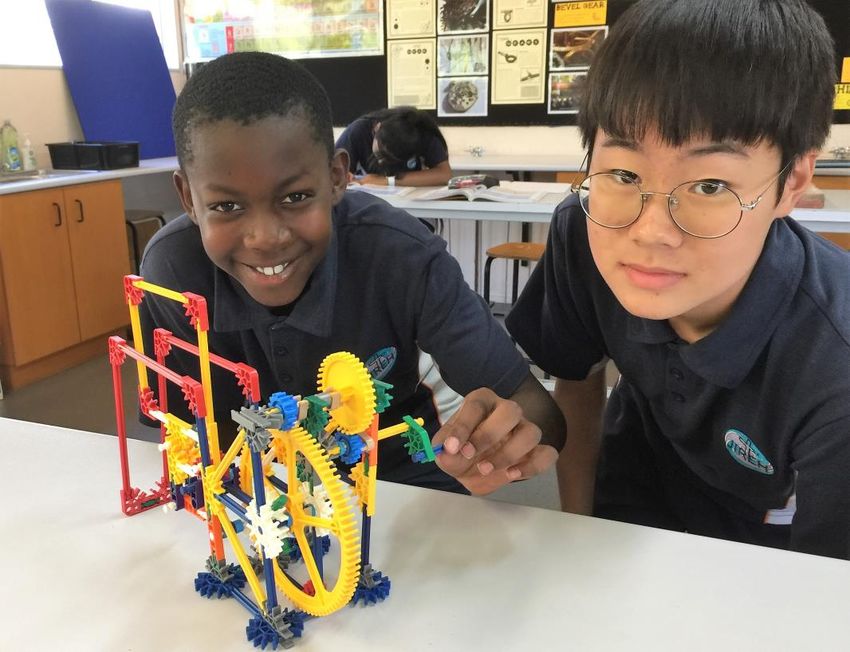
VISION FOR A JIREH CHRISTIAN SCHOOL GRADUATE
The vision for the Jireh Christian School graduate is that they are Christ centred, confident,
connected, contributing and continually learning.
CHRIST CENTRED be able to CONNECTED be able to
• Actively demonstrate the fruit of the Spirit • Seek to serve the community and be inclusive
• Make decisions based on a Biblical world view • Collaborate
• Be an authentic disciple of Christ • Respect, appreciate and discern the ideas and
• Living to please God through excellence
cultures of others
CONFIDENT be able to CONTRIBUTING be able to
• Share their faith with others. • Think critically and be engaged
• Be an independent, assessment capable learner • Be good citizens showing care for others
• Have a strong cultural and spiritual identity • Be actively involved in solving real life problems
• Be an effective communicator
CONTINUALLY LEARNING be able to
• Be a problem solver
• Persevere
• Be resilient
• Respond to a changing world
• Develop giftings faithfully
Strategic Plan 2020– 2022 2
PRINCIPLES FOR JIREH CHRISTIAN SCHOOL
The principles set out below embody beliefs about what is important and desirable at Jireh Christian School.
They underpin all school decision making. The principles relate to how curriculum is formalised at Jireh
Christian School; they are particularly relevant to the processes of planning, prioritising and review.

The curriculum is consistent with these twelve principles:

 CENTRALITY OF GOD AND THE BIBLE                                 LEARNING TO LEARN
 The Triune God has the pre-eminent place in the life of the     The curriculum encourages all students to reflect on their
 Christian. The Bible, given by God, is divinely inspired and    own learning processes and to learn how to learn.
 is trustworthy and authoritative for all of life. Christian
 education must ensure that students learn about the             TREATY OF WAITANGI
 world from a Biblical worldview.                                The curriculum acknowledges the principles of the Treaty of
                                                                 Waitangi and the bicultural foundations of Aotearoa New
 THE IMPORTANCE OF KNOWLEDGE,                                    Zealand. All students have the opportunity to acquire
 UNDERSTANDING AND WISDOM                                        knowledge of Te Reo Maori me ona tikanga.
 Wisdom, understanding and knowledge provide practical
 guidance for everyday living. These components form the         COMMUNITY ENGAGEMENT
 basis for effective action in all areas of life.                The curriculum has meaning for students, connects with
                                                                 their wider lives and engages the support of their families,
 RESPONSIVE DISCIPLESHIP                                         whanau and communities.
 It is important that teachers understand, teach and model
 lives based on the principles in the Bible and, therefore,      CULTURAL DIVERSITY
 require ongoing professional development in this regard.        The curriculum reflects New Zealand’s cultural diversity
 Christian education is not just an introspective activity. At   and values the histories and traditions of all its people.
 Jireh Christian School we seek to disciple and equip young
 people to share God’s dynamic message of hope, peace
                                                                 COHERENCE
 and love. The staff seek to encourage students to discover
                                                                 The curriculum offers all students a broad education that
 God’s purpose for them personally, the world in which
                                                                 makes links within and across learning areas, provides for
 they live and their vocation.
                                                                 coherent transitions and opens up pathways to further
                                                                 learning.
 PARENT PARTNERSHIP
 God has given to parents the primary accountability for
                                                                 INCLUSION
 the educational nurture of their children. Jireh Christian
                                                                 The curriculum is non-sexist, non-racist and non-
 School partners with parents and involves the wider
                                                                 discriminatory; it ensures that students’ identities,
 community in assisting them in carrying out this
                                                                 languages, abilities and talents are recognised and affirmed
 responsibility.
                                                                 and that their learning needs are addressed.

 HIGH EXPECTATIONS
                                                                 FUTURE FOCUS
 The curriculum supports and empowers all students to
                                                                 The curriculum encourages students to look to the future by
 learn and achieve personal excellence, regardless of their
                                                                 exploring such significant future focused issues as
 individual circumstances.
                                                                 sustainability, citizenship, enterprise and globalisation.

                                                                                            Strategic Plan 2020– 2022         3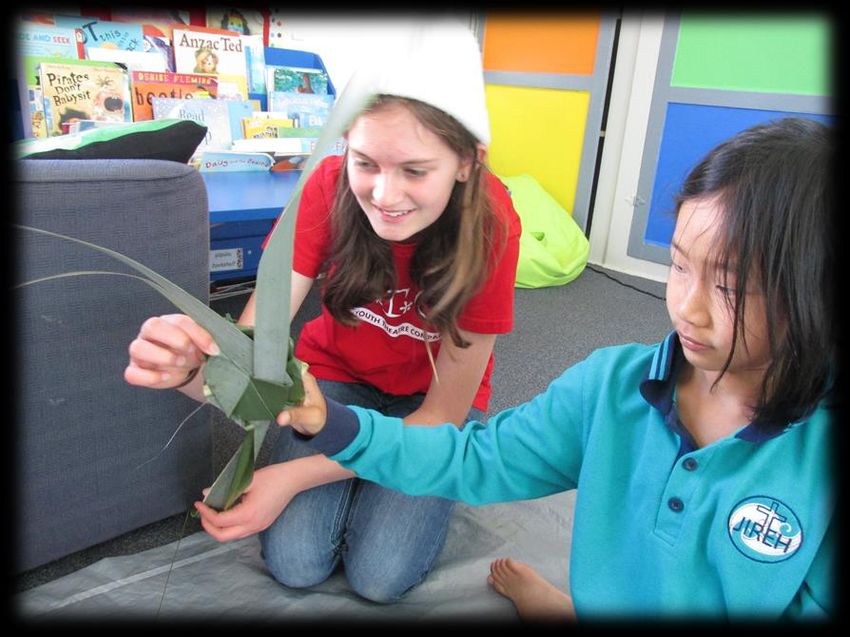
KEY COMPETENCIES
                     “The competencies also draw on knowledge,
                   attitudes and values in ways that lead to action”

The Jireh Christian School Curriculum identifies five key competencies, as listed below. Students will use these
competencies to live, learn, work and contribute as active members of their communities. More complex than skills,
the competencies also draw on knowledge, attitudes and values in ways that lead to action. They are not separate or
stand-alone. They are the key to learning in every learning area and, therefore, need to be prioritised in planning and
teaching.

The development of the competencies is both an end in itself, (a goal) and the means by which other ends are achieved.
Successful learners make use of the competencies in combination with all the other resources available to them e.g.
the Bible, knowledge, tools and skills. Students need to be challenged and supported to develop them in contexts that
are increasingly wide ranging and complex.

Students will be equipped with the knowledge, skills, values and attitudes in the following key
competencies:

 MANAGING SELF

                        • Demonstrates knowledge of when to lead, when to follow and when to act
                          independently
                        • Employs strategies for meeting challenges
                        • Establishes personal goals, plans and manages projects
                        • Sets challenging standards
                        • Is enterprising, resourceful, reliable and resilient
                        • Exhibits a Godly motivation with a ‘can do’ attitude
                        • Demonstrates a desire to be an able and effective learner

 RELATING TO OTHERS

                        • Interacts effectively with diverse people in different contexts
                        • Demonstrates active listening skills
                        • Recognises different points of view
                        • Demonstrates effective negotiation skills
                        • Shares ideas and communicates their faith
                        • Is open to new ideas while demonstrating discernment
                        • Has awareness of how words and actions affect others
                        • Cooperates effectively to develop
                          ideas, strategies and thinking
                        • Balances competition with cooperation

                                                                                        Strategic Plan 2020– 2022    4
PARTICIPATING AND CONTRIBUTING

              • Is actively involved in the community
              • Contributes appropriately as a group member
              • Makes connections with others
              • Creates opportunities for others in a group
              • Balances privileges, roles and responsibilities

THINKING

              Uses creative, critical and reflective processes to inform decision making
              • Actively seeks to use and create knowledge for good
              • Reflects on their own learning (metacognition)
              • Asks questions for the purposes of extending knowledge and understanding
              • Challenges the basis of truth, assumptions and perceptions
              • Draws on personal knowledge, wisdom and a deep-seated reliance on God
              • Is intellectually curious

USING LANGUAGE, SYMBOLS AND TEXTS

                  •   Interprets and uses words, numbers, images, movement, metaphor in context
                  •   Confidently uses ICT to access information and communicate with others
                  •   Recognises how choices of language affect people’s understanding or responses
                  •   Competently studies and applies the Bible as a foundation text
                  •   Interacts effectively with diverse people in different contexts

                                                                          Strategic Plan 2020– 2022   5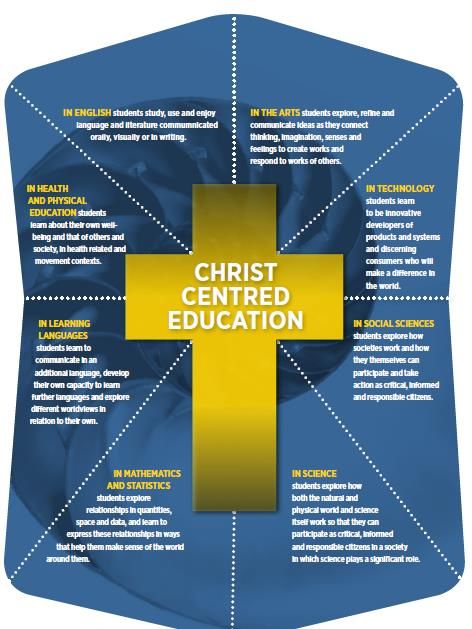
CULTURAL DIVERSITY AND MAORI DIMENSION
HOW WILL THE SCHOOL REFLECT NEW ZEALAND’S CULTURAL DIVERSITY?
  •   By ensuring that all cultures are respected and maintained by all who attend and are linked to this
      school.
  •   By acknowledging that the values and customary rights of the significant groups in New Zealand
      society (Pakeha and Maori) are mutually respected and given cultural mileage and impetus at this
      school.
  •   By having programmed activities, cultural events and significant evidence on display which reflect
      the cultural identities of students, staff and the community.
  •   By liaising with leaders in the community to support and advise the school on cultural matters.

HOW WILL THE SCHOOL REFLECT THE UNIQUE POSITION OF THE MAORI CULTURE?
  •   By ensuring that staff have opportunities for professional development in order to enhance their teaching of
      Te Reo and tikanga Maori.
  •   By regular reflection, discussion and evaluation of how each teacher is reflecting Tikanga Maori in the
      classroom in terms of content and delivery.
  •   By consulting Maori advisors to assist in the development of Maori incentives and programmes.
  •   By consulting with our Whanau Korero group who meet regularly.
  •   By students attending Maori cultural activities that are promoted through the school.
  •   By having relationship with iwi of Avondale through visits to the marae.
  •   By having the school mission statement in Te Reo and English and including a Maori hoahoa which reflects
      the values, intent and tangata whenua of our school.
  •   By liaising with the local kaumatua and outside agencies such as; Team Solutions and MOE about the
      improvement and innovation of Maori programmes at school.

WHAT REASONABLE STEPS WILL THE SCHOOL TAKE TO INCORPORATE TIKANGA MAORI
INTO THE SCHOOL’S CURRICULUM?
  •   By ensuring that all planning is done with Tikanga Maori in mind, using the Te Whare Tapa Wha as a
      guide to ensure the well-being of the whole child is being addressed.
  •   The inquiry model used explores Tikanga Maori as part of the process.
  •   By ensuring that Te Reo is taught in every class and is part of the weekly
      timetabling.
  •   By ensuring all students have the opportunity to participate in Kapa Haka each
      week.

WHAT WILL THE SCHOOL DO TO PROVIDE INSTRUCTION IN TE REO FOR
FULL TIME STUDENTS WHOSE PARENTS ASK FOR IT?
  •   Students receive instruction in Te Reo weekly, working through an online programme to
      ensure correct pronunciation and progression through language instruction so that each
      year is built upon.

                                                                                    Strategic Plan 2020– 2022    6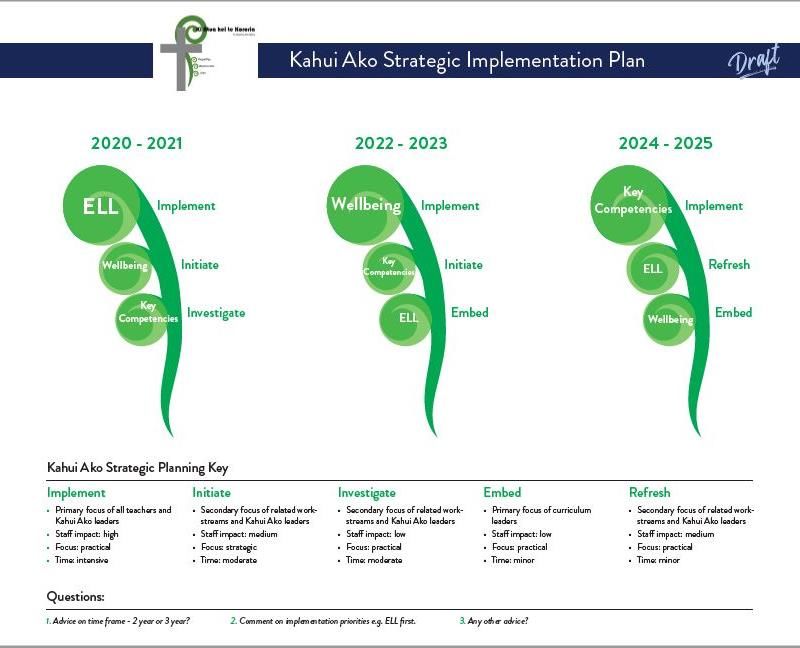
CHRIST CENTRED EDUCATION

                           Strategic Plan 2020– 2022   7
SELF-EVALUATION CYCLE 2020 - 2022

                         STRATEGIC                                          REGULAR
            Growing the Intermediate Area of the school   ELL
 2020
            Opening a Maker Space                         Learning Area: Digital Technologies
            Developing an Intermediate Technology         Key Competencies
            programme and space
            ERO (External)
            Special Character (External)                  Finance
 2021
                                                          Support staff
                                                          Learning Area: Mathematics
                                                          Wellbeing
            Developing the campus to accommodate roll     Health & Safety
 2022       growth
                                                          Learning Area: Languages
                                                          Property

The Strategic Plan is evaluated annually by the Board of Trustees.

                                                                                     Strategic Plan 2020– 2022   8
Linking the Four Levels of Strategic Planning
                 at Jireh Christian School

2030 Growth and Development Plan

                   Purpose:
                   1. Outlines a long-term strategic plan to ensure Jireh Christian School
                      continues its journey towards becoming a school of choice.
                   2. Provides a big picture view of where Jireh Christian School wants to be by
                      2030.
                   3. Allows key decision makers to assess the cost and timing of achieving the
                      vision.

                   Includes:
                   1. A philosophical rationale to inform strategic thinking.
                   2. A list of strategic initiatives to be achieved by 2030, organised into six
                      domains of effective, research supported school practices.
                   3. A list of strategic initiatives related to Jireh Christian School’s co-curricular
                      programmes to be achieved by 2030, organised into service, leadership,
                      arts, missions and sport (SLAMS).
                   4. Timelines outlining the proposed resourcing, roll growth and infrastructure
                      changes required to support the 2030 Growth and Development Plan.

Strategic Plan 2020 - 2022 Plan
                    Purpose:
                    1. Outlines the medium-term strategic plan for the next three years. Goals
                       are aligned to the 2030 Growth and Development Plan.

                    Includes:
                    1.   A summary of the rationale to inform and guide strategic thinking.
                    2.   A list of strategic initiatives to be achieved in the next three years,
                         organised into six domains of effective research supported by school
                         practice.
                    3.   A list of strategic initiatives related to Jireh Christian School co-curricular
                         programme to be achieved in the next three years, organised into
                         services, leadership, arts, mission and sports (SLAMS).
                    4.   A timeline outlining the proposed resourcing, roll growth and
                         infrastructure changes required in the next three years.
                    5.   A list of short-term strategic improvements to be achieved in the next
                         three years, linked to the Kahui Ako/Community of Learning (CoL)
                         achievement challenges.

                                                                         Strategic Plan 2020– 2022         9
Annual Plan 2020

                   Purpose:
                   1. Outlines the short strategic plan for 2020. Goals are aligned to the 2030
                      Growth and Development Plan.

                   Includes:
                   1. A list of strategic initiatives to be achieved in 2020, organised into six
                      domains of effective, research supported school practice.
                   2. A list of strategic initiatives related to Jireh Christian School’s co-curricular
                      programme to be achieved in 2020, organised into service, leadership,
                      arrest, missions and sports (SLAMS).
                   3. The identification of the first phase of implementation towards
                      improvements to be achieved in the next year. Linked to the Kahui
                      Ako/Community of Learning (CoL) achievement challenges and the MOE
                      priorities of excellence and equity for all students and implementing a new
                      digital technology curriculum in 2020.

2020 Work Plan

                   Purpose:
                   1. Outlines a detailed plan for 2020. Goals are aligned to the 2030 Growth and
                      Development Plan.

                   Includes:
                   1.   Identification of specific details related to the 2020 Annual Plan, such as
                        the identification of staff responsibilities and resourcing allocation.
                   2.   A detailed implementation timeline, including termly progress milestones.
                   3.   Detailed planning towards progressing short-term strategic improvements
                        in 2020, linked to the Kahui Ako/Community of Learning (CoL) achievement
                        challenges and MOE priority for excellence and equity for all students and
                        implementing the new Digital Technology Curriculum.
                   4.   An outline of how the 2020 strategic plan priorities are reflected in
                        professional development, BOT workplans and meeting calendars.

                                                                       Strategic Plan 2020– 2022      10
PROFESSIONAL DEVELOPMENT AND INDUCTION PROGRAMME 2020-2022
TEACHING PASTORAL CARE TEACHING Digital TEACHING PRACTICE- DIGITAL LEARNING- POLICY AND BICULTURAL MOE Kahui Ako/
PRACTICE Wellbeing CHRISTIANLY TEACHING Teaching as inquiry, Fluency, BYOD, PROCEDURES Ka Hikitia, Tataiako, INITIATIVES Community of
COACHING Restorative SYSTEMS eTap, assessment, numeracy, digital citizenship HEALTH AND Treaty of Waitangi, Learning (CoL)
Effective Practice, SharePoint, literacy, moderation, data SAFETY SCHOOL Maori Culture,
Teaching Peacemakers OneNote, informed decision making POLICIES AND Language and
Practices Vulnerable Google PROCEDURES Identity, Productive
Children Classroom- Partnerships
Hapara,
2020 Buddy Coaching Equity and Special Character Consolidating Embedding and reflecting on Developing digital Staff Embed cultural Digital ELL - Implement
- Continue to Excellence Professional Learning how to navigate the Prime Maths programme fluency across the retreat/orientation competencies in technologies:
embed a Programme e-tap for staff day - How we do learning programme Computation- Wellbeing –
culture of Embedding recording eTap - reporting to parents - things? al thinking for initiate
learning and Tapasa KWT - Introducing The incidents, as a mid and end year - working Introduce IT Embed teaching Te digital
growth among Theological mark book towards online up to date activator Reo across the technologies Key Competencies
the staff Framework and reporting school - investigate
through buddy Special Character Embedding Using eTap to record Introducing BOTs Designing and
coaching as part Guidelines Hapara as an achievement and track across the school developing
of the appraisal online learning improvement digital
process Induction for new staff platform Years outcomes
- readings and BTI 5-8 Moderating writing across
Developing course the school and gaining
teacher common understanding of
competency to NZACS Conference the curriculum levels
teach ELL
students across Introduce Korean in Tiwai
the curriculum learning area
2021 Developing Learning Support- Special Character Work towards Becoming familiar with the Continue Staff Embed cultural Reflect on, ELL - embed
student Success for All - Professional Learning online reporting Pact Tool developing digital retreat/orientation competencies in make
graduate profile Building an Programme - embed to parents and fluency across the day – health and learning programme necessary to Wellbeing -
with key inclusive KWT Special Character real time staff safety - how we do the new implement
competencies education system Guidelines assessment on things? Embed teaching Te technology
with an the parent IT activator - techy Reo across the curriculum Key Competencies
assessment Induction for new staff portal buddies school - initiate
rubric - readings and BTI
course Teachers share their
knowledge of how
NZACS Conference to use Bots
effectively across
the school
2022 Refresh Well Being, (Kahui Special Character Use OneNote Using the Pact tool across Moving towards Staff Embed cultural Embed new ELL - refresh
appraisal Ako) Professional Learning and ShP the school to ensure being a digital fluent retreat/orientation competencies in technology
system Programme confidently by common understanding and school with skilled day – health and learning programme curriculum. Wellbeing- embed
staff across the consistent, accurate staff safety - how we do Digital
Induction for new staff school assessment things? Embed teaching Te technologies- Key Competencies
- readings and BTI Key Competencies Reo across the -implement
course (Kahui Ako) school
NZACS Conference
Strategic Plan 2020– 2022 11STRATEGIC CHARTER 2018 – 2020
STRATEGIC MAP 2020 - 2022
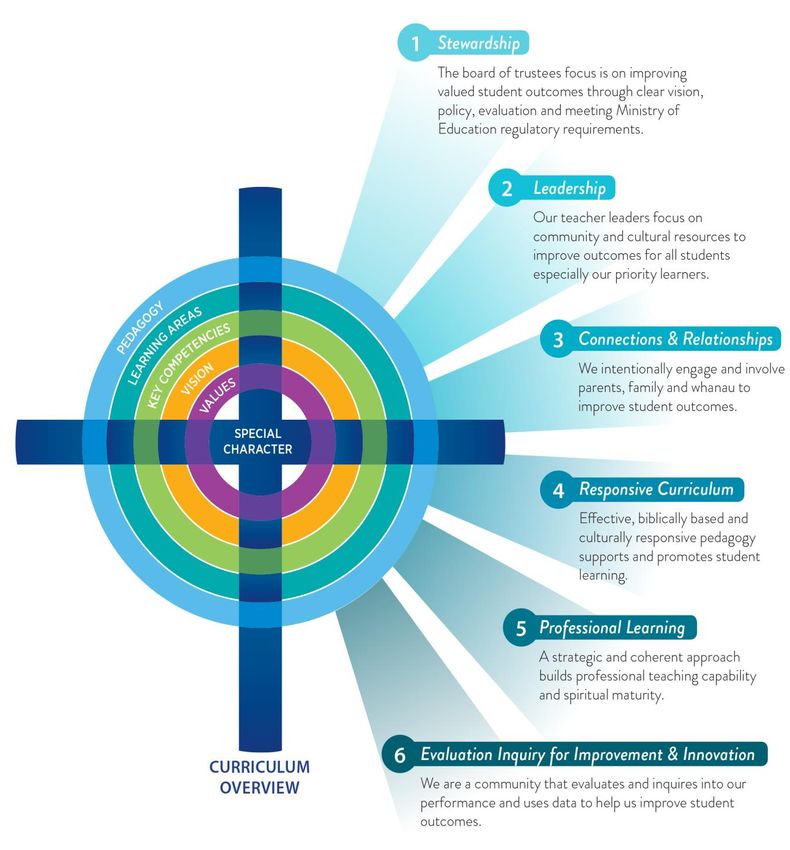
Strategic Plan 2020– 2022 121. Stewardship
The BOT is intentionally and actively involved in setting the strategic path for the school for the
next three years at the start of 2020
Internal and External Evaluation Cycle 2020 ERO
The BOT has external reviewers to systematically evaluate their progress and achievement against
well-researched and agreed evaluation indicators to ensure that they are meeting their statutory
requirements and governance expectations.
The BOT increases its capability to govern for all students to achieve their full potential. 2021.
Stewardship Training Curriculum 2022
Newly elected Board members and proprietors are inducted into their role using an effective
and comprehensive training programme. The BOT systematically works through a professional
development curriculum that equips them with the specific knowledge and skills to proficiently
serve in their respective stewardship roles.
2. Leadership
Leadership Professional Development 2020-2022 and Focussed Inquires
Focussed inquiries are aligned with school wide initiatives. The Leadership Capabilities
Framework is used to guide practice and inquiries to build capacity and capability.
To ensure that our leaders remain current with future educational initiatives, they are given
opportunities to study examples of best practice through our Educational and Special Character
funding. OneNote used as a recording platform.
Review of Leadership Appraisal to ensure it is robust and is aligned with strategic goals based on
data. 2020.
3. Powerful Connections and Relationships
Meeting with specific cultural groups to ensure authentic parent and whanau voice is heard,
including Pacifica, Asian and Maori through the Korero whanau group.
Continue to build strong relationships with the local community through service, sport, special
education and leadership affiliations, 2020-2022.
Wellbeing of staff and students through carrying out achievement goals of the kahui ako. 2021.
Strategic Plan 2020– 2022 134. Effective Teaching and Curriculum
New Digital Technologies Curriculum 2020
Our digital curriculum focusses on teaching students to design their own digital solutions and
become creators of, not just users of, digital technologies to prepare them for the modern
workforce.
Prime Mathematics introduced across the school through the Professional Learning plan which
will be embedded and reviewed in 2020
Second Language. 2020
Year 1 - 8 Te Reo, Year 7/8 Korean. Being bilingual is associated with improved ability in tasks
that require focussed attention. Furthermore, students who study a second language perform
better in English and Mathematics, as well as demonstrating higher levels of creativity and
problem-solving skills. Introducing a second language for students will allow them to acquire the
associated skills and benefits at a stage when they are developmentally receptive to learning a
second language.
ELL Teaching
All teachers and TAs will be equipped to best serve the growing number of ELL students in the
school.
Form and join Professional Learning Groups. 2020 - 2022
Project-based learning. 2021. Solving real life problems through Future Problem Solving
Programme.
Personalised Tracking and Mapping. 2021 - 2022. Students set goals and map their personal
growth against the vision for a Jireh Christian School Graduate profile.
Learning Support. 2021. Teaching and Tutoring groups set up to ensure that all students,
particularly those at risk, have every opportunity to succeed.
5. Empowered and Capable staff
PLD opportunities are meaningful, relevant and readily available to empower staff.
Kahui Ako/Community of Learning (CoL). 2020. Jireh Christian School is a member of a Kahui
Ako/Community of Learning(CoL) of likeminded schools. The CoL identifies areas for
improvement and works collaboratively to use the available expertise from member schools and
the Ministry of Education to improve student outcomes.
Growth Coaching. 2020. Teachers at Jireh Christian School improve their craft as part of growth
coaching, which includes a professional buddy who supports them to reflect deeply on their
practice. While the appraisal process focuses on teacher development, clear procedures and
guidelines provide accountability and guidance regarding the school’s expectations related to
professionalism.
Teaching Christianly Development Plan. 2020 - 2022. Introducing and embedding the KingsWay
Trust Theological Framework and Special Character Guidelines.
Strategic Plan 2020– 2022 146. Evaluation for Improvement and Innovation
Common Schoolwide Inquiry and Evaluation Practices. 2020.
Inquiry-based learning and evaluation practices become a powerful force for learning when
embraced by the whole school. Jireh Christian School’s approach to inquiry learning and
evaluation practices will:
• reflect our school community
• meet the needs of our learners
• establish a common language
• create a consistent learning environment for all students
• take into account the vision, principles, values and key competencies of the New Zealand
Curriculum.
Follow the Evaluation Cycle. 2020.
which includes external evaluation, (ERO) and Special Character (KingsWay Trust)
Internal reviews of support staff, wellbeing across the school, finance and the learning area of
Mathematics, reviewing the efficacy of the Prime Mathematics programme and how the
implementation can be improved to provide the best opportunity for success for all learners.
Special needs, ensuring that the systems in place ensure all students are catered for and their
needs identified and addressed.
Evaluation Cycle. 2021.
Health and Safety procedures are robust enough to ensure the safety and wellbeing of all those
who work at Jireh Christian School and that the work/learning environment is as safe as possible
for all.
Literacy is reviewed, looking at data and the necessary steps are made to ensure continued
improvement.
Campus Development. 2022
The development of the site for future growth, in conjunction with the proprietor to include a
Makerspace and a flexible Technology area for hard and soft materials, electronics and STEAM
subjects.
Strategic Plan 2020– 2022 15Service Leadership Arts Mission Sport
SLAMS
Our Co-curricular Programme Strategic Initiatives for 2020 - 2022
Service In line with our valued Jireh Outcomes, Jireh Christian School does not want to
adopt an island mentality. Students are encouraged to be outward looking, showing
genuine interest in and concern for others. An avenue for this to happen practically
is through Links with Community Service Groups. In 2020 we will strategically
partner with community service groups to bless our community. This requires the
establishment and maintenance of relationships with other organisations that are
keen to see our students serve. Some of these are local rest homes and ‘Feed the
Streets Avondale’.
Service Day. 2020. Dedicate a day to serving in the community. This can become an
annual event serving different areas of need in the community from helping people
to cleaning up local creeks.
Helping prepare and serve lunches and performing at the Christmas concert,
partnering with Feed the Streets Avondale.
Leadership 2020 - Year 7 and 8 leadership programme grows and develops to include more
leadership opportunities for students to serve the school community through
servant leadership. Introduce a Head girl and boy.
Embed the fortnightly leadership opportunities.
2021 - Year 7 and 8 attend the Student Leadership conference in Christchurch.
Arts 2020 – Christmas Around the World
2021 – School musical production
Mission 2020-2022 - Supporting TEAR Fund child
2021 - Send a mission team to Cambodia
2022 - Market Days for mission fundraising
Sport 2020 - Increased involvement in local sports cluster in a greater variety of sports.
Host the Auckland Christian Schools cricket zone day.
2021 - After school sports teams in a variety of sports.
Strategic Plan 2020– 2022 16STRATEGIC MAP 2020 – 2022
(linked to our Kahui Ako, Strategic Challenges and MOE Priorities)
WELLBEING
To raise the overall wellbeing of students in all the dimensions of wellbeing to develop student resilience
and grit.
A. School-wide climate and practice Increase the positive student experience by 5% each year.
B. Teaching and learning Increase the positive teacher-student engagement levels by
5% each year.
C. Community partnership Increase the community partnership statistics levels by 5%
each year.
D. Pro-social student culture and strategies Increase the positive manner staff and students relate to
each other by 5% each year.
E. Maintain an anti-bullying culture Decrease any anti-social behaviour levels by 5% each year.
LEARNING SUPPORT
To raise the overall achievement of all at risk students.
At risk students improve in literacy and numeracy results by an increase of 10% in their diagnostic
assessment each year.
ELL students improve in literacy results by an increase of 10% in their diagnostic assessment each year.
KEY COMPETENCIES
To ensure all students are increasing in their knowledge, skills and attitudes of the key competencies of
thinking, relating to others, managing self, participating & contributing and using language symbols and
texts.
School to develop key competencies in conjunction with the graduate profile - JCS valued outcomes.
An increase of 10% is recorded annually in students’ knowledge, attitudes and skill of the key competencies
at every level. A graduate student profile will be used.
DIGITAL LEARNING
Staff and students are competent users of digital devices for learning and demonstrate computational
thinking e.g. formulate problems in a way that enables students to use a computer and other tools to
solve them.
Staff and student confidence levels in using digital devices for learning and engaging with computational
thinking increase by 10%.
(Linked to Kahui Ako/Community of Learning (CoL) Goals)
Strategic Plan 2020– 2022 172020 STRATEGIC FOCUS
STRATEGIC CHARTER 2018 – 2020
(Linked to the 2030 Growth and Development Plan and reflects the first year of planned progress)
Strategic Plan 2020– 2022 182020 Strategic Focus
1. Stewardship
The BOT is intentionally and actively involved in setting the strategic path for the school for the next
three years at the start of 2020
Internal and External Evaluation Cycle 2020 ERO
The BOT employs external reviewers to systematically evaluate their progress and achievement
against well-researched and agreed evaluation indicators to ensure that they are meeting their
statutory requirements and governance expectations.
2. Leadership
Jireh Christian School Leaders integrate the Educational Leadership capabilities, as identified in the
Educational Council Leadership Capability Framework, into all professional learning, development
and appraisal. The leadership capabilities are intended to provide high-level guidelines for leadership
development based on shared understandings of what leadership in different spheres of influence
looks like in practice in schools. The focus is on improving leaders’ capability in areas such as
curriculum, relationships, leadership, pedagogy to support learners and wellbeing.
3. Powerful Connections and Relationships
- for equity, excellence and community building.
Meetings with specific whanau groups, including our Korero group, will meet to gain parent voice and
aspirations for their children.
Workshops will be designed to help parents assist their children with their learning at home and be
an integral part of their child’s learning journey as we partner together to ensure equity and
excellence for all. The data of Pacifica and Maori will be specifically analysed to gauge progress.
The Parents Association Cultural dinner will be run by parents where traditional food will be prepared
and enjoyed with a programme of cultural items- dance, song, musical instruments etc.
Parents are actively encouraged to come into school and share particular areas of expertise with the
students as part of our teaching and learning programme. Some examples of this are; the Week of
Workshops, parents run electives, sports coaches from the parent community, workers in the health
industry and horticulture to assist with vegetable growing and sustainability.
4. Effective Teaching and Curriculum
- for equity and excellence.
Professional learning will take place in the area of Mathematics with the evaluation of the Prime
Mathematics programme and how to best approach assessment. The mathematics results will be
carefully monitored to gauge the efficacy of the programme.
Digital Technologies Curriculum will be introduced using digital technology to develop computational
thinking and an understanding of how digital systems work. Use digital technologies to create new
ways of doing and solving problems. Bots will be used in all classrooms.
Strategic Plan 2020– 2022 19The Target learning group will be the ELL students Year 3 - 8, (2020). There has been an increase in
the number of ELL students in the school. The learning area of foci will be writing. Progress will be
monitored and reported on to the BOT regularly. Teaching and learning pedagogy will form the
basis for a teaching inquiry to ensure that the students are accessing the curriculum in a way which
brings progress. Professional development will take place for teachers in how to best grow and
develop ELL students to speak, read and write in English.
Second Language 2020 - Year 1 - 8 Te Reo, Year 7/8 Korean - Being bilingual is associated with
improved ability in tasks that require focussed attention. Furthermore, students who study a second
language perform better in English and Mathematics as well as demonstrating higher levels of
creativity and problem-solving skills. Introducing a second language for students will allow them to
acquire the associated skills and benefits at a stage when they are developmentally receptive to
learning a second language.
5. Empowered and Capable Staff
- Kahui Ako/Community of Learning (CoL) Jireh Christian School is a member of a Kahui
Ako/Community of Learning (CoL) of likeminded schools.
The CoL identifies areas for improvement and works collaboratively to use the available expertise
from member schools and the Ministry of Education to improve student outcomes.
Growth Coaching Teachers at Jireh Christian School improve their craft as part of growth coaching,
which includes a professional buddy who supports them to reflect deeply on their practice. While the
appraisal process focuses on teacher development, clear procedures and guidelines provide
accountability and guidance regarding the school’s expectations related to professionalism.
Staff will embed Tapasa and cultural competencies with specific reference to our school and our
whanau and how we can ensure all Pacifica students are being given every opportunity to succeed.
The document Success for All will be unpacked by staff to ensure that we develop and embed a
culture of inclusivity. Teachers will give evidence of how this is happening in their class, reflecting on
the changes made to ensure all students feel included and challenged.
Teaching Christianly Development Plan – The KingsWay Trust Theological Framework and Special
Character guidelines will be unpacked.
6. Evaluation for Improvement and Innovation
- common Schoolwide Inquiry and Evaluation Practices 2020.
Inquiry-based learning and evaluation practices become a powerful force for learning when
embraced by the whole school. Jireh Christian School’s approach to inquiry learning and evaluation
practices will:
• reflect our school community
• meet the needs of our learners
• establish a common language
• create a consistent learning environment for students
• take into account the vision, principles, values and key competencies of the New Zealand
Curriculum
Strategic Plan 2020– 2022 20Follow the Evaluation Cycle. 2020.
which includes external evaluation, (ERO) and Special Character (KingsWay Trust)
Internal reviews of support staff, wellbeing across the school, finance and the learning area of
Mathematics, reviewing the efficacy of the Prime Mathematics programme and how the
implementation can be improved to provide the best opportunity for success for all learners.
Special needs, ensuring that the systems in place ensure all students are catered for and their
needs identified and addressed.
KAHUI AKO/COMMUNITY OF LEARNING AND MOE
PRIORITIES:
WELLBEING
To raise the overall wellbeing of students in all the dimensions of wellbeing to develop student resilience
and grit.
A. School-wide climate and practice Increase the positive student experience by 5% each
year.
B. Teaching and learning Increase the positive teacher-student engagement
levels by 5% each year
C. Community partnership Increase the community partnership statistics levels by
5% each year
D. Pro-social student culture and strategies Increase the positive manner staff and students relate
to each other by 5% each year
E. Maintain an anti-bullying culture Decrease any anti-social behaviour levels by 5% each
year
LEARNING SUPPORT
To raise the overall achievement of all ELL students.
At risk students improve in literacy and numeracy results by an increase of 5% in their diagnostic
assessment each year.
KEY COMPETENCIES
To ensure all students are increasing in their knowledge, skills and attitudes of the key competencies of
thinking, relating to others, managing self, participating, contributing and using language symbols and
texts.
School to develop key competencies in conjunction with the graduate profile - JCS valued outcomes.
An increase of 10% is recorded annually in students’ knowledge, attitudes and skill of the key competencies
at every level. A graduate student profile will be used.
Strategic Plan 2020– 2022 21DIGITAL LEARNING
Staff and students are competent users of digital devices for learning and demonstrate computational
thinking e.g. formulate problems in a way that enables students to use a computer and other tools to
solve them.
Staff and students will have a greater understanding of how digital technology systems work and they will
use digital technologies to create new ways of doing.
Staff and student confidence levels in using digital devices for learning and engaging with computational
thinking increase by 5%.
Strategic Plan 2020– 2022 22Service Leadership Arts Mission Sport
SLAMS
Our Co-curricular Programme Strategic Initiatives for 2020
Service In line with our valued Jireh Outcomes, Jireh Christian School does not want to
adopt an island mentality. Students are encouraged to be outward looking, showing
genuine interest in and concern for others. An avenue for this to happen practically
is through links with Community Service Groups. In 2020 we will strategically
partner with community service groups to bless our community. This requires the
establishment and maintenance of relationships with other organisations that are
keen to see our students serve. Some of these are local rest homes and ‘Feed the
Streets Avondale’.
Helping prepare and serve lunches and performing at the Christmas concert,
partnering with Feed the Streets Avondale.
Leadership 2020 - Year 7 and 8 leadership programme grows and develops to include more
leadership opportunities for students to serve the school community through
servant leadership. Introduce a Head girl and boy.
Embed the fortnightly leadership opportunities.
Arts 2020 – Evening of the Arts- exhibition and musical/poetry
recitals with supper.
Mission 2020- Supporting TEAR Fund child
Sport 2020 - Increased involvement in local sports cluster in a greater
variety of sports. Host the Auckland Christian Schools cricket zone day
Strategic Plan 2020– 2022 23PROFESSIONAL DEVELOPMENT AND INDUCTION PROGRAMME 2020
TEACHING PASTORAL TEACHING Digital TEACHING DIGITAL POLICY AND BICULTURAL MOE Kahui Ako/
PRACTICE CARE CHRISTIANLY TEACHING PRACTICE- LEARNING- PROCEDURES Ka Hikitia, INITIATIVES Community
COACHING Wellbeing SYSTEMS Teaching as Fluency, HEALTH AND Tataiako, of Learning
Effective Teaching Restorative eTap, inquiry, BYOD, digital SAFETY Treaty of (CoL)
Practices Practice, SharePoint, assessment, citizenship SCHOOL Waitangi,
Peacemakers OneNote, numeracy, POLICIES Maori Culture,
Vulnerable Google literacy, AND Language and
Children Classroom- moderation, PROCEDURES Identity,
Hapara, data informed Productive
decision Partnerships
making
2020 Buddy Coaching Equity and Special Character Consolidating Embedding and Developing digital Staff retreat/ Embed cultural Digital ELL - Implement
Continue to embed a Excellence - Professional how to navigate reflecting on the fluency across the orientation day - competencies in technologies:
culture of learning and Tapasa will be Learning e-tap for Prime Maths staff How we do things learning programme Computational Wellbeing -
programme recording programme thinking for digital initiate
growth among the staff embedded.
incidents, as a Introduce IT Embed teaching Te technologies
through buddy KWT- Introducing mark book eTap - reporting to activator Reo across the Key
coaching as part of the The Theological parents - mid and school Designing and Competencies -
appraisal process Framework and Embedding end year - working Introducing BOTs developing digital investigate
Special Character Hapara as an towards online up across the school outcomes
Teaching Te Reo across Guidelines online learning to date reporting
the school platform Yrs5 - 8 Using eTap to
Induction for new record achievement
staff- readings and Introducing and track
Key Competencies-
BTI course Hapara as an improvement
creating a graduate
student profile with an online learning
NZACS Conference Moderating writing
assessment rubric platform Yrs 4 - 8
across the school
and gaining
Developing teacher common
competency to teach understanding of
ELL students across the the curriculum
levels
curriculum
Introduce Korean in
Tiwai learning area
Strategic Plan 2020– 2022 24ANALYSIS OF VARIANCE
ANALYSIS OF VARIANCE 2019
Jireh Christian School
Achievement Targets 2019
Curriculum Literacy - Writing
Areas:
Key Using language, symbols and text to construct meaningful communication
Competency:
Baseline ELL students will produce a writing sample in Term 4, (2018) and Term 4,
Data: (2019) and the progress measured in terms of curriculum writing levels from
Year 2 - Year 8. e-asTTle will be used to measure writing progress.
Strategic There will be a focus on a target cohort of students - Years 2 - 7, (2018) Years 3
Goal: - 8, (2019) ELL students.
This cohort will show significant progress in writing. Significant progress is
going up 2 e-asTTle sub levels, (If they are below the expected curriculum level
in writing). They will be measured using the e-asTTle tool in Term 4 2018 and
then again in Term 4 2019.
Results in In November 2018 ELL Year 2-7 students were tested using the e-asTTle
Nov 2018 writing assessment tool and the following results were recorded:
Number of students at curriculum levels in year levels
Curriculum 1i 1ii 1iii 2B 2P 2A 3B 3P 3A 4B 4P 4A
levels
Yr 2 8 6 1 2
Yr 3 2 3 1 3 2
Yr 4 1 3 1 1
Yr 5 1 2
Yr 6 1
Yr 7 1
Below At Above
Strategic Plan 2020– 2022 25ANALYSIS OF VARIANCE 2019
Jireh Christian School
Achievement Targets 2019
Curriculum Literacy - Writing
Areas:
Key Using language, symbols and text to construct meaningful communication
Competency:
Baseline ELL students will produce a writing sample in Term 4, (2018) and Term 4,
Data: (2019) and the progress measured in terms of curriculum writing levels from
Year 2- Year 8. e-asTTle will be used to measure writing progress.
Strategic There will be a focus on a target cohort of students - Years 2 - 7, (2018) Years 3
Goal: - 8, (2019) ELL students.
This cohort will show significant progress in writing. Significant progress is
going up 2 e-asTTle sub levels, (If they are below the expected curriculum level
in writing). They will be measured using the e-asTTle tool in Term 4 2018 and
then again in Term 4 2019.
Results in In November 2019 ELL Year 3-8 students were tested using the e-asTTle
Nov 2019 writing assessment tool and the following results were recorded:
Number of students at curriculum levels in year levels
Curriculum 1i 1ii 1iii 2B 2P 2A 3B 3P 3A 4B 4P 4A
levels
Yr. 3 1 6 3 4
Yr. 4 1 2 3 2 3
Yr. 5 1 1 1 1 2
Yr. 6 2 1 1 1 1
Yr. 7 1
Yr. 8 1 1
Below At Above
Strategic Plan 2020– 2022 26ANALYSIS OF VARIANCE 2019
Number of ELL students who have made significant progress, Progressed Progressed
(progressing by 2 sub-levels within the curriculum levels) in writing by 1 level by 2 or
from Years 3 - 8 as measured by the e-asTTle assessment more
sub-levels
Year 3 7 8
Year 4 5 6
Year 5 1 4
Year 6 1 2
Year 7 2
Year 8
A number of ELL students have gone up by one or more levels in their writing scores, using eAsTTLe as the
measure of achievement. There is a far greater percentage of ELL students achieving within curriculum
levels 2 and 3 by the end of 2019. At the end of 2018, far more students were achieving in curriculum levels
1 and 2 and only one at level 3 across the school. The number of students achieving above the curriculum
level in writing has gone from 6 to 18. Although the number of students achieving below the expected
curriculum level for writing has reduced from 16 to 8 students, this is still too many who are not achieving
at expectation. They will continue to be part of the target cohort for 2020.
Strategic Plan 2020– 2022 27ANALYSIS OF VARIANCE 2020
Jireh Christian School
Achievement Targets 2020
Curriculum Literacy - Writing
Areas:
Key Using language, symbols and text to construct meaningful communication
Competency:
Baseline ELL students will produce a writing sample in Term 1, (2020) and in Term 4,
Data: (2020) and the progress measured in terms of curriculum writing levels from
Year 2 - 8. e-asTTle will be used to measure writing progress.
Strategic There will be a focus on a target cohort of students, ELL - Year 2 - 8, (2020).
Goal: This cohort will show significant progress in writing. Significant progress is
going up 2 e-asTTle sub levels, (If they are below the expected curriculum level
in writing). They will be measured using the e-asTTle tool in Term 1 2020 and
then again in Term 4 2020.
Results in In February 2020 ELL Year 2-8 students were tested using the e-asTTle writing
Feb 2020 assessment tool and the following results were recorded:
Number of students at curriculum levels in year levels
Curriculum 1i 1ii 1iii 2B 2P 2A 3B 3P 3A 4B 4P 4A
levels
Yr. 2 17
Yr. 3 7 1 4 2 1
Yr. 4 1 1 3 1 2 4 1
Yr. 5 1 4 3 1 1 1 1
Yr. 6 4 4 1 1
Yr. 7 2 1 2 1
Yr. 8 1 1 2 1
Below At Above
Strategic Plan 2020– 2022 28Results in In November 2020 ELL Year 2-8 students were tested using the e-asTTle
Nov 2020 writing assessment tool and the following results were recorded:
Number of students at curriculum levels in year levels
Curriculum 1i 1ii 1iii 2B 2P 2A 3B 3P 3A 4B 4P 4A
levels
Yr. 2
Yr. 3
Yr. 4
Yr. 5
Yr. 6
Yr. 7
Analysis of Assessment Data:
Strategic Plan 2020– 2022 29ANALYSIS OF VARIANCE 2020
This cohort of students has been chosen for a number of reasons as described below;
- achievement Data indicates a need for raising the achievement in writing with a focus of ELL students. Where many
of the ELL students can use everyday language to communicate with their friends they do not have the necessary
academic language needed to access the curriculum, talk and write about their learning and express their ideas
adequately.
- the fast changing demographics of our school over a third ELL and 90% of all NE students ELL
- Focus of our Kahui Ako achievement challenge for 2020.
Action Taken By Whom When Expected Results
School wide All students and February Collect initial data. Identify student needs and
pre-test teachers 2020 classify students into Target Group - ELL students.
Review beginning Teachers Feb 2020 Accelerated progress in Target Group.
of Term 1
Weekly meetings All teachers led by Weekly • Discuss and reflect on teaching and learning
leaders of learning needs, of both teachers and students.
areas • Discuss concerns and celebrate success (short
term goals).
Quarterly All teaching staff Quarterly To track progress of students and report to parents
meetings
Know your learner Students and Ongoing • Collaborative home-school partnership and
by both students teachers parent support with class programmes.
and teachers • Cultural identity
• Family student voice
• Relevant to everyday life
• Changing practice
• There will be regular contact between school
and home, and parents will be engaged in their
children’s learning.
PLD’s All teachers led by Term 1 - 4 • Set up differentiated PLD to upskill teachers.
TOD’s Principal and • Shared understanding
leader of Literacy • Set up writing folders
and Leaders of • Collaborative planning.
learning areas. • Differentiated PLD will be provided to teachers
Kahui Ako focus as on acceleration and what it looks like for each
one of the
student.
achievement
challenges 2
TOD’s.
Two within school
leaders to ensure
Kahui Ako goals
are being met in
our school.
Frequent All teachers Term 1,2 • To gauge efficacy of teaching and learning
Assessment programme. Reflections on teaching and
brainstorming of ideas that will lead to more
effective learning.
Strategic Plan 2020– 2022 30Ongoing support • Leaders of learning will be actively involved in
classrooms to model, provide support and
monitor programmes.
• Practice analysis conversations will take place
because of these visits.
ELL Support – Small ELL teacher and TA Term 1 - 4 • Students will receive ELL support by the ELL
groups/individual teacher and in class support to assist with their
In-class support learning to assist with the development of
language for learning.
Teachers assess ELL Teachers Term 1, 3 • Teachers will track student progress using the
students using the ELLPs
ELLPs
Strategic Plan 2020– 2022 31ANALYSIS OF VARIANCE 2020
Action Taken By Whom When Expected Results
Opportunities are Teachers Staff Willingly and confidently share with colleagues.
created for teachers meeting and
to share their learning area
expertise. meetings
Develop a learning Leaders of Once a term • Leaders of learning meet specifically to monitor
action plan to learning areas progress of target students.
ensure integration • Meetings will be held at end of term with each
of assessment, Learning Area to discuss progress of focus students.
content knowledge • There will be regular contact between school and
and pedagogical home and parents will be engaged in their
content knowledge children’s learning through weekly home notes.
to be responsive to Parent meetings and emailing.
student’s needs.
Teacher Inquiry into All teachers On-going • Teacher goals set.
their practice and its • A spiral of inquiry will be used to record progress
relationship to against these goals with a focus on student
student progress. achievement.
• There will be regular contact between learning
areas to share stages of inquiry.
IEP’s All stakeholders Twice a year • These will be written for all Priority/focus students
who are a year behind the expected curriculum
Once a Term level and progress against goals will be monitored.
Action Plans Teachers or as • Differentiated learning programmes will be
necessary developed to meet specific needs.
Share bright spots Leaders of Yrs 1 - 8 • To analyse data, effective teaching and to
and problem areas learning/all share good practice
teachers at staff
meetings
Rigorous Target Students On going • There will be a rigorous moderation process.
moderation of • There will be critical analysis of data and rigorous
writing to take place. tracking of target students.
2020/2021 - Planning
Students will use progressions to inform next learning / goal setting.
Student agency will be developed.
There will be clarity and understanding of the links between speaking, reading and writing.
Targets/Focus students are collaboratively set, understood and monitored. Priority groups will be formed for
Maori, Pasifica, ELL and all at risk students.
Strategic Plan 2020– 2022 32You can also read


