Joint Health and Wellbeing Strategy 2016-21 - London Borough of Richmond upon Thames - London ...
←
→
Page content transcription
If your browser does not render page correctly, please read the page content below
London Borough of
Richmond upon Thames

Joint Health and Wellbeing
Strategy 2016-21
Foreword

As representatives of the three statutory partners of the Health and Wellbeing Board,
we are delighted to present the refreshed Joint Health and Wellbeing Board Strategy
(JHWBS) for the London Borough of Richmond upon Thames.
The Health and Wellbeing Board brings together elected                   Whilst ensuring that people with long-term conditions and
members and leaders from the local health and social care                mental health problems receive high quality and joined up
system. We have understood that the strength of the board lies           services, equally, we need to get better at helping residents to
in its position as a systems leader, and our ability to champion         stay healthy for as long as possible. The theme of prevention
key aspirations in the actions of our own and partner                    marks an important shift in resources towards community-
organisations. The strategy does not outline specific projects or        based initiatives, working with villages, communities and our
action plans, therefore, but establishes the direction we want           partners to protect and develop an environment that enables
our health and social care services to take, which it is the duty of     individuals to start well, live well and age well. The approach
the council, Clinical Commissioning Group (CCG) and other                throughout people’s lives emphasises the importance of
partners to implement in their own commissioning and action              nurturing health and wellbeing from the start of life and
plans. The strategy is not exhaustive of all health and care issues      acknowledges children’s services, communities and schools
but covers those which demonstrate this sense of direction.              as key players in this.
This strategy marks a chapter in the ongoing development of the          In implementing the strategy, we would like to express our
Health and Wellbeing Board and reflects our learning from                ongoing commitment to engaging with our residents, service-
public meetings, seminars, working groups and Listening Events,          users and carers. They have a vital role to play in shaping
which have given us the invaluable opportunity to hear directly          services and highlighting unmet need, and ensuring that
from residents. It is through this process that we identified key        services deliver the outcomes that people want.
themes for the strategy and explored ways that the board can
                                                                         If you have any comments about the strategy or questions
have most impact.
                                                                         about the Health and Wellbeing Board, please contact
The theme of this strategy is “prevention and joined-up                  public.health@richmond.gov.uk.
services throughout people’s lives, to enable all residents
                                                                         Councillor Christine Percival
to start well, live well and age well” and builds on the focus
                                                                         London Borough of Richmond upon Thames
of the previous strategy which was integration of services.
                                                                         Dr Graham Lewis
Integration has become one of the defining features of how
                                                                         Chair of Richmond Clinical Commissioning Group
the Health and Wellbeing Board, council and CCG operate and
we will continue to drive this forward. In the strategy we have          Julie Risley
acknowledged Outcomes Based Commissioning as one of                      Healthwatch Richmond
the vehicles for achieving integration and for delivering the
outcomes that residents, patients and carers tell us they
want. As a Board, we emphasise that, in the context of the
current financial pressures, it is important that we continue to
explore opportunities for collaborative solutions and efficiencies.

1                                                               London Borough of Richmond Upon Thames • Joint Health and Wellbeing Strategy 2016-21
Contents

                                                                               01      Foreword
                                                                               02      Contents
                                                                               03      Executive Summary
                                                                               04      Introduction
                                                                                       The Health and Wellbeing Board
                                                                                       How the Health and Wellbeing Board Operates
                                                                               05      About the Strategy
                                                                                       Strategic Theme
                                                                                       How the Strategy Works
                                                                               07      Health and Wellbeing: strategic links
                                                                               09      Context and Enablers
                                                                                       Context
                                                                                       Enablers
                                                                               10      Strategy Development
                                                                                       Engagement
                                                                                       Equalities Impact Needs Assessment
                                                                                       Joint Strategic Needs Assessment
                                                                               13      The Joint Health and Wellbeing Strategy
                                                                               15      1. Start Well
                                                                               18      2. Live Well
                                                                               21      3. Age Well
                                                                               24      Appendix 1
                                                                                       Summary of achievements of the Joint Health
                                                                                       and Wellbeing Strategy 2013-16
                                                                               26      Appendix 2
                                                                                       The Richmond Story 2015-16: Summary
                                                                               27      Appendix 3
                                                                                       Glossary

London Borough of Richmond Upon Thames • Joint Health and Wellbeing Strategy 2016-21                                                 2
Executive Summary

HEALTH AND WELLBEING BOARD                                                  employment opportunities. While most children and young people
                                                                            in Richmond are healthy and have a good start in life, not all enjoy
Richmond’s Health and Wellbeing Board (HWB) brings together
                                                                            the same opportunities to fulfil their potential and achieve.
elected members and local leaders from the health and social
care system for adults and children, in order to improve the                The strategy encompasses a number of significant developments
health and wellbeing of its local population and work to                    that seek to increase focus and resources towards prevention
reduce inequalities.                                                        and early intervention, and demands strong partnership working
                                                                            to make the best of resources. The HWB intend to target their
ABOUT THE STRATEGY                                                          work as a systems leader, to ensure the best start in life for all
The Joint Health and Wellbeing Strategy 2016-2019 (JHWBS)                   children through a joined-up approach to family health and
aims to build on the achievements and aspirations of the HWB                wellbeing, to ensure all children and young people are able to
to date. This refreshed strategy highlights the Board’s continuing          reach their full potential. Promoting resilience and emotional
commitment to integration through the theme of “prevention                  wellbeing through a whole systems approach is an important
and joined-up services throughout people’s lives, to                        aspect of this work; connecting families, communities, schools
enable all residents to start well, live well and age well”.                and services to provide holistic support to the borough’s children
                                                                            and young people.
It is the purpose of this strategy to provide a framework that the
Council, Richmond Clincal Commissioning Group (CGG) and other               LIVE WELL
partners will implement through subsequent commissioning and
                                                                            The Live Well chapter tackles the four main unhealthy behaviours
action plans. Therefore, the strategy aims to be concise and
                                                                            of smoking, drinking too much alcohol, poor diet and lack of
purposeful rather than a comprehensive review of work across
                                                                            physical activity as well as poor emotional and mental wellbeing,
the health and social care system; each chapter incorporates
                                                                            which are responsible for a large proportion of ill health and long
carefully selected actions and ‘Transformational Initiatives’ that the
                                                                            term conditions in the borough. These health behaviours are
Board feels and can have significant impact. The HWB will review
                                                                            known to be primarily influenced through exposure to cues in
the progress of the strategy on an annual basis and it is intended
                                                                            the environment, social circumstances or psychological stresses.
that a ‘score card’ of performance measures will be developed.
                                                                            The HWB understand the importance of working with
CONTEXT AND ENABLERS                                                        communities and the Council to adapt the local environment to
                                                                            minimise these behaviours.
The JHWBS is set in the context of significant budget pressures
due to central government reductions or restrictions, combined              The HWB will take action to embed prevention through cross
with increased demand for local services. Wandsworth and                    council and CCG commissioning, further utilising workplaces and
Richmond Councils are in the process of establishing a Shared               Village Planning to ensure connectivity and inclusion. The Board
Staffing Structure to help deliver some of these savings.                   intends to promote access to community assets such as parks,
                                                                            open space, accessible streets and cultural activities, improving
Within this context, integration and prevention are identified              access to services and healthy environments.
as enablers - the main capabilities through which the HWB will
advance its strategic goals. Outcomes Based Commissioning                   AGE WELL
can also be seen as an enabler in achieving integration and, by
                                                                            The Age Well chapter recognises the disparity between the
enabling partners to work together to manage demand and
                                                                            number of people in the borough living longer and the number
risk, developing services with a more preventative ethos.
                                                                            of people in the borough living longer with a diminished quality
STRATEGY DEVELOPMENT                                                        of life. Loneliness and isolation is a principle concern, as are the
                                                                            physical and psychological implications of assuming caring roles.
Richmond HWB recognises the value of involving our community
and local stakeholders in shaping decisions about health and                In order to make a meaningful change, the Board will need to
social care and the services they receive. To develop this strategy         galvanise partners across the health and social care system to
the Board engaged in a ‘learning by doing’ process, participating           deliver integrated health and social care services. Through
in facilitated seminars to draw out themes and priorities, hosting          working with individuals, communities and services, the HWB
Listening Events and a public consultation on the draft strategy.           intends to reduce the number of people experiencing loneliness
                                                                            and social isolation, ensure the contribution of carers of all ages
The Joint Health and Wellbeing Strategy                                     is recognised and support and enable older residents to stay as
                                                                            independent as possible.
START WELL
The Start Well chapter recognises that what happens in early life,
starting from conception, affects health and wellbeing in later life –
from obesity and mental health, to educational achievement and

3                                                                  London Borough of Richmond Upon Thames • Joint Health and Wellbeing Strategy 2016-21
Introduction

The Health and Wellbeing Board
LONDON BOROUGH OF RICHMOND UPON THAMES
                                                                                Guiding Principles
Richmond’s Health and Wellbeing Board (HWB) brings together                      As part of its development, the members of the HWB
elected members and local leaders from the health and social                     worked together to develop a set of ‘Guiding Principles’
care system for adults and children, in order to improve the                     that underpin everything the HWB does, including how it
health and wellbeing of its local population and work to reduce                  will deliver the strategy.
inequalities. Membership includes councillors, the Chief
Executive of Richmond Council, senior officers from Adult and                      1 	 Commitment
                                                                                                  for all: to work towards the best
                                                                                       possible outcomes for all the people of Richmond – the
Community Services and Public Health, GPs and senior officers
                                                                                       HWB will challenge on behalf of any groups overlooked.
from the Richmond Clinical Commissioning Group and Achieving
for Children, as well as representatives from the voluntary                        2 	 Public and patient involvement: the public will have
sector, NHS England and Healthwatch Richmond. In addition to                           an active role to play in shaping public services. The
membership, the HWB also has joint working arrangements with                           HWB expect that people will be helped to have their say,
other partners, such as the Local Safeguarding Children’s Board.                       their preferences will be taken into account and they will
                                                                                       be given an account of the way their views were used.
The HWB’s statutory partner organisaions are:
  London Borough of Richmond Upon Thames
•	                                                                                3 	 Carer
                                                                                             of all ages, and support for carers: is a key
• Richmond Clinical Commissioning Group (CCG)                                          component of our local model of care. The HWB will
•
  Healthwatch Richmond                                                                 seek response to local needs that acknowledge the vital
                                                                                       role of carers, including young carers, and their support.
Acting as a systems leader for health and wellbeing, it is the
responsibility of the HWB to work together to understand the                       4 	 Integrated
                                                                                                  responses to need: the HWB will
community’s needs and assets, agree strategic priorities and                           strengthen integrated responses to people’s needs and
enable commissioners to work in a more joined up way in order                          will examine the intended and unintended
to promote the health and wellbeing of residents. For more                             consequences of any commissioning strategies on other
about the responsibility and accountability of the board, see                          local partners.
www.richmond.gov.uk/health_and_wellbeing_partnership                               5 	 Evidence based approch: the HWB are committed to

                                                                                       a transparent and open approach, and rigour of
How the Health and                                                                     declaring sources of evidence, including costs and value
Wellbeing Board Operates                                                               for money. The HWB will ensure the flow of evidence
                                                                                       into decision making.
CHAMPIONING ASPIRATIONS
The HWB has committed to championing the key aspirations                           6 	 Prevention
                                                                                                  and promotion of independence:
                                                                                       strategies will evidence a systematic approach to
as outlined in this strategy, and in the HWB’s Guiding Principles.
                                                                                       prevention and promoting independence. The HWB
Through championing, HWB members have a collective and
                                                                                       will look for root causes of problems, not just quick
individual responsibility to ensure that these are reflected in
                                                                                       fixes of symptoms.
the business of their own and partner organisations, are heard
in other groups and committees, and become embedded in                             7 	 Better care, closer to home: the HWB will support
strategies and commissioning across the health and social                              strategies that aim to streamline pathways; improve
care system.                                                                           access, and provide care closer to home.
This is a two way process and board members also have a role                       8 	 Sustainability
                                                                                                      for Richmond: the HWB is committed
to play in feeding back insights and learning from their own and                       to developing a care system that is not only financially
partner organisations to further inform the work and priorities                        sustainable, but also minimises adverse impacts on
of the board. As a result, local people should experience better                       society and on the natural environment, which could
health, reduced health inequalities, and higher quality, more                          jeopardise the ability of future generations to meet their
joined up, health and social care services which are focused                           health and social care needs.
on the outcomes as articulated by local residents.

CO-PRODUCTION AND ENGAGEMENT
The HWB understands the vital contribution that residents, service-users and carers have in shaping the design and delivery of local
services. The board have role to play in ensuring their voice is included co-productively at all levels within the operations of its own
and partner organisations.
For more information on the HWB’s engagement framework see: www.richmond.gov.uk/health_and_wellbeing_partnership

London Borough of Richmond Upon Thames • Joint Health and Wellbeing Strategy 2016-21                                                                4
About the Strategy

            All people in Richmond are able to achieve their full potential, live their lives with
            confidence and resilience, and access quality services that promote independence
            and deliver value for money”
                                                                                           Richmond’s Health and Wellbeing Vision

                                                                        each chapter incorporates carefully selected actions and
Strategic Theme                                                         ‘Transformational Initiatives’ that the board feels demonstrate
                                                                        this sense of direction and can have significant impact. A
                                                                        number of relevant strategies are illustrated on the following
            Prevention and joined up services                           page to demonstrate the JHWBS’s reach across the CCG, Local
            throughout people’s lives to enable                         Authority and partners.
            all residents to start well, live well,
                                                                        MONITORING IMPACT ACROSS THE SYSTEM
            and age well”
                                                                        The impact of the leadership of the HWB, and the JHWBS,
                           Theme of the Joint Health and                will be assessed across the system, through inputs, outputs
                              Wellbeing Strategy 2016-21                and outcomes.
                                                                        The HWB will conduct an annual review of progress made on
The HWB’s first Joint Health and Wellbeing Strategy (JHWBS),            the strategy, which will be published as part its programme of
2013-16, focused on the integration of services, identifying            public meetings. It is intended that a ‘Score Card’ of performance
priority areas where improvements could be made through                 measures using national indicators and other local indicators will
addressing the interfaces between organisations across health           be developed to assess the impact of the system.
and social care.
This refreshed strategy highlights the continuing commitment to
integration through the theme of ‘supporting joined up                        Inputs
services’ and aims to widen its reach to include ‘maximising
                                                                              •	 Board
                                                                                       member representation on key decision making and
prevention support’; championing approaches to help
                                                                                  implementation boards
prevent, reduce, or delay residents’ need for care.
                                                                              •	 Influence
                                                                                           cross council and NHS strategic planning for
To do this, the strategy highlights the need for joint working to                 prevention and joined up services throughout people’s lives
drive forward preventative approaches at all levels: through
                                                                              •	 Take
                                                                                      steps to address inequalities in health and social care
targeted services for those who are ill or groups that are most at
                                                                                  through accessible and targeted services
risk; through community approaches which promote social
connectivity and an underpinning community resilience, and;
through approaches that influence the place and environment
we live in, enabling the preferred and easy choice to also be the
healthy choice.
                                                                              Outputs
For a summary of achievements of the JHWBS 2013-16,                           •	 Delivery and evaluation of the ‘transformational initiatives’
see Appendix 1.
                                                                              •	 Embedded
                                                                                               and sustained focus on the HWB Board
How the Strategy Works                                                             Principles across all council and NHS commissioning
                                                                                   intentions, including Outcomes Based Commissioning
This strategy is a tool that will enable the HWB as leaders in the
health and social care system, to champion key principles and
set out a direction of travel for health and wellbeing in the
London Borough of Richmond upon Thames.
It is the purpose of this strategy to provide a framework that the
                                                                              Outcomes
whole council, CCG and other partners will implement through
subsequent strategies, commissioning and action plans.                        •	 A
                                                                                   score card will be used to monitor the impact of the system
Therefore, the strategy aims to be concise and purposeful rather
than a comprehensive review of work across the system;

5                                                              London Borough of Richmond Upon Thames • Joint Health and Wellbeing Strategy 2016-21
STRATEGY STRUCTURE                                                             AUDIENCE AND PARTNERS
The themes of ‘joined-up services’ and ‘maximising prevention                  The primary audience for the JHWBS is the HWB, local leaders,
support’ underpin the three main chapters of the strategy (Start               officers and commissioners who are responsible for its delivery.
Well, Live Well, Age Well) which outlines health and wellbeing                 However, care has been taken to make the strategy as
throughout people’s lives (from conception to end of life).                    accessible as possible and we trust it will also be useful for
                                                                               residents and partners, such as the voluntary sector and
Each chapter highlights why it is important, specific issues in
                                                                               schools, in understanding priorities and how all partners can
Richmond, how the HWB will take action, and how it will drive
                                                                               contribute to health and wellbeing.
change through a purposefully identified selection of
‘transformational initiatives’. These are listed in the most relevant          A summary version of the strategy will be developed that is
chapter, however the HWB understands that stages in the life are               more accessible to a wider audience. A glossary of key
not clearly defined and many aspects of health as wellbeing, such              terminology is attached as Appendix 3.
as active travel and caring, are relevant throughout people’s lives.
Each chapter contains an illustrative case study to show how
actions could impact the experience of residents in practice.

              Start Well                            Live Well                                            Age Well

      0            10           20           30           40           50          60         70         80          90         100+

                                                                 Age in Years

London Borough of Richmond Upon Thames • Joint Health and Wellbeing Strategy 2016-21                                                              6
Health and Wellbeing: strategic links

This JHWBS is not intended to supersede or replace existing strategies for specific areas or client groups, but provides an
overview that will link with plans across the council and CCG, some of which are outlined below.

                                             Community Plan
                                             Corporate Plan

                                                                                                                  Cultural Partnership Strategy
                                                                                                                  Digital Inclusion Strategy
    AfC Business Pan
                                                              VOLUNTARY AND
    Youth Justice Plan
                                                               COMMUNITY
    Strengthening Families                                       SECTOR                                                          ,C           ULTURA
    Looked after Children Strategy                                                                                           MIC
                                                                                                                    O   NO
    SEN Strategy and Transitions Plan
                                                                                                             O   EC                Living and
    Joint Children and Young People’s Plan                                                                CI                        Working

    CAMHS Transformation                                                                             SO                            Conditions
                                                                                         RA      L
                                                                                                                                          D     CO M M
                                                                                      NE

                                                                                                  Work                                 AN
                                                                                                                                  AL
                                                                                   GE

                                                                                               Environment
                                                                                                                             CI                 AL   LIFE
                                                                                                                        SO               I   DU
                           CHILDREN’S SERVICES                                                                                       V
                                                                                                                                  DI
                     (INCLUDING ACHIEVING FOR CHILDREN)
                                                                                                                        I    N

        Parks and Open Space                                                      Education
        Local Development Framework
        Integrated Transport Plan
        Licensing Policy
        Village Planning
        Planning Core Strategy
                                                                                  Agriculture
        Principles for Sport                                                       and food                                                       Age, Se
        Cycling Strategy                                                          production                                                  constitutio

                                    ENVIRONMENT
                                                                                                     WIDER DETERMINANTS OF

7                                                         London Borough of Richmond Upon Thames • Joint Health and Wellbeing Strategy 2016-21
CCG System Transformation Plan (STP)
                            FINANCE AND                                     Operating Plan
                             CORPORATE                                      Systems Resilience Plan
                              SERVICES                                      Commissioning Plans
                                                                            Richmond Cancer Strategy

AL AND EN
                V I RO                                                CLINICAL
                            NM
                                 EN                                 COMMISSIONING                         Joint CCG and Council:
                                      TA                               GROUP
    Unemployment                         L   CO                                                           Better Care Fund plan
                                                  N                                                       Better Care Closer to Home Strategy
                                                  D

                                                                                                          Prevention Framework
M UN I T Y
                                                      IT

             N ET
                                                       IO

                                    Water and                                                             Dementia Strategy
                    WO
                                                           NS

                                    Sanitation
E S T YLE              R    KS
                                                                                                          Carers Strategy
             FAC                                                                                          Outcome Based Commissioning
                   TO
                        R
                        S

                                                      Healthcare                              ADULT AND
                                                       Services                               COMMUNITY
                                                                                               SERVICES

                                                                                                      Annual Public Health Report
 ex and                                                Housing                                        Autism Strategy
onal factors
                                                                                                      Community Safety Partnership Plan
                                                                                                      Housing Strategy
                                                                                                      Homelessness Strategy
                                                                                                      Village Planning
                                                                                                      Substance Misuse Strategy
F HEALTH AND WELLBEING                                                                                Sexual Health Strategy

       London Borough of Richmond Upon Thames • Joint Health and Wellbeing Strategy 2016-21                                                     8
Context and Enablers

To ensure the success of the Joint Health and Wellbeing Strategy           interest company Achieving for Children, in partnership with
and commitment to its priorities, it is important to acknowledge           the Royal Borough of Kingston upon Thames.
and understand the context in which the HWB must operate,
and how these external factors can form both constraints and               OUTCOMES BASED COMMISSIONING
opportunities. Within this context, integration and prevention             Richmond HWB is committed to championing an Outcomes
are identified as enablers - the main capabilities through which           Based Commissioning (OBC) approach to commissioning health
the HWB will advance its strategic goals. Outcomes Based                   and social care services. ‘Outcomes’ refer to the impacts or end
Commissioning can also be seen as an enabler in achieving                  results of services on a person’s life. As such, outcome-focused
integration and, by enabling partners to work together to                  services aim to achieve the aspirations, goals and priorities of
manage demand and risk, developing services with a more                    service users.
preventative ethos.
                                                                           Richmond CCG and Council intend to commission a long term
Context                                                                    (7-10 years) outcomes based contract for the delivery of out of
                                                                           hospital health and social care services for the adult population
AUSTERITY
                                                                           of the borough of Richmond. Further work is also taking place to
The Council and CCG are operating within the context of                    develop an OBC approach for mental health community services
significant budget pressures due to central government                     and it is intended that this will be in place by April 2017. OBC will
reductions or restrictions, combined with increased demand                 enable commissioners to create the circumstances in which
for local services. Central government funding restrictions are            provider organisations can innovate to deliver integrated models
expected to continue for the foreseeable future, as part of the            of care and better outcomes for services users, and realise
Government’s strategy to reduce the national deficit.                      efficiencies across the system.
The HWB aims to support the Council, CCG and its partners in
managing demand pressures and highlights synergies to help
                                                                           Enablers
ensure the long term sustainability of our services and wider              INTEGRATION
environment. The board has identified prevention and joined-up
                                                                           Integration and the joining up of services has been, and continues
services as the focus of the refreshed strategy as these areas
                                                                           to be, a key aspiration of the HWB, and the Board has used its
contribute to the long term sustainability of the health and social
                                                                           position as a systems leader to champion and drive this forward.
care system. The HWB are aware that these areas are often
                                                                           For example, it formed the focus of the first HWB Strategy, which
vulnerable to budget cuts during times of austerity because of
                                                                           addressed aligning the interfaces between services which were
their longer term outcomes.
                                                                           not joined-up from a patient perspective. As a result, integration
No additional financial resources have been identified to                  has become one of the defining features of how the HWB, local
implement this strategy. We will be seeking to implement                   authority and Richmond CCG conduct their business now and in
the strategy within, and through the redistribution of,                    the future. This refreshed strategy builds on integration and aims
existing resources.                                                        to widen its reach by highlighting ways in which joint working
                                                                           (through health, social care and other departments such as
WANDSWORTH AND RICHMOND SHARED                                             environment) can strengthen and support prevention.
STAFFING ARRANGEMENT
                                                                           PREVENTION
Wandsworth and Richmond Councils are in the process of
establishing a Shared Staffing Arrangement (SSA) for the officer           Prevention is recognised as a priority of the Council and CCG, as
functions of the two Councils by 2017. The initial focus is on             demonstrated in strategies such as the Prevention Framework
joining management structures and reducing duplication.                    and Better Care, Closer to Home. The JHWBS outlines the role
In the longer term, opportunities for further savings to reduce            that the HWB can take in further driving this forward and
overheads, for example getting better deals from suppliers when            supporting a shift towards more cost-effective place and
commissioning services, will be pursued.                                   community level approaches to prevention, enabling an
                                                                           environment in which the preferred and easy choice is also
The shared approach is estimated to save up to £10 million for             the healthy choice.
each borough per year. The Councils will adopt a Political
Sovereignty Guarantee that clearly describes how local autonomy            To do this, action must be taken to join up work across the
and identity will be safeguarded, and each Council will continue to        organisations and help partners (such as environment and
develop its own role for community leadership. For the HWB, this           planning) to understand their role and contribution towards the
will mean continuing to focus on the needs of the Richmond                 prevention agenda. Working with communities (such as localities,
population and the local service responses to those needs.                 village areas and vulnerable groups), will enable the HWB to build
                                                                           on community assets, promoting a community resilience that
The scope of the SSA does not currently include Richmond’s                 works alongside integrated, targeted health and social care
children’s services which are delivered through the community              interventions for those who fall ill or are most at risk.

9                                                                 London Borough of Richmond Upon Thames • Joint Health and Wellbeing Strategy 2016-21
Strategy Development
Learning by Doing Engagement
To develop this strategy the board engaged in a ‘learning by Richmond HWB recognises the value of involving our community
doing’ process, participating in facilitated seminars to draw out and local stakeholders in shaping decisions about health and
themes and priorities. Development of the strategy included: social care and the services they receive.
• Review of Joint Strategic Needs Assessment (JSNA) including As part of its wider consultation and engagement process, a
‘The Richmond Story 2015-16’ range of existing public and patient engagement data was
reviewed to inform the content of the strategy, specifically, this
•
An Equalities Impact Needs Assessment (EINA) on the included the in-depth OBC engagement process.
potential impact of the strategy
The HWB also held two public ‘Listening Events’. These events
•
A wide review of previous engagement reports gave the opportunity for HWB members to hear directly from
residents and the organisations that work with them about their
•
Engagement in HWB Listening Events
experiences of health and wellbeing. These were on the themes
• A
series of strategy working groups with HWB members of ‘Healthy Lifestyles’ and ‘Health and Wellbeing for Children and
and key council and CCG officers Young People’. Feedback from the Listening Events has further
informed the theme and content of this strategy. A summary of
•
An 8-week public consultation on the draft strategy key themes are highlighted below.
Healthy Lifestyles – March 2015
Opportunities for the commissioners
Enhance the assets available in
to connect with the community,
the local community to promote
voluntary organisations and
healthier choices and to motivate
employers to improve access to
people to choose the healthy option
services and healthy environments
Improve local communities to help older Need to consider everyone has
people stay healthy. For example, adapt different needs. We need to engage
the environment to increase accessibility and support vulnerable groups to live
and provide opportunities for people to healthily too, e.g. carers, older people,
develop new skills people with learning difficulties
London Borough of Richmond Upon Thames • Joint Health and Wellbeing Strategy 2016-21 10Children and Young People – September 2015
A whole family approach to prevention
Universal services should provide a
and intervention is important in helping
nurturing environment in which
parents feel supported, and children
preventive services and advice can be
feel cared for and make progress
delivered e.g. schools, wider community
towards their developmental milestones
It is important that young people
have confidence in the services
Need to raise awareness of mental ill they come into contact with e.g.
health within the wider community in school nurse. Professionals need
order to de-stigmatise mental health to be approachable, trustworthy
and able to signpost them to the
correct support
Outcomes Based Commissioning Engagement Review
Integrated care across health and
social care in terms of seamless Services need to develop a holistic
care and effective communication outcomes approach - people want
and information sharing between better integration between services
all involved in providing care addressing patients’ and carers’
mental, physical and social needs
Invest in long term prevention
(including de-stigmatising mental
health) and recovery services which Patients and carers want to see
include the local voluntary sector, and the same health and social care
start at the beginning with schools professionals every time, in order to
build a relationship and develop trust
The full OBC engagement report is available at: www.richmondccg.nhs.uk
11 London Borough of Richmond Upon Thames • Joint Health and Wellbeing Strategy 2016-21Equalities Impact Needs Assessment Joint Strategic Needs Assessment
To examine the potential impacts of the JHWBS an EINA Through the HWB, the council and CCG have a statutory duty to
was carried out, examining the nine protected characteristics. prepare and publish a Joint Strategic Needs Assessment (JSNA)
These are: age, disability, gender, race, religion/belief, sexual for Richmond. The JSNA is the ongoing process to describe the
orientation, marriage/civic partnership, maternity, and current and future health and wellbeing needs of the local
gender reassignment. population to inform services.
Importantly, the process showed that there are strong links The JSNA provides a framework for improving local health and
between protected characteristics and health and wellbeing, wellbeing and addressing inequalities. For all JSNA products,
and that several groups may be at a greater risk of poorer visit: www.datarich.info/jsna
outcomes. Whilst the strategy (particularly in relation to the
theme of prevention) will consider a shift towards more THE RICHMOND STORY 2015-16
universal, place-level interventions, it is important that, in The Richmond Story is a snapshot of the local needs identified
addition, targeted services are in place to protect the most through the JSNA process. It is developed to inform
vulnerable. All characteristics were considered, and the commissioning intentions and the JHWBS. The Richmond Story
greatest impact highlighted for: 2015-16 highlighted the following priority areas:
•
Age; There is an aging population in Richmond presenting •
Maximising prevention opportunities
associated issues such as managing long-term conditions,
loneliness and isolation, and dementia. A significant •
Reducing health inequalities
proportion of the population is under the age of 19 •
Minimising harms and threats to health
presenting the opportunity for significant impact by
establishing preventative approaches early in development. •
Planning for increasing numbers of people with
long-term conditions and promoting independence
•
Disability; 12% of people in Richmond are living with a
disability. Those with disabilities are more likely to have For a summary of the Richmond Story, see Appendix 2, or
long-term conditions and more complex health needs, and for the full version visit www.datarich.info/jsna
therefore targeted, tailored services are required.
•
Gender; Research shows that men smoke more, eat more,
and eat less fruit and vegetables than women, and therefore
are more at risk of ill health and poor wellbeing. Women
experience a longer life expectancy than men and are more
likely to take on the caring role in later years.
•
Pregnancy and Maternity; Pregnancy and early years has a
significant impact both on the health of the child and the
mother, presenting a significant opportunity to promote
health and wellbeing throughout people’s lives.
•
Race and Ethnicity; Black and Minority Ethnic (BME) groups
represent 14% of the population of Richmond. Some BME
groups can be at risk of poorer health outcomes. Research
shows that community and place-level approaches to
prevention, as well as reaching the whole population, are
effective in these groups.
•
Sexual orientation; Lesbian, Gay, Bisexual and Transgender
people generally have higher needs in some areas,
particularly mental health which can impact on health
behaviors such as alcohol use, smoking poor diet, and
physical activity.
The full EINA is available at
www.richmond.gov.uk/acs_eina_reports
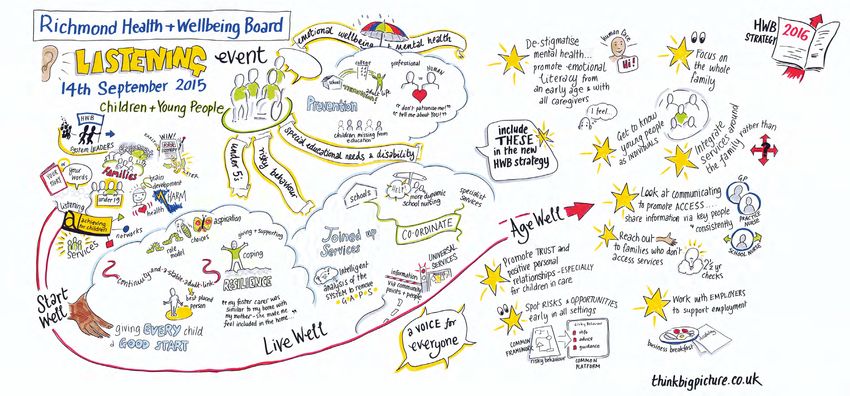
London Borough of Richmond Upon Thames • Joint Health and Wellbeing Strategy 2016-21 12The Joint Health and Wellbeing Strategy Think Big Picture – graphic recording of listening event for Children and Young People 13 London Borough of Richmond Upon Thames • Joint Health and Wellbeing Strategy 2016-21
London Borough of Richmond Upon Thames • Joint Health and Wellbeing Strategy 2016-21 14
1. Start Well

ABOUT THIS THEME –WHY IS IT IMPORTANT?
•
  What happens early in life (starting from conception) affects                How will the Health and Wellbeing
  health and wellbeing in later life – from obesity, heart disease             board, as a systems leader, take action
  and mental health, to educational achievement and                            to enable people to start well?
  employment opportunities.
                                                                              •
                                                                                Enable children, young people and families to be
•
  Pregnancy and early childhood (0-3 years) are particularly
                                                                                resilient, connected and able to look after themselves
  important periods –a loving, nurturing family environment
                                                                                and each other.
  provides the foundation for healthy development and
  ensuring a child is ready for school.                                       •
                                                                                Promote positive conditions and places for children,
                                                                                young people and families to grow, learn, work and
•
  There is a strong economic case for investing in prevention
                                                                                play and be safe.
  programmes. Intervening early can avoid the potential high
  costs of dealing with developmental problems, drug and                      •
                                                                                Ensure all children and young people feel included
  alcohol misuse, antisocial behaviour, domestic abuse                          and not stigmatised; and empowered to meet their
  and crime.                                                                    aspirations- regardless of social and cultural
                                                                                background, caring responsibilities, or disability
SPECIFIC ISSUES IN RICHMOND                                                     and mental health difficulties.
Most children and young people in Richmond are healthy and                    •
                                                                                Ensure services and professionals work sensitively
have a good start in life. However not all children and young                   and in partnership with children, young people
people enjoy similar positive health outcomes and therefore                     and families, and ensure better understanding and
opportunities to achieve. Prevention is critical to ensuring that all           transparency about issues of sharing of information/
children and young people can fulfil their potential, particularly              confidentiality and safety.
those living in poorer social circumstances.
                                                                              •
                                                                                Integrate and coordinate services around the family.
•
  Most children achieve a ‘good level’ of developmental
                                                                              •
                                                                                Make prevention and early help central to universal /
  progress by 5 years old, but children living in less well-off
                                                                                mainstream services.
  families are less likely to achieve this marker of readiness
  for school.
•
  Around 3,000 (21%) primary school aged children are
  obese or overweight.
•
  The What about YOUth survey showed that 15 year olds in
  Richmond engage in significantly more risky behaviours
  (smoking, alcohol and drug use) compared to peers nationally.
•
  The School Health Survey shows that many children
  and young people experience anxiety and emotional
  difficulties due to a range of concerns including exams,
  bullying and relationships.
•
  Young people say they want early access to specialist
  mental health support to avoid later crisis.
•
  Evidence indicates that Richmond has higher rates of young
  people attending hospital who are self-harming compared to
  other London boroughs.
•
  Service improvements for vulnerable young people with
  special education needs and disabilities, and those leaving
  care, are needed, especially improved access to training,
  employment and housing.

15                                                                London Borough of Richmond Upon Thames • Joint Health and Wellbeing Strategy 2016-21
TRANSFORMATIONAL INITIATIVES THAT THE BOARD WILL CHAMPION
The strategy for Start Well encompasses a number of significant developments that
seek to increase focus and resources towards prevention and early intervention,
and demands strong partnership working to make best use of resources.
Ensure the Best Start in Life Promote Resilience and
for all Children Emotional wellbeing through
a Whole Systems Approach
The Early Years Development Plan (currently being
developed) has the aim of ensuring all children have the A new Transformation Plan (encompassing the Children and
best start in life through a joined up approach to family Adolescent Mental Health Services (CAMHS) transformation)
health and wellbeing. The Early Years Pathway provides the is the start of a five year Emotional Wellbeing and Mental
framework for enabling integrated delivery of high quality Health Strategy for children and young people. This is based
prevention and early intervention services across health on extensive engagement with children, young people and
visiting, children centres, early education, primary care, families. This plan is focused on improving outcomes
maternity and safeguarding. through a whole-system approach; families, communities,
schools and services.
The focus is on joint working in areas of high impact:
The strategy centres on promoting resilience and early help,
•
Transition to parenthood
particularly through schools and community settings, and
•
Maternal mental health improving access to specialist mental health support.
•
Breast feeding and managing healthy weight Schools will be a fundamental partner. It also addresses the
needs of children and young people with special education
•
Parent-led integrated 2 ½ year review needs and disabilities including attention deficit hyperactivity
(health and early education) disorder (ADHD) and autism.
•
Managing minor illness
For example health visiting and children centres are working
to achieve the internationally recognised standards (UNICEF) Champion the Development
that means services are ‘BabyFriendly’ –an approach that of an Outcomes Framework
respects a mother’s choice, whilst providing sensitive advice
and support for breastfeeding. We propose to take forward the development of an
outcomes framework for children and young people. This
Many women can suffer mental health problems during and
framework will enable strategic partners to work together
after pregnancy –from mild to more severe level. We aim to
and commission services that are focused on achieving the
have a clear pathway in place covering early detection and
outcomes that matter to children and young people.
diagnosis, and additional support (for example ‘listening
Importantly it will involve a significant engagement process
visits’ by the health visitor) and /or access to specialist
with children, young people and families to define a set of
mental health services.
‘outcomes’- measures of improvement in health and
wellbeing as the basis for the design and commissioning of
programmes and services.
Champion the Strengthening
Families Programme
This is a nationally-led strategy for supporting families with
a range of complex needs- including unemployment, low
income, domestic abuse, health problems (such as mental
health difficulties and misuse of drugs and alcohol), and
young children who are not thriving or older children
engaging in anti-social behaviour or truancy. It is based on
a multi-agency model – a team approach that is focused
on the family.
Achieving for Children is taking forward Phase 2 – a five
year programme starting in 2015/16. This involves a
multi-agency approach to ensure families are identified
as early as possible and that there is a comprehensive
response to their needs. A method of risk stratification
will support the process.
London Borough of Richmond Upon Thames • Joint Health and Wellbeing Strategy 2016-21 16Case Study: Whole-school approaches to promoting emotional wellbeing and mental health
‘Whole-school’ approaches to promoting the social Sarah started cutting herself at 15 years old. She found
and emotional wellbeing of children and young people self-harming gave a sense of control in dealing with her
encompass all aspects of the school life, as well as learning emotions of distress, confusion and loneliness. Unkind text
and teaching. The school nursing service will develop messages made her feel worse. A collaborative initiative
its role in promoting emotional wellbeing and mental by the school nursing service and the emotional wellbeing
health. This will include effective personal, social, health service was established in response to a number of schools
and economic (PSHE) classes on healthy relationships concerns about young people self-harming. Sarah was able,
and sexual health, addressing issues such as body image, in a small group setting, to understand the feelings and
stress management, positive relationships, and on-line reasons for her self-harming. She gained the confidence to
safety. It will also include providing advice and support understand everyone reacts to situations in different ways
through confidential drop-in sessions, group sessions and was able to find other coping mechanisms that are
and telephone and on-line communications. Outreach healthier, giving her hope for the future.
school and community based clinics will be piloted by
the Emotional Health service to provide timely access to
psychological therapies.
17 London Borough of Richmond Upon Thames • Joint Health and Wellbeing Strategy 2016-212. Live Well
ABOUT THIS THEME – WHY IS IT IMPORTANT? •
Local residents say making full use of local assets such can
help support healthy behaviours and reduce poor health
•
The main unhealthy behaviours of smoking, alcohol misuse,
outcomes. For example, green spaces to increase
poor diet and lack of physical activity, as well as poor
opportunities for physical activity, and increasing the
emotional and mental wellbeing, are responsible for a large
availability of healthy food.
proportion of ill health and long-term conditions, including
cancers, cardiovascular disease, diabetes and dementia.
•
These health behaviours are known to be primarily influenced How will the Health and Wellbeing
through exposure to cues in the environment, social board, as a systems leader, take action
circumstances or psychological stresses, establishing to enable people to live well?
‘automatic’ processes which result in unhealthy behaviors
such as eating too many sugary foods or being inactive. •
Embed prevention through cross council and CCG
commissioning and place level planning.
•
There is interdependency between emotional wellbeing,
mental health and the prevention and management of long •
Further utilise Workplaces and Village Planning, including
term conditions. Living with a long-term condition (and being Community Links, for connectivity and inclusion.
unable to work as a result, for example) can decrease
•
Coordinate access to Health Checks, Health Improvement
emotional wellbeing: unhealthy behaviours are often taken up
Services, and Psychological Wellbeing Services. Promote
as a coping mechanism (e.g. smoking), resulting in further ill
access to community assets such as parks, open space,
health and decreased wellbeing.
accessible streets and cultural activities.
•
Cost effective and universal interventions have an opportunity
•
Increase the focus on access to services and healthy
to reach all populations regardless of socioeconomic group.
environments in and around the Workplace in
•
Universal interventions require a systems approach which partnership with communities, local businesses,
includes interventions at a place, community and individual community organisations and the voluntary sector.
level. In a time of austerity, place and community level
interventions are required for a population reach. Individual
level interventions will be required for a targeted approach for
vulnerable groups.
More information about this theme can be found in the Annual
Report of the Director of Public Health 2016.
www.richmond.gov.uk/annual_public_health_report
SPECIFIC ISSUES IN RICHMOND
Most people in Richmond are healthy, but the incidence of
people living with long term conditions in older adulthood is
increasing at an alarming rate. Important opportunities for
prevention include:
•
Engagement in the four risk behaviours in Richmond is
significant, 17,000 (11%) adults smoke, 24,000 (16%) adults
are physically inactive, 68,000 (45%) adults do not eat 5 fruit &
veg per day and 38,000 (25%) adults drink alcohol at
increasing or higher risk levels. Population estimates indicate
that over 65,000 (45%) people living in Richmond are carrying
excess weight.
•
Emotional wellbeing underpins health behaviours, 22,000
(16%) adults in Richmond are living with a common mental
disorder, such as anxiety or depression.
•
Many people would benefit from diagnosis and treatment of
previously undiagnosed disease, or behavior change support
if at high risk of disease.
London Borough of Richmond Upon Thames • Joint Health and Wellbeing Strategy 2016-21 18TRANSFORMATIONAL INITIATIVES THAT THE BOARD WILL CHAMPION
Champion a Systems Approach Champion Active Travel in the
to Prevention London Borough of Richmond upon
Thames
The Prevention Framework and the Annual Report of the
Director of Public Health, outline the need for a whole Being active everyday makes us feel good, gives us the
systems approach to Live Well. To have the required space to notice what’s around us and has protective
population impact efforts must be targeted to enable the benefits, improving resilience and physical health. To
healthy choice to be the easy and preferred choice. This can achieve sustainable improvements in physical activity levels
be achieved through coordinated efforts at a place and we also know that activity needs to be embedded into the
community level which provides cues and supports day to day routine and become an automatic process.
automatic processes for living well. These universal
approaches offer more cost-effective alternatives to one-to- “If Londoners swapped motorised trips that could
one service level interventions. This could include, for reasonably be walked and cycled, 60% of them would
example, a coordinated and partnership approach to the meet the recommended 150 minutes of physical
promotion and ability to engage in active travel. The Mental activity per week through active travel alone. The
Health Strategy for Richmond highlights the importance of population of London would gain over 60,000 years of
supporting resilience in working age men, this could include healthy life every year which would deliver an
community driven approaches such as workplace economic health benefit of over £2 billion annually
programmes and individual solutions such as the Improving through reduced sickness and increased
Access to Psychological Therapies (IAPT) programme. Access productivity.” Mayor of London’s Office
to individual level support services are also required for The Prevention Framework for Richmond outlines the
vulnerable and at risk groups to support people to overcome required partnership of the CCG and council to develop the
physical, cognitive and social challenges to living well place level infrastructure and community norms to enable
active travel. Active travel is a central element to the
Integrated Transport Plan and Cycling Strategy. The council
is also developing a short training package to enable council
Champion Improved Accessibility
staff to promote active travel.
to Balanced Food Options
The HWB has a critical role to play to lead and co-ordinate
Accessibility to varied and balanced food options is the partners to embed active travel. This could be achieved
biggest predictor of our consumption. To enable people to through training frontline health and social care staff to
make the preferred and healthy choice, a whole systems promote the benefits of active travel, working with transport
approach is needed. This will include the availability of a to improve road infrastructure, working with schools to
variety of foods in the places where people spend their time, promote active travel and Physical Education in school time,
for example workplaces and around schools. Where choice and engaging local businesses to enhance their travel plans
has been limited, high fat and high sugar foods often to encourage (help to buy cycle schemes) and enable
become the default for many people. An increased (provide storage and shower facilities) active travel.
awareness of a variety of foods and the associated positive
experience can be introduced with workplace programmes
and parent and child cooking initiatives. To achieve this, a
collaborative partnership approach is required with local
businesses, communities and voluntary sector services. A
recent workshop held between Richmond and the Town
and County Planning Association (TCPA) included partners
across the council and highlighted the benefits of planning
for health for a population level impact. This included a
restriction in the density of take-away outlets close to
schools. Championing a comprehensive and cross-partner
approach to support health and wellbeing will be essential
for living well.
19 London Borough of Richmond Upon Thames • Joint Health and Wellbeing Strategy 2016-21Champion Midlife Live Well Checks & Workplace Health
Prevention
Health checks provide awareness of risk which is relevant and community assets for living well. There is an opportunity to
tailored to the individual based biochemical markers, such as promote the importance of Midlife Live Well Checks, with a
raised blood sugar. Furthermore, risk information is specific focus on men. Being in employment has vast positive
communicated by the GP which is known to be an effective benefits to health and wellbeing. These positive effects of
conduit for galvanising change and access to support services. psychological wellbeing needed for the management of long
The new healthy living service for Richmond will be focusing term conditions, including cancers, are an important asset for
even more attention on taking Health Checks out to supporting the best health outcomes. Living with a long term
communities that healthcare has so far been less able to reach. condition does also require additional aspects of self-care
Given that the population of Richmond is, in the most part, of which need to be accounted for and with appropriate flexibility
working age and in employment, the HWB will have a role in and support from employers and colleagues. The healthy
championing an approach to target workplaces. workplace charter includes guidance for organisations to
provide appropriate one-to-one support for people to manage
Recovery
their conditions, alongside their work commitments in
The new healthy living service has been tasked with addition to organisational leadership which instills a
demonstrating better linkages between services and supportive environment for recovery.
Case Study:
LIVE WELL CHECKS
In 2013/14 Richmond’s Health Check programme He met with a health trainer who identified that his days
reached 6,040 residents. Over 15% of those identified were often spent sitting at work or on the train. They talked
as ‘at risk’ were referred to the Live Well service. The Live about what was important to him and put him in touch
Well, Health trainer programme has already been working with volunteers for the local rugby club where he used to
with users to set goals for emotional wellbeing. This has be a member. He was also encouraged and reluctantly
included links with psychological therapies and the expert attended a Health Walk with a colleague, where he was
patient programme and has benefitted 78% of their positively surprised by how good it felt to get out of the
service users. office and connect with colleagues. One year on, Mike
is making the most of all of his time, he cycles to work,
Mike Richmond is 47 years old, inactive and works in a
dropping off the kids with their scooters on the way after
busy firm in Richmond. When his Director told the team
a catch-up. Mike also volunteers, guest coaching for the
that they were being given the opportunity for a ‘Live Well
rugby club once a month which he says makes him feel
Check’ his initial response was to have a laugh with his
10 years younger as he is so focused on the team, he
colleagues and say “not for me”. However, following his
completely forgets about work. As a result, his blood sugar
assessment which identified pre-diabetes, things quickly
has returned to normal levels and Mike feels healthier and
changed for Mike.
more energetic.
RECOVERY IN THE WORKPLACE
Peter Sheen is 55 years old, and was diagnosed with work streams without the pressure of day-to-day delivery.
Prostate Cancer last year. Peter works for a busy firm and Following treatment Peter wasn’t able to get much sleep
was concerned that he would need to leave his job. Peter’s and so maintained home working whilst maintaining
manager supported him in discussions with Occupational regular contact with the Workplace Champions Group, of
Health and Human Resources where they worked through which he is a keen member. Getting active after treatment
a flexible working plan during his time of treatment. For was important to him, the journey to and from work was
a period of time, it was clear that he would be unable to of concern too, but was made possible by the access to
meet the requirements of his substantive role, an interim the community toilet scheme and benches. The workplace
was brought in to support with the daily demands and health programme also offered gentle yoga sessions which
Peter retained other duties of his post for a protected Peter reports have been invaluable socially, physically and
duration of time. He had regular meetings to review psychologically. Peter is now back at work full time and
the flexible working agreement which enabled Peter to reports that the supportive infrastructure as invaluable to
remain part of the organisation with influence over his his recovery.
London Borough of Richmond Upon Thames • Joint Health and Wellbeing Strategy 2016-21 20You can also read


