KCC Transport Scheme Business Case Report - Folkestone Seafront CO04300262/030 Revision 03 - The South ...
←
→
Page content transcription
If your browser does not render page correctly, please read the page content below

KCC Transport Scheme
Business Case Report
Folkestone Seafront

CO04300262/030 Revision 03
March 2015
Document Control Sheet

Project Name:      Folkestone Seafront
Project Number:    CO04300262
Report Title:      KCC Transport Scheme Business Case Report
Report Number:     030

Issue               Prepared               Reviewed            Approved
Status/Amendment
00 (Draft)          Name:                  Name:               Name:
                    Iain Morrison          Wayne Garside       Steve Whittaker

                    Signature:             Signature:          Signature:

                    Date: 30/01/15         Date: 30/01/15      Date: 30/01/15
01 (Draft)          Name:                  Name:               Name:
                    Iain Morrison          Wayne Garside       Steve Whittaker

                    Signature:             Signature:          Signature:

                    Date: 04/02/15         Date: 04/02/15      Date: 04/02/15
02 (Draft)          Name:                  Name:               Name:
                    Iain Morrison          Steve Whittaker     Steve Whittaker

                    Signature:             Signature:          Signature:

                    Date: 19/02/15         Date: 19/02/15      Date: 19/02/15
03 (Final Issue)    Name:                  Name:               Name:
                    Iain Morrison          Steve Whittaker     Steve Whittaker

                    Signature:             Signature:          Signature:

                    Date: 09/03/15         Date: 09/03/15      Date: 09/03/15
Project Name           Folkestone Seafront
Document Title           KCC Transport Scheme Business Case Report

        Contents

        1       Introduction ....................................................................................................... 1
                1.1    Overview .......................................................................................................... 1
                1.2    Purpose of Report ............................................................................................. 1
                1.3    Specific Scheme ................................................................................................ 2

        2       Project Outline ................................................................................................... 3
                2.1    Location of the Scheme...................................................................................... 3
                2.2    Current Conditions ............................................................................................. 3
                2.3    Scheme Layout and Function .............................................................................. 7
                2.4    Category of Scheme Transport Business Case ...................................................... 7
                2.5    Background to the Transport Business Case......................................................... 7
                2.6    Context of the Transport Scheme Funding Bid and TBC ........................................ 9
                2.7    ‘Screening’ Summary for Scheme 2015/16 LGF Bid and Supporting TBC ............... 10

        3       Strategic Case .................................................................................................. 13
                3.1    Overview ........................................................................................................ 13
                3.2    Purpose of the Proposed Investment ................................................................. 13
                3.3    Strategic Context ............................................................................................. 13
                3.4    The Case for Change ....................................................................................... 18
                3.5    Scheme Objectives and Scope .......................................................................... 22
                3.6    Determining Success of the Scheme .................................................................. 24
                3.7    Constraints and Dependencies .......................................................................... 26
                3.8    Scheme Strategy Options ................................................................................. 27
                3.9    Scheme Risks .................................................................................................. 28
                3.10 Stakeholders and Interests ............................................................................... 29

        4       Economic Case ................................................................................................. 31
                4.1    General KCC Approach to Scheme Economic Case .............................................. 31
                4.2    Background..................................................................................................... 34
                4.3    Appraisal Assumptions ..................................................................................... 36
                4.4    Scheme Options Assessed ................................................................................ 36
                4.5    Economic Case Content and Method ................................................................. 39
                4.6    Preferred Scheme Option ................................................................................. 45
                4.7    Appraisal Summary Table ................................................................................. 45
                4.8    Value for Money Statement .............................................................................. 46

Doc. Ref.:CO04300262 /030 Rev. 03                                    -i-                                            Issued:   March 2015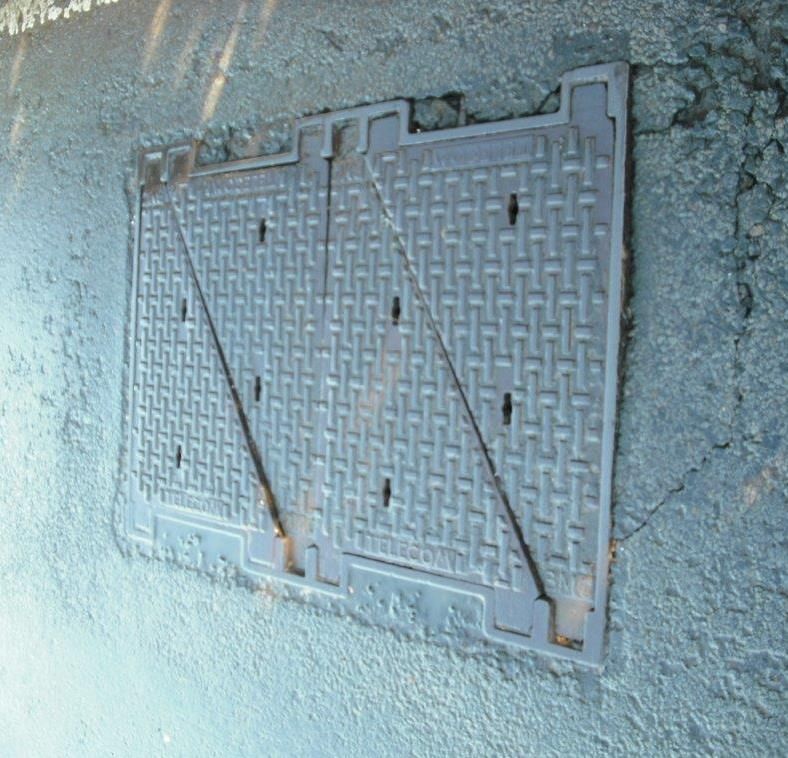
Project Name           Folkestone Seafront
Document Title           KCC Transport Scheme Business Case Report

        5       Financial Case .................................................................................................. 49
                5.1    Overview ........................................................................................................ 49
                5.2    Project Costs ................................................................................................... 49
                5.3    Project Funding ............................................................................................... 50
                5.4    Financial Risk Management Strategy ................................................................. 51

        6       Commercial Case .............................................................................................. 55
                6.1    Overview ........................................................................................................ 55
                6.2    Expected Outcomes from the Commercial Strategy ............................................ 55
                6.3    Commercial Viability of the Scheme................................................................... 55
                6.4    Scheme Procurement Strategy .......................................................................... 56
                6.5    Commercial Risk Assessment ............................................................................ 57

        7       Management Case ............................................................................................ 58
                7.1    Overview ........................................................................................................ 58
                7.2    Project Governance, Roles and Responsibilities .................................................. 58
                7.3    Evidence of Previously Successful Scheme Management Strategy ........................ 61
                7.4    Stakeholder Engagement ................................................................................. 63
                7.5    Project Risk Management ................................................................................. 66
                7.6    Project Assurance ............................................................................................ 67

        8       Operational Case .............................................................................................. 68
                8.1    Overview ........................................................................................................ 68
                8.2    Criteria for Scheme Operation........................................................................... 68
                8.3    Scheme Operational Risks ................................................................................ 69

        9       Scheme Monitoring, Evaluation and Benefits Realisation ................................ 70
                9.1    Overview ........................................................................................................ 70
                9.2    Outcomes Monitoring ....................................................................................... 70
                9.3    Outcomes Evaluation/Benefits Realisation .......................................................... 71

        10      Conclusions and Recommendations ................................................................. 72
                10.1 Conclusions ..................................................................................................... 72
                10.2 Recommended Next Steps................................................................................ 72
                10.3 Value for Money Statement .............................................................................. 72
                10.1 Funding Recommendation ................................................................................ 73

        Appendix A             Whole Life Cost Calculations
        Appendix B             Section 151 Officer Letter

Doc. Ref.:CO04300262 /030 Rev. 03                                   - ii -                                         Issued:   March 2015
Project Name Folkestone Seafront
Document Title KCC Transport Scheme Business Case Report
1 Introduction
1.1 Overview
Amey has been commissioned by Kent County Council (KCC) to prepare a Transport
Scheme Business Case (TBC), appropriate to the size and scope of each scheme, for
each of the projects which have been allocated Local Growth Fund finance by the South
East Local Enterprise Partnership (SELEP).
1.2 Purpose of Report
The overall purpose of this TBC report is to provide a ‘proportionate’ justification for the
2015/16 funding allocated to the Folkestone Seafront: onsite infrastructure and
engineering works. The scope of the TBC is not aligned with any specific stage of the
Department for Transport (DfT) ‘Transport Business Cases’ procedure. Rather, it is a
‘lighter touch’ report in the spirit of the DfT advice for’ LEP Assurance Framework’
(December 2014), which agrees with using ‘proportionate appraisal’ appropriate to the
scope of a transport scheme.
The TBC report does, however, consider the five key strands of TBC content required by
DfT and HM Treasury’s The Green Book, namely strategic, economic, financial,
commercial, and management. It also brings in other strands where relevant, such as
summary of predicted scheme outcomes and scheme operational case. It draws from
the results of the earlier Amey Gap Analysis of KCC programmed transport schemes and
the resulting scheme development briefs.
This TBC report may need to stand as an interim submission, justifying SELEP allocation
of 2015/16 LGF to the Folkestone Seafront: onsite infrastructure and engineering works,
but which will need to be supplemented by a further TBC submission in later financial
years, as the content and delivery aspects of the scheme are resolved in greater detail.
The report broadly follows the 5-Case Model for Transport Business Case preparation,
incorporating design and environmental issues as well as a summary of the overall risks
in terms of project delivery and project funding approval. These risks include:
The potential for the project to be called in for review by DfT or other bodies
before it is delivered
The potential for challenge from stakeholders which may jeopardise or delay the
project
Doc. Ref.:CO04300262/030 Rev. 03 -1- Issued: March 2015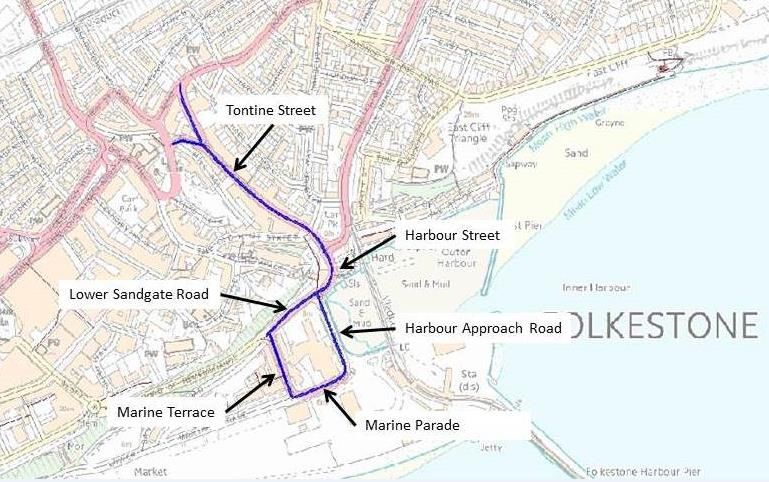
Project Name Folkestone Seafront
Document Title KCC Transport Scheme Business Case Report
The potential that a subsequent review of the project after implementation may
identify issues relating to the delivery of overall outcomes (e.g. job creation or
transport modal shift)
1.3 Specific Scheme
This scheme, as in the first strategic outline business case submitted to SELEP (2014), is
entitled: Folkestone Seafront: onsite infrastructure and engineering works.
Doc. Ref.:CO04300262/030 Rev. 03 -2- Issued: March 2015
Project Name          Folkestone Seafront
Document Title          KCC Transport Scheme Business Case Report

        2          Project Outline

        2.1        Location of the Scheme

                   The Folkestone Seafront: onsite infrastructure and engineering works comprise Tontine
                   Street on the eastern extents of Folkestone’s Creative Quarter and Harbour Street which
                   leads to Folkestone Harbour. The one-way gyratory system of Harbour Approach Road,
                   Marine Parade, Marine Terrace, and Lower Sandgate Road are also included. A location
                   plan of the scheme extents is shown in Figure 1.

                   Figure 1 – Scheme Location

        2.2        Current Conditions

                   The road network included in the Folkestone Seafront: onsite infrastructure and
                   engineering works is of very poor quality. Identified on the latest mechanical condition
                   data surveys, the aforementioned roads require strengthening to mitigate against further
                   degradation of the surface course.

                   Historic records from the condition data surveys suggest that this area has had an
                   underinvestment in previous years.

Doc. Ref.:CO04300262/030 Rev. 03                        -3-                                 Issued:   March 2015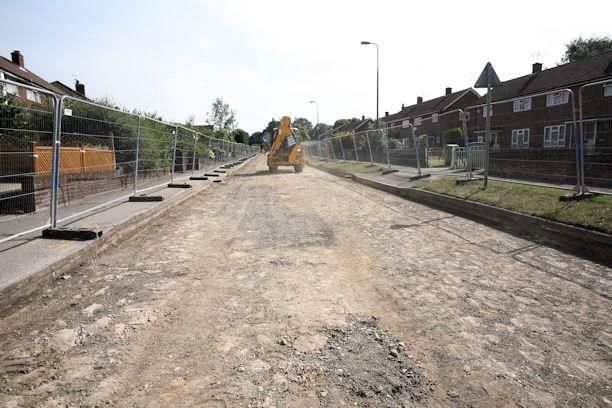
Project Name          Folkestone Seafront
Document Title          KCC Transport Scheme Business Case Report

                   The area under consideration is urban in nature with a mixture of commercial, residential
                   and recreational premises. The current road network reflects a sector of the economy
                   which is no longer in existence, namely, that of ferry/freight traffic. The proposed
                   conversion of Tontine Street to two-way will improve general access to the Creative
                   Quarter, Harbour area, and the Old Town leading to improved accessibility to
                   employment opportunities for job seekers in the surrounding areas, and providing a
                   more direct route to and from the Harbour for residents and visitors alike.

                   The proposed conversion of Tontine Street to two-way will also support a robust bus
                   service that cannot be sustained under the current arrangements.

                   There have been a number of improvements in the area around Folkestone Harbour.
                   The most significant of these is the creation of the Creative Quarter which is a home for
                   artisans, artists, retailers and others working in a range of digital and creative industries,
                   as well as education.

                   Major improvements to the harbour-side itself, include the popular interactive fountain,
                   new restaurants, support for events and the introduction of a sea sports facilities.

                   All the above improvements will result in increased numbers of pedestrians and cyclists
                   to the area. There is therefore an increased need to ensure that the highway network is
                   fit for purpose.

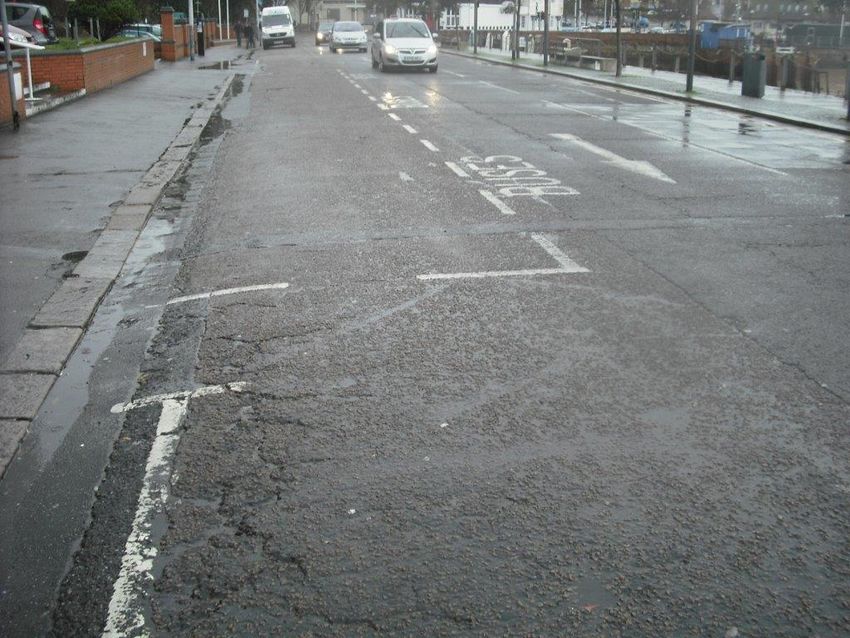
                   Photographs of the current conditions are shown in Figures 2 to 6.

                   Figure 2 – Current Conditions (Marine Parade)

Doc. Ref.:CO04300262/030 Rev. 03                          -4-                                  Issued:   March 2015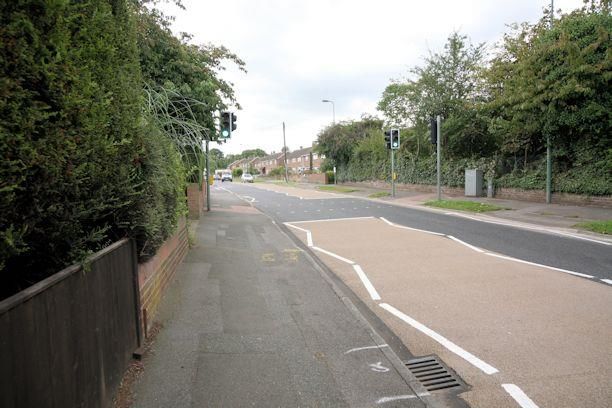
Project Name          Folkestone Seafront
Document Title          KCC Transport Scheme Business Case Report

                   Figure 3 - Current Conditions (Harbour Street)

                   Figure 4 - Current Conditions (Marine Terrace)

Doc. Ref.:CO04300262/030 Rev. 03                     -5-            Issued:   March 2015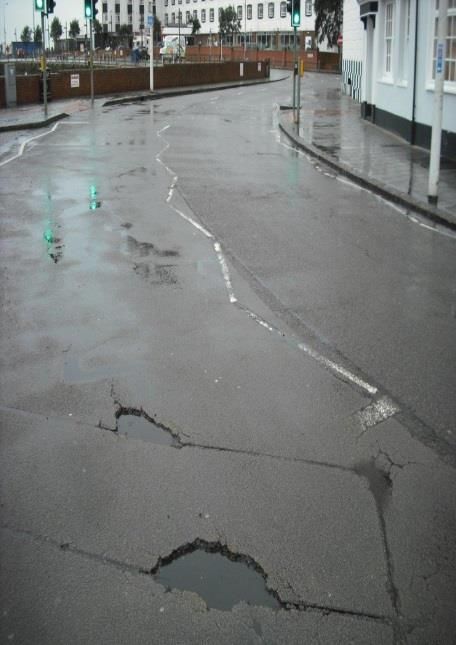
Project Name          Folkestone Seafront
Document Title          KCC Transport Scheme Business Case Report

                   Figure 5 - Current Conditions (Tontine Street)

                   Figure 6 - Current Conditions (typical ironworks)

Doc. Ref.:CO04300262/030 Rev. 03                     -6-               Issued:   March 2015
Project Name Folkestone Seafront
Document Title KCC Transport Scheme Business Case Report
2.3 Scheme Layout and Function
The Folkestone Seafront: onsite infrastructure and engineering works will improve the
carriageway condition on a number of streets between the centre of Folkestone and the
harbour. The scheme has been identified based on results from annual carriageway
condition surveys. The identified streets require substantial repair, due to failure of lower
carriageway construction levels.
The current layout consists primarily of a number of one-way systems. Tontine Street is
one-way (away from the Harbour towards Dover Street: The Tram Road is the one-way
street that returns from Dover Street to the harbour area). Harbour Street is a short
section of two-way carriageway that connects Tontine Street and The Tram Road to a
one-way (clockwise) gyratory system that includes Harbour Approach Road, Marine
Parade, Marine Terrace, and Lower Sandgate Road.
2.4 Category of Scheme Transport Business Case
With a projected expenditure of £0.5m, this scheme is categorised as ‘small’, according
to criteria agreed between SELEP and DfT.
2.5 Background to the Transport Business Case
UK Treasury’s ‘The Green Book’ (July 2011) sets out a process for presenting the
business case for investment schemes involving public funds. This approach has been
endorsed by DfT and tailored specifically to transport investment in ‘The Transport
Business Cases’ (DfT, January 2013). The TBC usually involves three stages:
Strategic Outline Business Case (SOC)
This is the scope-setting stage of the investment process. The purpose of the SOC is to
confirm the strategic context of the investment; to make a robust case for change; and
to provide stakeholders and customers with an indication of the proposed way forward,
together with indicative costs. Since an earlier pre-feasibility review has already
established that the scheme can achieve an economic benefit, the SOC in this case
takes account of this in the context of the modified design. More detailed design work
will be conducted as the Transport Business Case progresses.
Outline Business Case (OBC)
This is the detailed planning phase of the investment, revisiting the OBC in more detail
and to identify a preferred option which demonstrably optimises value for money. It
Doc. Ref.:CO04300262/030 Rev. 03 -7- Issued: March 2015Project Name Folkestone Seafront
Document Title KCC Transport Scheme Business Case Report
also sets out the likely approach to funding; demonstrates its affordability; and details
the supporting procurement strategy, together with management arrangements for the
successful rollout of the scheme.
Full Business Case (FBC)
This takes place within the procurement phase of the project, though before a formal
decision to proceed has been made and prior to the formal signing of contracts and the
procurement of goods and services. The purpose of the FBC is to revisit the OBC and
record the findings of the subsequent procurement process. It also sets out the
recommendation for an affordable solution which continues to optimise VFM, and
includes detailed arrangements for the successful delivery of goods and
implementation of services from the recommended supplier.
‘Lighter Touch’ Transport Business Case
As mentioned in section 1.2, DfT and SELEP have confirmed that a streamlined
approach to presenting the TBC for the KCC schemes, earmarked for funding in
2015/16, is appropriate, if the scheme value is relatively small (i.e.Project Name Folkestone Seafront
Document Title KCC Transport Scheme Business Case Report
Are supported by a robust case for change that fits with wider public policy
objectives – the ‘strategic case’;
Demonstrate value for money – the ‘economic case’;
Are commercially viable – the ‘commercial case’;
Are financially affordable – the ‘financial case’; and
Are achievable – the ‘management case’.
This document uses this 5-case model in an appropriate and proportionate way to
demonstrate the merit of investing in the proposed Folkestone Seafront: onsite
infrastructure and engineering works.
2.6 Context of the Transport Scheme Funding Bid and TBC
Currently, standard DfT guidance requires promoters of all schemes involving an
investment of public funds over £5m, (‘major schemes’), to prepare and submit a
Transport Business Case. Previously a Business Case would be submitted to the
Department for Transport (DfT).
Recent Government policy changes have involved the devolution of decision-making for
smaller major schemes to Local Enterprise Partnerships (LEPs). These bodies are
designed to direct investment for an area based on economic priorities set through a
partnership which is private-sector led. Kent County Council is in the South East LEP
(SELEP) area.
The devolved funding arrangements were put in place in July 2014 through the Local
Growth Deal announcements, including devolution of funds to the SELEP on the basis of
the SELEP ‘Growth Deal and Strategic Economic Plan’ (March 2014).
This Transport Business Case submission to SELEP forms a bid to request confirmation of
the already allocated LGF funding for the scheme.
Doc. Ref.:CO04300262/030 Rev. 03 -9- Issued: March 2015Project Name Folkestone Seafront
Document Title KCC Transport Scheme Business Case Report
2.7 ‘Screening’ Summary for Scheme 2015/16 LGF Bid and Supporting
TBC
This report consists of a ‘lighter touch’ transport scheme business case in support of the
2015/16 LGF bid for the Folkestone Seafront: onsite infrastructure and engineering
works. As such, the TBC has been tailored to be ‘proportionate’ to the scope of the
scheme and the scale of required funding. This means that some criteria for justifying
the scheme have only been considered in a simplified way, with qualitative supporting
evidence, rather than with detailed quantified appraisal. Less relevant criteria for this
scheme have been largely omitted from the TBC report.
Table 1 gives a ‘screening’ summary to show how each of the transport scheme
appraisal criteria specified by DfT (broadly aligned with WebTAG Appraisal Summary
Table – AST) have been handled with respect to the 2015/16 LGF bid for the Folkestone
Seafront: onsite infrastructure and engineering works.
Table 1 – ‘Screening’ Summary for ‘Lighter Touch’ Scheme Appraisal and TBC
Quantitative
/ Qualitative
Appraisal of
‘Proportionate’ Details
Impacts? Details To be Covered
Covered in this Scheme
Scheme Impact only in a Later-Stage
(2015/16) ‘Lighter-
Scheme TBC?
Touch’ TBC?
Quantitative
Qualitative
Economy (Travel Congestion
Impacts for All Users)
User Travel Time (congestion) No anticipated impact
User Travel Distance (operation) No anticipated impact
Yes – Reduced likelihood of
Journey Reliability (travel time variability) delay caused by temporary
works
Wider Impacts
Yes – likely to support
Regeneration
regeneration
Wider Economy
Agglomeration Economies No anticipated impact
Output in Imperfect Markets No anticipated impact
Doc. Ref.:CO04300262/030 Rev. 03 - 10 - Issued: March 2015Project Name Folkestone Seafront
Document Title KCC Transport Scheme Business Case Report
‘Proportionate’ Details Quantitative
Details To be Covered
Covered in this Scheme / Qualitative
Scheme Impact only in a Later-Stage
(2015/16) ‘Lighter- Appraisal of
Scheme TBC?
Touch’ TBC? Impacts?
Labour Market Tax Revenue No anticipated impact
Housing (Property) Impact Value No anticipated impact
Public Accounts Impacts
Public Accounts Cost No anticipated impact
Indirect Tax Revenue No anticipated impact
Environmental Impacts
Noise No anticipated impact
Air Quality No anticipated impact
Greenhouse Gas No anticipated impact
Landscape No anticipated impact
Townscape Yes – improved aesthetics
Heritage (Historic Environment) No anticipated impact
Biodiversity No anticipated impact
Water Environment No anticipated impact
Social / Distributional impacts
Yes – may encourage
Physical Activity
cyclists
Yes – Improved experience
Journey Quality for road users (cars and
NMUs)
Yes – possible reduction in
Accidents accidents caused by
potholes
Security No anticipated impact
Supports Tontine Street
Accessibility of Services / Opportunities
development
Personal Affordability No anticipated impact
Severance No anticipated impact
Absenteeism (Employer Benefit) No anticipated impact
Non-User Option / Non-Use Value No anticipated impact
Door to Door Strategy for
Sustainable Transport
Information on transport options No anticipated impact
Doc. Ref.:CO04300262/030 Rev. 03 - 11 - Issued: March 2015Project Name Folkestone Seafront
Document Title KCC Transport Scheme Business Case Report
‘Proportionate’ Details Quantitative
Details To be Covered
Covered in this Scheme / Qualitative
Scheme Impact only in a Later-Stage
(2015/16) ‘Lighter- Appraisal of
Scheme TBC?
Touch’ TBC? Impacts?
Ticketing for entire journey No anticipated impact
Transport connections across stages &
No anticipated impact
modes
Safe & comfortable transport facilities No anticipated impact
Influencing travel demand, awareness &
No anticipated impact
behaviour
Effective Scheme Design
Yes – extent of scheme
Fitness for Purpose / Successful Operation determined by condition
data surveys
Future Network Resilience and Resistance
No anticipated impact
to Shocks
Doc. Ref.:CO04300262/030 Rev. 03 - 12 - Issued: March 2015Project Name Folkestone Seafront
Document Title KCC Transport Scheme Business Case Report
3 Strategic Case
3.1 Overview
The Strategic Case outlines the overarching reasons for proposing the scheme
intervention, in terms of its contribution to improving local transport and making
effective use of infrastructure. A further consideration is the scheme’s alignment with
wider aspirations, such as a prosperous economy, an enhanced community, an attractive
and sustainable environment, safer and healthier lifestyles and access to opportunities
for all.
Ultimately, the Strategic Case indicates who, what, why, when, where and how, the
scheme will assist.
3.2 Purpose of the Proposed Investment
The Folkestone Seafront: onsite infrastructure and engineering works are required to
strengthen the road carriageway on a number of streets in an area of Folkestone that is
earmarked for future regeneration. The streets form an important connection between
the proposed regeneration area and the more recently completed regeneration area,
namely the Folkestone Creative Quarter. These streets have not had adequate
investment in previous years and as a result are becoming degraded with reactive
maintenance being more increasingly applied. This type of repair does not tackle the
underlying causes of the degradation.
By strengthening the carriageway the immediate benefit are aesthetic and safety. The
more thorough maintenance planned as part of these works will ensure that these
benefits will be retained for a much longer period than currently.
3.3 Strategic Context
In line with the latest Government guidance for SELEP (‘LEP Assurance Framework’,
HMT, December 2014), the Folkestone Seafront: onsite infrastructure and engineering
works are justified in a manner ‘proportionate’ to the scope of the scheme and the scale
of funding required.
Doc. Ref.:CO04300262/030 Rev. 03 - 13 - Issued: March 2015Project Name Folkestone Seafront
Document Title KCC Transport Scheme Business Case Report
There are a number of other benefits that will be realised. The improved streetscape
aesthetics associated with a well maintained highway are important factors in creating
the right conditions for future inward investment in Folkestone, which with it brings more
opportunities for employment. This scheme is therefore of economic and social
importance and supports the wider strategic direction of KCC.
3.3.1 National Strategy: ‘National Infrastructure Plan’
The Folkestone Seafront: onsite infrastructure and engineering works align with the
‘National Infrastructure Plan’ (HMT, December 2013) as this investment will ensure that
the local road network is kept in good order, preventing potholes and making journeys
safer.
Whole life planning and cost control is one of the key actions that the Infrastructure
Client Group is focussing on to 2020. The whole life cost of options considered as part of
this commission will therefore be a key driver in the development of a preferred solution.
There is reliance from other areas of investment on the highway asset to work
effectively. It is therefore important that these assets are sufficiently resilient to
degradation over time.
3.3.2 National Strategy: ‘Creating Growth, Cutting Carbon’
The Folkestone Seafront: onsite infrastructure and engineering works align with ‘Creating
Growth, Cutting Carbon – Making Sustainable Local transport Happen’ (DfT, January
2011) as the objective of the scheme recognises the economic and social importance of
well-maintained highways to local communities. Improvements to the streets in the
study are will encourage more sustainable modes of transport (public transport and
cycling) and will improve the safety of these streets as damage/accidents caused by the
degraded asset is reduced. This scheme will improve the condition of the roads within
the study area and reduce the re-occurrence of pot-holes that otherwise would have the
potential to cause damage/accidents and ultimately discourage cyclists.
3.3.3 National Strategy: ‘Door to Door’
The Folkestone Seafront: onsite infrastructure and engineering works will deliver a high
quality cycling environment in the Harbour area of Folkestone as a result of the
improvement to the carriageway (i.e. removal of uneven surfaces, sunken ironwork, and
potholes). This aligns with ‘Door to Door’ A Strategy for Improving Sustainable Transport
Integration’ (DfT, March 2013).
Doc. Ref.:CO04300262/030 Rev. 03 - 14 - Issued: March 2015Project Name Folkestone Seafront
Document Title KCC Transport Scheme Business Case Report
3.3.4 Regional Strategy: ‘Growth Deal and Strategic Economic Plan’
The Folkestone Seafront: onsite infrastructure and engineering works align with the SEP
‘Growth Deal and Strategic Economic Plan’ (SELEP, March 2014) by improving the
highway asset between the recently developed Folkestone Creative Quarter and the
proposed revitalisation of Folkestone Seafront, thus supporting the transformation of the
local economy through the likes of tourism. The Folkestone Seafront and Harbour
regeneration schemes are envisaged to bring 1,000 new homes and up to 10,000 m2 of
commercial floor space together with improvements to the beach and seafront facilities.
It is important that the highway asset is resilient enough to combat the potential
increases in use.
The ‘Growth Deals Initial Guidance for Local Enterprise Partnerships’ (July 2013) sets out
the key elements of a Strategic Economic Plan. This includes aligning local authority
capital and revenue spend. The Folkestone Seafront: onsite infrastructure and
engineering works provide evidence of a clear asset management strategy with whole
life costs influencing the preferred option.
3.3.5 Local Strategy: ‘Growth without Gridlock’
The Folkestone Seafront: onsite infrastructure and engineering works align with ‘Growth
without Gridlock’ – A Transport Delivery Plan for Kent (Kent CC, December 2010) by
supporting the regeneration proposals for the seafront as part of the Folkestone Harbour
and Seafront Masterplan, with better access to the seafront from the town centre.
These works also support Health and Safety elements of The Plan, by making the
highway network safer for the likes of cyclists and other non-motorised users (NMUs). It
also supports the improvement of public transport to development sites and expansion
of the urban bus network in a sustainable way.
3.3.6 Local Strategy: Local Transport Plan for Kent 2011-16
The Folkestone Seafront: onsite infrastructure and engineering works align with principal
aims of the Kent CC third Local Transport Plan 2011-16 (LTP3).
Doc. Ref.:CO04300262/030 Rev. 03 - 15 - Issued: March 2015Project Name Folkestone Seafront
Document Title KCC Transport Scheme Business Case Report
LTP3 requires that “current spending pressures call for a continued emphasis on the
maintenance of existing assets in the short term. However, a step-change is required in
the way in which the annual maintenance programme is executed, including the
adoption of asset management principles which move beyond short term, reactive works
towards a more strategic, programmed approach which has the potential to deliver
significantly higher value for money”. The evidence to support this scheme’s value for
money is included in the Financial Case (Section 5)
There are a number of specific Transport Objectives in the LTP that the Folkestone
Seafront: onsite infrastructure and engineering works are also aligned with. These are
set out in Table 2 below.
Table 2 - Scheme Alignment with LTP3 Objectives
Folkestone Seafront
LTP3 Theme LTP3 Objective Contribution to Achieving
Objectives
Growth Without Gridlock Tackling Congestion Reduction in disruption to
(Support Economic Growth) network caused by reactive
maintenance
Supporting Regeneration and Facilitates improvement of
Delivering Housing public transport to
development sites and
expansion of the urban bus
network in a sustainable way
Access to Jobs and Services Improves access to jobs and
services by efficient means of
transport like public transport,
and cycling
A Resilient Network Maintains and improves the
long term condition of the road
network
UK Gateway Improves Folkestone Harbour
area
A Safer and Healthier County Safer Roads Potential to reduce number of
(Contribute to Better Safety, collisions and resultant
Security and Health) casualties as need for road
users to avoid potholes (i.e. by
swerving) is removed
Protecting Communities Reduces impact of disruption
and pollution (noise, air
quality, vibration) due to
reduced frequency of
maintenance works
Active Transport Encourages cycling
Doc. Ref.:CO04300262/030 Rev. 03 - 16 - Issued: March 2015Project Name Folkestone Seafront
Document Title KCC Transport Scheme Business Case Report
Folkestone Seafront
LTP3 Theme LTP3 Objective Contribution to Achieving
Objectives
A Safe and Secure Network Fewer numbers of potholes
that may cause accidents
(particularly for cyclists)
Supporting Independence Supporting Independence for Improves access by cycling
(Promote Equality of All and complimenting expansion
Opportunity)
of the urban bus network.
Supports the investment at the
Seafront and in the vicinity of
the Creative Quarter.
Tackling a Changing Climate Reducing Emissions Will improve carbon efficiency
(Tackle Climate Change) due to reduced occurrences of
start-atop associated with road
works
Smarter Travel Encourages cycling
Enjoying Life in Kent Accessing Life’s Opportunities Improves access to the
(Improve Quality of Life) Folkestone Seafront and
Harbour regeneration scheme
Enjoying the Journey Will improve the journey
experience of all road users
Protecting Kent’s Natural and Reduces impact of pollution
Man-made Environment (noise, air quality, vibration)
due to reduced frequency of
maintenance works
Sociable Streets Will enhance wellbeing
through facilitation of cycling
3.3.7 Local Strategy: Local Plan
The Folkestone Seafront: onsite infrastructure and engineering works will indirectly
support the aims of the Shepway District Local Plan by improving the townscape and
encouraging inward investment. The most relevant aims are:
to concentrate new development in or adjoining the main urban areas, wherever
possible, whilst protecting identified areas of open and undeveloped space with
recreational or amenity value;
to improve people’s employment opportunities and support the local economy;
to support the vitality and viability of Folkestone Town Centre as the main retail,
commercial and cultural centre; and
Doc. Ref.:CO04300262/030 Rev. 03 - 17 - Issued: March 2015Project Name Folkestone Seafront
Document Title KCC Transport Scheme Business Case Report
to enhance people’s quality of life through meeting economic and social needs in
a way that ensures the protection and enhancement of the environment and of
resources for leisure, arts, recreation and sporting activities.
The scheme will not conflict with any wider strategy directions.
3.4 The Case for Change
There are a number of factors that support the development of the Folkestone Seafront:
onsite infrastructure and engineering works.
There is a strategic requirement to ensure more sustainable solutions are
promoted. The whole life costs for this proposed scheme support this application;
Deferred maintenance makes future maintenance more expensive and reduces
the residual life of the asset; and
This scheme is a ‘small’ scheme (costing £0.5) and is considered value for
money.
3.4.1 The Need for the Scheme
The road network included in the Folkestone Seafront: onsite infrastructure and
engineering works is of very poor quality. Identified on the latest mechanical condition
data surveys, the aforementioned roads require strengthening to mitigate against
recurring issues with the binder and surface course.
Historic records from the condition data surveys suggest that this area has had an
underinvestment in previous years.
Table 3 shows that this scheme will not be directly responsible for the creation of any
new homes or jobs. It is difficult to quantify any new jobs that may be created indirectly
by the fact that the highway network is in a good state of repair with further degradation
reduced or delayed.
Table 3 – New Homes and Jobs Targets
Target Numbers of New Homes and Jobs to be Enabled by the Scheme
Post
2015/16 2016/17 2017/18 2018/19 2019/2020 2020/2025 Total
2025
No. Jobs 0 0 0 0 0 0 0 0
No. Homes 0 0 0 0 0 0 0 0
Doc. Ref.:CO04300262/030 Rev. 03 - 18 - Issued: March 2015Project Name Folkestone Seafront
Document Title KCC Transport Scheme Business Case Report
Without this scheme, the highway network within the study area may become less
attractive with the upshot being that residents and visitors avoid the area and use more
sensitive parts of the town to access the Harbour area, Seafront Development, and
Creative Quarter.
Two-way AADF information gathered along Harbour Street shows that the number of
cyclists in the area has risen over the past decade. It is envisaged that this trend will
continue as a result of ongoing regeneration, bringing more cyclists into/through the
area. Improving the condition of the roads within the study area will make it safer for all
road users as the need for cyclists to avoid potholes etc. is reduced.
3.4.2 Current Transport Problems
This scheme does not resolve any transport issues directly but it does support the
strategic requirements to develop a sustainable approach to maintenance. The
conversion of Tontine Street to two-way will benefit from this scheme as even though it
is primarily a signs and lines scheme, it will open up the Harbour area to improved Public
Transport accessibility.
3.4.3 Likely Impact of No Change
The Economics of Road Maintenance Report (Gould et al 2013) produced by Transport
Research Laboratory (TRL) on behalf of RAC Foundation and the Association of Directors
of Environment, Economy, Planning & Transport (ADEPT) suggests that timely treatment
of assets can keep them in a good state of repair and reduce or delay further
degradation. While this incurs earlier costs it can avoid greater costs in the future and
therefore reduce net present costs to the highway authority. It also implies that planned
maintenance regimes may:
• Reduce accident rates;
• Reduce wear and tear on vehicles;
• Decrease journey times/ reduced journey reliability;
• Decrease noise and vibration for adjacent properties;
• Decrease fuel consumption and emissions;
• Reduce creations of spray and dust;
• Greater impact of interventions by others;
• Reduced risk of asset failure; and
Doc. Ref.:CO04300262/030 Rev. 03 - 19 - Issued: March 2015Project Name Folkestone Seafront
Document Title KCC Transport Scheme Business Case Report
• Improved accessibility for all types of road users.
It is clear that investment in road maintenance can improve a number of factors which
be measured in both a quantitative and qualitative terms.
There is also the risk that the poor state of infrastructure in the Harbour area could deter
developers and inward investors as the impression could be that the area is on the
decline. Providing a good quality infrastructure will negate this issue.
Table 4 summarises the current and future problems that the scheme is intended to
solve.
Table 4 – Summary of Problems
Summary of Identified Problem Issues to be Resolved by the Scheme
Details of Problems
Strategic / Local (e.g. Type, Scale, Timeframe, Affected Groups and Impact
Context & Primary / Severity)
Identified Problem
Secondary Problem
Issue
Existing Problems Future Problems
Strategic / Primary /
Localised Secondary
Asset will require increasing
Primary Asset Condition Poor asset condition numbers of temporary and
permanent repairs
Claims for damages caused by Number of claims likely to rise as
Asset Condition
degrading asset degradation continues
Reactive maintenance increases
Conditions likely to worsen over
Congestion occurrences of congestion –
time
delays due to roadworks
Associated impacts associated
Localised Environmental Conditions likely to worsen over
with roadworks including noise
Impacts time
pollution, vibration, air quality
Secondary
Potential for accidents as vehicles
due to skidding and also because
Conditions likely to worsen over
Accidents road users may take evasive
time
action to avoid hazards (e.g.
potholes).
The one-way nature of the roads
in the area may result in Conditions likely to worsen over
Operation
significant diversions in order to time
carry out roadworks
Future investment in Folkestone
Lack of investment in area
town centre becomes more
Primary Lack or investment between town centre and
challenging to secure without
harbour area
additional incentives
Strategic
Condition of asset discourages
cyclist to use these roads to Conditions likely to worsen over
Secondary Asset Condition
access the Harbour and Seafront time
areas
Doc. Ref.:CO04300262/030 Rev. 03 - 20 - Issued: March 2015Project Name Folkestone Seafront
Document Title KCC Transport Scheme Business Case Report
3.4.4 Factors Driving the Need for Change
There are a number of drivers for change:
Increasingly limited highway maintenance funding – value for money
becoming progressively more important with the principles of whole life costing
being used increasingly to reduce longer term costs of maintenance;
Pressures to reduce costs – early life failures of surface course are currently
being maintained through a reactive approach which provides poor value for
money;
Improved service to customers – improvement in public perception of the
network through improvement in responses to local surveys. Reduced occurrence
of potholes; and
Minimise repeat visits to repair the same defect - widespread and severe
early life failures of the surface course have presented significant safety concerns
in addition to the reduced level of service, poor value for money and increased
disruption resulting from the increased requirement for maintenance.
3.4.5 Opportunities for Betterment
By its very nature, the Folkestone Seafront: onsite infrastructure and engineering works
will improve accessibility for all types of road users. This has the potential to provide
health, fitness, and general well-being improvements as there is the potential to increase
the numbers of cyclists and pedestrians through the area. More specifically opportunities
for betterment include:
Wider Regeneration – the works will support the longer term regeneration
strategy to improve access for residents and visitors to and from the Harbour
area and to improve local bus services. Physical improvements and investments
in town centres are often justified in terms of acting as a stimulus for further
investment in the retail sector or creating the conditions for future commercial
and residential investment ;
Political Intervention – conditions of highways are becoming a ‘hot topic’ with
bad winters, hot dry summers, and flooding all having a significant impact on
highway condition;
Accident Claims – declining highway conditions can lead to increased number
of third party claims;
Doc. Ref.:CO04300262/030 Rev. 03 - 21 - Issued: March 2015Project Name Folkestone Seafront
Document Title KCC Transport Scheme Business Case Report
Environmental Improvements - poor road surfaces contribute to increased
fuel consumption. Improving the road surface will lead to decreasing fuel
consumption therefore decreasing emissions, both in terms of localised
emissions, such as oxides of nitrogen (NOx) and particulate matter (PM),
heightened levels of which are associated with negative health impacts such as
asthma, and carbon dioxide (CO2), which contributes to climate change
3.5 Scheme Objectives and Scope
3.5.1 Objectives
There are a number of both direct and indirect objectives of this scheme. These are set
out below:
Objective 1 - Reduce reactive maintenance
Objective 2 - Improve Public Perception
Objective 3 - Deliver a financially sustainable scheme which limits long-term
maintenance liability
Objective 4 - Deliver scheme to a tight programme
Objective 5 - Maintain or improve the local environment around the scheme
Table 5 summarises the broad scheme objectives / identified problems, intended
outcomes and target timeframe for achieving the aims of the scheme.
Doc. Ref.:CO04300262/030 Rev. 03 - 22 - Issued: March 2015Project Name Folkestone Seafront
Document Title KCC Transport Scheme Business Case Report
Table 5 – Summary of Objectives
Summary of Objectives / Identified Problems and Outcomes to be Achieved by the Scheme
Strategic / Local
Context & Primary /
Timeframe to
Secondary Objective Broad Scheme Objective /
Details of Scheme Targeted Outcomes Achieve
Identified Problem
Scheme Aims
Strategic
Primary /
/
Secondary
Localised
Objective to be
Reduce reactive maintenance in area by
Reduce reactive maintenance achieved in 12
30%
Primary months
Deliver scheme to a tight Before June
Localised Complete works before summer
programme 2015
Objective to be
Improvement in annual performance KPI’s
Secondary Poor public satisfaction achieved in 12-
by at least 10%
36 months
Objective to be
Deliver a financially sustainable Reduced maintenance spend on roads
Primary achieved in 12-
scheme within study area
36 months
Strategic
Objective to be
Facilitate Tontine Street conversion to two-
Secondary Wider regeneration achieved in 12
way
months
3.5.2 Scope
The scope of the Folkestone Seafront: onsite infrastructure and engineering works are
limited to Tontine Street, Harbour Approach Road, Marine Parade, Marine Terrace, and
Lower Sandgate Road. The works include strengthening of the carriageway only. The
works are provisionally programmed for delivery in September 2015.
Table 6 summarises the project scope. The scheme will not deliver improvements to
street lighting, street furniture, or signs and lines.
The preferred option will have a design life of 25 years.
Doc. Ref.:CO04300262/030 Rev. 03 - 23 - Issued: March 2015Project Name Folkestone Seafront
Document Title KCC Transport Scheme Business Case Report
Table 6 – Summary of Project Scope
Items Within and Outside the Scope of the Scheme Project
Item of Interest Details Within Scope of the Scheme Details Outside Scope of the Scheme
Limited to Tontine Street, Harbour Approach
Carriageway Road, Marine Parade, Marine Terrace, and
Lower Sandgate Road
Footway Not Included
Street Lighting Not Included
Street Furniture Not Included
Signs and Lines Not Included
3.6 Determining Success of the Scheme
Fulfilment of certain successful performance criteria, together with negotiating a number
of essential hurdles to fund and deliver the scheme, can be regarded as ‘Critical Success
Factors’ (CSF) for the Folkestone Seafront: onsite infrastructure and engineering works,
in accordance with HM Treasury’s ‘The Green Book’ (July 2011).
3.6.1 Critical Success Factors
There are several ‘Critical Success Factors’ (CSF) that will determine if the Folkestone
Seafront: onsite infrastructure and engineering works can be introduced satisfactorily.
These CSF are essentially a combination of performance, finance and delivery
assurances, as suggested in HM Treasury’s ‘The Green Book’ (2011) and which can be
assessed qualitatively and broadly aligned under the five criteria of the ‘Transport
Business Cases’ (DfT, January 2013).
The CSFs for the Folkestone Seafront: onsite infrastructure and engineering works have
been selected and categorised as follows:
CSF1: Strategic Fit
Will reduce car use and increase active travel;
Will lock-in benefits of other transport investments in local and surrounding
areas;
CSF 2: Prosperous and Sustainable Economy and Value for Money
Will reduce cost of travel and increases journey reliability for scheme users;
Will improve safety for scheme users;
Doc. Ref.:CO04300262/030 Rev. 03 - 24 - Issued: March 2015Project Name Folkestone Seafront
Document Title KCC Transport Scheme Business Case Report
Will maximise return on investment, striking a balance between the cost of
delivery and the cost to the economy of non-delivery;
Will limit long-term maintenance liability;
Will improve public health through active travel;
Will reduce carbon emissions and enhances the natural / urban environment;
Will expand access to opportunities in an equitable manner;
CSF 3: Affordable Finance
Can be delivered within the likely capital funding available;
CSF 4: Achievable Construction
Can be delivered using current engineering and technological solutions;
Can be procured through accepted methods of commissioning;
CRF 5: Manageable Implementation and Operation
Can be delivered within the timeframe of available funding;
3.6.2 Successful Performance Criteria
Some of the critical success factors for the Folkestone Seafront: onsite infrastructure and
engineering works relate to the operational performance of the intervention.
The characteristics and outcomes that will be assessed, once the scheme is completed,
are:
Number of reactive maintenance repairs per annum;
Number of third party claims per annum;
3.6.3 Measurement of Successful Scheme Performance
Table 7 summarises the proposed measurements and thresholds of acceptability that will
be used to assess the performance of the scheme against its intended objectives and
identified problems.
Doc. Ref.:CO04300262/030 Rev. 03 - 25 - Issued: March 2015Project Name Folkestone Seafront
Document Title KCC Transport Scheme Business Case Report
Table 7 – Summary of Measurements to Determine Scheme Success
Summary of Measurements and Thresholds of Acceptability for Determining Scheme Performance Against
Objectives and Problems
Localised / Strategic Success Criteria: Thresholds of Acceptability for
Context & Primary / Scheme Performance Measurements
Secondary Scheme Type of
Objectives & Objective / Scheme
Problems Identified Performance Acceptable / Targeted Unacceptable
Strategic Problem Issue Measurement Outcome Values Outcome Values
Primary /
/
Secondary
Localised
Reduction in journey
Reduce dis- time reliability within 5
benefits (to users) Improved journey time year period post
Journey Time
of reactive reliability through area. implementation of
maintenance scheme compared
with existing data
Increase in
Primary Reduce dis-
environmental impacts
benefits (to
Noise pollution Reduction in environmental within 5 year period
environment) of
Localised Air Quality impacts post implementation
reactive
of scheme compared
maintenance
with existing data
Works Before end of September
Tight programme After September 2015
completion 2015
Poor public Annual
Secondary Increase in score of >10% Any decrease in score
satisfaction performance KPI
Deliver a financially
> BoQ cost estimate
Primary sustainable Outturn Cost BoQ cost estimate
(+5%)
scheme
Strategic
Facilitate Tontine
Street Before end of September
Secondary Wider regeneration After September 2015
conversion to 2015
two-way
3.7 Constraints and Dependencies
3.7.1 Scheme Constraints
The Folkestone Seafront: onsite infrastructure and engineering works are constrained by
a number of factors.
Results of the condition surveys within the study area;
The locations of regeneration areas in the Folkestone harbour area. The scheme
connects the Creative Quarter to the proposed Seafront Development; and
The busy tourist period. The works are to be completed prior to the summer.
Doc. Ref.:CO04300262/030 Rev. 03 - 26 - Issued: March 2015Project Name Folkestone Seafront
Document Title KCC Transport Scheme Business Case Report
3.7.2 Scheme Dependencies
There are dependencies between this scheme and the proposed conversion of Tontine
Street to two-way. Essentially a lining and signing scheme the Tontine Street conversion
will benefit greatly from the reconstructed carriageway. Should the conversion take place
prior to the Folkestone Seafront: onsite infrastructure and engineering works, there will
be a need to re-line etc. causing repeat disruption needlessly. This will have a negative
impact on local businesses and reduce public perceptions.
The local bus company have also expressed that they are proposing to extend their
route coverage to the Harbour and Seafront area but only once the carriageway is
upgraded (presumably to reduce costs associated with damage caused by the poor road
condition).
Regeneration is a complex jigsaw with health, economy, education, social services,
environment, transport and infrastructure all forming part of the picture vital for
successful long term regeneration.
This scheme has the opportunity to support the proposed regeneration in the area.
Whilst not directly related to this scheme, the proposed developments in the Seafront
area of Folkestone will benefit from a fit for purpose infrastructure.
3.8 Scheme Strategy Options
3.8.1 Scheme Strategy Identification and Sifting
There are three potential scheme strategies that have been considered to resolving the
identified problem issues and achieving objectives. These are:
Continue with reactive maintenance for a period of five years before carrying out
major maintenance (design life of 25 years);
Carry out more permanent repairs (surface course only with design life of 5 to 10
years) before carrying out major maintenance (design life of 25 years);
Carry out major maintenance (design life of 25 years).
3.8.2 Proposed Scheme
The proposed scheme strategy is to carry out major maintenance in 2015. This will
achieve the local and strategic objectives by providing a quality asset that will not require
the levels of reactive maintenance currently experienced.
Doc. Ref.:CO04300262/030 Rev. 03 - 27 - Issued: March 2015Project Name Folkestone Seafront
Document Title KCC Transport Scheme Business Case Report
The scheme will enable the Tontine Street conversion to two-way to be completed. This
will increase the exposure of the study area to public transport. Should the increase in
buses occur when the carriageway is in its current state, further degradation could be
accelerated.
3.8.3 Alternative Scheme Options
The alternative schemes identified have not been carried forward on the basis of whole
life costing over a 25 year period as discussed in Section 4.
3.9 Scheme Risks
As with any transport scheme there are a number of risks and issues that must be
managed. For the purposes of this Business Case, the main risks associated with
proposed investment to progress the Folkestone Seafront: onsite infrastructure and
engineering works are summarised in Table 8 below under the headings of project
delivery and project funding.
Table 8 - Scheme Risks
Risk description Likelihood Impact Likelihood Mitigation
x Impact
Public event taking place in Public consultations to
town/hotel 1 3 3 take place early to avoid
clash of events
Stats and utilities, particularly if STATS to be identified
there is anything associated ASAP, including trial
with the port, or drainage that 1 3 3 holes if required
may not show up on the stats
requests.
Road permits/TTRO not being Coordination to take
agreed/issued in time. place early so all
1 3 3
issues/impacts are
discussed early
Stakeholder/Supply Chain ECI to be taken place
Certainty 1 3 3 with Eurovia to ensure
resources are set aside
Delays/certainty of funding Development of robust
Business Case approved
by the SELEP.
1 3 3 Regular discussion of
Local Growth fund with
SELEP.
Doc. Ref.:CO04300262/030 Rev. 03 - 28 - Issued: March 2015You can also read


