Kent and Medway Sustainability and Transformation Partnership One Year On conference Conference report
←
→
Page content transcription
If your browser does not render page correctly, please read the page content below
Kent and Medway Sustainability and
          Transformation Partnership
                       One Year On conference

                               Conference report
                                                                                                          Page | 1

                        Great Danes Hotel, Maidstone
                                      31 October 2017

Transforming health and social care in Kent and Medway is a partnership of all the NHS organisations in
Kent and Medway, Kent County Council and Medway Council. We are working together to develop and
deliver the Sustainability and Transformation Partnership for our area
Executive summary
The sustainability and transformation plan for Kent and Medway was published in
November 2016. It set out a shared ambition and high level draft plans to improve health
and social care services and gave doctors, nurses, social care practitioners and health and
local authority leaders a clear and exciting ambition: to improve health and wellbeing,
reduce health inequalities between different areas, improve the quality of services so
people get better clinical outcomes and patient experience, and create a sustainable system
within available resources, most importantly staff and funds.
One year on from the publication of the plan, the Kent and Medway Sustainability and
Transformation Partnership (STP) has made good progress in developing detailed plans to
transform the design and delivery of services, as well as pushing forward with grass-roots
initiatives that are already having a positive impact on the lives of local people.
The idea behind the One Year On conference was to recognise and acknowledge the work of
the STP so far and to bring together key people involved in health and care services across
Kent and Medway. As well as looking back, a key objective of the event was to discuss the
next phase of the STP’s work and how partner organisations and groups can best approach
it together.
Hosted by the STP leadership team, more than 300 people attended the event. Delegates
were drawn from a wide variety of groups and professions including clinical and managerial
leaders from health and social care, district and borough councils, patient groups, and
community and voluntary sector organisations. Those involved in taking the work of the STP
forward in a clinical, managerial and advisory capacity were also present, including those
responsible for the day-to-day running of the STP, the STP Programme Board, Clinical and
Professional Board and workstreams as well as members of the STP’s Patient and Public
Advisory Group (PPAG).

A wide range of speakers, offering national and local perspectives on clinical leadership,
system transformation, engagement, workforce and planning shared their thoughts with
delegates during three plenary sessions, an overview of which can be found in this report.
There was a good Twitter debate with over 100 tweets on the subjects raised during the day. The
conference tweets reached a further 9,600 people. View the #KMconf2017 Storify story here.

An online audience interaction tool called Sli.do was also used throughout the event
enabling delegates to submit their questions to the speakers via their smartphones, in real
time. These questions were shown on the main screen and enabled the Chair to put forward
the most popular questions to the speakers. Questions and polling from this medium can be
found in Appendix I.

Page | 2
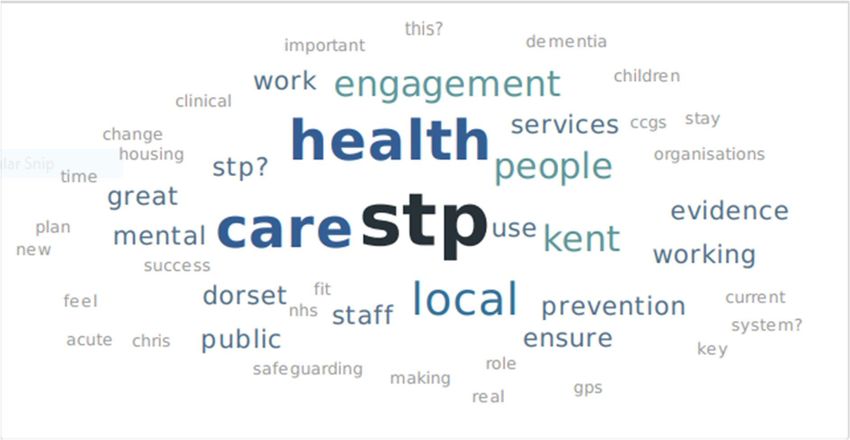
Slido conference word cloud

Workshop sessions allowed delegates to discuss priority areas and actions that they felt
were necessary to help achieve the STP’s aims and objectives and the outputs from these
sessions have provided a rich source of content for the work of the STP programme. The
outputs from these sessions can be found in Appendix II.

At the end of the conference, STP Chief Executive, Glenn Douglas, thanked delegates for
their input and enthusiasm. He acknowledged their contribution not just to the debate at
the conference, but to delivering improved health and social care across Kent and Medway
as part of the STP in the round. He promised that all information from workshop sessions
would be collated and reviewed so that they can be included in further work and used as a
measure to assess progress. He made a personal commitment to continue to drive the
review of stroke services in Kent and Medway forward at a fast pace, to continue to support
work to find solutions for the acute service challenges in east Kent, and emphasised the
importance of getting the local care model right and implementing it at scale.

Glenn pledged to ensure the Kent and Medway plans give more attention to mental health
and prevention, and to focus on the productivity work as a way to help deliver
transformation by releasing and aligning resources to where they are needed most. In
addition, it was clear that there was a strong need to take the opportunity of our
partnership working to coordinate better around winter performance this year, and to
design together a system infrastructure that really works to deliver the highest quality,
sustainable services for local people into the long-term.
Acknowledging that the STP was relatively new and that trust between individuals and
organisations had to be built, Glenn said he felt that progress had been made in this area
and he believed that partner organisations and stakeholders would continue to build on and
strengthen this approach, working across organisational boundaries for the benefit of
people in Kent and Medway, over the next twelve months and beyond.

Page | 3
About this report
This is not a verbatim account of the day but an overview document, capturing the key
themes, insights and actions from the event. The content of this report will be used as
content for workstreams and in pre-consultation and consultation documents, evidence and
materials.

Page | 4
Foreword
From: Dame Ruth Carnall, Glenn Douglas
Interim Chair and Chief Executive, Kent and Medway Sustainability and Transformation
Partnership
When we started developing the One Year On conference earlier in 2017, it was with the
aim of taking stock of what our partnership has achieved over the past 12 months and to
take time out to agree what our next steps should be. This aim, was reflected in a speech to
the conference from Chris Hopson of NHS Providers who said that some systems struggled
to look beyond the immediate concerns of day-to-day performance challenges to have the
time or headspace to “plot a glorious new future together”. For all of us involved in the STP
in Kent and Medway, the One Year On conference gave us the time and headspace to look
back, and, more importantly, to look ahead.
Throughout the day, we were
struck by the commitment people
showed to the ‘joined-up’
approach to working facilitated by
the STP. It is clear that leaders at
every level across Kent and
Medway recognise the STP isn’t
an add-on and a way of avoiding
the present. There is an
acknowledgement that by
plotting the future together we
can create a health and care system that can not only withstand the current and anticipated
future pressures upon it, but that will also deliver higher quality services and improved
outcomes within the funding and resources we have available to us.
We both heard a powerful message from delegates about the need to consider and address
wider social factors when designing and planning care and a genuine desire to create a
system that delivers care that is appropriate to the way that people live in the 21st century
and not based around the disease-specific approach of the past. There was also a general
commitment to break the silo mentality that affects many care settings and, in particular, to
stop thinking of health and social care services as separate entities but as part of the same
fabric of support.
We also wanted the conference to be a chance to look at what is already happening on the
ground in Kent and Medway. Over the last year, the partnership has highlighted many local
initiatives where innovative approaches are improving services and experiences for patients.
This is change that’s happening now; led by doctors, nurses, social care professionals, carers
and volunteers. It is that energy, effort and enthusiasm that we need to harness and
replicate on a more comprehensive basis.

Page | 5
There are compelling reasons why we need to rethink our approach to the way we plan,
design and deliver health and social care services. These were articulated in the NHS Five
Year Forward View in 2014 and translated into a local context through our draft plans and
the case for change that we published in March of this year. Much of what we discussed at
the One Year On conference will take us to the next level in creating that new approach.
Between us, we generated some great ideas about how to do this. Following the
conference, I hope that we can build on this momentum and continue the debate about
how we take forward the actions described in this report. In his summing up, Glenn Douglas
identified key areas that the conference had highlighted for him and we, on behalf of the
STP leadership, commit to acting on these.
For those who attended, we give our grateful thanks for their enthusiasm, knowledge and
insight and we look forward to working together, not only to “plot our glorious new future
together” but make that future a reality for the 1.8 million people we serve in Kent and
Medway.

Glenn Douglas, Chief Executive, Kent and Medway STP
Dame Ruth Carnall, Interim Chair, Kent and Medway STP

Page | 6
Aims of the conference
           o   Share the sustainability and transformation partnership’s ambition for the
               future of Kent and Medway health and social care services
           o   Review successes and share and agree priorities for the next twelve months
           o   Demonstrate commitment to integration, clinical leadership and patient and
               public involvement
           o   Facilitate greater cross-organisational/ workstream/ sector join-up to support
               the delivery of the STP
           o   Share learning and knowledge from a national level and from other STPs
               across the country
           o   Elicit outputs including clear actions to support the next phase of the STP
               programme.

Page | 7
A summary of thoughts from conference speakers
Conference speakers were drawn from a variety of professional perspectives and
backgrounds. They shared their different perspectives on STP development and system
transformation. The speaker biographies can be found in Appendix III.

Morning plenary
Our ambition, priorities and direction of travel
Chair’s opening remarks
Dame Ruth Carnall opened the event by reflecting on the challenging start that STPs had
had following their launch in 2015, Citing ‘conspiracy theories’ that had initially sprung up
about them across the country, Dame Ruth reflected that such high levels of critical
commentary had made it difficult for leaders to focus on the plans when the noise about
them was initially so negative. She said that the conference was an opportunity to get
behind the rhetoric and see what has been achieved and what can be achieved over the
next period.
                                                          As Chair of the Kent and Medway
                                                          partnership, Dame Ruth said she
                                                          knew that a great deal of hard work
                                                          and the development of important
                                                          priorities had been achieved over
                                                          the past year. She made the point
                                                          that the conference was not simply
                                                          about looking back on what had
                                                          been achieved, but was also a
                                                          staging post as to what the STP
                                                          should look to do next and the
                                                          knowledge, insight and input of all
delegates was crucial to this effort.
Dame Ruth then welcomed STP Chief Executive, Glenn Douglas, to the stage and
congratulated him on his appointment as chief executive. She said that Glenn’s decision to
accept the role has been a brave one as he would no longer be in a position to make change
happen directly at an organisational level, but instead would need to make change through
working with others across a myriad of complex organisational structures – but that there
was a clear line of sight for this and real synergies that could be created by working
together.

Page | 8
Glenn Douglas, Chief Executive, Kent and Medway Sustainability and Transformation
Partnership
Glenn reflected on the ambitions of health and social care partners across Kent and Medway
and the work to date and thanked all those involved for their hard work and commitment.
He said that he was looking forward to feedback, insights and ideas from delegates to help
progress to the next stage of the partnership’s evolution. Glenn stressed that
communication is the key to success and health and social care systems and organisations
really do need to work together; not simply talk about it.
Glenn reflected on specific issues affecting the health and care economy in Kent and
Medway, citing population growth, specific population demographics and existing and
emerging public health challenges. To deal with the latter, he said that the health and social
care system need to ‘be smarter’ at prevention techniques and strategies to stop people
becoming ill in the first place. He said that there are significant levels of variation in care and
outcomes across Kent and Medway especially in areas of high deprivation – often affecting
the poorest and most vulnerable – and this needs to stop. Glenn said that “we must go from
providing a good service to middle class people to providing the best care possible for all
people”.
Glenn emphasised the need for a more
imaginative approach to tackling health
and social care issues and a clear and
concise clinical strategy. He gave the
example of stroke services and how
neighbouring regions have much better
results for stroke care than currently
seen in Kent and Medway. He also
stressed the importance of the local care
model that has been developed as part
of the STP work programme, and how application of this is currently sporadic across the
county and needs to be rolled out consistently and comprehensively.
Glenn focussed on work taken forward as part of the Productivity workstream and said that
this work demonstrated that there are opportunities to do things better as a system that do
not require a radical reorganisations, but do require a re-think in our approach that can lead
to greater efficiency and financial savings. Specific examples include using the system’s
collective purchasing power to get a better deal from suppliers, and when hiring agency
staff.
Reflecting that there are 1.8 million people in Kent and Medway that we are here to serve,
Glenn reiterated that we have a shared responsibility to do our best for them and he
believed that the sustainability and transformation partnership – a coalition of 17 health
and local authority organisations - was our best chance to make real changes for the better.

Page | 9
Clinical leadership for change: lessons learnt from the Dorset STP
Dr Karen Kirkham, Clinical Lead, Dorset CCG/Accountable Care System
Dr Kirkham opened her presentation by saying that the health and care systems in Dorset
and Kent and Medway shared similar challenges and problems. She outlined the history of
the Dorset STP and told the conference that Dorset’s journey to become an accountable
care system (ACS) involved a three-year programme of work initially focused on a county-
wide Clinical Services Review. This was clinically-led, based on evidence and included a new
focus on co-design, open and honest dialogue, some difficult conversations and the
cultivation of strong relationships between partners and stakeholders. Dr Kirkham told
delegates that this is not a fast process and there are no short cuts.
Dr Kirkham said that she believed that whole system review and transformation is essential
if real change is to be achieved but this had to happen with strong, consistent and
meaningful engagement of clinicians, staff, patients and the public and other stakeholder
groups who share an agreed vision for the future. As she outlined the four major
influencers: ‘peers, public, press and politicians’, Dr Kirkham said that high-quality,
consistent, and relentless communication and engagement is vital for success.

                                                    Dr Kirkham reflected on the
                                                    importance of a truly collaborative
                                                    arrangement between partner
                                                    organisations and the huge importance
                                                    of clinical leadership in healthcare
                                                    transformation programmes. She
                                                    described challenges around
                                                    organisational alliances and resistance
                                                    to change and told the conference that
                                                    building trust between new partners,
                                                    identifying key stakeholders to act as
agents for change within their organisations and supporting these new leaders is critical for
success on this difficult but worthwhile journey.
System transformation – a local perspective
Paul Bentley, Chief Executive, Kent Community Health NHS Foundation Trust and Senior
Responsible Officer for development of the Accountable Care Partnership for East Kent
Paul began his presentation by setting out how system transformation is being taken
forward as part of the Kent and Medway STP programme and outlining how NHS England is
encouraging health and care economies to become Accountable Care Systems (ACSs) as the
next step in supporting the delivery and implementation of health and social care
transformation plans. He described how work is underway in Kent and Medway to look at
how health and care commissioners and providers can operate in a more integrated way.
This includes proposals for a small number of Accountable Care Partnerships (ACPs) to plan,
buy and deliver services, as well as defining, developing and implementing a vision for

Page | 10
accountable care; alongside the development of single strategic commissioner for Kent and Medway. It is envisaged that there may be two to three accountable care partnerships within the overarching Kent and Medway accountable care system, although Paul stressed that no decisions had been made about this yet. He said that local system transformation needed to be looked at within the context of existing governance structures and systems. Paul said there needed to be a step-change in how individuals accessing health and care services were perceived and treated; he said that “we need think about a ‘person’ not a ‘patient’”. He went on to explain how the STP’s local care model is based on the concept that care wraps around a person, rather than a patient receiving treatment within just a medical model, from disparate teams and organisations. With that in mind, Paul said that there needed to be clarity about the role of a strategic commissioner in any future accountable care system to ensure that the voices of local people – whether patients, carers or those not yet seeking health and care support – were adequately heard within a new integrated commissioner and provider framework. System transformation – a national perspective Hardeep Jhutty, Senior Strategy Advisor, System Transformation Group, NHS England Hardeep opened her presentation by setting out how accountable care systems will be an ‘evolved’ version of sustainability and transformation partnerships, working as a locally integrated health and care system. Hardeep outlined how commissioners and providers across the NHS and local government are already working more closely together to improve the health and wellbeing of their local population and make best use of available funding. While health and care organisations are collectively trying to deliver the best care for local populations, it was worth pausing to reflect on what that meant in practice. Prevention and public health campaigns and strategies, more integrated working, intervening earlier on the disease journey and thinking about what services people wanted to be provided rather than what organisations and individuals were willing to provide, was a good starting point. Hardeep referred to the ‘Vanguard’ programme where ‘new care models’ had already been implemented, allowing a population health approach to be taken to the provision and delivery of local health and care services. Extending this to wider system-level collaborations will enable transformation to be bigger, more effective and faster-paced. Page | 11
Acknowledging that there is variation
across the country as to where individual
sustainability and transformation
partnerships are in the transformation
process, Hardeep told the conference that
feedback from the frontline had told NHS
England that system working has moved
on ‘light years’ since the advent of STPs.
STPs themselves were ‘a means to an end’
and not an alternative to organisational
responsibility. She told the conference that “the ‘P’ in partnership is more important than
the ‘P’ in plan”.
Describing the benefits of becoming an accountable care system to delegates, Hardeep said
that they will have more control and freedom over performance, budgets and health
management approaches. She said that it is a natural next step for STPs, that by working as
a system it would be possible to transform care at a faster pace and would give local
systems the ability to go further with local changes more quickly.
There is a national understanding that ‘one size will not fit all’ where it comes to the shape
and format of an accountable care system, and regional variations will be understood and
supported. Hardeep said that they must not become complex and complicated ways of
obsessing over governance arrangements and that existing early accountable care systems
had arranged Memoranda of Understanding between partner organisations as a means of
addressing these issues.
Hardeep noted that any legislative change in light of the introduction of accountable care
systems was unlikely given that there is a full programme of parliamentary activity on other
areas at present.
She reflected that just as local systems would need to change, both NHS England and NHS
Improvement recognised that they would need to adapt to provide the necessary support to
local systems.
Hardeep told the conference about the national accountable care system
development programme and the support packages available to help systems make
these changes. While the first wave of accountable care systems is now up and
running, plans for the second wave, at the beginning of 2018, are underway with
NHS England looking to identify candidate systems to go forward. Regional teams are
leading this work and potential systems need to meet five criteria to quality for the
next wave. Hardeep outlined the five key criteria for the next wave: Coherent and
defined population of about 500k
A strong track record of delivering care
Ongoing redesign of how care is delivered
Page | 12 Strong financial management
Effective leadership and strong working relationships at the bedrock of the system.
STPs – why, what and where to? Reflections from a national perspective
Chris Hopson, Chief Executive, NHS Providers
Chris gave delegates an overview of NHS Providers’ perspective on the STP process,
challenges faced by others across the country and keys to unlocking success.
Chris warned against overloading STPs with unrealistic expectations that they are
responsible for “all and everything”. He told the conference that “If you’ve seen one STP,
you’ve just seen one STP”, explaining that there is significant variation between STPs in
terms of focus, structure and pace.
Those who were making most progress usually had a head start in the form of strong
working relationships across organisational boundaries or were already involved in a review
of services. Others who were struggling were often dealing with a geographically challenging
and ‘unwieldy’ footprint and were dealing with pressing performance and operational issues
that made it difficult to “plot a glorious new future together”.
Chris went on to describe factors that can unlock success including: the need for a pragmatic
approach, strong working relationships, prioritising patient need at the expense of individual
organisations, focussing on a small number of priorities and driving rapid, on the ground
practical improvements.
Working with people to drive change and improvement
Neil Tester, Deputy Director, Healthwatch England
Neil opened his presentation by
giving the conference an overview
of the role and remit of
Healthwatch at a national and local
level. He described the importance
of a strong and consistent
engagement approach at the heart
of service change and
transformation programmes within
the health and care environment.
He told delegates that it was vital to
think about voluntary and community sector organisations when considering engagement
and this is an approach that must be embedded into organisations and systems.
Neil said that he was aware that STPs had had an uneasy birth, with the accusations of
secrecy that Dame Ruth had outlined in her opening remarks. He said that those involved in
the development of STPs had also been concerned about a ‘mob mentality’ in opposition to
any proposed changes and this made constructive engagement and dialogue extremely
Page | 13difficult to achieve. Neil said that we now need to get beyond these concerns and continue making progress in improving services for local people. Across the country local Healthwatch groups have been working hard to help local systems deliver real engagement with people, Neil said. At a national level, Healthwatch England has been pleased with NHS England’s response to concerns they raised about how engagement principles needed to be embedded within the STP process. Neil stressed that engagement needed to be all-encompassing and comprehensive and that local systems need “to work with everyone, not just those who shout the loudest”. Afternoon Plenary Meeting the needs of local people: our clinical vision and local care model Meeting the needs of local people: our clinical priorities in Kent and Medway Dr Diana Hamilton-Fairley, Medical Director, Medway NHS Foundation Trust and Co-Chair of the Kent and Medway STP Clinical and Professional Board Dr Hamilton-Fairley gave the conference an overview of the work of the Kent and Medway Clinical and Professional Board to date. She said that there are clear national standards for quality and safety that need to be met and the system must transform the way it works to meet them. She told delegates that we cannot accept that stroke and vascular services are performing as poorly as they currently are, and we must move to transform the way that they are designed and delivered as soon as possible. Dr Hamilton-Fairley said that the Clinical and Professional Board will be building on work over the last year and developing a coherent pan-regional clinical strategy which will take a view on prevention, mental health, cancer, children and young people - all areas where the Kent and Medway area isn’t doing as well as it should be. Input from the conference workshops will inform this work. Our priorities for mental health across Kent and Medway Helen Greatorex, Chief Executive, Kent and Medway NHS and Social Care Partnership Trust and Mental Health Workstream Senior Responsible Officer Helen opened her presentation to the conference by saying that she felt blessed that, unlike in some other areas, the Kent and Medway sustainability and transformation partnership has embraced the importance of mental health in its work. Helen said that the STP is a once in a generation opportunity to make real change to health and care services. She told delegates that mental ill-health is an issue that affects one in four of us and people with serious mental ill health problems die 10 to 20 years earlier than the rest of the population. Helen said that this is “a scandal that has been tolerated for too long”. Page | 14
In terms of current focus and progress, Helen referenced the innovative work Kent and
Medway clinicians have led in developing ‘peer supported open dialogue’, as a treatment
approach – the first such programme to be offered in the country. Clinical leadership was
the key to unlocking this success. Helen said that a perinatal mother and baby unit would
soon be established in Kent and Medway which will make a major difference to women with
mental health issues during pregnancy or following the birth of a child. Helen also told the
conference that progress has been made to reduce out-of-area placements. Once costing
more than £1 million a month and leading to distress and upset for patients and families,
these have now been reduced to zero, with all inpatients being treated in Trust beds locally.
Implementing our local care model for ‘Dorothy’
Caroline Selkirk, Accountable Officer, NHS Medway CCG and Local Care Workstream
Senior Responsible Officer
                                                      Caroline introduced this session
                                                      saying how heartened she was by the
                                                      importance given to local care by
                                                      conference delegates during the
                                                      event’s discussions and workshops.
                                                      Introducing the local care model that
                                                      has been developed as part of the
                                                      Kent and Medway STP work
                                                      programme, Caroline outlined its key
                                                      components and guiding principles.
                                                      She also described the concept of
‘Dorothy’ – a character with a number of different and complex needs from a variety of
health and care providers created to demonstrate how the system in the future will set out
to treat the whole person.

Ian Sutherland, Director of Children and Adult Services, Medway Council
As part of the local care session, Ian told delegates how Medway Council has been working
with Medway CCG to implement a new model of care. With the aim of supporting people to
live full, active lives, to live independently for as long as possible and to play a full part in
their local communities, Ian said that good working relationships with local health
organisations has been one of the most helpful and important factors to align vision and
ambition.

Anu Singh, Corporate Director of Adult Social Care and Health, Kent County Council
Anu outlined Kent County Council’s vision for adult social care, based on a concept known as
‘House of Care’ with a guiding principle of helping people to improve or maintain their
wellbeing and live as independently as possible.

Page | 15
Telling delegates that we need to develop a care system that considers “What matters to people – not just what the matter is with people”, Anu outlined several initiatives currently underway to promote greater independence around enablement, telecare and person- centred reviews. Dr John Ribchester, Chair and Clinical Lead, Encompass, Whitstable As Chair and Clinical Lead of the Encompass Vanguard, Dr Ribchester told the conference how the ‘multi-speciality community provider’ partnership had made great strides in ensuring that health and social care worked together. The model used at Encompass provides patient care designed to meet local people’s needs and ensures patients receive more services close to their homes, rather than having to travel to hospital. Dr Ribchester explained how the model of care worked in practice, the workforce requirements behind it and how integrated case management works for patients and staff at the Vanguard. Closing plenary Right people, right place, transforming our workforce Clare Simpson, National Workforce Lead, National Association of Primary Care and Strategic Workforce Advisor, New Care Models, NHS England Dr Steven Laitner, GP and advisor to the Kent and Medway STP Clinical and Professional Board Maria Howdon, Head of Membership Development at NHS Thanet CCG In a joint presentation to the conference, the speakers covered a population approach to workforce redesign and new care models as well looking at how these concepts are working in practice at the Thanet ‘Primary Care Home’. Clare said that with the challenges and constraints around the scarce availability staff to recruit, the existing focus on roles and supply needed to be replaced. She recommended an approach that sought to do far more with the resources available and that looks beyond the traditional boundaries of job roles to functions, in order to achieve this. Dr Laitner told the conference that it was important to look outside of health care to other sectors when designing services to establish or anticipate what end-users and patients want. Multidisciplinary teams could achieve much but financial drivers also needed to be aligned to enable real progress. Revisiting the format of roles, functions and teams is essential in delivering more integrated care, with a ‘squad’ mentality allowing individuals to play to their strengths. Maria explained how the Thanet Primary Care Home had been created to support a specific cohort of patients within Thanet who were mildly, moderately or severely frail. Care is arranged and provided to them according to need from a multi-disciplinary team. This is a Page | 16
grass-roots initiative that has grown organically over time with a workforce strategy based
on competencies rather than job roles.

Summing up and next steps, Glenn Douglas, Chief Executive, Kent and Medway
Sustainability and Transformation Partnership
Glenn thanked delegates for the energy and ideas they had bought to the event and
promised that the outputs from workshop sessions will be collated, reviewed and included
in further work and used as a measure to assess progress.
He summarised the key themes and actions from the day:
    1. The importance of getting local
       care right – it is the foundation
       that everything else needs to
       be built on and Dorset’s
       example amply demonstrates
       why that is the key to success.
       There also needs to be clear
       priorities in local care,
       targeting areas where the
       greatest outcomes and
       financial impact can be seen
       first
    2. The Kent and Medway sustainability and transformation partnership is relatively
       new. Trust has to be built and many speakers had outlined how important it was to
       establish good, solid working relationships across organisational boundaries. The STP
       is making good progress in this direction and will continue to do so over the next
       twelve months
    3. The natural shift to accountable care systems and partnerships, with work already
       underway to establish a structure for these in Kent and Medway
    4. ‘P’ is for ‘partnership’, not just for ‘plan’. That includes everyone involved in health
       and social care, with the voluntary and community sector and carers also a key
       component of that effort
    5. STPs are being asked to do ‘all and everything’. Prioritisation is key and partner
       organisations need to complement one another and agree where responsibility lies
    6. With one in four people affected by mental health issues, more needs to be done to
       address this and while he was pleased that Helen Greatorex was kind enough to say
       that she found it relatively easy to be part of the conversation and get mental health
       on the agenda, Glenn felt that we could do more to give this area more prominence
       in the STP’s work
    7. More attention needs to be given to the prevention agenda to support people in
       making healthier choices and looking after their own health and wellbeing more
       effectively

Page | 17
8. Continuing to focus on the productivity work is vital to help deliver transformation
by releasing and aligning resources to where they are needed most
9. In addition, it is clear that there is a strong need to take the opportunity of our
partnership working to coordinate better around winter performance this year, and
to design together a system infrastructure that really works to deliver the highest
quality, sustainable services for local people into the long-term
10. Glenn said that the poor outcomes in stroke were one of the current failings of the
local NHS and this needs to be changed. He made a personal commitment to drive
the review of stroke services in Kent and Medway forward at a faster pace
11. Recognising the role of district and borough councils in helping address wider
determinants of health such as housing and education, Glenn made a commitment
to work more closely with district and borough councils as well as top tier local
authorities
Glenn Douglas concluded by reminding delegates that “We really are all in this together”
and that the important next step from today was to take the ideas, energy and ambition in
the room about working together as a system and to translate this into action on the ground
– each and every one of us. As Aristotle said, ‘the whole is greater than the sum of its parts.’
Ends
Page | 18Appendices Transforming health and social care in Kent and Medway is a partnership of all the NHS organisations in Kent and Medway, Kent County Council and Medway Council. We are working together to develop and deliver the Sustainability and Transformation Partnership for our area
Appendix I

10 most ‘up voted’ conference questions
How do we ensure all the work put into the STP is not wasted because of
restructuring in a few years’ time because of the usual national directives/ changes?
The work going on across Kent and Medway is key. There is no question that we need to plan and
implement changes to improve the health and wellbeing of our population; to improve the quality
and clinical sustainability of services; and to use our limited resources in the most effectively way.
Elements of this work have been underway for some time (for example, to improve the quality and
clinical sustainability of services such as stroke across Kent and Medway, and acute services in
east Kent), or to drive forward ‘prevention’ work. Other areas we may have been working on at
organisation level for some time but are now working on at a health and social care ‘system’ level
across Kent and Medway, such as our approach to local care, and to productivity. We have made
significant progress over the past year through taking a ‘system’ approach, which has been
facilitated by the STP, but ultimately the relationships, networks and system approach are delivered
through individuals working together across organisational boundaries. We are confident this
should and will continue whatever future structures are in place.

                                                                                                                   Page | 1
Why if the system is about collaboration are the CCGs still keen and actively
tendering services?
A challenge for any significant change programme is that we must continue to deliver services for
patients and the public in parallel to improving how we work. This means that inevitably CCGs will
need to continue to tender for services to ensure there are no gaps in provision until any new
working arrangements are in place. Wherever possible new contracts will be drawn up with an eye
on the likely future landscape in Kent and Medway.

Great content today, but themes and messages many of us have heard before. What
changes will actually have been delivered when we sit here in a years’ time?
By late 2018 we will have rolled out the local care model for frail and elderly people in Kent and
Medway. This will be implemented at local level to populations of around 50,000 people. The model
for each area will be tailored by local teams to meet the needs of their population. We will have also
completed the review of hyper acute stroke services and will – we anticipate - have started to
implement a new and improved approach to delivering hyper acute stroke care for patients in Kent
and Medway. The Clinical and Professional Board will have developed the next iteration of the
clinical strategy, which will focus on cancer, mental health and children’s services. We have already
started to make progress in terms of productivity gains in the way we procure some goods and
services, and we anticipate this area of work strengthening over the next period. The NHS in Kent
and Medway is using its collective purchasing power to get a better deal from suppliers, saving an
estimated £10million this year. In terms of our system transformation work – the purpose of which is
to have the right infrastructure in place to deliver our plans faster and better – this too should be
running in at least shadow form by this time next year.
Transforming health and social care in Kent and Medway is a partnership of all the NHS organisations in Kent and
Medway, Kent County Council and Medway Council. We are working together to develop and deliver the
Sustainability and Transformation Partnership for our area
How can staff and public stay motivated when leaders with great values (Matthew Kershaw) have to leave over what Glenn Douglas stated is only one part of the issue ie performance challenges? Matthew worked very hard to deliver the best possible services for patients, and was very supportive of his staff. It is as important as ever for all leaders, at every level across our health and social care organisations, to maintain and uphold their values and to continue to work for the good of the people who use our services, the taxpayers who fund them, and the staff who deliver them. However, the important thing here is not to focus on individuals but to recognise what all our health and social care teams need to do to play their part in helping our system work better and to keep focused on our goal to deliver responsive and high-quality services for local people. We have a dual challenge, to deliver in the here and now, whilst planning for and beginning to implement a better future. In addition, the STP leadership has a collective responsibility to demonstrate to staff, patients and the public how our plans will make things better for staff who deliver services and patients, service users and the public who rely on them. We are committed to doing that. If we are talking about integration and working together why are there three presentations for the local care model? Shouldn’t there just be one model? There is a single model for local care in Kent and Medway that has been developed. The work to date on the model for local care describes how people who have the highest health and social care needs will receive joined up care, delivered by multidisciplinary teams of health and social care professionals working in a coordinated and integrated way, to ensure that the holistic needs of the individual are met. The model has brought together existing work and early thinking from each of the eight CCGs in Kent and Medway, from Kent County Council and Medway Council, and it is right to acknowledge projects and pilots underway whilst drawing the ‘local care’ approach and model together at scale. We also know there is variation in need across our area and therefore the exact way in which the model is delivered may also differ across Kent and Medway, in order that it meets the specific needs of the population it serves. The presentations given at the conference showed the overarching local care model, and then more detail on how it is being implemented by health and social care colleagues in different areas. What progress so far of the STP would you most like to highlight? The greatest achievement of the STP is undoubtedly bringing together leaders, and their teams, from across social care, public health, the NHS, patient and public and third sector organisations to work across organisational boundaries and to broadly agree on a single vision for the future of health and care services in Kent and Medway. There is a shared understanding and endorsement of a new way of working that delivers joined up care to people, closer to where they live, designed to keep them as well as possible and to avoid lengthy and unnecessary stays in acute hospitals. Our next big challenge is to ensure we make this vision a reality, and do so as quickly as possible to ensure we address the three health and care gaps, as outlined in the national NHS Five Year Forward View, we know are impacting on the quality of services we can offer. Page | 2
Chris Hopson, the Chief Executive of NHS Providers, said some STPs are doing well,
some are struggling, others are in the middle. Which group does he think our STP is
in?
We asked Chris to answer this question, and he sent the following response:

It’s very difficult for me to judge from the outside. There are clearly some big challenges the STP in
Kent and Medway has to address but I was impressed with everything I saw and heard on the day
and the fact that you were holding the meeting in the first place. The recent success at Medway has
shown that rapid real improvement is possible, so I shall be watching your progress at STP level
with interest.

Why are we not moving forward and implementing the new model for stroke
services?
We are very much moving forward with the work to change the way we deliver hyper acute stroke
services in Kent and Medway, and this is a key priority for the STP. However, reconfiguring services
is a complex undertaking and it is essential that we get it right. Making major changes to the way
that services are organised and delivered – especially when they are dealing with serious conditions
such as stroke – requires detailed analysis of a wide variety of information including thoroughly
understanding and building on evidenced clinical best practice, patient numbers, demand for
services, staffing levels, travel times, and resourcing and capital requirements. Most importantly, we
have also spent significant time engaging with the clinicians who work in these services every day
and the patients, carers and families who rely on them, as well as political and public
representatives across Kent and Medway.
To make sure we have a robust and accurate evidence base on which to base our proposals, there
are several assurance and legal hurdles that we need to go through to ensure that the potential
options that we bring out for public consultation are the right ones. We are currently in that phase of
the work and over the next period will be discussing and critiquing our work in detail with the South
East Clinical Senate (a group of clinical experts from across the south east); a Joint Health
Overview and Scrutiny Committee (working across Kent and Medway), and with NHS England at a
local, regional and national level. A joint committee of the eight Kent and Medway CCGs and
neighbouring CCGs in Bexley in south east London, and High Weald, Lewes and Haven in East
Sussex, has been formed and will make the decision on the options for public consultation. We
expect the formal consultation to begin in the new year.

How are you going to ensure that mental health is seen as important and prioritised
alongside physical health?
As Dr Diana Hamilton-Fairley and Helen Greatorex discussed during their presentations, mental
health is, and has always been, a priority for the STP.
The new local care model will see greater provision of mental health services alongside physical
health care, particularly for those with the greatest health and social care needs. The local care
model recognises and addresses the impact of mental wellbeing on physical wellbeing, and vice
versa.
In addition, as we move towards more integrated primary, community and social care services,
mental health care will be easier to access for everyone, closer to where people live.

Page | 3
We also want to make sure that our prevention work includes a focus on mental health and
wellbeing. This was feedback to us at the conference and through the STP Patient and Public
Advisory Group.
In terms of our system transformation work, across Kent and Medway we are determined to
integrate our approach to physical and mental health and have discussed our preference for our
accountable care partnerships to include mental health, rather than to have a ‘stand-alone’ mental
health accountable care partnership.
Finally, services for people in crisis, and those with serious mental illness will continue to be
improved and developed across Kent and Medway. Helen Greatorex discussed some of the recent
developments and future plans in her presentation, including the new perinatal mother and baby
unit, the Open Dialogue programme and the reduction of use of out of area acute beds to zero.

Page | 4
Appendix II
One Year One conference: workshop notes
Achieving our productivity ambitions
Leader(s)
Steve Orpin, Director of Finance MTW, and Productivity Workstream
SRO & Sheila Stenson, Deputy Director of Finance, MTW and
Productivity Workstream Lead
Synopsis
Steve talked about financial targets.
Not about radical service redesign but how can we use services more productively.
Not delivery for 2021, delivery in next 20 to 21 days.
How can we track delivery?
Sheila spoke about mobilised working groups. Currently six, will be eight by December. Five
non-clinical, three clinical.
Sheila ran through the different working groups, who is leading on them and the potential
saving from those opportunities.
Productivity workstream part of the day-job. Need to think about how you are supporting
that. How to take the day-to-day forward.
Workshop broke into six groups to focus on workstreams:
Temp staffing x 7
Pathology x 5
Medicines x 11
T&O x 3
Supplies and services x 5
Corporate and back office x 11
Questions to consider are:
Which of the STP initiatives are most important to you or your organisation? What
ideas do you have?
How can we realise the opportunity at pace? What can the STP do to help your
organisation?
Transforming health and social care in Kent and Medway is a partnership of all the NHS organisations in
Kent and Medway, Kent County Council and Medway Council. We are working together to develop and
deliver the Sustainability and Transformation Partnership for our areaAction points or points to note: Facilitators from each workstream fed back to the group: Temp staffing Real support for initiative, concern for strength of message from CEOs in organisations. Break clause policy but will organisations adhere to it. One single document e.g. standard bank staff rate that goes to all organisations for sign off but needs embedded leadership from workstream. Workstream could be invaluable when linking with local care workstreams. Steve added working together across workstreams to avoid duplication. Engagement will be picked up via Programme Board (CEOs and Accountable Officers). Everyone to challenge organisations - how can we help, what can we do differently. Pathology Long and short-term discussed. Pathology needs better LIMBS (information management system) – could deliver a lot of benefits. What cash or services would that release? Consolidate work, review staffing models, bringing testing back into Kent or send-away tests. What does that do for quality of service offered, for example for GPs. Diagnostics etc. New tests, e.g. FIT. Could help to reduce demands on other services. Needs service buy-in, is it viable. Spin off to local services and national services. Kent and Medway laboratory services? Medicines Focus on JUG spend. Pharmacy, medicines and changing and development. Savings won’t necessarily be on drugs but possibly visits. Medicines link to other groups e.g. Elderly. Involve prescribers in what we are doing and patients. Patients may not be taking medicines which is waste. Barriers are how to we capture where we are making savings and barrier when sharing data across organisations. This needs to be feedback to Programme Board. T&O 35 areas for GIRFT (Getting it Right First Time programme) to get into by end of financial areas. Driven by commissioning habits in the past. The GIRFT programme helps to engage and challenge those behaviours. Where are the AHP services in Kent and Medway? Provided by who? Supplies and services Engagement, all parties involved across lots of groups that aren’t necessarily speaking to each other.
Mandating. Could STP mandate what we buy in area? For example: laptops. Need clinical
advice.

Timing. Sometimes STP slows things down – take advantage of current contacts to save
time and work where they are appropriate?

Corporate and back office
Informatics, joint data sets and warehousing.
Performance management
Capacity planning

Linking in with CCGs
Best use of estate and state of estate. Catering and maintenance.

Why do we not share services so well internally. Do we need support from eternal
organisations to help us to it well?

HR – shared services and polices, competencies.

Barriers – making sure we get all the ideas we can. Invite all members of workforce, how are
they involved? Do they understand what’s going on?

Support with resource to explore ideas. Commit to freeing up time/resource otherwise we
lose opportunities.
One Year One conference: workshop notes
   Delivering digital: embracing innovation and
             modernising the system
Leader(s)
Andrew Brownless, Digital Workstream Lead & Jen Bayly,
Cardiovascular Lead, Kent, Surrey and Sussex AHSN

Synopsis

Opening - explanation of the importance of increased digital tech in healthcare and benefits
of moving to paper light systems. The aim is for a ‘digital roadmap’ in Kent and Medway for
health and social care professions.

The key principles of information governance and how it applies to digital records, emphasis
was that those who cannot gain access to digital records will not be forgotten in its
implementation.

Academic Health Sciences Network (AHSN) are distributing Atrial fibrillation devices and
measuring their impact, the uptake of these devices has been ‘at risk’ patients identified in
the community, AHSN is measuring use to provide a snapshot of heat rhythms.

Question - where do recorded rhythms go? What is the next step in the pathway?

Comment – There are a limited number of devices across Kent, rhythms can be recoded via
the app.

Question – How is the app used? Could a carer summarise the readings?

Question – Why is this being invested in if it takes 30 seconds to take a patient’s pulse?

Comment – This means the pulse can be checked by any professional, such as HCA’s,
without risk of error

A service must [Emphasis] outline the framework of what the service aims to provide, and
then introduce digital technology to make it more efficient.

Around one third of patients with Atrial Fibrillation are undiagnosed. Of those, one third do
not have the optimum treatment, and the remainder are on anti-coagulants.

Comment – there are an estimated 12,800 undiagnosed patients in Kent, Surrey and
Sussex.

Cardiac services now adopt a ‘detect, review, protect’ approach, known AF patients in the

South East has seen an increase in the use of anti-coagulants, which has the potential to
save £8 million in treatment costs. Going forward, services can make use of digital
technology to ensure they are cost effective.

Transforming health and social care in Kent and Medway is a partnership of all the NHS organisations in
Kent and Medway, Kent County Council and Medway Council. We are working together to develop and
deliver the Sustainability and Transformation Partnership for our area
Comment – is this linked into developmental programmes for stroke and emergency care? They are all expected to be covered in the digital roadmap. Comment – is the proposal to create a single care record? This will be a shared care record that multiple services can feed into, allowing various disciplines of clinical staff to a record of care for each patient. Comment – regarding the NHS Health Checks Programme, could the proposal for shared care be linked in with that? We are currently working with Healthwatch UK and the Arrhythmia Association to embed devices and support them with the technology in recording AF readings. This will also be broadened to the local authorities. Comment [GP Rep] - how optimistic are you of success of the single care record? West Kent have implemented shared care on basic records, with positive feedback. This is achievable with the technology and support we currently have. West Kent have demonstrated the value and benefits of shared care. The requirement is there for a shared care record. Despite the flaws, more attention has been given to system transformation, as a response to deteriorating service quality. The benefits of digital apps and games in healthcare education are plain to see. The digital roadmap will allow us to create a dashboard of data sources and enable us to look at issues in digital AF recordings. Action points / points to note: The increasing role, benefits and limitations of digital technology in healthcare Will one singled shared care record be reliable and secure? Access to shared care records Potential for misuse of digital devices IT link – across organisations
One Year One conference: workshop notes
     Effective engagement and involvement on
         change with patients and our local
          communities: making it happen
Leader(s)
Neil Tester, Deputy Director, Healthwatch England, Ana Paula Nacif, Lay
Member, Patient and Public Engagement, NHS Canterbury and Coastal
CCG and Kent and Medway STP PPAG member & Carol Munt, Patient
Leader and Kent and Medway STP PPAG member

Synopsis

INTRO from Carol: Why engagement and involvement are so crucial to the STP
Are you doing it? If not, why not?
It is nationally mandated so if it’s not happening then we need to know why not

People still think they are ‘Secret transformation plans’

This is NOT about meetings in church halls but about getting off your butt and getting out
there and talking to the people that really matter, the ones who are going to be affected by
the changes.

Ana: What different levels of engagement with the public are there? Varying degrees,
codesign and coproduction is the only true engagement. Anything below that is just ‘doing
to’.
e.g. Hackney set up a neighbourhood scheme for getting children to exercise and play in the
streets. Asked the question about what the neighbourhood wanted and it was delivered
together. The community implement it themselves with support from statutory orgs. More
ownership from public.
Community police after London riots started working with public, brought in young people to
work with them, the YP became ‘the system’.
I feel like I am a ‘nagging voice’! Not just surveys and tick box exercises, they need to be
involved in the process. Stronger and resilient communities are more likely to be engaged.

Carol: We need to start viewing patients as an asset and a resource to help with service
design. Service users can often bring real innovation.
I don’t think many staff know how to engage with patients as colleagues.
‘Patient Leaders’ – informed patients and colleagues who engage with them as partners.
Embedding co-production.
Do we use social media properly? Do we reach out? Do we ask people to come in or do we
reach out to them?
There are so many ways to get involved with people, we can’t always do it the same way.
We will just get the same results.

Transforming health and social care in Kent and Medway is a partnership of all the NHS organisations in
Kent and Medway, Kent County Council and Medway Council. We are working together to develop and
deliver the Sustainability and Transformation Partnership for our area
You can also read


