Li Po Chun United World College School Report Academic Year 2020-2021
←
→
Page content transcription
If your browser does not render page correctly, please read the page content below
Li Po Chun United World College

         School Report

   Academic Year 2020-2021

               1
1. Our College
1.1 UWC Movement
UWC was founded in 1962 with the vision of bringing together young people whose experience
was of the political conflict of the cold war era, offering an educational experience based on shared
learning, collaboration and understanding so that the students would act as champions of peace. We
remain committed to this goal today but have expanded our reach to embrace the tensions and
conflicts that exist within as well as between societies.

UWC has 18 schools and colleges educating students aged between 2 and 19. The education at
UWC schools and colleges is underpinned by shared guiding principles. UWC schools, college and
programmes all have distinctive characters but share the same commitment to UWC’s mission and
values.

UWC depends on the dedication and expertise of an active volunteer based network called national
committees. National committees operate in more than 150 countries to recruit, select and prepare
more than 1000 students every year to join our colleges, schools and short programmes.

We welcome students from a deliberately diverse range of backgrounds and experiences. At UWC,
diversity extends to differences in socio economic background, culture, race and religion as well as
nationality. UWC students are united in their commitment to positive social action to build a more
equitable and fairer world.

1.2 UWC Mission and Values

UWC makes education a force to unite people, nations and cultures for peace and a
sustainable future

UWC schools, colleges and programmes deliver a challenging and transformational educational
experience to a diverse cross section of students, inspiring them to create a more peaceful and
sustainable future.

UWC believes that to achieve peace and a sustainable future, the values it promotes are crucial:

   •   International and intercultural understanding
   •   Celebration of difference
   •   Personal responsibility and integrity
   •   Mutual responsibility and respect
   •   Compassion and service
   •   Respect for the environment
   •   A sense of idealism
   •   Personal challenge
   •   Action and personal example

                                                  2
1.3 History of Our College
The birth of Li Po Chun United World College of Hong Kong, (LPCUWC) can be traced back to
1978 when Dr Lee Quo-Wei GBM JP (Sir Q W Lee) was Chairman of the Selection Committee
that was choosing Hong Kong students to study in UWCs overseas. He was deeply impressed by
the calibre of UWC graduates and their contributions to society. Even after he left the Committee
in 1982, his devotion to the UWC movement remained strong, and he dreamt of establishing a
UWC in China1. The concept of opening a United World College in Hong Kong was initiated
around 1987 by Sir Q W Lee (by that time Executive Chairman of the Hang Seng Bank) and Mr Li
Shiu Tsang MBE JP. The Li Po Chun Charitable Trust was named after Mr Li Po Chun (died in
1963), a prominent Hong Kong businessman and philanthropist. The trust remains a major
provider of educational grants in Hong Kong. The idea to open a UWC in Hong Kong received
enthusiastic support from Sir David Wilson2, then Governor of Hong Kong, and Mr David
Sutcliffe, then Principal of Atlantic College in Wales. A trust fund was established in Lord Wilson’s
name that still provides scholarships exclusively to enable students to come to the College.
Members of the founding Board visited other United World Colleges as did the architects chosen to
build the College, and the founding Principal of Pearson College, Jack Matthews, visited Hong
Kong to help develop and advise on the basic ethos and organisation of the College programme.
After several sites were considered and following long negotiations, the present large site – an area
from which rocks had been quarried to build the wall of Plover Cover Reservoir3, as seen by the
steep slope down to the Sports Centre – was gifted to the College by the Government of Hong
Kong on a fifty year lease, with the agreement of the Sino-British Land Commission. At the time
the site was selected, the location was quite remote, facing Tolo Channel in one direction and Ma
On Shan Country Park in the other, with no substantial urban development or transport
infrastructure nearby.
Once funding was secured, building commenced in 1991, the foundation stone being laid by Lord
Wilson on 12 February 1992. The College opened to its first students in September 1992, and was
formally opened by Prince Charles on 6 November 1992, less than 18 months after the UWC
International Board approved the project.
The first staff appointment was Dr David Wilkinson, the founding Principal, initially working out
of a hotel suite in Sha Tin, as staff were recruited and the College was equipped in the early part of
1992. Many pioneer staff still serve the College4. Dr David Wilkinson left in 1994 to found a
school in Bangkok, and has since been appointed founding Principal of the Mahindra United World
College of India.
Mr Blair Forster became Principal in August 1994. He served with distinction as Principal for nine
years before passing away after a long illness in September 2003. During his time as Principal, the
College developed and matured, in accordance with the UWC philosophy. Academic results
improved steadily to the point where the College’s IB results were among the best of the UWCs.
The Quan Cai programme expanded to embrace a huge range of activities in the areas of creativity,
action, service and campus support. An ongoing legacy is the ‘Blair Forster Memorial Trust’,
dedicated to providing scholarships to aid young people from East Timor.
1
At that time, Hong Kong was a British colony, but an agreement was reached that would see a change to Mainland
governance in 1997. Meanwhile, an agreement was reached to accept students from Mainland China into
LPCUWC, the first Mainland students to study the International Baccalaureate.
2
Later known as Lord Wilson of Tillyhorn.
3
Plover Cove Reservoir was built from 1960 to 1968, and was raised in 1973.
4
Pioneer teaching staff included Beta Chau, and on the administrative side, Flora Hui, Mandy Lo and Jack Wong.
3Dr Lee stepped down as Chairman of the Board in April 2000 to be replaced by Dr Li Yuet-ting
CBE, JP, the former Director of Education for Hong Kong. Dr Stephen Codrington became
Principal in May 2004. During Dr Codrington’s term as Principal, the educational programme at
the College diversified and grew, and the range of countries from which students were drawn
increased.
In December 2007, Dr Li Yuet-ting stepped down as Chairman of the Board, at which time Mr
Anthony Tong BBS accepted the role of Chairman.
In August 2011, Arnett Edwards was appointed Principal.
In January 2013, Mr S T Li, the College Supervisor, passed away and was replaced by Professor Lee
Ngok.
In August 2014, Mrs Ruth Lau became the College Supervisor.
College Year 2017-2018 represented the College 25th anniversary. The College organized on 25th
November 2017 a celebration event on campus in which nearly 1,000 people attended. The College
also arranged an Education Symposium at the Asia Society in which The Honourable Mrs Carrie
Lam Cheng Yuet-ngor officially opened for us.
1.4 LPCUWC Principles
The aim of LPCUWC is promote and follow the UWC mission in all the activities that it
undertakes.
In terms of the activities that students and staff undertake the following activities are seen as of
equal importance:
i) Academic activities
ii) Student Welfare activities (including Residential)
iii) Education Outside of the Classroom Activities
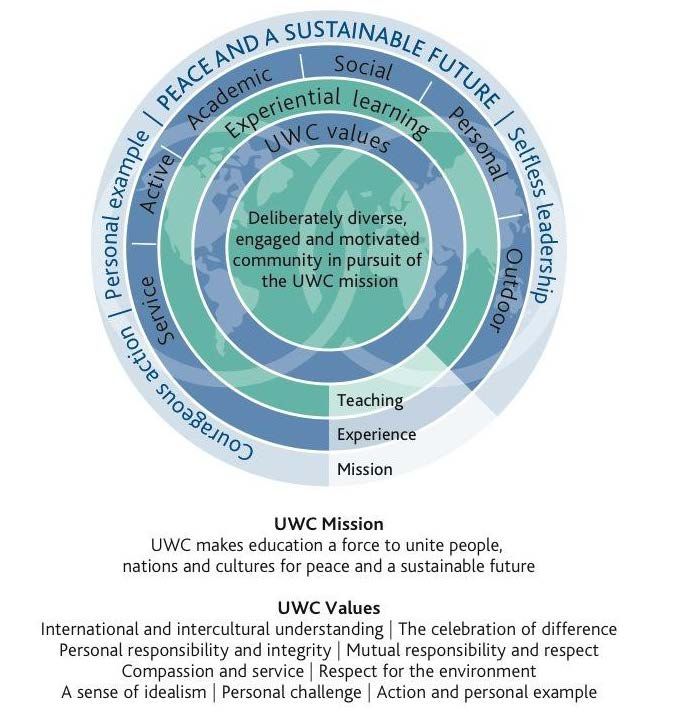
All of this is based on the UWC Educational Model which is detailed in Appendix 1.
1.5 Legal and Statutory Framework
The College is non-profit making and is recognised as a charity for tax purposes.
The principal framework for its operations is the Education Ordinance, and circulars issued by the
Education Department which apply to the College. LPCUWC is a member of the Direct Subsidy
Scheme - it receives a full grant for each Hong Kong student attending the College. As an
employer, it is subject to a number of other ordinances covering Employment, Safety, Health, Fire
and Building regulations.
4The Education Ordinance sets out the duties and responsibilities of the Management Committee,
Supervisor and Principal and the relationship between them in the running of the College and
accountability to the Education Department. A number of reports by the Education Commission
set out the government's forward strategy for education. Schools are offered incentives to pilot
new ideas e.g. school based management.
As an institution in receipt of funding from Government Trusts, our accounts are subject to
inspection by Government, and financial procedures are meticulously adhered to.
The College has its own Articles of Association which lay out procedures for the election of Board
members and the conduct of meetings.
52. Achievements and Reflection on Major Concerns
2.1 Significant Achievements
There were a number of significant achievements this year for the college:
a) Positively navigating the achievements of students during COVID-19
The college, as a collective, has successfully navigated the achievement of students, despite the
challenges of remote learning. This has been due to the extraordinary teamwork of teachers,
students and other staff working together for student success. This has occurred in a number of
ways:
• Successfully navigating the arrival of all students on to campus from overseas. The college
brought in 128 out of 130 overseas students from all around the world. All students had to
complete fortnights quarantine. The college’s last remaining student from Timor Leste arrived
in mid December.
• Ran our Quan Cai Programme (CAS) through remote means. Students creatively found
projects they could initiate remotely on-line
• To develop a Blended Learning model in all our activities, whether this be in academics; student
welfare or EOTC. Different approaches to delivery of materials included utilising the flipped
classroom; remote platforms (e.g zoom) and small group tutorials.
• Students managing their UWC experience remotely overseas. Staff supporting students in very
different time-zones.
• An outstanding set of IB Diploma results, which is the college’s best performance since 2009,
with 6 students obtaining the maximum 45 points and an average points score of 38.45
(worldwide average of 31.34). This is testament to the dedication of students and staff working
together in very adverse circumstances.
b) Youth Outreach Programmes
The college ran a number of Youth Outreach Programmes (all virtually) over the course of the
year. The programmes included a Global Awareness Camp; Peace Camp; Green Day; Design
Thinking Boot Camp; a Youth PeaceMakers Camp; Sino-Japan Youth Conference and AFS
Intercultural experience. In total 313 students from S1 to S5, joined these programmes. As they
were virtual overseas participants were able to join as well. The college is grateful for the support
of Alibaba; CLP; Rotary and AFS in supporting these programmes. These programmes are about
engaging more young people with the UWC mission & values.
c) Other Achievements
Details of Achievements based on the Development Plan (2020-2021) are detailed in the
Development Plan Report for 2020-2021 (Appendix 2).
62.2 Major Concerns
In reflecting on the concerns for the year, the major concern continues to be navigating COVID-19
and bringing the overseas students to Hong Kong. At the time of writing some Y1 students are in a
quarantine hotel, whilst others at the moment due to various travel restrictions currently cannot get to
Hong Kong.
Our other major concern continues to be obtaining scholarships for students from humble
backgrounds to gain access to a UWC education. The College, with the support of the Hong Kong
Committee continues to work hard to increase the donation amount.
.
73. Our Learning and Teaching (including Support for Student
Development)
As has been outlined the principles behind our learning and teaching are based on the three principles
outlined below. The College puts emphasis on holistic experiential education and learning.
3.1 Academic activities
The academic programme at LPCUWC is shaped by the requirements of the IB Diploma Programme.
As such, students consider the subject material in the light of the international context which provides
the context for the qualification and study at LPC. Students study 6 subjects - 3 at a Higher Level and 3
at a Standard Level - chosen from each of the six subject areas (as shown in the Diploma diagram).
In addition, all candidates must complete the Theory of Knowledge course which allows them to
question how knowledge is derived and how reliable it is. The Extended Essay is a 400 word piece of
academic writing that allows students to explore a topic of their choice, exploring subject matter that is
of interest and has inspired them to delve deeper.
83.2 Arrangements for Students with Special Needs
The Li Po Chun United World College is committed to the provision of a high quality education for all
students enrolled at the College. We believe that students with special educational needs should be
provided with the support they need to develop their potential and to fully participate and contribute to
this unique learning and living community.
Students at the College who require additional support are mainly classified into the following
categories:
• Students with a verified disability.
• Students with English as an Additional Language.
• Students with learning support needs.
• Students with emotional/social/mental health/family challenges
Different support mechanisms are put in place as needed working with the students in a holistic
manner.
3.3 Student Welfare activities (including Residential)
Li Po Chun United World of Hong Kong is a 100% residential community. Living together on the
same campus enables students to learn how to share, to trust, to get on with others, to learn from one
another, and to form friendships for life.
The fundamental principles of residential life are trust and consideration. Therefore, the rules guiding
our community are kept to the minimal and in line with the UWC Code of conduct.
The 256 students of LPCUWC live in the 4 residences of campus. They share rooms with three other
students. Residences and rooms are socio-engineered in order to offer the students the best
opportunities to share in a meaningful way. As far as possible, rooms are composed of two second year
and two first year students, two from Hong Kong and two from different overseas regions.
One of the goals of LPC UWC is to create a community which respects the expression of every culture,
while ensuring that no student's beliefs, faith or culture are denigrated. This means that students learn
to live with and appreciate peers who have different needs and values.
All full time teaching staff live on campus and are tutors. The tutors and the tutor groups are important
lines of support providing guidance, a ‘home away from home’ atmosphere, a shoulder to cry in time of
need and a group with whom to share good news.
93.4 Education Outside of the Classroom Activities
The EOTC programme focuses on experiential learning – learning by doing in a context outside the
traditional classroom in order to develop the whole person. EOTC is central to the values of a UWC.
The programme is comprised of:
• Quan Cai (IB CAS) activities
• China Week & Project Week
• Other College trips
• Cultural Evenings
• Orientation Week
• Sports & sports teams
• Outdoor pursuits
• First Aid training
• Student leadership
The aims of EOTC are to:
• Facilitate experiential learning
• Learning through doing
• Serving others
• Student leadership
• Challenge and risk taking
• Holistic development of the individual
Quan Cai (IB CAS)
Consists of 4 components:
• (Community) Service – service projects to the Hong Kong and wider community
• (Campus) Service – activities to support the running of the campus
• Creativity – activities that are artistic or require creative thinking
• Activity – activities focused on physical well being, sports & outdoor pursuits
Students must choose one activity from each component as part of their programme. The programme
is at the heart of EOTC and takes place on Monday evening, Tuesday, Thursday and Friday afternoon
and evening and at weekends: Students must choose one activity from each component as part of their
programme in Year 1 and two activities (one must be Community Service) in Year 2.
Students provide evidence/reflections on their learning. Students are supported by their tutors plus a
Staff Supervisor per activity.
Student Leaders participate in a number of leadership workshops throughout Year 2.
Project Week
All students participated in a Project Week during Term 2.
Project Week is focussed on facilitating Service and Challenge experiences.
10Students develop independence and leadership by proposing, leading and participating in trips.
Cultural Evenings
Five cultural evenings take place each year.
These highly anticipated presentations include pre-performance events and a dinner before the show.
The aim is to promote international understanding & appreciation.
The year begins with Welcome performances and ends with music/performance events. Throughout
the year there are four cultural evenings, each one focusing on a different region (Africa, Asia Pacific,
Europe, Middle East & South Asia, North America and South America on a two year rotation and
China annually.
A staff member supervises each evening; however the events are almost always student led.
Orientation Week
Orientation Week introduces new Year 1 students to all aspects of College and Hong Kong life. It is
led by staff and Year 2 students and takes place in the first week of term.
Outdoor Pursuits
The College runs a number of outdoor pursuits programme and has a partnership with Outward
Bound HK.
114. Student Performance
4.1 College Results 2021
Overall Performance
Total no. of eligible students 119 Out of 120 (one deferral)
No. students awarded Diploma 117 98.3%
No. students awarded Bilingual Diploma 62 (out of 62) 52.1%
No. students awarded Certificate 2 1.7%
Average Score of Diplomas Awarded 38.6
Average Score per Candidate 38.5
Table 1: General summary of statistics
The above results represent our best performance since 2009 by the cohort despite the current pandemic
and suspension of face-to-face classes and activities since February 2020. For instance, after receiving all
re-mark results, we have a total of 13 improved grades, including 6 students achieving the maximum 45
points this year (which is another record high since 2009). More importantly, the number of students not
being awarded a diploma is close to zero (as in recent years). This is the most encouraging reward since
we were able to support our students and help all of them meet the high demands of the IB Diploma
Programme under the two most challenging years in the history of this College. This is truly a testament
to our success in adapting, adjusting and adopting the Blended Learning Model in the last year and a half.
Figure 1 and 2 show that this year’s results are indeed the best within the last decade in terms of the
general distribution and maintain the impressive performance of the College, considering the additional
value that we know we provide.
6 Year Comparisons with the World
100
80 World results 2020
Cumulative %
Li Po Chun UWC 2016
60
Li Po Chun UWC 2017
40
Li Po Chun UWC 2018
20 Li Po Chun UWC 2019
0 Li Po Chun UWC 2020
24+ 30+ 35+ 40+ 45 Li Po Chun UWC 2021
DP Points
Figure 1: 2021 results (cumulative)
1218
16
14
12
10
No. of student
8 Normal Dist.
6
4
2
0
21 23 25 27 29 31 33 35 37 39 41 43 45
Figure 2: Distribution of results 2021
2020 - 2021 was another eventful year with a continual suspension of classes. With all but one student
on campus within the first term, the College was able to conduct the May 2021 IB Examinations as in
2019 and judging from the above results, our students responded well to these external assessments on
top of the internal assessments (either externally moderated or assessed). With the immense support from
their teachers and the residential team, all IB coursework were completed and submitted on time
electronically.
Figure 3 presents a comparison of recent years’ average DP points versus the worldwide score. As already
mentioned above, this year’s results are the best within recent years.
45.00
40.00 36.57 38.45
35.29 35.90 35.53 34.93
Mean DP Points
35.00 31.34
30.00
25.00
20.00
15.00
10.00
5.00
0.00
2016 2017 2018 2019 2020 2021 Worldwide
Year
Figure 3: Average DP points 2016 – 2021
13Bilingual Diploma
The number of candidates attaining a Bilingual Diploma is only one less than last year’s 63 but the
percentage remains the same at 52.1%, in which all of them succeeded in getting their diploma. This
suggests that the College has maintained her strong commitment to mother-tongue languages and a firm
stance in student subject choices. Furthermore, this percentage is way above the global figure of 25.9%
in 2020.
Core Subjects
Extended Essay (EE) and Theory of Knowledge (TOK) contribute a possible maximum of 3 points to
the overall total. The LPC results are, as usual, way better than the worldwide results particularly at the
high end for EE. This is also the case for TOK, which is a continual improvement thanks to a strong
and growing team of 8 experienced teachers.
Conclusion
This is a most pleasing set of results that are better than predictions and represent the commitment and
perseverance of this year’s cohort. Still, there are lessons to be learned and individual departments are
reviewing their own specific areas for further development. Unlike previous years, IB has introduced a
dual mode which allows schools to take on either an examination or non-examination route to cater for
the ever-changing COVID situations in different countries to the extent that within the same school, it
is possible for students to go down both routes. Indeed, one of our students had to opt for the non-
examination route because she was unable to return to Hong Kong and could not find an alternative
venue for her examinations back home.
4.2 Other Student Awards
External Awards
1) Harvard Book Prize (Y1)
- Winner: Uma Fox
- 1st Runner up: Miora Andriamahefa
- 2nd Runner up: Lydia Nottingham.
2) Wellesley Book Award (Y1): Winner – Sally Lo.
3) Princeton Book Award (Y2): Winner – Jorge Sabido Lugo.
4) Kiwanis has been suspended this year.
Internal LPC Awards (Y2)
1) Award for the Arts: Serena Lam
2) Award for Sports and Outdoor Pursuits: Bob Tsang
3) Award for Improvement through Effort: Sarah Balekage
4) Award for Promotion of Intercultural Understanding: Jadyn Ligoo
5) Award for Community Service: Ramisha Kabir.
145. Financial
5.1 Financial Summary for 2019/2020 School Year
Government Non-Government
Funds Funds
INCOME (in terms of percentages of the annual overall income)
DSS Subsidy (including government grants not subsumed in
25% N.A.
the DSS unit rate payable to schools) (Note 1)
School Fees N.A. 65%
Scholarship Received N.A. 6%
Donations N.A. 1%
Other Income N.A. 3%
Total 25% 75%
EXPENDITURE (in terms of percentages of the annual overall expenditure)
Staff Remuneration 35%
Operational Expenses (including those for Learning and 15%
Teaching)
Fee Remission / Scholarship1 40%
Repairs and Maintenance 7%
Depreciation 3%
Total 100%
Surplus/Deficit for the School Year # -1.50 month of the annual expenditure
Accumulated Surplus/Deficit in the Operating Reserve
2.25 months of the annual expenditure
as at the End of the School Year #
#
in terms of equivalent months of annual overall expenditure
Note 1: DSS subsidy from the government is used for supporting the expenditure of the teaching
activities for our DSS students.
Details of expenditure for large-scale capital works, if any:
1 The % of expenditure on fee remission/scholarship is calculated on the basis of the annual overall expenditure of the school. This %
is different from that of the fee remission/scholarship provision calculated on the basis of the school fee income as required by the
Education Bureau, which must be no less than 10%.
It is confirmed that our school has set aside sufficient provision for the fee remission / scholarship scheme according to Education
Bureau’s requirements (Put a “” where appropriate).
** Summary Subject to Audited Approval. **
155.2 Government Grants 2020-2021
5.2.1 Government Grant Expenditure 2020-21
a) Capacity Enhancement Grant Report for 2020-21
The 2020-21 academic year has covered several developments (below) that were proposed
last year and supported by the Capacity Enhancement Grant.
To facilitate the development of an online Blended Learning Model, the college WiFi
network has been enhanced by replacing and upgrading the access points at certain blind
spots with weaker connectivity to maintain consistent and stable internet access anywhere
within the campus.
An initial search and study of eLearning platforms, such as Schoology, Google Classroom,
MS Teams and Teamie, was conducted with an aim of best supporting our new model of
Blended Learning.
Subject specific eLearning applications, like Read&Write, MyiMaths and Turnitin, were
acquired to improve student’s independent studying as one form of Blended Learning.
b) Career and Life-Planning Grant
The utilisation of the Career and Life-Planning Grant is identified in the Development Plan
Report 2021-22
c) School-based After-school Learning and Support Grant (HKD800)
This was used to provide support to students with financial difficulty to undertake College
Quan Cai activities. The funds were used to fund activities that included African
drumming and swimming coaches.
d) One-off Special Support Grant (HKD100,000) (only spent HKD58,482)
58,482 HKD was utilized to employ extra manpower for cleaning the campus.
5.2.2 Government Grant Plan for 2021-22
a) Capacity Enhancement Grant 2021-22
The 2021-22 academic year will see several developments that will be supported by the
Capacity Enhancement Grant.
To further develop the Blended Learning Model and enhance student’s independent learning
both physically and virtually, additional electronic copies and/or licences will be acquired for
new textbooks.
To extend curriculum development into Blended Learning, online assessment will be explored
and implemented.
As before, new or better subject specific eLearning applications and software will be
investigated and introduced.
16The above enhancements will be covered by this year’s grant.
b) Career and Life-Planning Grant
The plan for the Career and Life-Planning Grant is detailed in Development Plan 2021-22
(Appendix 3).
c) School-based After-school Learning and Support Grant – to provide support to students
with financial difficulty to undertake College Quan Cai activities.
d) Sister School Scheme - application made. Awaiting approval.
176. Feedback on Future Planning
The College launched a new strategic plan on the theme: “Breaking Boundaries; Building
Bridges” in 2019 following an extensive consultation exercise. The strategic plan can be
summarised in the diagram below:
Details of the Strategic Plan can be found in Appendix 4.
The Development Plan for 2021-22 based on the Strategic Plan “Breaking Boundaries; Building
Bridges” is enclosed in Appendix 3.
18Appendix 1
UWC Educational Model
Summary of UWC Educational
Model
1. UWC Community: Deliberately diverse, engaged and motivated community in pursuit of the UWC
mission
Guiding Principles: “This education should take place within a diverse community. The selection of students
should ensure representation from regions and social groups that reflect the wide range of tensions among and
between people.”
Explanation: The core of the UWC experience lies within a diverse community of learners who share a
common commitment to the mission and values of the UWC movement. Diversity is supported by National
Committees in over 140 countries which interview and select students who have made the most of the
opportunities they have had and who exhibit qualities that fit with the UWC mission and values. Students are
then chosen to join school communities to ensure cultural, racial, gender, socioeconomic, and language
1diversity in pursuit of a common mission. In this way, each campus reflects a global diversity that enhances
connection, sharing, debate, and community living; and, thus encourages opportunities for growth, empathy,
and understanding. Faculty and staff actively engage in community life as teachers, tutors, mentors and
learners.
2. UWC Values
Guiding Principles: “All schools and colleges share the same basic values as outlined in the UWC mission
statement – international and intercultural understanding; celebration of difference; personal responsibility and
integrity; mutual responsibility and respect; compassion and service; respect for the environment; a sense of
idealism; personal challenge; action and personal example.”
“This education requires active promotion of intercultural understanding and the development of genuine
concern for others founded on shared life experiences, and cooperative and collaborative living. This
includes reflective dialogue on global issues and critical and courageous engagement in the pursuit of
peace.”
“Community interaction is placed at the heart of college life. This requires the full and active participation of
all members of the school or college.”
“Opportunities for students to practice personal initiative, self discipline and responsibility, to manage risk and
embrace challenge must be provided. Where appropriate, these opportunities are supported by a reassuring
adult presence.”
Explanation: This part of the model, together with the outcomes, speak to the values infused in a UWC
education throughout the movement.
3. Teaching: Experiential Learning
Guiding Principles: “Requires active promotion of intercultural understanding and the development of
genuine concern for others founded on shared life experiences, and cooperative and collaborative living. This
includes reflective dialogue on global issues and critical and courageous engagement in the pursuit of peace.”
“Community interaction is placed at the heart of college life. This requires the full and active participation of
all members of the school or college.”
“Students are able to engage in continuing, positive action towards issues of sustainability, on both
an institutional and individual level.”
“Opportunities for students to practice personal initiative, self discipline and responsibility, to manage risk
and embrace challenge must be provided. Where appropriate, these opportunities are supported by a
reassuring adult presence.”
Explanation: Experiential learning is fundamental to UWC. Experiential learning is the process of making
meaning from direct experience. Young people are thrust into a dynamic and diverse community. This
situation provides a plethora of challenging experiences to inspire a range of emotions and learning
opportunities. These experiences can be challenging, joyful, frustrating, and life-changing. UWC provides a
safe and supportive environment from which to learn through direct experience. By living and working
together, students develop empathy and make sense of their experiences through such means as reflection,
dialogue, trial-and-error, and perspective taking.
Along with living in a diverse community, students have opportunities to initiate and collaborate on areas of
passion, interact with the larger community, and take advantage of service, creative, and physical opportunities.
All of these programmes provide rich experiences for making meaning and learning.
2Experiential Education is a more formal pedagogy that employs a philosophical stance and a variety of
methodologies. Teachers and staff intentionally provide opportunities for students to engage in
activities, exercises, and events to mindfully make meaning and apply emerging skills and understanding.
4. Experience: Active – Academic – Social – Personal – Outdoor – Service
Guiding Principles: “Recognition is given to the fact that each individual possesses unique talents and abilities.
Programmes should exist in each college which enable all selected students to fulfill their potential.”
“Physical fitness and a healthy lifestyle are integral to the balanced development of the whole person.
Unhealthy lifestyles limit human potential and hinder progress in all dimensions of development.”
Explanation: Within the context of the experiential process are the actual experiences shared within the UWC
community. These are both formal and informal activities, programs, and situations that challenge students on
a variety of levels. Formal experiences balance high expectations within the context of a rigorous academic
programme, along with a rich and varied co-curricular program in which students engage in creative, physical,
and service learning both offered by others and initiated by students.
Students are also informally challenged through interactions in an intercultural and diverse environment in their
residence life and social activities. These challenges encourage sharing, dialogue, conflict transformation, and
reflection to encourage seeing the world from a variety of perspectives.
5. Mission and Outcomes: Peace and a Sustainable
Future Courageous Action • Personal Example •
Selfless Leadership
Guiding Principles: “Underpinning these principles is the pursuit of peace and justice as the founding
aim of UWC.”
“UWC schools and colleges offer life-defining experiences for young people, enabling them to discover the
possibility of change through courageous action, personal example and selfless leadership. This education
enshrines a commitment to the balanced development of the whole person; that is, its task is to encourage an
integrated development of human potential across a range of different dimensions, including the intellectual,
moral, aesthetic, emotional, social, spiritual, and physical.”
“Students are able to engage in continuing, positive action towards issues of sustainability, on both
an institutional and individual level.”
Explanation: By bringing together a diverse and motivated student body, immersing them in a global
community experience based on the UWC values, and challenging them formally and informally, students grow
in their abilities to be active global citizens.
The holistic UWC experience leads to learning skills, competencies, and outcomes toward the UWC mission
to make "education a force to unite people, nations and cultures for peace and a sustainable future."
3Appendix 2
Li Po Chun United World College of Hong Kong
Report on Development Plan 2020-21
The Development Plan needs to be read in conjunction with the College’s strategic plan “Breaking Boundaries; Building Bridges; 2019 and Beyond.”
The college Focus makes reference to the element of the strategic plan.
(A) Growth in Impact
College SMART Target Respon- Time Budget- Monitoring and Evaluation Review & Progress Against Targets
Focus sibility Frame ed Cost
A1 To run a range of outreach AK Sep 20 - ▪ Minimum of four events to be run Four virtual events held during college year
activities with a focus on May 21 during the college year (September by QC groups (IFP x2, GPS, SING).
Peace and Sustainability 2020 - May 2021) Three virtual events held during summer
Jun-Aug break (SJYC, AFS, YPM)
21 ▪ Minimum of one event to be run Total 267 unique participants reached, of
during the summer holiday (June - which 188 were Hong Kong-based, and 14
August 2021) admitted to UWC for 2021 intake.
A1 To coordinate the outreach AK Dec 20 ▪ Establish a database of the outreach Database of participants, parents, partners
activities that take place activities that take place (schools/public/private/non-profit)
May 21 ▪ To develop a system to collect established. More linkages to be made
information on participants and between parties, and database to be shared
partners for future promotion of the with Admissions/Development Office.
college
1(B) UWC Mission and Values
College SMART Target Respon- Time Budget- Monitoring and Evaluation Review & Progress Against Targets
Focus sibility Frame ed Cost
B1 Maximise Peace education WT June 21 Peace Initiatives Committee to Considered and applied during OW
through blended learning consider effective blended learning ‘Mission: Peace’ event and also during Peace
approaches and monitor and reflect on COP Day.
their application in College
programmes/calendar
B2 ▪ Electrical consumption NW June 21 TBD Sustainability Committee to promote ▪ Bio digester installed and operational.
on campus to be acquisition and fitting of devices and Measurement of food waste to be followed
measured via the fitting regularly monitor outcomes with a up between Admin and supplier.
of consumption devices. view to produce measurements to ▪ Electrical consumption can be measured in
▪ Bio digester installed & reduce both electrical consumption and Peace Centre but not yet fitted in other
made operational in food waste on campus. parts of the College.
order to measure food
waste in the canteen.
(C) Academic
College SMART Target Respon- Time Budget- Monitoring and Evaluation Review & Progress Against Targets
Focus sibility Frame ed Cost
C1 Development of Blended All Ongoing Nil Explore and apply different eLearning Achieved with a customized bi-weekly
Learning approaches for teachers models which will best support face- timetable, PowerSchool as the primary
distance/online learning to-face and online lessons both eLearning platform, ManageBac as the
synchronously and asynchronously centralized storage for IB submissions, Zoom
as the virtual classroom, Exam.net for online
tests and exams plus other teacher-preferred
platforms, like Google Classroom and MS
Teams.
2C2 Evaluation and review of All Ongoing TBD Compare different systems and Partially achieved with a comparison between
eLearning systems teachers propose the most suitable for Blended PowerSchool, Google Classroom and MS
Learning Teams and an initial study of Teamie.
(D) Education Outside the Classroom
College SMART Target Respon- Time Budget- Monitoring and Evaluation Review & Progress Against Targets
Focus sibility Frame ed Cost
D2 Blended Learning SR June 21 EOTC Committee (and possibly Trips A reduced EOTC programme ran due to
Committee) to lead initiatives for Covid19 restrictions. The programme ran
completing the EOTC programme more effectively in Term 2 with greater time
supported by blended learning in in afternoons for QC operation and relevant
response to the challenges of Covid19 EOTC focused meetings. A combination of
and the elongated teaching timetable. f2f and virtual EOTC events took place
Initiatives will be tested and reviewed successfully.
by the committee.
D3 More independent SR June 21 A programme of independent online The programme was implemented and well
approaches to learning is already proposed and will supported by students. It is anticipated that
completion of QC be evaluated by student and staff this will remain a regular option in the EOTC
requirements. reflection and feedback. (QC) programme in the future.
(E) Student Welfare
College SMART Target Respon- Time Budget- Monitoring and Evaluation Review & Progress Against Targets
Focus Sibility Frame ed Cost
E3 Student Code of Conduct MM May 21 ▪ HoHs will revisit the current ‘Rules Postponed to next academic year (Focus of
(rules for the community) for the community and consider residences team was on
changes. management/adaptation to Covid-19
▪ New document has been approved situation)
by community.
3E3 Student Protection Policy MM Term 1 The new document has been approved Postponed till next academic year. (Focus of
updated by community and Board. residences team was on
management/adaptation to Covid-19
situation)
E1 Tutor role and social MM Term1 ▪ Tutees experimenting difficulties Systems were put in place to allow TG to
distancing are supported early. meet f2f as far as possible.
▪ Tutor group and Block identity are Ideas of on-line activities shared with tutors.
created on-line. Block activities took place in an hydride
context.
(F) Fundraising and Financial Sustainability
College SMART Target Respon- Time Budget- Monitoring and Evaluation Review & Progress Against Targets
Focus Sibility Frame ed Cost
F1 Increase alumni giving rate WH Ongoing ▪ Alumni Tracer to update alumni Alumni Connect QC was tasked to follow up
and regular donation amount information for effective with Class Reps on an ongoing basis to
communication and engagement. update information of alumni of their class
▪ New donation management through email and the online Alumni Tracer
database being explored to form.
streamline donor management and Development of new online donation
donation analysis. management database (launched in August
▪ Relaunch regular donation 2021) for recording and tracking scholarship
campaign. donation data. Past alumni data was
▪ Pioneer Class (Class of 1994) 30- successfully migrated to the new system.
Year Reunion Scholarship Regular donation campaign and 30-Year
Fundraising. Reunion Scholarship Fundraising will be
key deliverables for the newly setup Alumni
Fundraising Subcommittee.
4F1 Sustain current medium net WH Stewardship of current medium net Sizable donations from four individual
worth donors and identify Ongoing worth donors (College visit, regular donors as a result of active engagement and
new ones updates of their scholarship recipients, stewardship by the Principal and
invitation to meet with the Principal Development Director.
and campus tour).
F1 Steward current major donors AE & Ongoing ▪ Donor-Scholarship Recipient The three-year scholarship programme by a
including corporate and WH communication facilitated by family foundation in HK was renewed for
foundation donors Development Director. two ethnic minority students at LPCUWC
▪ Invitation to catch up with the every year for three years. The corporate
Principal, meet with scholarship donor continues with their annual
recipients and campus tour). scholarship donations for 4-5 overseas
students each year as part of their 10-Year
Pledge starting 2017/18.
F1 Enhance endowment funds WH Nov ▪ UWC HK Foundation Task Force The Major Gift Team under UWC HK was
and build high networth 2020 members to focus on legal and set up and has been tasked to identify and
donor pipeline through governance, vision and mission of engage new external donors for potential
collaboration with UWC HK UWC Movement in Hong Kong endowment giving as well as one-off
Foundation Task Force, and donor prospects list scholarship giving for UWC Movement in
UWC HK and UWC development leading to the official Hong Kong.
Graduates Organisation setup of the UWC HK Foundation.
F1 Secure additional funding for WH Ongoing ▪ Finalise agreement and secure Launched virtual Youth Camps led by
outreach programmes (e.g. sponsorship from a sponsor/partner Youth Program Manager and sponsored by
PeaceMakers; Sustainability) who has agreed to support the Alibaba Entrepreneurship Fund, Rotary and
Global Awareness Virtual Camp in China Light and Power and supported by
December 2020 and Youth Design QCs namely Initiative for Peace (IFP),
Boot Camp in March 2021. Global Pioneers for Sustainability (GPS) and
▪ Identify partners for events under Social Innovation Network Group (SING).
Youth PeaceMakers and explore A few like-minded partners are interested in
sponsorships to support. supporting our Youth Programs; discussions
ongoing.
5(G) Capacity Building
College SMART Target Respon- Time Budget- Monitoring and Evaluation Review & Progress Against Targets
Focus sibility Frame ed Cost
G1 Consider a plan to support AE Ongoing To have needs across the College At the beginning of the year as part of the
staff and students in the identified (October 2020) Professional Development teachers reflected
Blended Learning Approach Implementation of support on their approaches to Blended Learning.
to teaching Sharing of different approaches to Blended
learning across different departments
occurred.
G1 Develop an approach to allow AE 02/21 An educational consultant had been A consultant has been appointed to work
staff to reflect on their secured to work from February 2020 with staff on “Creating a Positive Feedback
practice Work with the same consultant on the Culture”.
programme for 2021. Initial meetings held with teams of staff to
consider feedback in academic; Student
Welfare and EOTC.
G1 Continue the development of MM and All year Funding through the Career and Life New platform for University was
the UGC Team UGC Planning Grant for University investigated and the College introduced the
Team Guidance Counsellor system Maia
Explore different ways in which
support for UGC can occur through a A system for virtual University visits across
blended approach. several UWC was developed.
G2 To continue to work on the FH/Facil All Year Plan of works identified for EDB Ongoing process. EDB grant for Major
EDB Grants for Major ities Major Repairs and Lift Application. Repairs 2020-21 was obtained in April 2020
Repairs and Lift Application @$3.2M and in March 2021 @$27M for
to completion. Life Installation. Consultants were
appointed to draft letters of invitation/tender
documents for EDB’s consideration
/approval for the appointments of the project
consultants and main contractors.
6G2 To continue work on the AE All Year Work to continue to explore the An amphitheatre project has commenced.
development of the Lee Shau possibilities for the development. Architects through a competitive tendering
Kee Peace Education Centre process have been selected. Preparations of
site occurred in summer 2021.
(H) Communications and Outreach
College SMART Target Respon- Time Budget- Monitoring and Evaluation Review & Progress Against Targets
Focus sibility Frame ed Cost
H1 Admissions Director to further MM/AE Ongoing Marketing materials developed New English and Chinese leaflets and
develop the relationship with which encompasses alumni and information sheets developed for
Hong Kong Committee and students distribution at the International School
LPCUWC Development Team Expo in May 2021.
on effective marketing of UWC
H1 Development of Virtual Open MM/AE 08/20 Virtual Open Day events planned Created a video for a virtual campus tour.
Day events to support and communicated Hosted 5 online Info Days on Admissions,
Admissions UWC, student and parent sharings.
H2 External communication of Develop Ongoing ▪ Continue to leverage College’s Ongoing. Alumni and current scholar
special College and student -ment social media platforms (FB, IG, impact stories featured in monthly
stories through media contacts Office YouTube, LinkedIn) for Engagement Newsletter.
community engagement. Partnered with UWC HK Marketing for
▪ Share special College and alumni media coverage featuring our alumni.
& student stories for potential
media interviews.
H2 Youth Outreach AK/WH Ongoing A pool of alumni to be recruited to 14 alumni (2017-2020) volunteered as
Manager/Development Team to support a range of programmes that facilitators for three youth programmes
engage alumni to support are being developed. (IFP x2, YPM)
external youth education events
Higher level collaboration in the works
with Amy Yung’s group.
7H3 Communication of College AE & Ongoing ▪ Principal’s letter and zoom calls or Quarterly Principal’s Letter to alumni
updates and scholarship needs WH face-to-face meetings with about strategic developments of the
with community members different groups of stakeholders College.
(alumni, current or potential Principal and Development Director’s
donors/partners) participation in the virtual reunions of
▪ Invitation to meet with the Class of 2000 and Class of 2010.
Principal via Zoom call or College Successful scholarship fundraising by
visit for potential donors to learn Class of 2000 for their 20-Year reunion.
more about LPCUWC, UWC
Education and need-based
scholarships.
H3 Update alumni on opportunities Develop Ongoing ▪ LPCUWC Professional Talks Class of 2010 fundraised to support
to give back their talent ment Series featuring LPCUWC alumni COVID-19 related expenses for the
(through their profession), time Office speakers and moderators. college.
and treasures. ▪ LPCUWC London-based Alumni 89% sign up for UWC Pledge by Class of
to engage alumni based in Europe. 2021 for giving time, talent and treasure
▪ Principal’s Letter and Zoom after graduation.
meeting with alumni to update The College, UWC Hong Kong Committee
alumni on College developments and UWC Graduates Organization HK
and needs for scholarships. jointly organised three UWC Alumni
▪ UWC Pledge follow-up for Class Forums which replaced LPCUWC
2020 and roll-out for Class 2021. Professional Talks. These forums did not
only engage alumni in Hong Kong but also
overseas alumni and their network with an
average of 70 attendees per session.
H3 Establishment of “Alumni WH/AE 03/21 Provisional list of possible parents This was not realised. The focus has been
Parent Group” have been identified. the development of the Alumni
Work to be undertaken in 2021. Fundraising Group for the Board. This
new Board group will be the continued
focus for 2021-22
8Appendix 3
Li Po Chun United World College of Hong Kong
Development Plan 2021-22
The Development Plan needs to be read in conjunction with the College’s strategic plan “Breaking Boundaries; Building Bridges; 2019 and Beyond.”
The college Focus makes reference to the element of the strategic plan.
(A) Growth in Impact
College SMART Target Respon- Time Budget- Monitoring and Evaluation Review & Progress Against Targets
Focus sibility Frame ed Cost
A1 To coordinate & run a range of AK Sept 21 Minimum of four events to be run
outreach activities with a focus on - May during the college year (September
Peace, Sustainability & Innovation 22 2021 - May 2022)
Minimum of one event to be run
during the summer holiday (June -
August 2022)
Build on the existing database of
information on participants & partners
A2 UWC Harvard Impact Survey will Review of elements pertinent to
be published for review. LPCUWC for Development Plan
2022-23
1(B) UWC Mission and Values
College SMART Target Respon- Time Budget- Monitoring and Evaluation Review & Progress Against Targets
Focus sibility Frame ed Cost
B2 Maximise Sustainability education Sustaina By Sustainability Committee to consider
through blended learning bility June 22 effective blended learning approaches
Committ and monitor and reflect on their
ee application in College
programmes/calendar
B1, B2, Delivering an effective ‘virtual’ WT By Sep Feedback to be solicited from students
B3 Orientation Week amidst COVID- 21 and staff.
19 regulations
(C) Academic
College SMART Target Respon- Time Budget- Monitoring and Evaluation Review & Progress Against Targets
Focus sibility Frame ed Cost
C1, C4 IB 5 Year Review All By Sep Nil Complete the preliminary review
teachers 2022 documentation by relevant
stakeholders for the self-study
questionnaire.
C3 Academic policies update All By Nil Review and revise the policy for:
teachers June - Academic Honesty
2022 - Assessment
- Attendance
- Language
Generate the policy for SEN.
2(D) Education Outside the Classroom
College SMART Target Respon- Time Budget- Monitoring and Evaluation Review & Progress Against Targets
Focus sibility Frame ed Cost
D1, D2 Restoring face to face activities in SR Ongoin Within Regular monitoring of Covid 19
response to ongoing Covid 19 social g to existing regulations reflected in f2f/virtual
distancing regulations whilst June EOTC programme delivery.
sustaining virtual EOTC initiatives. 2022 budget
D1, D2 Delivering effective (Project) Hong SR Sept Within With no Trips Coordinator post in
Kong Week amidst Covid19 21- existing place, SR will facilitate HK Week,
regulations March PW with a view to streamlining the
22 budget process & rigorously applying
UWC/educational values.
(E) Student Welfare
College SMART Target Respon- Time Budget- Monitoring and Evaluation Review & Progress Against
Focus Sibility Frame ed Cost Targets
E3 Student Code of Conduct (review of MM May HoHs will revisit the current ‘Rules for
rules for the community) 21 the community and consider changes.
New document has been approved by
community.
E3 Student Protection Policy updated MM Term 1 The new document to be approved by
and aligned with UWC Common community and Board.
Standards for Safeguarding
E3 Safeguarding training for all staff All Aug Training of all staff on safeguarding.
(teaching and non-teaching) 21
E2 Developing a wellbeing programme HoHs All A programme is ready to implement in
for the College year 2022-2023.
3(F) Fundraising and Financial Sustainability
College SMART Target Respon- Time Budget- Monitoring and Evaluation Review & Progress Against
Focus sibility Frame ed Cost Targets
F1 Sustain current stream of fundraising WH June Donor stewardship through regular
income from current Corporate, 2022 engagement with the Principal and
Foundation and Individual medium scholars.
net worth donors
F1 Identify new donors for scholarship WH June Donation database management
giving 2022 Support the fundraising work of UWC
HK Major Gift Team.
Update donation pipeline with
relationship managers
F1 Increase LPCUWC alumni giving WH June Support the fundraising work of Alumni
rate 2022 Fundraising Subcommittee through
launch pack and donation menu
development.
Engage reunion alumni for class
scholarship fundraising for the College.
4(G) Capacity Building
College SMART Target Respon- Time Budget- Monitoring and Evaluation Review & Progress Against
Focus Sibility Frame ed Cost Targets
G1 “Creating a Consciously Positive ALL October Build on work developed by
Feedback Culture” within the 21 consultant
College Jan &
May 22 Develop the Why of doing this and
feedback to Staffing Sub-Committee
Use of Professional Development
time to develop the culture
G2 Continued development of the LSK FH/AE by Oct 2022 $10M Design & ongoing preparation work
Peace Education Centre - (LSK) for actual construction from Dec
Amphitheatre 2021 to Oct 2022.
Amphitheatre to be completed by
Oct 2022 for 30th anniversary in
November 2022.
G2 Lifts FH/AE Ongoing $27M EDB subvention of $27.168M
Up to Aug (EDB) granted in March 2021.
2024
Preparation & tendering process for
appointment of project consultants
by Sept 2021.
Project consultants to obtain EDB
approval on the final design and
appointment of Main Contractor by
Sept 2022.
Commencement of installation in
Dec 2022.
5G2 Major Repairs 2020-21 FH By Jan $3.2M Project consultants appointed in
2023 (EDB) early 2021. To continue the
tendering process for the
appointment of the Main Contractor.
+ Non-subvented Underground $1.5M Anticipated commencement of
Drainage Works (Lady works in summer 2022.
Lee)
The Non-subvented underground
drainage works would commence at
the same time in summer 2022.
G2 Introducing Maia platform to staff KB Term1 Training for staff on new platform.
and students Implementation to Year 2 students.
One personnel in UGC supported by
Career & Life Planning Grant.
(H) Communications and Outreach
College SMART Target Respon- Time Budget- Monitoring and Evaluation Review & Progress Against
Focus sibility Frame ed Cost Targets
H5 Preparation and Planning for 30th AE/WH Oct 2021 Steering Group established
Anniversary celebrations during 2022- April Outline of events produced with
23 2022 responsibility indicated
H1, H2 College Website Redesign WH Feb 2022 Work with Admissions, Outreach and
UWC HK Marketing to identify areas
of improvement for a theme-based
website for the College and clear
information search for prospective
students and parents.
6Appendix 4
Strategic Plan 2019 onwards
“Breaking Boundaries/Building Bridges”
Domain Objective
A) Growth in Impact 1. To have more young people from across Hong Kong positively
engaged with the UWC Mission and values
2. To further deepen the impact that UWC education has on the
students and staff at the college.
B) UWC Mission and 1. To continue to promote and develop the Peace facet of the
Values Mission of UWC.
2. To continue to promote and develop the Sustainability facet of
the Mission of UWC.
3. To continue to promote and develop the UWC values in all
aspects of college life.
C) Academic 1. To develop a Concept-based Learning approach across the
college
2. To further utilize IT as a tool for learning.
3. To further develop approaches to learning for students with a
range of different needs.
4. To promote the collective growth of teachers through the
development of learning communities
1You can also read


