Long Island Rail Road Performance Metrics Report - On Time Performance and Number of Short Trains are important metrics to customers. The LIRR has ...
←
→
Page content transcription
If your browser does not render page correctly, please read the page content below
Long Island Rail Road Performance Metrics Report

On Time Performance and Number of Short Trains are important metrics to customers. The LIRR
has shown marked improvement in these two areas through March 2019.
Executive Summary
The Long Island Rail Road has developed a robust performance management program enabling
it to measure whether goals are being achieved and to guide investment decisions. The MTA
Board requested that the LIRR report monthly on the following three key metrics: Systemwide
On Time Performance (OTP), the Number of Short Trains, and the Number of Track Circuit
Incidents Causing At Least One Delay. Highlights through March 2019 include:
Year‐to‐date through March the LIRR’s 2019 OTP is 93.2%%, including a 94.6% OTP in
March 2019, which was just over 6% better than March 2018. The 2019 annual goal is
94%.
Year‐to‐date through March the number of short trains dropped by almost 17% when
compared to the same period in 2018 (919 versus 1,102). The annual goal is a 10%
reduction.
Year‐to‐date through March, the LIRR experienced 21 track circuit failures that caused
at least one delay. This was eight more incidents more than the same period in 2018
and represented an approximate 62% increase from the same period in 2018. The
annual goal is a 16% reduction versus 2018.
Additionally, the LIRR has embarked on an anti‐fare evasion strategy that focuses on reducing
credit card fraud and improving on‐board fare collection. Some highlights in 2019 include:
The key initiative to reducing credit card fraud is the deployment of special chip
readers on ticket selling machines. The installation is scheduled to begin during Q2
2019 and be completed by the end of the year. Through February 2019, the LIRR’s
Credit Card Chargeback Rate was 0.77% versus a year‐end goal of 0.10%.
Effective February 12th, 2019, the LIRR is no longer accepting checks for payment on
new Mail & Ride accounts.
The Transportation Department has strategically deployed train crews to increase its
ability to collect fares onboard. The LIRR’s Fare Not Collected Rate as of February 2019
was 6.1%, which was less than the 2018 annual rate of 6.9%. The 2019 goal is 5%. The
LIRR’s Incorrect Fare Collected Rate year‐to‐date as of February 2019 was 10.8%,
which was less than the 2018 rate during the same time frame of 13.2%. The 2019
goal is 10%.
The LIRR has established ambitious goals for 2019 and the leadership team is reviewing
performance monthly to assess the impact that its activities and investments are having on the
customer experience. It will use this information to shape decisions as the year progresses.
Mark Young
Vice President – Management & Finance and Chief Financial Officer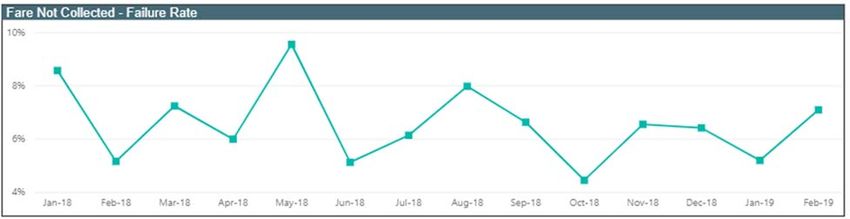
On Time Performance (OTP)
  Systemwide OTP represents the average on time performance of all LIRR trains. The national
  commuter railroad industry standard defines “on time” as a train that arrives at its final
  destination within 5 minutes and 59 seconds of its scheduled time. OTP provides the best overall
  picture of the Rail Road’s operating performance and surveys have revealed that it is the single
  most important factor affecting customer satisfaction.
  The LIRR’s 2019 OTP goal is 94%, which is significantly better than the five‐year average of 91.6%.
  While the LIRR has not achieved an annual 94% OTP since 2009, it continues to strive to achieve
  that level of performance even though there will be at least 209 scheduled track work programs
  during 2019 (including significant efforts related to Penn Station, Mainline Expansion, East Side
  Access and other projects) with a potential for more. There were 67 track work programs in 2009.

                                             Performance
                                                   Yearly Performance
Performance
                                                                                   YTD
 Indicator            2017            2018        2018 YTD       2019 YTD                      OTP Goal
                                                                                 Increase
   OTP               91.4%           90.5%          88.3%          93.2%           4.9%           94%

  OTP for March 2019 was robust at 94.6% and was the first month since April 2018 during which
  OTP was greater than 94%. Additionally, it was the highest single month OTP since May 2016
  when OTP was 94.7%. This elevates the LIRR’s YTD OTP to 93.2% (from 92.4% in February 2019),
  bringing the Rail Road closer to its annual goal of 94.0%. Lastly, when compared with the YTD
  total from 2018 (January, February and March) this represents an increase of 4.9%.
  Much of this improvement is due to the continued progress of LIRR Forward, which has improved
  key facets of performance and service. Some examples of these service improvements include a
  reduction in failures at our addressed switch locations, and the complete elimination of cars
  turning onto the right of way at our grade crossings, PSEG poles falling onto the right of way, and
  bridge strikes at Buckram Road and Post Avenue Bridges after their replacement.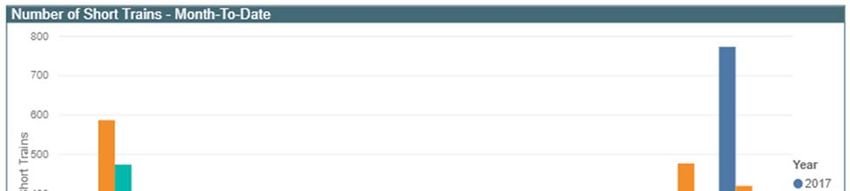
Number of Short Trains
     The number of short trains is defined as the total number of AM and PM peak trains that operate
     with fewer cars than planned. This is an important metric because operating with fewer cars than
     planned can result in overcrowding and produce delays. It is one of the most important indicators
     of customer satisfaction and short trains can result in standees. The LIRR’s 2019 goal for this
     metric is 3,397 short trains, which represents an 10% reduction from 2018’s number.

                                                 Performance
                                                       Yearly Performance
 Performance                                                                                              Short
                                                                               YTD         Reduction
  Indicator            2017           2018       2018 YTD 2019 YTD                                        Trains
                                                                             Reduction       Goal
                                                                                                          Goal
Number of Short
                       2691           3774          1102          919           17%           10%          3397
   Trains

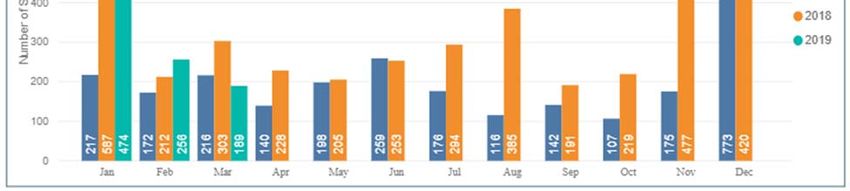
     For March 2019, LIRR customers experienced 189 short trains. When compared to the number
     of short trains in March 2018 (303), this represents an almost 38% reduction. Year to date, the
     LIRR has reduced the number of short trains by almost 17% when compared to the same period
     in 2018.
     This reduction year to date is due to a few initiatives. The LIRR increased its wheel truing capacity
     by 30%; it adopted an aggressive vegetation management campaign along the right of way,
     clearing over 220 miles of trees and shrubbery that could negatively impact performance with
     their leaf fall; and it proactively reduced the speed of trains in strategic locations, which mitigates
     the risk of flat wheels. Going forward in 2019, the LIRR will continue with these initiatives to
     mitigate the number of short trains.
Number of Track Circuit Failures
The LIRR is committed to addressing those issues that cause the most train delays. Because of
their location at major interlockings, track circuits are a critical piece of the infrastructure and
their failure can cause significant delays. Improved performance in this area will have a dramatic
impact on the customer experience and the Rail Road’s performance. The LIRR’s 2019 goal is to
reduce the number of track circuit failures that cause at least one train delay to 72 incidents,
which is the midpoint between the Rail Road’s best year since 2014 (59 failures in 2016) and its
worst year (86 failures in 2018) and would also represent an approximate 16% reduction from
2018.
Through the first three months of 2019, the LIRR has experienced 21 track circuit failures causing
at least one delay. This was 8 more incidents than the same period in 2018 and represents a YTD
increase from 2018 of approximately 62%. These failures occurred at several different
interlockings throughout the LIRR’s system and the causes varied. LIRR Engineering Department
is carefully reviewing the nature of these failures and determining what actions it can take to
reduce this number going forward.
Performance
Yearly Performance
Performance
2018 2019 YTD Reduction Incident
Indicator 2017 2018
YTD YTD Increase Goal Goal
Circuit Failures 61 86 13 21 62% 16% 72Anti‐Fare Evasion Strategy
The LIRR has developed a two‐pronged approach to its anti‐fare evasion strategy:
1. Address Payment/Credit Card Fraud
2. Enhance onboard ticket collection/validation
Credit Card Fraud Strategy
1. Deploy “Chip” Credit/Debit Card Acceptance at Ticket Selling Machines
Deployment will begin in Q2 2019 and be complete by the end of 2019.
2. Deploy Visa Anti‐Fraud Tool
Deployment will take place in Q2 2019.
3. Shift Monthly Pre‐Sale dates from 20th to 25th Day of Month
Implementation scheduled for the May monthly ticket ‐ April 25, 2019.
4. Eliminate Check Payment for New Mail and Ride Accounts
Status: Implemented on February 12, 2019. Existing accounts will be migrated in
phases through July 2019.
While the LIRR’s chargeback rate is trending upward, once chip readers are deployed, full
responsibility for fraud will shift to credit card companies and this rate will drop dramatically.On Board Strategy
1. Enhance Train Crew/Customer Education Efforts
The LIRR has launched a more robust education campaign through customer
communications (public announcements, social media, etc.) and internal
communications to train crews (bulletin boards, FAQs, notices, etc.). Phase 1 will
be completed in Q2 2019.
2. Charge On‐Board Fare if a Customer has not Pre‐Purchased an e‐Ticket
LIRR is considering the best approach to addressing this issue.
3. Reduce the Time Flag for Recently Activated e‐Tickets from 5 to 2 Minutes.
This will be applicable to LIRR once e‐Ticket electronic scanning begins in Q2 2019.
4. Reduce the e‐Tix Refund Fee Waiver Period from 5 Minutes to 2 Minutes
Implemented on February 12th, 2019.
5. Request that MTA Audit Services Re‐Assess Its On‐Board Compliance Program and
evaluate whether a redesign or expansion, performed either in‐house or by a third party,
would be beneficial.
Will launch in Q2 2019.
The data shows progress with regard to the Fare Not and Incorrect Fare Collected rate in recent
months. The LIRR expects continued improvement as the year progresses and the initiatives take
hold.You can also read


