Loosening COVID-19 Social Distancing Interventions: Lessons Learned from Abroad - April 2020
←
→
Page content transcription
If your browser does not render page correctly, please read the page content below
Loosening COVID-19
Social Distancing
Interventions: Lessons
Learned from Abroad

April 2020
S TA F F                                Anand Parekh, M.D.                                    Tyler Barton
                                              Chief Medical Advisor                                 Research Analyst

                                              G. William Hoagland                                   Thomas Armooh
                                              Senior Vice President                                 Project Assistant

                                              Kate Cassling                                         Edwin Chen
                                              Senior Manager, BPC Action                            Intern

ACK NOWLE DG M E NT S
The Bipartisan Policy Center would like to thank the CDC Foundation and The Commonwealth Fund for their generous support.
We also thank the following experts for serving on an advisory group for this study (their contributions do not equal endorsement):
John Barry, Dr. Gus Birkhead, Nancy Chockley, former Governor Mitch Daniels, former Governor Jim Douglas, Dr. Joe Eisenberg, Dr.
Bruce Gellin, Dr. Julie Gerberding, former Governor Chris Gregoire, Dr. Margaret Hamburg, Dr. Matthew Kavanagh, former Governor
John Kasich, Dr. Howard Koh, Dr. James Lawler, Dr. Judy Monroe, Dr. Jewel Mullen, Alan Murray, Reginald Williams.

DISCLAIMER
This report is the product of the Bipartisan Policy Center staff. The findings and considerations expressed herein do not necessarily
represent the views or opinions of the Bipartisan Policy Center’s founders or its board of directors.

2
Table of Contents
4 B AC KG R O U N D
6 G E R M A N Y CA S E S T U DY
9 P R E L I M I N A RY I N S I G H T S
14 FUTURE DIRECTIONS
3Background
As of the end of April 2020, there are more than 3 million confirmed cases of
COVID-19 resulting in over 200,000 deaths across approximately 200 countries.i
While initial containment efforts to identify and isolate cases as well as trace
and quarantine close contacts have been attempted to varying degrees of success
across the world, virtually every country has found it necessary to also implement
community mitigation strategies to slow the spread of the pandemic.
In the United States these strategies, which include personal protective measures,
have been previously recommended and utilized to respond to pandemic influenza.
For example, school closures, social distancing in workplaces, and postponing or
cancelling mass gatherings are thought to slow the acceleration in the number
of cases, reduce the peak number of cases and related demands on hospitals and
infrastructure, and decrease the number of overall cases and health effects.ii This is,
in essence, what “flattening” the pandemic curve is attempting to do.
In response to COVID-19, most states have implemented these specific strategies in
addition to broader ones, including stay-at-home orders and closures of nonessential
businesses. On April 13, the Centers for Disease Control and Prevention published
preliminary evidence from four metropolitan areas across the country showing
that using a combination of these strategies reduces community mobility – a proxy
measure for social distancing – and are likely contributing to slowing the spread of
infections.iii
Over the last several weeks, it appears the United States reached a plateau of
approximately 30,000 new confirmed cases and 2,000 deaths daily.iv One caveat
with confirmed cases is that testing unfortunately plateaued as well; thus, the
percentage of positive COVID-19 tests may be a better indicator to gauge whether
testing is sufficiently widespread to provide good data on which policymakers can
act. Using that variable, it appears half of the states may not yet be past their peak.v
Nevertheless, given the significant adverse economic consequences of community
mitigation measures, there has been growing pressure to gradually begin lifting
social distancing interventions. On April 16, President Trump unveiled the
administration’s Guidelines for Opening Up America Again to assist states and
localities in reopening their economies while still protecting American lives.vi
Some states have followed suit and taken steps to ease restrictions and have
offered detailed plans to do so over the coming weeks and months.vii,viii Various
organizations have also shared important guidance documents to support
governors in this regard. ix, x, xi There is general consensus that a more robust testing
infrastructure which promptly leads to the identification and isolation of cases,
a public health system that is well funded and supported to lead contact tracing
4efforts, and a health care system with capacity and available personal protective
equipment and critical medical material are essential to successfully loosening
community mitigation measures.
One additional input that could be important to decision-makers involves
analyzing the response of various countries around the world that are
temporally similar to or ahead of the United States on their respective pandemic
curves and are either contemplating or already in the process of loosening social
distancing interventions. Researchers have started tracking and comparing
the quantity and strictness of containment efforts and community mitigation
strategies across various countries over time through a Stringency Index. xii
Continued tracking as the initial pandemic wave recedes will help to assess
how countries are loosening government policies. East Asian countries such
as China and South Korea are the furthest along in opening up their business
sectors, while countries such as Hong Kong and Singapore still have significant
restrictions in place after a March spike in infections. Many European Union
countries are also in the process of making decisions with respect to loosening
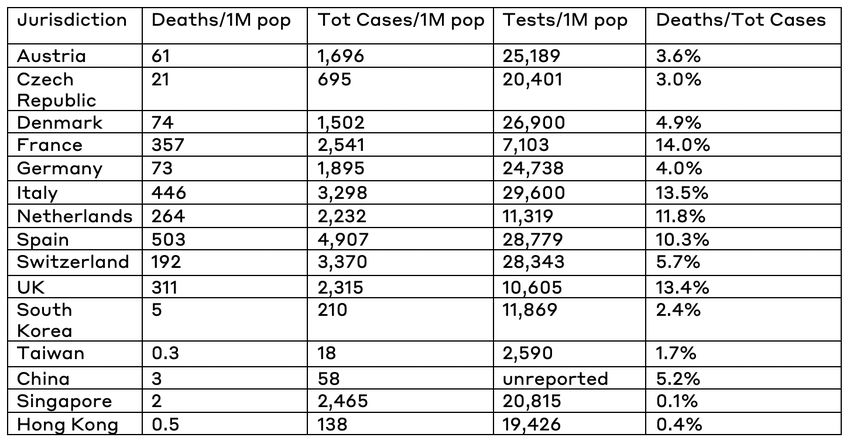
social distancing interventions. Table 1 provides a high-level snapshot as of
April 28, 2020 of the impact of COVID-19 on various East Asian and European
Union countries.
Table 1
Source: https://www.worldometers.info/coronavirus/
While many of these countries are distinct from the United States with respect
to their size, form of government, culture, and extent of personal freedoms,
lessons from their experiences could be helpful for U.S. policymakers.
To that end, the Bipartisan Policy Center initiated a study to assess how
countries around the world are attempting to relax social distancing
interventions as they transition from the initial pandemic wave. To assist with
5this project, BPC analyzed real-time qualitative data from the Health System
Response Monitor – a collaboration of the World Health Organization Regional
Office for Europe, the European Commission, and the European Observatory
on Health Systems and Policies. BPC also corresponded with experts connected
to the Commonwealth Fund’s International Health Policy and Practice
Innovations program, reviewed various media reports and published literature,
and drew on the expertise of an advisory group (see acknowledgments) which
met virtually on April 23, 2020. Focus countries included Austria, the Czech
Republic, Denmark, France, Germany, Italy, Netherlands, Spain, Switzerland,
the United Kingdom, South Korea, Taiwan, China, Singapore, and Hong Kong.
This white paper includes a case study of Germany’s response and approach to
loosening social distancing interventions, preliminary insights from a cross-
country analysis, as well as implications and initial recommendations for the
United States with respect to loosening social distancing interventions.
Germany Case Study
Global responses to COVID-19 vary greatly depending on a variety of factors
including size, geography, and government structure. There is no-one-size-fits-
all response as needs and feasibility differ from country to country. In order
to take lessons learned from countries that may be temporally ahead of the
United States, it is key that these approaches be feasible politically, socially, and
economically in our country.
Germany is comparable to the United States in many ways. Importantly, both
Germany and the United States have federal systems of government – meaning
power is shared between states and the federal government. As such, we
highlight Germany’s COVID-19 response and plans to loosen social distancing
measures in order to explore best practices to be considered for adoption in the
United States.
Response efforts
Germany has the 6th highest number of confirmed cases with more than
160,000 cases and 6,215 deaths. xiii The country saw its first case on January 27.
Since then, the German federal and state governments have taken many steps to
slow the spread of the virus.
Germany’s public health response to COVID-19 can be characterized in five
essential areas: health communication, physical distancing, isolation and
quarantine, monitoring and surveillance, and testing. Targeted efforts in these
6areas have led to decreased spread and the ability to reopen the country.
Health communication has been vital in preventing the spread of COVID-19 as
these efforts require collective participation. In early February, the German federal
government released official recommendations for prevention strategies including
hand hygiene, physical distancing when sneezing and coughing, and respiratory
etiquette. xiv The federal government leveraged social media to disseminate tutorials
for these safety measures. The Robert Koch Institute, or RKI, the government’s central
scientific institution in the field of communicable disease, also held daily press
briefings to communicate information on the outbreak. xv
Another critical prevention measure involves physical distancing since person-
to-person spread is the primary form of transmission. xvi Though states can have
individual plans, German states and the German Chancellor agreed upon similar
measures to delay the spread and alleviate the burden on the health care system.
Throughout March, federal and state governments gradually implemented more
intense physical distancing policies. xvii By March 16, the head of all states decided
to close bars, clubs, theaters, and other social spaces. On March 22, all states
implemented more social distancing measures including people maintaining 1.5
meters of physical distancing and a ban on more than two-person gatherings. One
state, Bavaria, enforced a curfew. The new social distancing measures were set to end
in early April but were extended until April 19. xviii Many states announced fines for
those who violate social distancing regulations. In addition to physical distancing
policies, the country requires isolation and quarantine for confirmed COVID-19 cases
and contact persons.
Monitoring and surveillance measures allowed medical officials to track the outbreak.
Germany’s RKI regularly updates laboratory testing criteria to ensure those who are
most at risk receive testing priority. The criteria for testing have changed throughout
the course of the pandemic. In order to determine testing needs, RKI conducted a
nationwide laboratory survey. The country has a high capacity for testing with the
ability to administer more than 600,000 tests per week. xix On April 9, RKI announced
an antibody study to monitor virus more efficiently where nearly 5,000 tests will
be administered per day. xx Additional antibody studies are in process to sample
individuals in four outbreak areas and a broader study looking at a representative
sample of 15,000 individuals across 150 locations in Germany. xxi
The Minister of Health also confirmed Germany’s Public Health Service will be
deploying team members and utilizing technology to enhance monitoring efforts
starting on March 25. All states agreed to have at least one contract tracing team of
five public health personnel per 20,000 inhabitants. To support these efforts, public
employees from other agencies will provide administrative assistance in identifying
and containing COVID-19 outbreaks. If further support is needed in areas of high
infection, soldiers and armed forces officials can be utilized. Additionally, the Ministry
of Health is providing resources to upgrade reporting software and hardware. These
7upgrades will help relieve administrative burden on local health offices as symptoms
are currently being monitored through daily house calls. Additionally, a German
research institute is developing a federally funded COVID-19 app. Users can receive
direct notifications from local health authorities on COVID-19 test results and access
contract tracing capabilities. xxii
Germany’s Plans to Reopen
Given that there is no vaccine or standard treatment for COVID-19, countries will
likely have to adopt a “suppress and lift” strategy. The German government is set to
announce official next steps on May 6. However, states generally have the authority
to conduct reopening autonomously. As of April 15, German states agreed to gradually
lift some social distancing rules including allowing car dealerships, bicycle shops,
bookstores, and stores up to 800 square meters to open.
All physical distancing measures will stay in place until May 3 and large gatherings
are banned until August 31. In order to decrease transmission while loosening social
distancing measures, all federal states have required face masks be worn on public
transportation and in stores.
The step-by-step plan is largely contingent upon the virus’ reproduction number
and the number of newly infected people per day. These data are dependent on the
country’s testing capacity – both for acute infections and past infections. In fact,
Germany only considered reopening once its reproduction rate fell below 1, to 0.7 on
April 16. xxiii Scientists suggest a reproduction rate below 1 means the virus will spread
slowly and eventually die out. xxiv Testing capacity will serve as a critical public health
indicator as these measures can determine the country’s ability to deliver necessary
care and contain the virus. According to the World Health Organization, countries
with extensive testing have less than 10% of their tests come back positive. Germany
is well below that benchmark with a positive result rate of 7.5%. xxv
Areas and population groups with relatively low risk of infection are set to open
first. On May 4, schools will begin to reopen. Students leaving secondary school or
vocational school this year or have qualification examinations will return on May
4. Students in their final year of primary school will also resume classes on May 4,
but younger elementary students do not have a return date set. Prior to any students
returning to school, the Standing Conference of Ministries of Education and Cultural
Affairs of the Länder in the Federal Republic of Germany must develop a plan for
teaching with hygiene, social distancing measures such as such as reduced class sizes,
and organization steps to prevent lines or groups from forming.
Bavaria has decided to delay secondary and primary school openings until May
11. Regardless of the reopening date, all schools must adhere to special hygiene
standards. Hair and grooming service providers are also allowed to begin reopening
with strict hygiene rules.
8Due to necessary prevention strategies, economies across the world are suffering. The
German government has allocated $825 billion to support the economy. In addition,
German officials have detailed a variety of measures to help the economy and labor
market. Economic aid is focused in three areas: extending safety net protections,
boosting employment and retention of staff in key sectors, and providing tax relief and
direct subsidies. Key to extending social support is expanding childcare to mitigate
necessary school and day-care closures. Under the Infection Protection Act, parents
who now provide childcare for children up to 12 years of age are eligible to claim
compensation for up to 67% of the net income. xxvi In order to support small business,
the federal government is distributing a one-time emergency supplement depending
on the size of the business.
The Ifo Institute for Economic Research recommends priority for reopening be given
to sectors that cannot easily work remotely especially those in the production industry
who could aid in manufacturing a vaccine. xxvii
Preliminary Insights
Based on BPC’s cross-country analysis, below are eight preliminary insights, along
with implications and initial recommendations for the United States.
1. Criteria for Loosening Social Distancing Interventions – Few countries have
explicit transparent quantitative criteria to guide decision-making. In Germany, as
mentioned above, the basic reproduction number, or R0, is continuously monitored
by the federal and state governments and must be kept under 1 to manage hospital
capacity. The Outbreak Management Team, which advises the government of
Netherlands on measures that should be met before social distancing interventions
are gradually eased, also recommends the R0 should be below 1 for a period of
time. It also generally recommends 1) the healthcare system, including ICUs,
should be no longer working at or above its capacity and should have had time to
recover; 2) testing capacity should be sufficient; 3) contact tracing capacity should
be sufficient to analyze large numbers of data; 4) and measurement systems should
be available to evaluate the effect of the strategy. xxviii In Switzerland, the gradual
relaxation of measures depends on criteria including the number of new infections,
hospital admissions and deaths, and hospital occupancy rates. xxix
Implications for United States: Guidelines for Opening America Up Again specifies
gating criteria based on a downward trajectory of influenza-like illness and COVID-
like cases reported within a 14-day period, a downward trajectory of documented
cases or percentage of positive tests within a 14-day period, and hospital capacity
without crisis care. xxx While some plans recommend a sustained reduction of
9cases for 14 days, other state plans such as Maryland’s call for first, a reduction in
the hospitalization rate, including the current ICU bed usage rate, for COVID-19
patients and second, a reduction in the number of daily COVID-19 deaths. xxxi, xxxii
The trajectory of cases or other metrics such as the doubling time of cases may be
somewhat limiting until there is a more robust testing infrastructure in place.
Recommendation: States, with the assistance of the federal government, should
develop and utilize a uniform and consistent set of quantitative metrics to
determine loosening of social distancing interventions that include indicators of
epidemic spread, health care capacity, and public health capacity.
2. Timeframe Between Phases – Various countries have specified time lengths
between phases of re-opening the economy. For example, Switzerland, the Czech
Republic, and Denmark all plan to allow 2-3 weeks between opening up various
sectors (e.g., business, schools). xxxiii, xxxiv
Implications for United States: The time period between stages in Guidelines
for Opening America Up Again are similar to the initial gating criteria: 14-day
reduction in symptoms and cases. Some states reportedly are considering shorter
timeframes between phases of opening up nonessential businesses. xxxv
Recommendation: Given the incubation period of the virus is estimated to be
between 2-14 days and the time from presenting symptoms to being tested can
range from a few days to over a week, two weeks between phases seem the absolute
minimum policymakers should wait to assess the impacts of infection spread prior
to further opening up of the economy. xxxvi
3. Sequencing Sectors of Economy – Various countries are sequencing the opening
of their economy based on the level of risk of transmission in specific sectors.
For example, Austria has opened smaller shops and garden centers first with
plans to open up bigger shops and malls as early as May, followed by hotels and
restaurants; the Czech Republic is largely following a similar sequence. xxxvii Other
countries appear to be also taking into account the level of economic importance
and disruption to a sector in terms of unemployment. For example, in addition to
prioritizing highly automated factories with a low risk of transmission, Germany
is considering parts of the manufacturing sector as a priority for opening, given its
high value-add to the economy. xxxviii Spain has also reportedly allowed restarting
of construction and manufacturing, although many businesses remain closed. xxxix
Italy has announced it will begin lifting a nationwide lockdown on May 4 with
construction and manufacturing being the first sectors allowed to restart. xl
Implications for United States: Experts have categorized nonessential businesses
based on their contact intensity, number of contacts, and modification potential
to allow for social distancing. This should guide policymakers with decisions
about opening up various sectors based on risk of transmission. xli Other experts
10have created frameworks mapping transmission risk by business disruption and
recommended prioritizing those sectors with low transmission risk and high
business disruption contingent upon occupational safety requirements being
met. xlii
Recommendation: Prior to these decisions being made, it is critical that CDC and
the Occupational Safety and Health Administration update their guidance for
employers to prepare and respond to COVID-19, and it is incumbent that these
entities be required to follow the recommended best practices for conducting social
distancing. xliii
4. School Openings – Countries differ with respect to the phases during which
school openings might occur, and this is further stratified based on the type of
school – primary, secondary, or higher education system. Some experts believe
the younger the child, the sooner that schools should re-open since younger
children cannot learn autonomously, need more in-person care and support,
and depend heavily on schools for their emotional and social development. In
addition, younger children who aren’t able to go to school will then need childcare,
further complicating the lives of many working parents; for example, nurseries in
Switzerland did not close at all for this reason during its recent pandemic wave. xliv
Implications for United States: While it appears children are less likely to develop
severe COVID-19 infections, there are many outstanding scientific questions
with respect to the transmissibility of the virus in children as well as how to best
protect high-risk individuals (e.g., older adults, individuals with chronic conditions)
who work in a school setting. There is also data to suggest that closing schools may
only have a small effect on limiting the spread of COVID-19. xlv Given the school
calendar in East Asian countries runs through the summer months, there may be
opportunities for the United States to track their experiences.
Recommendation: More research on school closures and guidance on mitigation
practices are urgently needed to inform policymakers prior to the start of the
2020-21 school year. Institutions of higher learning should also start preparing
and implementing plans to optimize distance learning and ensure the on-campus
safety of faculty and staff when public health authorities allow for reopening.
5. SARS-CoV-2 Testing1 – Initially, many of the countries analyzed noted difficulty
ramping up testing due to a shortage of reagents. With the realization that
loosening social distancing interventions is incumbent upon increased testing,
more countries are now planning to focus on vulnerable populations beyond just
symptomatic patients. For example, Austria recently announced plans to test
1 Discussion focuses on testing of the virus as opposed to antibody tests. This is because the latter
are still very much a work in progress in terms of their accuracy and implications for immunity;
thus, at this time it is difficult to use them as a guide to loosen social distancing interventions.
11all personnel and residents of retirement and nursing homes, and Denmark will
do the same in the event there is at least one confirmed case of COVID-19 in an
institution. xlvi, xlvii Italy’s regional experiences in Lombardy and Veneto demonstrate
the importance of testing to both protect vulnerable populations and to limit
transmission. Veneto’s significantly lower mortality rate compared to Lombardy is
thought to be partially due to its roughly four-times higher testing rate. In addition
to testing vulnerable populations, there is an ongoing regional pilot in Veneto
conducting testing on essential workers such as supermarket workers, public
transportation personnel, and police officers. xlviii WHO leaders have publicly stated
if the percentage of positive cases are less than 10%, then it is likely a country is
testing well. xlix
Implications for United States: The United States is learning from the experiences
of other countries. For example, in February, South Korea received global attention
for its drive-through screening centers which allowed more people to get tested
with less social contact. This has been emulated across various parts of the United
States. Nevertheless, most of the countries analyzed currently have higher testing
per capita than the United States. According to The COVID Tracking Project, the
United States performed about 1.5 million tests in the last week.l To replicate
Veneto’s successful testing strategy, the United States would have to increase
weekly tests to approximately 5 million. Many of the countries analyzed, such as
Austria, Denmark, and Netherlands, have a stated goal or capacity that would be
equivalent to an average of 4 million tests per week in the United States.
Recommendation: In other words, the immediate priority for the United States
should be to triple current SARS-CoV-2 testing capacity in the coming weeks to
support the loosening of social distancing interventions. Testing will serve to
provide direct protection to vulnerable populations and indirect protection to the
community by identifying and mitigating potential transmission hotspots.
6. Contract Tracing – As described earlier, Germany has provided the most
specificity in terms of the number of contract tracers it will require to reduce the
spread of COVID-19: five people in public health offices per 20,000 people. During
its first pandemic wave, Wuhan, China, required 1,800 contact investigator teams
of five people each before the city reopened – approximately one investigator for
every 1,200 individuals.li
To support contract tracers, Germany, France, and the Netherlands are considering
using voluntary mobile apps with Bluetooth technology for contact tracing.lii All of
the East Asian focus countries have used some form of technology-aided contact
tracing.liii Singapore uses a contact-tracing smartphone app – TraceTogether – that
identifies people who have been within two meters of a COVID-19 patient for at
least 30 minutes for follow up action by contact tracers.liv
Implications for United States: Experts estimate to begin loosening social
distancing interventions, at least 100,00 contact tracers will be needed to rapidly
identify contacts of infected individuals and ensure they self-isolate for 14 days;
this effort would require an estimated $3.6 billion over 12 monthslv; other experts
have called for $12 billion to help expand the contract tracing workforce.lvi The
12public health infrastructure has been chronically underfunded well before
COVID-19; in fact, experts have identified a $4.5 billion annual gap between
what the United States currently spends to build public health capabilities (e.g.,
surveillance, laboratory capacity, emergency preparedness and response) and
what would be required to assure the conditions that people can be healthy. The
Public Health Leadership Forum has called on the creation of a new Public Health
Infrastructure Fund to address this funding gap.lvii
Recommendation: Congress should address both the short-term contact tracing
and long-term infrastructure needs of public health in the next supplemental
package to optimally address the COVID-19 pandemic. Partnerships between
government and technology companies to develop Bluetooth privacy-protected
apps to assist with contract tracing should also be supported and accelerated. lviii,lix
7. Public Use of Non-Medical Masks – Several of the countries analyzed, such as
Austria, the Czech Republic, France, and Germany, are mandating the public wear
cloth-based masks particularly in areas where social distancing is not possible
such as public transport and grocery stores.lx The public use of masks has been
common across several East Asian countries as well. In phase one of Taiwan’s
social distancing measures, if individuals wear face masks properly, the social
distancing recommendations can be ignored.lxi
Implications for United States: Limited data exists for the public use of cloth-
based masks in preventing the spread of infectious diseases. Concerns include
inappropriate wearing of masks, lack of effectiveness due to moisture retention,
and a false sense of security that might reduce compliance with social distancing
interventions. Nevertheless, the theoretical promise of physically blocking droplets
spread from a cough or sneeze particularly in someone otherwise asymptomatic
has led to recommendations and in some cases, mandates for their use in public
particularly when social distancing is not possible. While the CDC has made such
a recommendation, various counties, cities, and states across the United States are
now mandating the use of face masks in public or upon entering stores.
Recommendation: Given that this trend will likely continue, the CDC should
launch a national awareness campaign to teach Americans best practices with
respect to making, donning, doffing, disinfecting, and maintaining cloth-based
masks. Central to this campaign must be the key message that masks do not in
any way replace personal protective measures or social distancing but rather
complement these strategies.
8. Communication – Winning the public’s trust is critical in any public health
crisis. The vice president of Taiwan, also a prominent epidemiologist, provides
regular public service announcement broadcasts from the office of the president
about key public health aspects of the response.lxii In Switzerland, even though the
13federal government has introduced relaxations of social distancing measures, the
recommendations to the general population are: “Stay at home whenever possible
and avoid unnecessary contact. Stay at home and go outside only if it is really
necessary. If you are older than 65 or you have some pre-existing condition, then it
is strongly recommended that you stay at home unless you need to see a doctor.”lxiii
Implications for United States: Messaging to the American public from the
White House needs to be clear, transparent, and evidence-based with scientific
information delivered by the nation’s leading medical experts.
Recommendation: The President’s Coronavirus Guidelines for Americans should not
be allowed to expire on April 30 lxiv ; they should be renewed for another month and
then updated based on epidemiological data available at that time. These are general
recommendations supporting personal protective measures and social distancing that
will help Americans slow the spread of the pandemic.
Future Directions
This white paper provides some preliminary insights on how several East Asian and
European Union countries are loosening social distancing interventions. Given that
suppression and lifting of these interventions will be a part of each country’s response
plans for the foreseeable future, additional cross-country analyses may be helpful to
U.S. policymakers. Future analyses should build on this initial effort in the following
ways:
1. Additional topic areas should be covered such as providing temporary housing to
those with confirmed cases of COVID-19 or close contacts who cannot or should
not recover in the home setting due to the likelihood of spreading the virus to
family members. While China forcibly moved close contacts into out-of-home
settings, experts believe this had a significant impact in reducing transmission.lxv
Taiwan provided hotel rooms for those who could not do so at home.lxvi France
is now considering this as part of its plans after its lockdown period.lxvii In the
United States, while individual jurisdictions are partnering with local hotels to
house COVID-19 cases or close contacts, a much more comprehensive nationwide
effort may be warranted.lxviii This is especially true since as of April 22, nearly 8 out
of 10 hotel rooms were empty across the country.lxix
2. In addition to cross-country analyses, more granular data on smaller areas within
countries may give insights into the heterogeneity of responses within a country.
Not all areas of a country are impacted similarly by the pandemic at a given point
of time. Intra-country analyses could be particularly helpful to the United States,
given the reality of individual state decision-making and responses.
143. Additional focus countries may also provide valuable information. Australia and
New Zealand have rapidly suppressed the virus through robust responses and
are contemplating next steps.lxx On the other hand, Japan’s northern island
of Hokkaido is experiencing an even more intense second wave of COVID-19
after restrictions were recently lifted resulting in significantly increased social
interaction.lxxi
15Endnotes
i Johns Hopkins University & Medicine, COVID-19 Dashboard by the Center for Systems Science
and Engineering at Johns Hopkins University, April 2020. Available at: https://coronavirus.jhu.
edu/map.html
ii Centers for Disease Control and Prevention, Community Mitigation Guideline to Prevent
Pandemic Influenza, April 2017. Available at: https://www.cdc.gov/mmwr/volumes/66/rr/
rr6601a1.htm
iii A. Lasry, D. Kidder, M. Hast, et. al., “Timing of Community Mitigation and Changes in Reported
COVID-19 and Community Mobility – Four U.S. Metropolitan Areas, February 26–April 1,
2020,” April 2020. Available at: http://dx.doi.org/10.15585/mmwr.mm6915e2
iv WorldOMeter, “World/Countries/United States,” April 2020. Available at: https://www.
worldometers.info/coronavirus/country/us/
v Nate Silver, “Coronavirus Cases Are Still Growing in Many U.S. States,” FiveThirtyEight, April
23, 2020. Available at: https://fivethirtyeight.com/features/coronavirus-cases-are-still-
growing-in-many-u-s-states/
vi White House, “Guidelines Opening Up America Again,” April 2020. Available at: https://www.
whitehouse.gov/openingamerica/
vii Alaa Elassar, “This is where all 50 States stand on reopening,” CNN, April 2020. Available at:
https://www.cnn.com/interactive/2020/us/states-reopen-coronavirus-trnd/
viii Governor Larry Hogan, Maryland Strong, Roadmap to Recovery, April 2020. Available at:
https://governor.maryland.gov/wp-content/uploads/2020/04/MD_Strong.pdf
ix American Enterprise Institute, National Coronavirus Response A Roadmap to Reopening,
April 2020. Available at: https://www.aei.org/wp-content/uploads/2020/03/National-
Coronavirus-Response-a-Road-Map-to-Recovering-2.pdf
x Johns Hopkins Bloomberg School of Public Health – Center for Health Security, Public Health
Principles for a Phased Reopening During COVID-19: Guidance for Governors, April 2020.
Available at: https://www.centerforhealthsecurity.org/our-work/pubs_archive/pubs-
pdfs/2020/200417-reopening-guidance-governors.pdf
xi National Governors Association, Roadmap to Recovery: A Public Health Guide for Governors,
April 2020. Available at: https://www.nga.org/wp-content/uploads/2020/04/NGA-Report.
pdf
xii University of Oxford, “Coronavirus Government Response Tracker,” March 2020. Available at:
https://www.bsg.ox.ac.uk/research/research-projects/coronavirus-government-response-
tracker
xiii Johns Hopkins University, “Coronavirus Resource Center: COVID-19 Dashboard,” 2020.
Available at: https://coronavirus.jhu.edu/map.html
xiv COVID-19 Health System Response Monitor, “Germany,” April 2020. Available at: hhttps://
www.covid19healthsystem.org/countries/germany/countrypage.aspx
16xv Ibid.
xvi World Health Organization, “Modes of transmission of virus causing COVID-19: implications
for IPC precaution recommendations,” 2020. Available at: https://www.who.int/news-room/
commentaries/detail/modes-of-transmission-of-virus-causing-covid-19-implications-for-ipc-
precaution-recommendations
xvii COVID-19 Health System Response Monitor, “Germany,” April 2020. Available at: https://www.
covid19healthsystem.org/countries/germany/countrypage.aspx
xviii Ibid.
xix Riham Alkousaa, “Germans told not to lower guard as lockdown is eased,” Reuters, April 2020.
Available at: https://www.reuters.com/article/us-health-coronavirus-germany-rki/few-hundred-
daily-coronavirus-cases-will-enable-easing-lockdown-germanys-rki-idUSKCN22613X?il=0
xx Rob Schmitz, “Germany is Conducting Nationwide COVID-19 Antibody Testing,” NPR, April 21, 2020.
Available at: https://www.npr.org/sections/coronavirus-live-updates/2020/04/21/839594202/
germany-is-conducting-nationwide-covid-19-antibody-testing
xxi COVID-19 Health System Response Monitor, “Germany”, “Testing,” April 2020. Available at:
https://www.covid19healthsystem.org/countries/germany/countrypage.aspx
xxii Natasha Lomas, Germany’s COVID-19 contacts tracing app to link to labs for test,” Tech Cruch,
April 23, 2020. Available at: https://techcrunch.com/2020/04/23/germanys-covid-19-contacts-
tracing-app-to-link-to-labs-for-test-result-notification/
xxiii Deutschland.de, “The timeline regarding coronavirus in Germany,” April 2020. Available at:
https://www.deutschland.de/en/the-timeline-corona-virus-germany
xxiv Joseph Eisenburg, “How Scientents Quantify the Intensity of an Outbreak Life COVID-19,”
University of Michigan Health Lab, March 17, 2020. Available at: https://labblog.uofmhealth.org/
rounds/how-scientists-quantify-intensity-of-an-outbreak-like-covid-19
xxv Angela Dewan, “Lifting lockdowns safely relies on effective testing. Germany surges ahead but US
states flying blind,”CNN, April 25, 2020. Available at: https://www.cnn.com/2020/04/25/world/
georgia-us-germany-coronavirus-lockdown-ger-intl/index.html
xxvi Louisa Kallhoff and Andre Zimmerman, “COVID-19 Update: Germany to Give Working Parents
State-Funded Compensation Claim During Closure of Childcare and Schools,” JDSUPRA, April
2020. Available at: https://www.jdsupra.com/legalnews/covid-19-update-germany-to-give-
working-75572/
xxvii Ibid.
xxviii COVID-19 Health System Response Monitor, “Netherlands”, April 2020. Available at: https://
www.covid19healthsystem.org/countries/netherlands/countrypage.aspx
xxix COVID-19 Health System Response Monitor, “Switzerland”, April 2020. Available at: https://
www.covid19healthsystem.org/countries/switzerland/countrypage.aspx
xxx White House, Guidelines Opening Up America Again, April 2020. Available at: https://www.
whitehouse.gov/openingamerica/
xxxi American Enterprise Institute, National Coronavirus Response A Roadmap to Reopening, April
2020. Available at: https://www.aei.org/wp-content/uploads/2020/03/National-Coronavirus-
Response-a-Road-Map-to-Recovering-2.pdf
17xxxii Governor Larry Hogan, Maryland Strong, Roadmap to Recovery, April 2020. Available at: https://
governor.maryland.gov/wp-content/uploads/2020/04/MD_Strong.pdf
xxxiii COVID-19 Health System Response Monitor, “Switzerland”, April 2020. Available at: https://
www.covid19healthsystem.org/countries/switzerland/countrypage.aspx
xxxiv Correspondence with Boston Consulting Group, April 25, 2020.
xxxv Alaa Elassar, “This is where all 50 States stand on reopening,” CNN, April 2020. Available at:
https://www.cnn.com/interactive/2020/us/states-reopen-coronavirus-trnd/
xxxvi Centers for Disease Control and Prevention, “Clinical Questions about COVID-19: Questions
and Answers,” April 2020. Available at: https://www.cdc.gov/coronavirus/2019-ncov/hcp/faq.
html#:~:text=the%20incubation%20period%20may%20range,2%E2%80%9314%20days.
xxxvii Marta Frackowiak, Jagoda Darlak, Anita Kobylinska, and Tommy Lund, “Factbox: Europe
Begins Easing Coronavirus Lockdowns,” Reuters, April 2020. Available at: https://www.reuters.
com/article/us-health-coronavirus-europe-factbox/factbox-europe-begins-easing-coronavirus-
lockdowns-idUSKBN21Z1P0
xxxviii Ifo Institute for Economic Research, Making the Fight Against the Coronavirus Pandemic
Sustainable, April 2020. Available at: https://www.ifo.de/DocDL/Coronavirus-Pandemic_
Strategy.pdf
xxxix Marta Frackowiak, Jagoda Darlak, Anita Kobylinska, and Tommy Lund, “Factbox: Europe
Begins Easing Coronavirus Lockdowns,” Reuters, April 2020. Available at: https://www.reuters.
com/article/us-health-coronavirus-europe-factbox/factbox-europe-begins-easing-coronavirus-
lockdowns-idUSKBN21Z1P0
xl Bloomberg News, “U.S. Cases Up 3.3%; Italy to Start Easing Lockdown: Virus Update,” Bloomberg,
April 2020. Available at: https://www.bloomberg.com/news/articles/2020-04-25/u-s-cases-rise-
4-5-u-k-premier-returns-to-work-virus-update
xli Johns Hopkins Bloomberg School of Public Health – Center for Health Security, Public Health
Principles for a Phased Reopening During COVID-19: Guidance for Governors, April 2020. Available
at: https://www.centerforhealthsecurity.org/our-work/pubs_archive/pubs-pdfs/2020/200417-
reopening-guidance-governors.pdf
xlii Correspondence with Boston Consulting Group, April 25, 2020.
xliii Centers for Disease Control and Prevention, “Interim Guidance for Businesses and Employers to
Plan and Respond to Coronavirus Disease 2019 (COVID-19),” April 2020. Available at: https://www.
cdc.gov/coronavirus/2019-ncov/community/guidance-business-response.html
xliv Correspondence with Dr. Rudolf Blankart & Kosta Shatrov, April 25, 2020.
xlv R. Viner, S. Russell, H. Croker, J. Packer, J. Ward, C. Stansfield, et. al., “School closure management
Practices during coronavirus outbreaks including COVID-19: a rapid systematic review,” The Lancet
Child & Adolescent Health, 4(5): 397-494, April 6, 2020. Available at: https://www.thelancet.com/
journals/lanchi/article/PIIS2352-4642(20)30095-X/fulltext
xlvi COVID-19 Health System Response Monitor, “Austria”, April 2020. Available at: https://www.
covid19healthsystem.org/countries/austria/countrypage.aspx
xlvii COVID-19 Health System Response Monitor, “Denmark”, April 2020. Available at: https://www.
covid19healthsystem.org/countries/denmark/countrypage.aspx
18xlviii COVID-19 Health System Response Monitor, “Italy”, April 2020. Available at: https://www.
covid19healthsystem.org/countries/italy/livinghit.aspx?Section=1.5%20Testing&Type=Section
xlix Angela Dewan, “Lifting lockdowns safely relies on effective testing. Germany surges ahead but US
states flying blind,”CNN, April 25, 2020. Available at: https://www.cnn.com/2020/04/25/world/
georgia-us-germany-coronavirus-lockdown-ger-intl/index.html
l The COVID Tracking Project, “US Historical Data,” April 2020. Available at: https://covidtracking.
com/data/us-daily
li Association of State and Territorial Health Officials, A Coordinated, National Approach to Scaling
Public Health Capacity for Contact Tracing and Disease Investigation, April 2020. Available at:
https://www.astho.org/COVID-19/A-National-Approach-for-Contact-Tracing/
lii World Health Organization, “COVID-19 Health Systems Monitor,” April 2020. Available at: https://
www.covid19healthsystem.org/mainpage.aspx
liii Yasheng Huang, Meicen Sun, and Yuze Sui, “How Digital Contact Tracing Slowed Covid-19 in
East Asia,” Harvard Business Review, April 15, 2020. Available at: https://hbr.org/2020/04/how-
digital-contact-tracing-slowed-covid-19-in-east-asia
liv “Combatting Covid-19: Lessons from Singapore, South Korea and Taiwan,” Knowledge@Wharton,
April 2020. Available at: https://knowledge.wharton.upenn.edu/article/singapore-south_korea-
taiwan-used-technology-combat-covid-19/
lv Johns Hopkins University, A National Plan to Enable Comprehensive COVID-19 Case Finding and
Contact Tracing in the US, April. Available at: https://www.centerforhealthsecurity.org/our-work/
pubs_archive/pubs-pdfs/2020/200410-national-plan-to-contact-tracing.pdf
lvi Franco Ordoñez, “Ex-Officials Call for $46 Billion for Tracing, Isolating in Next Coronavirus
Package,” NPR, April 27, 2020. Available at: https://www.npr.org/2020/04/27/845165404/ex-
officials-call-for-46-billion-for-tracing-isolating-in-next-coronavirus-packa
lvii Resolve NGO, Developing a Financing System to Support Public Health Infrastructure, October
2018. Available at: https://www.resolve.ngo/docs/developing-a-financing-system-to-support-
foundational-public-health-capabilities-final-draft-10.2.pdf
lviii David Phelan, “Apple & Google Surprise Update to COVID-19 App: Better Privacy, Improved
Bluetooth, No Huawei,” Forbes, April 2020. Available at: https://www.forbes.com/sites/
davidphelan/2020/04/24/apple--google-reveal-surprise-update-to-covid-19-contact-tracing-
better-privacy-more-precise-bluetooth-no-huawei/#8b88436ad911
lix Anindya Ghose and D. Daniel Sokol, “Unlocking Platform Technology to Combat Health Pandemics,”
Yale Journal on Regulation, March 18, 2020. Available at: https://www.yalejreg.com/nc/
unlocking-platform-technology-to-combat-health-pandemics-by-anindya-ghose-and-d-daniel-
sokol/?fbclid=IwAR2AzKcMt2H-HPnjLAQaxSwrliPr32_0CyvnUtthaTyCw6oRuyKLy0WxtyY
lx COVID-19 Health System Response Monitor, “Cross Country Analysis,” April 2020. Available at:
https://analysis.covid19healthsystem.org/
lxi Taiwan Centers for Disease Control, “CECC Announces Social Distancing Measures for COVID-19,”
April 2020. Available at: https://www.cdc.gov.tw/En/Bulletin/Detail/kM0jm-IqLwNBeT6chKk_
wg?typeid=158
lxii C. J. Wang, C. Y. Ng, R. Brook, Response to COVID-19 in Taiwan – Big Data Analytics, New
Technology, and Proactive Testing, March 2020. Available at: https://jamanetwork.com/journals/
jama/fullarticle/2762689
19lxiii Correspondence with Dr. Rudolf Blankart & Kosta Shatrov, April 22, 2020.
lxiv White House, The President’s Coronavirus Guidelines for America – 30 Days to Slow The Spread,
March 2020. Available at: https://www.whitehouse.gov/wp-content/uploads/2020/03/03.16.20_
coronavirus-guidance_8.5x11_315PM.pdf
lxv Nathan Vanderklippe, “‘Out-of-home’ measures in China helped limit spread of COVID-19,
epidemiologists say,” The Globe and Mail, April 7, 2020. Available at: https://www.theglobeandmail.
com/world/article-out-of-home-quarantine-measures-in-china-helped-limit-spread-of/
lxvi Chang-Ching Tu, “Lessons from Taiwan’s experience with COVID-19,” Atlantic Council, April 7,
2020. Available at: https://atlanticcouncil.org/blogs/new-atlanticist/lessons-from-taiwans-
experience-with-covid-19/
lxvii COVID-19 Health System Response Monitor, “France”, April 2020. Available at: https://www.
covid19healthsystem.org/countries/france/countrypage.aspx
lxviii A.D. Quig and Stephanie Goldberg, “Chicago to re-open shuttered hospitals, use hotels
for COVID-19 patients,” Modern Healthcare, March 24, 2020. Available at: https://www.
modernhealthcare.com/government/chicago-re-open-shuttered-hospitals-use-hotels-covid-19-
patients
lxix American Hotel and Lodging Association, COVID-19’S IMPACT ON THE HOTEL INDUSTRY, April
2020. Available at: https://www.ahla.com/covid-19s-impact-hotel-industry
lxx Damien Cave, “Vanquish the virus? Australia and New Zealand Aim to Show the Way,” New York
Times, April 24, 2020. Available at: https://www.nytimes.com/2020/04/24/world/australia/
new-zealand-coronavirus.html?utm_source=pocket-newtab
lxxi Abigail Leonard, “This Japanese Island Lifted Its Coronavirus Lockdown Too Soon and Became
a Warning to the world,” Time, April 2020. Available at: https://time.com/5826918/hokkaido-
coronavirus-lockdown/
2021
Policy Areas

                                                                             Economy

1225 Eye St NW, Suite 1000                                                   Energy
Washington, DC 20005

bipartisanpolicy.org                                                         Finance

202 - 204 - 2400
                                                                             Governance

                                                                             Health

                                                                             Housing

                                                                             Immigration

                                                                             Infrastructure

                                                                             National Security

The Bipartisan Policy Center (BPC) is a Washington, D.C.-based think tank
that actively fosters bipartisanship by combining the best ideas from both
parties to promote health, security, and opportunity for all Americans.
Our policy solutions are the product of informed deliberations by former
elected and appointed officials, business and labor leaders, and academics
and advocates who represent both ends of the political spectrum.

BPC prioritizes one thing above all else: getting things done.

    @BPC_Bipartisan
    facebook.com/BipartisanPolicyCenter
    instagram.com/BPC_Bipartisan
You can also read


