MAKING GENERAL SURVEILLANCE WORK: MYPESTGUIDE 'PANTRY BLITZ' - LAURA FAGAN, DEVELOPMENT OFFICER DEPARTMENT OF PRIMARY INDUSTRIES & REGIONAL ...
←
→
Page content transcription
If your browser does not render page correctly, please read the page content below

Making General Surveillance Work:
      MyPestGuide™ ‘Pantry Blitz’

Laura Fagan, Development Officer
Department of Primary Industries & Regional Development
Laura.Fagan@dpird.wa.gov.au
+61 449 979 078

                      Making General Surveillance Work, 9-10th Sept 2021
Our surveillance goals
Problem
• Industries are vulnerable to
  harmful exotic pests & diseases.
• Export of billions of dollars of
  Australian products is dependent
  on proof of area freedom from
  pests.
• Surveillance gaps means less
  data to support market access.
                                                        Free MyPestGuide™ reporting
Solution                                                tools were designed and tested.
• Make biosecurity a shared                             Experts verify incoming data to
  responsibility                                        improve early detection of pests.
• Provide everyone with an
                                         Pantry blitz

                              Pantry                    Data is analysed to deliver a
  app plus web-based pest     X2 beetles, moth?
                                                        probability of area freedom from
  ID and reporting tools.                               pests.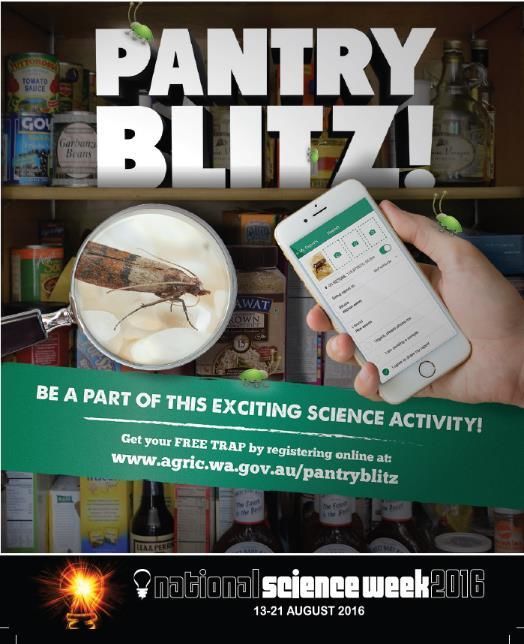
‘Pantry Blitz’ surveillance

                                                      General Surveillance
 Relies heavily on                                                         Relies heavily on
trained personnel                                                          community and
   and technology                                                          industry engagement

                        Need a mixture of
Expensive                     both
                                                                             Irregular
                     Khapra beetle (Trogoderma granarium) by Pia Scanlon
• A community event to
  discover which pests
  occur in WA pantries.

• Metro and rural
  communities were
  provided with traps.

• Aim was to increase
  community awareness
  about our food supply
  chain and engage
  across the agricultural
  sector.
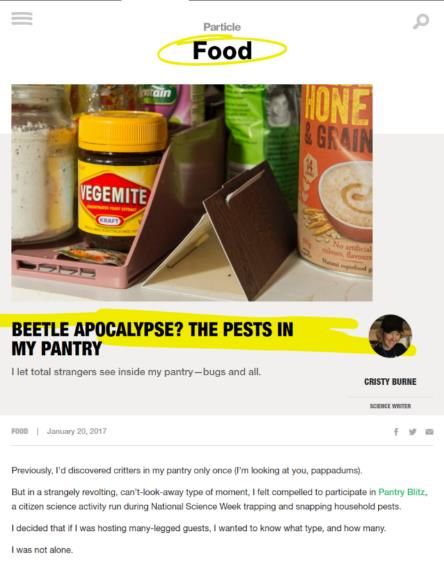
High risk pests in my pantry…really?

Carpet beetles such as Anthrenocerus australis, Anthrenus
verbasci, Attagenus unicolor, Antherenus flavipes
                                                                                                      Karnal bunt (Tilletia indica)

                                                                                Pantry blitz

        Khapra beetle larvae (Trogoderma granarium)                                            Indian meal moth (Plodia interpunctella)

                                                            Pantry

                                                            X2 beetles, moth?

 Khapra beetle (Trogoderma granarium) by Pia Scanlon                                                Rice weevil(Sitophilus oryzae)
Pantry Blitz 2016
• A general surveillance
  program for the public to take
  part

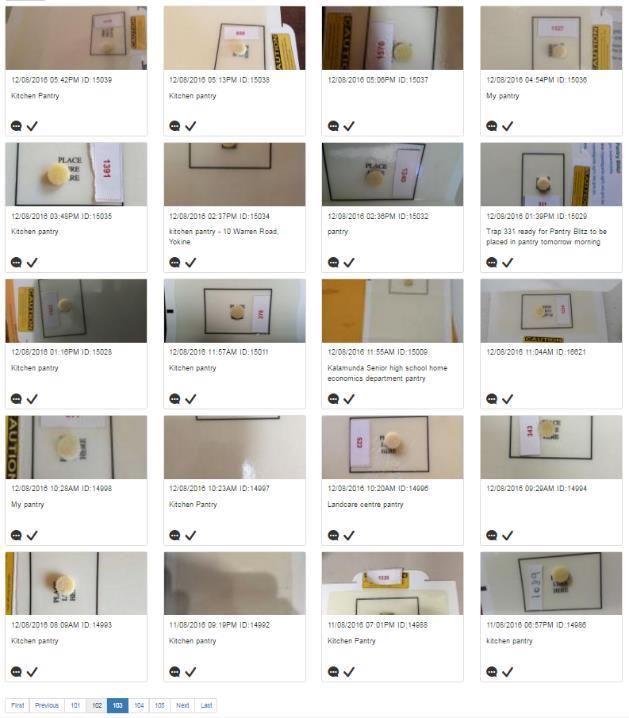
• Participants sign up to receive
  a sticky trap+lure+instructions

• They report findings using the
  MyPestGuide™ Reporter App

• Provide data on the presence
  and absence of pests; shows
  pest-free areas

Community response

Over 2,252 reports
received on the
Pantry Blitz website
Every single report
acknowledged by our
experts.

The dataflow process
Pantry Blitz 2017
Improve biosecurity awareness by explaining
     why it’s important to report zeros
   Inference adds value to every report
         2016
         2017

                                                 Photos by Pia Scanlon

 Carpet beetle reports infer we don’t have khapra beetle.
 So, reporting all species is important data!
Pantry Blitz 2021
Number of reports sent by
participants 2021
300
Number of people
250 4446 Cigarette beetle
200 1279 Booklice
150 679 Indian meal moth
100 11 Carpet beetle
50
0
1 2 3 4 5 6 7 8 9 10 More
Pantry Blitz 2016 Number of reportsPantry Blitz 2021
Reasons for participating in the Pantry Blitz
To contribute to protecting and caring for our environment
To contribute to science
To contribute to protecting agricultural production
To prevent harm to plants and/or animals
To protect ecosystem services, e.g. protection of habitats, water…
Because it is the right thing to do
To contribute to protecting our economy
To protect particular assets, such as my house, backyard,…
To be part of something bigger that can achieve outcomes I care…
To learn new skills and/or knowledge
To get involved in something new
Because it is my duty to do my bit
Because it is fun
It helps me belong to a group/community of like-minded people
To be viewed favourably by friends, family and peers
0% 10% 20% 30% 40% 50% 60% 70% 80% 90% 100%
Strongly agree Agree Somewhat agree Was not a consideration
1380 Participants signed up and 338 responded to the survey‘Other’ reasons for participating: • Curiosity about insects in their pantry (10%) • Contribute to research and biosecurity efforts (6%) • Contribute to other’s education e.g. own children (3%) • Controlling pests in their households (2%)
What worked well for                      What limits participation in
 participants?                             the Pantry Blitz?

• All aspects of the process e.g.          • Lack of awareness about the
  registration, guidelines, receiving a      existence of the program (38%);
  trap, communication with the program,      including importance of reporting
  use of the app and learning about          zeros.
  pests in the pantry (44%)                • Lack of time or life’s priorities (14%)
• Communication from the program           • Technical issues related to app, trap,
  (16%)                                      barcode (14%)
• Feedback received and associated         • Difficulty following instructions (6%)
  learning about pests in the pantry       • Apathy or lack of interest (4%)
  (13%)
                                           • Privacy (1%)
• The mobile app, including friendliness
  (10%)
What could be improved for next time? • Acknowledge each submission, include a phone line to respond to doubts and provide information on what the blitz finds (9%) • Increase awareness across schools (7%) • Trap suggestions like increasing the numbers, variety of trap forms and placement in the household (6%) • Provide personalised information on what is found during the program and eventual treatments (6%) • Provide a macro lens to take better pictures of small insects and provide comparative images to identify common pests.
Where to now… MyPestGuide™ Pantry Blitz 2022!
How do you report a pest bug in your garden or
                                                                Delivering a
orchard?
                                                                probability of area
                                                                freedom from
                                                                pests...

                                          Making General Surveillance Work, 9-10th Sept
Ongoing Challenges
• People, people, people…especially skilled diagnosticians.
• Maintaining standardised datasets to provide credible
evidence for the absence of exotic pests.
• Data sharing, privacy policy and updating dull procedures.
• Methodology to claim pest ‘area freedom’ for trade and
market access.
• Maintaining existing apps while developing areas to future
proof our diagnostic & surveillance system.
• Communicating how important everyone’s role is in
biosecurity….without boring them to death! The public is
always seeking NEW activities.MyPestGuide™ - WA’s first Pantry Blitz 2016
Guidelines for General Surveillance Programs, ABARES 2021Thank you
Visit dpird.wa.gov.au
Important disclaimer
The Chief Executive Officer of the Department of Primary Industries and Regional
Development and the State of Western Australia accept no liability whatsoever by reason of
negligence or otherwise arising from the use or release of this information or any part of it.
Copyright © Department of Primary Industries and Regional Development, 2021
Making General Surveillance Work, 9-10th SeptABARES Case studies - Overview
Day 1
1. Northern Australia Biosecurity Surveillance (NABS) Net
2. Weed Spotters Network Queensland
3. Weed Spotters Victoria
4. NZ General Surveillance Program – Plant health component
Day 2
1. FishWatch SA
2. MyPestGuideTM Pantry Blitz – Khapra beetle
3. Rural Practitioner Enhanced Disease Surveillance, South Australia
4. State Wide Array Surveillance Program (SWASP)
Making General Surveillance Work, 9-10th Sept
Guidelines for General Surveillance Programs, ABARES 2021MyPestGuide™ surveillance system
a. MyPestGuide™ Reporter app works alongside the online
community reporting system which links to additional field
guides for educating and informing people about pests.
d. Social media
is used to extend
messaging to
individuals.
e. Messaging is
easily adapted to
new campaigns
and pushed out
to individuals
Disease field guide for making reports.
the grains industry
b. Reports can be c. Public reports are verified
responded to by experts. by experts across
Project administrators jurisdictions and mapped.
can follow up to request
a sample, track field
operations and respond
to users requests .You can also read


