Maltese: What a Unique Breed!
←
→
Page content transcription
If your browser does not render page correctly, please read the page content below

Maltese: What a
Unique Breed!
Your dog is special! She’s your best friend and
companion and a source of unconditional love.
Chances are that you chose her because you like
Maltese, and you expected her to have certain traits
that would fit your lifestyle:

•   Trusting and affectionate
•   Compact; does well in small living quarters
•   Gentle-mannered and easy to get along with
•   Highly intelligent, playful, and energetic
•   Confident, steady, and fearless
•   Wonderful companion and family dog
•   Hypoallergenic coat sheds very little
•   Good around other pets and dogs

No dog is perfect, though, and you may have noticed
these characteristics, too:

•   Coat needs to be cared for frequently to prevent
    matting and tear staining
•   Can be snappy around children if not socialized
    properly
•   Difficult to housetrain
•   Has a tendency to bark quite a bit if not trained
    out of this habit
•   Fragile because of her small size
•   Prone to separation anxiety and associated
    barking and chewing behaviors

Is it all worth it? Of course! She’s got her own
personality, and you love her for it.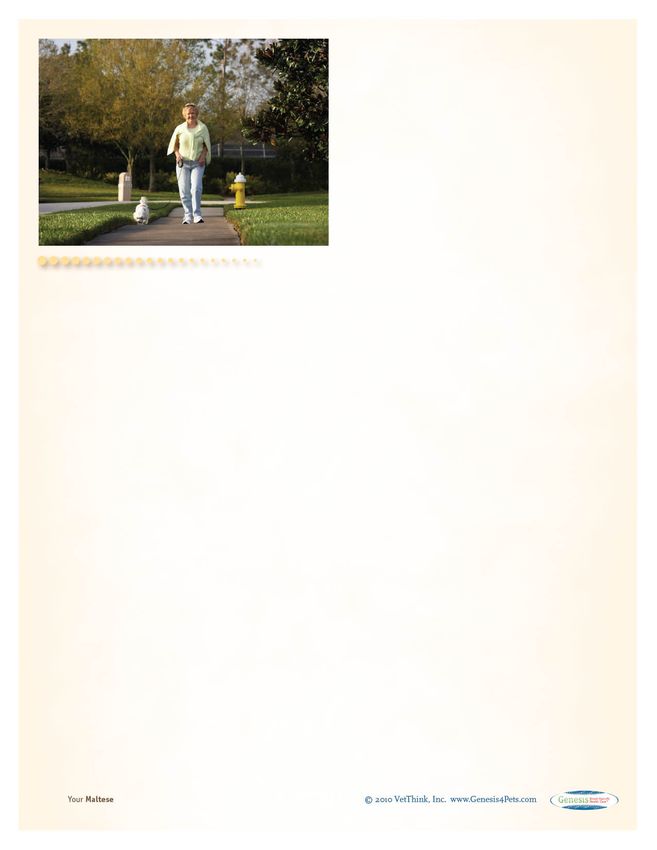
Dental Disease
                                                                     Dental disease is the most common chronic problem in
                                                                     pets, affecting 80% of all dogs by age two. And
                                                                     unfortunately, your Maltese is much more likely to
                                                                     develop this problem than other breeds. It starts with tartar
                                                                     build-up on the teeth and progresses to infection of the
                                                                     gums and roots of the teeth. If we don’t prevent or treat
                                                                     dental disease, your buddy will lose his teeth and be in
                                                                     danger of damaging his kidneys, liver, heart, and joints. In
                                                                     fact, the disease could shorten your pet’s life by one to
                                                                     three years! We’ll clean your dog’s teeth regularly and let
                                                                     you know what you can do at home to keep those pearly
                                                                     whites clean.

                                                                     Fluid Build-up in the Skull
                                                                     Water on the brain, or hydrocephalus, occurs when fluid
                                                                     builds up inside the skull and puts pressure on the brain
                                                                     tissue. This condition is most common in breeds with
                                                                     dome-shaped heads, like your Maltese. It is often present
Your Maltese’s Health                                                when the skull bones don’t fuse properly. Signs include
We know that because you care so much about your dog,                seizures, difficulty training the puppy, dulled mental
you want to take good care of him. That’s why we’ll tell             function, circling, and a spastic gait. It is usually diagnosed
you about the health concerns we’ll be discussing with you           early in life, but occasionally we diagnose it in adult dogs.
over the life of your Maltese.                                       We’ll do testing if symptoms develop. Sometimes surgery
                                                                     can alleviate the problem.
Many diseases and health conditions are genetic, meaning
they’re related to your pet’s breed. That doesn’t mean your          Glaucoma
dog will have these problems; it just means that he’s more           Glaucoma, an eye condition that affects people too, is an
at risk than other dogs. We’ll describe the most common              extremely painful disease (people say it’s like being
issues for Maltese to give you an idea of what may come              stabbed in the eye with an ice pick!) that rapidly leads to
up. Of course we can’t cover every possibility here, so              blindness. Symptoms include squinting, watery eyes;
always check with us if you notice any unusual signs or              cloudiness of the cornea (the clear window at the front of
symptoms.                                                            the eye); and redness in the whites of the eyes. In severe
                                                                     cases, the eye may look swollen or like it’s bulging. We’ll
This guide, and the health evaluation schedule it contains,          perform annual glaucoma screening for your pal to
helps us and you plan for your pet’s health-care needs. At           diagnose and treat it as early as possible. Glaucoma is a
the end of the booklet, we’ve included a description of              medical emergency. If you see symptoms, don’t wait. Call
what you can do at home to keep your Maltese looking and             us or an emergency clinic immediately!
feeling his best. You’ll know what to watch for, and we’ll
all feel better knowing that we’re taking the best possible
care of your pal.

Cancer
Cancer is a leading cause of death in older dogs. Your
Maltese will live longer than many other breeds and is
likely to get cancer in her golden years. Half of all cancers
are cured by surgically removing them, and some types are
treatable with chemotherapy. Early detection is critical!
We’ll perform periodic diagnostic tests and look for lumps
and bumps when we examine your pet. If she is
overweight, we’ll discuss exercise and diet because obesity
is a risk factor for some types of cancer.
Obesity
                                                               Obesity is a significant health problem in dogs and a
                                                               serious disease that may cause arthritis, some types of
                                                               cancer, back pain, and heart disease. Though it’s tempting
                                                               to give your pal food when he looks at you with those
                                                               soulful eyes, you can love him to death with human food
                                                               and treats.

                                                               Parasites
                                                               All kinds of worms and bugs can invade your dog’s body,
                                                               inside and out. Everything from fleas to ticks to ear mites
                                                               can infest her skin and ears. Hookworms, roundworms,
                                                               heartworms, and whipworms can get into her system in
                                                               any number of ways: drinking unclean water, eating or
                                                               stepping on feces, or being bitten by an infected mosquito.
                                                               Some of these parasites can be transmitted to you or a
                                                               family member and are a serious concern for everyone. For
                                                               your friend, these parasites can cause pain, discomfort, and
Heart Disease                                                  even death, so it’s important that we test for them on a
Heart failure is a common cause of death of Maltese in         regular basis. We’ll also recommend preventative
their golden years, and 75% of the heart disease is caused     medication as necessary to keep her healthy.
by valve deterioration. A valve that regulates blood flow
slowly becomes deformed so that it no longer closes
                                                               Spaying or Neutering
tightly. Blood then leaks back around the valve and strains
                                                               One of the best things you can do for your Maltese is to
the heart. Pets with heart valve disease (sometimes called
                                                               have him neutered (called spaying in females). In males,
mitral valve disease) have a heart murmur that can be
                                                               this means we surgically remove the testicles, and in
heard with a stethoscope. If your dog has a heart murmur
                                                               females, it means we surgically remove the uterus and
or physical signs that suggest heart problems, we’ll
                                                               ovaries. Spaying or neutering decreases the likelihood of
perform diagnostic testing to determine the severity of the
                                                               certain types of cancers and eliminates the possibility of
disease. We’ll repeat those same tests every year or so to
                                                               your pet becoming pregnant or fathering unwanted
monitor the condition. If valve disease is diagnosed early,
                                                               puppies. Performing this surgery also gives us a chance,
we may be able to prescribe medications that could
                                                               while your pet is under anesthesia, to evaluate and possibly
prolong her life for many years. Remember that proper
                                                               address some of the diseases your Maltese is likely to
dental care and weight control go a long way in preventing
                                                               develop. This is convenient for you and easy for your
heart disease.
                                                               friend. Don’t worry; we’ll let you know what specific
                                                               problems we’ll look for when the time arrives.
Infections
Maltese are susceptible to bacterial and viral infections—
the same ones that all dogs can get—such as parvovirus,
rabies, and distemper. Many of these infections are
preventable through vaccination, which we’ll administer to
your dog based on the diseases we see in our area, his age,
and other factors.

Mats and Hot Spots
Because she has that long, silky fur, your Maltese requires
a lot of brushing and skin care. Mats and tangles can lead
to skin infections, particularly moist, painful skin lesions
called hot spots. Brush your pet at least every two or three
days and keep an eye out for sores, especially in hot,
humid weather. Keep the area around her eyes clean and
dry with a warm, moist cloth and taking her to the groomer
often.
Taking Care of Your Maltese at Partners in Health Care
Home DNA testing is a rapidly advancing field with tests being
developed to help diagnose conditions before they become
Much of what you can do to keep your dog happy and problems for your friend. For the most up-to-date
healthy is common sense, just like it is for people. Watch information on DNA and other screening tests available
his diet, make sure he gets plenty of exercise, regularly for your pal, visit www.Genesis4Pets.com.
brush his teeth and coat, and call us or a pet emergency
hospital when something seems unusual (see “What to Your Maltese counts on you to take good care of him,
Watch For” below). Be sure to adhere to the schedule of and we look forward to working with you to ensure that he
examinations and vaccinations that we recommend for lives a long and healthy life. Our goal is to ensure that your
him. This is when we’ll give him the necessary “check- pal has the best health care possible: health care that's
ups” and test for diseases and conditions that are common based on his breed, lifestyle, and age. Please contact us
in Maltese. Another very important step in caring for your when you have questions or concerns.
pet is signing up for pet health insurance. There will
certainly be medical tests and procedures he will need
throughout his life, and pet health insurance will help you Health Evaluation Schedule for
cover those costs.
Maltese
Routine Care, Diet, and Exercise Now that you’ve read about the health issues we’ll be
Build her routine care into your schedule to help your monitoring, we wanted to give you an at-a-glance
Maltese live longer, stay healthy, and be happier during summary of what services we’ll provide to keep your
her lifetime. We cannot overemphasize the importance of a Maltese happy and healthy. It may seem like your pet is
proper diet and exercise routine. Overweight Maltese are prone to quite a few problems, but don’t worry; we’ll take
more prone to cancer, heart disease, arthritis, and other the lead in keeping her healthy for a lifetime. We’ll review
problems. these health-care steps with you in more detail, but please
Brush her coat at least three times a week. feel free to ask questions or voice concerns at any time.
Maltese have serious problems with their teeth, so
you’ll need to brush them at least three times a week! Studies to determine the frequency of inheritance or
Keep your dog’s diet consistent, and don’t give her disease in this breed either have not been completed or are
people food. inconclusive. There is a general consensus among canine
Feed a high-quality diet appropriate for her age. genetic researchers and veterinary practitioners that the
Exercise your dog regularly, and don’t overdo conditions we’ve described herein have a significant rate
exercise. of incidence and/or impact in this breed.
What to Watch For
Give us a call immediately if you notice any of these signs
in your Maltese:
Vomiting or chronic diarrhea
Weight loss or weight gain
Lumps, bumps, and moles
Lethargy, mental dullness, or excessive sleeping
Fearfulness, aggression, or other behavioral changes
Limping or lameness
Hair loss
Coughing or difficulty breathing
Episodes of weakness
Pot-belly appearance
Inability or straining to urinate
Cloudiness, redness, itching or any other abnormality
involving the eyes
Itchy skin (scratching or licking)
Change in appetite or water consumption
Scratching or shaking the head, or discharge in the earMaltese-Specific Problems We’re
Puppy to Adolescent:
Infant to 17 in People Years
How We’ll Keep Your Maltese Healthy (√) Age Services We’ll Provide Looking For
6–8
weeks
Head-to-tail physical examination
Internal parasite test and/or deworming
Abnormal skull formation
Heart murmurs
Vaccinations Hernias
Discuss socialization and at-home puppy care Proper dental alignment
Parasites
10–12
weeks
Brief physical examination
Heartworm prevention
Proper growth rate
Behavioral problems
Vaccinations Parasites
Discuss caring for your dog’s teeth at home
14–16
weeks
Brief physical examination
Internal parasite check
Adult teeth coming in properly
Skin infections
Vaccinations Tonsillitis
Discuss obedience training, nail trimming, and Parasites
grooming
Schedule spay/neuter surgery
4–6
months
Head-to-tail physical examination
Presurgical diagnostics for spay or neuter
Mats and hot spots
Internal organ health prior to spay/neuter surgery
surgery
1 year Head-to-tail physical examination
Heartworm test
Mats and hot spots
Excessive weight gain
Internal parasite check Behavioral problems
Vaccinations Heartworms and other parasites
Discuss diet, weight, and exercise
2 years Head-to-tail physical examination Dental disease
in People Years
Adult: 18 to 39
through Internal organ health evaluation Mats and hot spots
8 years Glaucoma screen starting at age 6 Healthy weight
Internal parasite check Internal organ health and function
Heartworm test Glaucoma
Vaccinations Heartworms and other parasites
9 years Head-to-tail physical examination Dental disease
Senior: 40 to 59
in People Years
through Senior internal organ health evaluation Mats and hot spots
11 years Glaucoma screen Healthy weight
Heart health check Internal organ health and function
Internal parasite check Glaucoma
Heartworm test Heart disease
Vaccinations Heartworms and other parasites
12 years Head-to-tail physical examination Dental disease
Senior: 40 to 59
in People Years
and older Golden years internal organ health evaluation Mats and hot spots
Cancer screen Healthy weight
Glaucoma screen Arthritis
Heart health check Internal organ health and function
Internal parasite check Signs of cancer
Heartworm test Glaucoma
Vaccinations Heart disease
Heartworms and other parasites
Note: We recommend twice-a-year examinations so that we may diagnose problems sooner.
This approach also gives you the budget-friendly option of spreading preventive testing over two visits rather than one.You can also read


