Migration and Asylum Making border security efficient and more humane - European Union
←
→
Page content transcription
If your browser does not render page correctly, please read the page content below
Independent Review on European Security and Defence                                      Volume N° 39

 Migration and Asylum
 Making border security
 efficient and more humane

 Interview on migration, border security and asylum

                   Jean Asselborn,                                                              Gerald Knaus,
                   Minister of Foreign and European                                             Founding Chairman of the
                   Affairs, Minister of Immigration                                             European Stability Initiative (ESI),
                   and Asylum, Luxembourg                                                       Berlin

                          www.magazine-the-european.com                                                                     Edition 2/2021
Editorial

  Humane aspects of border security
  A     nyone who has a well-founded fear of being perse-                one common issue: how to strike an appro-

                                                                                                                                                 photo: private, LISphoto.com
        cuted for reasons of race, religion, nationality, mem-           priate balance between humanity at their
  bership of a particular social group or political opinion              borders and the legitimate desire to protect
  should be protected by the Geneva Refugee Convention                   their security?
  which celebrates its 70th anniversary on 28th July 2021.               Member States of the European Union
  Any person meeting these universal criteria is a refugee               have shared competence on immigration              Hartmut Bühl
  and should never be pushed back into a situation                       and must abide by its principles. There are
  where they risk persecution and serious harm.                          precise rules concerning, for instance, the free move-
  This radical new idea of protecting refugees was born                  ment of people (blue card). Member States do not have
  of the experiences of the second world war and, over                   much leeway in applying these rules, but they have
  the years, it has become a universal value. The non-re-                much more leeway on irregular immigration. And there
  foulement principle – no-pushbacks-rule – is the core                  lies the problem.
  of this convention and also applies to people who face                 The proposal for a New Pact on Migration and Asylum
  torture and inhumane treatment, the death penalty and                  was launched last September by the Commission. Its
  indiscriminate violence in situations of armed conflict.               aim is to forge consensus among Member States and
  The implementation of this global system to protect                    put an end to their current divergences on migration
  refugees has always been patchy and its rules have                     policies.
  been violated continuously since it entered into force in              The Commission’s proposal is very ambitious with, first-
  1951. However, in spite of its deficiencies, the non-re-               ly, the challenge imposed by the Council to achieve con-
  foulement principle has saved millions of lives across                 sensus, and secondly, the call on nations to agree to a
  the world and will continue to do so.                                  package approach on the main issues of the pact, like
  We know only too well, however, that pushbacks are                     the compulsory border procedures, which are refused
  still being carried out everywhere, even by Member                     by most of the States in the South, and the solidarity
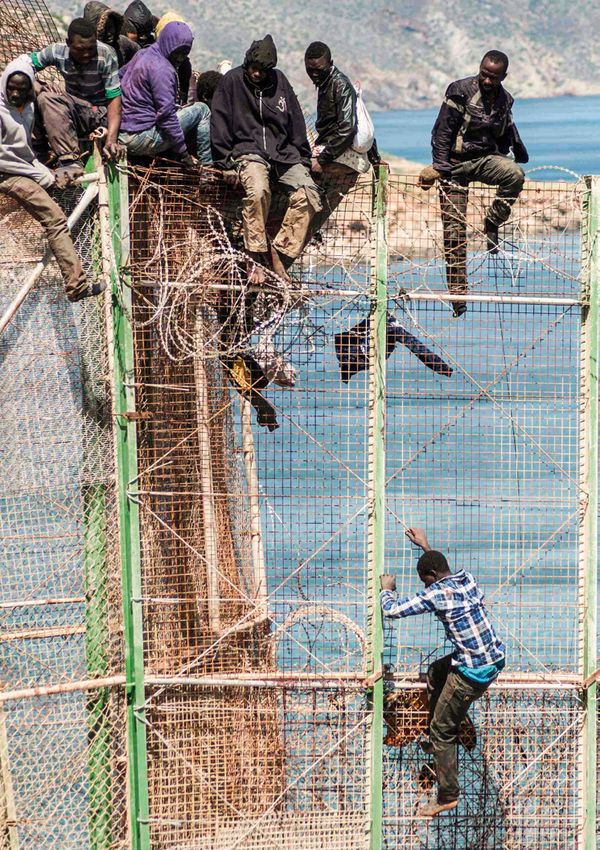
  States of the European Union. Harrowing scenes show-                   mechanism with its concept of return sponsorship,
  ing the Spanish border police roughly pushing back                     vigorously rejected by the Visegrad States in the East.
  thousands of people at the border between Spain and                    The continuing divergences of Member States on migra-
  the enclave of Ceuta were broadcast around the world                   tion and asylum is not only a question of humanity and
  after the Moroccan government opened the border in                     solidarity, it touches on the very credibility of our Union.
  order to put pressure on Spain because of its policy                   It seems to me that the Union is not yet ripe for this
  towards the Polisario movement. Pressuring Spain                       great leap forward, and there will inevitably be further
  in this way is tantamount to pressuring the European                   intense discussions, including moratoria. However,
  Union, in the same way that Turkey’s President Erdogan                 what each Member State might at least do in the mean-
  is blackmailing Europe. Is this twin strategy about to                 time is verify if people in danger are being treated with
  destabilise the European Union?                                        humanity at its borders.
  Nations need borders and it is for them to determine
  the kind of borders they want. Societies in general want
  secure borders, but they also have a feeling of empathy,
  the basis for responsible and humane border control.
  Throughout the world, nations have problems with their
  border regime. The reasons are manifold but there is

IMPRESSUM: The European − Security and Defence Union

Headquarters: International Consulting                                     Editorial Assistant: Céline Merz, Linz a. Rhein (GE)
6, Rue du Château, F 28260 Berchères-sur-Vesgre (FR)                       E-Mail: editorial.assistant.esdu@gmail.com
E-Mail: hartmut.buehl@orange.fr                                            Translator: Miriam Newman-Tancredi, Strasbourg (FR) and London (GB)
Publisher and Editor in Chief: Hartmut Bühl, Berchères-sur-Vesgre (FR)     Layout: Beate Dach, SpreeService, Berlin (GE)
Phone: +49/172 32 82 319                                                   Advertisement & Sales: Hartmut Bühl, Berchères-sur-Vesgre (FR)
E-Mail: hartmut.buehl@orange.fr                                            Phone: +49/172 32 82 319
Deputy Editor-in-Chief: Nannette Cazaubon, Paris (FR)                      Print: Polyprint GmbH (GE)
E-Mail: nannette.cazaubon@magazine-the-european.com                        © 2021 by International Consulting, France

                                                                                                                                                                                3
THE EUROPEAN – SECURITY AND DEFENCE UNION

    THE EUROPEAN –
    SECURITY AND DEFENCE UNION

                                                                                                                       21–38
    Vol. No. 39

    Content                                                                                                            MAIN TOPIC:
                                                                                                                       Migration and
                                                                                                                       Asylum
         3        Editorial, Hartmut Bühl
         6        News, Nannette Cazaubon                                                                              How to make borders
                                                                                                                       more humane

    8–20
    In the Spotlight
    The renewal of transatlantic relations                                                                   20       Books & publications
                                                                                                                      Gerald Knaus’ book on flight, migration and asylum

         8        Stepping up: a stronger Europe for stronger transatlantic                                  22       Migration, border security and asylum
                  security and defence                                                                                More humanity at Europe’s borders
                  The EU will need to assume greater responsibility                                                   Interview with Jean Asselborn, Luxembourg,
                  by Ambassador Wolfgang Ischinger, Munich                                                            and Gerald Knaus, Berlin

         10       America is back to world policy                                                            26       Between solidarity and responsability
                  Significant political polarisation in the US                                                        The New Pact on Migration and Asylum
                  Interview with Michael Singh, Washington, D.C.                                                      by Stefanie Buzmaniuk and Ramona Bloj, Paris

         13       NATO summit 2021                                                                           28       Environmental migration – multifarious solutions
                  Documentation                                                                                       to engage now
                                                                                                                      Avoiding the worst possible scenarios
         14       The role of third states in guiding the EU’s security policy                                        by Mariam Traore Chazalnoel and Dina Ionesco, Geneva
                  Strategic orientation towards the Middle East
                  by Christopher Eid, France                                                                 30       Frontex’s role in safeguarding European security
                                                                                                                      Border management in transformation
         16       Afghanistan – a loss of Western credibility                                                         by Fabrice Leggeri, Warsaw
                  Commentary by Hartmut Bühl, Paris

         17       Green Deal: the Commission’s “Fit for 55” package
                  Documentation

         18       Defeating Covid-19 through worldwide common digital
                  procedures
                  Synchronising all processes
                  Interview with Dr Dirk Wössner, Koblenz

         photo: © 8880 - stock.adobe.com (cover); Auswaertiges Amt/photothek (left); Nikos Pilos (right);   page4: ©European Union, 2021/EC – Audiovisual Service/Dati Bendo; page 4-5: Flavio Gasperini SOS MEDITERRA

4
Content

                                                                                                             39–52
                                                                                                             Security and defence
                                                                                                             The CSDP is developing

       32   The displaced – a continuous failing of
            the global community
            How to restore humanity and hope                                                       40        EU Satellite Centre: operational support to the CFSP
            by Andrea Quaden, Syria                                                                          and CSDP
                                                                                                             Actionable geospatial intelligence analysis
       34   The castaways of hell                                                                            by Sorin Ducaru, Madrid
            The death rate is increasing
            by François Thomas, Marseille                                                          42        An integrated approach for sustainable security
                                                                                                             The CSDP continues to develop
       36   The EU migration policy we need                                                                  by Vice Admiral Hervé Bléjean, Brussels
            An asylum system needs an ethic concept
            by Panagiotis Nikas, Athens                                                            44        Shaping the role of the EU in armament cooperation
                                                                                                             and export
                                                                                                             The community path remains taboo
                                                                                                             by Maria Camello and Federico Santopinto, Brussels

                                                                                                   46        Specificities of German parliamentary democracy in
                                                                                                             armaments policy
                                                                                                             Reliability is key in cooperation
                                                                                                             by Dr Marie-Agnes Strack-Zimmermann MdB, Berlin

                                                                                                   48        The French-German armament cooperation:
                                                                                                             difficult but essential for Europe
                                                                                                             Diverging strategic objectives
                                                                                                             by Patrick Bellouard, Paris, and
                                                                                                             Cyrille Schott, Strasbourg

             The European – Security and Defence Union is the                                      49        War in a robotic age
            winner of the 2011 European Award for Citizenship,
                                                                                                             Pandora’s box is already open
            Security and Defence, and was awarded in 2019 the
               Jury’s Special Prize of the same competition.
                                                                                                             by Israel Rafalovich, Brussels

ANEE                   page 5: © Operation IRINI, 2021 /Francesco Natale /Source: EC – Audiovisual Service

                                                                                                                                                                          5
THE EUROPEAN – SECURITY AND DEFENCE UNION

                                                                                                                  Cyber security
    Covid-19 vaccination
                                                                                                                  Josep Borrell criticises
    The European Civil Protection Mechanism supports
                                                                                                                  China
    countries in need
                                                                                                                  (Ed/nc) On 17th July, EU High Represent-
    (Ed/nc) Through the European                                                                                  ative Josep Borrell made a declaration
    Civil Protection Mechanism, the                                                                               on behalf of the EU urging China to take
    European Commission has so far                                                                                action against cyber-attacks undertaken
    supported the sharing of over 3m                                                                              from its territory. He announced that EU
    Covid-19 vaccines by Member                                                                                   Member States, together with partners,
    States with countries outside the                                                                             were exposed to malicious cyber activi-
    EU. The delivery is coordinated by                                                                            ties that significantly affected their econ-
    the Commission which finances up                                                                              omy, security, democracy and society
    to 75% of the costs of transport.                                                                             and that the EU assesses these attacks to
    Janez Lenarčič, Commissioner                                                                                  have been carried out from the territory of
    for Crisis Management said: “EU                                                                               China. Borrell also stated that malicious
    Member States continue to sup-
    port global vaccination efforts.
    3m vaccines have al-ready been                                               photo: ©Near - stock.adobe.com
    facilitated via the European Civil
    Protection Mechanism. I thank all countries for showing their solidarity. Vaccination for all is
    essential to beat this pandemic.”
    To date, EU Member States have pledged over 159m vaccine doses with countries outside the
    EU via Covax, the EU Civil Protection Mechanism, or bilaterally.
    Member States have also delivered millions of masks, protective suits, disinfectants, and other
    support such as ambulances and ventilators to countries in need.
        Web https://bit.ly/3Bp3ZNn

    EU – Hungary                                                                                                   HR/VP Josep Borrell       photo ©European Union

    Next round in the ring
    (Ed/nc) In response to criticism from the European                                                            cyber activities with significant effects
    Union, Hungary’s far-right Prime Minister Viktor Orbán                                                        that targeted government institutions
    announced a referendum on the new anti-LGBTIQ (Les-                                                           and political organisations in the EU and
    bian, Gay, Bisexual, Transgender, Intersex, Queer) law                                                        Member States as well as key Europe-
    on 21st July. It is just another uppercut in Orbán’s fight                                                    an industries have been detected. He
    with the EU that has reacted against his new law ban-                                                         declared that these activities, conducted
    ning homosexual and transsexual people from being                        photo: ©European Union/              from China, can be linked to the hacker
                                                                                Alexandros Michailidis
    featuring in educational materials or prime TV, in shows                                                      groups known as Advanced Persistent
    and films aimed at children. Commission President Ursula von der Leyen officially                             Threat 40 and Advanced Persistent
    stated that ”this Hungarian law is a shame.” Dutch Prime Minister Mark Rutte even                             Threat 31.
    suggested that Hungary should leave the EU.                                                                   The High Representative declared: “The
    Orbán hit back on 21st June, warning of the “sovietisation” of the EU and declaring                           EU and its Member States strongly de-
    that the European Parliament (EP) is only respecting its ideological and institution-                         nounce these malicious cyber activities,
    al interests. EP President David Sassoli commented: “Only those who don’t like                                which are undertaken in contradiction
    democracy think of dismantling parliaments.”                                                                  with the norms of responsible state
    On 2nd July 2021 the Hungarian Prime Minister went into the next round, calling                               behaviour as endorsed by all UN member
    leaders of far-right parties in 16 countries to join forces to make their voices heard                        states. We continue to urge the Chinese
    in the context of the current EU debate on the future of Europe.                                              authorities to adhere to these norms
    Finally, on 15th July, the European Commission launched legal action against                                  and not allow its territory to be used for
    Hungary over the new anti-LGBTIQ legislation and on 20th July, the second EU-wide                             malicious cyber activities, and take all
    rule-of-law report was published, highlighting the deteriorating situation of demo-                           appropriate measures and reasonably
    cratic standards in Hungary. Budapest is still awaiting the EU executive approval of                          available and feasible steps to detect,
    its €7.2bn recovery plan...                                                                                   investigate and address the situation.”

6
News

Climate                                                                                                  Sahel
New EU Forest Strategy                                                                                   Operation Barkhane -
                                                                                                         change of strategy
                                                                                                         (Ed/hb, Paris) In mid-June 2021, French
                                                                                                         President Emmanuel Macron announced that
                                                                                                         the French military engagement in the Sahel
                                                                                                         would be reduced. The
                                                                                                         reasons are two large
                                                                                                         losses (50 soldiers)
                                                                                                         and nearly €1bn a
                                                                                                         year without visible
                                                                                                         results in combating
                                                                                                         terrorism in the Sahel
                                                                                                         region.
The Forest Strategy foresees the planting of 3bn trees accross Europe by 2030                            One month later, at the end of a virtual G5
                                                                  photo: ©Panumas - stock.adobe.com      Sahel meeting, Macron announced more
                                                                                                         details: France will reduce the number of
(Ed/nc) On 16th July, the European Commission adopted the new EU Forest                                  soldiers engaged in Barkhan operations
Strategy for 2030, which contributes to the “Fit for 55” package of measures                             from 5,100 to less than 3,000 by closing
aimed at achieving greenhouse gas emission reductions of at least 55% by                                 three bases in the north (Kidal, Tassalit and
2030 and climate neutrality in 2050 in the EU.                                                           Timbuktu) at the beginning of 2022. This
In the fight against climate change and biodiversity loss, forests are essen-                            goes hand in hand with a change of strategy
tial as they help to reduce the impacts of climate change, for example by                                from accompanying local forces to strongly
cooling down cities, protecting from heavy flooding, and reducing the impact                             engage directly against terrorists.
of drought. Europe’s forests suffer from many different pressures, including                             The parallel EU engagement “Tabuka” led
climate change. The EU Forest Strategy for 2030 promotes the most climate                                by France (500 personnel) with contingents
and biodiversity friendly forest management practices, encourages resource                               from the Czech Republic, Estonia, Italy, and
efficient wood use, and announces a legal proposal to step up forest monitor-                            Sweden at the Menaka base in Mali will
ing, reporting and data collection in the EU.                                                            continue focussing on the training of local
The strategy is accompanied by a roadmap for planting 3bn additional trees                               special forces.
across Europe by 2030.                                                                                       Web https://bit.ly/36K9Te1
→ See also our documentation on the Green Deal, p.17
     Web Forest Strategy: https://bit.ly/2UxrG5F
     Web 3bn trees: https://bit.ly/2UYtnJd
                                                                                                         NATO
                                                                                                         Space Pitch Day winner
Floods                                                                                                   (Ed/nc) On 17th June, the NATO Communica-
Brussels ceremony for flood victims                                                                      tions and Information (NCI) Agency hosted
                                                                                                         a NATO Space Pitch Day in partnership with
                                                                                                         the NATO Space Centre, located in NATO’s
                                                                                                         Allied Air Command. At the event, six teams
                                                                                                         pitched their proposals aimed at improving
                                                                                                         space situational awareness. The winner,
                                                                                                         chosen by a selection board, is the French
                                                                                                         company Safran Data Systems. The winner
                                                                                                         will have the opportunity to interact closely
                                                                                                         with the NATO space operational community,
                                                                                                         in order to provide further demonstrations
                                                        photo: ©European Union, 2021 / François Lenoir
                                                                                                         and to increase the common understanding
(Ed/nc) On 20th July, the President of the European Council, Charles Michel,                             of requirements and capabilities.
together with 27 EU ambassadors, held a minute of silence for the victims
of the floods that took place in Austria, Belgium, Germany, Luxembourg and
Netherlands.

                                                                                                                                                            7
THE EUROPEAN – SECURITY AND DEFENCE UNION

    In the Spotlight                                          +++ Transatlantic Relations +++

          Washington’s call to action has not yet been answered

          Stepping up: a stronger Europe
          for stronger transatlantic security
          and defence
          by Ambassador Wolfgang Ischinger, Chairman of the Munich Security Conference, Munich

     I n Europe, the sigh of relief was noticeable when President
       Biden stressed the renewed US commitment to NATO at
     the beginning of his tenure. Speaking at the Munich Security
                                                                          to address the challenges arising from China and Russia, and
                                                                          essential for being a strong partner of the United States in
                                                                          developing a powerful approach towards the two countries. An
     Conference (MSC) Special Edition in February 2021, he made it        important component of the Biden administration’s expec-
     crystal clear that the United States is “fully committed” to the     tations is that the EU step up its efforts to counter the rise of
     NATO Alliance; article V – the assurance that an attack on one       authoritarianism.
     is an attack on all – is an “unshakable vow.”1 Since then, the
     Biden administration has repeatedly reaffirmed and followed          2. Deepening European defence and security cooperation –
     up on this firm commitment to NATO and the transatlantic             from paper to action
     partnership – be it in the context of Secretary of State Blinken’s   A European Defence Union, deepening military cooperation,
     participation in the NATO Summit in March, the US decision           pooling and sharing resources, and reconciling different
     to not withdraw but increase troops in Germany, or President         strategic cultures, is not a new idea. Since 2016, a number of
     Biden’s eight-day trip to Europe in June.                            initiatives have been launched, including PESCO (Permanent
     This alliance-based approach, however, goes hand in hand             Structured Cooperation on Security and Defence) and the EDF
     with greater US expectations of its partners. This was highly        (European Defence Fund). However, so far, the results have
     visible at the G7 summit in Cornwall when President Biden            been weak, especially in terms of real military capacity to act.
     urged the European allies to support US efforts in boosting          While much ink has been spilled on concepts like “strategic
     democracy more strongly. The communique published after              autonomy” or “sovereignty” and while calls for a “European
     the NATO leaders’ meeting sets an ambitious agenda. It is now        army” are highly present in the public discussion, European
     time for Europe to show that the transatlantic alliance is not a     defence is nowhere near that. Facing the repercussions of the
     one-sided love affair, but that Europe is willing and capable to     Covid-19 pandemic that will put additional pressure on Euro-
     step up and fulfil its international commitments.

     The European part of the equation
     To make Europe a more valuable partner and to improve the
     shared transatlantic security architecture, the following four          Munich Security Conference
     points should be guidelines for a European to-do list.                  For nearly six decades, the
                                                                             strengthening of transatlantic
     1. Enhancing the coherence of the EU’s foreign policy and               ties has been at the heart of
     formulating a joint approach towards China and Russia                   the MSC’s mission. While the
     The European Union will only be able to assume international            ongoing pandemic has forced
     leadership when speaking with one voice. To prevent the EU              the MSC to not hold the 57th Munich Security Conference in 2021,
     from being “held hostage by those who hobble European                   we remain committed to providing a platform for transatlantic
     foreign policy with their vetoes”, as German foreign minister           exchange on security policy challenges in these critical times.
     Heiko Maas put it in a recent speech,2 the current unanimity            Therefore, the MSC has initiated the series ‘Beyond Westless-
     requirement in EU foreign and security policy needs to be               ness: The Road to Munich’ with several events between February
     abolished. As the path towards qualified majority voting will be        2021 and February 2022 to prepare the ground for the next
     long, member states should start by giving up their veto rights         Munich Security Conference.
     voluntarily and by raising the costs for veto use.                          Web https://securityconference.org/
     Formulating a joint European strategy is also urgently needed

8
+++ Transatlantic Relations +++
“Asmoving
the United States are increasingly
their focus to the Indo-Pacific,
Europe will need to assume greater
responsibility in its eastern and
southern neighbourhoods.”
Ambassador Wolfgang Ischinger
has been the chairman of the Munich Security
Conference since 2008. A German career diplomat,
he was State Secretary (Deputy Foreign Minister)
photo: MSC/Kuhlmann
from 1998 to 2001. From 2001 to 2006, he was
Germany’s Ambassador to the US, and from 2006
to 2008, to the Court of St James’s. He is a Senior
Professor at the Hertie School, Berlin, and serves
on the boards of companies as well as non-profit
pean defence, European states need to make sure that they do institutions, including Atlantik-Brücke, Berlin, the
not turn inwards – as they did after the 2008/2009 financial American Academy, Berlin, and the Atlantic Council
crisis resulting in “bonsai armies” across Europe – but use of the United States, Washington D.C.
the pandemic as additional incentive to expand and deepen
cooperation within the EU and NATO.3
3. Renewing the commitment to increase defence spending
The signal that Europe is willing to invest more in the security neighbourhoods. While the US will continue to support its
of the Alliance starts with a renewed commitment to a higher European partners, Europe will have to take the lead in crisis
defence expenditure and to long-term financing. While it is management operations, including in the Sahel region.
widely agreed that the spending target of 2% of the country’s
GDP is no adequate benchmark for a country’s actual con- We need a proactive Europe
tribution and capabilities, a significant increase in defence Rather than waiting for proposals and calls to action from its
spending is needed. More importantly, as NATO states have transatlantic partner, Europe should come up with its own ini-
repeatedly reaffirmed their commitment to the 2%, the target tiatives. It needs to sketch out how it sees its role in the future
has become a central symbol of Alliance solidarity. Any efforts transatlantic security and defence partnership, what it is wil
to improve the framework for assessing the contribution of ling to invest politically and economically, and what it expects
NATO members thus need to take it as a starting point and from the United States. So far, Washington’s call to action has
build on it. Secretary Blinken just signaled his openness to not been answered.
do so, reaching out to NATO partners by stressing: “The full
implementation of these commitments [2%] is crucial. But
1
Remarks by President Biden at the 2021 Virtual Munich Security Conference |
we also recognize the need to adopt a more holistic view of The White House (https://bit.ly/3vSYGSn)
burden sharing. […] We must acknowledge that because allies 2
Speech by Foreign Minister Heiko Maas at the opening of the 19th Ambassadors
have distinct capabilities and comparative strengths, they will Conference “Build back better – Foreign policy for the post-COVID world” –
Federal Foreign Office (auswaertiges-amt.de) (https://bit.ly/3dcYg2M)
shoulder their share of the burden in different ways”.5 3
Saving European Defense From the Coronavirus Pandemic – Carnegie Europe –
Carnegie Endowment for International Peace; Toward a New “Lost Decade”?
4. Moving from burden-sharing to burden-shifting Covid-19 and Defense Spending in Europe | Center for Strategic and Internation-
al Studies (csis.org) (https://bit.ly/3h1hj1f)
Finally, Europe needs to understand that today, it is not just 4
Zeitenwende | Wendezeiten – Special Edition of the Munich Security Report on German
about classic burden-sharing – meaning increasing ones’ Foreign and Security Policy | Munich Security Conference (https://bit.ly/3wUuSpS)
contribution to collective security and defence – but more and 5
Reaffirming and Reimagining America’s Alliances: Speech by Secretary of State
more about burden-shifting.6 As the United States are increas- Blinken following NATO Foreign Ministerial | U.S. Mission to the North Atlantic
Treaty Organization (usmission.gov) (https://bit.ly/3wVza0r)
ingly moving their focus to the Indo-Pacific, Europe will need 6
Seizing Biden’s Pivot to Europe: Time for Responsibility-Sharing | The German
to assume greater responsibility in its eastern and southern Marshall Fund of the United States (gmfus.org) (https://bit.ly/3x8uAM4)
9
THE EUROPEAN – SECURITY AND DEFENCE UNION

     In the Spotlight                                                 +++ United States +++

        The country must care for the wounds in its society

        America is back to world policy
              Interview with Michael Singh, Managing
              Director, The Washington Institute for                       our leading role on the world stage requires us to maintain our
              Near East Policy, Washington, D.C.                           vigor and prosperity as a country, which in turn demands that
                                                                           we find ways to overcome our polarisation.

      The European: Mr Sing, during the last year we saw pictures of       The European: The new president has been very busy in his first
      America, which shocked all those who believed in the demo-           100 days. He has been active in international policy, reversing
      cratic values the United States has always defended. We saw          most of his predecessor’s decisions concerning relations with
      the murder of a black citizen, George Floyd, by a white police       Europe and NATO, the Paris Climate Change Agreement, and
      officer in Minnesota in July 2020. We couldn’t believe what was      the World Health Organisation. He also defined the directionof
      reported from Washington in January 2021: the attack on the          his foreign policy and the future US relations with China and
      US Congress, the cradle of democracy, encouraged by a former         Russia. But how will he deal with the domestic crisis, which at
      US president, who wanted to return to power after having lost        the same time is a public health, economic, and, most impor-
      democratic elections. America’s society seems to be in turmoil.      tantly, a social crisis?
      Can one speak of a divided nation?                                   Michael Singh: It is irrefutably the case that the Biden adminis-
      Michael Singh: There can be little doubt that we are enduring        tration’s top priorities are domestic – the United States, like
      an era of significant political polarisation. While there are gaps   much of the world, has been plunged into a public health and
      within each party – based on age, education level, etc. – it is      economic crisis for more than a year, though thankfully we
      the partisan gap between Republicans and Democrats that is           seem to be through the worst of it thanks to the combined
      most pronounced. What’s more, this polarisation is deepest           efforts of the current and previous administrations and of the
      with regard to some of our most difficult issues – for example,      American society as a whole. But difficult challenges remain:
      racism, gun policy, and climate change – and increasingly            getting Americans back to work, for example, and tackling
      seems to affect Americans’ views not just of politics and polit-     deeply divisive challenges related to racism, immigration, and
      ical leaders, but of one another. Combined with what seems           other issues.
      to be an increasingly tribalised media and a declining regard
      for institutions – whether religious, social, or governmental –      The European: But isn’t there a cleavage between domestic and
      this polarisation has made compromise and problem-solving            international policy?
      difficult.                                                           Michael Singh: I think that it is a mistake to think that we can-
                                                                           not tackle domestic and overseas challenges at the same time
      The European: Yet we should not forget that there are still          – we can, and we must. Indeed, the two can reinforce one an-
      things on which Americans agree!                                     other – foreign policy may be an area where Republicans and
      Michael Singh: You are right. For example, large majorities          Democrats can begin to find common ground, and conversely,
      want the United States to maintain its leadership role in the        the more successful and prosperous we are at home, the
      world and lead through diplomacy and alliances. Sustaining           stronger we will be on the world stage. But we must begin with
                                                                           a conscious decision to seek and find common ground with our
                                                                           domestic political opponents, and to work jointly toward our
                                                                           mutual success – bipartisanship is a choice.

          “  There can be little doubt that we
             are enduring an era of significant
                                                                           The European: There is a certain optimism in your answer, but
                                                                           do you believe that President Biden will be able to achieve
                                                                           reconciliation between the rural and traditional America and
             political polarisation.”                                      the urban population living in cities which are often more open
                                                                           to progress and societal change as we see it in Europe?
                                                                           Michael Singh: In my view, discussion of a “rural-urban divide”
                                                                           in the United States is often more caricature than reality. While

10
+++ United States +++
photo: Official White House Photo by Lawrence Jackson
President Joe Biden and Vice-President Kamala Harris walk from the Oval Office of the White House to the Rose Garden to deliver remarks on
the American Rescue Plan, 12th March 2021
there are real differences between rural and urban areas in the Depression, but will be much shorter, thanks to the pande
United States, they are not as stark as our friends overseas ima mic’s decline and aggressive fiscal and monetary policies by
gine. One of the first pieces of advice I give to diplomats from Congress, the current and previous administrations, and the
Europe and elsewhere posted to Washington is to go around Federal Reserve. Significant questions remain – how long, for
the United States and develop a real understanding of the example, it will take the US GDP and unemployment to return
country and its people, in all their diversity. As someone who to their pre-pandemic trajectories, and whether, as well as
is from the Midwestern United States but has lived his entire which groups of workers will suffer long-term disadvantages.
life in and around cities, I think it is important to recognise that But as things stand today, the US economy appears set to
rural areas are not monolithic, but are more diverse and vibrant rebound in 2021.
– and frankly essential to the American economy – than is
often recognised. I think that rather than focusing on fixing a The European: But in the longer run, significant internal ques-
supposed rural-urban divide, we need to instead seek to help tions face US economic policymakers...
both rural and urban areas address their local problems and Michael Singh: Indeed. To name just a few challenges, US pol-
promote worker mobility so that individuals can more easily icy has to reflect how and whether to expand the social safety
move between different locations. net, how to cope with the effects of climate change, and to
what extent federal debt, poised to reach its highest level ever
The European: Let’s continue on the subject of the economy: in proportion to GDP, is a problem demanding action. And we
the new president found a worrying situation with the pan- must grapple with these questions in an environment in which
demic stirring up numerous sectors. Does Biden see himself Americans of both parties are increasingly skeptical of trade
as a new Roosevelt, who led the US out of the 1930s economic and other forms of international economic integration. These
crisis? Could the huge investment programme he launched are issues that will demand leadership from the White House.
this spring help to bring people together and give America new And, most importantly, they will require a revival of Congress’
breath? ability to forge bipartisan compromise for the common good.
Michael Singh: The Covid-19-induced economic recession
in the United States was indeed the sharpest since the Great
→ Continued on page 12
11THE EUROPEAN – SECURITY AND DEFENCE UNION
In the Spotlight
+++ United States +++ +++ EU after Brexit+++
The European: Politically the domes- Michael Singh nine in 10 favour main-
tic situation isn’t easy for Biden. The is the Lane-Swig Senior Fellow and taining existing alliances.
Democrats have a razor-thing control managing director at The Washing- And according to Gallup,
of the Senate and apparently, Trump’s ton Institute for Near East Policy, Americans’ views of trade
voters continue to believe in the former and a former senior director for actually grew more positive
president. This Right – protectionist, Middle East affairs at the White over the past several
isolationist, profoundly mistrustful and photo: Lloyd Wolf House from 2005 to 2008. years. It is up to the United
open to conspiracy theory – is completely States’ political leadership
hostile to Biden. What are the conse- – the Biden administration,
quences for the President’s agenda? Democrats and Republi-
Michael Singh: As I already noted, American society is more cans in Congress, and leadership at the state and local levels
polarised today, and those on the ideological fringes more con- – to work together to deliver on these things and to create the
fident and influential than at any point in recent memory. Yet at conditions that allow the creativity and self-confidence that
the same time, and perhaps a bit paradoxically, polls suggest have always defined the United States to be fully realised. I
that Americans dislike this polarisation and would like to see continue to believe that for all of our troubles and divisions, we
their leaders work to overcome it. I think this is especially the remain eminently capable of coming together to accomplish
case after what has been an enormously difficult couple of great things.
years for Americans and for much of the world. But amid this
polarisation, it can be easy to forget that there is plenty that The European: Mr Singh, I thank you for this conversation.
unites Americans. Our readers will be grateful to follow your ideas and insightful
views.
The European: Could you please develop this point?
Michael Singh: We share both concerns – for example, over The interview was led by Nannette Cazaubon.
the rising challenge from China, or deepening economic
inequality – as well as aspirations – to remain the strongest
and most economically vibrant country in the world, and to
devise a foreign policy that prioritises peace and diplomacy
100-day mark: Biden’s job approval
over conflict. These common concerns and aspirations present
an opportunity both for President Biden, who campaigned as
a centrist able to work across party lines, and Republicans,
who need to outline a positive agenda to broaden their appeal
going forward.
The European: So, can we conclude that Joe Biden and his
Vice-President Kamala Harris form a future-oriented presiden
tial team capable to overcome the last four last years and
energetically tackle the huge challenges in the country, with a
diplomacy directed to the US middle class?
Michael Singh: In my view, middle-class Americans want a
foreign policy that delivers prosperity and security, plain and
simple. And polls suggest that they have a good grasp of
what is needed to accomplish that – according to the Chicago
Council on Global Affairs, for example, two-thirds of Americans
want to see the US maintain a leading role in world affairs,
“Ieminently
continue to believe that for all of our troubles and divisions, we remain
capable of coming together to accomplish great things.”
12documentation
NATO Summit 2021
(Ed/Hartmut Bühl, Paris) On 14th June, at the 2021 NATO Summit in Brussels, NATO leaders discussed
a wide range of political and military issues as well as the future of NATO. The agenda included nine
main decisions and the support of the NATO 2030 initiative.
Key decisions
1. NATO 2030 was at the heart of discus-
sions. Based on a variety of inputs from
experts, civil society and the private
sector, NATO Secretary General Jens
Stoltenberg presented recommenda-
tions which formed the bedrock of the
NATO 2030 agenda.
2. US President Joe Biden succeeded to
re-establish lost confidence of NATO
leaders in the US ally by underpinning the
US’ full commitment to NATO’s Article
5 (defence).
3. Furthermore, there was no doubt about Official portrait of NATO Allies photo: © NATO
reinforcing the Alliance’s unity, broad-
ening its approach to security and con- 6 - Boost training and capacity-building
tributing to safeguarding the rules-based
international order.
4. NATO leaders took decisions to prepare
“ By agreeing on
the NATO 2030
by stepping up NATO’s efforts to assist its
partners’ capacity-building in areas like
counter-terrorism, stabilisation, countering
NATO for the challenges of today and
tomorrow, including Russia’s pattern
initiative, leaders hybrid attacks, crisis management, peace-
keeping, and defence reform.
of aggressive behaviour and the rise have made the
of China, terrorism, cyber-attacks and
disruptive technologies, and security
decision to make 7 - Combat and adapt to climate change by
endorsing an ambitious new NATO Climate
implications of climate change. our Alliance Change and Security Action Plan to help
NATO leaders agreed on 9 proposals:
stronger and NATO and its Allies develop clear aware-
ness, adaptation and mitigation measures,
1 - Deepen political consultations in NATO better fit for the and committed to significantly reducing
by broadening them, including an addition- greenhouse gas emissions from military
al yearly meeting of foreign ministers and
future.” activities and installations.
more consultations with Allied capitals in Jens Stoltenberg,
different formats. NATO Secretary General 8 - Develop the next Strategic Concept
by inviting the NATO Secretary General
2 - Strengthen deterrence and defence to lead the process to develop it. This key
by reaffirming their strong commitment 4 - Preserve the technological edge by document describes the overarching se-
to Allied deterrence and defence. Allies launching a Defence Innovation Accel- curity environment in which the Alliance
will continue to aim to meet, by 2024, the erator for the North Atlantic (DIANA) to will operate.
NATO-agreed guideline of spending 2% of boost transatlantic cooperation on critical
Gross Domestic Product on defence and technologies and to establish a NATO Inno- 9 - Invest in NATO by ensuring the Alli-
20% of annual defence spending on major vation Fund to invest in startups working ance has the right resources, both through
new equipment. on emerging and disruptive technologies. national defence expenditure and NATO
common funding.
3 - Improve resilience by agreeing to take 5 - Uphold the rules-based international
a broader and more coordinated approach order by strengthening NATO’s relationships
to it, including through a strengthened re- with like-minded partners and international
silience commitment, developing resilience organisations – including the European Web
objectives to guide nationally tailored goals Union – and to forge new engagements, Communiqué https://bit.ly/2TlzfvL
and implementation plans. including in Asia, Africa and Latin America. Factsheet https://bit.ly/3euxi7u
13THE EUROPEAN – SECURITY AND DEFENCE UNION
In the Spotlight +++ Lebanon +++
Lebanon case study
The role of third states
in guiding the EU’s
security policy
by Christopher Eid, PhD student on European policy, France
T he search for closer relations between the European Union
and the countries of the Mediterranean basin has taken the
form of a Mediterranean partnership agreement (Gomez, 2018)
In early August 2020,
Lebanon became the cen-
tre of attention for many
which provides for cooperation in various fields and establish- international actors such
es an open global level of interaction, which includes integra- as the EU, the United Arab
tion. This agreement was signed with each country separately, Emirates (UAE) and the
including Lebanon, in 2002. Kingdom of Saudi Arabia (KSA) after the 4th August explosion in
The Mediterranean area is today a major part of the world Beirut. This call for attention was given by French President Ma-
where geopolitical instability is present. According to several cron, with a final objective of creating a Lebanese government
notions and in the context of public policy narratives, the Euro- to ensure some political stability at the local level. This initia-
pean Neighborhood Policy (ENP), through which Europe seeks tive creates an important French role on the Lebanese territory
its strategic presence, constitutes a policy necessary nowadays and presents a solution for the ongoing Lebanese political
to ensure and achieve the maximum geopolitical stability in crisis. However, there is no EU support. The strategic approach
this region. of the Common Foreign and Security Policy (CFSP) mentions
the need to deal with third states and partner countries to
Lebanon and the EU security approach ensure maximum outcomes of the Common Security and
With the increasing political and security tensions and prob- Defence Policy (CSDP). The first pillar of the CSDP is building
lems in the Middle East, the need for a complete structured EU the capacities and capabilities of partners. This is extremely
security and defence architecture is highly necessary to face important to achieve synchronisation between the EU and the
the threats on all levels. The ENP1 towards some countries in selected country on geopolitical, social and economic levels.
the Middle East, such as Lebanon, tends to strengthen pros- Another pillar of the CSDP is the act of responding to external
perity, human rights and security by applying (theoretically) EU conflicts and problems with strategic approaches, adapted to
principles and views to establish a common and shared base each threat. The final pillar is to protect the EU and its citizens,
between the EU and the country. The door for third state parti thus, linking external conflicts and problems with the first two
cipation in tailoring the EU security architecture is open, yet pillars to achieve maximum protection of EU citizens.
the extent of participation remains to be determined.2
Enhancing EU capabilities to protect partners
The EU Institute for Security Studies, in collaboration with the
French Permanent Representation to the EU, shared a report
Christopher Eid at the end of a high-level conference that was held on 12th
is a Ph.D. student in Political Science on International Se- March 2021. The report focused on the ways in which the EU
curity and Defence Policies in France. He holds a master’s can strengthen its capabilities in sea, air, space, and cyber. By
in Diplomacy and International Security from the Holy Spirit connecting all these domains, the EU will enhance its ability to
University of Kaslik. In June 2018 he participated in courses protect its own territory and can ultimately project security to-
in international defence acquisition negotiations at the Na- wards EU partners. This Strategic Compass will ultimately lead
val Postgraduate School in Monterey, California. He was a the EU to become a stronger global partner. The EU security
speaker for the Doctoral Module on European policies, Jean and defence vision as it is shown in the Middle East is after all
Monnet Erasmus programme in February 2021. a micro-level approach and the successful application of this
orientation has to imply all EU countries.
14+++ Lebanon +++
“With the increasing political,
security tensions and
problems in the Middle
East the need of a complete
structured EU security and
defence architecture is
highly necessary.”
The port of Beirut after the explosion of
4th August 2020
photo: © Anna Om, stock.adobe.com
Lebanon – a perfect case for the EU and it is in the EU’s interest that terrorists do not infiltrate
Let us focus on the Lebanese case, aiming to link the ENP and through it. The preservation of a safe Lebanese border is
the 2016 EU Global Strategy (EUGS) to show the importance a critical issue in the fight against terrorist groups, as said
of third states such as Lebanon on the EU security level. James Cleverly, the UK minister of Middle Eastern Affairs.5
The EUGS promotes the idea of protecting the interests of Lebanon, close to the EU, can ensure optimum results of such
European citizens by applying concepts such as peace and a security focused EUGS.
security, prosperity and partnership towards partners where The EU must improve its cooperation mechanism with third
the EU will be a responsible global stakeholder investing in states like Lebanon to cover large parts of the security gaps.
EU partnerships as it laid down in the text of the European
External Action Service (EEAS/2016). Working with partners
on a regional approach to address common challenges is a The article was written in collaboration with Sylvie Ollitrault, DSP,
key point in the EUGS. Political Sciences School, University of Rennes 1, France and Francisco
The ENP towards Lebanon, which entered into force in April Barroso, Political Sciences Department, School Of Law, Holy Spirit
2006 as the EU-Lebanon Association Agreement,3 promoted University of Kaslik (USEK), Lebanon
Lebanon as a stable, democratic, and politically open country The positions and ideas in this article express the viewpoint and opinion
with a strong economy. The revised ENP with the Southern of the author and do not obligate any other party.
Neighborhood published on 9th February 20214 mentioned
that the EU should help and support Lebanon’s efforts to
resolve ongoing domestic, economic, political, and social
crises and thereby lacking the security approach gaps filled 1 The ENP includes countries that are subdivided into two partnerships. The
Eastern Partnership consists of states that were previously part of the Soviet
within the EUGS. The EU, through the Strategic Compass, Union (Armenia, Azerbaijan, Belarus, Georgia Moldova, and Ukraine), while the
compiled some of the EU capabilities to achieve maybe the Southern Partnership includes countries of the MENA region (Algeria, Morocco,
most needed objectives today, ensuring the security of EU Egypt, Israel, Jordan, Lebanon, Libya, Syria, Tunisia, and the Palestinian Author-
ity). In this chapter, references to the ENP would apply solely to the MENA
borders internally and externally as a common nexus. At the
countries.
due date of 2022, as well as during its process, the Strategic 2 Kinga Bruzenska/Lucia Rybnikarva, Reinforcing European defence by deeper
Compass will allow external threats to be neutralised in order and wider partnerships, The European Security and Defence Union, N° 38 page
45
to establish internal security.
3 European Commission, European Neighborhood Policy And Enlargement Nego-
tiations, https://ec.europa.eu/neighbourhood-enlargement/neighbourhood/
The door to Europe countries/lebanon_en
The Strategic Compass is a way of putting together all ca- 4 European Union JOINT COMMUNICATION TO THE EUROPEAN PARLIAMENT, THE
COUNCIL, THE EUROPEAN ECONOMIC AND SOCIAL COMMITTEE AND THE COM-
pabilities in one common EU toolbox, mainly depending on MITTEE OF THE REGIONS, Brussels 2021
defence, whereas foreign affairs create a pragmatic vision of 5 Source: https://www.gov.uk/government/news/cleverly-ends-visit-to-leba-
what Europe is facing today. Lebanon is the door to Europe non-economic-reforms-a-must
15THE EUROPEAN – SECURITY AND DEFENCE UNION
In the Spotlight +++ Afghanistan +++
Commentary
Afghanistan – a loss of Western credibility
by Hartmut Bühl, Publisher, Paris
O n 11th September (9/11) all American sol-
diers will have left Afghanistan. Joe Biden,
the new US President, has followed the policy
attacks caused big losses among NATO’s civil
and military contingents and created serious
doubts within member countries about the
set out by his predecessor and his countrymen sense of their engagement. French socialist
will surely thank him for it. President Hollande withdrew his combat troops
Britain’s top officer however has voiced dismay at the at the end of 2012, leaving behind, as a sign of soli-
announcement by the US President that Americans troops darity with the Afghans, only a small contingent for logistics
are to be withdrawn from Afghanistan. Nick Carter said in and training purposes.
an interview with the BBC on 16th April 2021, that while he Big losses inflicted on the US military led to initiatives for
respected the view taken by the Biden administration, it is a political solution under President Obama in 2011. Under
“not the decision we hoped for”. President Trump, who promised in his 2016 campaign to
The other allies will now hurry to withdraw their civil and bring US troops home from Afghanistan, the negotiations
military forces, as their protection depends on US state-of- in Doha culminated on 29th February 2020 in the “Agree-
the art systems; they therefore have no option but to follow ment for Bringing Peace to Afghanistan between the Islamic
the US lead. It is a bitter disillusion for Europe! The Euro- Emirate of Afghanistan which is not recognised by the
pean Union, whose ambition is to promote stability and United States as a state and is known as the Taliban and
peace worldwide, will have to take account of this setback the United States of America”.
in resetting its strategic compass.
To me, it would have made sense for the U.S to maintain A decision with risks
operations at its airbase in the North of Kabul, where The agreement charts a course for the withdrawal of
drones and airpower could have been deployed to protect American troops, a central Taliban objective. Washington
Afghan forces as well as those of NATO and other partners. achieved a division of power in Afghanistan and reached its
Joe Biden’s decision to leave Afghanistan, based on the goal that the US would never again be attacked by terrorist
Doha Agreement of 29th February, 2020, will leave behind organisations based there. But the US didn’t oblige the Tal-
170,000 Afghan soldiers, an army that is still not fully iban to cohabit without resorting to force, one of its initially
formed and not well enough trained and equipped to hold declared objectives. After nearly 20 years of conflict, the
its own in military operations. Afghan government came face to face with Taliban leaders
to shape the country’s future!
From Petersberg to Doha But believing in the good intentions of the Taliban runs
The Petersberg Afghanistan Conference near Bonn in contrary to all the experience of their policy and conduct in
Germany in 2001 created some euphoria, after the Taliban Afghanistan over the last three decades. I am sure that in
pullback, about the possibility of launching reforms in the the short term the Taliban will strive to govern the country
country and introducing democratic standards. Education alone. They will bomb themselves into power and row back
would be revolutionised, schools built and girls, deprived every bit of societal and economic progress that has been
of education until then, would be able to attend them. achieved by international aid. The Americans are surely not
Billions of dollars were spent, modern telecommunications so naïve that they couldn’t foresee this development. They
were installed, streets and schools were built across the know what happens when foxes and the lambs are put into
country. The economy was stimulated and GDP reached un- the same stable!
precedented levels. Unfortunately however, the democrati- Will Biden come back to his decision to keep the Taliban
sation of society soon reached its limits. Repeated terrorist from power? If not, we will see a humanitarian disaster.
16+++ Green Deal +++
documentation
The Commission’s “Fit for 55” package
(Ed/Hartmut Bühl, Paris) On 14th July, the European Commission adopted a package of proposals to
prepare the EU climate, energy, land use, transport and taxation policies to reduce net greenhouse
gas emissions by at least 55% by 2030. In its Communication “Fit for 55”: delivering the EU’s 2030
Climate Target on the way to climate neutrality”, the Commission proposes the legislative tools
to deliver on the targets agreed in the European Climate Law and to enable the necessary acceler-
ation of greenhouse gas emission reductions in the next decade.
The Commission’s package combines a
large set of interdependent measures:
The EU Emissions Trading System (ETS)
puts a price on carbon and lowers the
cap on emissions from certain economic
sectors every year.
The Effort Sharing Regulation as-
signs strengthened emissions reduc-
tion targets to each Member State for
buildings, road and domestic maritime
transport, agriculture, waste and small The Berlaymont building, headquartres of the European Commission, lit in green
industries. to mark the European Green Deal photo: European Union, 2021/EC – Audiovisual Service/Lukasz Kobus
The Regulation on Land Use, Forest- The ReFuelEU Aviation initiative will technologies and removing outdated
ry and Agriculture sets an overall EU oblige fuel suppliers to blend increasing exemptions and reduced rates that cur-
target for carbon removals by natural levels of sustainable aviation fuels in rently encourage the use of fossil fuels.
sinks, equivalent to 310m tonnes of jet fuel taken onboard at EU airports,
CO2 emissions by 2030. including synthetic low carbon fuels, A new Carbon Border Adjustment Mech-
known as e-fuels. anism will put a carbon price on imports
The Renewable Energy Directive will of a targeted selection of products to
set an increased target to produce 40% The FuelEU Maritime initiative will ensure that ambitious climate action in
of our energy from renewable sources stimulate the uptake of sustainable Europe does not lead to ‘carbon leak-
by 2030. maritime fuels and zero-emission tech- age’. This will ensure that European
nologies by setting a maximum limit on emission reductions contribute to a
The Energy Efficiency Directive will set the greenhouse gas content of energy global emissions decline, instead of
a more ambitious binding annual target used by ships calling at European ports. pushing carbon-intensive production
for reducing energy use in the EU through outside Europe.
stronger CO2 emissions standards for The revision of the Energy Taxation
cars and vans with a revised Alterna- Directive proposes to align the taxa- The Commission has also proposed a
tive Fuels Infrastructure Regulation to tion of energy products with EU energy new Social Climate Fund that will sup-
complement emissions trading. and climate policies, promoting clean port EU citizens most affected or at risk of
energy or mobility poverty. The objective is
to help mitigate the costs for those most
“
exposed to changes. The fund will provide
This is the make-or-break decade in the €2,2bn over 7 years in funding for renova-
fight against the climate and biodiversity tion of buildings, access to zero and low
emission mobility, or even income support.
crises. The European Union has set Furthermore, public buildings must also be
ambitious targets and today we present
renovated to use more renewable energy
and to be more energy efficient.
how we can meet them.”
Frans Timmermans, Executive Vice-President for the European Green Deal Web https://bit.ly/3BjPkTP
17THE EUROPEAN – SECURITY AND DEFENCE UNION
In the Spotlight +++ Digitalisation +++
Supporting care givers by synchronising all processes
Defeating Covid-19 through worldwide
common digital procedures
Interview with Dr Dirk Wössner, CEO, CompuGroup Medical, Koblenz
The European: Dr Wössner, you became Dirk Wössner: Indeed, you are right. We
the Chief Executive Officer of CompuGroup are also fostering learning from data
Medical (CGM) in 2021, at a time when Dr Dirk Wössner and providing more and more clinical
the company’s state-of-the-art software has been the CEO of CompuGroup Me- decision support for all those involved
is supporting Covid-19 vaccinations dical in Koblenz since 2021. He holds in care processes.
worldwide. Even more than before the a doctorate in chemistry. From 1997
pandemic, the whole world is now calling to 2002 he worked for McKinsey & The European: Many countries have
for connections between people, facilities, Company in Munich and Madrid before already passed laws to further digitalise
and processes for an optimised impact of holding various management positions their healthcare sectors. Do states or
diagnoses and therapies. Is this pandem- at Deutsche Telekom until 2015. He governments need to do more to nudge
ic a real breakthrough for digitalisation was then responsible for mobile and the process forward?
in the health care sector in Europe and cable business consumers in Canada, Dirk Wössner: Numerous governments
worldwide? before becoming a member of the ma- have recognised the urgent need for ac-
Dirk Wössner: Absolutely. This pandem- nagement board of Deutsche Telekom tion and have adopted large investment
ic has made us aware of how crucial until 2020. programmes, worth billions in some
well-functioning and efficient healthcare cases – for example, in Germany with
is, as well as the opportunities that the “Krankenhauszukunftsgesetz” (Hos-
arise from digitalisation of processes, data processing and pital Future Act) and in France with the “Ségur de la Santé”
information exchange. Many services were useful before the package of measures. All Member States of the EU should
pandemic, but since the worldwide spread of COVID-19, there follow suit so that the European Union can become the global
has been a big leap forward and everyone has seen and ex- leader in the digitalisation of healthcare.
perienced video consultations, telemedicine, personal health
records, digital vaccination records and so on. The European: Certainly, one of the major digitalisation
projects in European healthcare is the German Telematics
The European: CGM has benefited greatly from this dynamic Infrastructure. What can you tell us about the status and future
growth of digitalisation. But at the same time, medical care of this project in Germany?
has only benefitted to a limited extent so far from information Dirk Wössner: While in the past, the Telematics Infrastructure
technology and telematics. The greater part is yet to come. mainly involved access and administrative processes, it is
What are your value creating goals? now starting to support medical care itself. This includes a
Dirk Wössner: There are indeed many growth opportunities medication plan, emergency data set, physicians’ letters – real
driven by digitalisation, which is only just beginning to devel- support for secure and coordinated healthcare. Within this
op its strengths in many areas. project, our company is committed to creating a broad basis for
We always focus on the so-called “patient journey”, i.e. the a digitally supported patient journey. Hundreds of thousands
course of treatment for a patient, for example from the family of healthcare professionals and millions of patients will benefit
doctor’s office to the hospital, the rehabilitation clinic, etc. from these achievements.
Often, many care givers are involved in one healthcare pro-
cess and our goal is to support them by synchronising all the The European: Let me come to data security and turn to your
processes. conviction that digital health is a win/win situation, because
secure data and secure digital technologies are key responses
The European: Thus, you are enabling the patients themselves to sudden health threats. But these exchanges are not without
to participate. risk and danger. They need to be ultra-secure, especially if data
18You can also read


