Milestone 2 1.04 Mapping Open Networks Future World Impact Assessment and Least Regrets to MERLIN Activities - Project Merlin
←
→
Page content transcription
If your browser does not render page correctly, please read the page content below

Milestone 2
1.04 Mapping Open Networks Future
World Impact Assessment and Least
Regrets to MERLIN Activities
By Lobna El Gammal

17/06/2020
Contents
1   Introduction .......................................................................................................................................... 3
           Background ................................................................................................................................... 3
    The ENA’s Open Networks Project & The Five Worlds ......................................................................... 3
    The Baringa Future World Impact Assessment..................................................................................... 4
    Least Regrets ......................................................................................................................................... 5
    The MERLIN Project .............................................................................................................................. 6
2   The MERLIN Project & The Future World Impact Assessment Transition Paths .................................. 8
           FWIA and Distribution-level DER Valuation ................................................................................ 10
3   The MERLIN Project & Least Regrets Functions.................................................................................. 11
4   Beyond the MERLIN Project ................................................................................................................ 20
5   Glossary ............................................................................................................................................... 20
6   References .......................................................................................................................................... 21

Page 2                                                                                           Mapping Open Networks to MERLIN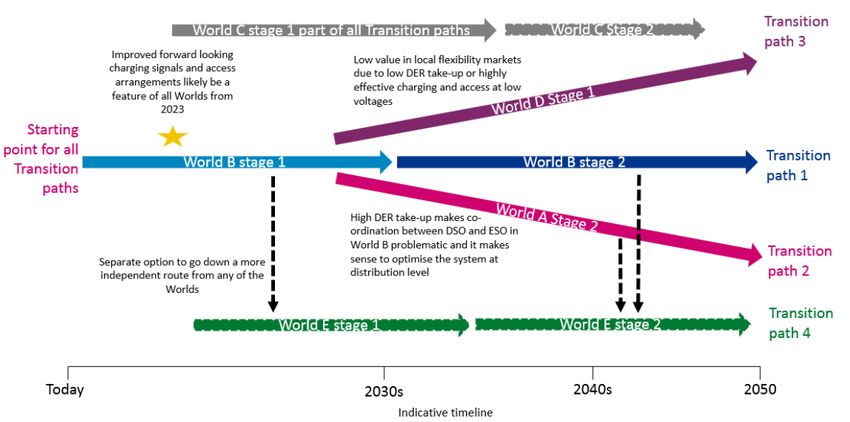
1 Introduction
This report aims to outline how the MERLIN project aligns and supports the work undertaken in the Energy
Networks Association (ENA) Open Networks Project’s least regrets exercise and Baringa’s Future World
Impact Assessment (FWIA) to MERLIN project activities.

This report is organized into three chapters, these chapters cover the following aspects:
1.      Background and Context
2.      The MERLIN Project & The FWIA Transition Paths
3.      The MERLIN Project & Least Regrets Functions

        Background
This section will provide an overview of the key activities under consideration in this report. These
activities are:

    •    The ENA’s Open Networks Project and The Five Worlds
    •    The Baringa Future World Impact Assessment
    •    The ENA’s Least Regrets
    •    The MERLIN project

The ENA’s Open Networks Project & The Five Worlds
The Open Networks Project is an ENA industry initiative that is focused on underpinning the delivery of
the smart grid in the United Kingdom (UK). As per the ENA, the Open Networks Project “seeks to enable
the uptake of new smart energy technologies by more and more homes, businesses, and communities in
the UK. Allowing customers to take advantage of these new technologies to take control of their energy
will lower costs and secure the energy we rely on every day” [1].

Workstream 3 of the Open Networks Project focusses on the transition to a Distribution System Operator
(DSO). The ENA describes a DSO as an entity that “securely operates and develops an active distribution
system comprising networks, demand, generation and other flexible DER. As a neutral facilitator of an
open and accessible market, it will enable competitive access to markets and the optimal use of DER on
distribution networks to deliver security, sustainability and affordability in the support of whole system
optimisation” [2].

The output of this workstream is five future worlds that model “how future industry structures could best
deliver flexibility markets providing services from DER for both national and regional (transmission and
distribution) requirements.” The Five Worlds are best described by the ENA as visualized in Figure 1. The
ENA does not identify these worlds as mutually exclusive or complete but instead as potential future
market, organizational, and operational structures that could co-exist.

Page 3                                                           Mapping Open Networks to MERLIN
Figure 1: The ENA's Five Future Worlds [2] The Baringa Future World Impact Assessment The ENA asked Baringa to undertake an independent impact assessment of the Future Worlds. The Future World Impact Assessment (FWIA) is intended to reflect on the relative strengths and weaknesses of the Future Worlds and the impacts they may have on network operators and users [3]. This was done though an assessment of the Future Worlds against over 30 criteria defined by the ENA and stakeholders. While the assessment did not recommend a specific world to pursue, it did deliver pathways by which the Future Worlds may be achieved and identified their objectives and trade-offs. The FWIA identified four transition paths to the Future Worlds, as presented in Figure 2. Most importantly, FWIA identified Phase 1 where World B is pursued at least until 2023 and incorporates the constructs of World C across each of the transition paths. Page 4 Mapping Open Networks to MERLIN
Figure 2: The FWIA Five Transition Paths [3]

Least Regrets
The ENA’s Least Regrets assessment is the third product of the Open Networks Workstream 3 [4]. This
builds on the five transition paths outlined by Baringa’s FWIA and identifies World B, of DSO-ESA co-
coordination as the least regrets path to pursue in the short- and medium- term [5].

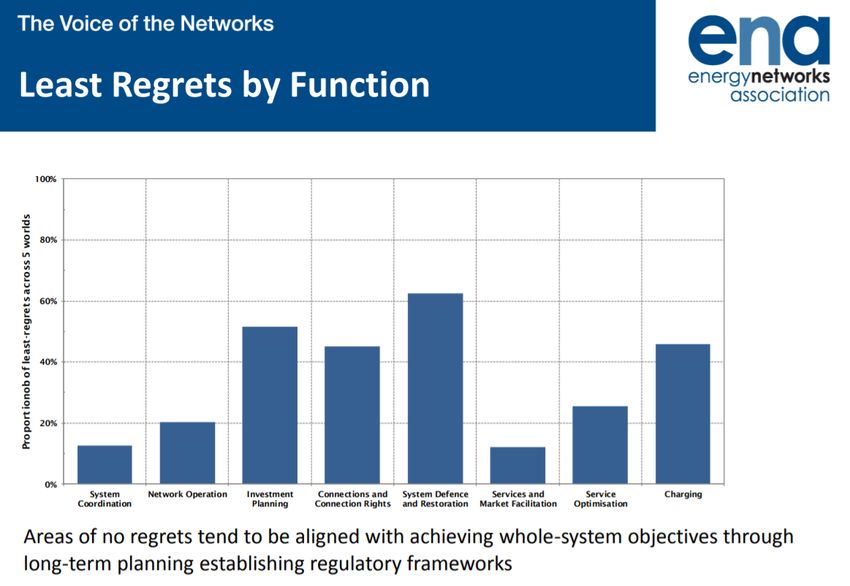
Specifically, this product has identified areas of functionality that would be common to all Future worlds,
presented in Figure 3 . Ordered by their relevancy across each of the Future worlds, these are:

    •    System Defence and Restoration
    •    Investment Planning
    •    Connections & Connection Rights
    •    Charging
    •    Service optimization
    •    Network operation
    •    Services and Market Facilitation
    •    System coordination

Page 5                                                                  Mapping Open Networks to MERLIN
Figure 3: Least Regrets by Function as Presented in [4]
These functions are further detailed into activities that would be conducted by a variety of Future World
entities including a DSO and an ESO for example (the entities differ by world). The ENA Workstream 3
recommends that these serve as a basis for building smart grid initiatives at present.
The MERLIN Project
The MERLIN project is a smart grid initiative that will investigate and demonstrate activities a DSO could
conduct as a system operator, potentially in any of the Future worlds. Per the ENA’s commentary of the
FWIA, this positions the project to align well with the least regrets analysis.
The MERLIN project will investigate the ways in which a Future World DSO may valuate flexibility to
support decision making. More specifically, the project will determine how smart solutions and DER
flexibility service solutions can be assessed and compared to maintain the distribution network. This will
be trialled in a jurisdiction of SSEN’s network for this project and will be comprised of two software
deployments that will contribute to one another but offer separate value-adds:
1. A planning tool that will compare various solutions to network constraints and reinforcement
needs. Specifically, the comparisons will be based on financial and power systems metrics. This
project will see the deployment of a tool that facilitates the comparison of how flexibility solutions
compare to traditional network reinforcement solutions based on cost and ability to relieve
network constraints. As a part of the MERLIN project, Opus One Solutions’ GridOS Integration
Distribution Planning software will serve as the planning tool.
2. A flexibility market simulator that will simulate various flexibility market scenarios for two
different regions within SSEN’s jurisdiction. Specifically, the simulator will utilise a DER valuation
Page 6 Mapping Open Networks to MERLINmodel to generate simulated flexibility requests and will utilise smart solution financial and
technical information to simulate a market deployed to service network needs through the
utilization of flexibility. As a part of the MERLIN project, Opus One Solutions’ GridOS Flexibility
Markets Simulator software will serve as the flexibility market simulator.
The MERLIN project will develop case studies from the SSEN Future Energy Scenarios (FES) that reflect
different potential future scenarios by simulating loading, network, flexibility, and pricing constructs. The
planning tool and flexibility market simulator tools will then be deployed to assess how SSEN as a DSO
would operate under said case studies, when there are more mature markets and the ongoing
management of DSO and P2P services becomes economically vital for all actors.
This project will, in the long term, inform the Power Systems Economics Roadmap at SSEN. The purpose
of the roadmap is to define where DNOs currently are with respect to the technical capabilities that help
understand Power Systems Economics and to then define an end point of where they can be in a Future
World. This will enable SSEN and other DNOs to perform a gap analysis to identify areas of research that
will be needed to take the organization to where it needs to be in the Future Worlds.
Page 7 Mapping Open Networks to MERLIN2 The MERLIN Project & The Future World Impact
Assessment Transition Paths
The ENA’s World A focuses on flexibility coordination and dispatch met by the DSO while World B on DSO-
ESO co-coordination (Figure 1). FWIA states that Worlds A and B produce the maximum benefits in the
short-term while requiring the least effort from stakeholders. Each of the four transition paths assumes
that World B will be pursued until 2023, at which point each of the pathways diverge to deliver one of the
five future worlds.
A key objective of the MERLIN project is to support DSOs building out key planning and coordination
functionality, which is a World B requirement and serves as the short-term future for each transition path.
Another objective of the MERLIN project is to address the techno-economic impacts of planning for
flexibility through determining scenarios by which DER and local flexibility markets may defer
reinforcements on the distribution network. This addresses some of the key factors that the FWIA
identifies will occur in World A and will continue past 2023, namely:
• Development of frameworks in which flexibility providers can stack revenues and interact with
different markets proves too complex for co-coordination
• High DER update
• Captured and quantified benefits to utilizing DER and local flexibility markets to defer
reinforcements on low voltage distribution networks.
Additionally, the MERLIN project can offer learnings for the complexity of co-coordination with an ESO
market given a pilot of coordination with only one layer of a flexibility market.
The FWIA report highlights the need for a trial to develop the economic concepts, tools and
methodologies and identified the need for greater understanding of Power System Economics to ensure
the best whole system solutions for GB networks can be determined. MERLIN proposes to close the gap
identified by focusing on Power System Economics which will inform investment decisions and be
significant to network customers looking to build business cases through the objective of supporting the
transition to a smart grid for DER integration into the electricity distribution network and simulation of
other markets. The FWIA identifies four areas for future work that can help to inform which transition
path is most likely to be pursued beyond the 2023 World B. The MERLIN project addresses two of these
directly:
1. What is the value of flexibility to network operators at low voltages?
A MERLIN project focus is to understand the value flexibility markets can offer to DSOs and how
this relates to traditional solutions to network operations. Specifically, the MERLIN project will
entail activities that quantify the value a DER may offer in relieving network congestion. As per
the FWIA, “[…] further trials, to test the economic viability of these local flexibility markets will
help inform the extent to which a transition to World A remains a credible pathway.”
The results of the MERLIN project can support Baringa and the ENA in determining how viable
flexibility markets are. For example, the MERLIN project will identify scenarios in which DER
costs in a flexibility market are higher than traditional solution costs, shedding light in conditions
under which flexibility markets may not be the most economic solution based on today’s
Page 8 Mapping Open Networks to MERLINassessment criteria which is being aligned through the ENA Open Networks Project. However,
this alignment does not consider non-traditional assessment factors including some outside of
the DNOs present remit. In a Future World, whole system factors potentially including social
benefits may have a significant impact on the economic viability of the available options.
Through MERLIN the industry will better understand the likely impact of each factor and the
complexity associated with implementation. This can then form the base for longer term pre-
procurement assessment processes.
Finally, the FWIA states “A greater understanding of the economics of local flexibility markets
will be crucial in understanding if Stage 2 of World A is likely to be required. Further information
in this area would also help to reduce the range of uncertainties placed around our quantitative
analysis.” The MERLIN project will close this gap by using power systems economics to evaluate
the value of flexibility to system operators at the low voltage. In a future world, this will inform
investment decisions and support business case development for both network operators and
network customers.
2. How can industry arrangements facilitate a different pace of change across regions?
The FWIA assessment identified one of the key triggers for the transition paths as the uptake of
DER, which can vary by geography. The MERLIN project will be developing case studies that
showcase various combinations of DER uptake that can be modelled in different areas. This will
include varying DER type, availability, contract structure, and penetration. Additionally, the
MERLIN project will consider these case studies in two different areas, Fort Williams, and
Oxfordshire. While the project will not comment directly on industry codes and regulations that
can facilitate various transition paths, MERLIN will be able to comment on the impact of various
DER distribution and uptake conditions within SSEN jurisdiction.
Page 9 Mapping Open Networks to MERLINFWIA and Distribution-level DER Valuation
The FWIA illustrated benefits from Future Worlds as saving money across four categories: avoided
transmission investment; avoided distribution investment; reduced balancing services costs; and avoided
generation investments. Figure 4 visualizes the result of Baringa’s evaluation across all Future Worlds,
between two FES scenarios considered.
Figure 4: Proportionate Breakdown of Benefits by Category across Future Worlds [3]
In each scenario, avoided distribution investment costs play a large role in the benefits of a Future World.
This is especially the case in scenarios with high DER uptake. This assessment took avoided distribution
investment to be “avoided reinforcement costs caused by locational constraints”. The methodology used
by Baringa to quantify avoided distribution investments were based on the (CDCM) which is based on
generic incremental costs experienced on low voltage (LV) systems. The MERLIN project will align with
Baringa’s exercise in a number of ways:
• A DER valuation study as a part of the project will have the project team investigate different
ways in which SSEN can quantify the benefits a flexibility service may offer to constraint relief.
This will consider approaches including, similar to, and beyond those considered for the FWIA
• The MERLIN project will be able to account for more geographically specific benefits of a
flexibility market. For example, both the planning tool and flexibility utilization simulator will
account for MERLIN’s LV network model and utilize metrics identified by SSEN to value flexibility
services
• Finally, the FWIA considered the benefits of flexibility services at a high level and order of
magnitude scale. The MERLIN project will be able to consider a more granular level, reporting on
costs for specific network configurations as using the planning tool, and simulating flexibility
market payments using the flexibility utilization simulator.
Finally, the concluding remarks of the FWIA recommends future work that shapes “a greater
understanding of how markets would interact and the commercial arrangements between parties would
help to validate the operational viability of each Future World, and in turn the attractiveness to investors
in flexibility.” The MERLIN project will work to develop this understanding by modelling flexibility
services of different contract structures and values with the case studies developed reflecting flexibility
services with both long-term and spot market constructs.
Page 10 Mapping Open Networks to MERLIN3 The MERLIN Project & Least Regrets Functions
The ENA’s commentary on the FWIA addresses three key points with MERLIN project strategically
supporting points 2 and 3:
1. That the least regrets path identified aligns well with the DSO-TSO cooperation approach
throughout the UK
2. That incorporating price driven flexibility will enhance the readiness of all stakeholders in the DSO
transition
3. That regional differences must be accounted for in activities to support the DSO transition
First, the MERLIN project will provide case studies that outline the ways in which flexibility services can
be valuated and the ways in which flexibility markets may operate based on these valuations. Second, the
MERLIN project will include an assessment of two key and different areas in SSEN’s jurisdiction, providing
commentary on the impact of region on the DSO functions at SSEN.
As per the ENA’s assessment and Figure 3, the least regrets functions outlined are intended to align such
that they achieve whole system objectives. This means that some of the functions can be worked towards
by a DSO entity and others by other entities such as the ESO. Below, key activities attributed with each of
the least regrets functions (with the exception of Charging as it is not the role of a DSO) are aligned with
the planning and flexibility market simulation components of the MERLIN project. Specifically,
functionality offered in either toolset are aligned with key least regrets activities. Additionally, the value-
add of the MERLIN project relative to these activities is highlighted, across various Future Worlds. Finally,
this is rolled up into Table 1: Alignment of MERLIN Activities to Least Regrets Functions, which identifies
which of the least regrets functions the MERLIN project may support a DSO in building towards.
Table 1: Alignment of MERLIN Activities to Least Regrets Functions (Figure 3),
To what extent may the MERLIN project
contribute to developing this function at SSEN?
Investment Planning High
Service Optimization High
Services and Market Facilitation Medium
Network Operation Medium
System Coordination Low
Connections and Connection Rights Low
System Defence and Restoration None
Charging None
Table 2 outlines how each least regret function is facilitated by the project trial. This is separated by
planning and flexibility market simulation tool to indicate specifically software functionality that will allow
for the overall MERLIN project value-add to be realized.
Page 11 Mapping Open Networks to MERLINTable 2: MERLIN contribution to each Least Regrets Function
Planning Tool Flexibility Market Simulator MERLIN Project Value-Add
Design Contracts and - Ability to capture contract - Ability to capture bid and offer - This project will borrow
Terms & Conditions for structure per flexibility provider curves from flexibility providers and contract structures for flexibility
procuring ancillary made available to optimize by the optimize flexibility requests for market providers from the TRANSITION
services (DER) operator. This includes indicating services while respecting bids and and LEO projects. These are
availability and utilization costs offers themselves built on the Open
per DER - Ability to report on Networks contract template for
- Ability to report on overall recommended settlement per DER today’s Active Power Services.
network operations costs as well based on market simulation These will be captured in
as costs payed out per DER to analyses performed by both the
operate a network given dispatch planning and flexibility tools.
of flexibility for constraint Specifically, the project trials will
management power flow vary contract payment
objectives structures and values between
Investment Planning
availability and utilization. This
will allow DSOs to better
understand how different
contract and payment structures
for flexibility shape the overall
cost to operate network
operations and/or flexibility
markets. This will allow later
work under TRANSTION and LEO
to be directed by MERLIN
learning. It also facilitates
greater economic analysis,
verification and validation,
increasing the weight of overall
Oxfordshire learning.
Create a visible - Ability to provide a GIS view - Ability to report on total - The MERLIN project will
measure of flexibility of the network, identifying asset flexibility service requests generated visualize the impacts of
on the networks locations flexibility operations to support
Page 12 Mapping Open Networks to MERLIN- Ability to view market and simulated market participant constraint minimization visually
participating DER based on responses using the planning tool and by
location - Ability to export all reporting and numbers via the simulator.
- Ability to visualize network filter by flexibility provider
conditions (powerflow, voltage,
constraints, and loading) on the
network given network conditions
and DER operations
- Ability to quantify the
number of times a flexibility
service would be dispatch to
support constraint minimization
on the network
- Ability to report on
flexibility dispatch and costs of
dispatch
- Ability to export all
reporting
Present customer - Ability to provide both operator - The MERLIN project will
information of and market participant interfaces, deliver a platform that provides
opportunities in a allowing the various actors to better flexibility providers as well as
consistent way – understand the economic viability of a system operators visibility to
heatmaps etc. service. Aids investment and reduces simulated market operations
the risk of stranded investment. This such that customer information
includes presenting flexibility requests is accessible and can be
and clearances to market participants reported on. This is important
and overall system costs and flexibility in future platform deployments
dispatch to operators. to engage and inform flexibility
providers.
Universal Contract for - Ability to capture contract - Ability to capture bid and offer - This project will borrow
Optimisation
Flexibility Providers structure per flexibility provider curves from flexibility providers and contract structures for flexibility
Service
made available to optimize by the optimize flexibility requests for market providers from the TRANSITION
operator. This includes indicating services while respecting bids and and LEO projects. These will be
offers captured in analyses performed
Page 13 Mapping Open Networks to MERLINavailability and utilization costs by both the planning and
per DER flexibility tools. Specifically the
project trials will vary contract
payment structures and values
between availability and
- Ability to report on overall - Ability to report on utilization. This will allow DSOs
network operations costs as well recommended settlement per DER to better understand how
as costs payed out per DER to based on market simulation different contract and payment
operate a network given dispatch structures for flexibility shape
of flexibility for constraint the overall cost to operate
management power flow network operations and/or
objectives flexibility markets
Contract Process - Ability for flexibility providers to - The MERLIN project will
submit bids and offers to flexibility engage customer groups in
market that will be respected in market Oxfordshire and have them
operations providing some of the market
- Ability for flexibility providers to simulation inputs, including bids
interact with market platform in real- and offers. This addresses a
time development of the 2019
Market Rules Simulation session
led by TRANSITION. This could
draw out areas where a more
traditional process would act as
a barrier to entry for some
actors. Similarly, the simulations
aim to better understand the
impact of contract durations and
whether the most economic for
the DSO stimulates markets.
Activation, dispatch - Ability to simulate dispatch - The MERLIN Project will
and settlement of flexibility such that power flow identify the optimal activation
is optimized to minimize system or dispatch of assets for each
constraints project trial scenario. These can
Page 14 Mapping Open Networks to MERLIN- Ability to report on dispatch be compared across trial
of flexibility simulating their scenarios to investigate how
complete availability to constraint forecasted loading may impact
minimization dispatch flexibility utilization.
Review and rate - Ability to allocate flexibility - The MERLIN project trial
flexibility service providers as completely available scenarios will explore the
provider for dispatch to support system techno-economic impact of non
constraint minimization objectives or part delivery of flexibility.
or to associate operating This will include comparing the
schedules to flexibility providers network constraints and
- Ability to report on dispatch network operation costs
of flexibility simulating their associated with scenarios in
complete availability to constraint which flexibility is fully available
minimization dispatch or optimisation and others in
- Ability to report on overall which flexibility does not always
network operation costs given respond to optimal dispatch.
flexibility provider behaviour and This will outline the risk DSOs
costs should account for in flexibility
delivery and will quantify the
extent to which flexibility under-
delivery may impact network
operations ad costs
- Direct engagement with
flexibility service providers in
Oxfordshire will allow SSEN to
better understand the market
structures that would promote
and/or incentivize acceptable
flexibility service provider
behaviour
Page 15 Mapping Open Networks to MERLINDevelop consistent - Ability to provide operators and - This project will provide
best practice for end to flexibility service providers with an opportunity for flexibility
end process of interfaces to enrol flexibility providers services to be utilized to relive
procurement, in a market and visualize flexibility D-network constraints in
activation, dispatch services requested and delivered addition to voltage management
and settlement of D- - Ability to engage market and peak reactive services. This
network connected participants in an interactive simulation will involve the activation of
flexibility in which flexibility providers submit and these services with live
update bids and offers participants and reporting on
settlement recommendations.
- Ability to request flexibility This will explore how a flexibility
services based on power flow driven
Services & Market Facilitation
platform deployed can serve the
system services, namely: constraint end to end process of
management; voltage management; procurement, activation,
and peak reactive dispatch, and settlement in
future worlds. potential
dispatch
Develop good practice - Ability to generate reporting that - This project will build out
and consistency for documents flexibility dispatch, bids and DER penetration and flexibility
post-event evaluation – offers, and calculated settlements at market scenarios that vary DER
review service per flexibility provider and aggregate types and locations as well as
provision levels contract structures and values.
Following, the overall costs to
operate various market
simulations can be reported and
compared to one another
and/or traditional solutions.
This allows DSOs to explore the
financial management of
flexibility for network services
Page 16 Mapping Open Networks to MERLINDefine guaranteed - Ability to model the - Modelling the 11kV and
standards of distribution network from the 33kV networks in the same
performance between 33kV HV substation level to the system is unique and tests the
DSO and ESO for 11kV LV level level of power flow visibility that
utilising flexibility on - Ability to ensure that might be needed by the ESO
the distribution flexibility services connected to and/or DSO in future
network the network do not constrain the coordination
network at any level
- Ability to perform sub-
transmission and distribution level
power flows
Design a consistent and - While the MERLIN project
effective feedback loop may not impose direct penalties
for those providing on market participants for their
System Coordination
services –e.g. behaviour in a market as the
ratings/penalties? performance of a market will be
simulated, case studies will
allow SSEN to consider potential
times in which flexibility
providers do not deliver
committed services and the
impact this may have on the
grid.
- Engagement with
flexibility service providers and
Oxfordshire will allow SSEN to
better understand the market
structures that would promote
and/or incentivize acceptable
flexibility service provider
behaviour. Further, the LEO
project will investigate this in
Oxfordshire, thus MERLIN will
support.
Page 17 Mapping Open Networks to MERLINUnified approach to LV - Ability to reflect LV - Ability to account for network - This project will translate
system monitoring and networks data aggregated at 11kV model based powerflow in simulating two SSEN network models into
visibility of data network level the market ensuring that no flexibility Common Information Model
- Ability to perform services are generate that may (CIM) format that can be easily
timeseries power flow based on compromise the 11kV or 33kV transferred across systems
forecasted load & generation data networks within SSE which is useful as it
on both 11kV and 33kV networks creates one source of truth for
- Ability to update network SSEN network model data
model configuration and asset - Regardless of the Future
properties to determine their World pursued, network model
impact on flexibility market consideration will be necessary
simulations to consider the power systems
impact of flexibility markets.
This project will offer lessons
Network Operation
learned on deploying a
simulation of a flexibility market
on such a network model
- This project will also
generate load profiles that will
model a number of future case
studies, which will be useful to
consider as they reflect
conditions within which SSEN
may transition towards a DSO
role
Consistent - Ability to report on and - Ability to house request flexibility - This project will involve
methodology/approach compare constraints on the from providers such that network defining a DER valuation
for the management of network across a period of time constraints are resolved, at the lowest methodology that will
constraints for various future load scenarios overall cost to the operator determine how traditional
and network configurations solutions to constraint
- Ability to model flexibility management can be compared
dispatched to relieve network in cost to smart solutions for
constraints and report on constraint management
associated costs
Page 18 Mapping Open Networks to MERLIN- Multiple load and
network scenarios and
conditions will be compared as a
part of the MERLIN project. This
comparison will be
technoeconomic and will include
the frequency of network
constraints over any time
period. In this way, the trial
scenarios will allow DSOs to
investigate the ways in which
different traditional solutions
and/or placements of DER may
impact network constraints
experienced.
Design a common - Ability to capture contract - Ability to capture bid and offer - This project will borrow
Connection Agreement structure per flexibility provider curves from flexibility providers and contract structures for flexibility
& Flexibility Agreement made available to optimize by the optimize flexibility requests for market providers from the TRANSITION
Connection & Connection Rights
operator. This includes indicating services while respecting bids and and LEO projects. These will be
availability and utilization costs offers captured in analyses performed
per DER - Ability to report on by both the planning and
- Ability to report on overall recommended settlement per DER flexibility tools. Specifically, the
network operations costs as well based on market simulation project trials will vary contract
as costs payed out per DER to payment structures and values
operate a network given dispatch between availability and
of flexibility for constraint utilization. This will allow DSOs
management power flow to better understand how
objectives different contract and payment
structures for flexibility shape
the overall cost to operate
network operations and/or
flexibility markets
Page 19 Mapping Open Networks to MERLIN4 Beyond the MERLIN Project
The MERLIN project is an initiative at SSEN that will eventually feed into the Power Systems Economics
Roadmap and transition SSEN to perform DSO roles in any Future World and in the meantime as a part of
any of the FWIA transition paths. Based on the least regrets analysis, there are a number of initiatives that
can prepare SSEN to build out even more of the DSO functions common across all transition paths. These
are:
• Investigating the ways in which the D-network flexibility market can be aggregated to respond to
ESO market requests. This will position SSEN to communicate all necessary data to and from the
ESO and model Future Worlds in which co-coordination exists
• Trialling various contract structures and formats with flexibility service providers. This will allow
SSEN to determine the most cost-effective and efficient way to contract for flexibility services
• Deployment of a market that serves as operational in real-time and cannot be reconfigured to
simulate various configurations. This will provide learnings on the participation and dispatch of
flexibility service providers
• Facilitating the linkage of a flexibility market to operational and outage data through an advanced
distribution management tool. This will further increase visibility of flexibility market activities on
the LV network. It will also allow SSEN to understand how the market would react to emergency
situations
5 Glossary
CDCM Common Distribution Charging Methodology
DER Distributed Energy Resource, synonymous with flexibility service
provider for the purpose of this report
DNO Distribution Network Operator
DSO Distribution System Operator
ENA Energy Networks Association
ESO Energy System Operator
FES Future Energy Scenarios
FMT Financial Management Tool
FWIA Future World Impact Assessment conducted by Baringa
GridOS Opus One Solutions’ software, deployed to meet MERLIN project
objectives
GridOS IDP GridOS Integrated Distribution Planning Module
GridOS FMS GridOS Flexibility Market Simulator
LV Low Voltage
NMF Neutral Market Facilitator
UK United Kingdom
Page 20 Mapping Open Networks to MERLIN6 References
[1] Energy Networks Association, "Open Networks Project Overview," Energy Networks Association,
London, 2017 .
[2] Energy Networks Association, "Developing Change Options to Facilitate Energy Decarbonisation,
Digitisation, and Decentralisation," Energy Networks Association, London , 2018.
[3] Baringa, "Future World Impact Assessment," Baringa, London, 2019.
[4] Energy Networks Association, "Least Regrets Workstream 3 Product 3," London, 2019.
[5] Energy Networks Association, "Open Networks Response to Impact Assessment Consultation,"
London, 2019.
Page 21 Mapping Open Networks to MERLINContact us:
futurenetworks@sse.com
www.ssen.co.uk/Innovation
@ssen_fn
Scottish and Southern Electricity Networks is a trading name of: Scottish and Southern Energy Power Distribution Limited Registered in Scotland
No. SC213459; Scottish Hydro Electric Transmission plc Registered in Scotland No. SC213461; Scottish Hydro Electric Power Distribution plc
Registered in Scotland No. SC213460; (all having their Registered Offices at Inveralmond House 200 Dunkeld Road Perth PH1 3AQ); and Southern
Electric Power Distribution plc Registered in England & Wales No. 04094290 having its Registered Office at Number One Forbury Place,
43 Forbury Road, Reading, Berkshire, RG1 3JH which are members of the SSE Group. www.ssen.co.ukYou can also read


