MONTHLY PRICE AND POLICY UPDATE * - OILSEEDS, OILS & MEALS
←
→
Page content transcription
If your browser does not render page correctly, please read the page content below
OILSEEDS, OILS & MEALS
                                       MONTHLY PRICE AND POLICY UPDATE *

                                                              No. 130, May 2020

a) Global price review                                                          Main drivers behind the latest drop in soybean
                                                                                values include:
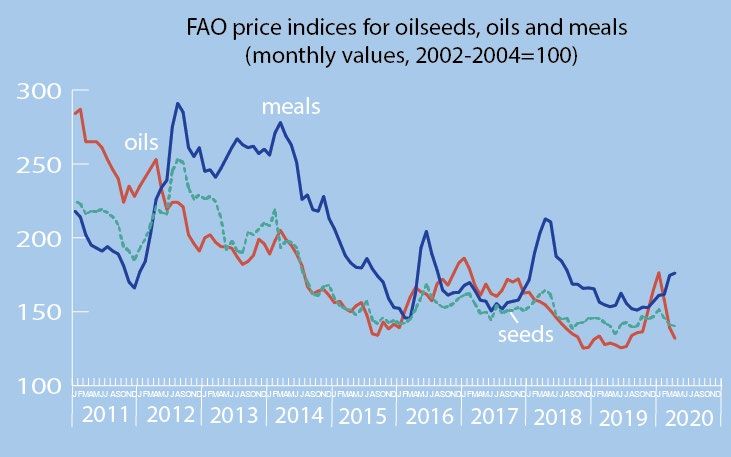
In April, FAO’s price index for oilseeds                                        - continued concerns over the impact of the
contracted slightly, shedding 0.7 points (or 0.5                                   COVID-19 pandemic on global demand;
percent) and marking the lowest level since                                     - COVID-19-related suspensions of operations
September 2019. By contrast, FAO’s oilmeal                                         by a number of meat processing plants in the
index appreciated for the fifth consecutive month,                                 United States of America (USA), which
gaining 1.6 points (or 0.9 percent) and posting a                                  resulted in reduced feed demand from live-
20-month high. In the meantime, the vegetable                                      stock producers;
oils index remained on a downward slope, losing                                 - subdued demand for exports from the USA
another 7.2 points (or 5.2 percent), though still                                  given strong competition from Brazil, where
faring slightly above the level recorded in the                                    further currency depreciations continued to
corresponding month of last year.                                                  boost exports; and
                                                                                - rapid planting progress in the USA amid
The marginal fall in the oilseed price index                                       favourable weather conditions.
represents the combined result of weakening                                     Downward pressure on prices was, however,
soybean values and firmer quotations for                                        somewhat contained by concerns over protracted
sunflowerseed and, to a lesser extent, rapeseed.                                dryness denting harvests in parts of Brazil and
International soybean prices declined for the third                             Argentina. By contrast, international sunflower-
consecutive month, recording a nine-month low.                                  seed values rebounded noticeably in April, in

                                                                                                                      – cont’d on next page –

* The Monthly Price and Policy Update, or MPPU, is an information product provided by the oilseeds desk of the Trade and Markets
Division of FAO. It reviews the development of international prices for oilseeds, oils and meals as reflected by FAO’s price indices and
spots important policy and market events selected from a variety of official and unofficial sources. Section b) of the present issue covers
developments observed during March and April 2020. Previous issues can be downloaded from the FAO website at the following URL:
http://www.fao.org/economic/est/publications/oilcrops-publications/monthly-price-and-policy-update/en/.
FAO – Trade and Markets Division
                                                                         (www.fao.org/economic/est/en/)

Global price review – cont’d                              remained on a downward trajectory, falling for
                                                          a third consecutive month and marking a seven-
response to a COVID-19-related temporary export           month low. The fresh drop in prices was driven
ban introduced by the Eurasian Economic Union,            by both the protracted trough in international
of which the Russian Federation – the world’s             crude oil values and the depressing effect of the
second largest supplier – is a member. In the case        COVID-19 pandemic on global demand for palm
of rapeseed, after falling markedly in March,             oil in food as well as energy sectors. Adding to
international prices recovered somewhat in April.         the downward pressure on prices were higher-
Evidently, the depressing effect of poor rapeseed         than-anticipated crop harvests in Malaysia and
oil uptake by biodiesel producers (in the wake of         announcement that Malaysia’s ongoing
widespread movement restrictions under COVID-             implementation of higher national blending
19) was offset by the prospect of tightening              mandates for palm oil-based diesel would be
supplies in the European Union (EU) and unfa-             suspended. Subdued demand also weighed on
vourable weather conditions reported in some of           international soy and rapeseed oil prices, with
Canada’s key production regions.                          soyoil values also affected by higher than
                                                          anticipated crushings in the USA. By contrast,
The continued strength in the oilmeal price index         world sunflower oil prices rebounded in April,
mainly reflects firmer rapeseed and sunflower             underpinned by firm import demand amid
meal values, while soymeal prices remained                concerns over tightening export availabilities.
virtually unchanged month-on-month. Sharp
drops in rapeseed crushings in the EU – caused
by declining demand from biodiesel producers –
led to a pronounced rise in rapeseed meal prices,
with spill-over effects on sunflower meal,
a substitute protein source in animal feed.
As for soybean meal, while lower-than-expected
harvests in South America and logistics con-
straints in Argentina bolstered international prices
in early-April, the above-mentioned temporary
shutdowns of meat processing facilities in the
USA eventually pulled down soymeal prices.

The latest drop in the vegetable oil index
primarily reflects weakening palm, soy and
rapeseed oil prices, whilst sunflower oil values
trended upward. International palm oil quotations

                                                                                                              2
                                      MPPU – issue no. 130, May 2020
FAO – Trade and Markets Division
(www.fao.org/economic/est/en/)
b) Selected policy developments and on industrial activities including agricultural
industry news processing facilities, thereby threatening to dis-
rupt the harvesting, processing and movement of
grains to markets and ports. However, most such
National COVID-19 responses measures were reversed swiftly, after companies
agreed to adopt stringent health protocols to
protect workers. Reportedly, the ultimate impact
The below is a non-exhaustive list of coronavirus- on the production and movement of grains was
related national policy measures featuring specif- limited, while the enforcement of health protec-
ic reference to oilcrops and derived products, as tion policies at riverine and coastal ports left
reported by various official and unofficial sources export logistics unaffected.
(NB: non-crop specific policy interventions • China: Reportedly, docking operations in
designed to keep the entirety of agricultural Chinese ports, which had slowed down tempora-
supply chains and food markets functioning are rily as a result of stringent sanitary inspection
not covered due to space limitations). procedures applied to incoming vessels, reverted
to normality towards mid-March.
1. Measures affecting production, transport • India: Reportedly, lack of trucks and labour
and port logistics: in the countries listed below, force at ports and refining facilities during the
movement restrictions and other health measures extended nationwide lockdown led to localized
introduced to contain the spread of COVID-19 disruptions in the country’s vegetable oil supply
temporarily affected domestic oilcrop production chain.
and/or related downstream activities. • Malaysia: On 18 March, to avoid disruptions
• Argentina: Although the country’s agricul- in palm oil production, the Federal Government
tural sector and foreign trade were essentially agreed to exempt the palm oil sector from a
exempt from compliance with nationwide six-weeks nationwide lockdown. However, on
lockdowns, in the second half of March, 24 March, after several estate workers tested
movement restrictions and sanitation activities positive for the disease, Sabah, the country’s
imposed temporarily by municipal authorities, largest palm oil producing state, ordered harvest
together with preventive measures enforced by and milling operations to cease and restricted
truckers associations and port workers unions, movement of staff in three out of seven districts.
resulted in momentary disruptions of i) truck Eventually, the ban was extended to another three
movements and grain deliveries, ii) grain/oilseed districts and prolonged by two weeks, affecting a
handling, crushing and storage activities, and total of 100 000 workers. After 17 days, planta-
iii) vessel docking, unloading/loading operations. tions and mills that were free of infections were
The localized, transitory disturbances lasted about allowed to resume operations at half capacity,
2–3 three weeks, after which domestic grain flows provided strict health protocols were applied.
and export operations normalized again. Reportedly, on 19 April, a single palm oil planta-
• Brazil: Distribution, storage and shipment tion complex in Sabah was ordered to close
of agricultural commodities and food products temporarily because of violations of movement
were declared as ‘essential’ by the Federal control orders and several fresh infections.
Government, along with the transportation of Lockdowns also led to the temporary shutting of
cargos more generally. Notwithstanding, in the 16 private port jetties used by Sabah plantation
second half March, a number of municipal companies to export their products. Although the
authorities enforced quarantine measures that various closures were only temporary, they led to
affected grains and oilseeds flows. In particular, tens of thousands of Indonesian migrant workers
two towns in Mato Grosso, the country’s largest returning home. It was unclear how the resump-
soybean and maize producing state, placed curbs tion of operations would be impacted by the
3
MPPU – issue no. 130, May 2020FAO – Trade and Markets Division
(www.fao.org/economic/est/en/)
resulting labour shortages. On a separate note, in combined. Furthermore, farmers financially hurt
March, the Federal Government also announced by the epidemic will also be provided access to
that, for a two-week period, vessels arriving more flexible federal loans.
from certain countries would not be accepted at
Malaysian ports – a measure said to have ham- 3. Import policies: to prevent potential supply
pered the palm oil supply flow out of Malaysia. shortfalls during COVID-19 emergencies, a num-
• Paraguay: Reportedly, in the second half of ber of countries temporarily liberalized imports of
March, operations at the country’s grain terminals oilcrops and derived products, while Sri Lanka
experienced delays due to logistics issues arising also restricted imports in a bid to counter the eco-
from nationwide lockdowns. nomic impact of the health crisis.
• Colombia: On 7 April, the government sus-
2. Producer support measures: COVID-19 pended the import tariffs for maize, soybeans and
related farmer relief packages included oilcrop- sorghum in a bid to reduce domestic feed produc-
specific support measures in the following two tion costs and hence consumer prices for meat.
cases. The tariff suspension is due to remain in place
• European Union: On 4 May, the European until end June 2020.
Commission announced several support measures • Mauritania: On 26 March, the Government
to enable – based on the schemes available under exempted selected food products, including edible
the Common Agricultural Policy and Common oils, from taxes and customs duties. The exemp-
Market Organization – the hardest hit sectors to tion was scheduled to remain in force until the end
help re-balance supply and adjust to demand shifts of 2020.
caused by the health crisis. The measures include • Pakistan: On 7 April, the government sus-
increased flexibility in the implementation of pended the additional customs duty of 2 percent
sectoral market support programmes for selected for imports of soybean, rapeseed, palm and sun-
products, including olive oil. flower oil and their respective seeds. The import
• United States of America: On 20 April, the duty would remain suspended until 30 June.
Government announced a relief programme worth • Saudi Arabia: The country’s Agriculture
USD 19 billion to help U.S. farmers cope with the Development Fund announced direct and indirect
impact of coronavirus. The programme targets loans to facilitate imports of a range of agricul-
farmers who have suffered a five-percent-or- tural products, including soybeans.
greater price decline due to COVID-19 and face • Sri Lanka: The Government suspended,
additional significant marketing costs as a result from 16 April to 15 July, imports of certain non-
of lower demand, surplus production and dis- essential goods to counter the economic impact of
ruptions to shipping patterns and the orderly the COVID-19 crisis. Products concerned include
marketing of commodities. The package includes oilcrop flours and meals and selected oils. At the
USD 3.9 billion for pay-outs to producers of same time, commercial banks were directed to
selected row crops, including soybeans, rapeseed facilitate imports of certain commodities, inclu-
and sunflowerseed. On 19 May, USDA informed ding palm, safflowerseed and cottonseed oil.
that producers would receive a single payment • Uzbekistan: On 3 April, the Government
based on 50 percent of a producer’s 2019 total reduced import duties on selected consumer
production or on unsold inventory as of 15 goods, including vegetable oils. The measure is
January 2020, whichever is smaller. For soybeans, scheduled to remain in place until the end of
rapeseed and sunflower, the applicable payment 2020.
rates would be, respectively, USD 0.45–0.50 per
bushel, USD 0.01 per pound and USD 0.02 per 4. Export policies: the countries listed below
pound. A payment limitation of USD 250 000 per temporarily restricted exports of oilcrops or
person or entity will apply, for all commodities derived products to prevent domestic supply
4
MPPU – issue no. 130, May 2020FAO – Trade and Markets Division
(www.fao.org/economic/est/en/)
shortages and stabilize domestic prices amid the to ensure that palm oil deliveries to factories
COVID-19 emergency. remained adequate amid nationwide movement
• Eurasian Economic Union: The customs restrictions. At the same time, the farmgate price
union comprising Armenia, Belarus, Kazakhstan, for fresh fruit branches would remain guaranteed
Kyrgyzstan and the Russian Federation banned at THB 4 per kg (USD 0.13).
exports of a number of agricultural products,
including sunflowerseeds and crushed and un- 6. Biodiesel market: some countries implemen-
crushed soybeans. The measure came into force ted (or considered introducing) changes in their
on 12 April and was set to last through 30 June. domestic biodiesel policies in response to declines
Regarding the Russian Federation, unofficial in fuel demand triggered by nationwide lockdowns.
sources reported delays in the issuance of export • Brazil: With respect to vegetable oil-based
certificates for sunflowerseed from the last week biodiesel, in April, Brazil’s National Agency
of March onward. of Petroleum Natural Gas and biofuels (ANP) –
• Kazakhstan: On 22 March, the Government which holds auctions to ensure that mandatory
banned the exportation of selected staple foods, blends of diesel with biodiesel are met –
including sunflowerseed and sunflower oil, until announced that, fuel distributors would be
1 September 2020. On 3 April, Government offi- requested to withdraw only 80% of the settled
cials announced that, in the case of crude sun- volume (rather than the customary 95%), given
flower oil, the export ban would be replaced by that domestic demand for biodiesel had dropped
and export quota – while the ban would remain in significantly.
place for refined sunflower oil and sunflowerseed. • European Union: According to media
• Kyrgyzstan: On 23 March, the Government reports, some EU member states considered
banned exports of selected food and feed products, calling for derogations of biodiesel blending
including vegetable oil, for a period of 6 months. obligations following both the plunge in inter-
• Romania: On 10 April, the Government national petroleum prices and the decline in local
banned exports of grains, oilseeds and derived biodiesel uptake as road fuel demand collapsed in
products to non-EU markets. The measure was the wake of national lockdowns.
lifted again after one week. • Malaysia: The Government decided to tem-
• Serbia: On 14 March, the Government im- porarily suspend its recently launched B20 pro-
posed a 30-day export ban for sunflowerseed and gramme, which envisaged a gradual, countrywide
derived products. shift to transportation diesel containing 20 percent
palm oil-based biodiesel – compared to the B10
5. Market regulation: two countries regulated mandate in place since February 2019 (see also
the domestic market of specific oilcrop products MPPU Mar.’20). The decision was prompted by
in a bid to shield consumers from price rises a sharp decline in domestic fuel demand resulting
during the COVID-19 crisis. from temporary COVID-19 related movement
• North Macedonia: To protect consumers restrictions and reflects Government efforts to
and prevent market speculation, in March, the channel public resources towards measures con-
Government froze the prices of certain food taining the epidemic. Reportedly, the B20 rollout
commodities, including olive oil. will be paused in those states were the new policy
• Thailand: To reduce the retail price of palm was yet to be implemented and would resume
oil, on 7 April, the Department of Internal Trade once to be implemented and would resume once
requested entrepreneurs to lower the price for the need for COVID-19 related measures ceases.
one-litre bottles to THB 39–40 (USD 1.22–1.25), • United States of America: The USDA
depending on brands. Furthermore, the Commerce announced plans to make available up to USD
Ministry stepped up collaboration with refiners 100 million in competitive grants for activities
5
MPPU – issue no. 130, May 2020FAO – Trade and Markets Division
(www.fao.org/economic/est/en/)
designed to expand the availability and sale of BRAZIL – biofuel policy: In line with past
renewable fuels. The measure is expected to announcements, on 1 March, the Government
benefit ethanol and biodiesel producers that have raised the nationwide mandatory biodiesel blend
been affected by decreased energy demand due to to 12%, compared to the 11% rate in place since
nationwide lockdowns. September 2019 (see also MPPU Sep.’19 &
Jan.’20).
ARGENTINA – export policy: A revised export CHINA – market regulation: According to
duty scheme for selected agricultural commodities industry sources, since the start of the current
has come into force on 5 March, along with the year, China’s state-owned grain corporation
reactivation of the export registration mechanism Sinograin released 1 million tonnes of soybeans
that had been suspended on 26 February (see also from state reserves to the country’s state-owned
MPPU Jan. & Mar.’20). Citing fiscal policy crusher Cofco. Reportedly, the move was
reasons, the Government raised the duty for prompted by supply concerns amid low levels
soybean, soymeal and soyoil to 33% (compared of commercial stocks following temporary
to the 30% rate in place since December 2019), slowdowns in imports. On a separate note,
thus retaining a uniform tax rate for primary and unofficial sources reported that the Government
secondary/value-added products. Under the was considering to add up to 10 million tonnes of
revised duty scheme, larger/commercial farms soybeans to state reserves with a view to i) help
will be subject to higher duties than smaller-scale shield domestic markets from potential supply
farms: the 33% rate will only apply to farmers disruptions linked to the COVID-19 pandemic,
producing more than 1000 tonnes of soybeans per and ii) honour pledges to increase purchases of
year; while farmers harvesting between 500 and agricultural goods from the United States of
1000 tonnes will continue to pay 30%, and pro- America (see MPPU Jan.’20 on the US-China
ducers with an output of less than 500 tons will be ‘Phase-one’ trade deal).
charged duties ranging between 20% and 29%.
Reportedly, the top duty rate will apply to about CHINA / CANADA – rapeseed trade:
one quarter of the country’s soybean farmers, who The two countries allowed a phytosanitary
account for three-quarters of total production. agreement regulating the shipment of Canadian
As for other agricultural commodities, the export rapeseed to China to expire on 31 March (see also
duties for wheat, maize, sorghum, beef and MPPU Nov.’16). Notwithstanding, China would
poultry have been left unchanged, while those continue to accept imports of Canadian rapeseed,
for sunflowerseed, groundnut and their respective provided that a reduced dockage limit of 1% of
crude oils were lowered from 12% to 7% and foreign material is respected – a requirement
those for confectionary sunflowerseed/groundnuts, allegedly linked to concerns about the trans-
refined sunflowerseed/groundnut oil and mission of blackleg disease through dockage.
sunflowerseed/groundnut meal from 12% to 5%. Since the required dockage limit is lower than
The export tax for biodiesel was raised from 27% the 2.5% standard set out Canada’s Grain
to 30%. Commission, processing costs for Canadian
rapeseed shippers are expected to rise. At the
BANGLADESH – market regulation: same time, China’s import licenses for Canada’s
With a view keep prices of basic foodstuffs stable two largest rapeseed suppliers would remain
during the month of Ramadan, the Central Bank suspended (see MPPU May’19), according to
of Bangladesh temporarily capped the interest rate trade officials. Market observers expect bilateral
for import financing of essential agricultural com- talks aimed at restoring full access for all
modities – including edible oils – at 9 percent. Canadian exporters to continue – in line with
6
MPPU – issue no. 130, May 2020FAO – Trade and Markets Division
(www.fao.org/economic/est/en/)
continued Chinese efforts to diversify its oilseed February). During the months of March and April,
imports amid the ongoing COVID-19 pandemic. the palm oil reference price dropped further,
falling below the USD 750 per tonne threshold
COLOMBIA – food standards: that triggers export taxation; consequently, during
In February, the Colombian Ministry of Health April and May, the tax on crude palm oil ship-
announced that, from November 2022, warning ments will be zero. Furthermore, the export levy
labels would be required on food products that are of USD 50 per tonne remains in place, given that
high in saturated fats, salt and added sugars. palm oil reference prices fared above the USD
In addition, regulations regarding nutrition-related 619 per tonne threshold that activates the levy.
labels would be made more stringent. Reportedly,
the final adoption of the new labelling standards is INDONESIA – export policy: With a view not
scheduled for May 2021. to disrupt the country’s palm oil exports, the
Indonesian Government decided to revoke rules
INDIA – agricultural support: that would require exporters of palm oil to use
Amid nationwide lockdowns imposed to halt the exclusively Indonesia-flagged vessels for their
spread of COVID-19, procurement of Rabi crops shipments. Based on announcements made in
by government agencies has begun in the 2018, the requirement was due to come into force
country’s major agricultural states on the in May 2020 (see also MPPU May’18).
scheduled date (15 April), despite logistical
hurdles including labour shortages. Reportedly, INDONESIA – coconut replanting support:
during the first 7 days a total of 111 638 tonnes The Indonesian Ministry of Agriculture plans to
of oilseeds were procured at minimum support rejuvenate 11 405 hectares of coconut plantations
prices. Procurement is expected to continue in 10 provinces across the country, with North
through 30 June. Sulawesi destined to be the largest recipient under
the 4-year programme.
INDIA – import policy: In March, the Indian
Government decided not to extend the temporary INDONESIA – certified sustainable palm oil:
safeguard duty imposed in September 2019 on A Presidential Regulation overhauling the
refined palm oil imports from Malaysia (see Indonesian Sustainable Palm Oil (ISPO)
MPPU Sep.’19). Malaysia’s new Government certification system was published on 13 March,
welcomed the decision and confirmed its interest ending a lengthy reform process meant to address
in strengthening the commercial ties between the a variety of implementation obstacles faced since
two countries. Moreover, in April, the Indian the scheme’s launch in 2011 (see MPPU Aug.’11,
Government eased the strict licensing require- Apr./Dec.’13, Mar.’16, Apr.’17, May’18 &
ments for refined palm oil imports that it had Nov.’19). The initiative’s declared objective is to
introduced at the beginning of the current year create an effective, efficient, fair and sustainable
(see MPPU March ’20). According to industry oil palm management system that is able to
sources, the decision was prompted by concerns support national economic development. More
that the recently imposed COVID-19 lockdowns specifically, the reform of the existing certifi-
could curtail domestic edible oil supplies and cation system is directed at i) improving the
drive up consumer prices. management of the country’s oil palm plantations
in line with reformulated ISPO principles and
INDONESIA – variable export dues: criteria guaranteeing socially, economically and
In line with recent falls in palm oil reference environmentally viable production; ii) raising the
prices, Indonesia’s export tax on crude palm oil acceptance and competitiveness of palm oil
for March was lowered to USD 3 per tonne products in both the national and international
(compared to the USD 18 per tonne rate applied in market; and iii) enhancing the reduction of GHG
7
MPPU – issue no. 130, May 2020FAO – Trade and Markets Division
(www.fao.org/economic/est/en/)
emissions. Accordingly, reform efforts would commercial growers – notably the Target Income
concentrate on: introducing more stringent ISPO and Forward Contract programmes – have been
standards and requirements; raising attention to replaced by schemes excluding elements of public
deforestation and peatland conversion issues; subsidy elements. On the other hand, support
making certification mechanisms more account- programme earmarked for small and medium
able and transparent, while allowing the parti- producers of selected row crops (including oil-
cipation of public, private and civil society seeds) remained in place, with direct payments
stakeholders; and introducing sanctions for rates remaining unchanged compared to 2019.
business players violating the system’s provisions.
Furthermore, the new regulation will extend MEXICO – food standards:
mandatory certification to smallholder growers, New mandatory front-of-package nutrition label
which will be given 5 years to achieve certifi- requirements are set to be implemented across
cation and are entitled to receive support the country in three stages. Reportedly, from
including financial assistance. In Indonesia, 1 October 2020, food product labels are required
smallholders manage about 40% of the country’s to include: i) warnings regarding nutritional
total oil palm plantation area. According to content that could affect certain health conditions
observers, to date small producers lacked access among the population; ii) cautionary legends; and
to government support, training and high-yielding iii) the prohibition of characters, graphics or
seedlings and, to make up for the resulting low pictures intended to promote consumption among
levels in productivity, they tended to clear new children.
land for planting using slash-and-burn methods –
a problem that the revised ISPO scheme tries to PHILIPPINES – agricultural support:
address. The Government has launched a new public-
private partnership to provide assistance to the
ITALY – market regulation (biodiesel): country’s coconut farmers. Under the programme,
The Italian Competition and Market Authority coconut agribusiness centres serving as one-stop-
(AGCM) fined the country’s leading oil and gas shops for coconut growers would be set up in each
company for allegedly disseminating misleading of the country’s 67 provinces. The centres will
advertising messages to promote the sale of allow partner agencies to channel assistance to
certain biodiesel products. The agency challenged small coconut growers, while investors would link
the company’s assertions regarding i) the positive up directly with producer groups for the supply of
environmental impact associated with the raw materials or finished products.
concerned products’ use, and ii) the fuel’s
characteristics in terms of fuel economy and RUSSIAN FEDERATION – GMO policies:
GHG emission reduction. The Government informed that, from 20 April
2020 through 1 December 2021, imports of GM
MALAYSIA – variable export tax: soybeans and soymeal products used as feed
In line with the recent gradual fall in crude palm whose registration has expired would not require
oil prices, Malaysia’s export tax on crude palm renewed state registration.
oil has been lowered to 5 percent and 4.5 percent
in April and May respectively (compared to the SRI LANKA – import policy: With effect from
6 percent rate applied in March). 10 April, the special commodity levy imposed on
imported palm oil was raised from LKR 200 per
MEXICO – agricultural support: kg to LKR 300 per kg (USD 1.08 and 1.62 respec-
Mexico’s Federal Expenditure Budget for 2020 tively), while the import levy on soyoil and sun-
includes significant cuts in support to agriculture. flower oil was raised to LKR 275 per kg (USD
In particular, the support programmes for large 1.48).
8
MPPU – issue no. 130, May 2020FAO – Trade and Markets Division
(www.fao.org/economic/est/en/)
SUDAN – export policy: certain parts of the country. The registration is
The Sudanese Government banned groundnut limited to five years, during with time EPA would
exports as of 1 April 2020. Furthermore, local evaluate any potential weed resistance that may
storage of groundnuts for the purpose of develop.
influencing prices was prohibited. Reportedly,
the measures are aimed at stabilizing domestic Sector development measures
consumer prices and maximizing the added value • Ghana – coconut: According to media reports,
of Sudanese groundnuts. coconut palm has been added to the purview of
Ghana’s National Tree Crop Development
THAILAND – pesticide regulation: Authority (NTCDA), a body set up under the
The Thai Government plans to introduce, from country’s National Tree Crops Development Bill
1 June 2020, zero-tolerance for residues of two of December 2019. Accordingly, NTCDA will be
agro-chemicals, paraquat and chlorpyrifos, in food mandated to develop and regulate production,
ingredients and food products. The new require- processing, marketing and export of coconut
ment would apply to production, possession, products. Reportedly, the agency would focus its
importation and exportation. The use of attention on business development, employment
glyphosate, on the other hand, continues to be creation and livelihood opportunities along the
allowed, although it remains subject to permission country’s coconut value chain. On a separate note,
and several restrictions will continue to apply to in February, Trade Ministry officials and repre-
its use in crop cultivation. sentatives of the country’s coconut associations
and banks paid a visit to an Indonesian supplier of
TURKEY – import policy: In a bid to facilitate coconut products with a view to develop commer-
imports and thus prevent increases in consumer cial ties. (See also MPPU May’19)
prices of edible oil, the Government temporarily • Morocco – olive tree: The European Bank
lowered the import tariff for sunflowerseed oil for Reconstruction and Development (EBRD)
from 36 percent to 30 percent. At the same time, pledged to loan up to MAD 55 million (USD 5.6
the reference price on which tariffs are applied million) to the Moroccan olive oil sector in a bid
would be reduced from USD 1 000 to USD 800 to boost its productivity. Reportedly, the funds are
per tonne. The measures will remain in place from earmarked for the construction of an olive oil mill
1 February to 30 June 2020. Reportedly, the need in the Fez-Meknes region as well as other projects
to secure import flows arose after the Eurasian aimed at increasing the number of farmers
Economic Union (which includes the Russian involved in olive tree cultivation. The initiative
Federation, i.e. Turkey’s principal supplier of complements efforts by the Moroccan
sunflowerseed) decided to temporarily ban Government to increase the sector’s capacity
sunflowerseed exports on the backdrop of the and output, with special attention given to export
COVID-19 emergency (see above). oriented operations. (See also MPPU June’17)
UNITED STATES OF AMERICA – pesticide Peatland conservation: The UN Food and
regulation: The U.S. Environmental Protection Agriculture Organization (FAO) launched a
Agency (EPA) cleared the use of the herbicide geospatial on-line tool to help countries preserve
isoxaflutole on genetically modified soybeans, critical carbon stores known as peatland. To halt
allegedly providing soy farmers with a new tool peatland degradation and effectively plan peatland
to control weeds that have become resistant to restoration, the agency called for urgent mapping
many other herbicides. Isoxaflutole has been and monitoring activities at national level and
classified as a restricted-use pesticide, meaning offered recommendations on how to manage
that users must receive special training in order to peatlands. According to FAO, locating and
use it. Furthermore, its use will only be allowed in accurately mapping peatlands – via a mix of
9
MPPU – issue no. 130, May 2020FAO – Trade and Markets Division
(www.fao.org/economic/est/en/)
satellite and ground-based tools – allows to communities. Reportedly, an environmental
effectively monitor changes in peatland advocacy group contributed to the development
conditions, notably their water level, thus spotting of the company’s new NDPE-policy.
risks of fires and harmful GHG emissions. • Withdrawal from forest protection platform:
To facilitate countries’ access to high-quality Citing concerns over governance and financial
imagery, the agency developed a state-of-the-art, matters, a global palm oil trading firm chose to
open-source monitoring module. Reportedly, resign as a member of the High Carbon Stock
the tool is being successfully used in Indonesia, Approach (HCSA) organization. Created in 2014,
where it provides timely information about soil the body developed a methodology that helps
moisture trends to help detect drainage and agribusinesses identify forest areas that should be
monitor restoration efforts. Similar applications protected – as opposed to degraded lands with low
are planned in the Congo Basin and in Peru. carbon and biodiversity values that may be devel-
oped. The concerned company informed that,
Free trade agreement – EU / Viet Nam: despite its withdrawal, it remains firmly com-
The Free Trade Agreement between the European mitted to using – across its supply chain – the
Union and Viet Nam, which is set to come into HCSA toolkit.
force during the course of 2020, is expected to • Sustainability concerns: A Norwegian
benefit EU olive oil producers: under the agree- sovereign wealth fund opted to divest from a
ment, the average tariff of 8.7 percent that Viet Peruvian consumer goods company over alleged
Nam applies to olive oil imports from the EU will human rights violations and deforestation
be eliminated. The southeast Asian country is activities in its palm oil supply chain.
viewed as a lucrative market due to its large • Blockchain application: The Malaysian Palm
population and steadily rising wages and Oil Council (MPOC) started to actively promote
consumer spending. (See also MPPU July’19) the use of blockchain technology to enhance
traceability, accountability and transparency
Palm oil – private sector initiatives across the country’s palm oil supply chain – with
• Production sustainability – Guatemala: the ultimate objective to raise the level of trust in
The Palm Grower Association of Guatemala Malaysian palm oil. The technology is meant to
(GREPALMA) reported that the number of complement the country’s mandatory sustaina-
signatories to its sustainable production principles bility certification and standards. Reportedly, a
has grown steadily and now covers three-quarters blockchain-based mobile application and web
of the organization’s total associated land. interface will be made available to oil palm
In 2020, the association plans to launch a zero- growers (–plantations as well as smallholders–)
deforestation agreement involving the public and palm oil processors. Detailed information
sector. Reportedly, the initiative would include would be collected to enable stakeholders and
provisions for third party satellite-based consumers to efficiently track palm oil from
verification of compliance. production to final distribution. (See also MPPU
• Responsible sourcing – Indonesia: Sep.’19)
A global trading company with palm oil opera-
tions in Indonesia’s Papua province committed to Palm oil – third party study: UK researchers
a policy of ‘No Deforestation, No Peatland, No conducted a study on the desirability and viability
Exploitation’ (NDPE), including pledges to of replacing palm oil – on the grounds of pro-
protect the rights of local indigenous communities duction sustainability concerns – with plant oils
and to compensate for the deforestation caused by like rapeseed, sunflower oil, shea butter and
its activities in the region. In recent years, the tropical oils like coconut oil or microbial single-
company faced scrutiny over a local subsidiary’s cell oils derived from algae or yeast. The different
forest clearing activities and disputes with local options have been reviewed from a technical,
10
MPPU – issue no. 130, May 2020FAO – Trade and Markets Division
(www.fao.org/economic/est/en/)
environmental and economic perspective, i) educating the public, ii) ensuring company
including the option of improving the sustain- compliance and due diligence in meeting
ability of existing oil palm cultivation practices. voluntary industry standards, and iii) creating a
Allegedly, attempts to raise output of alternative level playing field for agribusinesses. Close
existing crop oils would present their own collaboration across commodity industries and
technical and environmental challenges. The only supply chains as well as with governments and
possible large-scale direct replacement would be NGOs is seen as fundamental in halting defo-
single-cell oils, but these are said to require restation and protecting forests. Offering to
significant further development before becoming collaborate with the Commission and the EU
commercially viable. On a related note, it appears Parliament, the certification body called for the
that a number of start-ups are currently working introduction of binding rules to ensure companies
on synthetic replacements for palm oil. According act responsibly and follow high standards to
to media reports, one start-up is developing bio- address pressing environmental and social issues.
reactors to convert – via a fermentation process – • Trademark use: Pointing to a rise in the use
food waste and industrial by-products into oil- of its trademark on consumer products at the
producing yeast. global level, RSPO claimed that the market
started to demand RSPO-certified sustainable
Palm oil – RSPO news palm products. Allegedly, mainstream consumers
• Grievance case: A new grievance case has are increasingly taking note of where ingredients
been opened by the Roundtable on Sustainable are sourced and what impact these have on the
Palm Oil (RSPO), the global, industry-led environment and human right issues.
certification body. In March, the organization • Gender equality: RSPO reported a high
accepted to review third party claims that one of number of female field facilitators in a pilot
its member companies has been involved in project helping smallholder oil palm growers in
unlawful deforestation in Indonesia’s Central Indonesia’s Riau province to adopt sustainable
Kalimantan province. Reportedly, the complain- management practices while improving produc-
ant used public records and satellite imagery to tivity. Reportedly, the project supports the active
spot deforestation on the concerned company’s participation of women. Based on an analysis of
plantations and to detect encroachment on their role in farming operations, their access to
protected areas. training and capacity building activities has been
• Government cooperation: In response to facilitated and their involvement in farmers
the European Commission’s communication on groups promoted.
stepping up EU action to protect and restore the
world’s forests (see MPPU Sep.’19 & Mar.’20), Responsible soy – financing mechanism:
the RSPO released a position paper on how the A fund management company launched the
group and its members could support the efforts Responsible Commodities Facility (RCF), a
of EU governments to protect forests and promote mechanism aimed at incentivising farmers in
deforestation-free supply chains. Welcoming the Brazil’s Cerrado region to grow soybeans on
Commission’s call for measures allowing to lower degraded lands such as former cattle pastures –
the climate impact of European consumers across as opposed to clearing forests and other native
commodities, including palm oil, RSPO stated vegetation. Under the facility, farmers would be
that close collaboration with governments is offered tailored crop financing and land resto-
urgently needed. The group sees regulatory ration loans that combine low interest rates and
actions as an opportunity for governments to long repayment terms. The Cerrado biome is
be part of the solutions that RSPO is already estimated to include 18 million hectares of
promoting. Reportedly, RSPO believes that degraded land suitable for row crop farming.
governments have a critical role to play in The new funding facility aims at reaching more
11
MPPU – issue no. 130, May 2020FAO – Trade and Markets Division
(www.fao.org/economic/est/en/)
than 600 medium-sized farms over the next Research Foundation. The selected projects will
10 years, potentially restoring 1.2 million hectares cover various aspects of varietal research and pest
of that land. To be eligible, farmers would be control.
required to give up their right to legally deforest • United States of America – soybean:
their land. Reportedly, the new supply chain A group of U.S. researchers is working on how
would be constantly monitored by employing a to make soybeans become resistant to specific
range of traceability systems, while the sustain- herbicides using the CRISPR gene editing
ably sourced commodities would be marketed technology. Their work is supported by the North
through a dedicated selling platform linked to a Central Soybean Research Program, an initiative
blockchain registry. The fund would be operated supported by 13 state soybean grower associa-
around blended finance, mixing finance from tions. In the United States, varietal traits generated
international agencies with private finance and through gene editing techniques are not regulated
investments. Green bonds issued by RCF are as GMOs.
expected to begin trading on the London Stock • Italy – xylella fastidiosa: Italian olive oil
Exchange later this year. RCF has been developed producer Filippo Berio announced plans to
with support from the UK Government and partner with Italy’s National Research Council
includes a collaboration agreement with the UN (CNR) on a three-year project on xylella
Environment Programme. The facility is expected fastidiosa, the bacterial disease threatening the
to act as a delivery mechanism for the Cerrado country’s olive cultivation. Reportedly, research
Manifesto, signed by 50 civil society organiza- activities would concentrate on varietal resistance,
tions and nearly 150 consumer good companies to vector control, and soil and plant management
reduce deforestation from soy production (see techniques. On a separate note, according to
MPPU Dec.’18). research and field trials conducted by Italy’s
Council for Agricultural Research and Agro-
Food safety standards – company initiative: economic Analysis, an organic treatment
Reportedly, global oils and fats supplier Bunge combined with appropriate agronomic practices
Loders Croklaan set out to significantly lower can help trees affected by the deadly disease
the presence of 3-monochloropropanediol esters recover. Reportedly, a compound based on zinc,
(3-MCPDe) – a group of toxic contaminants copper and citric acid is able to reach and damage
formed during vegetable oil/fat refining processes the xylella bacterium inside the olive tree xylem.
– across its European oil portfolio, in line with Accompanying farming practices include the
apposite EU legislation coming into force in removal of weeds and other wild plants hosting
January 2021 (see also MPPU Sep.’19 & vectors such as spittlebug.
Jan.’20). The initiative is meant to ensure that
food manufacturers can comply with the R & D – product development
forthcoming regulations. Reportedly, the new • Omega3-rich camelina seed:
regulations will impact primarily food companies Two-year field trials with camelina sativa
operating in the bakery, confectionary, and infant genetically modified to produce omega3 fatty
food sectors. acids normally sourced from marine oils have
shown that it can be successfully grown in the
R & D – varietal research/pest control UK, Canada and the United States of America.
• Canada – rapeseed: Six new rapeseed Allegedly, modified camelina is economically
research projects are expected to receive funding superior to competing strains of modified
under the agronomic research programme of the rapeseed as it features a higher content of omega3
industry-owned Canola Council of Canada. fatty acids when calculated as a percentage of oil
Reportedly, matching funds will be made avail- yield. The research has been conducted by
able by the farmer-funded Western Grains universities in the UK and Norway, in collabo-
12
MPPU – issue no. 130, May 2020FAO – Trade and Markets Division
(www.fao.org/economic/est/en/)
ration with a global fish feed manufacturer. (See and a cooperative of olive oil producers, with
also MPPU July’19) funding from the Spanish Government, the
• Olive waste recycling: Spanish researchers European Agricultural Fund for Rural
are developing value-added compostable bio- Development, and the European Innovation
plastic compounds using olive pit, a by-product Partnership. The target application for the new
normally used for energy production. The project compounds is packaging material for olive oil
has been set up by a plastics technology institute related products. (See also MPPU Mar.’19)
For comments or queries
please use the following Email contact:
FAO-oilcropsmarkets@fao.org
The views expressed in this information product are those of the author and do not necessarily reflect the views or policies of FAO.
The designations employed and the presentation of material in this information product do not imply the expression of any opinion whatsoever on the
part of FAO concerning the legal or development status of any country, territory, city or area or of its authorities, or concerning the delimitation of its
frontiers or boundaries. The mention of specific companies or products of manufacturers, whether or not these have been patented, does not imply that
these have been endorsed or recommended by FAO in preference to others of a similar nature that are not mentioned.
The use, reproduction and dissemination of this product is encouraged, provided that appropriate acknowledgement of Food and Agriculture
Organization of the United Nations (FAO) as source is given.
13
MPPU – issue no. 130, May 2020FAO – Trade and Markets Division
(www.fao.org/economic/est/en/)
1 7
International Prices (US$ per tonne) FAO Indices (2002-2004=100)
Soybeans 2 Soybean Palm Oil4 Soybean Rapeseed Oilseeds Vegetable oils Oilcakes/
oil3 Cake 5 Meal6 Meals
Annual (Oct/Sep)
2004/05 275 545 419 212 130 104 103 101
2005/06 259 572 451 202 130 100 107 96
2006/07 335 772 684 264 184 129 150 128
2008/09 437 849 682 409 206 157 146 179
2009/10 429 924 806 388 220 162 177 183
2010/11 549 1308 1147 418 279 214 259 200
2011/12 562 1235 1051 461 295 214 232 219
2012/13 563 1099 835 539 345 213 193 255
2013/14 521 949 867 534 324 194 189 253
2014/15 407 777 658 406 270 155 153 194
2015/16 396 773 655 351 232 151 155 168
2016/17 404 806 729 336 225 154 160 171
2017/18 402 820 648 381 258 152 154 182
2018/19 370 744 523 328 247 142 130 159
Monthly
2019 - January 381 746 534 343 273 146 131 165
2019 - February 380 766 558 330 263 145 134 156
2019 - March 371 730 527 320 248 142 128 155
2019 - April 365 733 534 318 244 140 129 153
2019 - May 347 738 510 320 234 135 127 154
2019 - June 369 725 505 337 236 141 125 163
2019 - July 374 738 498 322 225 143 126 156
2019 - August 363 775 540 315 215 139 134 152
2019 - September 366 765 563 315 201 140 136 151
2019 - October 386 765 579 319 214 147 136 153
2019 - November 377 771 683 318 216 145 151 153
2019 - December 377 814 765 324 237 147 165 157
2020 - January 391 872 840 332 240 152 176 161
2020 - February 376 801 741 334 245 146 158 162
2020 - March 367 722 621 364 255 141 139 175
2020 - April 363 675 573 363 280 140 132 176
1
Spot prices for neares t forward s hipment
2
Soy beans (US, No.2 y ellow, c.i.f. Rotterdam)
3
Soy bean oil (Dutch, f.o.b. ex-mill)
4
Palm oil (Crude, c.i.f. Rotterdam)
5
Soy bean meal (44/45%,Hamburg f.o.b. ex-mill)
6
Rapes eed meal (34%,Hamburg f.o.b. ex-mill)
7
The FAO indices are calculated us ing the Las pey res formula ; the weights us ed are the average export values
of each commodity for the 2002-2004 period. The indices are bas ed on the international prices of five s elected
s eeds , ten s elected vegetable oils and five s elected cakes and meals .
Sources : FAO and Oil W orld
14
MPPU – issue no. 130, May 2020You can also read


