Multilingual Schema Matching for Wikipedia Infoboxes
←
→
Page content transcription
If your browser does not render page correctly, please read the page content below
Multilingual Schema Matching for Wikipedia Infoboxes

        Thanh Nguyen1                    Viviane Moreira2                  Huong Nguyen1                 Hoa Nguyen1          Juliana Freire3
                                         1
                                             University of Utah                2
                                                                                   UFRGS-Brazil            3
                                                                                                               NYU Poly
                        {thanhnh,huongnd,thanhhoa}@cs.utah.edu                        viviane@inf.ufrgs.br      juliana.freire@nyu.edu

ABSTRACT                                                                                   used to derive better translations in cross-language informa-
Recent research has taken advantage of Wikipedia’s multi-                                  tion retrieval and machine translation [11, 24, 30, 32].
lingualism as a resource for cross-language information re-                                   But even though many languages are represented in Wiki-
trieval and machine translation, as well as proposed tech-                                 pedia, the geographical distribution of Wikipedia users is
niques for enriching its cross-language structure. The avail-                              highly skewed. One of the explanations for this effect is
ability of documents in multiple languages also opens up                                   that many languages, including languages spoken by large
new opportunities for querying structured Wikipedia con-                                   segments of the world population, are under-represented.
tent, and in particular, to enable answers that straddle dif-                              For example, there are 328 million English speakers world-
ferent languages. As a step towards supporting such queries,                               wide and 20% of the Wikipedia pages are in English; in con-
in this paper, we propose a method for identifying mappings                                trast, there are 178 million Portuguese speakers and only
between attributes from infoboxes that come from pages                                     3.75% of Wikipedia articles are in Portuguese. Recognizing
in different languages. Our approach finds mappings in a                                   this problem, there are a number of ongoing efforts which
completely automated fashion. Because it does not require                                  aim to improve access to Wikipedia content. By leveraging
training data, it is scalable: not only can it be used to find                             the existing multilingual Wikipedia corpus, techniques have
mappings between many language pairs, but it is also ef-                                   been proposed to: combine content provided in documents
fective for languages that are under-represented and lack                                  from different languages and thereby improve both docu-
sufficient training samples. Another important benefit of                                  ments [1, 5]; find missing cross-language links [29, 33]; aid
our approach is that it does not depend on syntactic simi-                                 in the creation of multilingual content [19]; and help users
larity between attribute names, and thus, it can be applied                                who speak different languages to search for named entities
to language pairs that have distinct morphologies. We have                                 in the English Wikipedia [35].
performed an extensive experimental evaluation using a cor-                                   Besides textual content, Wikipedia has also become a
pus consisting of pages in Portuguese, Vietnamese, and En-                                 prominent source for structured information. A growing
glish. The results show that not only does our approach                                    number of articles contain an infobox that provides a struc-
obtain high precision and recall, but it also outperforms                                  tured record for the entity described in the article. This has
state-of-the-art techniques. We also present a case study                                  enabled richer queries over Wikipedia content (see e.g., [2,
which demonstrates that the multilingual mappings we de-                                   17, 25]). While much work has been devoted to supporting
rive lead to substantial improvements in answer quality and                                structured queries, no previous effort has looked into pro-
coverage for structured queries over Wikipedia content.                                    viding support for multilingual structured queries. In this
                                                                                           paper, we examine the problem of matching schemas of in-
1. INTRODUCTION                                                                            foboxes represented in different languages, a necessary step
  With over 17.9 million articles and 10 million page views                                for supporting these queries.
per month [38], Wikipedia has become a popular and im-                                        By discovering multilingual attribute correspondences, it
portant source of information. One of its most remarkable                                  is possible to integrate information from different languages
aspects is multilingualism: there are Wikipedia articles in                                and to provide more complete answers to user queries. A
over 270 languages. This opens up new opportunities for                                    common scenario is when the answer to a query cannot be
knowledge sharing among people that speak different lan-                                   found in a given language but it is available in another. In a
guages both within and outside the scope Wikipedia. For                                    study of the 50 topics used in the GikiCLEF campaign [13],
example, cross-language links, that connect an article in one                              just nine topics had answers in all ten languages used in
language to the corresponding article in another, have been                                the task [6]. However, almost every query had an answer in
                                                                                           the English Wikipedia. Thus, by supporting multi-language
Permission to make digital or hard copies of all or part of this work for
                                                                                           queries and providing the relevant English documents as
personal or classroom use is granted without fee provided that copies are                  part of the answer, recall can be improved for most other lan-
not made or distributed for profit or commercial advantage and that copies                 guages. In addition, some queries can benefit from integrat-
bear this notice and the full citation on the first page. To copy otherwise, to            ing information present in multiple infoboxes represented in
republish, to post on servers or to redistribute to lists, requires prior specific         different languages. Consider the query Find the genre and
permission and/or a fee. Articles from this volume were invited to present                 the studio that produced the film “The Last Emperor”. To
their results at The 38th International Conference on Very Large Data Bases,
August 27th - 31st 2012, Istanbul, Turkey.
                                                                                           provide a complete answer to this query, we need to combine
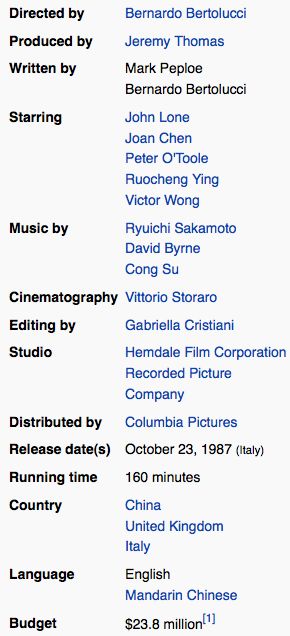
Proceedings of the VLDB Endowment, Vol. 5, No. 2                                           the information from the two infoboxes in Figure 1.
Copyright 2011 VLDB Endowment 2150-8097/11/10... $ 10.00.

                                                                                     133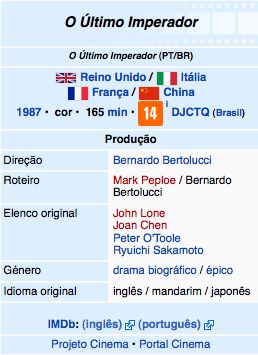
There are several challenges involved in finding multilin-
gual correspondences across infoboxes. Even within a lan-
guage, finding attribute correspondences is difficult. Al-
though authors are encouraged to provide structure in Wiki-
pedia articles, e.g., by selecting appropriate templates and
categories, they often do not follow the guidelines or follow
them loosely. This leads to several problems, in particu-
lar, schema drift—the structure of infoboxes for the same
entity type (e.g., actor, country) can differ for different in-
stances. Both polysemy and synonymy are observed among
attribute names: a given name can have different seman-
tics (e.g., born can mean birth date or country of birth)
and different names can have the same meaning (e.g., alias
and other names). This problem is compounded when we
consider multiple languages. Figure 1 shows an example of
heterogeneity in infoboxes describing the same entity in dif-
ferent languages. Some attributes in the English infobox
do not have a counterpart in the Portuguese infobox and
vice-versa. For instance: produced by, editing by, distributed
by, and budget are omitted in the Portuguese version, while
género (genre) is omitted in the English version. An anal-
ysis of the overlap among attribute sets from infoboxes in
English and Portuguese (see Table 5) shows that on aver-
age only 42% of the attributes are present in both languages.                    (a) English           (b) Portuguese
Besides the variation in structure, there are also inconsisten-          Figure 1: Excerpts from English and Portuguese in-
cies in the attribute values, for example: running time is 160           foboxes for the Film The Last Emperor.
minutes in the English version and 165 minutes in the Por-
tuguese version; Ryuichi Sakamoto appears under Music by                 statistics within and across languages, and an automati-
in English and under Elenco original (cast) in Portuguese.               cally derived bilingual dictionary. These different sources
   To identify multilingual matches, a possible strategy would           of similarity information are combined in a systematic man-
be to translate the attribute names and values using a mul-              ner: the alignment algorithm prioritizes the derivation of
tilingual dictionary or a machine translation system, and                high-confidence correspondences and then uses these to find
then apply traditional schema or ontology matching tech-                 additional ones. By doing so, it is able to obtain both
niques [31, 10, 12]. However, this strategy is limited since, in         high precision and recall. The algorithm finds, in a single
many cases, the correct correspondence is not found among                step, inter- and intra-language correspondences, as well as
the translations. For example, in articles describing movies,            complex, one-to-many correspondences. Because WikiMatch
the correct alignment for the English attribute starring is              does not require training data, it is able to handle under-
the Portuguese attribute elenco original. However, the dic-              represented languages; and since it does not rely on string
tionary translation is estrelando for the former and original            similarity on attribute names, it can be applied both to sim-
cast for the latter, and neither is used in the Wikipedia in-            ilar and morphologically distinct languages. Furthermore, it
fobox templates to name an attribute. WordNet is another                 does not require external resources, such as bilingual dictio-
source of synonyms that can potentially help in matching,                naries, thesauri, ontologies, or automatic translators.
but its versions in many languages are incomplete. For in-                  We present a detailed experimental evaluation using in-
stance, the Vietnamese WordNet [36] covers only 10% of the               foboxes in Portuguese, Vietnamese, and English. We also
senses present in the English WordNet. Furthermore, tradi-               compare WikiMatch to state-of-the-art techniques from data
tional techniques such as string similarity may fail even for            integration [3] and Information Retrieval [20], as well as to a
languages that share words with similar roots. Consider the              technique specifically designed to align infobox attributes [5].
term editora, which in Portuguese means publisher. Using                 The results show that WikiMatch consistently outperforms
string similarity, it would be very close to editor, but this            existing approaches in terms of F-measure, and in particu-
would be a false cognate.                                                lar, it obtains substantially higher recall. We also present a
   Recently, techniques have been proposed to identify mul-              case study where we show that, through the use of the cor-
tilingual attribute alignments for Wikipedia infoboxes. But              respondences derived by WikiMatch, a multilingual querying
these have important shortcomings in that they are designed              system is able to derive higher-quality answers.
for languages that share similar words [1, 5], or demand a
considerable amount of training data [1]. Consequently, they             2. PROBLEM DEFINITION
cannot be effectively applied to languages with distinct rep-
                                                                            A Wikipedia article is associated with and describes an
resentations or different roots; and their applicability is also
                                                                         entity (or object). Let A be an article in language L associ-
limited for under-represented languages in Wikipedia, which
                                                                         ated with entity E. Among the different components of A,
have few pages and thus, insufficient training data.
                                                                         here, we are interested in its title; infobox, which consists
Contributions. We propose WikiMatch, a new approach
                                                                         of a structured record that summarizes important informa-
to multilingual schema matching that addresses these limi-
                                                                         tion about E; and cross-language links, URLs of pages in
tations. WikiMatch gathers similarity evidence from multi-
                                                                         languages other than L that describe E. An infobox I con-
ple sources: attribute values, link structure, co-occurrence
                                                                         tains a set of attribute-value pairs {h a1 , v1 i, . . . , h an , vn i}.

                                                                   134
Figure 1(a) shows the infobox of an English article with 14 3.1 Matching Entity Types across Languages
attribute-value pairs. Since there is a one-to-one relation- There are different mechanisms to associate entities with
ship between I and its associated E, we use these terms types, including the assignment of categories to articles and
interchangeably in the remainder of the paper. We define template types to infoboxes. It is also possible to cluster
the set of attributes in an infobox I as the schema of I (SI ). the infoboxes and infer types based on their structure [26].
The value v of an attribute a in an infobox I may contain Regardless of the mechanism used, in Wikipedia, the en-
one or more hyperlinks to other Wikipedia entities. For ex- tity type system is different for different languages, thus
ample, in Figure 1(a), the value for the attribute Directed by an important task is to identify the mappings between the
contains a hyperlink to the entity Bernardo Bertolucci. We types. WikiMatch adopts a simple approach that leverages
denote such a hyperlink by the tuple h = (I, v, J), where the cross-language links. The intuition is that if a set of
J is the infobox pointed to by v. We distinguish between infoboxes belonging to entity type T often link (through a
hyperlinks that point to another entity in the same language cross-language link) to infoboxes of in a different language of
(which define relationships) and hyperlinks that point to ar- type T 0 , then it is likely that types T and T 0 are equivalent.
ticles describing the same entity in different languages. We
refer to the latter as cross-language links. We denote by 3.2 Computing Cross-Language Similarities
cl = (IL , IL0 ) a link between the documents in languages L Given two schemas ST and ST0 for a type T , in languages
and L0 which represent the same entity. These links can be L and L0 respectively, our goal is to identify correspondences
found in most articles and are located on the pane to the between attributes in these schemas (Section 2). To deter-
left of the article. mine if a pair of attributes < a, a0 >, where a 2 ST and
An article is also associated with an entity type T . For a0 2 ST0 , forms a correspondence, we compute the similarity
example, the article in Figure 1(a) corresponds to the type between a and a0 by combining different sources of informa-
“Film”. There are different ways to determine the entity tion, notably: value similarity, attribute-name correlation,
type for an article, including from the categories defined and cross-language link structure.
for the article; from the template defined for the infobox; Cross-Language Value Similarity. Because of the struc-
or from the structure of the infobox. Given a set IL of tural heterogeneity among infoboxes in different languages
infoboxes in language L associated with entity type T , we (see Appendix A), by combining their attributes in a unified
refer to the set of all distinct attributes in IL as the schema schema for each distinct type, we gather more evidence that
of T (ST ). Given two infoboxes IL and IL0 with type T helps in the derivation of correspondences. We also collect
that are connected by a cross-language link, we refer S to the for each attribute a in an entity schema ST , the set of val-
union of the attributes in their schemas, SD = SI SI 0 , as a ues v associated with a in all infoboxes with type T . Value
dual-language infobox schema. The problem we address can similarity for two attributes is then computed as the cosine
be stated as follows: Given two sets of infoboxes IL and IL0 similarity between their value vectors.
in languages L and L0 , respectively, such that both sets are Since a concept can have different representations across
associated with the entity type T and the infoboxes in the languages, direct comparison between vectors often leads to
sets are connected through cross-language links. To match low similarity scores. Thus, we use an automatically created
ST and ST0 , the schemas of infoboxes in the two sets, we translation dictionary to help improve the accuracy of the
need to find correspondences (or matches) h a, a0 i such that similarity score: whenever possible, the values are translated
a is an attribute of SI , a0 is an attribute of SI 0 , and a and into the same language before their similarity is computed.
a0 have the same meaning. Similar to Oh et al. [29], we exploit the cross-language links
among articles in different languages to create a dictionary
3. THE WIKIMATCH APPROACH for their titles. The translation dictionary from a language
WikiMatch works in three steps. First, it identifies map- L to language L0 is built as follows. For each article A in
pings between entity types in different languages, e.g., it L with a cross-language link to article A0 in L0 , we add an
determines that type “Film” in English corresponds to type entry to the dictionary that translates the title of article A
“Filme” in Portuguese. It then computes, for each type, the to the title of article A0 .
similarity for all attribute pairs within and across languages. Given an attribute a with value vector va in language L,
To do so, it leverages information available in Wikipedia, an attribute a0 with value vector va0 in language L0 , and a
including: attribute values, link structure of articles, cross- translation dictionary D, we construct the translated value
language links, and an automatically-derived bilingual dic- vector of a as follows: if a value of va can be found in D, we
tionary. As another source of similarity, WikiMatch uses La- replace it by its representation in L0 . We denote the trans-
tent Semantic Indexing (LSI) [7] as a correlation measure. lated value vector of a as vat , and define the value similarity
Because WikiMatch does not rely on string similarity func- between a and a0 as: vsim(a, a0 ) = cos(vat , va0 ), where the
tions for attribute names, it is effective even for languages vector components are the raw frequencies (tf ).
that do not share words with similar roots. Example 1. Given the vectors for nascimento and born re-
Even though it is useful to consider multiple similarity spectively as: va ={1963, Irlanda:1, 18 de Dezembro 1950:1,
sources, an important challenge that ensues is how to com- Estados Unidos:1} and va0 ={1963, Ireland:1, June 4 1975:1,
bine them. While searching for attribute correspondences, United States: 2}, where the numbers after the colons in-
WikiMatch incrementally combines the different sources, and dicate the frequency of each value. Translating va , we get
selects the high-confidence matches first, in an attempt to vat ={1963, Ireland:1, December 18 1950:1, United States:1}.
avoid error propagation to subsequent matches. As the last Thus, vsim(va , va0 ) = cos(vat , va0 ) = 0.71
step, to improve recall, the derived correspondences are used Link Structure Similarity. Attribute values in an infobox
to help identify additional correspondences for attributes often link to other articles in Wikipedia. For example, at-
that remain unmatched. tribute Directed by in Figure 1(a) has the value Bernardo
135!" !# !$ !% !& !"!"!" !'
Let D = {di |i = 1..m} be the set of dual-language in-
()*' " + " + " !"!"!" "
!46! + " " " " !"!"!" "
foboxes associated with entity type T , and A = {aj |j =
BC
)7;6*0'1562 " " + + " !"!"!" " 1..n} the set of unique attributes in D. In the occurrence
2=)>26 + " " " + !"!"!" + matrix M (n⇥m) (with n rows and m columns), M (i, j) = 1
3?'@>A6 " + " " + !"!"!" +
91:63456'7) " " + " + !"!"!" +
if attribute ai appears in dual-language infobox dj , and
M (i, j) = 0 otherwise. Each row in the matrix corresponds
DE
5)*76 + + " + " !"!"!" "
'123456'7) " + " + " !"!"!" " to the occurrence pattern of the corresponding attribute over
)>7*)20')562 + " " + " !"!"!" "
D. See Figure 2(a) for an example of such a matrix. We ap-
(a) Co-occurrence matrix ply the truncated singular value decomposition (SVD) [20]
to derive M f = Uf Sf VfT by choosing the f most impor-
!"# $%&' (%&' )**+&,-*./01&+
+,-- +,%& +,.$ ()*'/0'123456'7)
tant dimensions and scaling the attribute vectors by the top
!"!"!" +,-% +,-" +,8$ 91:63456'7)/05)*76 f singular values in matrix S. SVD causes cross-language
!"!"!" +,-# +,attributes may have different values and yet be synonyms, or is added to the existing match mj ), otherwise, it is ignored.
vice versa. Thus, to derive correspondences, an important The idea is to test for positive correlations between all at-
challenge is how to combine the similarity measures. We tributes of a match to see whether it is possible to integrate
propose an AttributeAlignment algorithm (Algorithm 1) the attributes in question into the existing matches. Since
which combines different similarity measures in such a way TLSI is set low, the requirement of having positive corre-
that they reinforce each other. Given as input the set of all lations with all attributes in an existing match is not too
attributes for infoboxes that belong to a given type, it groups strict and helps merge intra- and inter-language synonyms.
together attributes that have the same label, and for these, We should note, however, that by relaxing this constraint
combines their values—we refer to the set of such groups as (e.g., to include only some of the attributes), it is possible
AG. The attribute groups in AG are then paired together, to increase recall at the cost of lower precision.
and for each pair, the similarity measures are computed IntegrateMatches is based on the algorithm used by Su
(Section 3.2). This step creates a set of tuples that asso- et al. [34] to construct groups of Web form attributes. How-
ciate similarity values with each attribute pair: (< ap , aq >, ever, our experiments (Section 4.2) show that, attribute cor-
vsim, lsim, LSI). The tuples with a LSI score greater than relation alone, is not sufficient to obtain high F-measure
a threshold TLSI are then added to a priority queue P . In- scores. Further, since our correlation measures work for at-
tuitively, a pair of matching attributes should have a high tribute pairs both within and across languages, as illustrated
positive correlation. However, due to the heterogeneity in in the example below, IntegrateMatches can discover both
the data, this correlation may be weak, so TLSI should be intra and cross-language synonyms.
set to a low value. Example 2. Consider the attribute pairs in Figure2(b) for
The tuples in P are sorted in decreasing order of LSI score. type Actor, ordered by descending LSI scores, with TLSI =0.1.
The goal is to prioritize matches that are more likely to be Assume that the set of existing matches M includes m =
correct and avoid the early selection of incorrect matches, {died ⇠ falecimento}, and we have two candidate pairs,
which can result in error propagation to future matches. The p1 = and p2 =. Since
similarities for a pair of attributes ap , aq are combined as the LSI score for morte and falecimento is greater than TLSI ,
follows: If max(vsim(ap , aq ), lsim(ap , aq )) > Tsim then < morte is integrated into m, i.e., m = { died ⇠ falecimento
ap , aq > is a certain candidate correspondence. The intuition ⇠ morte}. In contrast, p2 is not added to m since the LSI
is that two attributes form a certain correspondence if they score for falecimento and nascimento is zero as they are in
are correlated and this is corroborated by at least one of the the same language and co-occur often.
other similarity measures. So that certain correspondences
are selected early, Tsim is set to a high value. Algorithm 1 AttributeAlignment
One potential drawback of WikiMatch is that it requires 1: Input: Set of infobox attributes for an entity type T
these two thresholds to be set. We have studied the behavior 2: Output: Set of matches M
3: begin
of WikiMatch using different thresholds, and as we discuss 4: M ;, P ;
in Appendix B, our approach remains effective and obtains 5: for each pair < ap , aq > such that ap , aq 2 AG do
high F-measure for a broad range of threshold values. 6: Compute vsim, lsim, LSI
7: P P [ (< ap , aq >, vsim, lsim, LSI) | LSI > TLSI
Figure 2(a) shows a subset of the attributes in English 8: while P 6= ; do
and Portuguese for the type Actor. The cells in this matrix 9: Choose pair < ap , aq > with the highest LSI score from P
contain the number of occurrences for an attribute in each 10: if max(vsim(ap , aq ), lsim(ap , aq )) > Tsim then
11: M IntegrateMatches(< ap , aq >, M )
dual-language infobox. The matches in the ground truth 12: else
are indicated by the arrows. Notice that died matches two 13: U < ap , aq > /*buffering uncertain matches*/
attributes in Portuguese. Figure 2(b) shows some of the at- 14: Remove < ap , aq > from P
15: U 0 ReviseUncertain(U )
tribute pairs in P , with their similarity scores. For example, 16: for each u 2 U 0 do
the pair is a certain match because all 17: M IntegrateMatches(u, M )
similarity scores are high. 18: end
If a candidate correspondence < ap , aq > does not satisfy Algorithm 2 IntegrateMatches
the constraint in line 10 (Algorithm 1), it is added to the 1: Input: candidate pair < ap , aq >, set of current matches M
set of uncertain matches U (line 13) to be considered later 2: Output: updated set of matches M
(Section 3.4). Otherwise, if it does satisfy the constraint, it 3: begin
is given as input to IntegrateMatches (Algorithm 2), which 4: if neither ap nor aq 2 M then
5: M M + {ap ⇠ aq }
decides whether it will be integrated into an existing match, 6: else if either ap or aq appears in M
originate a new one, or be ignored. IntegrateMatches out- 7: /* suppose ap appears in mj and aq does not appear*/
puts a set of matches, M , where each match m = {a1 ⇠ 8: for each aj 2 mj , s.t. LSIqj > TLSI do
9: mj mj + (⇠ {aq })
.. ⇠ am } includes a set of synonyms, both within and across 10: end
languages. IntegrateMatches takes advantage of the corre-
lations among attributes to determine how to integrate the
new correspondence into the set of existing matches. If nei- 3.4 Revising Uncertain Matches
ther of the attributes in the new correspondence appears in
Since our alignment algorithm prioritizes high-confidence
the existing matches M , a new matching component is cre-
correspondences, it may miss correspondences that are cor-
ated (line 5). If at least one of the attributes is already in a
rect but that have low confidence—the uncertain matches.
match mj in M , e.g., suppose ap appears in mj , and the LSI
Consider, for example, value similarity. While born and
score between aq and all attributes aj in mj is greater than
morte (died) are not equivalent, their similarity is high since
the correlation threshold TLSI (line 8), then aq becomes a
they share many values and links—both attributes have val-
new element in mj (line 9, where + ⇠ {aq } denotes that aq
ues that correspond to dates and places. On the other
137hand, although outros nomes and other names are equiv- the pair Vietnamese-English (Vn-En) than for Portuguese-
alent, their value similarity is low as they do not share val- English (Pt-En)—this is also reflected in the number of types
ues or links. Consequently, even though high value simi- covered by the Vietnamese infoboxes (see below). We se-
larity provides useful evidence for deriving attribute corre- lected Portuguese and Vietnamese infoboxes that belong to
spondences, it may also prevent correct matches from being articles which have cross-language links to the equivalent
identified. The ReviseUncertain step uses the set M of English article. The dataset for the Pt-En language pair
matches derived by AttributeAlignment (line 15) to iden- consists of 8,898 infoboxes, while there are 659 infoboxes for
tify additional matches, by reinforcing or negating the un- the Vn-En pair. Infoboxes that belong to the same entity
certain candidates (in set U ). A challenge in this step is type are grouped together (Section 3). There are 14 such
how to balance the potential gain in recall with a potential groups for Pt-En, and 4 for Vn-En.
loss in precision. Our solution to this problem is to consider Ground Truth. We created the ground truth for all entity
only the subset U 0 of attribute pairs in U whose attributes types in the dataset. A bilingual expert labeled as correct
are highly correlated with the existing matches. To capture or incorrect all the correspondences containing attributes
this, we introduce the notion of inductive grouping score. from two distinct languages. A pair of attributes h a, a0 i
Let < a, a0 > be an uncertain correspondence in U , and let is considered a correct alignment if a and a0 have the same
Ca and Ca0 be the set of matched attributes co-occurring meaning. The ground truth set for the Pt-En pair has 315
with a and a0 , respectively, in their mono-lingual schemas. alignments while the Vn-En pair has 160 alignments.
The inductive grouping score between a and a0 is the aver- Evaluation Metrics. To account for the importance of dif-
age grouping score of a and a0 with each attribute in Ca and ferent attributes and, consequently, of the matches involving
Ca0 : them, we use weighted scores. Intuitively, a match between
1 X
ge(a, a0 ) = g(a, ca ) ⇤ g(a0 , c0a ) frequent attributes will have a higher weight. Let C be the
|C| 0 0 0 set of cross-language matches derived by our algorithm; G
ca 2Ca ,ca 2Ca |ca ⇠ca
be the cross-language matches in the ground truth; ST the
where the grouping score g is computed as follows: set of attributes of entity type T in language L; and ST0 be
Opq
g(ap , aq ) = the attributes in language L0 of the corresponding type of T .
min(Op , Oq ) Given an attribute ai 2 ST , we denote by c(ai ) and cG (ai )
Op and Oq are the number of occurrences of attributes ap the set of attributes in ST0 that correspond to ai in C and
and aq , and Opq is the number of times they co-occur in the G, respectively. Let AC and AG the set of attributes in ST
set of infoboxes. Note that the grouping score is computed that appear in C and G, respectively. The weighted scores
for the schemas of the two languages separately. The induc- are computed as follows:
tive grouping score is high if ap and aq co-occur often with X |ai |
P recision = P P r(c(ai )) (1)
the attributes in the discovered matches. ak 2AC |ak |
ai 2AC
The final step is to integrate revised matches (lines 16-18). X |ai |
We take advantage the certain matches in M to validate the Recall = P Rc(c(ai )) (2)
|ak |
revised matches U 0 : IntegrateMatches is invoked again but X
ai 2AG a k
0
2A G
|aj |
this time it considers pairs with similarity lower than Tsim . P r(c(ai )) = P 0
⇤ correct(ai , a0j ) (3)
0 2c(a ) |ak |
Although we could first threshold on different values of Tsim , 0
aj 2c(ai ) a i
X k
|a0j |
as we discuss in Section 4.2, revising uncertain matches as Rc(c(ai )) = P ⇤ correct(ai , a0j ) (4)
0
a separate step improves recall while maintaining high pre- 0aj 2cG (ai ) a0 2cG (ai ) |ak |
k
cision for a wide range of Tsim values. where |ai | represents the frequency of attribute ai in the
Example 3. Consider the attribute pairs in Figure 2(b), let infobox set; correct(ai , a0j ) returns 1 if the extracted corre-
M={born⇠nascimento, spouse⇠cônjuge} be the set of exist- spondence < ai , a0j > appears in G and 0 otherwise. Similar
ing matches. The pairs and to [15], we compute precision and recall as the weighted av-
are uncertain candidates since their value erages over the precision and recall of each attribute ai (Eq.
similarities are lower than the threshold. If the attributes in 1 and 2), and the precision and recall of attribute ai are
these pairs co-occur often with born and spouse, the induc- also averaged by the contribution of each attribute a0j in
tive grouping scores ge of and ST0 which corresponds to ai (Eq. 3 and 4). We compute F-
are high, and thus, these candidate matches measure as the harmonic mean of precision and recall. The
will be revised and added to U 0 . Since {born⇠nascimento} intuition behind these measures is shown in Example 4.
has been identified as a match, morte cannot be integrated Example 4. Consider ST = {a1 , a2 }, ST0 = {a01 , a02 , a03 },
into this match because morte and nascimento are in the and associated frequencies (0.6, 0.4) and (0.5, 0.3, 0.2). Sup-
same language and co-occur in infoboxes (their LSI score is pose G = {{a1 ⇠ a01 ⇠ a02 }, {a2 ⇠ a03 }}, and the align-
zero). In contrast, neither outros nomes nor other names ment algorithm derives M = {{a1 ⇠ a01 }, {a2 ⇠ a03 }}. We
appear in M , so this pair is added as a new match. have c(a1 ) = {a01 }, c(a2 ) = {a03 }, while cG (a1 ) = {a01 , a02 },
cG (a2 ) = {a03 }. Therefore:
4. EXPERIMENTAL EVALUATION pr(c(a1 )) = 0.5
0.5
⇤ correct(a1 , a01 ) = 1 and pr(c(a2 )) = 1;
0.6 0.4
Datasets. We collected Wikipedia infoboxes related to P recision = 0.6+0.4 ⇤ pr(c1) + 0.4+0.6 ⇤ pr(c2) = 1;
movies from three languages: English, Portuguese, and Viet- 0.5 0 0.3
rc(c(a1 ))= 0.5+0.3 ⇤ correct(a1 , a1 )+ 0.5+0.3 ⇤ correct(a1 , a02 )
namese. Our aim in selecting these languages was to get 0.5 0.3
= 0.8 ⇤ 1 + 0.8 ⇤ 0 = 0.625, and rc(c2 ) = 1;
variety in terms of morphology and in the number of in- 0.6 0.6
Recall = 0.6+0.4 ⇤ rc(c(a1 )) + 0.6+0.4 ⇤ rc(c(a2 )) = 0.775.
foboxes. Portuguese and English share words with similar
roots, while Vietnamese is very different from the other two Finding Matches with WikiMatch. For each entity type
languages; and there are significantly fewer infoboxes for in the two language pairs, we ran WikiMatch and derived a
138set of matches. Table 1 shows examples of such matches. Table 2: Weighted Precision (P), Recall (R), and
Note that we are able to find alignments where an attribute F-measure (F) for the different approaches.
in one language is mapped to two (or more) attributes in Portuguese-English
the other language. For this experimental evaluation, we Type
WikiMatch Bouma COMA++ LSI
P R F P R F P R F P R F
configured WikiMatch as follows: the threshold Tsim used film 0.97 0.95 0.96 0.79 0.99 0.88 0.99 0.95 0.97 0.01 0.20 0.02
for both vsim and lsim was set to 0.6; the LSI threshold show 1.00 0.89 0.94 0.82 0.68 0.75 0.98 0.52 0.68 0.07 0.05 0.06
(TLSI ) was set to 0.1. The same values were used for all actor 1.00 0.52 0.68 1.00 0.24 0.39 0.70 0.52 0.60 0.15 0.26 0.19
languages and entity types without any special tuning. artist 1.00 0.72 0.84 1.00 0.55 0.71 1.00 0.34 0.51 0.75 0.50 0.60
channel 0.80 0.69 0.74 1.00 0.33 0.50 0.89 0.56 0.68 0.26 0.40 0.32
Table 1: Some alignments identified by WikiMatch company 0.86 0.87 0.87 1.00 0.53 0.69 0.95 0.70 0.81 0.67 0.74 0.71
comics ch. 0.97 0.87 0.92 0.99 0.65 0.79 0.99 0.77 0.86 0.37 0.53 0.43
!"#$ %&'()*)$+$,-.*/0+1 20$(.34$+$,-.*/0+1 album 1.00 0.93 0.96 1.00 0.69 0.82 1.00 0.77 0.87 0.56 0.48 0.52
!"#$%&'()(!"#$*+$!(,-( ./'(!"01()(!"#$*+$!(,-( adult actor 0.84 0.59 0.69 1.00 0.26 0.41 0.73 0.43 0.54 0.22 0.19 0.20
"!"'23('#"4"135()(5314634$( (1471(148()(5314634$ book 0.80 0.75 0.77 0.75 0.58 0.66 0.75 0.66 0.70 0.15 0.36 0.21
I':"$ $5$1*'('#"4"135()(9+3##"14( (!"01(:";1()(9+3##"14 episode 0.81 0.90 0.85 0.86 0.32 0.47 1.00 0.38 0.55 0.09 0.17 0.12
#'+$"#'()(mogeneous across languages. Still, WikiMatch outperforms ity contributes 13% in precision for Vietnamese, while for
other approaches for entity types with both high (e.g., film Portuguese the contribution is 1%. Without LSI, F-measure
in Vn-En) and low overlap (e.g., channel ). drops 12% in Portuguese and 7% in Vietnamese.
Limitations. We should note that not all correct attribute Figure 3 shows how WikiMatch (WM ) and WikiMatch
pairs co-occur in the data—some will not be found in any without ReviseUncertain (WM* ) behave when each of the
dual-language infobox. For example, no dual-language (Pt- features is removed. In all cases, the recall of WM is higher.
En) infobox contains the attributes prêmios and awards This confirms the importance of ReviseUncertain, which
even though they are synonyms. Like other approaches, is able to identify additional correct matches even when
WikiMatch is not able to identify such matches since all sim- WikiMatch is given less evidence.
ilarity measures return low scores. However, these are rare Table 3: Contribution of different components
matches, which as we see from the results, do not signif-
Portuguese-English Vietnamese-English
icantly compromise recall. Another limitation of our ap- Configuration
P R F P R F
proach is that, currently, it does not support languages that WikiMatch 0.93 0.75 0.82 1.00 0.75 0.84
do not use alphabetical characters. WikiMatch-ReviseUncertain 0.94 0.54 0.66 1.00 0.59 0.72
4.2 Contribution of Different Components WikiMatch-IntegrateMatches
WikiMatch random
0.84
0.74
0.70
0.40
0.75
0.50
0.95
0.77
0.74
0.56
0.82
0.64
We analyzed how much each component of WikiMatch WikiMatch single step 0.39 0.89 0.52 0.56 0.88 0.64
contributes to the results by running it multiple times, and WikiMatch-vsim 0.90 0.43 0.58 1.00 0.51 0.68
each time removing one of the components. The results, av- WikiMatch-lsim 0.92 0.74 0.82 0.87 0.70 0.78
eraged over all types, are summarized in Table 3. WikiMatch WikiMatch-LSI 0 83
0.83 0 64
0.64 0 72
0.72 0 89
0.89 0 69
0.69 0 78
0.78
leads to the highest F-measure values, showing that the com- 1.0 without:
% change
bination of its different components is beneficial.
0.8
WikiMatch-ReviseUncertain. When ReviseUncertain
0.6
is omitted, recall drops substantially while there is little or
no change to precision. This underscores the importance of 0.4
this step: ReviseUncertain leads to F-measure gains be- 0.2
tween 14% and 20% for the two language pairs. We note 0.0
that the effectiveness of ReviseUncertain varies across the WM* WM WM
WM WM* WM WM
WM* WM WM
WM* WM WM
WM* WM WM
WM* WM
different types: types whose correspondences have low value no vsim no lsim no LSI no vsim no lsim no LSI
similarity tend to benefit more from ReviseUncertain. Pt-En Vn-En
WikiMatch-IntegrateMatches. This configuration gen- Precision Recall
erates matches without the IntegrateMatches step, which
Figure 3: Impact of ReviseUncertain
check the pairwise correlation constraints for the attributes
in a match. As we discuss below, removing this step leads
5. CASE STUDY: EVALUATING
to a drop in precision for both Pt-En and Vn-En. This hap-
pens because it finds some incorrect matches that have high CROSS-LANGUAGE QUERIES
lsim or vsim values, which in WikiMatch are filtered out by The usual approach to answering cross-language queries is
IntegrateMatches. to translate the user query into the language of the articles,
WikiMatch random. To assess the contribution of or- and then proceed with monolingual query processing. Our
dering candidate pairs by their LSI scores, we compared it attribute correspondences can help retrieval systems in this
to a random ordering, while maintaining both value and translation process.
link similarity constraints to validate match candidates. As To show the benefits of identifying the multilingual at-
the results show, the random ordering leads to significantly tribute correspondences, below, we present a case study
lower values for both precision and recall. This indicates the using WikiQuery [25], a system that supports structured
LSI ordering is effective at reducing error propagation. queries over infoboxes. WikiQuery supports c-queries, which
WikiMatch single step. In WikiMatch single step, we consist of a set of constraints on entity types, attribute
omit the invocation of IntegrateMatches (line 17 in Al- names and values. For example, for the query: What are the
gorithm 1) and consider as correspondences all candidates Web sites of Brazilian actors who starred in films awarded
whose lsim or vsim values are positive. The sharp decline with an Oscar?, the corresponding c-query is expressed as:
in F-measure provides evidence that considering certain and Q: Actor(born=Brazil, website=?) and Film(award=Oscar),
uncertain matches separately is crucial. where, Actor and Film are entity types; born, website, and
Similarity Features. We have also studied the contri- award are attribute names.
bution of different similarity sources. We report the re- The matches identified by WikiMatch for a given language
sults of three variations of WikiMatch where each omits pair are stored in a dictionary. To provide multilingual an-
the use of one feature: WikiMatch-vsim, WikiMatch-lsim, swers to a query, WikiQuery looks up the dictionary and
and WikiMatch-LSI. For WikiMatch-LSI, the candidate pairs retrieves, for each term in the source language, its transla-
were sorted in decreasing order of max(vsim, lsim), and tions into the target language. If a translation cannot be
validated by the constraints on just these features. The found for a given attribute a, the query is relaxed by remov-
numbers indicate that value similarity is the most impor- ing the constraint on a.
tant feature. Without vsim, F-measure drops about 29% The Experiment. We ran a set of ten c-queries (Table 4)
in Portuguese and 19% in Vietnamese. Link similarity has in Portuguese and Vietnamese on the respective language
a bigger impact Vietnamese than Portuguese. As expected, datasets. We then translated the queries into English (as
this feature is likely to be more important for language pairs described above) and ran them over the English dataset.
with more diverse morphologies. For example, link similar- For each query, the top 20 answers were presented to two
140Pt Pt->En Vn Vn->En
70 k Table
Query 4: List of c-queries used in the Case Study
60 Movies with an actor who is also a politician
1 filme(nome=?) and ator(ocupação="político")
50
e Gain
phim(tên=?) and di!n viên (công vi"c ="chính khách")
40 Actors who worked with director Francis Ford Coppola in a movie
Cumulative
2 filme(nome=?) and ator(nome=?) and diretor(nome="francis ford coppola")
30
phim(tên=?) and di!n viên(tên=?) and #$o di!n(tên="francis ford coppola")
20 Movies that won Best Picture Award and were directed by a director from England
10 filme(direção=?) and prêmio(melhor filme=?) and
3 diretor(nascimento| país de nascimento|país|data de nascimento="Inglaterra")
0
phim(#$o di!n=?) and gi%i th&'ng(phim xu(t s)c nh(t=?) and
1 2 3 4 5 6 7 8 9 10 11 12 13 14 15 16 17 18 19 20
#$o di!n(sinh|n*i sinh="anh")
k answers
Movies directed by director younger than 40 (born after 1970) and that have gross
Figure 4: Cumulative Gain of k answers revenue greater than 10 million
4
filme(receita > 10000000) and diretor(nascimento|data de nascimento >=1970)
evaluators who were required to give each answer a score on phim(doanh thu|thu nh+p >10000000) and #$o di!n(sinh|ngày sinh >=1970)
a five-point relevance scale. The results were evaluated in Books that were written by a writer born before 1975
5 livro(nome=?) and escritor(nascimento 1950)
cause the English dataset covers a considerable portion of Headquarters of companies with revenue greater than 10 billion
the contents both in Portuguese and Vietnamese infoboxes, 10 companhia (sede=?, faturamento > 10 bilhões)
it often returns many more answers. công ty(tr/ s'|tr/ s' chính=?, doanh thu|thu nh+p > 10 billion)
Even though the CG is larger when the queries are trans-
lated into English, the gain for Vn!En queries is smaller
than the one obtained for Pt!En. This is due, in part, to these approaches and ours. While ontologies have a well-
an artifact of our translation procedure. The Vietnamese defined and clean schema, Wikipedia infoboxes are hetero-
dataset is very small, and many of the English types and geneous and loosely defined. In addition, these works con-
attribute names do not have any correspondences in Viet- sider ontologies in isolation and do not take into account
namese. As a result, the queries in our workload that include values associated with the attributes. As we have discussed
these dangling types and attribute names cannot be trans- in Section 4, values are an important component to accu-
lated and are relaxed by WikiQuery. Although answers are rately determine matches. Last, but not least, in contrast
returned for the relaxed queries, few (and sometimes none) to VLCR, our approach does not rely on external resources.
of them are relevant. Since the Portuguese dataset is larger Schema Matching. The problem of matching multilingual
than the Vietnamese dataset, this problem is attenuated. schemas has been largely overlooked in the literature. The
only work on this topic aimed to identify attribute corre-
6. RELATED WORK spondences between English and Chinese schemas [37], re-
Cross-language matching has received a lot of attention lying on the fact that the names of attributes in Chinese
in the information retrieval and natural language processing schemas are usually the initials of their names in PinYin
communities (see e.g., [9, 21]). While their focus has been (i.e., romanization of Chinese characters). This solution not
on documents represented in plain text, our work deals with only required substantial human intervention and a manu-
structured information. More closely related to our work are ally constructed domain ontology, but it only works for Chi-
recent approaches to ontology matching, schema matching, nese and English. Although it is possible to combine tra-
and infobox alignment, which we discuss below. ditional schema matching approaches [31] with automatic
Cross-Language Ontology Alignment. Fu et al. [12] translation (similar to [12, 10]), as shown in Section 4, this
and Santos et al. [10] proposed approaches that translate is not effective for matching multilingual infoboxes.
the labels of a source ontology using machine translation, Also related to our approach are techniques for uncertain
and then apply monolingual ontology matching algorithms. schema matching and data integration. Gal et al. [4] de-
The Ontology Alignment Evaluation Initiative (OAEI) [28] fined a class of monotonic schema matchers for which higher
had a task called very large crosslingual resources (VLCR). similarity scores are an indication of more precise mappings.
VLCR consisted of matching three large ontologies includ- Based on this assumption, they suggest frameworks for com-
ing DBpedia, WordNet, and the Dutch audiovisual archive bining results from the same or different matchers. However,
and made use of external resources such as hypernyms re- due to the heterogeneity across infoboxes, this assumption
lationships from WordNet and EuroWordNet—a multilin- does not hold in our scenario: matches with high similarity
gual database of WordNet for several European languages. scores are not necessarily accurate. To this hypothesis, we
Although related, there are important differences between have experimented with different similarity thresholds for
141COMA++, and for higher thresholds, we have observed a we plan to explore approaches that take uncertainty into ac-
drop in both precision and recall. count [8]. While in this paper we focused on infoboxes, we
Cross-Language Infobox Alignment. Adar et al. [1] would like to investigate the effectiveness of WikiMatch on
proposed Ziggurat, a system that uses a self-supervised clas- other sources of structured data present in Wikipedia.
sifier to identify cross-language infobox alignments. The Acknowledgments. We thank Gosse Bouma, Sabine Mass-
classifier uses 26 features, including equality between at- mann and Erhard Rahm for sharing their software with us,
tributes and values and n-gram similarity. To train the clas- and the reviewers for their constructive comments. Viviane
sifier, Adar et al. applied heuristics to select 20K positive Moreira was partially supported by CAPES-Brazil grant
and 40K negative alignment examples. Through a 10-fold 1192/10-8. This work has been partially funded by the
cross-validation experiment with English, German, French, NSF grants IIS-0905385, IIS-0844546, IIS-1142013, CNS-
and Spanish, they report having achieved 90.7% accuracy. 0751152, and IIS-0713637.
Bouma et al. [5] designed an alignment strategy for English
and Dutch which relies on matching attribute-value pairs:
values vE and vD are considered matches if they are identi-
8. REFERENCES
cal or if there is a cross-language link between articles corre- [1] E. Adar, M. Skinner, and D. S. Weld. Information
sponding vE and vD . A manual evaluation of 117 alignments arbitrage across multi-lingual wikipedia. In WSDM,
found only two errors. Although there has not been a di- pages 94–103, 2009.
rect comparison between these two approaches, Bouma et al. [2] S. Auer, C. Bizer, G. Kobilarov, J. Lehmann,
state that their approach would lead to a lower recall. But R. Cyganiak, and Z. G. Ives. DBpedia: A nucleus for
the superior results obtained by Ziggurat rely on the avail- a web of open data. In ISWC, pages 722–735, 2007.
ability of a large training set, which limits its scalability and [3] D. Aumueller, H. H. Do, S. Massmann, and E. Rahm.
applicability: training is required for each different domain Schema and ontology matching with COMA++. In
and language pair considered; and the approach is likely to SIGMOD, pages 906–908, 2005.
be effective only for domains and languages that have a large [4] G. Avigdor. Uncertain Schema Matching. Morgan &
set of representatives. Adar et al. acknowledge that because Claypool Publishers, 2011.
their approach heavily relies on syntactic similarity (it uses [5] G. Bouma, S. Duarte, and Z. Islam. Cross-lingual
n-grams), it is limited to languages that have similar roots. alignment and completion of wikipedia templates. In
In contrast, WikiMatch is automated—requiring no train- CLIAWS3, pages 21–29, 2009.
ing, and it can be used to create alignments for languages
[6] N. Cardoso. GikiCLEF topics and wikipedia articles:
that are not syntactically similar, such as for example, Viet-
Did they blend? In Multilingual Information Access
namese and English. Nonetheless, we would have liked to
Evaluation I. Text Retrieval Experiments, volume 6241
compare Ziggurat against our approach, in particular, for
of LNCS, pages 318–321. Springer, 2010.
the Pt-En language pair. Unfortunately, we were not able
to obtain the code or the datasets described in [1]. [7] S. Deerwester, S. T. Dumais, G. W. Furnas, T. K.
Landauer, and R. Harshman. Indexing by latent
semantic analysis. Journal of the American Society for
7. CONCLUSION Information Science, 41(6):391–407, 1990.
In this paper, we proposed WikiMatch, a new approach for [8] X. Dong, A. Y. Halevy, and C. Yu. Data integration
aligning Wikipedia infobox schemas in different languages with uncertainty. In VLDB, pages 687–698, 2007.
which requires no training and is effective for languages with [9] I. Dornescu. Semantic QA for encyclopaedic questions:
different morphologies. Furthermore, it does not require ex- QUAL in GikiCLEF. In CLEF, pages 326–333, 2009.
ternal sources such as dictionaries or machine translation [10] C. T. dos Santos, P. Quaresma, and R. Vieira. An
systems. WikiMatch explores different sources of similarity API for multi-lingual ontology matching. In LREC,
and combines them in a systematic manner. By prioritiz- pages 3830–3835, 2010.
ing high-confidence correspondences, it is able to minimize
[11] S. Ferrandez, A. Toral, I. Ferrandez, A. Ferrandez,
error propagation and achieve a good balance between re-
and R. Munoz. Exploiting wikipedia and eurowordnet
call and precision. Our experimental analysis showed that
to solve cross-lingual question answering. Information
WikiMatch outperforms state-of-the-art approaches for cross-
Sciences, 179(20):3473–3488, 2009.
language information retrieval, schema matching, and multi-
lingual attribute alignment; and that it is effective for types [12] B. Fu, R. Brennan, and D. O’Sullivan. Cross-lingual
that have high cross-language heterogeneity and few data in- ontology mapping - an investigation of the impact of
stances. We also presented a case study that demonstrates machine translation. In ASWC, pages 1–15, 2009.
the benefits of the correspondences discovered by our ap- [13] GikiCLEF - Cross-language Geographic Information
proach in answering multilingual queries over Wikipedia: by Retrieval from Wikipedia.
using the derived correspondences, we can translate queries http://www.linguateca.pt/GikiCLEF.
posed in under-represented languages into English, and as a [14] Google translator
result, return a larger number of relevant answers. http://www.google.com/translate.
There are a number of problems that we intend to pur- [15] B. He and K. C.-C. Chang. Automatic complex
sue in future work. To further improve the effectiveness schema matching across web query interfaces: A
of WikiMatch, we would like to investigate the use of a correlation mining approach. ACM TODS,
fixed point-based matching strategy, such as similarity flood- 31:346–395, 2006.
ing [23]. Because our approach is automated, the results it [16] K. Järvelin and J. Kekäläinen. Cumulated gain-based
produces can be uncertain or incorrect. To properly deal evaluation of IR techniques. ACM TOIS, 20:422–446,
with this issue during the evaluation of multilingual queries, 2002.
142[17] G. Kasneci, F. Suchanek, G. Ifrim, M. Ramanath, and matching for web query interfaces. In EDBT, pages
G. Weikum. NAGA: Searching and ranking 77–94, 2006.
knowledge. In ICDE, pages 953–962, 2008. [35] R. Udupa and M. Khapra. Improving the multilingual
[18] A. Kontostathis and W. M. Pottenger. A user experience of wikipedia using cross-language
mathematical view of latent semantic indexing: name search. In ACL-HLT, pages 492–500, 2010.
Tracing term co-occurrences. Technical report, Lehigh [36] Vietnamese wordnet. http://vi.asianwordnet.org.
University, 2002. [37] H. Wang, S. Tan, S. Tang, D. Yang, and Y. Tong.
[19] A. Kumaran, K. Saravanan, N. Datha, B. Ashok, and Identifying indirect attribute correspondences in
V. Dendi. Wikibabel: A wiki-style platform for multilingual schemas. In DEXA, pages 652 –656, 2006.
creation of parallel data. In ACL/AFNLP, pages [38] Wikimedia traffic analysis report.
29–32, 2009. http://stats.wikimedia.org/wikimedia/squids/
[20] M. Littman, S. T. Dumais, and T. K. Landauer. SquidReportPageViewsPerCountryOverview.htm.
Automatic cross-language information retrieval using
latent semantic indexing. In Cross-Language
Information Retrieval, chapter 5, pages 51–62, 1998. APPENDIX
[21] B. Magnini, D. Giampiccolo, P. Forner, C. Ayache, A. STRUCTURAL HETEROGENEITY
V. Jijkoun, P. Osenova, A. Peñas, P. Rocha,
Using the alignments in our ground truth sets (Section 4),
B. Sacaleanu, and R. F. E. Sutcliffe. Overview of the
we analyzed the structural heterogeneity of the infoboxes by
CLEF 2006 multilingual question answering track. In
considering the overlap among attribute sets from infoboxes
CLEF, pages 223–256, 2006.
in a given language pair. For each infobox IL in language L
[22] C. D. Manning, P. Raghavan, and H. Schütze. which has a cross-language link cl to its equivalent infobox
Introduction to Information Retrieval. Cambridge IL0 0 in language L0 , we computed the overlap between their
Univ. Press, 2008. schemas SI and SI0 as the size of intersection between at-
[23] S. Melnik, H. Garcia-Molina, and E. Rahm. Similarity tributes in SI and SI0 over the size of their union. To be
flooding: A versatile graph matching algorithm and its considered part of the intersection, an attribute pair must
application. In ICDE, pages 117–128, 2002. appear in the ground truth.
[24] D. Nguyen, A. Overwijk, C. Hauff, D. Trieschnigg, The results for each entity type and language pair are
D. Hiemstra, and F. de Jong. Wikitranslate: Query shown in Table 5. The English-Vietnamese pair is more ho-
translation for cross-lingual information retrieval using mogeneous than the English-Portuguese pair. Considering
only wikipedia. In Evaluating Systems for Multilingual only the entity types appearing in both language pairs (i.e.,
and Multimodal Information Access, volume 5706 of film, show, actor, and artist) the average overlap is 44% for
LNCS, pages 58–65, 2009. Portuguese-English and 69% for Vietnamese-English. As
[25] H. Nguyen, T. Nguyen, H. Nguyen, and J. Freire. seen in our experimental results (Table 2), all approaches
Querying Wikipedia Documents and Relationships. In we considered have better results when the overlap is larger.
WebDB, pages 4:1–4:6, 2010.
[26] T. Nguyen, H. Nguyen, and J. Freire. Entity and Table 5: Overlap in infoboxes
!"*+"'-)#1*&2
relationships discovery in wikipedia. Technical report,
*'$"*%1*&2
)54#+1)*+',
*'$/)-0
*&)--.#
./"%'5.
*'$"*%
University of Utah, Salt Lake, UT, 2010. )#34$
(,"+.,
%&'(
3''6
)*+',
),+"%+
!"#$
[27] T. Nguyen, H. Nguyen, and J. Freire. PruSM: A
!"#$% !"# $%# $&# %&# '%# !'# %(# %&# $)# !*# !'# "!# $)# !&#
prudent schema matching strategy for web-form &%#$% *)# )%# $"# ")#
interfaces. In CIKM, pages 1385–1388, 2010.
[28] Ontology alignment evaluation initiative.
http://oaei.ontologymatching.org. B. ADDITIONAL RESULTS
[29] J.-H. Oh, D. Kawahara, K. Uchimoto, J. Kazama, and Macro-averaging. The weighting employed in the evalu-
K. Torisawa. Enriching multilingual language ation metrics used in Section 4 can be considered as micro-
resources by discovering missing cross-language links averaging. We also computed macro-averaging by discard-
in wikipedia. In WI-IAT- Vol.1, pages 322–328, 2008. ing the weights and just counting distinct attribute-name
[30] M. Potthast, B. Stein, and M. Anderka. A pairs. The results in Table 6 show that WikiMatch is still
Wikipedia-based multilingual retrieval model. In outperforms the other approaches.
ECIR, pages 522–530, 2008. Table 6: Macro-averaging results
[31] E. Rahm and P. A. Bernstein. A survey of approaches WikiMatch Bouma COMA++ LSI
to automatic schema matching. VLDBJ, P R F P R F P R F P R F
PT-EN 0.88 0.60 0.71 0.93 0.36 0.52 0.79 0.47 0.59 0.27 0.28 0.27
10(4):334–350, 2001. VN-EN 1.00 0.58 0.73 1.00 0.34 0.51 0.93 0.45 0.60 0.60 0.43 0.50
[32] P. Schönhofen, A. Benczúr, I. Bı́ró, and K. Csalogány.
Cross-language retrieval with wikipedia. In Advances Threshold Sensitivity. We have studied the sensitivity
in Multilingual and Multimodal Information Retrieval, of WikiMatch to variations in the thresholds used in our
pages 72–79, 2008. algorithms. Figure 5 shows the variation of the weighted
[33] P. Sorg and P. Cimiano. Enriching the crosslingual F-measure as the thresholds Tsim and TLSI increase. The
link structure of wikipedia - a classification-based lines show that WikiMatch is stable over a broad range of
approach. In WikiAI, pages 1–6, 2008. threshold values. As a general guideline, TLSI should be set
[34] W. Su, J. Wang, and F. Lochovsky. Holistic schema low since the main purpose of LSI is to sort the candidate
matches, while Tsim should be set high as it determines the
143You can also read


