NACo INFORMATION SESSION: FISCAL RECOVERY FUND - ELIGIBLE USES FOR BROADBAND INFRASTRUCTURE
←
→
Page content transcription
If your browser does not render page correctly, please read the page content below
NACo INFORMATION SESSION:
    FISCAL RECOVERY FUND

             ELIGIBLE USES FOR
     BROADBAND INFRASTRUCTURE
                   JANUARY 20, 2022
KEY HIGHLIGHTS OF THE GUIDANCE
1. Final Rule is effective April 1, 2022, but counties can take advantage of flexibility prior to that date

2. Allows counties to use up to $10 million of ARPA Recovery Funds as “loss revenue” for the provision of general
   government services without needing to use the Treasury revenue loss formula

3. Improves revenue loss calculation formula to include utility revenue and liquor store sales, at option of counties

4. Clarifies eligible use of funds for capital expenditures and written justification for certain projects

5. Presumes certain populations were “impacted” and “disproportionately impacted” by the pandemic and therefore
   are eligible to receive a broad range of services and support

6. Streamlines options for premium pay, by broadening the share of eligible workers who can receive premium pay

7. Authorizes re-hiring of local government staff, either at or above pre-pandemic levels

8. Allows Recovery Funds to be used for modernization of cybersecurity, including hardware and software

9. Broadens eligible use of funds for water and sewer projects to include culvert repair, dam and reservoir rehabilitation

10. Broadens eligible broadband infrastructure investments to ensure better connectivity to broader populations

                              National Association of Counties | www.NACo.org | May 2021
                                                                                National Association of Counties | NACo.org | January 2022 | 2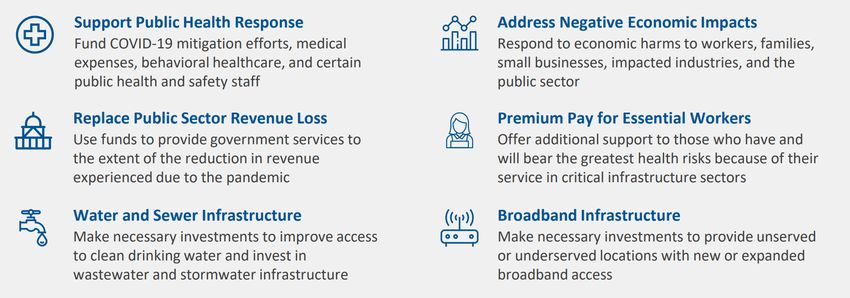
REPORTING REQUIREMENTS
On January 7, Treasury released the Project and Expenditure Report and User Guide.

• The following counties are required to submit a Project and Expenditure Report the Treasury by January
  31, 2022:

    ― Counties with populations that exceed 250,000 residents (referred to as Tier 1 recipients by Treasury)
    ― Counties with a population below 250,000 residents yet received more than $10 million in Recovery
      Funds (referred to as Tier 2 recipient by Treasury)

• The Project and Expenditure Report will cover the period between March 3, 2021, and December 31,
  2021, and requires the reporting of project, obligations and expenditure data, subaward data, as well as
  certain required programmatic data

• Counties with populations below 250,000 residents and received less than $10 million in Recovery Funds,
  are not required to submit a report by January 31, 2022

    ― First reporting deadline is now April 30, 2022, and annually afterwards

                              National Association of Counties | www.NACo.orgNational
                                                                              | May 2021
                                                                                      Association of Counties | NACo.org | January 18, 2022 | 3
ILLUSTRATION ONLY OF SAMPLE ALLOWABLE USES OF RECOVERY FUNDS,
PER U.S. TREASURY GUIDANCE
National Association of Counties | NACo.org | January 2022 | 4DECODING THE LANGUAGE OF THE GUIDANCE
Throughout the Final Rule, U.S. Treasury uses various key words that are
important to understand in determining the eligible use of funds.
• “Should” and “must” = Mandatory reporting, use and compliance
• “May” and “encourage” = Allows county discretion
• Proportional & Reasonable
National Association
National Association of Counties | www.NACo.org | May 2021of Counties | www.NACo.org | January 2022 | 5REPLACING LOST REVENUE
Counties can use Recovery Funds to provide government services, up to the amount revenue loss experienced.
Under the Final Rule, counties now have two options:
KEY NEW FEATURES IN FINAL RULE
1. NEW $10 MILLION REVENUE LOSS ALLOWANCE
• Counties can allocate up to $10 million of their total Recovery Fund allocation to spend on government services
• Counties can still calculate actual revenue loss through Treasury formula
• Simplifies reporting requirements for counties using the standard $10M standard allowance
• 2,137 counties (70%) now eligible to invest entirety of allocated Recovery Funds in general government services
2. IMPROVEMENTS TO THE REVENUE LOSS FORMULA
• General revenue now includes utility revenue and liquor store revenue, at discretion of the county
• Counties can choose to calculate revenue loss on a fiscal year or calendar year basis – must pick & stay with 1 option
• Counties must adjust actual revenue totals for the effect of tax cuts/increases adopted after January 6, 2022
• Revenue loss growth rate changed from 4.1% to 5.2%
National Association of Counties | www.NACo.org | May 2021
National Association of Counties | NACo.org | January 2022 | 6REPLACING LOST REVENUE
Counties may use “lost revenue” for general government services up to the revenue loss amount,
whether that be the standard allowance amount ($10 million) or the amount calculated using Treasury’s formula:
• Government services generally include any service traditionally RECOVERY FUNDS USED TO REPLACE
provided by a government, unless Treasury has stated otherwise
“REVENUE LOSS” ARE MORE FLEXIBLE
• Common examples include, but are not limited to:
AND MAY BE USED FOR A BROAD RANGE
― Construction of schools and hospital
― Road building and maintenance, and other infrastructure OF GOVERNMENT SERVICES,
― Health services PROGRAMS AND PROJECTS OUTSIDE OF
― General government administration, staff and TYPICAL ELIGIBLE USES OF RECOVERY
administrative facilities
FUNDS UNDER THE INTERIM
― Environmental remediation
RULE. HOWEVER, REVENUE
― Police, first responders and other public safety services
(including purchase of fire trucks and police vehicles) RECOUPMENT CANNOT BE USED FOR
RAINY DAY FUNDS OR DEBT SERVICES
National Association of Counties | www.NACo.org | May 2021
National Association of Counties | NACo.org | January 2022 | 7REPLACING LOST REVENUE
KEY TAKEAWAYS
• Counties have two options to calculate revenue loss:
1. Up to $10 million of ARPA allocation
2. Calculate revenue loss with Treasury formula
• If your county previously declared “$0” for revenue loss in the Interim Report, you are
allowed to update this number in the first Project and Expenditure Report
• If your county is declaring revenue loss, you may abide by the reporting requirements
within the Project and Expenditure Report’s “revenue loss” category
National Association of Counties | www.NACo.org | May 2021
National Association of Counties | NACo.org | January 2022 | 8REPLACING LOST REVENUE
Counties may use “lost revenue” for general government services up to the revenue loss amount,
whether that be the standard allowance amount ($10 million) or the amount calculated using Treasury’s formula:
HOWEVER, the following activities are NOT an eligible use of a county’s “revenue loss” allowance:
• Extraordinary contribution to a pension fund
• Debt service payment, including Tax Anticipation Notes (TANs)
• Rainy day or reserve account
• Settlement agreement, judgment, consent decree or judicially confirmed debt (with limited exceptions)
• Activity that conflicts with the purpose of the American Rescue Plan Act statute (e.g. uses of funds that conflict
with COVID-19 mitigation practices in line with CDC guidance and recommendations)
• Violations of Award Terms and Conditions or conflict of interest requirements under the Uniform Guidance
National Association of Counties | www.NACo.org | May 2021
National Association of Counties | NACo.org | January 2022 | 9BROADBAND INFRASTRUCTURE
The Final Rule broadens eligible broadband infrastructure investments
to ensure better connectivity for residents.
KEY NEW FEATURES IN FINAL RULE
1. BROADENS BROADBAND INFRASTRUCTURE FLEXIBILITY
Under the IFR,
• Under IFR, counties were required to invest in households and
counties were
businesses without reliable wireline 25 Mbps download/3 Mbps required to invest in
upload
households and
• Final Rule allows counties to invest in locations without reliable
wireline 100 Mbps download/20 Mbps upload
businesses without
2. AFFORDABILITY IS A REQUIREMENT reliable wireline
• Projects must include an affordability option for households with an 25 Mbps download/
identified need for broadband infrastructure investment 3 Mbps upload
National Association of Counties | www.NACo.org |National
May 2021Association of Counties | NACo.org | January 2022 | 10BROADBAND INFRASTRUCTURE
PROJECT IDENTIFICATION AND DESIGN
1. IDENTIFY AN ELIGIBLE AREA FOR INVESTMENT
• Counties are encouraged to prioritize projects that are designed to serve locations without access to
reliable wireline 100 Mbps download/20 Mbps upload speeds
• Beyond the threshold, counties have broad flexibility to define need in a community, including:
• Lack of access to a reliable high-speed broadband connection
• Lack of affordable broadband
• Lack of reliable service
2. DESIGNING THE PROJECT
• Projects are required to meet or exceed 100 Mbps download/100 Mbps upload (flexibility for 100
Mbps/20 Mbps)
• Households and businesses with an identified need for additional broadband do not need to be the only
ones in the service area served by an eligible broadband infrastructure project
• Projects can choose to consider any available data for determining areas for investment
National Association of Counties | www.NACo.org |National
May 2021Association of Counties | NACo.org | January 2022 | 11BROADBAND INFRASTRUCTURE
BUILD-TO SPEED STANDARDS
1. BUILD-TO SPEED STANDARDS
• Projects are required to meet or exceed 100 Mbps download/100 Mbps upload
• Flexibility remains in place building to 100 Mbps/20 Mbps with scalability to 100 Mbps symmetrical
if geographical, topological or cost restraints exist
2. FIBER-OPTIC INFRASTRUCTURE
• Recipients are encouraged to prioritize investments in fiber-optic infrastructure wherever feasible
3. RELIABILITY
• Recipients should ensure that their broadband infrastructure provides “reliable” service at required
speeds and does not require a reliance on providers’ advertised speeds in their assessments.
4. MIDDLE-MILE
• Recipients are permitted to make investments in “middle-mile” connections, but Treasury continues to
encourage recipients to focus on projects that will achieve last-mile connections
National Association of Counties | www.NACo.org |National
May 2021Association of Counties | NACo.org | January 2022 | 12BROADBAND INFRASTRUCTURE
AFFORDABILITY
1. AFFORDABILITY PROGRAM INTEGRATION
• FCC’s Affordable Connectivity Program (ACP) and/or provide access to broad-based affordability
program to low-income consumers
2. ENCOURAGEMENTS
• Recipients are encouraged to consult with the community on the general affordability needs of the
target markets in the proposed service area.
• Recipients also encouraged to require that services provided by a broadband infrastructure project
include at least one low-cost option offered without data usage caps and at speeds that are sufficient for
a household with multiple users to simultaneously telework and engage in remote learning.
3. REPORTING
• Recipients will be required to report speed, pricing, and any data allowance information as part of
mandatory reporting to Treasury
National Association of Counties | www.NACo.org |National
May 2021Association of Counties | NACo.org | January 2022 | 13BROADBAND INFRASTRUCTURE
NEGATIVE ECONOMIC IMPACTS
1. AID TO HOUSEHOLDS AND COMMUNITIES
• Recipients are reminded under the Final Rule that subsidies to households and communities impacted
by the pandemic to access the internet, broadband adoption programs, digital literacy programs, and
device programs are eligible programs to respond to the public health and negative economic impacts of
the pandemic.
2. EQUIPMENT COSTS
• Services that expand internet access without constructing new networks are an appropriate use of funds
as assistance to households in responding to a negative economic impact. This can include: subsidies for
the cost of internet service, other programs that support adoption of internet service where available,
digital literacy programs, or programs that provide devices and equipment to access the internet (e.g.
programs that provide equipment like tablets, computers, or routers) to households.
National Association of Counties | www.NACo.org |National
May 2021Association of Counties | NACo.org | January 2022 | 14BROADBAND INFRASTRUCTURE
ADDITIONAL CLARIFICATIONS
1. PRIORITIZING SUPPORT FOR PUBLIC NETWORKS
• The Final Rule continues to prioritize support for broadband networks owned, operated by, or affiliated
with local governments, nonprofits, and cooperatives.
2. DUPLICATION OF EFFORTS AND RESOURCES
• To the extent that recipients consider deploying broadband to locations where there are existing
enforceable federal or state funding commitments for reliable service at speeds of at least 100 Mbps
download and 20 Mbps upload, recipients must ensure Recovery Funds are designed to address an
identified need for additional broadband investment that is not met by existing commitments.
3. CYBERSECURITY
• The Final Rule allows for modernization of cybersecurity for existing and new broadband infrastructure
as an eligible use, regardless of their speed delivery standards.
• Cybersecurity modernizations through hardware, software, and protection of critical infrastructure is an
eligible provision of government services under revenue loss as well.
National Association of Counties | www.NACo.org |National
May 2021Association of Counties | NACo.org | January 2022 | 15BROADBAND INFRASTRUCTURE
ADDITIONAL CLARIFICATIONS
1. USE OF FUNDS TO MEET NON-FEDERAL MATCH UNDER IIJA
• The IIJA specifies under the BEAD program a contribution of not less than 25% of non-Federal funds. The
IIJA further states that matching contributions may include funds provided to an eligible entity or
subgrantee under ARPA for the purpose of deployment of broadband services.
• The project must comply with program requirements established by both programs in order to use funds
from the IIJA and the Recovery Funds
National Association of Counties | www.NACo.org |National
May 2021Association of Counties | NACo.org | January 2022 | 16DENTON COUNTY, TEXAS
- County is allocating funds for a broadband project and
needs assessment student.
- Goals of the project are to deliver services to every
household in Denton County, allow local providers to
purchases services for their area, create a system to
deliver 100 Mbps upload and download speeds and
provide options to operate a cooperative/non-profit to
distribute and manage the system.
National Association of Counties | www.NACo.org | January 2022
17 | 17SUMMIT COUNTY, OHIO
- Allocated $35 million for the county’s broadband fiber ring
expansion, and $25 million for community broadband
grants to build off the fiber ring
- Project will connect 31 community governments and the
County government, and each community will have the
ability to build broadband networks and provide
internet/data services to schools, libraries, businesses
and residents.
- Ring will serve as the backbone for public safety
communications network
National Association of Counties | www.NACo.org | January 2022
18 | 18WESTMORELAND COUNTY, PA
CYBERSECURITY
- County has allocated $277,000 to modernize
cybersecurity and improve critical infrastructure
- County has also allocated $344,000 for the purchase of a
five-year licensing agreement with Cisco Unified
Connections to improve digital collaboration
National Association of Counties | www.NACo.org | January 2022
19 | 19NACo INFORMATION SESSION:
FISCAL RECOVERY FUND
ELIGIBLE USES FOR
BROADBAND INFRASTRUCUTRE
JANUARY 20, 2022You can also read


