NACo LEGISLATIVE UPDATE: OVERVIEW OF TREASURY'S REPORTING & COMPLIANCE GUIDANCE FOR THE FISCAL RECOVERY FUND - Indiana Association of ...
←
→
Page content transcription
If your browser does not render page correctly, please read the page content below

NACo LEGISLATIVE UPDATE:
OVERVIEW OF TREASURY’S REPORTING & COMPLIANCE GUIDANCE FOR
THE FISCAL RECOVERY FUND
                                              UPDATED: JUNE 30, 2021
KEY HIGHLIGHTS OF THE GUIDANCE
1. The Fiscal Recovery Fund was established to help turn the tide on the pandemic, address its
   economic fallout and lay the foundation for a strong and equitable recovery.

2. Funds may cover costs from March 3, 2021 through December 31, 2024.

3. There is no deadline for counties to certify for the Recovery Funds.

4. Broad flexibility to help those disproportionately impacted by the COVID-19 pandemic.

5. Recovery Funds can be distributed into interest-bearing accounts.

6. Understand the important differences between CARES Act Coronavirus Relief Fund (CRF) and ARP
   Fiscal Recovery Fund, especially for county employee payroll support.

7. Use of recouped “lost revenue” is more flexible than other Recovery Fund eligibility.

8. Recovery Funds may not be used as non-federal match, unless specifically authorized.

9. Re-hiring local government staff to pre-pandemic levels.

10. Counties may use Recovery Funds for routine pension costs of employees.

11. Counties may use Recovery Funds to invest in certain critical infrastructure projects.

                                                                        National
                              National Association of Counties | www.NACo.org    Association
                                                                              | May 2021 of Counties | www.NACo.org | June 2021 | 2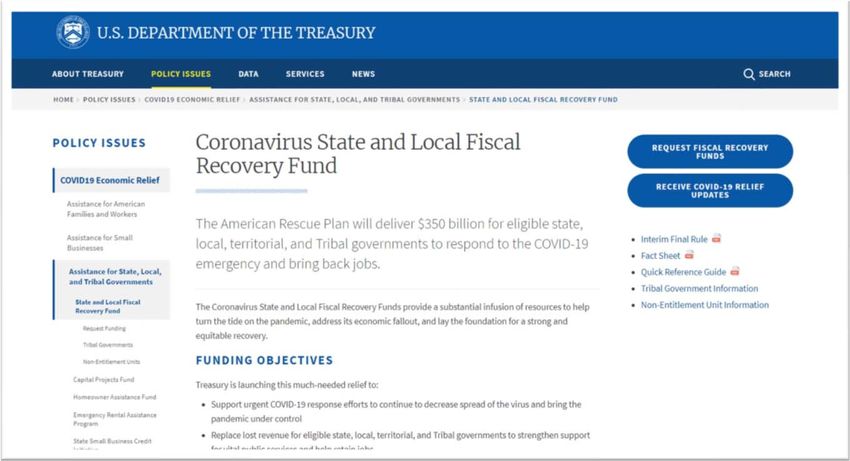
• Interim final rule
                                           • Fact sheet
                                           • FAQs
                                           • Quick reference guide
                                           • County Recovery Fund allocations

DEADLINE TO SUBMIT COMMENTS TO TREASURY IS JULY 16, 2021

                               National Association of Counties | www.NACo.org | June 2021 | 3
UPDATED FAQ DOCUMENT
Treasury released an updated FAQ document Tuesday, June 8

1. Recovery Funds can be used to cover costs of consultants to assist with managing and
   administering the funds

2. Recovery Funds can be used to establish public jobs programs (I.e. subsidized employment,
   combined education and on-the-job training, job training to accelerate rehiring or address negative
   economic impacts

3. Clarification on revenue loss language (audited financial data, county data versus Census Bureau
   data)

4. Flexibility for costs incurred by March 3, 2021, for public health response/negative economic impacts,
   premium pay, revenue loss and water, sewer and broadband projects

5. New CFDA number – 21.027 – Counties should update systems and reporting to reflect final CFDA
   number for Recovery Fund

6. Counties do not need approval from Treasury to determine whether an investment in water, sewer or
   broadband project is eligible under the Recovery Fund IFR

                                                                      National
                            National Association of Counties | www.NACo.org    Association
                                                                            | May 2021 of Counties | www.NACo.org | June 2021 | 4
UPDATED FAQ DOCUMENT
Treasury released updated FAQ documents on Thursday, June 17 for broadband investments:

JUNE 17 FAQ UPDATE – BROADBAND INVESTMENTS
1. Provide service to unserved or underserved households or businesses means prioritizing
   deployment of infrastructure that will bring service to households or businesses that are not
   currently serviced by a wireline connection that reliably delivers at least 25 MPS download speed
   and 3 MBS of upload speed

     ― These unserved or underserved do NOT need to be the only ones in the service area funded
       by the project

2. Project may have a holistic approach that provides services to wider area in order, for example, to
   make the ongoing service of unserved or underserved households or businesses more
   economical to sustain into the future

3. Clarifies definition of “reliably” meet or exceed broadband speed threshold

4. Allows “middle mile” projects that help achieve last-mile connections by leveraging the middle-
   mile network

                                National Association of Counties | www.NACo.org | May 2021
                                                                                       NATIONAL ASSOCIATION OF COUNTIES | WWW.NACO.ORG | JUNE 2021 | 5
UPDATED FAQ DOCUMENT
Treasury released updated FAQ documents on June 24:
1. Assistance to households or businesses: Negative impact at the “population or group level”
2. Investments in outdoor spaces:
― Qualified Census Tracts (QCT) and other populations, households and areas disproportionately impacted
― Services for stronger neighborhoods & communities, esp. health disparities & social determinants of health
― Enhance outdoor spaces (e.g. restaurant patios) and the built environment (e.g. façade improvements)
― Counties may also use funds for parks and recreation
3. Expedite court case backlog cleanup including COVID safety measures, hiring court staff/attorneys & other costs
4. Assistance for small business startups
5. Definition of revenue excludes all federal funds including state transfers of federal funds to counties
6. Respond to increased violence and crime during to the pandemic
7. Pre-project development of water, sewer and broadband projects, including broadband mapping
National Association of Counties | www.NACo.org | May 2021
NATIONAL ASSOCIATION OF COUNTIES | WWW.NACO.ORG | JUNE 2021 | 6REPORTING & COMPLIANCE GUIDANCE
PART 1: GENERAL GUIDANCE
1. Key Principles
2. Statutory Eligible Uses
3. Treasury’s Rulemaking
4. Uniform Guidance
PART 2: REPORTING REQUIREMENTS
1. Interim Report
2. Project and Expenditure Report
3. Recovery Plan Performance Report
National Association of Counties | www.NACo.org | May 2021
NATIONAL ASSOCIATION OF COUNTIES | WWW.NACO.ORG | JUNE 2021 | 7U.S. TREASURY: REPORTING PRINCIPLES
Treasury released new reporting guidance that focuses on:
• Accountable: Requires program and performance reporting to build public awareness, increase
accountability, and monitor compliance of eligible uses. Counties are required to account for every dollar
spent and provide detailed information on how funds are used.
• Transparent: Those recipients receiving the largest amount of funds will be required to publicly post a
detailed Recovery Plan Performance Report each year so the public is aware of how funds are being used
and outcomes are being achieved. In addition, Treasury will provide comprehensive public transparency
reports using the project and expenditure reports that recipients are required to provide.
• User friendly: Reporting has improvements requested by recipients of CARES Act funding, including
deadlines 30 days after the close of the reporting period (versus 10 days in CARES), streamlined
requirements for smaller funding recipients, and increased availability of bulk upload capabilities.
• Focused on Recovery: Reporting guidance addresses the Biden administration’s priority areas for an
equitable economic recovery, including provisions that prioritize equity, focus on economically distressed
areas, support community empowerment, encourage strong labor practices, and spotlight evidence-based
interventions.
National Association of Counties | www.NACo.org | May 2021
NATIONAL ASSOCIATION OF COUNTIES | WWW.NACO.ORG | JUNE 2021 | 8PART 1: GENERAL GUIDANCE
STATUTORY ELIGIBLE USES
1. Respond to the COVID-19 public health emergency and its negative economic impacts
2. Premium pay
3. Provision of government services, to the extent of the reduction in revenue
4. Investments in water, sewer and broadband infrastructure
EXPENDITURE CATEGORIES: Treasury outlines 7 categories with 66 subcategories
1. Public health (12)
2. Negative economic impacts (14)
3. Service to disproportionately impacted communities (16)
4. Premium pay (2)
5. Infrastructure (17)
6. Revenue replacement (1)
7. Administrative (4)
National Association of Counties | www.NACo.org | May 2021
NATIONAL ASSOCIATION OF COUNTIES | WWW.NACO.ORG | JUNE 2021 | 9PART 1: GENERAL GUIDANCE
TREASURY’S RULE
• Eligible and restricted uses of Recovery Funds
• Eligible costs and timeframe: March 3, 2021 – December 31, 2024
• Public health/negative economic impacts
• Premium pay
• Revenue loss
• Investments in water, sewer and broadband
• Reporting requirements
• Interim Report
• Quarterly/Annual Project and Expenditure Reports
• Annual Recovery Plan Reports
National Association of Counties | www.NACo.org | May 2021
NATIONAL ASSOCIATION OF COUNTIES | WWW.NACO.ORG | JUNE 2021 | 10PART 1: GENERAL GUIDANCE
UNIFORM ADMINISTRATIVE REQUIREMENT
• Subject to Uniform Administrative Requirements, Cost Principles and Audit Requirements (Uniform
Guidance)
• Counties should implement internal controls and effective monitoring to ensure compliance with
Treasury reporting requirements
• Administrative costs:
• Recipients may use funds for administering Recovery Funds that support effective
management and oversight of funds
• Ensure compliance with Cost Principles
• Cash management:
• Recovery Funds can be placed into interest-bearing accounts
• Interest DOES NOT need to be returned to Treasury
• Interest DOES NOT need to be used on Recovery Fund eligible expenses
National Association of Counties | www.NACo.org | May 2021
NATIONAL ASSOCIATION OF COUNTIES | WWW.NACO.ORG | JUNE 2021 | 11PART 1: GENERAL GUIDANCE
UNIFORM ADMINISTRATIVE REQUIREMENT
• Eligibility:
• Counties are responsible for ensuring funds are used for eligible purposes (including
subrecipients)
• Equipment and real property management:
• Must follow Uniform Guidance and be used for the originally authorized purpose
• Procurement:
• Any procurement of Recovery Funds must follow Uniform Guidance
• Program income:
• The IFR does not prohibit program income, but additional guidance is needed on treatment of
income
• Reporting:
• Counties are required to complete financial, performance and compliance reporting as required
in Part 2 of the compliance/reporting guidance
• Expenditures may be reported on a cash or accrual basis, as long as the methodology is
consistently applied
• Counties need to establish controls to ensure completion and timely submission of reports
National Association of Counties | www.NACo.org | May 2021
NATIONAL ASSOCIATION OF COUNTIES | WWW.NACO.ORG | JUNE 2021 | 12PART 1: GENERAL GUIDANCE
AWARD TERMS AND CONDITIONS
• Recording keeping requirements:
• Counties must maintain records and financial documents for 5 years after funds have been
expended
• Single audit requirements:
• Counties that spend more than $750,000 in federal award during a fiscal year are subject to
Single Audit Act
• Civil Rights Act compliance:
• Ensure no discrimination on basis of race, color, national origin, disability, age or sex
• Signed assurance when requesting funds
• Provide annual information on compliance
• Subrecipient reporting and compliance:
• Manage and monitor subrecipients (I.e. nonprofit, small business, etc.) for compliance
• Identify subrecipient (I.e. subaward, compliance, reporting)
• Develop risk of noncompliance
• Develop written process/procedures for monitoring and risk assessment
National Association of Counties | www.NACo.org | May 2021
NATIONAL ASSOCIATION OF COUNTIES | WWW.NACO.ORG | JUNE 2021 | 13PART 1: GENERAL GUIDANCE
OTHER KEY ITEMS FOR REPORTING REQUIREMENTS
• Projects:
• Use of funds for new versus existing projects, and eligible government services
• Include only closely related activities directed toward a common purpose
• Counties must assign a project to a single expenditure category (outlined in Treasury’s reporting
and compliance guidance)
• Evidence-based intervention (pg. 33):
• Builds upon data focused within Treasury IFR
• Interventions with strong, moderate or preliminary evidence
• Treasury reporting and compliance document provides additional information on different levels
of evidence-based intervention
National Association of Counties | www.NACo.org | May 2021
NATIONAL ASSOCIATION OF COUNTIES | WWW.NACO.ORG | JUNE 2021 | 14REPORTING REQUIREMENTS BY RECIPIENT
Project and Recovery &
Recipient Interim Report
Expenditure Report Performance Report
States, U.S. territories, By August 31, 2021, By October 31, 2021, and By August 31, 2021, and
metropolitan cities and counties with expenditures by then 30 days after the annually thereafter by July
with a population that exceeds category end of reach thereafter 31
250,000 residents
Metropolitan cities and counties Not required
with a population below 250,000
residents which received more
than $5 million in SLFRF funding
Tribal Governments
Metropolitan cities and counties By October 31, 2021, and
with a population below 250,000 then annually thereafter
residents which received less
than
$5 million in SLFRF funding
NEUs Not required
National Association of Counties | www.NACo.org | May 2021
NATIONAL ASSOCIATION OF COUNTIES | WWW.NACO.ORG | JUNE 2021 | 15NEW REPORTING UPDATES
• Interim Report: Due by August 31, 2021, the Interim Report requires all counties to report
programmatic data for spending between March 3 and July 31, 2021
• Project and Expenditure Report: These reports require project and expenditure data for awards and
sub-awards, demographic information for each project, and other programmatic data
•
• Initial Project and Expenditure Report is due October 31, 2021
• For counties with awards above $5 million, project and expenditure reports are due
quarterly
• For counties with awards under $5 million, project and expenditure reports are due
annually
• Recovery Plan Performance Report:
• Only required for counties with populations over 250,000 residents
• Required to be published annually on the county website and provided to Treasury
• Contain detailed project performance data, including information on efforts to improve equity
and engage communities
• Recovery Plan Performance Report is due August 31, 2021, followed by annual submission
National Association of Counties | www.NACo.org | May 2021
NATIONAL ASSOCIATION OF COUNTIES | WWW.NACO.ORG | JUNE 2021 | 16NACo LEGISLATIVE UPDATE:
OVERVIEW OF TREASURY’S REPORTING & COMPLIANCE GUIDANCE FOR
THE FISCAL RECOVERY FUND
UPDATED: JUNE 30, 2021You can also read


