Network Slicing - Cover theme: Network ...
←
→
Page content transcription
If your browser does not render page correctly, please read the page content below
Winter 2018

                               message
The magazine for telecom insiders

         Celtic-Plus
         Newsletter 2/2018

Network
  Slicing
The Kennedy perspective
The truth, the whole truth
and nothing but the truth

European issues
5G end-to-end facilities

A bit beyond
Digital shrink
EURESCOM message

Headline
Subhead

     New EUREKA Cluster CELTIC-NEXT
     will start on 1st January 2019

     The new EUREKA Cluster CELTIC-NEXT is the successor                          cybersecurity, Artificial Intelligence, 5G and beyond, FinTech, Big Data,
     of Celtic-Plus. The 8-year-programme is dedicated to next                    business analytics, and IoT. A special focus of CELTIC-NEXT is on
     generation telecommunications and will start operations                      applications and services serving vertical sectors such as content
     in January 2019.                                                             (video, gaming), e-health, smart cities, agriculture, mobility, energy,
                                                                                  automotive, e-commerce, and industry/ manufacturing.
     CELTIC-NEXT is a business-driven programme for developing the next
     generations of telecommunications technologies and services in order         Further information is available on the CELTIC-NEXT Website at
     to meet the evolving needs of businesses and citizens in Europe.             www.celticnext.eu
     The technological focus of CELTIC-NEXT is on research areas like

    Join the Industry-Driven Research Programme
    for Next Generation Telecoms
    CELTIC-NEXT Call for Project Proposals – Deadline: April 2019

    Do not miss the opportunity to participate in CELTIC-NEXT, the                Benefits of participating in CELTIC-NEXT include:
    industry-driven European ICT and telecommunications research                  ■ You are free to define your project proposal according to your own

    programme under the umbrella of EUREKA. Submission deadline                     research interests and priorities.
    for the first CELTIC-NEXT call for project proposals is in April              ■ Your proposals are not bound by any call texts, as long as it is within

    2019; the exact date and the submission form will be provided                   the ICT/telecommunications area.
    on the CELTIC-NEXT website in January 2019.                                   ■ CELTIC-NEXT projects are close to the market and have a track record

                                                                                    of exploiting their results soon after the end of the project.
    CELTIC-NEXT projects are collaborative private-public partnership R&D         ■ High-quality proposals have an excellent chance of receiving funding,

    projects. All EUREKA member countries and associated countries can              with an average success rate of 60 %.
    financially support them. More information on public funding and              ■ The results of the evaluation will already be known in November 2018.

    national contacts per country can be found on the CELTIC-NEXT Website
    under Public Authorities. Please talk to your national contact early in the   If you have any questions or need help, do not hesitate to contact us;
    process.                                                                      we are pleased to help you.
    Preparing and submitting a CELTIC-NEXT project proposal is easy. Just
    register on the CELTIC-NEXT online proposal tool, fill in the Web forms,      Contact:
    and upload your proposal in pdf. Access to the proposal tool and to a                                      Peter Herrmann
                                                                                  CELTIC-NEXT Office
    proposal template will be available via the Call Information page on the                                   herrmann@celticnext.eu
                                                                                  office@celticnext.eu
    CELTIC-NEXT website.                                                                                       Website: www.celticnext.eu

2   Eurescom message Winter 2018
EDITORIAL

Dear readers,

Network slicing has become one of the major          oped by 5G PPP project SliceNet. In an article        sage editor Uwe Herzog explains the new Euro-
concepts in 5G. What has driven the develop-         from Orange France, the authors present their         pean 5G end-to-end facilities and how they
ment of the slicing concept is the ambition to       results on how Artificial Intelligence can serve      facilitate 5G trials with vertical sector industries.
better utilise future networks. While some are ex-   future sliced networks. In the final cover theme      Finally, in the latest "A bit beyond" article you
cited about the opportunities slicing provides,      article researchers from Eurecom present their        can learn about how AI-powered chatbots could
others doubt that slicing is really that new and     insights on slicing and orchestration in a service-   help you tackle stress and depression.
revolutionary.                                       oriented Radio Access Network (RAN) architec-            My editorial colleagues and I hope you will find
   In this issue of Eurescom message, we will        ture.                                                 value in this edition of Eurescom message, and
shed light on network slicing and present insights      This edition of Eurescom message also in-          we would appreciate your comments on the cur-
from leading European researchers in this area.      cludes a variety of further articles on different,    rent issue as well as suggestions for future is-
   In the first article of the cover theme,          ICT-related topics. See, for example, the new         sues.
Eurescom message editor Anastasius Gavras            opinion article by Eurescom director David Ken-
presents an overview on network slicing with a       nedy on how the meaning of the term “truth” has
focus on the motivation and concepts of slicing.     changed in the information age in his column          Milon Gupta
The next article presents the framework for slice    "The Kennedy Perspective". See also our “Euro-        Editor-in-chief
control, management and orchestration devel-         pean issues” section, in which Eurescom mes-

Cover image: © fotolia.de

                                                                                                                             Eurescom message Winter 2018     3
EURESCOM message

Headline
    EVENTS CALENDAR
Subhead
     25 – 28 November 2018                                               25 – 28 February 2019
     6th Global Wireless Summit                                          Mobile World Congress 2019
     Chiang Rai, Thailand                                                Barcelona, Spain
     http://web2.mfu.ac.th/conferences/gws2018/                          https://www.mobileworldcongress.com/

     28 – 30 November 2018                                               17 – 18 June 2019
     6th Global 5G Event                                                 7th Global 5G Event
     Rio de Janeiro, Brazil                                              Valencia, Spain
     https://5g-ppp.eu/6th-global-5g-event-5g-technology-changing-       https://5g-ppp.eu
     pardigms-of-a-new-society/
                                                                         18 – 21 June 2019
     4 – 6 December 2018                                                 EuCNC 2019
     ICT 2018: Imagine Digital – Connect Europe                          Valencia, Spain
     Vienna, Austria                                                     https://www.eucnc.eu
     https://ec.europa.eu/digital-single-market/en/events/
     ict-2018-imagine-digital-connect-europe

     SNAPSHOT

     Healthcare assistant on wheels
                                                                     Moxi (photo) is an AI healthcare robot. The prototype
                                                                     has been designed to serve as a supporting member of
                                                                     healthcare professional teams. Its purpose is to relieve
                                                                     staff of non-patient facing logistical tasks, in order to give
                                                                     nurses more time to focus on patient care. The developers
                                                                     claim that Moxi is socially intelligent, autonomous, mobile,
                                                                     safe, and flexible. Moxi has been developed by Diligent
                                                                     Robotics, a US startup based in Austin, Texas.

                                                                     For further information see the Diligent Robotics website at
                                                                     http://diligentrobots.com/moxi/

4   Eurescom message Winter 2018
CONTENTS

                           Contents

                            3     Editorial
                            4     Events calendar
                            4     Snapshot

THE KENNEDY PERSPECTIVE     6     The truth, the whole truth and nothing but the truth

COVER THEME                       Network Slicing
                            7     Overview on network slicing – Motivation and concepts
                            9     End-to-end cognitive network slicing – The SliceNet framework for slice      Network
                           11
                                  control, management and orchestration

                                  Slicing and network intelligence – How AI serves future sliced networks
                                                                                                                 Slicing
                           13     Slicing and orchestration in a service-oriented RAN architecture

                           Celtic-Plus Newsletter

                            2     Imprint
                            2     Editorial
Outlook 2019                3     UK to join funders supporting Celtic-Plus projects
                            3     CELTIC-NEXT Cluster starts in January 2019
Events                      5     CELTIC Proposers Day in Madrid
Project Highlights          7     E3 – Successful business development of e-health services
Start-up Success Stories    8     A new paradigm in digital asset management – Innovative DAM solution
                                  by Perfect Memory based on Celtic-Plus results

EUROPEAN ISSUES            16     5G end-to-end facilities – Facilitating 5G trials with vertical sector
                                  industries
NEWS IN BRIEF              19     Next EU framework programme “Horizon Europe” is taking shape ++
                                  Regulation on free flow of non-personal data adopted ++
                                  Wi-Fi Alliance® introduces new naming system for Wi-Fi generations

A BIT BEYOND               21     Digital shrink – How Artificial Intelligence is entering psychotherapy

                           22     Imprint

                                                                                                            Eurescom message Winter 2018   5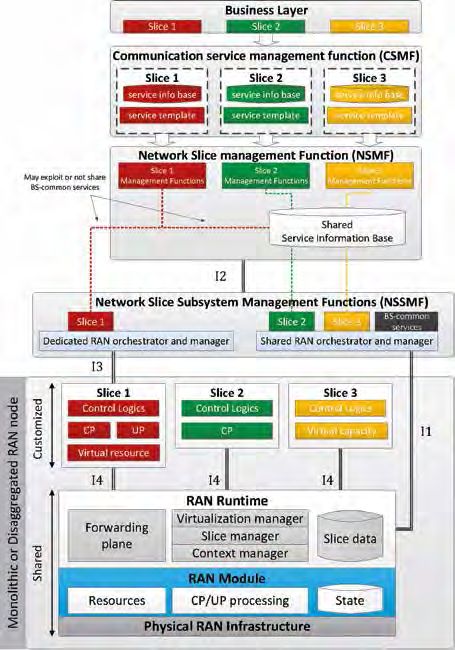
T H E K E N N E DY P E R S P E C T I V E

The truth, the whole truth and nothing
but the truth

                       David Kennedy
                       Eurescom
                       kennedy@eurescom.eu

We are now in the information age and, for
the first time, we are all beginning to realise
that we have been fed a lot of false informa-
tion as part of the wonderful widespread
availability of information today. In fact the
business of information management has
been going on for as long as people have
been trying to manipulate others – probably
forever, but the difference today is that the
tools of the information age are making the
whole concept more dangerous.
                                                         © fotolia.de
We are all aware of marketing – where, for the
purpose of promoting a product or service, or
even a political view, information is spread              The social media algorithms have a lot to an-           One of the biggest challenges to truth is our
through advertising and media to promote the           swer for here. Facebook and similar sites tend to       current trend for trying to be balanced in every-
ambition of whoever is paying for it.                  show you more of the type of information you            thing. There is a recurrence of people choosing to
   The concept of propaganda, which has con-           like. Therefore it is actually limiting your informa-   believe there is no global warming. They are a
notations of using parts of the truth for political    tion to the sort that reinforces your pre-held views    minority, but media representations will put them
effect originated somewhere in the middle ages.        and steers you towards more contact with people         in debate one to one with respected scientists
Again it is something we can deal with, as we          who have similar views as you. So it is guilty of       representing the majority of the scientific com-
know the source and can rationalise against the        preventing you from having a healthy selection of       munity. This concept of “balance”, giving an
inherent bias – but it is still a powerful political   viewpoints to consider.                                 uneducated perspective the same airtime as the
tool.                                                     This has the effect of polarizing communities.       informed educated viewpoint is creating a new
   Misinformation is more difficult, as here peo-      If we only speak and interact with people who           political concept where my ignorance has the
ple often share untrue things they have seen and       share our views we will end up with false ideas         same rights as your educated view.
liked because they fit with their views and preju-     about the world around us. For example, I often            If we allow this to continue, we will end up in a
dices. The subtlety is that they do not actually       have to deal with the view that all Irishmen drink.     world where the truth does not really matter and
know the information is false because they want        This usually comes from people who spend a sig-         governance done like reality TV where people
to believe it.                                         nificant proportion of their time in Ireland in the     vote for what they like regardless of the conse-
   Humour can also be an information weapon.           pubs and, because they only have this view, they        quences. And worse still the elected representa-
But we need to defend humour, as in many cas-          assume that is the full truth. They need to get out     tives will only act to grant the whimsical mass
es it is the first weapon for attacking unjust re-     more!                                                   wishes rather than consider what is right and
gimes or highlighting the double standards of             So what can we do with our biased polarized          good for society.
many of our political representatives.                 social information networks today? I, for one,
   But our new trend is disinformation, which is       would like to have a truth filter on the content.         Maybe we’re already there …
where individuals or groups deliberately spread           My truth filter would tell me, if the source of
false information to influence the views and opin-     information was untrustworthy, just as my mail
ions of the public in general or, even worse, to       client warns me against potential harmful attach-
obscure the truth. This is often done by spread-       ments. Some would argue that truth is a matter
ing false stories and or rumours in order to dam-      of perspective but I don’t agree. Truth is usually
age the public perception of people or events.         absolute but, just as history is often the account
                                                       of what happened by whoever won, people can
                                                       be economical with the truth and then it be-
                                                       comes propaganda again.

6   Eurescom message Winter 2018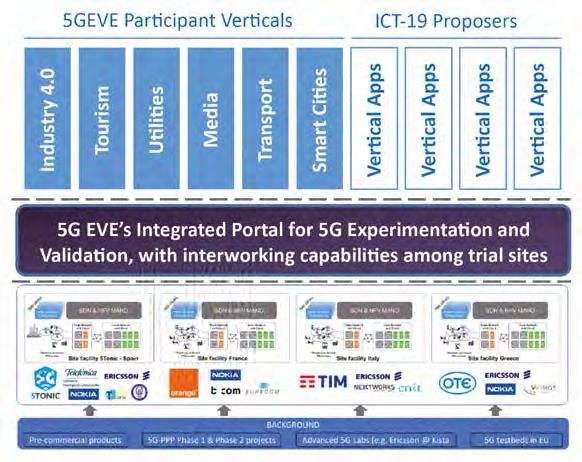
Cover Theme: Network Slicing

Overview on network slicing
Motivation and concepts

                                                       n   Enhanced Mobile Broadband (eMBB) – also            n   Convergence of fixed and mobile access –
                                                           called Extreme Mobile Broadband                        Treat all access technologies equally and de-
                                                       n   Ultra-Reliable and Low Latency Communica-              liver the same user experience regardless of
                                                           tions (URLLC), and                                     the network access technology type.
                          Anastasius Gavras            n   Massive Machine Type Communications                n   Innovation ecosystem and new business mod-
                          Eurescom                         (mMTC)                                                 els – Evolve the network into a digital business
                          gavras@eurescom.eu                                                                      ecosystem that is attractive for innovators in
                                                       In addition to the main key performance indica-            the vertical industries, for service providers
                                                       tors relevant to the service experience, such as           and operators alike.
The future of society is tightly coupled with          user data rate, latency, and density of devices,
the evolution of information and communi-              the following aspects are relevant from the de-        Business motivation
cation technologies. The new 5G network                ployment and network operational perspective
infrastructure is currently in the focus of re-        and should be met by network slicing:                  From a business point of view, a slice includes a
search, innovation and increasingly receives           n Service diversity – The ability to deliver differ-   combination of all relevant network resources,
media attention. 5G is not only about a fast-             ent service classes (eMBB, URLLC, mMTC)             network functions, service functions and en-
er network access, but marks a transition                 over the same infrastructure.                       ablers required to fulfil a specific business case
from a rather static network infrastructure            n Guaranteed performance – Simultaneously              or service, including the functions of an Opera-
to a much more dynamic one. It is just too                guarantee several performance KPIs, such as         tion Support System (OSS) and Business Sup-
expensive and inefficient to build a separate             user data rate or reliable service.                 port System (BSS).
infrastructure for each service.                       n Fast deployment and short time-to-market –              The behaviour of a network slice is realized via
                                                          The ability to deploy and provision network         a network slice instance. From the network infra-
Hence the basic motivations are to increase the           services for customers in hours or even min-        structure point of view, network slice instances
utilisation of network infrastructure resources, to       utes.                                               require the partitioning and assignment of a set
enable its shared use for multiple applications        n Resource isolation – Guarantee that each net-        of resources that can be used in an isolated, dis-
posing very diverging requirements on the net-            work service tailored for a customer is secured     junctive or non- disjunctive manner for that slice.
work and to add the required flexibility and scal-        and does not suffer performance degradation            Network slicing transforms the networking per-
ability to meet these requirements.                       by other services.                                  spective by abstracting, isolating, orchestrating,
   Network slicing is one of the main concepts in      n Automation and autonomic network manage-             softwarizing, and separating logical network func-
5G. The concept was first formulated by the Next          ment – Increase the agility and ease of adapta-     tions from the underlying physical network re-
Generation Mobile Networks (NGMN) Alliance in             tion of the network performance to unforeseen       sources.
the context of future networks. Slicing was origi-        network conditions.
nally defined as a set of run-time network func-
tions, and resources to run these network func-
tions, forming a complete instantiated logical
network to meet certain network characteristics
required by the service.
   Historically the concept of slicing is older. For
example PlanetLab – a global research network
that supports the development of new network
services – was established in 2003 and defines
slicing in a similar way.
   The definition that is given by 3GPP today is
that of a logical representation of the network
functions and corresponding resource require-
ments necessary to provide the required telecom-
munication services and network capabilities [1].

Requirements and drivers

In the course of identifying the requirements for
the 5G network infrastructure a large number of
use cases have been described and analysed by
standards bodies, such as 3GPP and ITU or in-
dustry forums such as NGMN. The different re-
quirements have been consolidated and agreed
in three main classes:
                                                                                                                                 Eurescom message Winter 2018   7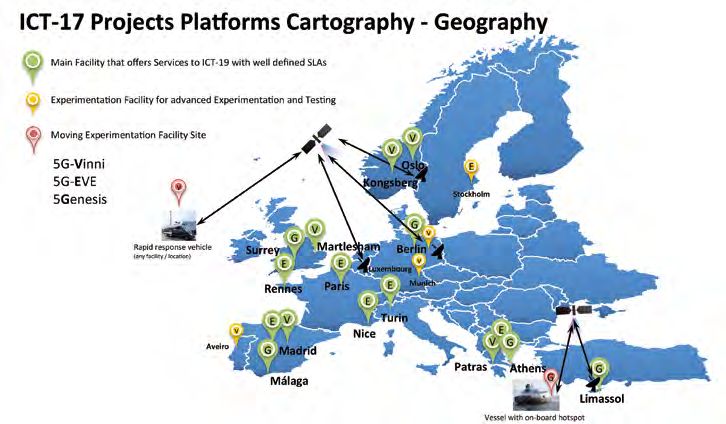
Cover Theme: Network Slicing

   To support network slicing, the management
plane creates a group of network resources, con-
nects them with the physical and virtual network
and service functions as appropriate, and instan-
tiates the network and service functions assigned
to the slice. During slice operations, the control
plane is governing all network resources, network
functions, and service functions assigned to the
slice. It controls them as appropriate to support
an end-to-end service.
   The establishment of slices is both business-
driven, because slices are the support for differ-
ent types and service characteristics and busi-
ness cases, as well as technology-driven because
slices are a grouping of physical or virtual re-
sources (network, computation, storage) which
can act as a sub network. A slice can accommo-
date service components and physical and/or
virtual network functions in all network segments:
access, core, back-/front-haul, edge and enter-
prise networks.
   Network operators can use network slicing to         The basic concept of network slicing (Source: 5G Architecture white paper, V2.0 [2])
enable different services to receive different treat-
ment and to allow the allocation and release of         with a slice to be considered as the unit of pro-      Conclusion
network resources according to their context and        grammable resource, such as network, computa-
contention policy. Network softwarization tech-         tion and storage.                                      Network slicing continues to be the subject of
niques may be used to realize and manage net-              SDN is often complemented by Network Func-          heated debates, in particular in the context of
work slicing. Network slicing provides the means        tion Virtualisation (NFV), which represents an al-     demonstrating the capabilities it promises. Ad-
by which the network operators can provide pro-         ternative way to design, deploy and manage net-        vanced 5G validation trials and pilots are being
grammable network capabilities to over-the-top          work services. SDN and NFV are related concepts        executed worldwide. They aim to showcase the
providers and other market players without              – SDN is used to separate the control and data         ability to meet diverging vertical industry require-
changing their physical infrastructure. Slices can      planes of the network, while NFV focuses on op-        ments during concurrent use of the same net-
dynamically support multiple services, multi-ten-       timising the network services themselves. NFV          work infrastructure by multiple applications.
ancy, and the integration means for vertical in-        aims to speed up the deployment of new net-            Each vertical industry application is seeking inde-
dustries such as the automotive, energy, health-        works services by implementing them in software        pendent service guarantees that slicing and virtu-
care, media/entertainment and other industries.         that can be provisioned rapidly in virtualised en-     alisation as well as multi-domain resource man-
   The figure indicatively illustrates how infra-       vironments.                                            agement must assure. With the first deployments
structure resources are assigned to slices and                                                                 of 5G planned in 2020, there is little time to trial
how network functions are allocated to slices.          Separating hype from reality                           and experiment with network slicing.

Virtualisation                                          What is the difference between a slice and a Vir-      References
                                                        tual Private Network (VPN)? This is the most fre-      [1] 3GPP TR 23.799 V14.0.0 (2016-12)
Network virtualisation is an essential ingredient       quently asked question in heated debates about         [2] 5G PPP Architecture White Paper, Version
for network slicing. It is defined by the ability to    the value of network slicing. Trying to separate       2.0, https://5g-ppp.eu/wp-content/
create logical, virtual networks that are decou-        hype from reality, the articles in this cover theme    uploads/2018/01/5G-PPP-5G-Architecture-
pled from the underlying network hardware to            provide insight into new network capabilities and      White-Paper-Jan-2018-v2.0.pdf
ensure the network can better integrate with and        applications that were not possible before.
support virtual environments. Virtualisation takes         For example the article on “Slice and Network
advantage of the efficiency and agility of soft-        Intelligence” explains how slicing is combined
ware-based computation and storage, and trans-          with Artificial Intelligence and Big Data to ensure
pose these properties to the network.                   effective network operations and network man-
   The induced software programmability led to          agement. The article on “End-to-End Cognitive
the introduction of Software Defined Networking         Network Slicing” provides an overview of the
(SDN) which is a method of using software to            SliceNet project, which delivers a full framework
create network abstraction layers over the physi-       for slice control, management and orchestration.
cal infrastructure and separate logically isolated      Finally the article on “Slicing and Orchestration
virtual networks. It is this property that inspired     in a Service-Oriented RAN Architecture” provides
ITU to define slicing as the basic concept of net-      an insight on how slicing is applied to the Radio
work softwarization. According to ITU-T Y.3011          Access Network (RAN), which is probably one of
slicing allows logically isolated network partitions    the most challenging areas for slicing, because
                                                        the radio spectrum is such a scarce resource.

8   Eurescom message Winter 2018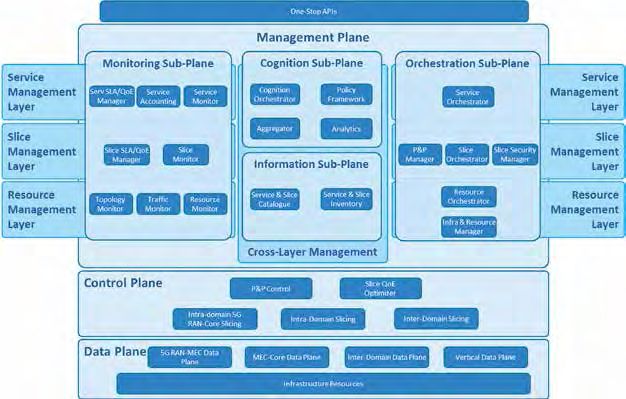
Cover Theme: Network Slicing

End-to-end cognitive network slicing
The SliceNet framework for slice control, management and orchestration

                    Qi Wang
                    University of the West of Scotland
                    Qi.Wang@uws.ac.uk

                    Jose Alcaraz-Calero
                    University of the West of Scotland   Figure 1: E2E network slicing framework concept in SliceNet
                    Jose.Alcaraz-Calero@uws.ac.uk

                                                            The 5G PPP is an EU initiative set up to boost      applications. Figure 1 illustrates the E2E network
                                                         Europe’s position in the global market for 5G net-     slicing framework concept in SliceNet.
                                                         works. SliceNet is one of the 5G-PPP projects ad-         A network slice in SliceNet is an independent,
                                                         dressing the slicing concept across operator do-       end-to-end logical network running on a shared
                    Maria Barros Weiss                   mains and offering a multi-domain multi-tenant         physical infrastructure, which spans across all
                    Eurescom                             plug & play control framework for vertical cus-        the network segments and may include a verti-
                    barros@eurescom.eu                   tomisable network slicing. SliceNet will advance       cal’s enterprise networks and multiple network
                                                         slicing-based softwarisation of 5G systems with        service providers’ domains to provide one or
                                                         architectural enhancements and infrastructure          more services.
The future generation networks aim to over-              integration, as well as novel enablers for the slic-      A network slice comprises specific RAT settings
come the limitations of current network                  ing control plane, management plane and cross-         and a set of network functions (virtual and/or
paradigms. They do so by addressing the                  plane orchestration.                                   physical) over the end-to-end logical network to
challenges of controlling, managing, and or-                For 5G network operators, SliceNet will enable      achieve the expected SLA and all the resources
chestrating a fully softwarised network and              a truly end-to-end multi-domain network manage-        (virtual and/or physical, dedicated and/or
services running on the infrastructure. The              ment paradigm with integrated FCAPS (Fault,            shared) required to run these network functions
instrument for achieving this vision is net-             Configuration, Accounting, Performance and Se-         that are purposely selected and chained to deliv-
work slicing. In this article we explain how             curity). For 5G service providers and users,           er the end-to-end service and the associated
the SliceNet project, which is part of the Eu-           SliceNet will achieve significantly higher service     SLA. The data plane over which network slices
ropean 5G Infrastructure PPP, is contribut-              quality towards warranted perceived quality            operate should be programmable according to
ing to the realisation of network slicing.               through intelligent QoE-driven design. For 5G ver-     the SLA requirements.
                                                         tical businesses, SliceNet will help them to em-          Some of the control and monitoring capabili-
SliceNet is set to implement end-to-end multi-           ploy 5G services in a more rapid and efficient         ties of the network slice can be exposed to the
domain network slicing that provides a manage-           manner through a ‘one-stop-shop’ approach.             vertical user by means of a plug & play control
ment plane for slices. Thus, SliceNet facilitates                                                               framework. The network slice service provider
the creation of value-added services by verticals        End-to-end network slicing                             and/or digital service provider can optimise the
and optimised Quality of Experience (QoE) for                                                                   QoE of the service provided by the network slice
end users.                                               To date reported prototypes do not implement           to enhance the experienced quality. In this con-
                                                         truly end-to-end (E2E), QoS/QoE-aware network          text, we focus on slices for applications by verti-
5G motivation and context                                slice control, management and orchestration            cals.
                                                         across multiple administrative domains. SliceNet          A network slice’s lifecycle and FCAPS (Fault,
Infrastructure providers are concerned with opti-        has identified this gap as a high-priority technical   Configuration, Accounting, Performance and Se-
mising the utilisation of their infrastructure re-       issue to tackle for achieving the E2E application      curity) management and orchestration belong to
sources. At the same time they are keen to offer         quality required for the adoption of 5G applica-       the network management plane. Cognitive net-
richer services to customers who are more and            tions. Current solutions have mostly focused on        work slice management is envisioned to support
more demanding, not only in regard to service            the Radio Access Network (RAN) and Core net-           dynamic QoE optimisation for the verticals’ net-
usage but also regarding QoE expectations. On            work in a single 5G operator’s domain for net-         work slices during their operational lifetime.
the other hand, vertical customers are demand-           work slice prototyping, even if they need an E2E
ing a much higher flexibility in controlling the         dimension in order to be adopted for large-scale
network services they receive.
                                                                                                                                  Eurescom message Winter 2018   9
Cover Theme: Network Slicing

Figure 2: SliceNet logical architecture for network slice control and management

SliceNet network slice control, manage-                over a shared Knowledge) loop to empower the          distribution networks with self-healing capabili-
ment and orchestration architecture                    management plane to achieve cognitive network         ties. Secondly, the e-Health Smart/Connected
                                                       slice management for the verticals. Finally, an       Ambulance use case shows how to improve the
To realise the SliceNet network slicing concept,       orchestration sub-plane delivers the orchestration    emergency ambulance services by leveraging
the project has defined an overall logical archi-      capabilities across the planes and at the various     mobile/multi-access edge computing. Thirdly,
tecture for slice control, management and or-          layers.                                               the Smart City use case demonstrates an Intelli-
chestration (Figure 2), which is compliant with                                                              gent Public Lighting system in the city Alba Iulia
the 3GPP models for network slicing [2].               Adoption by vertical industries                       in Romania and assesses the various technical
   As you can see in Figure 2, SliceNet has de-                                                              and operational KPIs against the initial status
fined a modular architecture that is structured        SliceNet employs a “verticals in the loop” design     quo in the city.
into three planes. At the bottom, there is a net-      and prototyping approach. There is a strong inter-
work slice QoS aware, programmable data plane.         est of the verticals’ industries towards 5G tech-     Conclusion and outlook
This data plane spans the different network seg-       nologies. Vertical stakeholders are forming part-
ments within a single domain, as well as verti-        nerships with 5G ICT industry stakeholders to         SliceNet aims to achieve E2E QoS/QoE aware
cals’ data plane and cross-domain data paths           achieve the fully connected society vision of 5G.     network slicing with cognitive network slice man-
from the E2E perspective. Over this data plane,        The European Commission (EC) incentivises ver-        agement capabilities beyond the state of the art.
an overlay control plane controls the network          tical industry participation in research from the     Towards this end, the project will advance net-
slices on top of 4G/5G network infrastructures.        early stage, which includes supporting project        work slicing-based 5G systems with significant
   It is worth clarifying that this SliceNet control   trials by verticals. Users are very much in the fo-   architectural enhancements to 4G/5G networks,
plane operates and interacts with the underlying       cus of 5G network solutions, and users’ QoE has       and produce novel enablers in terms of multi-
4G/5G control plane and data plane for added           been the focus of SliceNet.                           domain network slicing, plug & play control, cog-
values of network slice control. In particular, the                                                          nitive management, among others. The three
SliceNet plug & play control enables the verticals     Use cases                                             selected use cases, aligned with the three main
to monitor, control and manage their own slices.                                                             5G network slice types, will demonstrate the over-
At the top in this architecture, a cognitive network   SliceNet will be demonstrated through three rep-      all benefits in adopting the SliceNet framework
slice management plane oversees the control            resentative vertical use cases. They are aligned      for network slice control, management and or-
plane and the data plane.                              with the three 5G use case classes defined by         chestration in meeting the diverse QoS/QoE re-
   The management plane itself is organised into       3GPP, namely Ultra-Reliable Low-Latency Com-          quirements from various vertical businesses.
four sub-planes. Firstly, a monitoring sub-plane       munications (URLLC), massive Machine-Type
provides the monitoring capabilities of running        Communication (mMTC), and enhanced Mobile             References
slices at multiple layers including resources, slic-   BroadBand (eMBB).                                     [1] https://slicenet.eu/
es, and services. Secondly, a cognition sub-              The vertical use cases include the following.      [2] http://www.3gpp.org/NEWS-EVENTS/3GPP-
plane, together with an information sub-plane,         Firstly, the Smart Grid Self-Healing use case         NEWS/1951-SA5_5G
enables a MAPE-K (Monitor-Analyse-Plan-Execute         demonstrates enhanced automation in energy

10    Eurescom message Winter 2018
Cover Theme: Network Slicing
Slicing and network intelligence
How AI serves future sliced networks
Embedding Artificial Intelligence (AI) into the net- slice is done via the Single Network Slice Selec-
work will provide a greater level of automation and tion Assistance Information (S-NSSAI), which is
adaptiveness, enabling efficient orchestration composed of Slice/Service Type (SST) and Slice
Imen Grida Ben Yahia and dynamic provisioning adapted to the type of Differentiator (SD). UE receives services through
Orange Labs Networks slice, the offered services and the nature of net- a Protocol Data Unit (PDU) session, which is a
Imen.gridabenyahia@ work functions. It will also result in higher resil- logical connection between the UE and network.
orange.com iency and better availability of future sliced net- The S-NSSAI is included in any signalling mes-
works and their associated services. sage containing PDU Session information, so
Next Generation Radio Access Network (NG-RAN)
The network slicing concept is enabled to apply policies at PDU session level
according to the SLA represented by the network
A network slice is a logical network provisioned slice. A maximum of eight S-NSSAI items may be
Joanna Balcerzak with a set of isolated virtual resources on the sent in signalling messages between the UE and
Orange Labs Networks shared physical infrastructure that can be dynam- the network. A PDU session belongs to only one
joanna.balcerzak@ ically created to provide specific network capabili- specific network slice instance.
orange.com ties and characteristics. The network slicing con-
cept [1] consists of Service Instance Layer, Management requirements for slicing
Network Slice Instance Layer and Resource Layer.
Future networks with slicing need to have The network slice instance selection for User Each slice must be independently managed as a
built-in and embedded intelligence. This will Equipment (UE) is normally triggered as part of separate network. In the following, a set of re-
enable better agility, resiliency, faster cus- the registration procedure by the first Access and quirements are listed to properly operate slices:
tomization and higher security, which are Mobility Management Function (AMF) in the core n Isolation to prevent from attacks or faults in
required by 5G users and a growing number network that receives the registration request one slice, becomes necessary to avert bad im-
of vertical use cases in areas like eHealth, from the UE. The AMF retrieves the slices that are pact on other slices.
Smart City, and Smart Grid. In this article, allowed by the user subscription and interacts n A large number of Key Performance Indicators
we explain the challenges of using Artificial with the Network Slice Selection Function (NSSF) (KPIs) require real-time advanced automation
Intelligence (AI) in sliced networks, recall to select the appropriate network slice instance to ensure KPI association, correlation, fore-
the network slicing concept, sketch the role that will serve a particular device. casting of indicators evolution and anomaly
of AI for future network operations, and in- A given UE may access multiple slices over the detection of data.
troduce the network data analytics function same access network. Each slice may serve a n Slice congestion and the prevention of impact-
(NWDAF) as an entry point to AI. particular service type based on a Service-level ing other slices.
Agreement (SLA). The identification of a network
Figure 1: Future Network Intelligence with AI – a simplified view
Eurescom message Winter 2018 11Cover Theme: Network Slicing
3GPP's 5G standardization efforts and could be-
come a central point for analytics in the 5G core
network. NWDAF provides an identifier for each
network slice instance and its associated load
level information. Several network functions are
using this NWDAF, such as the Policy Control
Function (PCF) and the NSSF (Network Slice Se-
lection Function). The PCF may use that data in
its decision policies, and the NSSF may use the
load level information provided by NWDAF for
slice selection.
In figure 2, the general framework for 5G net-
work automation is depicted as follows:
The Mobility Pattern is a concept defined in
3GPP. It may be used by the AMF to characterize
Figure 2: Network Data Analytics Function – Towards Analytics in Network Slicing and optimize the UE mobility. This concept gives
the opportunity to predict the mobility, since
n “Smart” monitoring with aggregation and cor- rameters to meet a given deployment constraints NWDAF can learn UE mobility history and dis-
relation techniques becomes mandatory to or a vertical request. That kind of system learns cover the rules and patterns of UE mobility. In its
take into account the different levels intro- from past deployments to better fit the future turn, the AMF determines and updates the Mobil-
duced by the Network Slicing concept: service ones. ity Pattern of the UE based on subscription of the
level, slice level and resource level. Machine learning and deep learning models, UE, statistics of the UE mobility, network local
n Performance requirements for the different algorithms and techniques leverage slice, service policy, and UE-assisted information, or any com-
slices are a challenge: it takes into account the and resource management operations, hereafter bination of them.
number of devices, the types of devices, their some examples: The statistics of the UE mobility can be his-
mobility and traffic patterns, the delay and the 1. Smart prediction and forecasting of networked torical or according to an expected UE moving
jitter requirements, the device capabilities, but slice resources enable better anticipation of trajectory. This information can be used for opti-
also the slice granularity per service type, the faults, performance degradation and maintain mization and seamless transition of the handover
flow or even the distribution of traffic per slice, service availability to verticals. With machine process while ensuring better quality of service
and so on. learning, service unavailability and interrup- with direct impact on QoE improvement. Data
tion are avoided especially for critical services related to UE behaviour can be also useful in
Future network intelligence with AI like remote surgery. case of analytics to introduce tailored services
2. Cognitive scaling embeds ML algorithms to taking into account the habits and preferences of
Artificial Intelligence and big data are multi-disci- adjust network and cloud capacity accordingly the client.
plinary domains spanning from statistics, robot- to usage analysis and forecasting results.
ic, machine learning to optimization, and more. 3. The context of slicing is particularly highlight- Conclusion
Hence, future network intelligence is the target to ing the consideration of multi-levels (services,
reach with AI and big data. In figure 1, we show slices and their associated resources) and het- Artificial Intelligence for services, slices and their
a simplified view of Future Network Intelligence erogeneous data sources: In this regards, data associated resources is becoming a must for
with AI. It shows that the future network encom- fusion techniques, with for example, Convolu- managing the network operations. In fact, the
passes the previous network generation as tional Neural Networks (CNN) and Long Short future network is a combination of different and
well as 5G sliced networks. From these hetero Term Memory (LSTM) are recommended to heterogeneous technologies, data formats (sev-
geneous network generations, different data ensure data discovery and association, pat- eral levels) and massive customization per slice
sources will be available. tern identifications, data dependency and cor- and per services involving a huge set of KPIs to
The goal of AI will be to extract information, relation. maintain. Thus AI and big data are essential and
build knowledge and make decisions based on 4. Preventing attacks and malware which target require a methodology to meet the active trans-
data analysis and the formal modelling of slices, established services and verticals as well as formation of networks.
services and resources status. In the following we ensuring the QoS of a given network slice ses-
cite several cases to exemplify AI for future sliced sion requires advanced techniques of anomaly References
networks [2]. detection or learning-by-interaction techniques [1] NGMN 5G P1 Requirements & Architecture
Optimization algorithms are essential to effi- to prevent attacks and fraud from happening Work Stream End-to-End Architecture; Descrip-
ciently allocate network elements and devices on the networks. The network is then able to tion of Network Slicing Concept by NGMN Alli-
while reducing the energy consumption. In addi- “remember” what was tagged as nasty event ance; v.1; 2016-01
tion, optimization techniques allow an efficient and to prevent that from happening thanks to [2] IEEE-Communication-Society, Network Intelli-
deployment of the slice and the offered services deep learning techniques including pattern gence Initiative, https://www.comsoc.org/com-
while combining different constraints and inputs recognition. mittees/emerging-technologies-initiatives/
like the customer preferences, slice types, re- network-intelligence
source status and in the meantime meet the AI’s entry point for network slicing
business constraints.
Network recommendation systems that are The network data analytics function (NWDAF)
usually based on learning by interaction tech- could be considered as an entry point to realize
niques like reinforcement learning recommend AI in the sliced future networks applications cited
the network configurations slice templates pa- above. Hence, NWDAF forms a part of the
12 Eurescom message Summer 2017Celtic-Plus
Newsletter 2/2018
Outlook 2019: CELTIC-NEXT Cluster starts in January 2019
Events: CELTIC Proposers Day in Madrid
Project Highlights: E3 – Successful business development
of e-health services
Start-up Success Stories: A new paradigm in
digital asset managementC E LT I C - P L U S N E W S L E T T E R
Editorial
Table of Contents Dear reader,
Editorial ........................................................... 2 The CELTIC-NEXT Cluster was endorsed by the In this issue, you can also read about our Pro-
EUREKA High Level Group at the 3rd and final posers Day in Madrid, which was hosted by CDTI
Outlook 2019 meeting of the Finnish EUREKA Presidency on the Spanish funding agency. We had 70 regis-
UK to join funders supporting Celtic-Plus 20th June 2018 in Helsinki. CELTIC-NEXT will for- tered participants from eight different countries.
projects ............................................................ 3 mally start its operations in January 2019. In this Highlights of the day were the keynote on Artifi-
CELTIC-NEXT Cluster starts in January 2019 .... 3 issue you will find the most important facts on cial Intelligence and the panel on successful
what is new and what remains, when CELTIC- CELTIC projects showing impressing results such
Events NEXT will start next year. as “The world’s first 100G quantum safe trans-
CELTIC Proposers Day in Madrid ...................... 5 Maybe the shortest information of this Newslet- port over 2,800 km”. The Public Authorities from
ter is at the same time the most exciting: Innovate Spain, Germany and Sweden presented their na-
Project Highlights UK has announced that they will fund CELTIC tional funding schemes and 8 project ideas were
E3 – Successful business development of e-health projects in 2019. So if you have good partners shown and discussed in the networking session.
services ............................................................ 7 from the United Kingdom, please invite them to In the Celtic-Plus Autumn Call that closed on
join you and to participate in CELTIC project pro- 15th October, we received four CELTIC project
Start-up Success Stories posals. proposals – the evaluation by the Group of Ex-
A new paradigm in digital asset management – Start-ups are of critical importance for our re- perts, the Public Authorities and the CELTIC Core
Innovative DAM solution by Perfect Memory search activities. We have asked Steny Solitude Group is currently ongoing and the results will be
based on Celtic-Plus results .............................. 8 from Perfect Memory, a French SME that exists known after the Label Meeting that will take
since 2008. It is an SME that has already over- place in Heidelberg in mid-November 2018.
come a number of difficulties in its first 10 years Celtic-Plus is fast evolving towards CELTIC-
of existence and that generates now more and NEXT and we expect that CELTIC-NEXT will con-
more business. Steny explains how his company tinue to attract our highly innovative community,
can help to make any data and document action- which is constantly pushing the borders of ICT
able for the business. Perfect Memory was creat- technology. If you are not yet part of the Celtic-
ed thank to two CELTIC projects. See this and Plus community and would like to join, there are
more information in Steny’s Article. ample opportunities, like, e.g., the online Pro-
The Project Highlight of this issue is about a poser’s Day on 29 of November 2018. Other
very good CELTIC project, the E3 project. You Proposers Days for early 2019 will be announced
may recall the announcement one year ago on shortly and, of course, the next call for proposal,
“the first live transmission of awake surgery”. E3 which ends in April 2019. Feel free to talk to me
has now ended, and the coordinator, Oscar or any other colleagues at the Celtic-Plus Office
Chabrera from Vilynx, explains the outcome of – I look forward to hearing from you.
this project. Vilynx is a start-up company that was
created after a successful CELTIC project. I would Peter Herrmann
like to highlight the impressive achievements and Editor-in-chief
feel proud that we at CELTIC have facilitated their
success.
IMPRINT
Editor-in-chief:
Peter Herrmann
herrmann@celticplus.eu
Contact:
Celtic Office
c/o Eurescom GmbH
Wieblinger Weg 19
69123 Heidelberg, Germany
Tel: +49 6221 989 381
Fax: +49 6221 989 451
www.celticplus.eu
2 Celtic-Plus Newsletter Winter 2018OUTLOOK 2019
UK to join funders supporting Celtic-Plus projects
In October 2018, the UK announced that it
will be supporting Celtic-Plus cluster pro-
jects in 2019. Innovate UK, part of UK
Research and Innovation, is the UK public
authority for granting national funding of
Celtic-Plus labelled international projects.
Further information will follow in the com-
ing months.
CELTIC-NEXT Cluster starts in January 2019
CELTIC-NEXT, the successor of Celtic-Plus,
will start its operation in January 2019. The
EUREKA Cluster dedicated to next-genera-
tion telecommunications has a duration of 8
years until December 2026. On 20th June
2018, the CELTIC-NEXT Cluster had
received the EUREKA Label in Helsinki,
based on a decision by the EUREKA High
Level Group.
At the HLR Meeting in Helsinki, CELTIC-NEXT
was represented by the two CELTIC Vice Chairs
Valery Blavette from Orange and Jari Lehmusvu-
ori from Nokia as well as the CELTIC Office Direc-
tor, Peter Herrmann.
Foundations of CELTIC-NEXT
The CELTIC-NEXT Core Group is composed of 8
operators, 7 technology providers and 1 research
organisation. In 2017 the CELTIC Core Group
identified the critical technological and societal
issues that need to be addressed in the coming
years. These topics are documented in the CELT-
IC-NEXT White Paper [1] and the CELTIC-NEXT
Scope and Research Areas document [2].
CELTIC-NEXT will be based on the core values
that have been supporting the Celtic community
for 15 years, i.e. a bottom-up industry-driven ap- Peter Herrmann presenting CELTIC-NEXT to the EUREKA High Level Group. On stage (from left) representatives
proach, along with large flagship projects aimed of the Finnish EUREKA Chairmanship team: Kenneth Nyholm, Heikki Uusi Honko (Chairman), and Tom Warras.
at solving issues of strategic importance through
a combined effort and coordinated approach of
public authorities and industry.
Celtic-Plus Newsletter Winter 2018 3OUTLOOK 2019 Main technological trends The main technological trends on the critical technological and societal issues that need to be addressed in the coming years are laid down in the CELTIC-NEXT Scope and Research Areas document, which is briefly summarised below. Networking and Cloud enablers addressing and using technology from such research areas as cyber security, artificial intelligence, 5G and beyond, FinTech, big data, business analytics, and IoT are considered as important orientations to develop. A special focus of CELTIC-NEXT will be on applications and services serving vertical sectors such as content (video, gaming), e- health, smart cities, agriculture, mobility, energy, automotive, e-commerce, and industry/ manu- facturing. Those verticals are equally important to advance, along with optimising and improving efficiency and reliability with the best end-to-end connectivity and security. The evolution of ICT services over the next period will be achieved via a partnership model where the vertical sectors collaborate in determining their ICT solutions. This will be a key focus of the CELTIC-NEXT end- to-end perspective. Another key issue for CELTIC-NEXT will be to develop communications infrastructures and ser- vices that can adapt to the requirements of vari- ous business sectors. The needs of communications between vehicles are, for ex- Representatives from vertical sectors will be ter. The label decisions will be known within 6 ample, quite different from the needs for piloting progressively invited to participate in the CELTIC- weeks after submission, and the first project will electrical power in buildings and houses. The NEXT Industry Core Group to ensure the continu- start in autumn 2019. same applies to the virtual and immersive reality ous cross-fertilisation of ideas. In parallel, the techniques that will become a critical element in telecommunications industry shall exploit the full References the health and media/digital industry in the com- power of cross sectors technologies such as Arti- ing years. There will be many unique challenges ficial Intelligence and Big Data, to define and [1] CELTIC-NEXT White Paper ‒ https://bscw. behind innovative manufacturing processes that provide customised and smart solutions for the celticplus.eu/pub/bscw.cgi/d26025/CELTIC- must be supported by one ubiquitous infrastruc- different economic sectors and the whole soci- NEXT-WhitePaper.pdf ture. We expect that many of the CELTIC-NEXT ety. [2] CELTIC-NEXT Scope and Research Areas projects will define and develop self-adaptable document ‒ https://bscw.celticplus.eu/pub/ solutions, able to fit the needs of many different First CELTIC-NEXT project bscw.cgi/d27676/Celtic-Next-Scope-and-Re- sectors and societal challenges. CELTIC-NEXT search-Area.pdf with its end-to-end approach is key for allowing The official start date of CELTIC-NEXT will be the the development of dedicated applications using 1st of January 2019. The Spring Call will close in the network with all the required features for a April 2019 – the precise date will be decided given economic sector. shortly after the editorial deadline of this newslet- 4 Celtic-Plus Newsletter Winter 2018
EVENTS

CELTIC Proposers Day in Madrid

On 26th September 2018, CELTIC and CDTI
jointly organised a Proposers Day hosted by
CDTI in Madrid. The goal was to help boost
the participation of Spanish companies in
CELTIC Projects. The Proposers Day pro-
vided information on funding opportunities
and project topics. This time the focus was
on Artificial Intelligence.

The Proposers Day was opened by Mrs Ángeles
Valbuena, Head of Foreign Technology Action
Programmes Department from CDTI, and by Mr
Riza Durucasugil, Celtic-Plus Vice-Chair from Ne-
tas. They welcomed the 70 participants and ex-
plained why progress in the technology field of       Welcome by Mrs Ángeles Valbuena (right), CDTI, Head of Foreign Technology Action Programmes Department
communications for the digital society is of criti-   and Riza Durucasugil, Celtic Vice Chair from Netas,Turkey
cal importance for Spain and Europe. The Span-
ish contribution has an important place in the
European activities of CELTIC.

Artificial Intelligence at Telefonica

Dr. Richard Benjamins, Telefónica’s Data and AI
Ambassador presented how Artificial Intelligence
is changing the business of telecom operators.
He explained that Telefonica is one of the most
digitalised telecom operator in Europe. Artificial
Intelligence helps the company to optimise the
business internally and improves operations of
business with the customers. It allows better pre-
dictions of communication behaviour and there-
fore allows to better meet the needs of their
customers.

                                                      Audience of the Proposers Day in the meeting room at CDT

                                                      CELTIC-NEXT project framework in                           and the challenges for applying these trends in
                                                      Spain, Germany and Sweden                                  the ICT domain. The current main topics are pro-
                                                                                                                 duction systems (Industry 4.0), energy systems
                                                      Juana Sanchez from CDTI presented the Spanish              for the future and social systems able to cope
                                                      involvement in CELTIC projects. Spanish compa-             with demographic changes. Influencing and
                                                      nies are among the most active in Celtic during            boosting the digital revolution is one of the top
                                                      the period from 2012 to 2018. There is no other            priorities of the German government.
                                                      country that had more participation in CELTIC              Lars Gustafsson from VINNOVA introduced the
                                                      projects than Spain. The next speaker from CDTI,           current main challenges in Sweden on Artificial
                                                      Emilio Iglesias, explained the funding mecha-              Intelligence, digital security and the investment
                                                      nisms of Innoglobal Calls and the open calls               in competences and education. He explained
                                                      from CDTI. CELTIC projects that will be submitted          that the EUREKA Clusters are strategically impor-
                                                      to the Celtic autumn call will be eligible to apply        tant for the internationalisation of SME and
                                                      to the coming Innoglobal Call that will close on           Swedish industry. He also explained how the pro-
                                                      5th December 2018.                                         cess for receiving funding in Sweden works.
                                                         Matthias Kuom from DLR explained the main
Dr. Richard Benjamins presenting the keynote speech   focus of funding in Germany on new mega trends
about Artificial Intelligence

                                                                                                                                  Celtic-Plus Newsletter Winter 2018   5
EVENTS
Juana Sanchez and Emilio Iglesias explaining CELTIC projects at CDTI Lars Gustafsson from VINNOVA
Jaime Ruiz from Nokia presented the CELTIC
project MONALIS focussing also on Video deliv-
ery technology that is the most bandwidth-hun-
gry application. It is targeting QoE assessment
and evaluation techniques for adaptive stream-
ing. Jaime underlined that the optimum experi-
ence in terms of perception and delivery
guarantee happens when the delivered format is
the minimum required for a given display.
Oscar Chabrera Villarreal from Vilynx pre
Matthias Kuom from DLR José Tomás Romero, head of innovation sented a series of very successful SME-led
department at AMETIC opened the panel on CELTIC projects commercializing e-health solu-
business impacts of CELTIC projects tions. The last, the E3 project, only finished last
summer. Very important in this project is that 4
hospitals are directly taking part in this project.
Among many results in the course of the project
the first live awake brain surgery retransmission
at TELECOM Nancy and Nancy University Hospi-
tal has been realized thanks to the E3 project.
Project proposal pitches
Another core element of the Proposers Day was
the pitching of project ideas. 8 proposers pre-
sented their ideas on a wide range of ICT topics.
They included autonomous vehicles, traffic mon-
itoring in cities 5G-related technologies, Artificial
Panellists (from left): Bruno Duval from Citypassenger, Antonio Cuadra Sanchez from INDRA, Jaime Ruiz from Intelligence, automotive telecoms, future service
Nokia, Oscar Chabrera Villarreal from Vilynx, and Reijo Savola from FTT platforms, data sovereignty, and tourism servic-
es. The presentations led to productive discus-
sions with the audience. Since then, two of these
Panel on business impacts of CELTIC result that the world’s first safe 100G quantum pitch presentations have already turned into proj-
projects transport over 2,800 km has been achieved in a ect proposals in the CELTIC Autumn Call in Octo-
trial of this project. In addition, a new world-re- ber. The evaluation by the CELTIC Experts is
José Tomás Romero from AMETIC opened and cord capacity of 400 Gb/s with single-photodi- currently progressing.
guided through the panel session. Bruno Duval ode reception has been achieved in this project.
from CityPassenger (a France SME) presented Antonio Cuadra Sanchez from INDRA present- n Further information
the results of the CELTIC projects ODSI and SEN- ed the EUREKA Innovation Award winner, CELTIC All presentations and project pitches are avail-
DATE-TANDEM both working in the Security do- project NOTTS – Next generation over-the-top able at https://www.celticplus.eu/event/propos-
main. The project allowed developing a new multimedia services. The project was awarded ers-day-in-madrid-26-september-2018/
security concept “Network-as-a-dongle” that has due to its excellence in providing a scalable and
already been implemented by a manufacturer. robust video streaming solution to deliver adapt-
CityPassenger highlighted the commercial and ed media content, with the guaranteed level of
technological advantages thanks to participating quality that customers expect and demand. Anto-
in these projects. nio explained why he and the projects partners
Reijo Savola from VTT presented the flagship are excited about the Business impacts that the
project SENDATE, which is also working in the project has generated.
Security domain. Reijo reported the impressive
6 Celtic-Plus Newsletter Winter 2018You can also read


