NETZWERKE UND KOOPERATIONEN - ALS INTERUND TRANSDISZIPLINAERE AUFGABE - DR. MACHIEL KEESTRA, INSTITUTE FOR INTERDISCIPLINARY STUDIES, UVA ...
←
→
Page content transcription
If your browser does not render page correctly, please read the page content below
Netzwerke und Kooperationen -
    als inter- und transdisziplinaere Aufgabe

     Dr. Machiel Keestra, Institute for Interdisciplinary Studies, UvA
Netzwerke und Kooperationen DENKEN, Innovation in der Hochschullehre
                - online Diskussionsbeitrag, 5. Mai 2021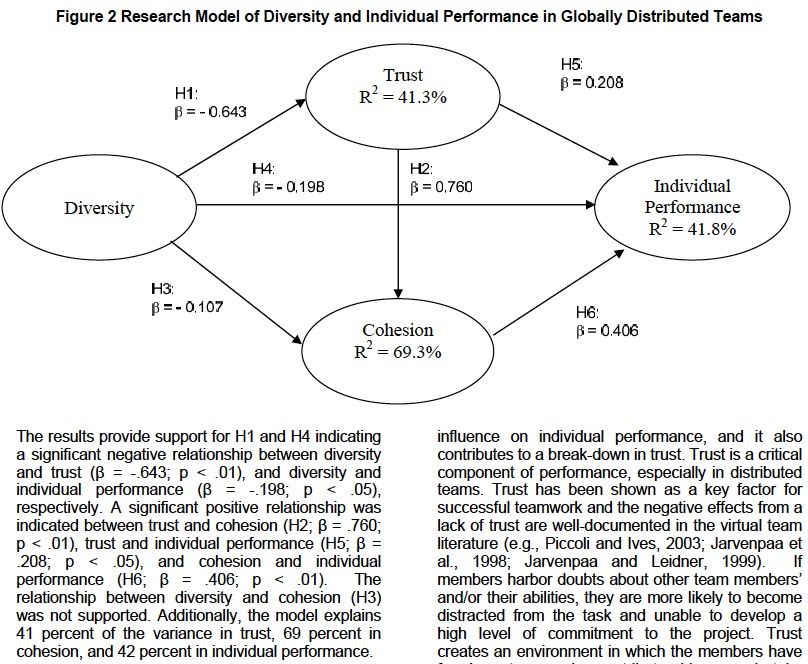
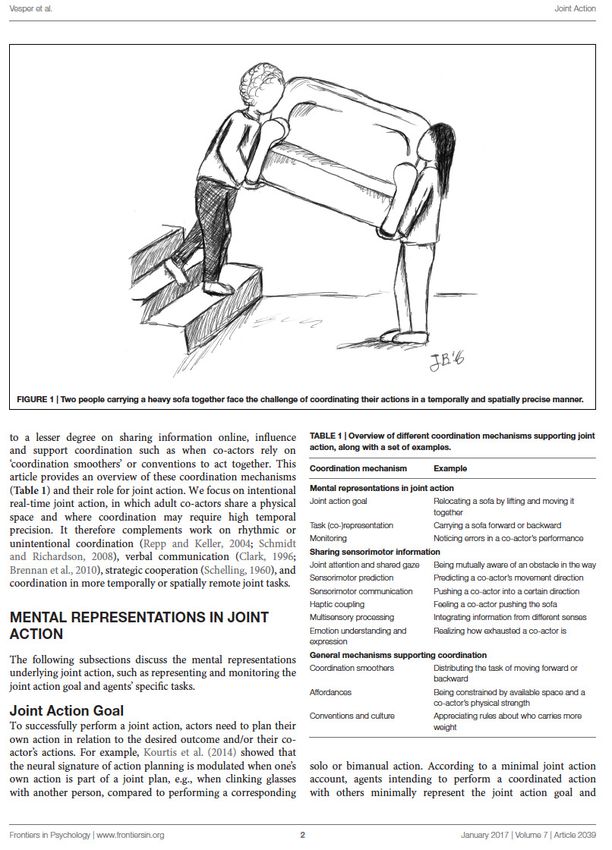
Kooperation: gemeinsam, doch mit Unterschieden

Bratman on joint action:
- shared goal

- separate purposes/aims

- meshed plans

- acknowledging differences re

  actions and goals/norms
- some stability is necessary

Pluralism can be maintained!
(cf. Bratman, 1992; 2007 Structures of Agency;
fig. Vesper e.a., in Front. Psych. 2018)
   Keestra - Netzwerke und Kooperationen - 5. Mai 2021   2

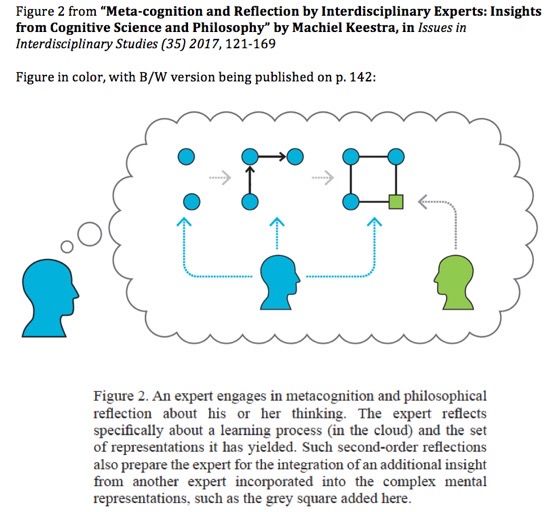
Metakognition als Bedingung der Kooperation

Self-knowledge, monitoring &
regulating one’s cognition:
 – awareness of one’s own
   representations, stragies etc.
 – recognition of differences in
   representation & cognition
 – preparedness to subsequently
   employ this pluralism
 (Keestra 2017: https://tinyurl.com/Keestra-
 Metacognition )

                                               3
Von individuellen zum team Kognition und
    Representationen
•    Bratman on ‘joint action’: shared
     distribution & coordination of tasks &
     knowledge

•    Distributed across members of a group
•    Distributed across internal & external
     structure
      •       (space, organization, artifacts, etc.)
•    Distributed through time, with interactions
                •     (Hutchins, 2000, ‘Distributed cognition’ in IESBS;
                •     Vesper e.a. 2018; fig. D’Angelo 2018)

          Keestra - Netzwerke und Kooperationen - 5. Mai 2021              4
Akademiker des 21. Jhdts: kooperierend und
netzwerkend

 Table from https://workfutures.substack.com/p/10-work-skills-for-the-postnormal

  Keestra - Netzwerke und Kooperationen - 5. Mai 2021                              5
Interdisziplinaritaet: Integration als Kennzeichen

“Interdisciplinary research is a mode of research
in which an individual scientist or a team of
scientists integrates information, data,
techniques, tools, perspectives, concepts, and/or
theories from two or more disciplines or bodies
of specialized knowledge, with the objective to
advance fundamental understanding or to solve
problems whose solutions are beyond the scope
of a single discipline or area of research
practice.”
       (Nat. Academies of Science, 2005; in Menken &
      Keestra, eds., Introduction to Interdisciplinary
      Research, 2016)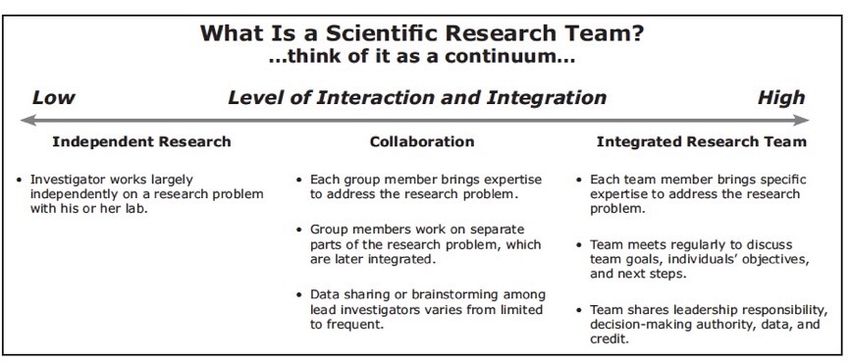
Integration und Interaktion sind ko-dependent

From: Bennett e.a. 2010: Starting to think about Team Science
 Keestra - Netzwerke und Kooperationen - 5. Mai 2021            7
Unterstuetzung der Kollaboration durch
 mentale Modellen, Repräsentationen

“… delineating various types of mental
models (…), we posit that the existing
constructs represented in the literature
can be categorized as team-level mental
representations focused on four basic
types of knowledge content:
-task related
-team related
-process related, and
-goal related.”
     (Wildman e.a. 2012, 92)

à Metacognition applies to cognition
of these types of content

    Keestra - Netzwerke und Kooperationen - 5. Mai 2021   8
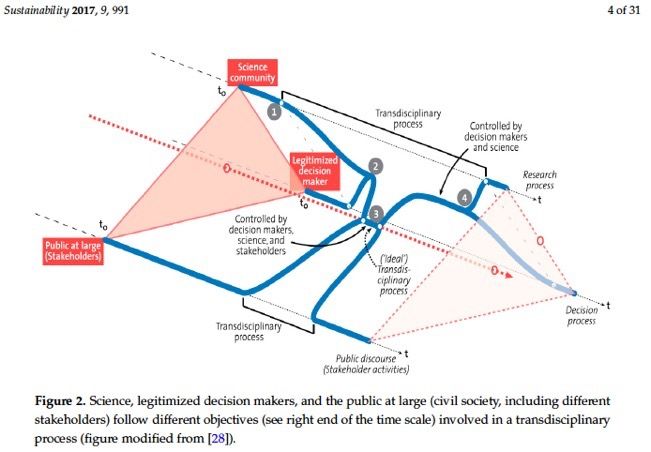
Kollaboration in unterschiedlichen Phasen -
 bedingt durch Koordination

Cf. coordinated collaborations in
transdisciplinary research project
with different parties in phases of:
- problem framing

- research

- integration & implementation of
   results
   (cf. Scholtz 2017)

                                               9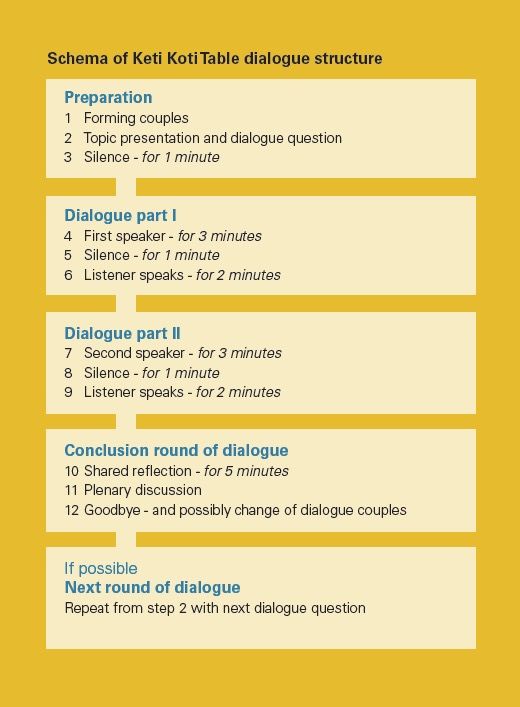
Zur inter-, trans-disziplinären und Aktionsforschung
brauchen wir selbst- und team-reflektierende Akademiker

 Collaboration requires team
 metacognition, reflection, and
 communication on e.g.:
 – Project goals
 – Different cognitive processes
 – Differences in norms, interests
 – Mutual expectations
 – etc.
 (Keestra 2017:
 https://tinyurl.com/Keestra-
 Metacognition )

                                                     10
Diversitaet als Bedingung und Herausforderung
Diversity policies must attend to:
- composition of team/community
- reflection upon different positions
- ensuring an trusting, safe environment
- conditions for equal participation
- allowing individuals’ belongingness &
uniqueness
(Cf. Brewer’s optimal distinctiveness theory;
Shore e.a. 2011; Settles 2019 ‘Team climate
mediates the effect of diversity’; fig. Garrison
2010)
Keestra - Netzwerke und Kooperationen - 5. Mai 2021 11Persoenlicher Dialog zur Auswechselung und Bildung des Vertrauens Dialogue is effective as it entails: - Voluntary inter-group contact - Perspective taking - Decreased intersubjective anxiety - Building trust - Empathy (Allport 1954; Keestra 2004; cf. Broekroelofs & Keestra [report] 2018; https://www.ketikotitafel.nl/keti-koti- table )
Structured dialogue:
- silent reflection
- equal speaking time
- listening is essential
- sharing feelings
Dialogue question(s) #1

- Have you ever experienced a
  feeling of loneliness, or being
  excluded, within the context
  of the university/ UvA?
- Can you share the emotional
  impact of that experience?
Dialogue question(s) #2

-   Did you ever feel connected with
    someone really different from you
    - yet not daring to reach out to
    her/him?
-   What made you hesitate about
    making a connection?
Contact: M.Keestra@UvA.nl
https://tinyurl.com/Keestra-Metacognition
https://tinyurl.com/Keestra-Future-ID
Homepage: www.uva.nl/en/profile/m.keestra
Institute for Interdisciplinary Studies: ww.iis.uva.nl
Ass. for Interdisciplinary Studies: http://www.interdisciplinarystudies.org/
Keestra - Netzwerke und Kooperationen - 5. Mai 2021 19You can also read


