New project to identify Jack the Ripper's last known victim - Phys.org
←
→
Page content transcription
If your browser does not render page correctly, please read the page content below
New project to identify Jack the Ripper's last
known victim
10 March 2017

                                                       of London between August and November 1888.

                                                        The research team consisted of Dr Turi King,
                                                        Reader in Genetics and Archaeology at the
                                                        University of Leicester and lead geneticist of the
                                                        Richard III project, Mathew Morris, Field Officer for
                                                        University of Leicester Archaeological Services
                                                        (ULAS) who discovered the remains of Richard III,
                                                        Professor Kevin Schürer, Professor in English
                                                        Local History who carried out the genealogical
                                                        study of Richard III and Carl Vivian, Video
                                                        Producer, who was video producer for the Richard
                                                        III project.

                                                           As any DNA analysis would rely on the
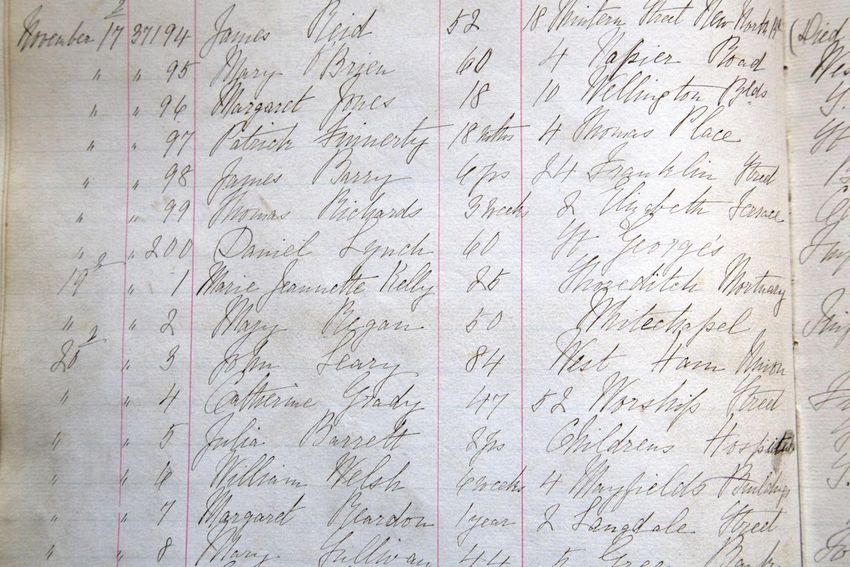
Mary Jane Kelly's grave. Credit: Carl Vivian University of unambiguous identification of the remains being
Leicester                                                  those of Mary Jane Kelly before such a project
                                                           could even be considered, the University of
                                                           Leicester team conducted a desk-based
                                                           assessment of the burial location of Mary Jane
Members of the University of Leicester team who            Kelly.
undertook genealogical and demographic research
in relation to the discovery of the mortal remains of The team visited St Patrick's Catholic Cemetery,
King Richard III have now been involved in a new Leytonstone, on 3 May 2016 in order to examine
project to identify the last known victim of Jack the the burial area. Research was carried out in the
Ripper - Mary Jane Kelly.                                  cemetery's burial records and a survey of marked
                                                           graves in the area around Kelly's modern grave
The researchers were commissioned by author                marker was undertaken.
Patricia Cornwell, renowned for her meticulous
research, to examine the feasibility of finding the        Their work was commissioned by Patricia Cornwell
exact burial location and the likely condition and         who is a crime writer, known for writing a best-
survival of her remains. This was done as a                selling series of novels featuring the heroine Dr Kay
precursor to possible DNA analysis in a case               Scarpetta, a medical examiner, and has also
surrounding her true identity following contact with written two books on Jack the Ripper.
Wynne Weston-Davies who believes that Mary
Jane Kelly was actually his great aunt, Elizabeth          Wynne Weston-Davies is a surgeon and author of
Weston Davies.                                             The Real Mary Kelly, an investigation into the life
                                                           and death of the Ripper's final victim. In his book
Now, in a new report, 'The Mary Jane Kelly                 published in 2015, Weston-Davies claimed that the
Project', the research team has revealed the               woman known to everyone as Mary Jane Kelly was
likelihood of locating and identifying the last known living under a pseudonym and was in fact his great
victim of Britain's most infamous serial killer known aunt Elizabeth Weston Davies.
as 'Jack the Ripper', who is thought to have killed
at least five young women in the Whitechapel area Patricia Cornwell contacted Dr Turi King at the

                                                                                                        1/3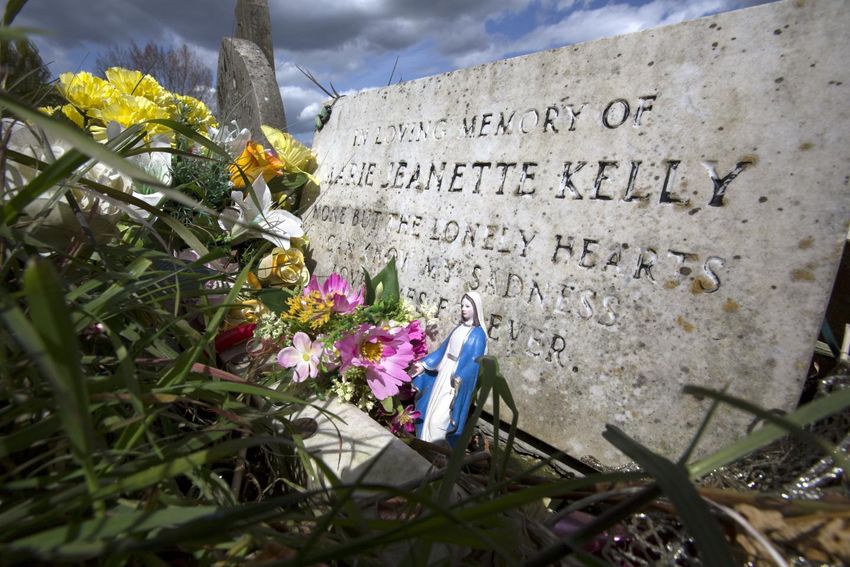
University of Leicester to assess the possibility of  Mathew Morris said: "There have been several
testing the DNA from the remains of Mary Jane         modern markers in the cemetery which have
Kelly and matching them against those of Weston-      commemorated Kelly since the 1980s and its
Davies.                                               location is likely to have little or no relevance to the
                                                      real location of the grave. Problems surrounding
Dr King said: "During initial discussions, two issues the location of the grave stem from the fact that this
arose - it was widely reported in the press in 2015 area of the cemetery was reclaimed in 1947, with
that the Ministry of Justice had indicated that it    earlier grave positions being swept away to make
would issue an exhumation licence to Wynne            way for new burials."
Weston-Davies - however in fact, they had only
acknowledged that they would consider such an         "Based on numerous calculations, we concluded
application if submitted.                             that in order to locate Mary Jane Kelly's remains,
                                                      one would most likely have to excavate an area
"Secondly, to complete any exhumation application encompassing potentially hundreds of graves
to the Ministry of Justice, a compelling case for the containing a varying, and therefore unknown,
exhumation as well as detailed information on the number of individuals."
location and state of the grave would be required,
not only for the exhumation of Kelly's remains, but Furthermore, current law relating to the exhumation
also to determine if any other remains might be       of human remains in England and Wales states that
disturbed in the process.                             consent from the next of kin for each set of remains
                                                      would be required - and in cases where there are a
                                                      large number of remains within a grave, it is
                                                      unlikely licences will be granted.

                                                       Professor Kevin Schürer, said: "In order to make an
                                                       application to the Ministry of Justice for a licence to
                                                       exhume Mary Jane Kelly's remains, the case for
                                                       Kelly being Elizabeth Weston Davies needs to be
                                                       compelling, not least because to test the theory by
                                                       exhuming the remains will almost certainly involve
                                                       disturbing the remains of other individuals buried in
                                                       the vicinity.

                                                       "Relatives of these individuals would need to give
                                                       consent and therefore traced and permission
                                                       sought. Given the number of individuals whose
                                                       remains would likely be disturbed, it would take
Burial records of Mary Jeannette Kelly from 1888 St.   months, possibly years, of genealogical research to
Patrick's Catholic Cemetary. Credit: Carl Vivian       trace them all."
University of Leicester
                                                       The team concluded that without a full review of the
"However, the precise location of her grave is         evidence cited by Weston-Davies, much of the
unknown and, not only that, it rapidly became clear    case for Mary Jane Kelly and Elizabeth Weston
that as such, the remains of a number of other         Davies being the same individual appears to be
individuals would have to be disturbed and that her    circumstantial or conjectural.
remains are highly likely to have been dug through
when the communal gravesite she was buried in          However, the report also found that DNA testing of
was reused in the 1940s making accurate                the remains of Mary Jane Kelly - should she be
identification of any of her remains highly            discovered - would allow for a comparison to be
problematic if not impossible."                        made between those remains and Weston-Davies

                                                                                                      2/3
in order to determine if the genetic data is consistent
                                    with them being related, and therefore likely to be
                                    Elizabeth Weston Davies.

                                   Dr King said: "As information presently stands, a
                                   successful search for Kelly's remains would require
                                   a herculean effort that would likely take years of
                                   research, would be prohibitively costly and would
                                   cause unwarranted disturbance to an unknown
                                   number of individuals buried in a cemetery that is
                                   still in daily use, with no guarantee of success.

                                   "As such it is extremely unlikely that any application
                                   for an exhumation licence would be granted. The
                                   simple fact is, successfully naming someone in the
                                   historical record only happens in the most
                                   exceptional of cases.

                                   "Most human remains found during excavations
                                   remain stubbornly, and forever, anonymous and
                                   this must also be the fate of Mary Jane Kelly."

                                     Provided by University of Leicester
                                   APA citation: New project to identify Jack the Ripper's last known victim (2017, March 10) retrieved 3
                                   June 2019 from https://phys.org/news/2017-03-jack-ripper-victim.html

                                   This document is subject to copyright. Apart from any fair dealing for the purpose of private study or research, no
                                   part may be reproduced without the written permission. The content is provided for information purposes only.

                                                                                                                                                3/3

Powered by TCPDF (www.tcpdf.org)
You can also read


