New Superintendents Meeting - Dr. Kari Monsees Financial and Administrative Services - Missouri Department of ...
←
→
Page content transcription
If your browser does not render page correctly, please read the page content below

Dr. Kari Monsees
                  Financial and Administrative Services

             New Superintendents Meeting

January 8,
   2021
Overview                      2

•   Missouri Leadership Development System
•   School Nutrition Programs
•   Finance & Governance Updates
•   Priority Standards
•   Discussion with Area Supervisors

3

MO Leadership Development System

MLDS Resources   4

Sample Video

5

School Nutrition Programs
SCHOOL NUTRITION PROGRAMS
                      Barbara Shaw, Coordinator

                        Food and Nutrition Services (FNS)

January, 2021   Department of Elementary and Secondary Education (DESE)
Current Programs
7
National School Lunch Program (NSLP)
After
School Snack Program
Seamless Summer Feeding Option (SSO)
School Breakfast Program (SBP)
Special Milk Program (SMP)
Fresh Fruit and Vegetable Program (FFVP)
Donated Foods ProgramSummer Feeding Seamless Summer Option (SSO) Summer Food Service
Programs Program (SFSP)
Who administers the Department of Education (DESE) Department of Health
Program? (DHSS)
USDA Child National School Lunch Program Child and Adult Care
Nutrition Program (NSLP) Feeding Program (CACFP)
Regulations
Site Eligibility: Area Eligibility- school must have at least 50% of students eligible
determined using for free or reduced price meals to operate an Open site.
October data Closed/Enrolled Site- out of the students “enrolled” 50% or more
must be eligible for free or reduced price meals.
Operation Traditional summer months, disaster, or break longer than 10 days
Price of meals All meals reimbursed at the free reimbursement rates.
Student Eligibility Eligibility documents not required all children have access to free
meals. SSO/SFSP participation does not determine the student as
8
“free” eligible.Administrative Reviews (ARs)
9
On-site compliance monitoring of schools
operating NSLP/SBP
Meal pattern compliance
School food service financial account maintenance
General areas such as smart snacks and
professional standards
5 year cycle started in SY 2019-2020
19-20, 20-21, 21-22, 22-23, 23-24AR Changes Due to Covid-19
10
Schools scheduled for an AR in SY 20-21 who are
participating in one of the summer food service
programs utilizing the nationwide waiver
flexibilities instead of operating NSLP will not
receive an AR as originally scheduled
The AR will be rescheduled in SY 2021-2022
Schools operating NSLP scheduled for an AR will
still receive a hybrid desk auditSSO Monitoring
11
Schools scheduled for an AR that operate SSO
the summer prior or summer after the AR will
receive an SSO compliance review
Forexample if the school is scheduled for an AR in
SY 2021-2022 and operates SSO the summer of SY
2020-2021 or the summer after will receive an SSO
review.Procurement
12
District Procurement Plan that meets Federal requirements
Procurement Review started in SY 2016-17
6 Year Cycle for non- Food Service Management Company
(FSMC) schools
Contract with an FSMC – 3 year cycle
Desk audit conducted by contracted company – Child
Nutrition Resource (CNR) with technical assistance offered
by Nutrition Procurement Specialist
Review schedule on FNS websiteClaims for Reimbursement
13
Submit claims through the DESE Web Applications
system for reimbursable meals and snacks
Due by the 15th of each month
Ex.
September claim due October 15th – payment
received around 25th of each month
60 day claim submission deadlines (USDA)
Ex.September claim – November 29, 2018
One-time exception allowed in 36 monthsFinancial Report
14
NSLP requires operation on a non-profit basis
Revenues and expenditures from ASBR
Available in September- review and submit
November 1 EXTENDED TO JANUARY 31
Review closing balance before submitting.
General funds must be used to cover any loss
(make an adjustment to balance if needed)15
CARES Act Funds Revenue Codes
Meal claims submitted for reimbursement for SSO, NSLP, SBP and
after school snack during March 2020-September 2020 are
reimbursed with CARES Act Funds. Do not use these for SFSP.
Use appropriate CARES Act codes for report food service
reimbursement for the payment months March-September.Excess Balance
16
If exceed a 3-month average operating cost
Contacted in January/February
Will be later this year due to the extensions to
submit the SNP financial report
Submit a plan and documentation to reduce the
excess balanceDetermining Student Eligibility
17
Direct Certification
Free meal
benefits based on SNAP, TANF
Mandatory download 3 times/year
Community Eligibility Provision (CEP)- 1 time yearly in
April
Updated and available every Monday
Direct Match, MOSIS, Zip Code
Extend eligibility to all students in the householdDetermining Student Eligibility
18
Free or Reduced Price Meal Applications
Distributed at the beginning of the school year
Household size and income, homeless, foster, SNAP
number
Adult signature and SSN must be provided
Homeless
District homeless liaisonCarry-over Eligibility
19
First 30 operating days of the new school year students may
continue to use (carry-over) eligibility determined during the
prior school year
Must change eligibility to “paid” status if an updated
determination has not been made
Pause in carryover: SY 20-21 schools operating SSO/SFSP
students benefits from SY 19-20 may carry-over for first 30
operating days of SY 21-22 when NSLP resumes.Verification
20
Process of verifying eligibility required by USDA
Select a sample size as of October 1 of students
subject to verification
Notify households and collect appropriate
documents
Must complete the process by November 15
Report due through the web application system by
December 15Verification Extension
21
Verification process has been extended to
February 28, 2021
Schools that collected free or reduced price meal
applications for SY 20-21 must complete
verification
Updated guidance in the Special Edition section
of the verification manual
Due date of the report will be announcedCEP – Eligibility Criteria
22
LEA wanting to elect CEP-must have an identified
student percentage (ISP) of at least 40% as of April 1st
of the school year prior
ISP: certified for free meals through direct certification
benefits (non-application)
Must keep source documentation (upload into Tiered
Monitoring)
LEA in the 4th yr of CEP showing less than 40% ISP can
apply for a grace year if eligibility is at least 30%Paid Lunch Prices
23
LEAs that had a negative balance in food service fund as of
December 31, 2019 were required to establish prices
according to the paid lunch equity tool
LEAs with a positive balance are exempt from pricing
requirements
Never required to raise more than 10 cents
Exemption may be requested if exceed a 3 month operating
cost
Required to maintain a local meal charge policy and provide
written policy to households annuallyPricing Adult Meals
24
Adults/teachers must pay for meals through all
Programs including summer food service programs
Transfer of funds to food service fund to make up the
difference if not priced sufficiently
Price calculation example:
Highest paid student lunch $2.60
Value of commodities + .3425
Paid lunch reimbursement + .39
(severe need with 6 cents)
Required adult lunch price = $3.3325 (round to $3.35)Severe Need Reimbursement
25
Qualify for severe need funding if school serves
at least 40% of lunches free or at a reduced price
in the second preceding school year
Determining severe need funding for SY 21-22:
due to inadequate student eligibility schools
may demonstrate to the State Agency that they
qualify for severe need reimbursement using
data from SY 19-20, 20-21 or 21-22Food Service Management Company
As you start your bid process-
Read through the “Contracting with Food Service Management Companies:
Guidance for Local Education Agencies.
LEAs must not use information prepared by FSMCs in the RFP. Doing so
prohibits the FSMC that prepared that information from the contract award [2
CRF 200.319(a)]
Send completed RFP and all documents to our office for approval
RFP will be approved with an approval letter
Next, advertise for up to 60 days.
Affidavit of Publication
Nationwide waiver allows FSMC contracts that may expire by or around June 30, 2021 to be
extended through school year 2021-2022 (June 30, 2022).Current Nationwide Waivers
27
Extended Summer Food Service Programs through
June 2021
Area Eligibility
Back to School Waivers
Offer
vs Serve, Meal Times, Non-congregate,
Parent/Guardian Meal Pick-up, Meal Pattern
Food Service Management Contract DurationThank You!
Since March schools have
served over 62 million meals!
2829
USDA Donated Food Distribution Program
30
Assists in offering schools discounted food options that
meet the nutritional needs for school children throughout
the nation.
Aids American farmers by purchasing only domestic food
Distributes food through various eligible food outlets to
support industry.
On average, most schools can supplement their lunch
program by nearly 30%.Important Dates
31
July - Letter of Value of Entitlement, USDA Food published
August - April - USDA Food Deliveries completed
January – USDA Foods Packet released for subsequent SY
SY 21-22, will release between January 15-22nd, 2021
February - USDA Foods Packet due
SY21-22, DUE February 19, 2021Program Entitlement
32
Previous school years’ total number of lunches served
SY20-21 Waiver, USDA Foods Entitlement Calculations
USDA issues rate of assistance
2020 = $0.3700/lunch
2019 = $0.3625/lunch
Example:
Lunches Served X Rate of Assistance = Entitlement $
100,000 X $0.3700 = $37,00033 Contact Food and Nutrition Services
Email: foodandnutritionservices@dese.mo.gov
Phone: 573-751-3526
Web address: http://dese.mo.gov/financial-admin-services/food-
nutrition-services
The Department of Elementary and Secondary Education does not discriminate on the basis of race, color, religion, gender, national origin, age, or disability in its programs and activities. Inquiries related to Department programs and to the
location of services, activities, and facilities that are accessible by persons with disabilities may be directed to the Jefferson State Office Building, Office of the General Counsel, Coordinator – Civil Rights Compliance (Title VI/Title
IX/504/ADA/Age Act), 6th Floor, 205 Jefferson Street, P.O. Box 480, Jefferson City, MO 65102-0480; telephone number 573-526-4757 or TTY 800-735-2966; email civilrights@dese.mo.gov.34 Finance & Governance Update
Budget Restrictions 35 • Announced June 30 for FY 2021 Foundation Formula: $123.3 M Parents as Teachers: $1.0 M Several new/recently added budget items restricted Total restriction for PK-12 of $133.2 M • Formula restriction applied entirely to July payment
State Revenue Update                               36

• FY 2021 collections as of December 31st:
      Individual Income Taxes     +23.2%
      Sales Taxes                  + 3.6%
      Corporate Income Taxes      +36.0%
      All Other                   +15.8%
      Refunds (deduct)            + 6.4%
      Net General Revenue        +20.06% (approx. +$908 M)
FY 2021 Basic Formula 37 Month Proration Percentage July 2020 54.83% August 2020 77.46% September 2020 83.06% October 2020 87.74% November 2020 90.07% December 2020 91.73% June 2021 TBD
SAT, DVM and Threshold                                          38

                      Percentages
State Adequacy Target (SAT) = $6,375

Dollar Value Modifier (DVM) for can be viewed at:
        http://dese.mo.gov/financial-admin-services/school-finance/data-reports

Threshold Percentages:
                                    FY 2019 & FY 2020   FY 2021 & FY 2022
Free & Reduced-Price Lunch               31.42%              29.45%
Special Education (IEP)                  12.06%              12.83%
Limited English Proficiency (LEP)         2.50%               2.07%

Formula calculation tool can be found at:
https://dese.mo.gov/financial-admin-services/school-finance/calculation-tools
Classroom Trust Fund 39
• Classroom Trust Fund (CTF) is one funding source of Basic Formula
• Be careful not to double budget
Other Total Basic
Classroom
State Formula
Trust Fund
Monies (Line 17)
(5319)
(5311) ProratedFY 2021 Classroom Trust Fund 40
$353,359,579
811,924 ADA $435 Per ADA
Appropriated
December payment projected $393 per ADA
October was an unusually high month for receipts due to a one-time deposit
FY20 finished at $327 per ADAFY 2021 Prop C 41
$958,400,000 914,349 $1,048 per
Appropriation 2020 WADA WADA
For every $10 million short of the appropriation, the amount per ADA adjusts by -$11 per
WADA.Prop C History – December Payment 42
Year WADA Amount Per WADA
2020 914,349 $528.67
2019 913,159 $496.73
2018 909,163 $494.27
2017 912,325 $477.52
2016 903,614 $495.32Section 160.530, RSMo PDC Expenditures 43 • This legislation modified the 1% professional development expenditure requirements if Transportation Aid falls below 25% of allowable costs. The local school board can vote to place less than 1% of the district’s formula monies into the professional development committee budget but cannot place less than one half of one percent of the formula monies into their budget. This modification started in FY19 and goes through FY24. • In no instance shall the district allocate less than one-half of one percent of the monies received pursuant to Section 163.031, exclusive of categorical add-ons, to the professional development committee of the district. • At minimum a district must spend no less than seventy-five percent of the one- half of one percent of the district’s formula monies in the fiscal year. The remaining amount must be restricted and carried forward for future professional development committee approved expenditures.
Calendar Requirements 171.031, RSMo.       44

Note: August 23         Minimum
                        requirement of
is the earliest start   1,044 hours
date in 2021.
                        Plan minimum of 36
                        weather make-up
                        hours

                        No longer
                        a minimum and
                        maximum day length

                        No longer requires a
                        minimum number of
                        days
Weather Make-Up Requirements 45 • Per 171.033.4, RSMo, “In school year 2019-20 and subsequent years, a school district may be exempt from the requirement to make up school lost or cancelled due to inclement weather in the school district when the school district has made up the thirty-six hours required under subsection 2 of this section and half the number of additional lost or cancelled hours up to forty-eight, resulting in no more than sixty total make-up hours required by this section.” • 1,044 hours in session required unless forgiven by weather make- up provision (522 for half day PK/K)
Weather Make-Up Requirements 46 • Inclement weather shall be defined as: Ice Snow Extreme cold Flooding Tornado Excessive Heat
AMI Flexibility 47
• Alternative Methods of Instruction § 171.033, RSMo.
Inclement weather, utility outage, contagious
disease
LEAs must have an approved plan
Important to communicate with stakeholders
Limited to 36 hours per year
Counts as hours attended – does not relieve the
requirement to schedule 36 make-up hoursAMI-X Update 48
• SBOE published rule 5 CSR 30-660.085 on July 7,
2020 and amended on October 6, 2020
Provides basis for payment under blended
learning
Requires an approved Alternative Methods of
Instruction – Extended (AMI-X) plan
Allows LEAs to submit alternate proposalsFAQ Updates 49 Q27: Will attendance be reported as virtual if an LEA starts the school year using the Distanced Instruction model for all students with plans to return onsite as conditions allow, but then completes an entire semester distanced? A: (Updated 12-22-20) For LEAs that complete an entire semester with Distanced Instruction, attendance will be reported in one of two ways. If the LEA coursework meets the requirements for virtual instruction under 162.1250, RSMo, attendance may be calculated for the semester consistent with that statute (e.g. 47% or 94%). LEAs that elect this approach do not need to update the instruction method field in the October MOSIS file. LEAs should consult with their student information system vendor to determine if student course assignments will need to be modified in order for attendance to be counted as virtual. If the LEA coursework does not meet the statutory requirements for virtual instruction, attendance for the entire year will be based on the onsite attendance rate for the portion of the second semester the student attends in person. The approach used to claim attendance for the first semester must be consistent for all students in the distanced/virtual mode of instruction within a grade span and will be monitored accordingly.
FAQ Updates                                                50

Q28: How will attendance be calculated if an LEA completes an entire year
with Distanced Instruction?
A: If an LEA continues with distanced instruction from the start of the
school year into the second semester, it is assumed to be Intermittent
Blended, with the onsite attendance rates to be applied to the entire year
(exception noted in Q27 above). DESE will continue to monitor the length
of distanced learning plans and provide additional guidance as needed.

Q29: What happens if a student in Distanced Instruction transfers out of an
LEA without any onsite attendance?
A: Neither the existing statute nor the attendance rule allow for claiming
attendance in such situations unless the student achieves course
completion through a qualified virtual course.
FAQ Updates                                     51

Q30: If a Local Public Health Agency (LPHA) discontinues contact
tracing efforts, can the LEA make the determination on quarantine
status for attendance claiming purposes?
A: If the LPHA has discontinued standard contact tracing efforts
and is not providing LEAs notification of quarantine status for
students, the LEA may make reasonable administrative
determinations for student quarantines of up to 14 days. School
officials should rely on other supporting information, to the
extent available, in order to make such a determination.
Supporting documentation should be maintained for use, as
needed, for audit purposes at year-end if the student is to be
claimed for attendance under an AMI-X plan.
School Audit Deadline                                 52

• The audit submission deadline has been extended to January
  31 due to the pandemic.
• Failure to submit the audit by January 31 could result in state
  aid payments being held until the audit is received.
• The audit must be submitted to DESE as a .pdf file.
• Signed board minutes approving the audit must be
  submitted as a .pdf file in the Tiered Monitoring System.
• Before submitting the audit documents, review the
  guidelines in the November 2020 Finance Memo to ensure
  the audit is complete.
Early 2021 June Enrollment and Attendance Trial 53 • Assist DESE, school districts and charter schools in determining: The effects of the COVID-19 pandemic on enrollment and student mobility Identify first semester graduates • This data collection will focus on accuracy of the following data for first semester: Entry Date/Entry Codes Exit Date/Exit Codes • LEAs do not need to cleanup MOSIS edits, or certify this early trial • Upload early trial before January 29, 2021
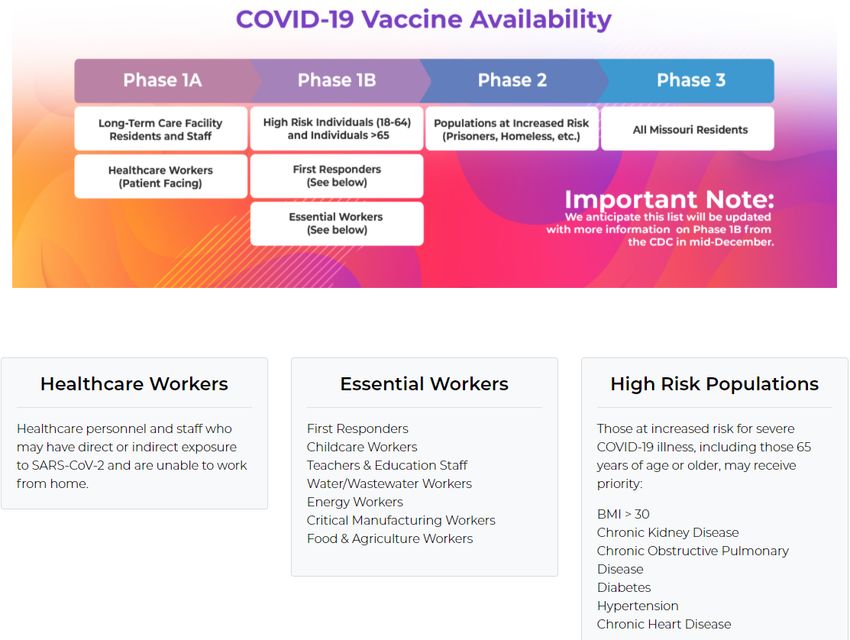
COVID-19 Vaccine Update 54
• Availability phases & tiers determined at the state level
Local jurisdictions cannot change
• Healthcare professionals in Phase 1A began receiving
vaccinations the week of December 14, 2020
School nurses among Phase 1A
o DHSS communicating with school nurses soon
• School staff = part of the Phase 1B essential workforce
• Timeline & logistics are TBD (when, where, how, etc.)COVID-19 Vaccine Update 55 Details at MOStopsCOVID.com
New Federal Relief Package 56
• ESSER II
$871 million
No equitable share requirement
15 allowable uses
• GEER II
$24 million public (est.)
$67.5 million non-public (est.)
• CRF extension
Email questions live to Communications@dese.mo.govSchool Finance 573-751-0357
Name Title
David Tramel, Coordinator, Financial and Administrative Services
David.Tramel@dese.mo.gov
Tammy Lehmen, Coordinator, School Finance
Tammy.Lehmen@dese.mo.gov Contact for districts in counties 048 & Kansas City Charters,
055-079 & 347-347
Debra Clink, Student Transportation Manager
Debra.Clink@dese.mo.gov Contact for districts in counties 080-115 & St Louis Charters
Kara Shumate School Finance Consultant
Kara.Shumate@dese.mo.gov Contact for districts in counties 001-047 & 049-05458 Priority Standards
Priority Standards 59 What are they? Content in the Missouri Learning Standards o Leverage o Endurance o Essentiality Rigorous and comprehensive
Priority Standards 60
Will play an important role in
Supporting local curriculum and instruction;
Implementing the Missouri Learning Standards;
and
Informing the Missouri Assessment Program.Priority Standards 61
In the fall,
Drafts were presented to Missouri education
stakeholders in virtual meetings;
Feedback was collected through stakeholder
discussions and surveys; and
Plans were made to revise the drafts.Priority Standards 62
Currently,
Revisions are underway in consultation with
external content experts; and
Work is in progress to locate or develop
supporting resources.Priority Standards 63
Next steps include
Presenting revised drafts to Missouri education
stakeholders for additional refinements;
Capturing a final round of stakeholder
feedback on revised, refined drafts;
Reviewing and incorporating feedback; and
Releasing Missouri priority standards.Questions? Contact us! 64
Assessment shaun.bates@dese.mo.gov
English Language Arts debbie.jameson@dese.mo.gov
English Learners cammy.goucher@dese.mo.gov
Mathematics chip.sharp@dese.mo.gov
Science kristen.mckinney@dese.mo.gov
Social Studies dixie.grupe@dese.mo.gov65
Thank you for your attention.
Lisa Sireno, Standards and Assessment Administrator
Lisa.Sireno@dese.mo.gov
573-751-3545Future Meetings 66 • Monday, Feb. 8 (10:00 am to 12:00 noon) • Thursday, Mar. 4 (1:00 pm to 3:00 pm)
67

               Break-Out Groups
Please login to your small group meeting invite to discuss
    any of today’s topics (or others) in greater detail.

Area Supervisors will request follow-up on any open items.

          Next meeting: Monday, February 8th
                10:00 am to 12:00 noon
You can also read


