NIPT Induction Workshop
       Programme
       2019-2020
  Information Booklet
           for
Newly Qualified Teachers
←
→
Page content transcription
If your browser does not render page correctly, please read the page content below
NIPT Induction Workshop
Programme
2019-2020
Information Booklet
for
Newly Qualified Teachers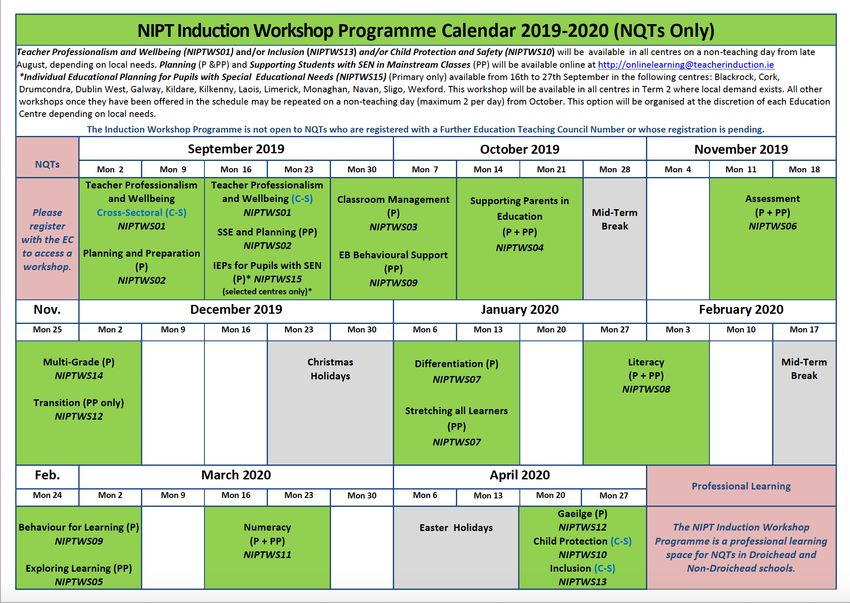
Contents
1. Welcome Letter.......................................................................................................................3

2. About NIPT………………………………………………………………………………………………………………………….4

3. Induction Workshop Programme Overview 2019-2020….………………….……………………………….5

4. The NIPT NQT Induction Workshop Programme in Association with ATECI ...........................6

5. NQT Workshops (Primary).......................................................................................................7

6. NQT Workshops (Post-Primary) ..............................................................................................8

7. Guidelines for NQTs attending the NIPT Induction Workshop Programme.......................9-13

      7.1 Induction Workshop Programme Requirement ........................................................9-10

      7.2 Registering for the Induction Workshop Programme ..................................................11

      7.3 Induction Workshop Programme Structure .................................................................11

      7.4 Workshop Engagement.................................................................................................12

      7.5 Agreed Protocols………………………………………………………………………………………………………12

      7.6 Other Supports .............................................................................................................13

8. Useful Contacts......................................................................................................................13

9. Protocols for NQT Concerns ..................................................................................................14

10. Droichead Quick Reference for NQTs....…………………………………………………………….………………15

11. NQT Induction Workshop Attendance Record .....................................................................16

12. NIPT Induction Workshop Calendar 2019-2020…………………………………………………………………17

                                                                         2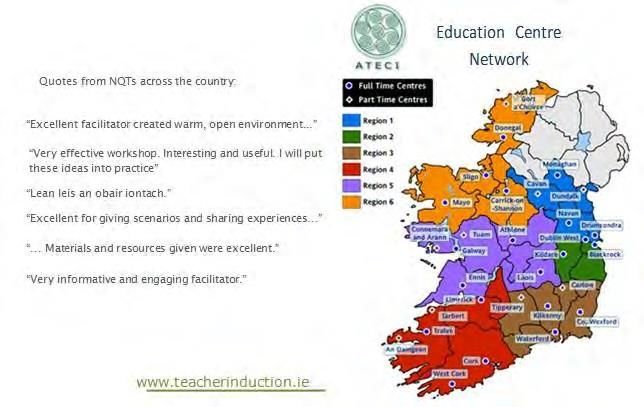
1. Welcome Letter

                                                                                         September 2019

Dear NQT,

Fáilte go dtí an Clár Náisiúnta Ionduchtaithe do Mhúinteoirí 2019-2020.

Having completed your initial teaching qualification you are now entering the next phase on the continuum
of teacher education. We wish to assure you that the National Induction Programme for Teachers (NIPT) will be
here to support you throughout the year ahead.

The Induction Workshop Programme is a flexible learning programme, funded by the Department of Education and
Skills, and designed to meet the particular professional learning needs of newly qualified teachers (NQTs). The
programme, coordinated by the National Induction Programme for Teachers, builds on the learning that took place
during initial teacher education. It can be tailored by an NQT to his or her particular circumstances. Subject to an
overall minimum of 20 hours of professional learning, NQTs may combine school-based professional learning
activities with off-site workshops.

Professional development (PD) will be central to your success and effectiveness as a teacher as you make your way
along the continuum of teacher education. The NIPT Induction Programme is the starting point for that process of
professional development, and we hope that you enjoy and benefit from participation in the programme. We
welcome feedback from you throughout the year, thus enabling the NIPT to innovate and develop the Induction
Workshop Programme.

We, at the National Induction Programme for Teachers, look forward to supporting you as you embark on the
induction phase of your career and we take this opportunity to wish you every success in the future. Go n-éirí
leat ar an mbealach!

Le gach dea-ghuí,

Mary O’Callaghan

NIPT National Coordinator

                                                            3
2. About NIPT
The National Induction Programme for Teachers (NIPT) supports the induction of newly qualified teachers (NQTs),
both primary and post-primary, into the teaching profession in Ireland.
NIPT Purpose: To support the professional growth of teachers during the induction phase
NIPT Vision: Quality induction for every teacher
NIPT Motto: To ask for support is a sign of strength
The main objective of induction is towards promoting the professional development of NQTs by way of systematic
support in their first year of teaching, thus laying the foundations for subsequent professional growth and
development. Wong, (2004) describes induction as:
"…a comprehensive, coherent, and sustained professional development process aimed to train, support and retain
new teachers and represents the first part of a lifelong professional development programme".
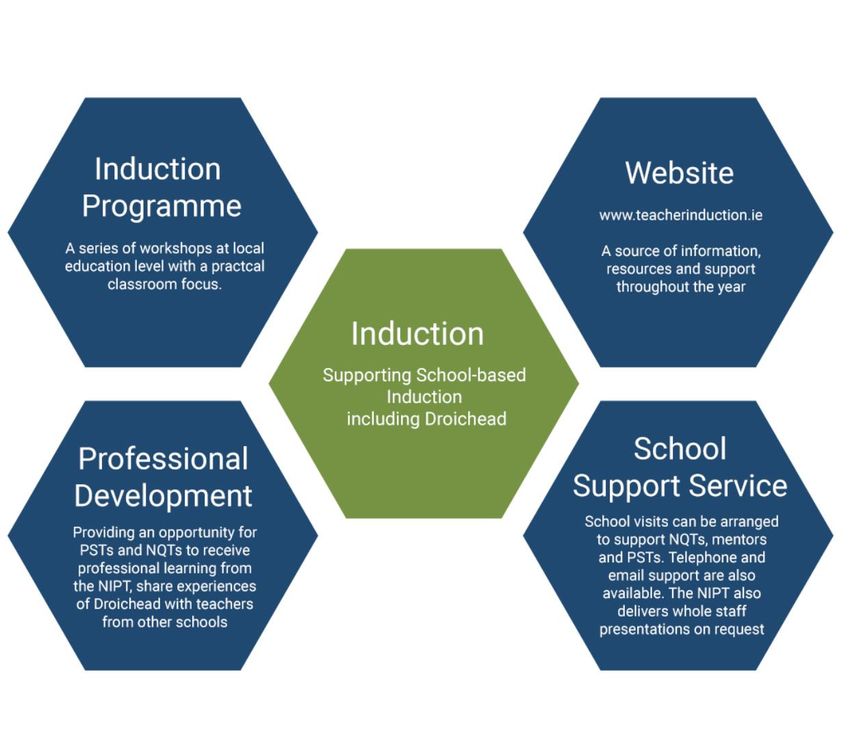
NIPT provides 5 pillars of support:
To find out more about NIPT, please visit www.teacherinduction.ie where you can access further
information, support and resources.
43. Induction Workshop Programme Overview 2019-2020
What is the The NIPT Induction Workshop Programme is a series of two-hour workshops, designed to
Induction support the professional development of Newly Qualified Teachers (NQTs).
Workshop The programme, run in collaboration with ATECI (Association of Education Centres of Ireland),
Programme? Department of Education and Skills (DES) and the Teaching Council, is facilitated by practising
teachers from local schools, in each of the 21 full-time education centres
The topics for the workshops are informed by feedback from NQTs, facilitators, schools,
national and international research and system needs.
It is a registration requirement with the Teaching Council for NQTs in non-Droichead schools
to complete 20 hours of Professional Development (PD).
What is the To afford NQTs with an opportunity to engage in professional dialogue with other NQTs on
function of a topics pertinent to every day classroom practice.
workshop? To build on learning from Initial Teacher Education (ITE).
To further develop professional knowledge, skills and attitudes.
To foster professional relationships with other NQTs from both primary and post- primary
sectors.
To share learning experiences and encourage reflective practice.
What is the Each workshop is two hours in duration, with approximately 20-25 participants.
structure of a Connections are actively made to prior learning by reflecting on key messages from ITE.
workshop? A series of activities guide the discussion and afford NQTs an opportunity to reflect on theory
in practice.
A variety of methodologies are used to promote discussion.
NQTs are encouraged to share knowledge and expertise.
An NQT booklet complements content in each workshop.
References are made to current and relevant DES documentation e.g. School Self-
Evaluation, Looking at our School, Well-Being in Schools, Child Protection.
What are the Connecting with a wide variety of initial teacher education providers.
challenges? Meeting the professional and pedagogical needs of NQTs who find themselves teaching in a
wide variety of contexts.
Accommodating the needs of NQTs who are not teaching.
Ensuring a standardised and consistent workshop programme experience for all NQTs.
Providing for flexibility within the organisation of the workshop programme, to
accommodate the varied needs of NQTs, while also recognising the logistical
arrangements at local education centre level.
How have we . Acknowledging 6 hours of school-based professional development for NQTs in non-Droichead
responded to the schools with an NIPT Mentor.
challenges? Providing two cross-sectoral workshops on a non-teaching day
Providing two online workshops: Planning at Primary and Post-Primary level and Supporting
Students with SEN at Post-Primary level.
What happens An NQT does not need to notify any organisation of completion of his/her Induction
when the Workshop Programme requirement. At the end of each month, data received from all
Induction education centres relating to your Induction Programme requirement will be collated and
Workshop transferred to the Teaching Council. The Teaching Council will then remove the Induction
Programme is Programme requirement from the registration of those NQTs who have completed the 20
completed? hour professional development requirement.
Continued support and professional development is offered through the local education centre
and other support services.
54. The NIPT NQT Induction Workshop Programme in Association with ATECI
The NIPT, in collaboration with the Education Centre Network (ATECI), facilitates an Induction Workshop Programme for
newly qualified primary and post-primary teachers (NQTs). The Induction Workshop Programme consists of a series of 13
primary and 12 face-to-face post-primary workshops, facilitated by practising teachers who have received training from NIPT.
It is a Teaching Council registration requirement for NQTs in non-Droichead schools who have completed their initial
teacher education since July 2012 to participate in the Induction Workshop Programme. In recent years, more flexibility and
choice have been built into the Workshop Programme.
The induction workshops are interactive and based on practical learning experiences. Opportunities are afforded to NQTs
to build on the learning experiences at Initial Teacher Education (ITE) level and to engage in professional dialogue with other
NQTs, based on current learning experiences and needs. Three of the induction workshops are delivered on a cross-
sectoral basis to both primary and post-primary NQTs and the remaining workshops are delivered on a sector-specific
basis. Feedback from NQTs and NIPT facilitators indicates that NQTs benefit from sharing ideas and experiences with NQTs
from both sectors.
The series of workshops is offered through each of the 21 full-time education centres throughout the country. NQTs can
register for the NIPT Induction Workshop Programme, whether in employment or not, with their local full-time education
centre.
Please visit www.ateci.ie for details of all education centres and register with your local education centre to attend NIPT
Induction Workshops.
NQTs who are teaching outside of Ireland and who have queries regarding the Induction Workshop Programme
should contact the Teaching Council at info@teachingcouncil.ie.
65. NQT Workshops (Primary)
Teacher Professionalism and Well-Being (Cross-Sectoral) Planning and Preparation: What is required? NIPTWS02:
NIPTWS01: This workshop is designed to provide NQTs with an This workshop is designed to support NQTs to plan in a
opportunity to explore and reflect on some of the professional focused, effective and efficient manner. Requirements
issues that may arise for NQTs as they begin their teaching regarding planning, preparation and recording of progress are
career. Key aspects include the Teaching Council Code of discussed and clarified. This workshop uses the guidelines for
Professional Conduct for Teachers, working with other adults in long-term planning and short- term planning and provides
a professional setting, caring for the voice, getting started with examples of planning templates which can be used to support
planning and maintaining a work/life balance. NQTs’ work over the year. Opportunities to discuss strategies
and share ideas will be a central element of this workshop.
Classroom Management & Organisation: What do I need to Supporting Parents in Education NIPTWS04: This workshop
focus on? NIPTWS03 This workshop provides NQTs with an focuses on the importance of developing positive working
opportunity to reflect on the concept of an effective teaching and relationships with parents. NQTs are encouraged to work
learning environment. The following topics are explored in this closely with parents to achieve optimum learning outcomes for
context: positive relationships, the social and learning their pupils/students. Effective communication skills and
environment, effective classroom organisation, a systematic strategies for building positive relationships are explored
approach to responding to behaviour, and teacher attitudes and through discussion and role‐play. Parent-teacher meetings,
behaviours. Opportunities to discuss strategies and share ideas both formal and informal, are a key focus of this workshop.
will be a central element of this workshop.
Assessment: Analysing Classroom Evidence NIPTWS06: The Literacy: Teaching and Managing a Reading Lesson
aim of this workshop is to build on prior knowledge in relation to NIPTWS08: This workshop will focus on the planning,
assessment methodologies. Resources from www.ncca.ie organisation and teaching of a reading lesson, using a range of
including Assessment in the Primary School Curriculum: texts. A key component of the workshop will be exploring the
Guidelines for Schools, The Aistear Toolkit and ACTION website use of a variety of reading procedures, skills and
are key references for the workshop. comprehension strategies.
Differentiation - Responding to the Needs of all Learners Behaviour for Learning NIPTWS09: This workshop builds on
NIPTWS07: This workshop provides NQTs with an opportunity to the Classroom Management workshop by focusing on teaching
consider and discuss how to respond to the diverse needs of all behaviour(s) essential for learning. The Behavioural, Emotional
learners in the classroom. Key elements of the workshop include and Social Difficulties: A Continuum of Support -Guidelines for
a discussion on the concept of differentiation, the role of the Teachers (NEPS: 2010) is a key reference for this workshop
teacher and the practical implementation of a number of which aims to give NQTs an understanding of the Classroom
differentiation strategies. Scenario-based discussion and teacher Support Process and the development and use of Individual
reflection are an integral part of this workshop. Behaviour Support Plans. Relevant case studies and resources
will be examined and participants’ own concerns will also be
explored.
Numeracy: Developing Good Practice in Mathematics Individual Education Planning for Pupils with Special
Teaching‐ How? NIPTWS11: The focus of this workshop is the Educational Needs (Primary) NIPTWS15: This workshop will
practical implementation of the principles of good mathematics support NQTs to plan for pupils with special educational needs.
teaching in everyday classroom practice. Emphasis is placed on It complements the workshop Planning and Preparation: What
the development of number sense, mathematical language, is required? A practical activity-based approach is used to
problem-solving skills, and mental and oral maths activities in explore the Individualised Education Planning (IEP) rationale,
the classroom. ** LITERACY AND NUMERACY FOR LEARNING IEP/school support plan content and process, the IEP/school
AND LIFE: The National Strategy to Improve Literacy and support plan writing and reviewing. The workshop also
Numeracy among Children and Young People 2011‐2020 (DES: explores the on-line and face-to-face supports available to you
2011) is a key reference document for this workshop. from SESS.
Multi-Grade Teaching in the Primary School NIPTWS14: Múineadh na Gaeilge NIPTWS12: Is é príomhchuspóir na
This interactive workshop focuses on four main areas from a ceardlainne seo ná deiseanna a thabhairt do na rannpháirtithe
multi-grade perspective: differentiation, teaching methodologies, a bheith ag obair i ngrúpaí. Cuirfear béim ar úsáid na teanga
classroom management and planning. Opportunities are afforded agus ar struchtúr an cheachta Ghaeilge, an cur chuige
NQTs to engage with a variety of methodologies throughout the cumarsáide, acmhainní, measúnú agus araile. Beidh deis ag na
workshop. Strategies and resources for NQTs subbing in multi- rannpháirtithe freisin plé le cásanna difriúla ó thaobh
grade settings are explored. mhúineadh na Gaeilge.
Inclusion (Cross‐Sectoral) NIPTWS13: This interactive Child Protection and Safety (Cross‐Sectoral) NIPTWS10:
workshop will focus on the classroom environment and This workshop is informed by Circular 0081/17 (DES), the
classroom planning to support inclusion. NQTs will be given an Child Protection Procedures for Primary and Post-Primary
opportunity to reflect on their own individual values, behaviours Schools (DES: 2017) and the Children First document-National
and attitudes which will determine inclusive practice in their Guidance for the Protection and Welfare of Children 2017). Key
classrooms. Emphasis will be placed on how to develop responsibilities for teachers with regard to child protection and
strategies to ensure that pupils/students with special safety are outlined, including reasonable grounds for concern,
educational needs are included mandated persons, threshold of harm, dealing with disclosures,
route of referral and procedures for reporting and recording.
76. NQT Workshops (Post-Primary)
Teacher Professionalism and Well-Being (Cross-Sectoral) NIPTWS01: School Self-Evaluation and Planning NIPTWS02: This workshop is
This workshop is designed to provide NQTs with an opportunity to designed to assist NQTs to plan in a focused, effective and efficient
explore and reflect on some of the professional issues that may arise manner. School Self-Evaluation and Junior Cycle are referenced and
for NQTs as they begin their teaching career. Key aspects include the discussed as well as the implications for the planning process are
Teaching Council Code of Professional Conduct for Teachers, working explored. Requirements regarding planning, preparation and
with other adults in a professional setting, caring for the voice, getting recording of progress are presented. This workshop provides
started with planning and maintaining a work/life balance. examples of planning templates that can be used to support NQTs’
work over the year. Opportunities to discuss and share strategies and
ideas will be a central element of this workshop.
Evidence Based Behavioural Support NIPTWS09: This workshop builds Numeracy for All NIPTWS11: This workshop will focus on how to
on the learning at ITE in exploring the additional needs that can be connect and develop the numeracy dimension across the curriculum
experienced by some students in the area of behaviour management. and to support school-wide numeracy development. Looking at how
It will aim to give NQTs an understanding of a range of behaviour teachers can support students in the development of the essential life
management strategies suitable for managing individual and group skill and also to support their own subject. Opportunities to discuss
behaviour. Support materials and resources from DES support services and share strategies and ideas will be a central element of this
are explored, such as NCSE. There are additional online extension workshop with a view to exploring the numeracy dimension of
materials if the NQT would like to investigate elements of classroom different subjects.
management.
Exploring Learning NIPTWS05: This workshop at its essence will Assessment and Feedback to all Learners NIPTWS06: This workshop
explore what it is to be a learner. It will reconnect with the NQTs aims to equip NQTs with a range of assessment methodologies which
understanding of themselves as a learner as developed at ITE and can be effectively applied across the curriculum. NCCA materials are
emphasise the impact that the teacher has on students learning. A central to the workshop and an NIPT A-Z of Assessment across
virtual class will be used by NQTs to help them to investigate the different subjects will be explored in order to look at how different
different learning styles students have and adapt their methodologies assessment methodologies apply across different subjects.
to meet these needs. Particular emphasis will be placed on the Participants share examples of work to date and examine ways of
learning profile of students with SEN. building and developing assessment to assist with effective planning,
teaching and learning in the classroom.
Content Based Literacy NIPTWS08: In this workshop the focus for Stretching all Learners NIPTWS07: This workshop emphasises the
NQTs will be on the skill sand strategies that can be used in different need to cater for the variety of Learners within the classroom and
classrooms. Using the format of Before, During and After Learning, the provides subject specific samples and ideas for resources to ensure
NQTs will examine different activities to support literacy development that all learners are stretched in their learning within the classroom.
in all subjects. Materials from PDST and NCSE are all referenced in the NQTs are afforded an opportunity to discuss a variety of scenarios that
workshop. arise in the classroom and are encouraged to reflect on and discuss
effective strategies. Challenging learners across the full spectrum, e.g.
providing extension activities are included.
Child Protection and Safety (Cross‐Sectoral) NIPTWS10: This Supporting Parents in Education NIPTWS04: This workshop focuses
workshop is informed by Circular 0081/17 (DES), the Child Protection on the importance of developing positive working relationships with
Procedures for Primary and Post-Primary Schools (DES: 2017) and the parents. NQTs are encouraged to work closely with parents to achieve
Children First document-National Guidance for the Protection and optimum learning outcomes for their pupils/students. Effective
Welfare of Children 2017. Key responsibilities for teachers with regard communication skills and strategies for building positive relationships
to child protection and safety are outlined, including reasonable are explored through discussion and role‐play. Parent-teacher
grounds for concern, mandated persons, threshold of harm, dealing meetings, both formal and informal, are a key focus of this workshop.
with disclosures, route of referral, and procedures for reporting and
recording.
Transition From Primary to Post-Primary School NIPTWS12: Inclusion (Cross‐Sectoral) NIPTWS13: This interactive workshop will
This workshop will focus on the practical skills and strategies that can focus on the classroom environment and classroom planning to
be of support to students as they move from a primary classroom to a support inclusion. NQTs will be given an opportunity to reflect on their
post-primary classroom. A primary and post-primary facilitator will be own individual values, behaviours and attitudes which will determine
present and will give valuable insights into the many transitions that inclusive practice in their classrooms. Emphasis will be placed on how
occur in the context of supporting and making the best connections to develop strategies to ensure that pupils/students with special
with curricula, teaching learning and social and emotional needs. educational needs are included.
Online Workshop only: Supporting Students with SEN in Mainstream Classes: This online workshop, is a collaboration between the National
Induction Programme for Teachers and the Special Education Support Service. Our aim is to promote a greater understanding among newly
qualified mainstream teachers in relation to students with special educational needs and the role mainstream teachers have in promoting the
inclusive school.
87. Guidelines for NQTs attending the NIPT Induction Workshop Programme:
Please note that from September 2019, Droichead is the sole route of induction for:
o Primary NQTs who have a minimum block of 60 days and are teaching in SEN settings, or in schools with
an Administrative Principal, or in schools outside of these categories already offering the Droichead
process.
o Post-primary NQTs who have a minimum of 200 hours in SEN settings, or in schools with 200+ students,
or in schools outside of these categories already offering the Droichead process.
For further information on Droichead visit www.teachingcouncil.ie and refer to the Droichead Quick Reference
Guide on page 15 of this document.
7.1 Induction Workshop Programme Requirement
NQTs not engaging in Droichead as set out above are required by the Teaching Council to complete a 20-hour
Professional Development (PD) Induction Workshop Programme. This may be a combination of workshops and/or
school-based induction. (Please note, while you are welcome to repeat a workshop to meet a professional
development need, you can only be credited for attendance at different workshops).
NQTs have three years to complete the Induction Workshop Programme from date of registration with the
Teaching Council. An NQT can register for the Induction Workshop Programme at an education centre, whether in
employment or not. Please visit www.ateci.ie for details of the 21 full-time education centres.
At the end of each month, NIPT Workshop Administration collates and transfers information (school-based hours
and workshop attendance) received from all education centres to the Teaching Council. The Teaching Council will
then remove the Induction Programme requirement from the registration of those NQTs who have completed the
20 hour professional development requirement.
The 20-hour Induction Programme requirement can be made up of any combination of the following:
Evening workshops across the year at local EC level: a series of 2-hour evening workshops will be available and
NQTs can complete 20 hours professional development by attending 10 different workshops.
One non-teaching day at local EC level: Two cross-sectoral workshops may run on this day: Teacher
Professionalism and Well-being and/or Inclusion and/or Child Protection and Safety. This day will be repeated
depending on demand. NQTs who attend may choose to attend one or both of the workshops. From October, all
other workshops, once they have been offered in the schedule, may be repeated on a non-teaching day, at the
discretion of the local EC. There are a maximum of two workshops per non-teaching day.
Online Workshops: There are a number of online workshops available to NQTs in both Primary & Post-primary
- Planning and Preparation (Primary)/School Self-Evaluation and Planning (Post-primary) and Supporting
Students with SEN in Mainstream Classes (Post-Primary). These are available at
http://onlinelearning.teacherinduction.ie/
9School-Based Professional Development: NQTs who have an NIPT trained mentor at school level, and whose
school has registered with the NIPT for induction release time for 2019-2020, may avail of up to 6 hours of school-
based induction activities as part of the Teaching Council’s 20-hour Induction Programme requirement. A form
available at www.teacherinduction.ie must be completed and returned to confirm the above.
Please see table below for summary:
NIPT Induction Workshop NIPT Induction Workshop School-based PD Online Workshops
Programme Programme (Schools with NIPT
(Evenings) (Non-teaching day) mentors only)
- Series of workshops Two workshops available on Induction activities Primary:
provided in local a non-teaching day*
Planning and Preparation
education centres*
Teacher
Post-Primary:
Professionalism and
Wellbeing School Self-Evaluation and
- NQTs choose to and/or Planning (PP)
attend 10 different Inclusion
workshops** and/or Supporting Students with SEN
Child Protection and in mainstream classes (PP)
Safety
10 x 2 hours = 20 hours PD 2 x 2 hours = 4 hours PD 6 hours PD 1 or 2 x 2 hours = 2 or 4 hours
PD
*Please check dates with your local education centre
** This applies to all workshops including online workshops
107.2 Registering for the Induction Workshop Programme
All NQTs must register with the local education centre and must update the local education centre if his/her
contact details change throughout the year or if they change education centres. All enquiries with regard to
workshops should be directed to the local education centre.
It is essential that NQTs accurately record their names and Teaching Council numbers on all attendance records.
Failure to do so may result in a delay in processing attendance records.
NB: Only NQTs who are registered under Regulation 2 (Primary) or Regulation 4 (Post-primary) with the Teaching
Council can register for the Induction Workshop Programme.
Only NQTs who have received a Teaching Council number can register for the Induction Workshop Programme.
The Induction Workshop Programme is not open to NQTs who are registered with a Further Education Teaching
Council Number or whose registration is pending.
An NQT may register for the Induction Workshop Programme at any stage throughout the year.
It is important to check with the local education centre with regard to communication arrangements
e.g. whether EC makes contact with NQTs via text/email/letter/phone.
If an NQT has any query with regard to the dates, times and venues of workshops he/she should contact
the local education centre.
NQTs must contact their local education centre if they wish to change from their assigned group, or
workshop date/ venue.
NQTs must keep their own record of the workshops they have completed.
7.3 Induction Workshop Programme Structure
The majority of the workshops are sector-specific. There are three workshops which are cross- sectoral: Teacher
Professionalism and Wellbeing, Child Protection and Safety and Inclusion. Primary and post-primary NQTs attend
the cross-sectoral workshops together and these workshops will be facilitated by both a primary and post-primary
facilitator.
Attendance for the full two-hour workshop is a requirement. There are attendance procedures and protocols
which must be adhered to by NQTs with regard to all workshops. This is to ensure fairness and consistency in
approach throughout the education centre network for all NQTs.
It is the NQTs responsibility to ensure that the workshop attendance record is signed*. The attendance record will
be available at the commencement of the workshop and subsequently placed in an NIPT envelope and sealed. The
facilitator will sign across the seal and cannot open the envelope once it is sealed. Please do not ask a facilitator
to record attendance once the envelope has been sealed. Anyone arriving after that time may stay for the
workshop, if they wish to do so, but cannot sign in for that workshop. *Please note that only workshops where an
NQT has signed in on the official attendance record will be recognised for registration purposes with the Teaching
Council
In the event of severe weather conditions, NQTs should check with the local education centre to confirm that the
workshop is taking place. It is also important to check the local education centre website on a regular basis for
workshop updates as there may be changes to the venue/date/time of a workshop.
117.4 Workshop Engagement
The workshops will build on the learning experiences from ITE and will afford an opportunity to discuss and share
knowledge and experiences with other NQTs.
All NIPT workshop facilitators are working in either the primary or post-primary sectors and will emphasise the
practical application of the topics covered.
In the interest of other participants we ask that NQTs participate constructively and engage actively in all the
workshops. Please be advised that the Teaching Council’s Code of Professional Conduct for Teachers (2012 and
updated 2016) applies to all aspects of the Induction Workshop Programme.
The following reflective questions regarding the workshops may be helpful:
What’s in it for me if I am currently teaching?
How might I modify my teaching as a result of this workshop?
If I have occasional subbing, what could I take away that I could easily implement in a classroom at short
notice?
How might my learning at a workshop inform my response (if I were asked in an interview) with regard to
catering for the different learning needs of a class?
What area of interest would I like to research a little more?
7.5 Agreed Protocols for Newly Qualified Teachers (NQTs) participating in the
Induction Programme with Education Centres
All NQTs should:
Register with the appropriate Education Centre and within the designated time-frame.
Take professional responsibility for registration, attendance, punctuality, participation and engagement in all
the workshops
Maintain a record of attendance which will be required for certification
Complete and submit one evaluation form per workshop to the workshop facilitator
Adhere to guidelines regarding device and mobile phone usage for the duration of the workshop programme
Follow protocol in relation to any queries regarding workshops. NQTs may contact NIPT if he/she feels that
that they have a query regarding a workshop e.g. content, approach etc.
127 . 6 Other Supports
If you would like to receive additional support or information on school-based mentoring, you or your school
principal can contact NIPT at info@teacherinduction.ie
A Professional Support Group (PSG) may be hosted by the local education centre in response to the needs of NQTs
in a particular area, following attendance at NIPT workshops. Topics at primary level may include Planning and
Preparation, Resource teaching, teaching Literacy/Numeracy, Special Educational Needs, Gaeilge, Introduction to
Primary Curriculum. Post-Primary NQTs may seek a PSG in subject specific areas. If you wish to request a
Professional Support Group in a specific area, please contact your local education centre. All queries in relation to
Teaching Council registration should be emailed to info@teachingcouncil.ie
8. Useful Contacts
Department of Education and Skills www.education.ie
Teaching Council www.teachingcouncil.ie
NIPT www.teacherinduction.ie
ATECI www.ateci.ie
NCCA www.ncca.ie
PDST www.pdst.ie
NCSE www.ncse.ie
INTO www.into.ie
ASTI www.asti.ie
TUI www.tui.ie
Limerick Education Centre, Probationary Desk for www.lec.ie
primary teachers
Inspire Wellbeing (Previously known as https://www.inspirewellbeing.org/workplaces
Carecall Service) 1800 411 057
139. Protocols for NQT Concerns
Protocol for NQT First step:
Contact the education
centre office to discuss
concerns
If you need additional If your concern is in If your concern is in
support and information relation to content or relation to a qualification
on any organisational materials, please email or registration issue,
issue, contact the Director the NIPT. please contact the
of the education centre. Teaching Council.
Visit the website of the
education centre or
www.ateci.ie for details of info@teacherinduction.ie info@teachingcouncil.ie
centres.
1410. Droichead Quick Reference for NQTs
What is Droichead is an integrated professional induction framework designed to support the
Droichead? professional learning of NQTs during induction, thus laying the foundations for subsequent
professional growth and learning for the next phase of their career
To fulfil the Complete a period of professional practice in an eligible setting
Droichead Engage in the Droichead process, which includes a combination of both school-based
condition, induction and additional professional learning activities
an NQT Declaration from the NQT that s/he is ready to move to the next phase of their
professional learning, and have collaborated with the PST to identify the area(s) of
must: interest for his/her future professional learning. And a joint declaration of the NQT and
PST that they have participated in a quality teaching and learning process
Who will The Professional Support Team (PST) is a team of fully registered teachers, ideally with
support the five years’ experience, which can include the principal, who work collaboratively to
support and mentor the NQT during school-based induction, in the first stages of their
NQT?
professional journey.
Schools may form a school PST or an inter-school PST or they may invite one external PST
member to join the internal school staff.
What is Any professional activity/conversation at school level which affords the teacher an
school- opportunity to reflect on professional practice and adapt and modify that practice accordingly
based e.g. professional conversations with a mentor/member of PST/other colleagues on teaching
induction? and learning, observation of teaching and learning and a range of other induction activities.
Droichead Through their engagement in the Droichead process, the NQT will:
Standards
have engaged professionally with the school-based induction and additional professional
learning activities
have shown their professional commitment to quality teaching and learning for their
pupils / students
have engaged in reflective practice that supports their professional learning, and practice,
both individually and collaboratively
What are Ensure that you are registered with the Teaching Council
the steps in Speak with the principal and/or mentor about the Droichead process in your school
the If you are an NQT in a Droichead school, apply to begin the Droichead process via ‘My
Registration’ portal on the Teaching Council website.
Droichead
Inform the PST when you have received the confirmation email from the Teaching
process? Council. The Droichead process can only commence on receipt of the confirmation email.
Confirm dates and times of Cluster Meetings at your local education centre
Familiarise yourself with your school's Droichead Standards document and Droichead
Outline document
1511. NQT Induction Workshop Attendance Record
Name
Sector TC Number
Workshop
Name/Code Date/Time EC/Venue Facilitator(s)
1.
2.
3.
4.
5.
6.
7.
8.
9.
10.
11.
12.
13.
NQTs should use the table above to record summary information about the workshops which they have attended.
1611. NIPT Induction Workshop Calendar 2019 - 2020
You can also read


