Nordic-Canada Health Solutions Initiative 2018-2019 - #nordicsolutions to global challenges
←
→
Page content transcription
If your browser does not render page correctly, please read the page content below

#nordicsolutions
                                 to global challenges
Nordic-Canada Health              funded by:

Solutions Initiative 2018-2019

Photo: OuluHealth
Initiative background
         ●   The Nordic Solutions to Global Challenges is a joint initiative by the Prime
             Ministers of the five Nordic countries to identify and promote Nordic sustainable
             solutions and strengths for global challenges
         ●   There was extensive mapping and analysis on Nordic strengths within health
             technology
         ●   The strengths identified were sustainable hospitals, smart digital solutions,
             assisted living technologies & personalized care (Menon report)
         ●   Executed “go-to-market” programs in the region by some of the partners

                                           Demonstrate stronger combined knowledge and
        The initiative’s goal              experience
        is to strengthen the
        Nordic message by                  Create a more complete solution and value
        bringing together                  proposition to Canadian stakeholders
        the five countries to:             Combine efforts to gain access to decision makers
                                           and market opportunities

                         The Initiative will be supported by Nordic Innovation,
                      the Nordic Embassies and Nordic Trade Promotion Offices
2
                                                                                                 2
7
S
e
p
t
e
m
b
e
r
2
Agenda

      Healthcare in Canada     ●   Geographical overview
                               ●   Healthcare spending
                               ●   Allocation of funds
                               ●   Patient journey

        Key Opportunities      ●   Hospitals
                               ●   Long term care & retirement homes
                               ●   Home & community care

         Approval Process      ●   Approval and procurement Canada

     Nordic-Canada Health      ●   Program background
                               ●   Details of program
        Solutions Initiative   ●   Partners & facilitators             #nordicsolutions
                               ●   Application process
                                                                       to global challenges

2
7
/
0
9
/
2
Why Canada?

             #1
             In the G7 for FEWEST DAYS
             to establish a new business   #1
             (World Bank Group, 2017)
                                           In the G7 for living conditions and
                                           QUALITY OF LIFE
                                           (OECD, 2017)

             #1
             In the G7 for LOWEST
             total effective taxes
             (PWC, 2017)
                                           #1
                                           MOST REPUTABLE
                                           among G7 countries
                                           (Reputation Institute’s Country Reptrak, 2018)

             #1
             Most HIGHLY EDUCATED
             workforce in the OECD
             (OECD, 2017)

                                                                                            4

2
7
S
e
p
t
e
m
b
e
r
2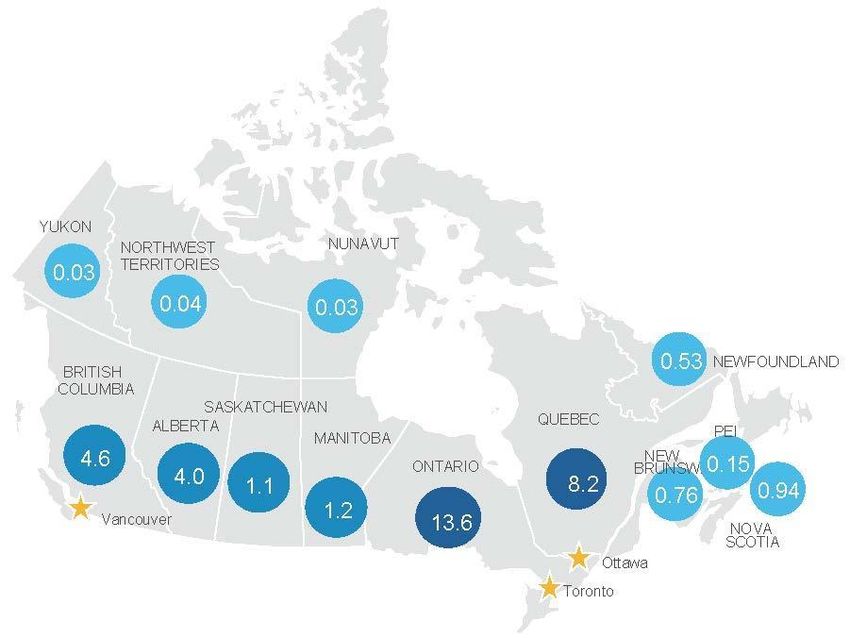
Introduction to Canada
    A stable economy with 36 million people, across 10 provinces & 3 territories

                                                           •   Six times zones - Canada is the 2nd
                                                               geographically largest country in the world
                                                           •   86% of Canada’s population is in four
                                                               provinces (Ontario, Quebec, Alberta, British
                                                               Columbia)
                                                           •   Provinces have more decision-making
                                                               abilities than federal government, leading to
                                                               differences in doing business in each
                                                               province
                                                           •   17% of population is over 65 years old in
                                                               2018, expected to grow to 23% by 2030

     Canada’s population 2016, millions
                                                                                                           5

2
7
S
e
p
t
e
m
b
e
r
2
Healthcare in Canada - Spending
    Publicly funded: Canada’s health spending is about C$242 billion with a 70/30 public and
    private split
                                               •    Contributes funding to the provinces and territories on a per capita basis as
            Federal Government                      well as to aboriginal, Inuit and veteran affairs
               5% spending                     •    Health Canada manages product regulations, standards and research
                                                    including some specific groups (medical devices. pharmaceuticals, natural
                                                    products, health research, food, consumer products)

    Provincial or Territorial Government   •       Managed by Ministry of Health and Long Term Care (Ontario) and administered
               65% spending                        own health insurance programs, ex: Ontario Health Insurance Plan (OHIP)
                                           •       Responsible for funding and delivery of hospital, community, long-term care,
                                                   mental and public health services

                                           •       There area 14 Local Health Integration Networks (LHINs) in Ontario
        Regional Health Authorities        •       Covers hospital and physician services, medically necessary diagnostics,
                                                   inpatient prescription, long term care and home and community care

             Out of pocket: 15%            •       Additional private insurance, held by about 2/3 Canadians, covers ex: vision
                                                   and dental care, prescription drugs, rehabilitation, home care
           Private insurance: 12%
                                           •       There is no cost-sharing for publicly insured physician, diagnostic, and
                  Other: 3%                        hospital services

                                                                                                                                    6

2
7
S
e
p
t
e
m
b
e
r
2
Allocation of funds for health services in Ontario
                                              Ministry of Health & Long Term Care

                 Regional Health Authorities                          OHIP           Public Health
              (14 Local Health Integration Networks)

                                                               Physicians’ payment
          Hospitals                Long term care
                                                                   for services

       Community care             Mental health &
       access centres            addiction services

         Community               Community health
       support services             services
                                                                                                     7

2
7
S
e
p
t
e
m
b
e
r
2
50% of Canada’s 2017 healthcare spending includes
    only hospital, drug and physician costs

      Top 3 areas          % health     2016                              Investments
      of spending          spending     growth              •   Federal government has granted $4.2
                                                                billion for Ontario over the next 10 years
                            28%          +1.9%                  •      $2.3 billion for better home care
    Hospitals                                                   •      $1.9 billion in support of mental
                                                                       health initiatives
                                                            •   Ontario is investing $155 million over 3
                            16%          +4.2%                  years to improve community-based
    Drugs                                                       palliative and end-of-life care
                                                                •      May 2017, medical assistance in
                                                                       dying legislation passed
    Physicians              15%          +3.4%
                                                            •    2018 - Free prescription medication
                                                                 for Ontarians under age 25 (4,400 listed
                                                                 drugs)
       How is it implemented?
       Health care is largely delivered by private individuals and organizations. These services,
       however, are financed by governments through public health insurance plans and direct
       funding to health care facilities                                                                     8

2
7
S
e
p
t
e
m
b
e
r
2
Patient care pathway                                                                                                    Out of pocket unless
                                                                                                                            covered by private
                                                                                                                            insurance (common)
                                                                        PATIENT                                             Publicly covered
                                                                                                                            healthcare

                 $0 co-payment                Emergency
                                              care only

         Primary Care                                                                                                 Dentist, Optometry
                                                Hospital                                                         Physiotherapy, Chiropractors,
            Doctors
                                                                                                                      Physiotherapy, etc.

      Referrals to                                                  Regional Health Authorities
    specialist and                                                (Local Health Integration Networks)
           testing

           Specialist                                 Home care                        Long term care               Private retirement home

                     •   Primary care physicians function as gatekeepers for access to all other health services in the system
                     •   Many family physicians and specialists work as independent contractors billing the provincial insurance
                         under ‘fee for service’ model with recent slow shift towards alternative payment plans
                     •   Physicians billing has reached C$22.8 billion in 2012-2013. This is growing on a 3.5% annum
                         average. The average income of a Canadian physician is $320,000 CAD (2012)
                     •   Since 2009, there has been an 8% increase in the number of nurses in Canada                                           9

2
7
S
e
p
t
e
m
b
e
r
2
Summary of insights
    •   Canada is similar to Nordics with its publicly-
        funded, universal healthcare system (Medicare)
    •   Decentralized and provincially/territorially
        managed – 13 different markets
                 • Ontario is the largest province and a
                      key entry point for healthcare in
                      Canada
    •   High spending – need for transformation due to
        aging population and increased cost of health
        care
    •   Fee for service is common
    •   Focus on efficiency with new interest in
        innovation, digital solutions, workflow optimization
        – showing particular interest in Nordics
    •   Over capacity for long term care facilities is
        causing focus on increasing home care
        services
    •   Changing towards a patient-centric care model

                                                               10

2
7
S
e
p
t
e
m
b
e
r
2
Agenda
Healthcare in Canada ● Geographical overview
● Healthcare spending
● Allocation of funds
● Patient journey
● Hospitals
Key Opportunities ● Long term care & retirement homes
● Home & community care
Approval Process ● Approval and procurement in Canada
Nordic-Canada Health ● Program background
● Details of program
Solutions Initiative ● Partners & facilitators #nordicsolutions
● Application process to global challenges
2
7
/
0
9
/
2Hospital statistics (Ontario)
1M km2
Area of Ontario
Full capacity
Half of all hospitals were at full
capacity with some hospitals
under 20 to over 1,200 beds at 140% capacity (85%
Range in the amount of beds/hospital considered safe capacity)
141 206,000 17%
public hospitals total number of acute hospital beds occupied by
corporations Ontario hospital patients who should be receiving
(262 hospital sites) employees care at home, in long-term care or
in the community
12
2
7
S
e
p
t
e
m
b
e
r
2Hospital spending
13
2
7
S
e
p
t
e
m
b
e
r
2Hospital sector:
Opportunities & Feedback
Efficient workflow and better
Optimizing hospital facility
waiting times
Medication management Infection control
Patient safety Lowering readmission rates
Interconnectivity Data SecurityHospitals – things to consider
• Hospitals are allocated ‘global annual
budgets’ for providing services
• Budgets fluctuate based on population,
need and efficiency
• Priority within reducing costs, improving
quality and outcomes, and giving patient
empowerment
• Wide spread use of EMR
• Older hospitals face difficulty in utilizing
Wi-fi/bluetooth based technologies due to
infrastructure
• Green builds are proactively
implementing fully digitized facilities
• Many hospitals require pilot projects prior
to implementation – requires time,
resources and funding
15
2
7
S
e
p
t
e
m
b
e
r
2Agenda
Healthcare in Canada ● Geographical overview
● Healthcare spending
● Allocation of funds
● Patient journey
● Hospitals
Key Opportunities ● Long term care & retirement homes
● Home & community care
Approval Process ● Approval and procurement in Canada
Nordic-Canada Health ● Program background
● Details of program
Solutions Initiative ● Partners & facilitators #nordicsolutions
● Application process to global challenges
2
7
/
0
9
/
2Long term care and retirement home stats
45% 78,872 700 6.5 million
public-sector Beds for long- licensed retirement Nursing visits
health care dollars stay residents homes in Ontario
spent consumed
by seniors
27 million
78,872 hours of personal support
Staff and homemaking services
to more than 600,000
clients per year
17
2
7
S
e
p
t
e
m
b
e
r
2Long term care & retirement homes:
Opportunities & Feedback
Efficient workflow Improve environment & experience
Improve e-connectivity Increase safety/health
Help plan & coordinate care Better manage food services
Human resources
18Long term care & retirement – things to consider
• Many long term care homes want to
pilot a new technology before
purchasing – costly and lengthy
• Public vs. private long term care
homes have different decision
makers and funders
• Safety and regulatory approvals can
be difficult to navigate and may be
lengthy processes
• Procurement rules and process may
differ between LHINs and long term
care homes
19Agenda
Healthcare in Canada ● Geographical overview
● Healthcare spending
● Allocation of funds
● Patient journey
● Hospitals
Key Opportunities ● Long term care & retirement homes
● Home & community care
Approval Process ● Approval and procurement in Canada
Nordic-Canada Health ● Program background
● Details of program
Solutions Initiative ● Partners & facilitators #nordicsolutions
● Application process to global challenges
2
7
/
0
9
/
2Home & community care stats
73% increase
in home care funding in Ontario
(from 2005-2015)
20% more patients
have been receiving care at home
in the past 5 years
13% more patient referrals
from hospitals
Caring for terminally ill patients in an
acute-care hospital is estimated to cost
Image source: Global News
over 10 times more
than providing at-home care
21
2
7
S
e
p
t
e
m
b
e
r
2Home & community care:
Opportunities & Feedback
Monitor and connect with
Efficient workflow
patients
Help patients self-manage their
Improve communication care
Physical & emotional security Reduce social isolationHome & community care – things to consider
• Ontario is made up of 14 different LHINs, each
with varying budgets and strategies – fragmented
province, subtle nuances between each LHIN
• Third party service providers (e.g. Saint
Elizabeth) are often technology users and
buyers, but not always (sometimes it is the
LHINs)
• Many LHINs and third party service providers will
require pilots in order to purchase new
technology – costly and lengthy
• Safety and regulatory approvals can be difficult
to navigate and may be lengthy processes
• Procurement process may be unclear between
LHIN and third party service provider
23
2
7
S
e
p
t
e
m
b
e
r
2Agenda
Healthcare in Canada ● Geographical overview
● Healthcare spending
● Allocation of funds
● Patient journey
● Hospitals
Key Opportunities ● Long term care & retirement homes
● Home & community care
Approval Process ● Approval and procurement in Canada
Nordic-Canada Health ● Program background
● Details of program
Solutions Initiative ● Partners & facilitators #nordicsolutions
● Application process to global challenges
2
7
/
0
9
/
2Approval process in Canada
Source: MaRS Discovery District
25
2
7
S
e
p
t
e
m
b
e
r
2Procurement in Ontario
● Ontario spent C$12 billion in 2017 on procurement of healthcare
goods and services
● 70% of medtech purchases are done at a hospital
● Highly fragmented process of procurement
● Approvals, reimbursement codes, clinical trials do not guarantee
adoption
● Must demonstrate cost savings/budget impact
● Hospitals often have their own Value Analysis Committee to
determine economic benefit of technology
● Over C$100,000 must go through a transparent tender process
(RFI/RFP/RFQ) - can take 6 mos - 2 years
● Shared Services (SSO) for commodity purchases - but starting to
procure innovative technology as well
● Bundled payment pilots on some procedures may lead to the
procurement of novel technologies and across silos
● Procurement by co-design and issuing problem statements
increasing - more novel solutions being adopted
26
2
7
S
e
p
t
e
m
b
e
r
2Agenda
Healthcare in Canada ● Geographical overview
● Healthcare spending
● Allocation of funds
● Patient journey
● Hospitals
Key Opportunities ● Long term care & retirement homes
● Home & community care
Approval Process ● Approval and procurement in Canada
Nordic-Canada Health ● Program background
● Details of program
Solutions Initiative ● Partners & facilitators #nordicsolutions
● Application process to global challenges
2
7
/
0
9
/
2Why Canada is great for Nordic companies
Canadian Med Tech Advantages Benefits
• Government committed to • Stable, predictable market growth
healthcare funding
• Attractive for commercializing new devices
• A top 10 medical device market
• Ideal for high quality clinical trials
• High volume tertiary care hospitals
• Ability to track and evaluate outcomes
• Integrated healthcare delivery
• Less trial set up times and better product
• Highly trained clinicians design feedback
• Top scientific talent • Access to leading edge science
• Health technology assessment • Faster, more efficient reimbursement
strategies for Canadian and global markets
28
2
7
S
e
p
t
e
m
b
e
r
2Why join?
29
2
7
S
e
p
t
e
m
b
e
r
2Our Nordic-Canada Health Solutions Initiative offers
full year program for accelerated market entry
2018 2019 2020
Determining Eligibility: Visit 1 to Canada: End of Official Program:
* April 1-3
Held in Nordic cities and online Nov. 19-23
• Canadian market 101 • Canadian health system advanced training • Companies are in a position
education session • Breakout detailed education sessions and to independently test or pilot
(free for all interested site visits within specific sub-sectors (i.e. with Canadian organization;
digital health, devices, etc.)
companies) establish partnership/
• Advanced pitch session with local experts
distribution agreement, etc.
• Q&A session with • Presentations from and networking with
Canadian expert Nordic companies already established in
Canada
• Application process for
program participation
Follow-up meeting (online or in person):
Spring
deadline Dec. 21
• Go-to-market strategy review and pitch
revisions with Canadian experts
* all dates
subject to
Visit 2 to Canada:
Fall 2019
change
• Small group or 1:1 tailored meetings with
relevant stakeholders
30
2
7
S
e
p
t
e
m
b
e
r
2Company application deadlines to join initiative
Task NOV DEC JAN FEB MAR APR MAY JUN JUL AUG SEP OCT NOV
One day Introduction to Healthcare in
19-
Canada workshop with Canadian experts 23
( held in Nordic cities and online)
Deadline to submit application for
21
participation
Selection of 20 companies to join 14-
program and signed agreement 18
Week
Nordic Initiative Kickoff call with all of
participants 11
First tour to Canada 1-5
Second tour to Canada TBD
Company costs include: 50,000 NOK to participate in Nordic Initiative and any company travel involved in the program
To apply to join the Nordic-Canada Health Solutions Initiative please register at: https://goo.gl/forms/5kbW9r463k5SHE593
31
2
7
S
e
p
t
e
m
b
e
r
2Facilitators of our Nordic initiative in Canada
32
2
7
S
e
p
t
e
m
b
e
r
2Odd Arild Lehne, Norway Health Tech
+47 958 33 144
oal@norwayhealthtech.com
www.norwayhealthtech.com
Kerry Allerton, Ministry of Foreign Affairs of Denmark
Senior Advisor, Healthcare & Life Sciences
M. +1 647 631 6947
kerall@um.dk
http://um.dk/en/
Agata Leszkiewicz, Business Sweden
Project Manager
T. +1 416 640 7477, M. +1 647 638 1474
agata.leszkiewicz@business-sweden.se
www.business-sweden.se
Lori Woloshyn, Innovation Norway Toronto
Market Manager
T. +1 416 920 0434 x124, M. +1 416 271 7327
lori.woloshyn@innovationnorway.no
www.innovationnorway.no
Johanna Tarvainen-Lee, Business Finland
Sr. Consultant
M. +1 416 400 1792
johanna@merenbridge.com
www.businessfinland.com
#nordicsolutions
Andri Marteinsson, Promote Iceland to global challenges
33
2
7
/
0
9
/
2Additional Slides - Innovation in Ontario
First province to have
Chief Innovation
Officer in Healthcare -
OCHIS
Dual report - Health
Minister and Innovation
Mandate: put $50 B
health systems to drive
wealth creation
http://ontario.ca/healthinnovation
OCHIS
34
2
7
S
e
p
t
e
m
b
e
r
2You can also read


