Part-Time Student Handbook 2018 - School of Mechanical and Aerospace Engineering - Nanyang ...
←
→
Page content transcription
If your browser does not render page correctly, please read the page content below
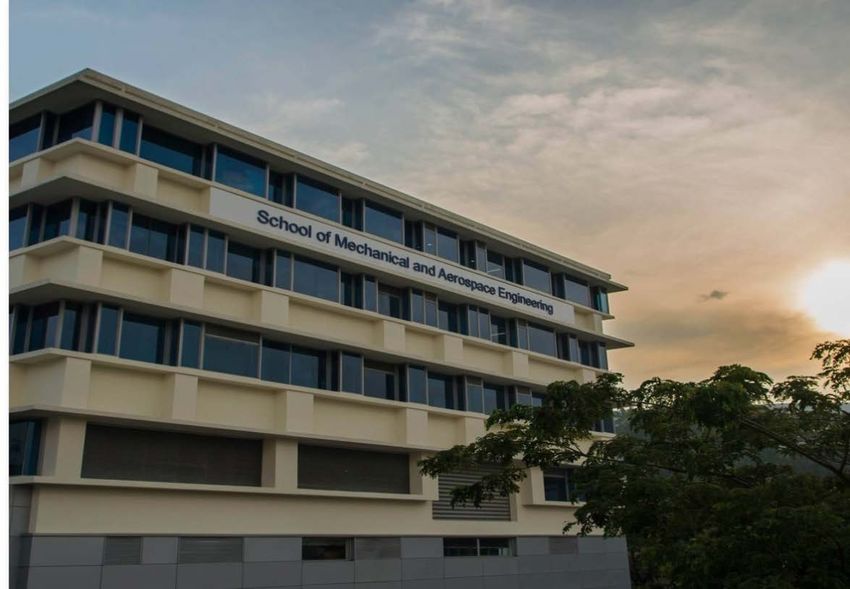
Part-Time Student
Handbook 2018

         School of Mechanical

            and Aerospace

             Engineering
Part-Time Student Handbook 2018   1

MAE PT Student Handbook 2018 e-version 1.1

This Handbook is based on information available at the time of
publication. The School reserves the rights to make changes
without notice. Students are advised to check the School’s website
(www.mae.ntu.edu.sg) and their NTU emails regularly for
updated information.
Table of Contents

The School ………………………………………………………...         1
Key Faculty Members …………………………………………        2
Part-Time Programme Committee …………………….     5
Pastoral Care Unit ……………………………………………..      6
Undergraduate Office………………………………………….       7
General Contact Information …………………………….    8
Programme Educational Objectives ………………….   10

Overview of Curriculum …………………………………….      11
Course Description …………………………………………….       18
Academic System ………………………………………………          29
Administrative Matters ……………………………………..     35
Financial Assistance …………………………………………..     43
Part-Time Student Handbook 2018   1

               The School

                      Vision

A global leader in education and research in Mechanical
   and Aerospace Engineering, preferred by students,
             industry and the community.

                     Mission

 To provide world-class education and conduct cutting-
edge research to achieve international eminence and to
 nurture leaders and professionals to serve society with
                integrity and excellence.
Key Faculty Members
Chair
Professor Ooi Kim Tiow
Phone: 6790 5486 Office: N3-02a-04
Email: d-mae@ntu.edu.sg
Associate Chair (Academic)
Assoc Professor Sunil Chandrakant Joshi
Phone: 6790 4725 Office: N3-02a-10
Email: vd-mae-acad@ntu.edu.sg
Associate Chair (Faculty)
Professor Khoo Li Pheng
Phone: 6790 6874 Office: N3-02a-06
Email: ac-mae-faculty@ntu.edu.sg
Associate Chair (Research)
Assoc Professor Wan Man Pun
Phone: 6790 6957 Office:N3-02a-25
Email: vd-mae-res@ntu.edu.sgPart-Time Student Handbook 2018 3
Key Faculty Members
Associate Chair (Students)
Assoc Professor New Tze How Daniel
Phone: 6790 5130 Office: N3-02b-60
Email: ac-mae-students@ntu.edu.sg
Assistant Chair (Academic)
Assoc Professor Duan Fei
Phone: 6790 5510 Office: N3.2-02-84
Email: asc-mae-acad@ntu.edu.sg
Assistant Chair (Faculty)
Assoc Professor Tan Ming Jen
Phone: 6790 5582 Office: N3-02b-49
Email: asc-mae-faculty@ntu.edu.sgKey Faculty Members
Assistant Chair (Graduate Studies)
Assoc Professor Anutosh Chakraborty
Phone: 6790 4222 Office: N3-02b-43
Email: asc-mae-gs@ntu.edu.sg
Assistant Chair (Research)
Assoc Professor Domenico Campolo
Phone: 6790 5610 Office: N3.2-02-74
Email: asc-mae-res@ntu.edu.sg
Assistant Chair (Research)
Assoc Professor Tegoeh Tjahjowidodo
Phone: 6790 4952 Office: N3-02c-68
Email: asc-mae-res@ntu.edu.sg
Assistant Chair (Students)
Asst Professor Marcos
Phone: 6790 5867 Office: N3-02a-08
Email: asc-mae-students@ntu.edu.sgPart-Time Student Handbook 2018 5
PT Programme Committee
Programme Director
Assoc Professor Tai Kang
Phone: 6790 4444 Office: N3.2-02-76
Email: mktai@ntu.edu.sg
Academic Coordinator
Assoc Professor Hoon Kay Hiang
Phone: 6790 5523 Office: N3-02c-94
Email: mkhhoon@ntu.edu.sg
Academic Coordinator/Lab Coordinator
Assoc Professor Tegoeh Tjahjowidodo
Phone: 6790 4952 Office: N3-02c-68
Email: ttegoeh@ntu.edu.sg
FYP Coordinator
Assoc Professor Li Hua
Phone: 6790 4953 Office: N3-02c-79
Email: lihua@ntu.edu.sgPastoral Care Unit
The Pastoral Care Unit is an embodiment of skills, knowledge and services
which the School offers to promote as a healthy, enjoyable and fruitful
campus life for students. It ensures that all MAE students have access to
counselling pertaining to academic matters, financial issues, relationships
problems et cetera. Where academic performance is concerned, this unit
assists the students in identifying their areas of difficulty and developing
strategies to improve their academic performance. This unit also helps to
administrate the School’s Peer Tutoring Programme. (More information)
Contact Point
Mr Koh Wee Hock
Pastoral Care Manager
Phone: 6790 5507 Office: N3-02a-22
Email: mwhkoh@ntu.edu.sgPart-Time Student Handbook 2018 7
Undergraduate Office
This unit provides a variety of administrative services for our undergraduate
students. Tel: 6790 5492 Location: N3-02a-14 Email: askMAE@ntu.edu.sg
Ms Agatha Ho (FYP Matters)
mklho@ntu.edu.sg
Ms Sarah Zhong (Curriculum Matters)
sarah.z@ntu.edu.sg
Ms Soh Mei Zhen (Course Registration)
mzsoh@ntu.edu.sg
Ms Susan Tan (PT Student Matters)
susantanpp@ntu.edu.sg
Mr Tan Wei Zhe (Examination Matters)
tanwz@ntu.edu.sg
Ms Tiana (EID Matters)
thaiyana@ntu.edu.sgGeneral Contact Information
Department / Enquiry of Location / General Contact
General Issues such as…
Office of Academic Services Location: Student Services Centre, Level 2
Office Operating Hours:
Please refer to OAS website for more
Mon to Thu: 8.30am to 5.45 pm
information on:
Fri: 8.30am to 5.15 pm
- For further enquiries on Matriculation/Change of
(Step-by-Step Guide, STARS planner, Programme/Leave of Absence
Registration schedule, Class schedule) Tel: 6592 2451
Email:
For further enquiries on Course Registration
(examination timetable and venue,
Tel: 6592 2445/ 2446
examination results, GPA system)
Email:
For further enquiries on Examinations/ Transcripts
(change of personal particulars, apply Tel: 6592 2447/ 2448
for semester leave, change of Email:
programme, withdraw from NTU)
Student Wellbeing Centre Location: University Health Service Building, #02-01
Professional counseling, group Office Operating Hours:
Mon to Thu: 8.30am to 5.45 pm
programmes and talks, training
Fri: 8.30am to 5.15 pm
workshops
Tel: 6790 4462
Email:
Centre for IT Services IT Service Counters:
1) One Stop @ SAC, NS3-01-03/03A
Computer account, resetting password, 2) Learning Pod @ South Spine, SS1-01-03
unlocking of NTU Network or Windows 3) Online Chat
Live account, email application matters Tel: 6790 4357 (from 7:00am to 11:00pm daily)
Email: servicedesk@ntu.edu.sgPart-Time Student Handbook 2018 9
General Contact Information
Department / Enquiry of General Location / General Contact
Issues such as…
Centre for Excellence in Learning Location: One Stop @ SAC, N3-01-03
and Teaching Tel: 6790 4357 (from 7:00am to 11:00pm daily)
NTULearn e-learning portal Email: servicedesk@ntu.edu.sg
Medical Centres
Fullerton Healthcare @ NTU Location: University Health Service Building
Consultation Hours:
Mon to Fri: 0830 - 2100
Sat: 0930 - 1200
Tel: 6793 6974 or 6793 6828
NTU Chinese Medicine Clinic @ School of Location: School of Biological Sciences, SBS-
Biological Sciences 01s-68
Consultation Hours:
Mon, Wed, Fri: 0900 - 1700
Tue, Thu: 0900 - 1730, 1800 - 2100
Tel: 6592 1732 or 6592 1733
Office of Finance Location: One Stop @ SAC, N3-01-03
All financial matters Office Operating Hours:
Mon to Thu: 8.30am to 5.00 pm
Fri: 8.30am to 4.45 pm
Closed on Sat, Sun & Public Holidays
Tel: 6790 4619 / 6790 5060
Email: UBS@ntu.edu.sgProgramme Educational Objectives
The Programme Educational Objectives of the B.Eng. (Mechanical)
programme are to:
(i) Produce graduates with the fundamental knowledge and skills for the
practice of mechanical engineering in a broad range of industries.
(ii) Provide students with a broad and flexible curriculum with
specialized electives that tailor to students’ career goals and to
inspire them to pursue specialized and graduate studies.
(iii) Develop students’ communication, practical and innovative skills
through group design, project work, and “technopreneurship”
activities.
(iv) Provide students with opportunities to read courses in business and
management so that they will be equipped to take on leadership and
managerial roles.
(v) Promote student's awareness of professional ethics, societal and
moral responsibility, and the need to engage in life-long learning.Part-Time Student Handbook 2018 11
Overview of the Curriculum
Curriculum Structure
Academic Unit Requirement
Core Major PE GER-Core GER-PE Total
70 12 10 3 95
The curriculum structure for the Part-Time B.Eng. (Mech) Engineering
programme comprises of the following categories of requirements:
I. Core Courses – These are compulsory courses required to satisfy a
programme’s requirement.
II. Major Prescribed Electives (Major PE) – These are courses for
specialisation in a particular degree programme.
III. General Education Requirement (GER) – This is a curriculum
requirement for broadening study. The compulsory GER-Cores are:
• GC0001 Sustainability: Seeing Through The Haze (1 AU)
• HY0001 Ethics and Moral Reasoning (1 AU)
• ET0001 Enterprise and Innovation (1 AU)
• HW0188 Engineering Communication I (2 AUs)
• HW0288 Engineering Communication II (2 AUs)
• MA0101 Engineers and Society (3 AUs)
The compulsory GER – Prescribed Elective (GER-PE) is:
MA8103 Human Resource Management (3 AUs)
Prerequisites
Some courses may only be offered to students who have obtained at least
the specified grade in related courses offered at a lower level. These lower-
level courses are called the “prerequisites” for the higher-level courses.Table of Curriculum
Courses offered are subject to changes due to future curriculum planning.
Students are advised to check the part-time programme webpage for
updated information.
Year of Semester 1 Semester 2 Special Term
Study
Year 1 MH2810 Mathematics A MA1001 Dynamics
24 AU (4 AU) (3 AU)
PH1012 Physics A (4 AU) MA2001 Mechanics
of Materials
MA1002 Fundamental (3 AU)
Engineering Materials
(3 AU) MA2006 Engineering
Mathematics (3 AU)
GC0001 Sustainability:
Seeing Through The Haze MA8103 Human
(1 AU) Resource
Management (3 AU)
HW0001 English
Proficiency (0 AU) *
Year 2 MA2003 Introduction to MA0101 Engineers & MA2071
24 AU Thermo-fluids (3 AU) Society (3 AU) Laboratory
Experiments
MA2004 MA2002 Theory of (1 AU)
Manufacturing Processes Mechanism (3 AU)
(3 AU)
MA3002 Solid
MA2005 Engineering Mechanics and
Graphics (3 AU) Vibration (3 AU)
MA2009 Introduction to HW0188 Engineering
Electrical Circuits & Communication I
Electronic Devices (3 AU) (2 AU)
* For students who fail Qualifying English Test.Part-Time Student Handbook 2018 13
Year of Semester 1 Semester 2 Special Term
Study
Year 3 MA3001 Machine MA4079 Final Year MA4079 Final
24 AU Element Design (3 AU) Project (2 AU) ** Year Project
(2 AU) **
MA3010 MA3004
Thermodynamics & Mathematical MA3071
Heat Transfer (3 AU) Methods in Engineering
Engineering (3 AU) Experiments
MA3005 Control Theory (ME) (1 AU)
(3 AU) MA3006 Fluid
Mechanics (3 AU)
HY0001 Ethics & Moral
Reasoning (1 AU) HW0288 Engineering
Communication II (2
ET0001 Enterprise & AU)
Innovation (1 AU)
Year 4 MA4079 Final Year MA4079 Final Year
23 AU Project (2 AU) ** Project (2 AU) **
MA4001 Engineering MA48xx Major PE 2
Design (4 AU) (3 AU)
MA4002 Fluid Dynamics MA48xx Major PE 3
(3 AU) (3 AU)
MA48xx Major PE 1 (3 MA48xx Major PE 4
AU) (3 AU)
** The 8 AU academic workload of MA4079 Final Year Project is spread over three
semesters and one special term (2+2+2+2 = 8); however, the tuition fees for this
module are billed over the first two semester/term (i.e. 4+4+0+0 = 8).
Laboratory Experiments and Project
MA2071 Laboratory Experiments (ME) and MA3071 Engineering Experiments
(ME) are scheduled in the special terms of your second and third year of
study respectively.For MA2071, students are required to complete ten (10) laboratory
experiments consisting of nine (9) Log-Sheet and one (1) technical report
submissions.
For MA3071, students are required to complete six (6) laboratory
experiments and one (1) project.
Attendance for Laboratory Experiments and Project is COMPULSORY. A
medical certificate/approved leave of absence will be required if you are
absent.
Assessment is based on performance during the laboratory sessions (CAs)
and written assessment (Log sheet and technical report). Each student will
be assessed on both their CAs and individual written assessments (Log sheet
or technical report). If you were absent for any Experiment Session you will
be marked Absent (ABS) and will be given No Marks for that session.
The weights for MA2071 experiments and technical report are given in the
table below:
9 Log-Sheet Experiments 1 Technical Report Experiment
50% 50%
CA Log Sheets CA Report
50% 50% 50% 50%
The weights for MA3071 experiments and project are given in the table
below:
6 Experiments 1 Project
60% 40%
CA Log Sheets CA Report
50% 50% 50% 50%Part-Time Student Handbook 2018 15
Submission of Reports
Students will submit the project report to the respective supervisor for
assessment two weeks after the completion of the project. It is the student's
responsibility to complete the report before the assessment deadline.
Locations of Laboratories
• Energy Systems Lab (N3.1A-B4-01)
• Fluid Mechanics Lab (N3-B2b-03)
• Heat Transfer Lab (N3-02a-01)
• Manufacturing Process Lab 2 (LHN-B4-06)
• Manufacturing Process Lab 3 (LHN-B3-02)
• Materials Lab 1 (N3.1-B2b-02)
• Mechanics of Machines Lab (N3-B1c-03)
• Mechanics of Materials Lab (N3.2-B2-01)
• Mechatronics Lab (N3.2-B1-03)
• Metrology Lab (N3.1-B3b-03)
• Precision Engineering Lab (N3-B4c-03)
For more information, students may contact Assoc Prof Tegoeh
Tjahjowidodo (Lab Coordinator) |6790 4952|N3.2-02c-68|
ttegoeh@ntu.edu.sgFinal Year Project
The final year project (FYP) is an integral and important part of the degree
programme. It is equivalent to 8 academic units (AUs), and the award of
honours is dependent upon the student's performance in the FYP.
You would commence your FYP in Semester 2 of the third year of study. It is
to be completed over three semesters and one special term. No extension of
this period is allowed.
In order to qualify for commencement of the FYP, students must be in Year 4
standing and must have:
(a) Gained exemption from MA2079 Engineering Innovation & Design (EID)
and MA3079 Professional Internship (PI) and
(b) Accumulated at least 56 AUs after the third year of study
All students who have met the above requirements are required to embark
on the FYP immediately at the beginning of the next semester. No delay in
the commencement of the FYP is allowed.
If a student has successfully obtained exemption from the EID/PI, but is
unable to accumulate the required number of AUs after completing his third
year of study, he will be permitted to commence his FYP only after he has
accumulated the required number of AUs following another semester of
study.
All FYP students are strongly advised to see their project supervisors on a
regular basis as such meetings are very necessary and important to the
students’ progress and performance in the projects. All FYP students are
required to submit FYP reports and undergo oral presentations for their FYP
at the end of the project. The oral presentations are scheduled immediately
after the examination period.Part-Time Student Handbook 2018 17
FYP students who have to go for in-camp training or overseas business
assignment on the scheduled date of the oral presentation are required to
submit supporting documents to the FYP coordinator as soon as it is known
so that an alternative (earlier) date can be arranged for their oral
presentation.
If the student’s progress is unsatisfactory, the supervisor may recommend an
extension of the project beyond the three (3) semesters and one (1) special
term duration. Such extension, if approved by the School, will come with a
serious penalty on the student’s grade for the FYP. If a student fails his/her
FYP, he/she has to do a new FYP with a different supervisor for another three
(3) semesters and one (1) special term period.
The School will notify students by email when they become eligible to start
FYP.
For more information, students may contact Assoc Prof Li Hua (FYP
Coordinator) |6790 4953|N3-02c-79| lihua@ntu.edu.sgCourse Description
Year 1 Courses
GC0001 Sustainability: Seeing Through the Haze (1 AU) Pre-requisite:
Sustainability from perspectives of various disciplines, including Nil
humanities, business, policy, economics, and science. Students will
learn about sustainability through a case study of oil palm
plantation.
HW0001 English Proficiency (0 AU) Pre-requisite:
Introduction; Drafting clear paragraphs; Constructing clear and Nil
concise sentences; Reading and oral skills
MA1001 Dynamics (3 AU) Pre-requisite:
Kinematics of Particles; Kinematics of Rigid Bodies; Kinetics of Having read
Particles; Kinetics of Rigid Bodies PH1012 and
MH2810
MA1002 Fundamental Engineering Materials (3 AU) Pre-requisite:
Engineering materials and their mechanical properties; Bonding, Nil
Crystal Structure, Defects, and Diffusion; Strengthening and
toughening mechanisms; Creep, fatigue and fracture; Ceramic
Materials, Structure and Properties; Structure of Polymers;
Corrosion and Degradation
MA2001 Mechanics of Materials (3 AU) Pre-requisite:
Review, Stress And Strain; Torsion; Shearing Stress in Beams; Nil
Transformation of Stress and Strain; Deflection of Beams; ColumnsPart-Time Student Handbook 2018 19 MA2006 Engineering Mathematics (3 AU) Pre-requisite: Linear algebra; vector calculus; Laplace transformation; Fourier MH2810 Analysis MA8103 Human Resource Management (3 AU) Pre-requisite: Nature of Human Relations; Study of Individual Behavior; Behavior Nil of Groups and Productivity Practices; Managing Technological Change; Managing in Knowledge-based Futures; Fundamentals of Leadership; HRM Skills of a Leader: Developing, Appraising and Rewarding Staff; Managing Performance: Corporate, Group and Individual; Productivity Innovation, Creativity and Inventive Culture; Internationalization and HRM; Managing Industrial Relations; Personal Career Development; Topical HRM Issues. MH2810 Mathematics A (4 AU) Pre-requisite: Functions and Derivatives; Integration; Complex numbers and Nil Vectors; Power Series; Multivariable Functions & Partial Derivatives; Ordinary Differential Equations PH1012 Physics A (4 AU) Pre-requisite: Vectors; Kinematics; Forces and Torques; Newton’s Laws of Motion; Basic Impulse and Momentum; Work and Energy; Thermal Physics; trigonometry Electric Field; Magnetic Field; Motion of Charged Particles and and calculus Applications; Circuits
Year 2 Courses
HW0188 Engineering Communication I (2 AU)                               Co-requisite:

Basic academic literacy skills; written and oral communication skills   HW0001
for the field of engineering

MA0101 Engineers and Society (3 AU)                                      Pre-requisite:

History of Engineering; Pre-independence history of Singapore; Social    Nil
and political development issues; Economic and industrial
development issues; National cohesion and total defense;
Engineering practice in Singapore; Engineering ethics; Our
neighbours and international; Challenges of globalization and the
new economy; Contribution of engineers in the new millennium

MA2002 Theory of Mechanism (3 AU)                                        Pre-requisite:

Fundamental Concepts of Mechanisms; Gears and Gear Train;                MA1001
Motion in Mechanisms: Kinematic Analysis; Motion in Mechanisms:
Static-Force Analysis; Motion in Mechanisms: Dynamic-Force
Analysis; Design and Analysis of Cam-and-Follower Systems

MA2003 Introduction to Thermo-fluids (3 AU)                              Pre-requisite:

Properties of pure substances; Work and heat; Energy and the first       Nil
law; Energy balance for closed systems and steady state control
volumes; Submerged surfaces and bodies; Elementary fluid dynamics

MA2004 Manufacturing Processes (3 AU)                                    Pre-requisite:

Introduction and overview of manufacturing; Dimensions and               Nil
surfaces measurement; Casting; Shaping processes for polymers;
Sheet metalworking; Materials removal processes; Joining processes;
Microelectronics manufacturing
Part-Time Student Handbook 2018      21

MA2005 Engineering Graphics (3 AU)                                   Pre-requisite:

Orthographic projections; Pictorial views and technical sketching;   Nil
Drawing standards and practices; Sectional views and machine
drawings; Development of surfaces; Dimensioning standards,
systems and conventions; Dimensioning features and finishes;
Tolerance dimensioning and limits; Geometric dimensioning

MA2009 Introduction to Electrical Circuits & Electronic Devices (3   Pre-requisite:
AU)
                                                                     Nil
Analysis of Resistive Linear Networks; Energy Storage Elements
and Transient Analysis; AC Network Analysis; Operational
Amplifiers and applications; Basic semiconductor devices and
applications; Logic Circuits

MA2071 Laboratory Experiments (ME) (1 AU)                            Pre-requisite:

Consists of 10 experiments related to Year 2 core courses            Nil

MA3002 Solid Mechanics and Vibration (3 AU)                          Pre-requisite:

Energy Methods of Analysis; Fracture Mechanics; Fatigue;             MA2001
Vibrations for Single-Degree-of-Freedom System; Vibrations for
Two-Degree-of-Freedom System
Year 3 Courses HW0288 Engineering Communication II (2 AU) Pre-requisite: Concepts in engineering communication and advanced professional HW0188 communication skills, with reference to technical communication and the Final Year Project, and Communication in the contemporary workplace ET0001 Enterprise and Innovation (1 AU) Pre-requisite: Introduction to the enterprise and innovation ecosystem of the Nil University, the Singapore society, and beyond. HY0001 Ethics and Moral Reasoning Pre-requisite: Introduction to three major ethical theories' utilitarianism, Kant's Nil deontology, and virtue ethics; ethical principles underlying academic integrity, research ethics, and intellectual property; ethics of environmental sustainability and conservation MA3001 Machine Element Design (3 AU) Pre-requisite: Power transmission components; Dimensioning and tolerancing Having read according to ISO standards, surface finish; Bearings; Threaded MA2001 and fasteners, power screw; Design of load carrying joints; Designing MA2002 against fatigue loading and wear; Design of machine structures MA3004 Mathematical Methods in Engineering (3 AU) Pre-requisite: Partial Differential Equations (PDEs); Finite Element Method (FEM); MH2810 Computational Fluid Dynamics (CFD) MA3005 Control Theory (3 AU) Pre-requisite: Introduction and Revision of Laplace Transform; System Responses - Having read transient and steady; PID Controls; Root Locus Technique; Frequency MA2006 Response Methods
Part-Time Student Handbook 2018           23

MA3006 Fluid Mechanics (3 AU)                                            Pre-requisite:

Momentum equation and its applications; Dimensional analysis and         MA2003
similitude; Internal flows and piping systems; Principles and
applications of fluid machines

MA3010 Thermodynamics & Heat Transfer (3 AU)                             Pre-requisite:

Second law and entropy. Entropy balance for closed systems and           MA2003
steady state control volumes. Ideal gas mixtures and psychometrics.
Heat transfer: conduction, convection and radiation

MA3071 Engineering Experiments (ME) (1 AU)                               Pre-requisite:

Consists of 6 experiments and 1 project related to Year 3 core courses   Nil
Year 4 Courses
MA4001 Engineering Design (4 AU)                                           Pre-requisite:

Product Definition; Conceptual Design; Embodiment Design; Detailed         Having read
Design & Engineering; Analysis & Documentation; Mechanical Power           MA3001
Transmission Systems; Hydraulic & Pneumatic Systems; Electric Motors
& Linear Motion Systems; Programmable Logic Control (PLC)
techniques; Review of basic engineering materials properties & failure
modes; Basics materials selection in design; Effect of component
geometry in materials selection; Compound objectives & multiple
constraint problems; Cost estimation tools

MA4002 Fluid Dynamics (3 AU)                                               Pre-requisite:

General equations of motion; Potential flow; Isentropic compressible       MA3006
flow; Normal shock waves, Fanno & Rayleigh line flows; Boundary layer
flow; External flow; Performance characteristics of pumps & turbines;
Unsteady flow

MA4079 Final Year Project (8 AU)                                           Pre-requisite:
This project spans across 3 semesters and 1 special term.
                                                                           Year 4
Students are required to analyze and synthesize problems in any of the     standing;
disciplines of mechanical and production engineering through a project
                                                                           Exemption
requiring application of basic engineering principles. The project may
                                                                           from MA3079
take any one or a combination of the following forms: feasibility study,
product development, computer modelling and analysis, design and
construction, testing and experimental investigation.
Part-Time Student Handbook 2018 25
Major Prescribed Electives
In addition to the year-4 core courses, students have to read four Major
Prescribed Electives. Students may choose their Major Prescribed Electives
(PEs) from any of the below specialisation groups. Those who have passed at
least three Major PEs from one specialization group will be deemed to have
specialised. Specialisation is optional.
Manufacturing Engineering
This provides students with a broad
knowledge of materials engineering Major PEs (Manufacturing Engineering)
and a fundamental understanding of
automated flow lines, vibratory bowl MA4837 Net Shape Manufacturing
feeders, industrial robots, rapid MA4838 Non-conventional
prototyping and computer-aided Manufacturing Processes
manufacturing. Students are taught MA4842 Engineering Metrology
the roles of engineering logistics in MA4845 Manufacturing Automation
achieving corporate goals of reducing MA4853 Manufacturing Systems
manufacturing costs and the savings
that come from planning and
managing supply chains effectively.
Systems Engineering
Systems Engineering helps to integrate
both engineering and non-engineering
disciplines in the conceptualisation,
Major PEs (Systems Engineering)
design, development (or manufacture)
MA4849 Operations Research
and distribution of products and in the
MA4850 Supply Chain & Logistics
collection of used products for reuse,
recycling and disposal. Systems Management
Engineers help to realise the notion of MA4853 Manufacturing Systems
integrated development in each sector MA4854 Quality Assurance &
of the economy. ManagementCourse Description MA4837 Net Shape Manufacturing (3 AU) Advanced metal casting; Powder metallurgy; Powder shaping and full density processes; Bulk deformation processes; Sheet metal forming processes; Plastics shaping processes; New and emerging technologies MA4838 Non-Conventional Manufacturing Processes (3 AU) Non-conventional manufacturing processes with relevance to industries such as biomedical, aerospace and precision engineering and comparing non-conventional processes with the more traditional manufacturing approaches MA4842 Engineering Metrology (3 AU) Introduction to the fundamentals of measurement; SI system; Terminology; Calibration; Areas of metrology; Principles, Instrumentation; Application; Case studies of historical examples of famous metrological failures, various measurement examples as well as industry-based problems. MA4845 Manufacturing Automation (3 AU) Basic knowledge of manufacturing automation; Types of manufacturing automation; Additive Manufacturing (AM) and its applications; Computer-aided manufacturing and automatic assembly MA4849 Operations Research (3 AU) Refresher on probability models; Decision-making under uncertainty; Utility and risk analysis; Forecasting; Queuing models; Inventory models, planning and control; linear and integer programming; transportation and assignment problems; network optimization; Application to manufacturing, logistics and healthcare systems
Part-Time Student Handbook 2018       27

MA4850 Supply Chain and Logistics Management (3 AU)

Introduction to supply chain management; Value of information; Multi-echelon
Inventory models; Supply Chain strategies; Supply chain and logistics network design;
Warehousing and transportation management; SC benchmarking and performance
measurement.

MA4853 Manufacturing Systems (3 AU)

Introduction to Manufacturing Systems, Facility layout design and line balancing,
Production planning, Variability, Production scheduling and shop floor control.

MA4854 Quality Assurance and Management (3 AU)

Introduction to Quality Assurance and Management including the fundamentals,
philosophies, practices, tools and international standards
Academic System
The University’s academic structure for its undergraduate programmes is
based on the Academic Unit System. The system provides opportunities for
students to broaden their learning experience and progress at a pace most
suited to their individual needs while maintaining high academic standards.

The main features of the Academic Unit System are the semester
arrangement of the academic year and the use of Academic Units (AU) for
measuring academic workload.

Academic Calendar
The academic year starts off with an orientation week. It is divided into two
semesters, Semester 1 of 18 weeks and Semester 2 of 17 weeks.
Examinations are held at the end of each semester. There are two special
terms during the Semester 2 vacation.

Academic Units
Under the Academic Unit System, each course is assigned a certain number
of AU. The AU is a measure of the student's workload associated with both
class attendance and preparation. For a typical one-semester course, the
number of AU is calculated as follows:
   •   1 hour of lecture/tutorial per week: 1 A
   •   3 hours laboratory/fieldwork per week: 1 AU

Academic Workload

To complete the degree requirements within the normal specified period of
candidature, students are encouraged to carry an academic load as specified
in the Table of Curriculum. Overloading of courses is subject to School’s
approval. Students on Academic Warning or Academic Probation are not
allowed to overload beyond 3 courses.
Part-Time Student Handbook 2018       29

Registration of Courses

All students must register their courses through the Student Automated
Registration System (STARS) according to the schedule announced by the
Office of Academic Services. Students who join any classes without
registration will not be allowed to take the examination(s) for the course(s)
involved.

Students with outstanding tuition will be denied access to STARS and barred
from course registration. Students must pay their outstanding fees before
registering courses.

Students may add or drop any course within the add/drop period as
announced by the Office of Academic Services. A course that is dropped
during the add/drop period will not appear in the official transcript. A student
who is still registered for a course after the add/drop period but did not
subsequently sit for the examination will be deemed to have read and failed
the course. An 'F' will appear on his official transcript.

Freshmen in their first semester of study do not need to register as the
courses will be pre-allocated by the School. However, they would have to
register for courses on their own from their second semester onwards.

Exemption

A Full-Time B.Eng. (Mech) student is required to pass the practical training
courses, MA2079 Engineering Innovation & Design (EID) and MA3079
Professional Internship (PI), in the Second and Third Year of study,
respectively.

However, a Part-Time B.Eng. (Mech) student must apply for exemption from
these courses by obtaining the relevant industrial work experience on a
technical job.
For exemption from EID, you need six (6) months of industrial work
experience on a technical job. For exemption from PI, you need another six
(6) months of industrial work experience on a technical job.

You must have gained these twelve (12) months of experience preferably
between the start of Semester 1 of Year 1 and end of Semester 1 of Year 2.
However, if you already have prior work experience before joining NTU, your
prior experience may be considered.

EID and PI exemption is a pre-requisite for commencing MA4079 Final Year
Project (FYP) in the fourth year of study. Hence, any delay in obtaining EID
and PI exemption may lead to a delay in the completion of FYP.

The School will notify students via email to apply for course exemption on
MA2079 and MA3079.

Classification of Students

Students are classified as Year 1 to Year 4 according to the number of AU
earned. Students placed on Academic Warning and Academic Probation will
not be re-classified until they have been restored to good academic standing.

                     Number of Academic Units Earned
                      (Core and Prescribed Electives)
      Year 1              Year 2            Year 3             Year 4
       0 - 16             17 - 39           40 - 55        56 and above

Period of Candidature

The period of candidature is as follows:

Normal:         4 years
Maximum:        6 years

Examination

An examination for each of the courses offered in the semester is held at the
end of the semester. Students are not allowed to retake courses they have
Part-Time Student Handbook 2018 31
passed in order to improve on the grades of these courses. The grades for all
attempts in all courses taken by a student are shown in his official transcript.
Grade Point Average (GPA) System
Grades and grade points are assigned as follows:
Letter-Grade Grade Point
A+ 5.00
A 5.00
A- 4.50
B+ 4.00
B 3.50
B- 3.00
C+ 2.50
C 2.00
D+ 1.50
D 1.00
F 0.00
The Cumulative Grade Point Average (CGPA) represents the grade average of
all courses (including failed courses) attempted by a student. The
computation of CGPA is as follows:
[Grade Point x AU for Course 1] + [ Grade Point x AU for Course X] + ….
[Total AU attempted in all the semesters so far]
CGPA calculator can be found here.
Freshmen Year GPA Exemption
Effective from AY2014-15, up to 6 letter-graded courses with fail grades on
first attempt in the Freshmen Year will be excluded from GPA computation.
This applies to examinable and non-examinable courses taken in the
student’s first 2 semesters of study in NTU, including adjoining Special Terms.
GPA exemption is not applicable for courses with fail grade taken on the
second or subsequent attempts in the Freshmen Year.The unused quota of 6 courses will lapse after the Freshmen Year.
Students are not eligible for promotion to the next study year if their CGPA is
nil arising from GPA exemptions, even if they meet the AU criteria.
The fail grade exempted from GPA computation will remain on the transcript.
Graduation Requirements
To be eligible for the award of a Bachelor’s degree from NTU, a part-time
student must fulfill the following conditions:
i. Successful completion of the prescribed academic unit requirement as
set out by the course curriculum.
ii. A minimum CGPA of 2.00 at the end of the final semester.
The criteria for satisfactory academic standing in any given semester are:
i. Maintaining a minimum CGPA of 2.00
ii. Completing at least 75% of the normal AU workload
Academic Standing
i. Students with poor results will be accorded the following academic
standing and subjected to performance review:
• Academic Warning – if the CGPA falls below 2.00 for any given
semester.
• Academic Probation – if the CGPA stays below 2.00 for the
following semester.
• Academic Termination – if the CGPA is still below 2.00 for the 3rd
consecutive semester, or at the end of the final semester of study.
A letter of termination will be issued. Appeal against termination on the
grounds of extenuating circumstances may be made, subject to the following
rules:Part-Time Student Handbook 2018 33
• The appeal must be submitted to the relevant School within 2
weeks after the release of the semester examination results or
before the start of the next semester, whichever is earlier.
• Normally only one appeal is allowed per candidature.
ii. A minimum CGPA of 2.0 must be maintained at the end of each
semester to qualify for the overloading of courses.
Classification of Degree
The cut-off for each degree class is as follows:
CGPA Degree Classification
Range 4-year Courses
4.50 - 5.00 Honours (Highest Distinction)
with at least an 'A-' grade for the Final Year Project
4.00 – 4.49 Honours (Distinction)
3.50 – 3.99 Honours (Merit)
3.00 – 3.49 Honours
2.00 – 2.99 PassAdministrative Matters
Change in Personal Particulars
Postal address and contact numbers are important means of
correspondence. To avoid any communication lapse, all students are advised
to update his/her personal particulars via Studentlink whenever there is a
change in address, employment or contact number(s).
Leave of Absence
Students must apply for medical leave or short leave of absence with their
respective Schools if they cannot attend classes on the following occasions:
• On days when there are laboratory sessions
• On days when quizzes or tests are conducted during classes
• On any other occasions that tutor(s) or lecturer(s) deemed as
compulsory for students' attendance
i. Categories of Leave Not Approved
• Returning to home country during festive periods e.g. Chinese New
Year, Hari Raya, etc.
• Participating in activities (in and outside campus) organised by
student bodies
ii. Medical Leave during Term Time
Students who are granted medical leave on the various abovementioned
occasions must complete a Medical Certificate Leave Form and deposit the
form attached with the medical certificate to the Collection Box at the MAE
Undergraduate Office at N3-02a-14.Part-Time Student Handbook 2018 35 All medical certificates must be submitted not later than 7 working days after the medical leave. If students submit the medical certificate after the deadline, they will be given zero mark for any test or quiz that they were absent from. Medical certificate leave forms can be downloaded from the School’s website for part-time undergraduate programme. iii. Medical Leave taken during Examination Periods Students who are absent from an examination due to illness are required to submit the original medical certificate (MC) using the MC Submission Form, together with the Authorisation for Release of Information and Acknowledgement (AAA) Form. These forms are available online and must be submitted to the Office of Academic Services at the same time and within two working days of absence from the examination. For further details, please click here. iv. Short Leave of Absence (< 7 days) Students who are absent from school due to non-medical reasons like in- camp training, business trip or other personal commitments are required to fill up the Short Leave of Absence (LOA) Form. The completed form must be submitted with supporting documents to the MAE Undergraduate Office. A generated email will be sent to the student’s NTU email account to notify of the approved status. The form is available here. v. Compassionate Leave Compassionate leave will be granted in the event of the demise of an immediate family (defined as parents, siblings and grandparents). Normally absence from School within 7 days of the event and on the day of the funeral is accepted as valid leave of absence on compassionate ground. vi. Semester Leave (1 – 2 semesters) Students who wish to apply for leave of absence for 1 – 2 semesters need to apply for their leave online via Studentlink → Administrative Matters →
Semester Leave of Absence and upload the relevant supporting documents.
Application must be submitted by the end of Week 2 of the semester,
otherwise the student will be required to pay the tuition and miscellaneous
fees for the entire semester. Upon receipt of the student’s application,
he/she will be called in for an interview if necessary. The purpose of the
interview is to advise the student from an academic perspective to make sure
that he/she is fully aware of the implications of taking semester leave. The
Office of Academic Services will write to the student about the outcome of
the application.

Student Intranet Account / Studentlink / PIN

All students who are admitted into NTU will be given access to the NTU
student network account. Students are required to log into their account
with their PIN number within the first week of the semester. If student forget
their PIN number, he/she can re-set it at his/her own convenience via the
Self-Service Student-Link PIN Reset. More details are available here.

The Centre for IT Services (CITS) can be contacted at 6790 4357 or CITS
helpdesk via servicedesk@ntu.edu.sg.

A host of important information and notices such as examination time-table,
examination seating arrangement, semester time-table, make-up class
schedule, report submission schedule, academic calendar, application to
appeal for examination results, subject registration, FYP selection, etc. can be
obtained through NTU Internet website and StudentLink.

All students are strongly encouraged to log into the website regularly to
update themselves with the latest news, events and happenings.

NTU E-Mails

NTU students’ E-mail account will be allocated to all students at the
beginning of his/her entry to the Part-Time B.Eng Programme. All students
are strongly encouraged to read NTU e-mails regularly as important
Part-Time Student Handbook 2018      37

information to students from the School/NTU will be disseminated through
this media. Lecturers may also contact students through this avenue.

Time-Table

Students may have to attend classes for 4 or 5 weekday evenings depending
on the number of courses they have registered. The semester timetable can
be obtained at the School website for part-time undergraduate programme.

Submission of Reports / Correspondence

Any reports to be submitted for assessment, or any correspondences, can be
dropped into the collection box marked “Deposit Box” at the MAE
Undergraduate Office (N3-02a-14) during or after office hours.

The opening hours of MAE Undergraduate Office are from 8.30am to 5.30pm,
Monday to Thursday and 8.30am to 5.00pm for Friday, unless otherwise
informed. Kindly indicate clearly the name of lecturer/tutor on the
reports/correspondences intended for them.

Make-Up Classes / Lab Sessions

Should any class sessions fall on a public holiday, the School will arrange
make-up classes if the lecturers deemed that it is necessary. You will be
notified of all make-up classes accordingly by the lecturer.

If a student misses any class test/quiz (for continuous assessment) during the
semester, he/she should make an alternative arrangement with the lecturer
concerned to take the test/quiz. Please be informed that these continuous
assessments contribute towards the overall grades for the course. In
addition, the student is also required to submit the completed Medical Leave
or Short Leave of Absence Form, whichever is applicable, to the MAE
Undergraduate Office.

Please note that there is no make-up lesson for laboratory sessions should
the student fail to attend it.
Academic Counselor

To provide students with academic guidance, student may approach the
academic coordinator of the Programme for academic advice:

Associate Professor Hoon Kay Hiang
Phone: 6790 5523
Email: mkhhoon@ntu.edu.sg
Office: N3-02c-94

Conversion from Part-Time To Full-Time

After the end of year-2 semester-2, students may be allowed to convert their
candidature to full-time study. Consideration for conversion is on a case-by-
case basis and students who convert to full-time study ARE NOT permitted to
revert back to part-time study.

Students who wish to convert to full-time study are required to apply for
conversion at the end of year-2 semester-2. More information can be found
here.

Please note that no conversion is allowed from Year-3 semester-2 onwards.

Examination Issues

All examination matters such as examination time-table, examination rules
and regulations, examination hall, seat allocation, etc. are planned by the
Office of Academic Services (Examination Branch). The School may relay
relevant information to you.

You will be required to sit for the examination of a course once you are
registered for it, except for non-examinable courses such as lab experiments
and projects. Under Statute 14 of the University’s Regulations, a student
who has been registered for a course and fails to take the examination for
the course shall be deemed to have sat and failed the examination unless the
Part-Time Student Handbook 2018     39

Board of Examiners is satisfied that there is good and sufficient reason for
such failure to take the examination.

All calculators to be used in the examination hall must be registered and bear
a valid seal from the School. A list of approved calculators and the
registration period for calculators will be made known to you at least one
month before the examination period in each semester.

A certification letter can be obtained from the School to facilitate the
application of examination leave from your work. Please contact the School
if you require the letter.

A student who is absent from an examination on account of illness is
permitted to appear for the examination at the next period of the
examination provided that he submits a medical certificate (MC) and an
Authorisation for Release of Information and Acknowledgement Form (AAA)
endorsed by a medical practitioner (registered with the Singapore Medical
Council) to the Office of Academic Services within two (2) working days of the
absence from the examination. Any fee payable for the medical examination
shall be paid by the candidate.

Examination Seating Arrangement

All students will be required to check their Examination Seating
Arrangements on-line by logging onto the StudentLink.

Examination Papers

Questions of past years’ examination papers submitted by the various
schools are managed by NTU Libraries and made available here.

For solutions, please consult your respective instructors.
Facilities within the School

For computer facilities, the following labs will be available to you, provided
that you do not interrupt any scheduled activities such as lessons, VIP visits
or maintenance.

 Laboratory            Location       Time Available For Use

 Computer Aided        N3-B3b-05      0830 to 1700hrs on weekdays
 Engineering Lab 1                    Closed on Saturdays, Sundays and
                                      Public Holidays
 Computer Aided        N3.2-01-34     0830 to 1700hrs on weekdays
 Engineering Lab 2                    Closed on Saturdays, Sundays and
                                      Public Holidays

For the use of other lab facilities apart from the scheduled lessons such as
projects, you will need to get permission from your project supervisor. Your
project supervisor will inform the lab concerned. Please bring along your
student card for identification when you use any of the School’s facilities.

Library Services

NTU Libraries provide a wide and diverse range of resources to support the
NTU scholarly and research community. Currently there are eight NTU
libraries on campus providing space, resources and services to support
learning and research. Some of these libraries open extended hours before
and during examination periods. All libraries are wireless enabled and there
are more than 700 work stations available for use.

All NTU students (including part-time students) are automatically library
members.

  LIBRARY                                   LOCATION
  Art, Design & Media Library               ART-01-03, 81 Nanyang Avenue
  Business Library                          N2-B2b-07, 50 Nanyang Avenue
  Chinese Library                           S3.2-B5-01, 50 Nanyang Avenue
  Communication & Information Library       CS-01-18, 31 Nanyang Link
Part-Time Student Handbook 2018 41 Humanities & Social Sciences Library S4-B3c, 50 Nanyang Avenue Lee Wee Nam Library NS3-03-01, 50 Nanyang Avenue Wang Gungwu Library CHC-02, 12 Nanyang Drive Library Outpost LHS-01-03, 52 Nanyang Avenue More information can be found here. Students are encouraged to browse through the websites to familiarize themselves with the rules and regulations governing the use and loan of the library materials, as well as the procedure of searching the library through OPAC. Photocopying Services Photocopying services are available at all libraries, provided by commercial suppliers for user’s convenience. Payment is by CashCard only except for Wang Gungwu Library which requires cash payment. CashCards are sold at Chinese Library, Lee Wee Nam Library Printing Room and Business Library Copy Room and can be topped up at the e-payment kiosks at all libraries.
Financial Assistance
NTU believes that no student should be denied the opportunity of a
university education because of financial difficulties. In order to enable such
students to pursue a university education, NTU offers several financial
assistance programmes for students pursuing a part-time degree
programme:

Financial     Brief Details
Scheme        (for updated info, please enquire at the Office of Admissions and
              Financial Aid)
Post-         • Full-time and part-time undergraduates who have a PSEA account
Secondary     • PSEA scheme also allows students to utilize their siblings’ PSEA
Education          funds for the payment of their tuition fees and miscellaneous fees
Account
(PSEA)
NTU Study     •   Singaporean part-time students pursuing their first undergraduate
Loan              degree
              •   Must be held concurrently with the maximum 90% Tuition Fee
                  Loan
              •   Per capita monthly household income (PCI)
Part-Time Student Handbook 2018 43
MOE Tuition Fee Subsidy
With effect from Academic Year 2011 onwards, eligible students enrolled in
NTU part-time degree programmes can pay subsidized tuition fees funded by
Ministry of Education (MOE):
Students must meet the following criteria in order to qualify for the subsidy:
i) Singapore Citizen (SC) or Singapore Permanent Resident (SPR) who
has not previously received government subsidy/sponsorship for a
first degree;
(Students who change their SC / SPR status after the admission period must
update Office of Academic Services before they submit their application)
ii) Be at least 21 years of age;
iii) Has 2 years of full-time work experience or has fully discharged his
full-time national service liability or is currently employed on a full-
time basis.
Applications for MOE fee subsidy are submitted online when students accept
an NTU Offer of Admission. Students who become eligible in their
subsequent years of study may apply at the beginning of each new semester.
Application guidelines and deadlines are available at the College of
Professional and Continuing Education website. For enquiry, students may
email CoPaCE.School of Mechanical and Aerospace Engineering
Nanyang Technological University
50 Nanyang Avenue Singapore 639798
Tel: (65) 6790 5492 | Fax: (65) 6795 4172
www.mae.ntu.edu.sgYou can also read


