Pharma: Strategic realignment for a better future - Arthur D Little
←
→
Page content transcription
If your browser does not render page correctly, please read the page content below
Pharma: Strategic realignment for a                  112/113
better future
Prism / 2 / 2020

Pharma: Strategic realignment for
a better future
... and how the industry will be forced to overcome
its hesitation to innovate in operations
Ben van der Schaaf, Aurelien Guichard

The life sciences sector faces significant impact from                   Amid the search for
                                                                         effective COVID-19
COVID-19 – and although the race for treatments and vaccines
                                                                         treatments and vaccines,
is dominating the headlines, the effect on the industry will             the pandemic will have
not solely be positive.                                                  long-term side effects for
                                                                         the global pharmaceutical
                                                                         industry. As our article
                                  In the short term, some companies
                                                                         explains, companies
                                  are laying people off and reducing     will need to focus on
                                  operations, whereas others are         change in three areas
                                  reallocating resources to focus on     (portfolio reprioritization,
                                                                         accelerated R&D
                                  COVID-19, or even ramping up
                                                                         and technology
                                  efforts in other areas. Stock-market   transformation) if they
                                  performance has been as diverse        are to position
                                  (Figure 1).                            themselves successfully
                                                                         for the future.

                          Organizations need to consider major
                          strategic questions now, to ensure
                          their success in the longer term.
                          The industry is clearly in the middle
of the efforts to combat COVID-19:

- More than 20 companies are trying to find a treatment with
either new or approved drugs1.

- More than 15 companies globally are mobilizing resources to
develop new vaccines2.

- Globally, by the end of May, more than 1,300 clinical trials
related to COVID-19 were recruiting patients3.

1. Marketwatch.com, 6 May 2020
2. Drugtargetreview.com, 9 April 2020
3. clintrials.gov, 31 May 2020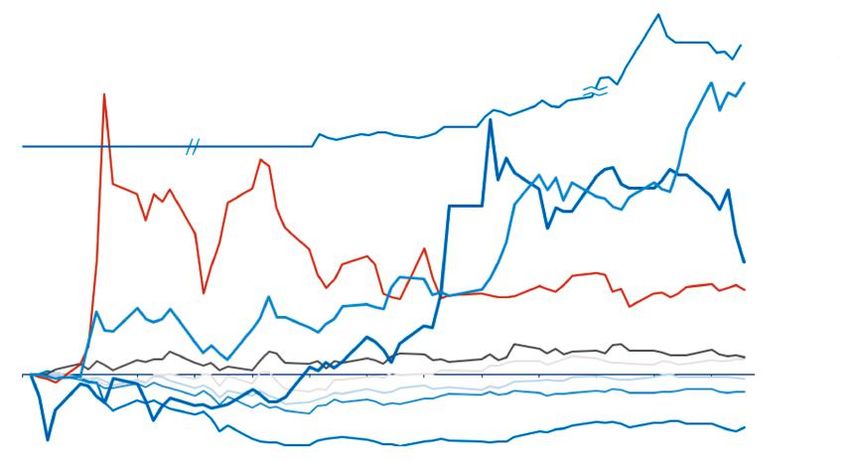
Pharma: Strategic realignment for a 114/115
better future
Prism / 2 / 2020
Acceleration of R&D: The urgency to identify
2.
1 789% treatments (from either new or approved medicines)
Genedrive
and vaccines has caused health authorities to turn
253%
Moderna things around with unparalleled speed. This will
raise expectations for shorter timelines in the future.
For example, the US government is working on an
accelerated vaccine program under the name “Warp
speed”4.
Tiziana
97%
73% Vir Techno 3. R
apid adoption of technology and transforming
operations: This involves digital innovation, especially to
13% Gilead
15% Lilly
solve the dilemma of the pharma “innovation paradox”,
-4% Sanofi whereby highly innovative companies in R&D are quite
-15%
S&P 500 conservative in operational innovation.
-46% Sage
Therapeutics
1. Strategy – Realigning the portfolio
17 Feb 24 Feb 2 Mar 9 Mar 16 Mar 23 Mar 30 Mar 6 Apr 13 Apr 20 Apr 27 Apr 4 May 11 May 18 May
Refocusing significant efforts on COVID-19 will not be without
Figure 1: Market performance and volatility of select pharma stocks since
consequences. A dollar can be spent only once, and even
the S&P 500 peak on February 19, 2020
though people and systems can be more productive, this
will inevitably lead to de-prioritization of R&D activity in
This work is driving collaboration between pharma companies,
other areas.
research institutions and government agencies, and does not
even include ongoing projects in the diagnostics industry.
• A significant number of companies are allocating
substantial resources to either developing or identifying
In this article we look at the impact of the crisis on life
treatments or developing vaccines for COVID-19
sciences and the long-term prognosis, and suggest some
(Figures 2 and 3). This will require reallocating resources
priorities for executives to consider in order to position
(people, facilities, budgets), which will lead to other
their companies best.
programs being delayed or cancelled. As it is difficult to
cancel an ongoing clinical trial, this will mostly impact
The impact of COVID-19 on life sciences programs that have not yet started. This means for
some patients it will take longer for treatments to
Our assessment is that the industry will see significant
become available, or it may not ever happen. Clinical
change in at least three areas:
programs have expiration dates linked to patents, and
must be executed by certain times to be attractive
Strategy – realigning the portfolio: Companies that
1.
commercially.
are allocating significant resources to COVID-19 are
forced to re-prioritize their limited resources, reducing
4. sciencemag.org – 12 May 2020
their focus on other activities.
Pharma: Strategic realignment for a                      116/117
                                                                           better future
                                                                           Prism / 2 / 2020

Organizations in the race for vaccines                                            scenarios hold learnings that are being leveraged) and
                                                                                  compelling regulators to (re)act much faster than they are
                                                  Pre-clinical   Phase 1          used to. Clearly these are extraordinary circumstances,
                                     BioNTech                                     and some of this progress will fall away when the
                         CanSino Biologics                                        situation normalizes. However, some of the lessons
                                                                                  that companies and regulators are learning should stick,
                   Inovio Pharmaceuticals
                                                                                  which will result in a smoother and faster process. Certain
                     Modern Therapeutics                                          caveats remain – a clinical trial that takes two years to
                                       Sinovac                                    perform cannot feasibly be delivered in less time. The
                       University of Oxford                                       randomized clinical trial will remain pre-eminent.
                    Arcturus Therapeutics
  Clover Biopharmaceuticals and GSK                                        Companies in the race for treatments
                                       CureVac                                                                                     Pre-clinical   Phase 1   Phase 2   Phase 3
                 Imperial College London                                                     Alexion Pharmaceuticals
                      Johnson & Johnson                                                                  Gilead Sciences
                                      Novavax                                                          Roivant Sciences
                            Sanofi and GSK                                                                        Athersys
    University of Queensland and GSK                                                                    Ascletis Pharma
                                                                                                                 Celularity
    Figure 2: Biopharma companies and research organizations are racing
                                                                                                                      I-Mab
    to combat COVID-19
                                                                                          Ridgeback Biotherapeutics
   Source: STAT COVID-19 Tracker - 14 May, 2020
                                                                                                                     AlloVir
                                                                                                                    Amgen
   •	M&A opportunities: Although the industry is generally
      cash rich, there are plenty of early-stage companies                       AstraZeneca and Vanderbilt UMC
      that will find it hard to survive this crisis, and others that                                               Celltrion
      are currently vulnerable due to other factors. This may                                                        Eli Lilly
      mean good acquisition opportunities for private equity,                                                        Grifols
      venture capital and larger pharma companies.                                            Neurimmune and Ethris
                                                                                                                          Pfizer
2. Acceleration of R&D
                                                                                        Regeneron Pharmaceuticals
                                                                           SAB Biotherapeutics and CSL Behring
The pandemic is forcing companies, regulators and
                                                                                Takeda, CSL Behring, Biotest, BPL,
governments to enhance collaboration and speed up R&D
                                                                                            LFB and Octapharma
activity in multiple ways. Regulators have demonstrated that
                                                                                                      Vir Biotechnology
they can act fast if they need to, and this potentially sets new
standards for the future.
                                                                           Figure 3: Biopharma companies and research organizations are racing
                                                                           to combat COVID-19
   •	The urgent drive for treatments and vaccines is forcing
                                                                           Source: STAT COVID-19 Tracker - 14 May, 2020
      companies to do things in ways they haven’t done
      before at this scale (although the Ebola and H1N1
Pharma: Strategic realignment for a 118/119
better future
Prism / 2 / 2020
3. Rapid adoption of technology and transforming These are just two areas, and beyond innovation and
operations operations, it may have a dramatic impact on culture. Taking
risks in operations, rather than just in major development
The pharmaceutical industry is home to an interesting programs, will become acceptable. Companies will therefore
paradox. It has a well-deserved reputation for innovation, need to develop new capabilities to manage these.
based on its R&D output and scientific prowess. However,
when you shift from science to operations there is generally Long-term prognosis for the industry
resistance to innovation and doing things differently. This
means that while organizations have been looking at options Everyone now uses the already-cliché phrase “the new
for telehealth, virtual trials, wearables, etc., progress has been normal”. Pharma executives, who are used to thinking long
cautious and slow. term while, at the same time, providing shorter-term updates
to Wall Street analysts, are looking well beyond the crisis
From an operational perspective, most of the pharma industry and planning how to best position their companies to take
has rapidly adopted working from home, opening quite a few advantage of the changed world.
eyes along the way. Remotely selling medicines or conducting
clinical trials is a lot harder, but significant efforts are being Currently, it appears the life sciences sector is not going
made to adapt operations. Research labs and manufacturing to be hit very hard financially. Although there is significant
facilities need to maintain core operations on site, but the longer-term uncertainty, compared to other sectors pharma
overall impact has been enough for pharma executives to is positioned to come out well. There will be strategic
start making plans for (radically) new ways of working: opportunities for new operating models, increased
productivity from new and accelerated technology, and
• Pharma has been reluctant to adopt digital beyond iPads potentially more efficient ways to market as regulators
for sales reps and other logical applications. COVID-19 change how they operate.
has radically changed this attitude, with future concepts
now up and running. With pharma associates not However, the overall environment will change significantly and
allowed into hospitals to monitor clinical trials, sales reps impact how well pharma companies can recover and grow:
not welcome at doctors’ offices, and patients unwilling
or unable to go to trial sites to get their medications or
undergo their assessments, companies have had to
be agile to maintain the integrity of trials and protect
their major investments. This has opened the door
to home visits (a key component of virtual trials) and
implementation of telemedicine, which are expected to
be here to stay.
• The same applies to working arrangements, with
companies concluding that they can safely rethink these
quite radically.Pharma: Strategic realignment for a 120/121
better future
Prism / 2 / 2020
• T
he general economy: Over 40 million people lost their Coronaviruses are here for the long term: Most
•
jobs in the US due to the coronavirus outbreak by late experts expect that the current coronavirus, and
May 20205, and a study by the Kaiser Family Foundation potential new ones, will not depart soon. This means
estimates that more than 27 million Americans may the pharma industry has a role to play in the long
lose health insurance, with almost 6 million of those term, and a commercial model is needed. This needs
not eligible for any subsidized coverage6. In Europe to fit with public expectations to avoid impacting
and Asia the impact will be different and slower, but the industry’s reputation. For example, in early May,
governments everywhere have gone very deep into the pricing of Remdesivir by Gilead (the first therapy
the red, which has led to increasing pressures on approved for COVID-19) was a hot topic. Of all the
budgets. Healthcare costs are an obvious target, which companies engaged in COVID-19-related trials, most will
means drug prices will be under close scrutiny. This just come out of it with experience and goodwill. A few
will impact the top line, and executives have to look at will be successful, and given the size of the market for
how to maintain margins, including new opportunities both therapy and vaccines, blockbuster status seems
uncovered during the crisis. Hospitals have been hard assured. The global vaccine market has already been
hit financially, which will impact their spending and growing at a healthy rate (Figure 4), which is now likely
ability to support clinical trials going forward. to improve. Scaling fast and globally will be a challenge,
but is a core competency of big pharma. Who “wins”
Operational transformation: Having been forced into
• could impact the whole industry – as shown by the
wholesale adoption of technology much faster than share price of Moderna quadrupling in less than three
anticipated or desired, life sciences companies will months on high hopes for vaccine development.
come out of the crisis with a new set of capabilities and
59
a thirst for putting them to work. Telemedicine, artificial 54
intelligence and machine learning, data science, and a 49
range of digital tools are now being used in clinical trials, 44
sales activities and other areas. The drive to implement 40
36
and innovate outside R&D has become stronger. Full 32
transformation will not happen overnight, but the
industry will not return to pre-crisis operating methods.
5. New York Times – 28 May 2020
6. Kaiser Family Foundation – 13 May 2020
2014 2015 2016 2017 2018 2019 2020
Figure 4: A view of global vaccine revenue ($BN) with 2019 and 2020
projected. The COVID-19 vaccine, once available, will change this picturePharma: Strategic realignment for a 122/123
better future
Prism / 2 / 2020
Insight for the executive
The crisis is an opportunity for the pharmaceutical industry
to do what it excels at – developing innovative therapies and
vaccines by using its scientific and operational capabilities,
and as a side benefit, enabling the sector to reshape its public
image into something much more positive. In our view, the
life sciences sector will come out of this crisis stronger, but
this won’t happen automatically. There are some takeaways
for executives as they position themselves for the new
normal:
• Consider current strategies relative to the new
environment. What is changing in the therapeutic areas
in which you are active, and do you need to adapt? Are
there any assets out there that are complementary to
your portfolios and can be acquired for good prices? Is
the risk landscape changing?
• If the R&D timeline is shortened, what does that mean
for you specifically? Where in your organization do you
need to change and bolster capabilities so you can take
maximum advantage of a shifting landscape and time
lines? If you make those choices now, you will have a
head start when the “new normal” becomes actually
normal.
• Pharma needs to step up the development of data
science and digital capabilities. Companies understand
this, and although some have made progress, it needs to
become ubiquitous. This will push pharma over the hump Ben van der Schaaf
and turn it into the data industry it really wants to be. is a Partner in Arthur D. Little’s New York office and a
member of the Healthcare & Life Sciences Practice.
Lastly, if you are not in the coronavirus rat race of developing
COVID-19 therapies or vaccines, build an understanding of the Aurelien Guichard
areas de-prioritized by others, and execute your strategy to is a Manager in Arthur D. Little’s Houston office and
take advantage. Patients need it. a member of the Healthcare & Life Sciences and
Operations Management Practices.You can also read


