PHD STUDENT HANDBOOK THE DEPARTMENT OF ENERGY, ENVIRONMENTAL & CHEMICAL ENGINEERING - DEPARTMENT OF ENERGY ...
←
→
Page content transcription
If your browser does not render page correctly, please read the page content below
The Department of Energy,
Environmental & Chemical Engineering

PhD Student Handbook                   2018-2019

eece.wustl.edu
Welcome to the Department of                                                                            Table of Contents
Energy, Environmental & Chemical                                                                        Policies, Registration & Advising 		           1
Engineering
                                                                                                        Qualifying Examination 			                     3
The Department of Energy, Environmental & Chemical Engineering (EECE) brings
together an interdisciplinary group of faculty to tackle global challenge problems
                                                                                                        Selection of Permanent Adviser 		              3
related to energy, environment and health. EECE provides integrated and
multidisciplinary programs of scientific education in cutting-edge areas organized
through four clusters: Aerosol Science and Engineering; Engineered Aquatics                             Requirements for PhD Degree 		                 4
Processes; Metabolic Engineering and Systems Biology; and Multiscale Engineering.
Degrees granted by the Department include: BS in Chemical Engineering; BS                               Financial Assistance 			                       6
in Applied Sciences in Chemical Engineering; Master of Engineering in Energy,
Environmental & Chemical Engineering; Master of Science in Energy, Environmental                        Core Courses 				 7
& Chemical Engineering; and PhD in Energy, Environmental & Chemical Engineering.
We welcome you to browse through this handbook to review the details and
                                                                                                        Forms 					 8
requirements of the PhD program.
Department Facts                                                                                        Staff 					 8
»» 114 undergraduate students

»» 31 Master of Engineering students                                                                    Faculty & Other Appointments 		                9

»» 85 PhD students

»» 19 tenured/tenure-track faculty

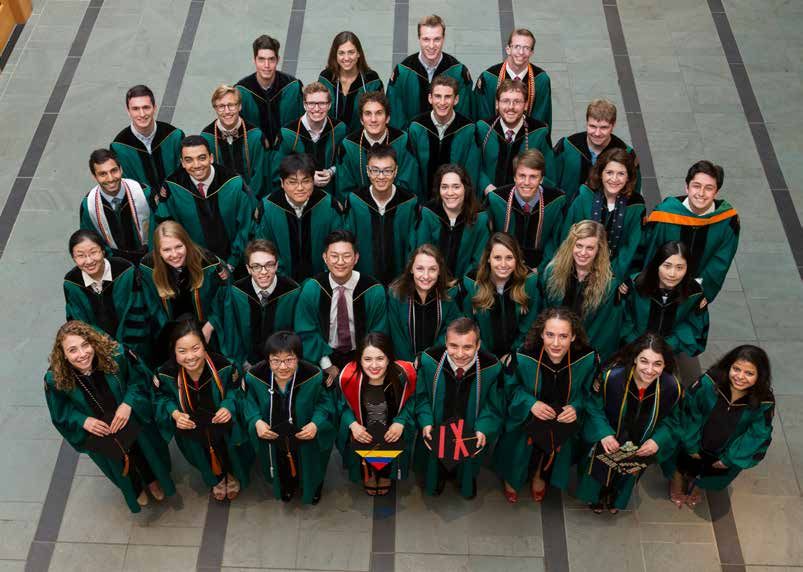
»» 2,870 alumni                                                                                         Cover image: PhD students in the Foston Lab

»» 138 referred journal publications (2017)

»» $7.4M in research expenditures (FY18)

»» No. 6 by the latest National Research Council Ranking
   of Doctoral Programs in Environmental Engineering Science

                                                                           Chair
                                                                        Pratim Biswas

                                  UG Program Director                                          Grad Program Director
                                         Yinjie Tang                                                   Young-Shin Jun

                                                         ac ad emic a n d r e se a r ch clust e rs

                       Aerosols                           Aquatics                      Multiscale                 Metabolic Engineering
                     Brent Williams                    Daniel Giammar                   Vijay Ramani                     Yinjie Tang

                                                             f u nde d r e se a r ch clust e rs

          CASE                             CCCU                           MAGEEP                          NRF/SEAL                     Energy Future
        Jian Wang                     Richard Axelbaum                  Pratim Biswas                   Pratim Biswas                   Vijay Ramani
Policies & Regulations Registration
A key objective of the PhD program is to promote cutting- edge Registration takes place each semester on dates announced
multidisciplinary research and education in the thematic areas of by WashU. Detailed instructions for registration plus necessary
Energy, Environmental & Chemical Engineering. The PhD student materials are mailed directly to all graduate students enrolled
closely interacts with his or her adviser in designing a program of during the previous semester.
study and research.
All graduate students in the department must register each
Students are admitted to the program by a competitive process, semester until all degree requirements are completed. The
and they start in the fall semester. The student is supported in the maximum time period for completing all PhD degree requirements
first year by fellowships provided by the Department. All students is seven years.
will be expected to have mentored teaching experience in the
There are three categories of registration:
second or third year of residency in the Department while they are
collaborating with their mentor on research. Active: Normally, students register in this category for a
minimum of nine credits each semester until they have earned
Temporary advisers will be assigned when the graduate students the total number of credit hours required for their degree. Near
are admitted. On arriving at WashU, the student will be advised the end of the student’s program, or after 72 credits are on the
by the temporary adviser on all academic procedural issues. The student’s record, he or she can register for less than nine credits
permanent faculty adviser will be assigned in December of the first but must enroll in EECE 884.
year of residency in the program.
Inactive: Students who have not completed their course
The following is a brief summary of the requirements for requirements but who, because of personal reasons, must
PhD students: suspend their studies temporarily, may register as inactive
students with the approval of their adviser and the Department
1) Base competency in core subject areas demonstrated by
passing the qualifying examination in first year of residency Chair. The School of Engineering & Applied Science sets the
in the program registration fee for inactive status.
2) Research rotations in first semester of study prior to choosing Special: Students who have earned the required number of
a permanent adviser credit hours and who have only to complete the writing of a
3) Demonstrated teaching experience as per graduate school dissertation may register as special students (register for
teaching requirement EECE 884, as per details above). This status is not appropriate
for students who are still actively engaged in the performance
4) Minimum of 36 credits for coursework and minimum of
of research.
30 credits for PhD research; total of 72 credits to earn the
PhD degree
Students who fail to register in one of the previously mentioned
5) Defend a proposal within 18 months of passing the qualifying categories will automatically have their graduate standing revoked.
examination Students whose graduate standing has been revoked may apply
6) Defend PhD dissertation by making an open oral seminar for reinstatement. There is an application fee for reinstatement
presentation, followed by questions from the dissertation ($100). Students seeking reinstatement may be required to take a
committee members special reinstatement examination and to repeat any previously
met requirements that fails to meet contemporary standards.
The purposes of this handbook are to provide guidance to
Candidates for the PhD degree who apply for reinstatement may
PhD students in EECE and to inform students of department-
be required to repeat the qualifying examination.
specific policies.
Helpful website — Graduate School:
graduateschool.wustl.edu
Graduate Student Handbook 2018-2019 1First-year Advising Rotation Requirements
Each student will complete the two research rotations by
Academic Adviser the end of the first semester. At the conclusion of each rotation,
Each entering graduate student will be assigned a temporary the student will submit a 10-page report for that rotation to
academic adviser by the Department Chair. This adviser will the EECE Academic Program Coordinator, Ms. Irma Adams.
be a full-time faculty member in EECE and will be responsible for The two 10-page reports will be evaluated by the Committee
acquainting the student with degree requirements, initial choice of Graduate Study as part of the Qualifying Examination. The
of classes as per guidelines, required laboratory rotations and format of each report is specified in the following:
seminar.
Up to 10 pages of single-space, Times New Roman pt. 12 font,
Research Rotation EECE 508 (Fall, First Year) one-inch margins, with the references separate (not included in
All first-year students will do research rotations in two laboratories as the 10-page limit).
per availabilities developed based on faculty interests. After meeting
with four or more professors to discuss research opportunities, Report Sections*:
students will submit at least three choices for the lab rotation. Based
on the choices, the Graduate Program Director, in coordination with Summary (max. 250 words) half-page
the faculty, will make the two matches for the student rotation. The
first-year PhD student will be in each laboratory for five weeks. Two Motivation, Objectives & Significance 1 page
rotations will be done in the fall semester. The student must sign up
for the zero credit course — EECE 508 (Pass/Fail option), and students
Brief background 1-2 pages
are expected to conduct research at least six hours per week, with the
details established in discussion with their mentor. Students will also
be responsible for submitting a brief report based on the research Research accomplished
conducted. (methods, results and discussion) 3-5 pages
Research Rotation Preference Form
Conclusions and recommendations
Based on the meeting with professors and the availability
for future research 1 page
of projects, the students will fill out the Research Rotation
Preference Form by Sept. 5 (4 p.m. to the department office).
* If a paper is being prepared or submitted, it may be attached in
As part of completing the form, the students are required to
addition to the report.
meet with four or more potential faculty mentors and to record
those meetings on the Research Rotation Preference Form. The
students will identify at least three faculty laboratories as their
choices for their rotation. The faculty choice should be made
within the faculty list in the Research Rotation Preference
Form. Faculty will also provide their preference information to
the department.
Research Rotation Selection
The faculty will review the research rotation preference sheets
and match each student to two rotation mentors. Under
exceptional circumstances, students will be allowed to update
their rotation assignments (after the first rotation). Any such
change must be approved by the Graduate Program Director,
the Department Chair and the faculty duly informed.
2 Department of Energy, Environmental & Chemical EngineeringQualifying Examination submitted to the faculty mentors at the end of the respective
research rotation.
The EECE PhD qualifying examination is to be taken in May of the first 4) For an oral examination, questioning will not rehash the
year of study in the program. It is administered by the EECE Graduate performance in written exams — but instead evaluate for
Committee and department faculty as appointed by the Chair. Details independent thinking and communication skills. The student
of the examination and other requirements are provided: should start the session with a five-minute (verbal with two
slides) presentation of his or her research interests. Following
1) Students should take the core EECE classes:
this, the oral examination committee will ask questions to
a) Transport Phenomena in EECE (EECE 501, fall)
judge the capabilities of the student.
b) Mathematical Methods in EECE (EECE 503, fall)
The final outcome of the EECE PhD qualifying examination will be
c) Students should take elective classes in at least two determined by the EECE faculty based on the recommendation of
cluster areas
the EECE Graduate Committee. The student can receive a Pass/
d) Do two independent research rotations in their Conditional/Fail grade for the examination.
first semester (EECE 508)
If the student fails the EECE PhD Qualifying Examination, he or she
e) The seminar (EECE 509) is required for all semesters of
residency in the PhD program. can petition to obtain a master’s degree. The requirements for the
master’s degree have to be met, and no financial aid is guaranteed
f) Students must obtain a cumulative GPA of 3.25 to appear for
to failed students after the first year of study. Failed students may
the written examination [Cum. GPA => 3.25] Only rigorous
engineering or science courses will be counted in the request to re-take the Qualifying Examination based on a petition.
cumulative GPA requirement calculations. Research course or This petition should be submitted in writing to the Department
independent study will not be counted in Cum. GPA. Chair within a week of receiving notification. The decision to re-
2) Two written tests selected from a menu of four: aerosols, take will be based on the student’s performance (e.g., GPA, written
aquatics, metabolic engineering or multi-scale engineering. and oral qualifying examinations, research rotations, and feedback
The students are expected to be familiar with content covered from the faculty and the student’s adviser) and will be made by the
in the following anchor courses of each cluster, respectively: Department Chair and the Graduate Program Director. It should be
noted that the student has no guarantee of financial support from the
a) Aerosol Science & Engineering
Department in the interim period (until the EECE PhD qualifying exam
(EECE 504 Aerosol Science and Technology, fall)
is passed).
b) Aquatics (EECE 505 Aquatic Chemistry, fall)
Regarding Conditional, if students fail to satisfy the condition
c) Metabolic & Systems Biology (EECE 506
Bioprocess Engineering I, spring) from the decision letter of the qualifying exam within one year, the
students will be advised to withdraw from the PhD program and
d) Multi-scale Engineering (EECE 501 Transport Phenomena,
fall; and EECE 507 Kinetics and Reaction Engineering financial support will be terminated.
Principles, spring)
Each cluster-specific test question will be prepared and graded by at Selection of Permanent
least two faculty members. The questions will be comprehensive and
an in-depth evaluation of the students’ skill sets in the proposed area.
Adviser
Scores for each group will be normalized by the PhD committee to After completing the second rotation by Dec. 3 of the first year,
ensure grading is uniform across the clusters. students will submit their top four choices for an adviser on the
Permanent Adviser Choice Form to the EECE Graduate Program
The student should choose the two areas based on the research
Coordinator. At the same time, each faculty member will notify the
cluster that he or she want to eventually do research in (e.g., if a
Graduate Program Director of (a) the number of students that he or
student is interested in researching with faculty in the aerosols
she wishes to advise and can support beginning in September 2018
cluster, he or she should answer test a); and choose one other area for
and (b) his or her ranked preferences of students to advise. Shortly,
breadth). The qualifying exam guideline will be provided in the EECE
the faculty will make the permanent adviser assignments. Students
Orientation Package.
will begin research with their permanent adviser in December. At
3) Do two independent research rotations (not with the same the end of the first semester (December of the first academic year),
faculty). The faculty mentor will assign a Pass or Fail. A students should find their permanent advisers. If a student cannot
Pass from two different faculty members is needed to Pass find a permanent adviser by the end of May of their first year, the
the qualifying examination. This will be based on reports student will be withdrawn from the PhD program.
Graduate Student Handbook 2018-2019 3Requirements for PhD Degree proposal are included in the last portion of this section. This proposal
will be submitted to the Thesis Committee at least one week prior to
Academic Requirements a Thesis Proposal Examination consisting of an oral presentation and
Candidates for this degree must complete a total of 72 credits questions before the committee. Regarding the Thesis Committee,
beyond the bachelor’s degree. Of these, a minimum of 36 must four of the five must be tenured or tenure-track Washington
be graduate coursework and a minimum of 30 must be doctoral University faculty; one of these four may be a member of the Emeritus
thesis research units. To be admitted to candidacy, students must faculty. The fifth member must have a doctoral degree and an active
have completed at least 18 credits at WashU, have an overall GPA research program, whether at Washington University, at another
equal or greater than 3.25 and pass the qualifying examination. The university, in government, or in industry. Three of the five must come
student must also have completed the research rotations and have from the student’s degree program; at least one of the five must not.
selected a permanent adviser. The committee is appointed by the Dean of the Graduate School upon
the request of the Department Chair or Graduate Program Director.
Transfer Credits: At most, nine graduate credits in a master’s Any exceptions to the normal composition of the committee should
program from another university may be counted as transfer credits be discussed with the Graduate Program Director and be approved
toward the required 36 units of coursework. PhD students can apply by the Dean of the Graduate School. The thesis proposal should be
for transfer credit only after they have passed the PhD qualifying successfully presented within 18 months of passing the Qualifying
exam by submitting a formal petition to the department. Examination and at least 12 months prior to graduation.
Maximum Research Units per Semester: At most, nine units of The student must met with the thesis committee (either as a group
research units may be taken in a semester. or individually) annually or submit an annual report to thesis
committee. The annual report can consist of one to two pages of the
Seminar Credits: The one-unit EECE seminar course may be taken
student’s research progress summary.
for graduate coursework credit in up to six semesters for a total
of 6 units. A student who has passed the Thesis Proposal Examination,
completed 30 units of required coursework toward the PhD
Independent Study Credits: At most, three units of coursework may
degree and published or submitted at least one first author
be taken as graduate independent study. An independent study must
peer-reviewed manuscript from the thesis research is eligible to
be entirely separate from study done as part of the graduate thesis
receive an MS degree along the way. No independent study credits
research. The student should prepare a proposed plan of study to
can be counted towards MS along the way. The publication and
be completed, and this plan must be described on the Independent
submission of the manuscript must be with the approval of the
Study Petition Form approved by the independent study instructor,
research adviser. Students must submit their request to receive the
student’s adviser, Graduate Program Director and Department Chair
MS degree at least one year before the thesis defense. The granting
for the independent study credits to count toward the 36 required
of the MS degree along the way is by approval of the Advisor and
units of coursework. This credit will not be counted toward the
Graduate Program Director.
cumulative GPA for a qualification exam requirement.
The following guidelines are recommended for the
400-level Courses: Courses must be 500-level graduate courses,
PhD Thesis Proposal:
except for up to three 400-level courses, provided that
they are approved by the Graduate Program Director and 1) The main body of the proposal should include
Department Chair. • Executive summary (no more than one page)
• Introduction (no more than five pages)
Thesis Proposal
(must be completed within 18 months after qualifying exam) • Research objectives (no more than two pages)
• Preliminary work (no more than five pages in the body of the
Following successful completion of the qualifying examination, the
proposal; additional preliminary data or papers can be included in
student and adviser will decide on a suitable problem whereupon the
the Appendices)
student will prepare a comprehensive written research proposal that
includes a thorough survey of the field, a discussion of those areas • Research plan (no more than 15 pages)
needing further research, and a tentative but clear definition of the • Timeline (no more than one page)
proposed research. Results of preliminary studies or feasibility studies • References (as needed)
should be included. The format and guidelines of the PhD thesis
4 Department of Energy, Environmental & Chemical Engineering2) The following Appendices should be included at the end requirement at this level. Therefore, all PhD candidates shall give at
of the proposal: least two formal presentations at the departmental or university-
• List of courses taken and to be taken with grades wide, or local level or at a national or international conference.
Among the presentations, at least one presentation should be oral
• Mentored teaching experience
at a national or international conference (this last requirement may
• A short CV of the student highlighting conference presentations be waived upon approval of the Graduate Studies Committee).
and journal papers (published/submitted/to be submitted)
During the semester, PhD students will have mentored teaching
• Copies of papers (optional)
experience in addition to the normal coursework and research that
are expected by the research adviser.
3) Font: Times New Roman
Thesis Defense
Font size: no less than 11 points
Upon completion of the thesis, candidates must present the
Line spacing: single-spaced
thesis in a public forum and successfully defend the thesis before
Page margin: one-inch margin around the pages their Thesis Committee. Students must submit their completed
thesis to the Committee at least two weeks prior to the defense.
PhD Students are referred to the National Science Foundation (NSF)
Without the approval of the committee members two weeks in
Guidelines for Proposal Writing Document as a reference.
advance, the defense process cannot be proceeded and the room
Mentored Teaching Experience will not be reserved. The student should also have submitted at
All students must have mentored teaching experience or assist in least one paper to a peer-reviewed journal prior to defending his
some teaching activity in the Department for at least two semesters or her thesis. Normally students are expected to have at least one
prior to graduation; in some cases, a student may be required to paper accepted in a peer-reviewed journal, and at least another
have mentored teaching experience in more than two semesters. paper submitted prior to graduation. Presentation at national
The Department has in place a fair process to assign students for conferences is also encouraged. At least four committee members
mentored teaching experience. This will normally be done after must be present at the defense (including the chair). Members of
the first year and after having passed the Qualifying Examination. the Dissertation Defense Committee normally attend in person,
In having mentored teaching experience, students should but one of the five (or, in case of an emergency, one of the four)
meet the Graduate School-wide Teaching Requirement for PhD members may attend virtually instead. Otherwise, the student
Candidates; details of fulfilling teaching requirements are described must reschedule the proposal/thesis defense.
in the Teaching Requirement Form with Policy Statement on
graduateschool.wustl.edu.
The mentored teaching experience may include, but is not limited
to: giving an actual lecture in an undergraduate class with the
instructor in attendance, introducing/interpreting laboratory
exercises, or conducting formal help sessions before exams. The
student who conducts mentored teaching experience will also
be expected to hold one-on-one office hours and participate in
grading homework assignments and exams. Both the students and
the instructor will evaluate each performance, and the Graduate
Studies Committee will use these evaluations to determine whether
the teaching requirement has been fulfilled for that semester. All
the PhD candidates are also required to attend one of the teaching
workshops offered by Teaching Center for the formal pedagogical
training prior to or during their first semester of the mentored
teaching experience in EECE.
PhD candidates shall also accumulate teaching experience at the
advanced level. Presenting one’s research in formal settings to
other graduate students and faculty is the best way to fulfill the
Graduate Student Handbook 2018-2019 5Financial Assistance not have a permanent adviser, they should consult their first-year
advisers to schedule any time off. Absence of research assistants
All full-time PhD students in good standing will receive financial must be scheduled so as not to impede the progress of an ongoing
assistance. Students are expected to discuss their financial aid research project and should be approved by the research adviser.
needs before finalizing their choice of an adviser. Academic
achievements and satisfactory performance in research and other
educational requirements while at WashU are the primary factors Other Policies
governing continuation of financial aid.
Seminars
Students who are placed on academic suspension will automatically Each year the department sponsors or participates in a series of
have their financial assistance cancelled, effective with the date of seminars by visiting lecturers and WashU faculty and students.
suspension. All full-time graduate students are required to enroll in EECE 509-
Research assistants receive a regular monthly stipend. A research Graduate Seminar, which is an S/F course carrying one unit of
assistant is normally not permitted to register for more than nine coursework credit. Full-time graduate students may receive up to
hours of graduate credit per semester after the first year. To derive six units of coursework for EECE 509. A passing grade (S) is required
the maximum educational benefit of research, a minimum of 20 hours for each semester for all full-time students and is earned by regular
per week is required by research assistants. attendance at these events.
However, graduate assistants whose thesis research coincides or If a student plans to miss or misses a seminar, they are required to
overlaps with their other research are expected to devote more than notify Ms. Irma Adams with a reason for the same. Missing more than
this minimum effort to research. The student’s diligence and devotion a certain number of seminars may require the student to make up
will be important factors to determine if the student is making work to obtain a passing grade. If a student misses more than three
satisfactory progress toward the completion of his or her degree. seminars in a given semester without a legitimate excuse, the student
will obtain an “F” grade.
Research assistantships are continued during the summer. Summer
appointments receive the same stipend as the academic year, but Copying Service
full-time effort (minimum of 40 hours per week) is expected. Graduate students may not charge copying work to the department
or a research project without prior authorization. Personal copies
Tax Liability
can be charged to a student’s personal account. The cost of copying
The taxability of the various types of awards described above is
and binding dissertations beyond the three copies required by the
determined by current policy of the U.S. Internal Revenue Service
department is considered a personal obligation.
(IRS). It is prudent to assume that all stipends are fully taxable and
that tax will be withheld. Questions concerning any individual’s tax Annual Reviews
liability must be referred to the IRS. All graduate students should meet with their advisers on a routine
basis. Every summer, the student will undergo a formal review of
Outside Employment
his or her progress by the adviser. A standard form given by the
Holders of fellowships, traineeships and assistantships are required
EECE department will be used. The faculty member is responsible
to devote their full effort to graduate studies. They are not permitted
for completing the review; and it is the student’s responsibility to
to engage in any outside employment without special permission of
remind the adviser to ensure that these reviews must be completed
the adviser and Department Chair.
annually by the end of the summer every year.
Time Off
Graduate students receiving financial support are expected to
commit themselves fully to their studies and research. Intersession
periods listed in the university Academic Calendar denote times when
classes are not in session, and graduate students are expected to
devote themselves full-time to their research during these periods.
Students on full support are permitted to take off a maximum of
two weeks during the calendar year for holidays, interview trips,
etc. Additional time off can be arranged in discussion with the
research adviser, but may result in a reduction of the student’s
stipend. During the first year in the program when students do
6 Department of Energy, Environmental & Chemical EngineeringCore Courses Menu of Graduate-level Elective Classes
(Please review list of exact offerings each year — current listings of
Students formulate their course program in consultation with their courses are maintained at eece.wustl.edu.)
adviser. The student is expected to be proficient in the following
core courses. PhD students are strongly urged to take at least three Aerosol Science & Engineering
graduate-level classes (400-level or higher) outside the Department 1) EECE 504* Aerosol Science & Technology (fall)
during his/her PhD program. These courses can be selected based
2) EECE 502 Advanced Thermodynamics in EECE (fall)
on discussion with their adviser and research interest areas.
3) EECE 512 Combustion Phenomena (fall)
Courses are offered to PhD students in two required core areas.
The courses corresponding to these areas are: 4) EECE 514 Atmospheric Science & Climate (spring)
a) EECE 501* Transport Phenomena in EECE 5) EECE 510 Advanced Topics in Aerosol Science &
Engineering (spring)
b) EECE 503 Mathematical Methods in EECE
Engineered Aquatic Processes
These courses will provide the base knowledge that is expected
of all PhD students in the Department. These classes will provide 1) EECE 505* Aquatic Chemistry (fall)
the fundamentals and the foundation in the topical areas that are 2) EECE 425 Environmental Engineering
essential for successful study and conduct of research in energy, Laboratory (fall)
environmental and chemical engineering.
3) EECE 531 Environmental Organic Chemistry (fall)
First-year students will also register for EECE 508 Research Rotation
4) EECE 533 Physical & Chemical Processes for Water
(zero credits, S/F grade, first semester). During every semester of
Treatment (spring)
residency, students should register for EECE 509 Seminar in EECE
(one credit, S/F grade). 5) EECE 534 Environmental NanoChemistry
(spring in even year)
Students can avail themselves of course sequences in areas of
specialization in the Department. Students are encouraged to Metabolic Engineering
review the same on the Department website (eece.wustl.edu),
1) EECE 506* Bioprocess Engineering 1 (spring)
discuss with their advisers and are encouraged to avail themselves
of these opportunities. In the first year of the PhD program, 2) EECE 554 Molecular Biochemical Engineering (spring)
students must take courses offered by the EECE department. 3) EECE 552 Biomass Energy Systems & Engineering (spring)
Suggested Course Selections for the First-year 4) EECE 551 Metabolic Engineering & Synthetic Biology (fall)
PhD Students
Multi-scale Engineering
Fall Semester (10 credits)
1) EECE 507* Kinetics & Reaction Engineering Principles
1) EECE 501* Transport Phenomena in EECE (spring)
2) EECE 503 Mathematical Methods in EECE 2) EECE 572 Advanced Transport Phenomena (spring)
3) Elective Classes (select from one or more Graduate Level 3) EECE 574 Electrochemical Engineering (spring)
Elective Classes below based on discussions with temporary
4) EECE 576 Chemical Kinetics and Catalysis (spring)
adviser, noting needs for PhD qualifying exam)
5) EECE 591 Energy and Buildings (spring)
4) EECE 508 Research Rotations (zero credits)
5) EECE 509 Seminar in EECE (one credit, Pass / Fail) Taking other graduate classes from Chemistry, Physics, Biology and
other departments in his/her first year must be approved by the
Spring Semester (10 credits) adviser and the Director of Graduate Studies through submitting a
1) Three or four Elective Classes (select from Graduate-level petition letter.
Elective Classes below based on discussions with permanent Courses from the Engineering Continuing Studies (T courses) cannot
adviser, noting needs for PhD qualifying exam) be counted toward doctoral degree course requirements. The
2) EECE 509 Seminar in EECE (one credit, Pass/Fail) courses counted for the doctoral degree should be credit-based
rather than pass/fail option.
* indicates anchor courses for each cluster which students should be familiar
with preparing qualifying exam according to the cluster the student have chosen
Graduate Student Handbook 2018-2019 7EECE Staff
Christine Tilley
Department Administrator
Forms 935-6170
christin@wustl.edu
Contact for:
• Grant submissions & management
List of Forms to be Completed by Students during Period of Study
• Budget/financial inquiries
Form Date Due Receive from & Submit to • Payroll
HRMS Personal Information Upon arrival Department Admin. TBD
Brauer Hall, Room 1015 Academic Program Coordinator
935-6070
Research Rotation Form Sept. 5 (4 p.m.) Program Coordinator Contact for:
Brauer Hall, Room 1015 • Graduate student administration
• Department course listing maintenance
• Faculty support
Permanent Adviser Choice Dec. 3 (4 p.m.) Program Coordinator
Kim Coleman
Thesis Information Form Two weeks before Program Coordinator
Assistant to the Chair
(used to start proposal process) Thesis Proposal Exam 935-5548
kcole@wustl.edu
Teaching Requirement Fulfillment Before thesis defense Program Coordinator Contact for:
• Appointments with Chair
Notice of Title, Scope & Procedure Six months before degree Program Coordinator • Student room assignments
of Dissertation (Thesis) conferral • Website updates & fliers
• Lab and office key distribution
Exit Document Last day at WashU Program Coordinator
Patty Kofron
Administrative Assistant
Post-graduation Job Survey Last day at WashU Program Coordinator
pkofron@wustl.edu
Contact for:
• Coordination of department events
• Conference room reservations/key
List of Forms Completed by Department Faculty or Staff distribution
• Mail and shipping distribution
Form Date Due • Processing of FedEx shipments
• Invoicing
PhD Qualifying Examination Result May of first year
Beth Mehringer
Thesis Proposal Result Upon Completion Accounting Specialist
of Exam 935-6548
bmehringer@wustl.edu
Contact for:
Annual Student Review By end of summer
• Travel reimbursements
(section for student response submitted to adviser) (every year)
• Local reimbursements (check requests)
• Travel advances
Final Program Form Three weeks before
(student will receive form for confirmation) Thesis Defense
Trisha Sutton
Office & Accounting Coordinator
935-6082
suttont@wustl.edu
Contact for:
• Purchase orders
• Grant Submissions
• Paycheck distribution
• e PARs
8 Department of Energy, Environmental & Chemical EngineeringFaculty
aero so l scie n ce & eng i n e er i n g
Pratim Biswas Richard Axelbaum Rajan Chakrabarty Rudolf Husar Elijah Thimsen Jay Turner
Chair & Professor Professor Assistant Professor Senior Professor Assistant Professor Professor & Vice Dean for
935-5482 935-7560 935-6054 935-6099 935-6103 Education
pbiswas@wustl.edu axelbaum@wustl.edu chakrabarty@wustl.edu rhusar@wustl.edu elijah.thimsen@wustl.edu 935-5480
jrturner@wustl.edu
a qu a ti c pr o ce sse s
Brent Williams Jian Wang Daniel Giammar Young-Shin Jun Fangqiong Ling Kimberly Parker
Associate Professor Professor Professor Professor and Assistant Professor Assistant Professor
935-9279 935-5548 935-6849 Director of Graduate Studies 935-8489 935-3461
brentw@wustl.edu jian@wustl.edu giammar@wustl.edu 935-4539 fangqiong@wustl.edu kmparker@wustl.edu
ysjun@wustl.edu
met ab o lic e n g in e e r i ng & s y s tem s b i ol og y
Douglas Allen Marcus Foston Tae Seok Moon Nathan Ravi Yinjie Tang Fuzhong Zhang
Joint Faculty Assistant Professor Associate Professor Joint Faculty Professor & Director of Associate Professor
587-1460 935-7866 935-5026 747-4458 Undergraduate Studies 935-7671
DAllen@danforthcenter.org mfoston@wustl.edu tsmoon@wustl.edu ravi@vision.wustl.edu 935-3441 fzhang29@wustl.edu
yinjie.tang@wustl.edu
mul t is c ale ph e n o m e n a
Peng Bai Milorad Dudukovic Palghat Ramachandran Vijay Ramani
Assistant Professor Professor Professor Professor
935-7911 935-6021 935-6531 935-7924
pbai@wustl.edu dudu@wustl.edu rama@wustl.edu ramani@wustl.edu
o t her appo in t me n ts
Janie Brennan Ray Ehrhard Benjamin Kumfer Trent Silbaugh Avni Solanki
Lecturer Research Associate Research Assistant Professor Lecturer Lecturer
935-9447 935-8589 935-5433 935-3362 935-5157
jbrennan@wustl.edu rehrhard@wustl.edu kumferb@wustl.edu tsilbaugh@wustl.edu asolanki@wustl.edu2018 Graduates Department of Energy, Environmental & Chemical Engineering CB 1180 • 1 Brookings Drive • St. Louis, MO 63130 Phone: (314) 935-6070 • Fax: (314) 935-7211 eece.wustl.edu
You can also read


