Position Paper: Towards a Sustainable Framework for Embedding Development Education in Initial Teacher Education programmes in the Irish Adult & ...
←
→
Page content transcription
If your browser does not render page correctly, please read the page content below
Mark Kearns

Position Paper:
Towards a Sustainable Framework for Embedding
Development Education in Initial Teacher Education
programmes in the Irish Adult & Community Education
Sector
Towards a Sustainable Framework for Embedding Development Education in Initial Teacher Education programmes in the Irish Adult & Community Education Sector

Saolta is a Development Education strategic partnership programme for the Adult and
Community Education sector in Ireland.
Development Perspectives (DP) is the lead partner in the partnership consortium, which also
includes AONTAS, Concern Worldwide, Irish Rural Link and the Adult and Community Education
Dept. of Maynooth University.
Mark Kearns is the research officer with Saolta and has a background in adult and community
education as well as in higher education. In addition to his role with DP-Saolta, Mark works as an
associate lecturer and teaching placement supervisor on the ITE programme for adult and
community education practitioners (PDE-FE) in Marino Institute of Education in Dublin.

                             This project was funded by the Department of Foreign Affairs (DFA). The content of this
                             communication represents the views of the author only and does not necessarily represent or
                             reflect DFA policy.

                              This research has been supported by the EERA/GENE research award. GENE is funded by the
                              European Union and by the national Ministries and Agencies that support GENE.

                                                                                                                                                          2
Towards a Sustainable Framework for Embedding Development Education in Initial Teacher Education programmes in the Irish Adult & Community Education Sector

      Table of contents

              1. Introduction                                                                                                                                 6

              1.1 Background                                                                                                                                  6

              1.2 Purpose of the Paper                                                                                                                        7

              1.3 Guiding Questions                                                                                                                           7

              1.4 Rationale for the proposed Framework: a summary                                                                                             7

              1.5 Framework Implementation: Timeframe; Approach                                                                                               8

              1.6 Outline of the Paper                                                                                                                        8
                                                                                                                                                              9
               2. Development Education: The role and place of Adult Learning & Education
              2.1 DE: A lifelong learning approach                                                                                                            9

              2.2 DE in ALE Worldwide: A lack of progress                                                                                                     10

              2.3 Recent Developments in the RoI-ACE sector                                                                                                   10
                                                                                                                                                              11
              2.4 RoI-ACE: Provision; Scale & Scope for DE
                                                                                                                                                              13
               3. Contextualising DE: Policies & Concepts; Controversies and Debates
              3.1 Embedding DE in ITE programmes: Problems and Possibilities                                                                                  13

              3.2 The need for a critical approach to DE in ITE programmes                                                                                    14

              3.3 DE in ITE- ACE: Scoping experience with ACE-ITE Providers                                                                                   14

              3.4 Building DE Capacity for Student-Teachers & Teacher-Educators                                                                               15

              3.5 Embedding DE in ITE programmes: A Multi-Agency, Partnership Approach                                                                        16

              4: Summary                                                                                                                                      17

              4.1 Rationale for the Framework                                                                                                                 17

              4.2 Achieving the Framework                                                                                                                     17

              4.3 Processes and procedures; next steps                                                                                                        18

               References                                                                                                                                     20

               Appendices                                                                                                                                     25

                                                                                                                                                              3
Towards a Sustainable Framework for Embedding Development Education in Initial Teacher Education programmes in the Irish Adult & Community Education Sector

       List of tables
          Table 1: List of ACE-ITE Providers (RoI)

          Table 2: RoI-ACE: Sectors; sub-sectors

          Table 3: Challenges and Barriers to Embedding DE in ITE Programmes

          Table 4: Capacity Building in DE for ACE Student Teachers & Teacher
          Educators

      List of figures
          Figure 1: Ubuntu Network Framework for Integrating DE in ITE (second level)

          Figure 2: Timeframe for developing a Framework for Embedding DE in the ACE
          Sector

                                                                                                                                                          4
Towards a Sustainable Framework for Embedding Development Education in Initial Teacher Education programmes in the Irish Adult & Community Education Sector

                   List of abbreviations & acronyms
                   ACE: Adult & Community Education

                   AEO: Adult Education Organisers

                   BTEI: Back to Education Initiative

                   CEF: Community Education Facilitators

                   CEN: Community Education Network

                   CFE: Colleges of Further Education

                   CSO: Central Statistics Office

                   CTC: Community Training Centres

                   CWI: Community Work Ireland

                   DE: Development Education

                   DES: Department of Education and Science

                   DFA: Department of Foreign Affairs
                   EAEA: European Association for the Education of Adults
                   EMSSGDE: European Multi-Stakeholder Steering Group on Development Education

                   ERSI: Economic and Social Research Institute

                   ETB: Education & Training Boards

                   EU: European Union
                   FE: Further Education

                   FET: Further Education & Training

                   GCE: Global Citizenship Education

                   GDPR: General Data Protection Regulation

                   IA: Irish Aid

                   IDEA: Irish Development Education Association

                   LDC: Local Development Company

                   NFQ: National Framework of Qualifications

                   NI: Northern Ireland

                   PLC: Post Leaving Certificate

                   PPN: Public Partnership Network

                   RoI: Republic of Ireland
                   RTC: Regional Training Centre
                   SDGS: Sustainable Development Goals

                   UN United Nations

                   UNESCO: The United Nations Educational, Scientific and Cultural Organization

                   VTOS: Vocational Training Opportunities Scheme

                                                                                                                                                              5
Towards a Sustainable Framework for Embedding Development Education in Initial Teacher Education programmes in the Irish Adult & Community Education Sector
Part 1: Introduction
1.1 Background
Development Education (DE) has been prioritized by Irish policymakers for some time now with the
Rep. of Ireland (henceforth RoI) receiving recognition for its leadership and strategic approach in this
area (Krause, 2010; GENE, 2015; GENE 2019). This is guided by, among other things, a commitment to
achieving UN-UNESCO Sustainable Development Goal (SDG) 4.7 which aims to equip all learners with
the skills and knowledge to promote sustainable development, sustainable lifestyles, gender equality
and so forth (UN 2015a). This commitment is encapsulated in successive National Strategy documents
(IA, 2007; 2016) which seek to provide direction, coherence and guidance for ensuring that all Irish
citizens are exposed to quality DE by 2030. While there has been some attempt to provide direction
and support for the large RoI Adult and Community Education (ACE) sector, this nonetheless lags
behind developments in the formal school system with no equivalent provision for embedding DE in
teacher education (TE) programmes for those working with adult learners. This refers to a long-
standing, coordinated effort on the part of policymakers, NGOs, HEIs and others to include DE at the
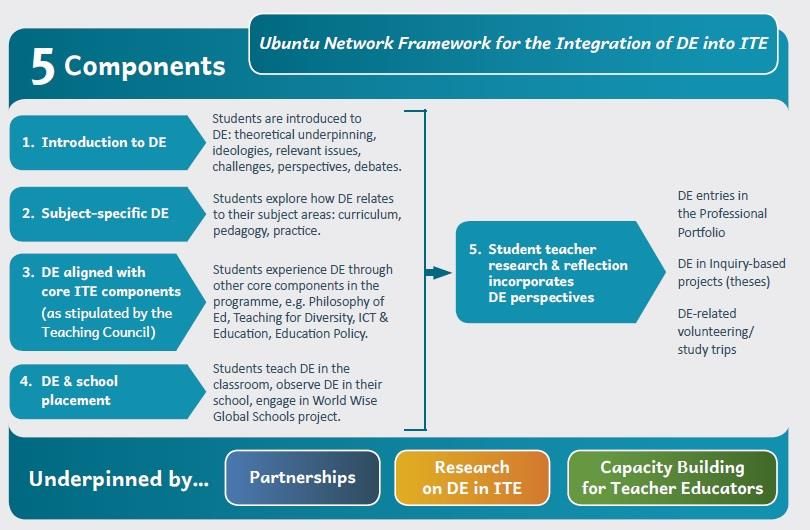
primary and second levels via the DICE and UBUNTU initiatives, respectively. Briefly, these projects aim
to include DE as an integral part of ITE programmes and that this is then embedded in curricula, in
syllabi and in teaching and learning methodologies that encourage school-aged learners to think
critically about DE topics and issues (see for example: Martin et al, 2016). Of particular relevance for
this paper and the proposed Framework is the UNBUNTU model and approach which incorporates
thirteen HEI providers of ITE (PME) at the second level.1
At the same time, recent moves towards professionalization of ACE has now allowed for a more
strategic, joined up approach to embedding DE in ITE in this sector. More specifically, there are eight
HEIs providing formal teacher training for professionals who are currently working, or hoping to work,
with adult learners across a broad range of (formal, non-formal/informal) education provision across
RoI.2 This means that in any given academic year, several hundred newly qualified ACE practitioners
enter the profession for the first time while already established professionals can now gain accredited
teacher status via the Teaching Council of Ireland (TCI).
1
See Appendix I, Figure 1 for a graphic illustration of the Ubuntu Framework for embedding DE in (2 nd Level) ITE programmes
2
A list of relevant providers and respective courses appears in Appendix II.
6Towards a Sustainable Framework for Embedding Development Education in Initial Teacher Education programmes in the Irish Adult & Community Education Sector
1.2 Purpose of the Paper
Given the above, this paper sets out the rationale (purpose) for a Framework for embedding DE in Initial
Teacher Education (ITE) programmes for those working in the diverse RoI-ACE sector. In specific terms,
this will help to inform policymakers, ITE providers and other stakeholders of the need for an intervention
and approach that is specifically geared towards those working with adult learners across a broad range
of formal, informal and non-formal education settings. This in turn reflects domestic as well as
international policy which seeks to extend DE to all learners at all levels and where the concept of lifelong
learning has become the overarching framework for achieving this (UN, 2015a; IA, 2016; UNESCO, 2014).
While the primary focus here is on informing the process of developing a Framework for embedding DE
in the ACE-ITE sector, it is hoped that this will make a broader contribution to the emergent research
dealing with this aspect here in RoI and elsewhere.
1.3 Guiding Questions
Bearing in mind recent policy developments as well as changing Government priorities for DE in RoI and
elsewhere, this paper is guided by the following questions:
1. What is the rationale (purpose) for the development of a Framework for embedding DE in the Irish ITE-
ACE sector?
2. Taking into account existing models and frameworks: how might this be achieved? and;
3. What are the necessary processes and procedures required to implement this Framework?
This is achieved by a review of the relevant literature on the matter with a particular focus on the growing
research relating to embedding DE in ITE programmes. This is further supplemented with findings from
an initial scoping exercise with ACE-ITE programme coordinators in the period March-April, 2021 and
which helped to establish the particular challenges as well as opportunities presented in developing and
implementing a Framework for embedding DE in the RoI-ACE sector.
1.4 Rationale for the proposed Framework: a summary
Based on the above questions, this paper will demonstrate that:
The proposed framework will help bring the RoI-ACE sector in line with developments in other parts of
Irish education, for scaling of DE activity and to extending its reach to adult learners participating across
a broad range of (formal/non-formal/ informal) learning provision. This includes those ‘hard to reach’
groups whose participation in the RoI education system remains marginal3 as well as ‘third-age’ learners
whose participation in DE is often overlooked4
A capacity building approach for students-teachers as well as teacher-educators is proposed and that a
multi-agency, partnership between all relevant stakeholders offers the best chance for developing,
implementing and sustaining this intervention
3
See DES (2019) for a detailed exploration of inequality and barriers to education for marginal groups in the RoI context
4
For a fuller exploration of this point see: Scheunpflug at al.(2009).
7Towards a Sustainable Framework for Embedding Development Education in Initial Teacher Education programmes in the Irish Adult & Community Education Sector
The need for further investigations and researches along with other measures to ensure a Framework
and an approach that this tailored to the specific needs of those working in the sector.
1.5 Framework Implementation: Timeframe; Approach
This paper sits within a specific timeframe and actions for achieving the proposed Framework (Figure 1,
Appendix III). This demonstrates how this will be further developed through the remainder of 2021 with
a view to its implementation on a pilot basis in the academic year 2022-2023. In the meantime, further
consultations with the relevant ITE providers as well other stakeholders will take place on foot of this
paper in order to provide additional guidance on the Framework development, structure, resourcing,
implementation and so on.
1.6 Outline of the Paper
The paper is presented in three further sections. By way of context, Section two looks at some of the key
developments in RoI-ACE and the potential this has for scaling of DE activity in this sector. Section three
focuses on the task of embedding DE in ITE programmes, opportunities as well as challenges, while the
final Section (Four) presents a summary of the key points arising from the research and concurrent
consultations (scoping) with the respective ITE providers.
8Towards a Sustainable Framework for Embedding Development Education in Initial Teacher Education programmes in the Irish Adult & Community Education Sector
Part 2 Development
Education: The role and place
of Adult Learning & Education
2.1 DE: A lifelong learning approach
While there are numerous definitions and descriptions available, a glance at the relevant RoI-based
literature shows a distinct preference for Irish Aid’s definition of DE as:
A lifelong educational process which aims to increase public knowledge and understanding of the
rapidly changing, interdependent and unequal world in which we live. By challenging stereotypes
and encouraging independent thinking, DE helps people to critically explore how global justice
issues interlink with their everyday lives. (IA, 2016, p.6).
A similar description is employed by UNESCO for Global Citizenship Education (GCE) and which invites
‘everyone of all ages and backgrounds to assume active roles, both locally and globally, to face and
resolve global challenges and ultimately to become proactive contributors to a more just, peaceful,
tolerant, inclusive, secure and sustainable world’ (UNESCO, 2014a, p.15). This in turn reflects an
increasing readiness on the part of policymakers globally to see the concept of lifelong learning as
providing the overarching framework for achieving the goals associated with DE (UNESCO, 2014; UN;
2015b). This further reflects the view that Adult Learning & Education (or ALE) represents an important
arena for DE given the potential that this has for engaging a broader range of learners and ‘hard to reach’
groups through a range formal, informal as well as non-formal education interventions (EAEA, 2019;
Bridge 47, 2019; UNESCO, 2019; ICAE, 2020). To take one example, in their recent Manifesto for Adult
Learning the European Association for the Education of Adults suggest that in addition to making a
significant contribution to social inclusion, active citizenship as well as personal benefits, adult education
is an important driver in the interconnections of the three dimensions of sustainable development -
economic, social and environment. The Association further notes the significant role played by adult
education in achieving the UN 2030 SDG Agenda:
Adult education provides information, debating spaces and creativity to develop new lifestyles, new
projects, and new approaches necessary for sustainable development. Looking at the global Agenda
2030 …adult learning contributes to the achievement of all 17 Sustainable Development Goals
(SDGs) by building the foundations of change in the social, political, economic, ecological and
cultural spheres (EAEA, 2019. p.18).
Elsewhere, UNESCO (2019) note how ACE professionals form the ‘backbone’ of efforts to integrate GCED
and SDG 4.7 themes effectively in ALE settings, and that this includes facilitators trainers, educators as
well as managers working in this area.
9Towards a Sustainable Framework for Embedding Development Education in Initial Teacher Education programmes in the Irish Adult & Community Education Sector
2.2 DE in ALE Worldwide: A lack of progress…
Despite this emphasis in policy, there is some concern around the progress or rather a lack of progress in
extending DE beyond the formal school system and to ALE contexts (UNESCO, 2019; LLLP, 2020; ICAE,
2020). In their fourth Global Report on Adult Learning and Education (or GRALE 4) UNESCO note that while
there had been some progress in achieving the broader aims for adult education set out by the earlier UN
Framework: ‘Only in respect of SDG target 4.7, concerning access to education for sustainable
development, human rights, gender equity, peace and global citizenship does the survey provide little or
no sign of progress in ALE’ (2019, p.174). Given this lack of progress, the UNESCO Report urged policymakers
to put ALE at the centre of efforts in achieving the UN-SDGs as well as on expanding adult learning provision
to include those groups whose participation in education remains marginal
This report has argued that a focus on participation in ALE is key to achieving the SDGs. This must mean
reviewing policies in the light of the evidence on participation, and investing in sustainable provision
that is accessible to learners from all backgrounds, as well as systematically supporting demand among
those who have been the most excluded in the past. This will enable ALE to play its full, and wholly
essential, part in achieving the SDGs (2019, p.171).
In their earlier GRALE 3 document, UNESCO (2017) report that ALE still receives only a small proportion of
public funding with 42% of countries spending less than 1% of their public education budgets on ALE, with
only 23% spending more than 4%, and thus the need for significant investment in the sector. Elsewhere,
ICAE (2020) note how progress towards achieving the aims of the UN-SDGs has been significantly impacted
by the continuing marginalisation of adult education and of CSOs and networks within the education and
development global network.
2.3 Recent Developments in the RoI-ACE sector
Indeed the relatively poor position of RoI-ACE has been consistently highlighted by domestic commentators
with the sector typically depicted as the ‘Poorer Princess’ or ‘Cinderella’ of the Irish education system.5 This
refers to poor resourcing and structures as well as precarious funding streams that particularly impact on
the functioning and longevity of community-based education organisations and initiatives (Mallows, 2018;
McGrath & Fitzsimons, 2010). However, recent developments have served to place the sector on a firmer
footing, including the establishment of SOLAS in 2013 to oversee developments in this area. Of particular
note is the publication of successive FET strategy documents (SOLAS, 2014; 2020a) while the incorporation
of further education into a new government department along with higher education is also seen as a
positive development.6 In addition, the professionalization of the sector forms part of a strategy for
Professional Development for Further Education and Training (SOLAS, 2016; 2020c) along with new
regulations introduced by the Department of Education and Skills (DES) and the Teaching Council of Ireland
(Teaching Council, Regulation 5, 2011). As such, it will be increasingly the case that those entering the
profession will have undertaken formal TE and while Irish ACE practitioners may not yet enjoy the same
status and job security as their primary and second-level counterparts, this move towards
professionalization is particularly welcome in a sector historically defined by part-time and casual work with
little security of tenure, limited opportunities for career development and a lack of structured career paths
(Murphy, 2017). Given the often tenuous funding streams that underlie much provision in the sector, to
what extent this contributes towards fairer, sustainable working practices for ACE practitioners remains a
5
See for example: Fleming (2012); O’Sullivan (2017)
6 Now the Department of Further and Higher Education, Research, Innovation and Science
10Towards a Sustainable Framework for Embedding Development Education in Initial Teacher Education programmes in the Irish Adult & Community Education Sector
moot point. However, it does mean that, in the context of DE, an opportunity now presents to bring ACE-
ITE in line with developments in the first and second levels and for extending its reach to a broader range
of adult education provision and learners.
2.4 RoI-ACE: Provision; Scale & Scope for DE
Despite its marginal status the ACE sector nonetheless delivers a broad range of education and training
services to many thousands of adult learners across RoI. Guided by the dual policy objectives of labour
market need and social inclusion (DES, 2000; 2016; SOLAS, 2020a), this includes further education, skills-
based training as well as ‘second chance’ education for adults returning to education or the workplace
following redundancy or a period of unemployment. The sector also includes a broad spectrum of
community-based education providers and initiatives as well as NGOs/CSOs with a national/international
remit. Moreover, ACE plays a key role in targeting hard to reach or marginal groups, including early school
leavers, those from low socio-economic groups, single parents, migrant groups, ethnic minorities as well as
those living in rural isolation. Bearing in mind this complexity of provision and providers, Table 2 attempts
to demarcate, in tentative fashion, the various sectors/ subsectors that comprise ACE in RoI.
Table 2: RoI Sectors; Subsectors
Provision Description
FET Sector
Adult Education Administered by the ETBs through Further Education & Training Centres
FETs); Colleges of Further Education (CFEs); (Regional Training Centres (RTCs);
Local Training Centres (LTCs); Specialist Training Centres
Skills focused and includes vocationally-related training, Apprenticeship
programmes as well as VTOS, BTEI and Literacy Skills provision
Colleges of Further Education ETB administered Colleges providing post-Leaving Cert PLC programmes
(CFE) from NFQ Level 5+. CFEs may also host Adult Education and Community
Community Education Includes a broad range of programmes usually focussing on specific local
need or demand and/or specialist need
Other ACE Provision
Community Education Non-ETB administered but may be funded or part-funded by an ETB. This
includes the large Community Education Network (AONTAS)
Community Development/ Local Development Companies (LDCs), Partnerships & Committees (LCDCs).
Community Work Specific programmes include: SICAP and Leader
PPNS: Networks of Community Groups affiliated to the County Councils.
Includes a broad range of activities and groups categorised as: Community,
Environment or Social Inclusion initiatives
County Councils County Council run projects and initiatives
NGOs/CSOs/Voluntary/Other Providers with a National and/or International Remit
Providers with a Regional-Local Focus
11Towards a Sustainable Framework for Embedding Development Education in Initial Teacher Education programmes in the Irish Adult & Community Education Sector
In terms of participation, the sheer diversity of providers and provision in the sector makes participation levels
difficult to quantify, particularly with respect to the Community Education/Community Work (sub-)sector, but
some statistics are available:
Eurostat (2020) report that c.12.6% of Irish adults aged 25-64 are involved in some form of formal
(accredited) as well as informal (non-accredited) learning, though this remains somewhat short of say,
Sweden (34.3%) as well as remaining short of the EU target of 15% of adults participating in lifelong
learning by 2020 (EC, 2011).
This equates to c.327k adults in the 25-64 age group participating in some form of lifelong learning
activity in RoI in 2019.
SOLAS estimate that in the statutory ETB- administered Further Education & Training (FET) sector
alone c.180k adult learners participated in full and part time courses across a broad spectrum of
vocational as well as non-vocational courses and programmes in 2018 (SOLAS, 2019).
There are approximately 10,000 people working in FET in a multiplicity of roles, categorised into three
main groups: learning practitioners, managers and support/administration staff (SOLAS 2020).
The AONTAS- sponsored CEN network includes over 100 independently managed community
education providers and while no firm statistics are available, this is likely to include hundreds of front-
line ACE practitioners working with many thousands of adult learners across a broad spectrum of adult
learning contexts.7
All of this means that there remains significant scope for scaling DE activity in RoI-ACE and that a Framework
for embedding this in relevant ACE-ITE provision represents an effective and sustainable way to achieve this.
This was one of the key findings of a recent initial mapping of DE activity in the Irish ACE sector and which
highlighted the potential for scaling of DE activity in this area (Kearns & O’Halloran, 2020). Kearns and
O’Halloran suggest that the task of ‘educating the educators’ should remain a priority for policymakers as this
aspect holds the greatest potential for extending the reach of DE to a greater proportion of RoI adults in an
effective, sustainable way (2020, p.41). This in turn follows trends where teacher education is increasingly
positioned as a key arena for embedding DE in educational systems and provision worldwide, though this task
is not without its challenges (Schugurensky & Wolhuter, 2020; UNESCO, 2017; 2018; Bourn, et al, 2017; Goren
& Yemini; 2018),
7
The forthcoming (June, 2021) AONTAS report on Community Education in RoI will provide some clarity here
12Towards a Sustainable Framework for Embedding Development Education in Initial Teacher Education programmes in the Irish Adult & Community Education Sector
Part 3: Development
Education & Initial Teacher
Education
3.1 Embedding DE in ITE programmes: Problems and Possibilities…
In their meta review of developments in this area, Bourn et al (2017) point to a greater emphasis on the
part on policy-makers for the inclusion of DE in ITE programmes, citing as evidence a diverse range of
initiatives and programmes in Canada (Mundy et al., 2007); Finland (Alasuutari, 2011); Scotland (Bourn et
al, 2016;); South Africa (Lotz-Sistka, 2011); South Korea (Sung, 2015) as well as in Ireland (Martin et al,
2016). This acknowledges the key role played by teachers - and by extension teacher-educators - as the
focus for achieving a sustainable DE practice in schools and in other education contexts (Bourn et al, 2017;
Chiba et al 2021; Edwards et al, 2020; Yemini et al, 2019). In this regard, Yemini et al (2019) suggest that
teachers may be the most influential agents of DE, determining both the way and the extent to which it is
implemented in classrooms. Yemini at al. (2019) found that professional development programs aimed at
fostering DE among teachers and preparing them for teaching DE have been shown to significantly impact
teachers' predispositions towards and understanding of these fields. While all of this gives some cause
for optimism, Edwards et al (2020) post a note of caution when they suggest that achieving this will be
particularly difficult if policymakers are not attentive to both the ways in which teachers learn to teach
about sustainability issues as well as the ways in which students acquire this knowledge and are assessed.
On this last point, Bourn et al (2017) note that teacher educators themselves do not get the focus they
deserve but that ‘motivated and enthusiastic teacher educators are more likely to include global issues
and themes in their ITE programmes and curricula in a meaningful way’. Despite the consensus for the
need to embed DE in ITE, relevant studies show that significant challenges remain in this task as
summarised in Table 3, below.
Table 3: Challenges and Barriers to Embedding DE in ITE Programmes
Challenge/Barrier Relevant studies
Limitations in student-teachers’ knowledge or Walter et al, 2020; Varadharajan & Buchanan, 2016
awareness of DE issues
Lack of confidence in teaching DE related issues Chiba 2021; Bourn, 2016
Shortcomings in teachers’ pedagogical skills and Appleyard & McLean, 2011; Brown, 2011; Bourn et al,
positive attitudes towards DE 2017
An over-crowded, subject-based curriculum that
hinders a cross-curricular, holistic approach to Ferguson-Patrick et al, 2014; Thomas and Banki, 2020
embedding DE in ITE
A lack of depth and scope of DE in ITE programmes; Damiani, 2018; Bourn, 2014; Scoffham, 2014; Estelle
‘surface’ or ‘uncritical’ approaches to DE & Fiechman, 2021
Gaps in teacher-educators’ understandings of DE as Bourn et al, (2017, pg12)
well as resource issues
13Towards a Sustainable Framework for Embedding Development Education in Initial Teacher Education programmes in the Irish Adult & Community Education Sector
This highlights for example: limitations in student-teachers’ knowledge or awareness of DE issues (Walter et
al, 2020; Varadharajan and Buchanan, 2016) and an associated lack of confidence in teaching DE topics in
the classroom setting (Chiba et al, 2021; Bourn, 2012); shortcomings in teachers’ pedagogical skills and
positive attitudes towards DE (Appleyard & McLean, 2011; Brown, 2011; Bourn et al, 2017); and an often
over-crowded, subject-based curriculum that hinders a cross-curricular, holistic approach to embedding DE
in ITE programmes (Ferguson-Patrick et al, 2014; Thomas and Banki, 2020). Still other research points to a
lack of depth and scope of DE in ITE programmes and the need to avoid token or ‘surface’ approaches to DE-
ITE (Scoffham, 2014; Estelle & Fiechman, 2021). On this last point, Scoffham (2013, p32) found that despite
partaking in a mandatory module on the subject, many of the student teachers in her study emerged with
only a ‘surface’ knowledge of DE issues and with ‘very little critical appreciation of the particular power-
interests that underpin global relations’. Elsewhere, Estelles and Fischman (2021) warn against the dangers
of an oversimplified, depoliticised approach to DE in ITE which merely promotes a type of “entrepreneurial
self” and where each individual is responsible for themselves and the future for all as a means of solving
global issues. For Estelles and Fischman, the emphasis on self-determination and individualized active
citizenship to be found in many ITE-DE interventions often performs as a ‘technology of subjection’ that
minimizes the responsibilities of government and the public sphere (2021, p.232.).
3.2 The need for a critical approach to DE in ITE programmes
These last contributions underline how a critical approach remains the hallmark of a meaningful DE and where
students have the opportunity to consider, among other things, the broader structural factors that underlie
the many issues which this attempts to address.8. Writing specifically in the context of DE-ITE and globalisation,
Ferguson-Patrick et al (2014) distinguish between a ‘skills-based approach’ and the notion of a ‘critical GCE’.
In the first conception, the focus for DE is on the production of globally competent citizens armed with key
skills in STEM as well as intercultural communication skills. The objective here is to develop individual as well
as national capacity to be economically competitive at a global level. This skills-based approach is in turn
accompanied by standardised outcomes, assessment and professional teaching and teacher standards. ‘This
is part of what we do in our teacher education programmes’ suggest Ferguson-Patrick et al (2014, p.471). For
Ferguson-Patrick and her colleagues, it is therefore important that teacher educators embrace a critical
approach that focusses on the negative impacts of globalisation which they consider vital for developing
citizens committed to social justice and human rights advocacy within a democratic process. For Ferguson-
Patrick et al (2014) a key issue then is exactly how we can do all these things in TE and ‘not be open to criticism
of resultant programmes as being simply tokenistic? (2014, p.471.)
3.3 DE in ITE- ACE: Scoping experience with ACE-ITE Providers
Indeed, the need to avoid a tokenistic approach and for a meaningful DE practice was further emphasised in
an initial scoping exercise conducted with seven of the relevant ACE-ITE providers (March-April, 2010).9 This
process identified a broad range of policy, institutional as well as programme factors for consideration,
including variations in provider capacity programme format(s), length, design and modules as well as differing
levels and depth of understanding of DE, DE issues. In keeping with relevant studies on the matter, the
challenges involved in embedding DE across existing curricula and modules in a meaningful, sustainable way
were emphasised, with a clear potential for embedding DE in some ITE modules but a less that obvious 'fit' in
8 The work of Andreotti (2016) remains seminal here while Oxley & Morris (2013) provide a solid overview of the various conceptual
approaches to DE-GCE
9 See Appendix IV for a summary of this scoping exercise with ITE providers
14Towards a Sustainable Framework for Embedding Development Education in Initial Teacher Education programmes in the Irish Adult & Community Education Sector
others. Given the diversity of teaching practicum, there was some consensus around the need for a capacity
building approach that would allow student-teachers to ‘reimagine’ or ‘reinvent’ DE in the context of their own
(vocational, non-vocational) subject areas, though the unique positon of NCAD is noted. This in turn implies a
more generic model and approach compared with say, a subject-based approach at the second level and
where there already exists clear and obvious links between DE and curricula, learning outcomes. A similar
capacity building approach would also apply to teacher educators in terms of guidance and support for
embedding DE into existing ITE modules. In short, the scoping exercise underlines the need for a unique,
tailored approach that will allow ITE providers working in this sector to evolve their DE practice according to
institutional as well as staff and programme needs, existing DE focus and so forth. Thus, while some may be
well placed to start this process as per the established timeframe others may need further time, support and
guidance in implementing any proposed intervention. It is also anticipated that initial levels of engagement
may differ among the respective providers and that some form of piloting may be the best way forward here.
3.4 Building DE Capacity for Student-Teachers & Teacher-Educators
Bearing in mind the challenges involved, Table 4 attempts to delineate the particular capacity building
measures for embedding DE in ITE. This may also serve as a starting point for determining the overall
programme learning outcomes in the final Framework document.
Table 4: Capacity Building in DE for ACE Student Teachers & Teacher Educators
Programme Learning Outcomes
Students will be able to:
Critically engage with DE, DE issues and debates;
Recognise the value and role of DE in terms of achieving the broader aims and
objectives of education, the role of the educator and so forth;
Explore how DE ‘fits’ in their own teaching and site of practice in an authentic,
meaningful way;
Utilise DE teaching methodologies and approaches that encourages students to
develop creative, action-oriented responses to DE; DE issues
Apply DE to their own practice and reflect on this;
Respond reflexively to developments in DE, DE policy and practice
This further reflects the views of the providers that took part in the scoping exercise and who emphasised
the need for an authentic DE experience where student teachers’ recognise the value of DE and how this
‘fits’ within their own teaching and specific site of practice. This would seem to be especially relevant in
the context of teaching in the ACE sector where there may not be an obvious correlation between DE and
the subject matter they are teaching. Equally, these capacity building measures apply to teacher
educators’ who themselves may be unfamiliar with DE issues and themes, but who play an important role
in modelling a DE approach within ITE modules and content. Whatever final form this will take, it would
also seem imperative that these efforts are underlined by a joined-up, partnership approach to
embedding DE in ITE programmes.
15Towards a Sustainable Framework for Embedding Development Education in Initial Teacher Education programmes in the Irish Adult & Community Education Sector
3.5 Embedding DE in ITE programmes: A Multi-Agency, Partnership Approach
Certainly the available evidence would indicate that the best chance of achieving success lies in a
nationally coordinated, strategic partnership approach and where HEIs remain the focal point of
embedding DE in ITE (Tarozzi & Inguaggiato, 2018; Tarozzi & Mallon, 2019; GENE, 2017; UNESCO 2019;
Spira and Sirkka, 2018; Bourne et al, 2017). Spira and Sirkka (2018) note that partnerships continue to
represent an important mechanism for the scaling of quality, sustainable DE and for extending the reach
of educational interventions in this area. Similarly, Bourn et al note that unless there is a national drive or
external input for DE/ESD in teacher education, then provision by teacher educators tends to be ‘ad-hoc
and limited’ (2017 p.8). Tarozzi & Inguaggiato go further when they suggest that any attempt to embed
DE in ITE needs to be framed within a national, long-term strategy and coordinated approach comprising
all stakeholders.
Our research shows the efficacy of adopting a national strategy, setting clear objectives at national
level with a large consensus, phased in long-lasting steps, supported politically and financially for more
than a decade, involving all the strategic political actors, both institutional and noninstitutional, at
every political level from intergovernmental to local communities and horizontally, involving all the
agencies of the territory, and particularly NGOs. (2018, p.35)
This last contribution recognises the importance of NGOs here as major drivers in promoting DE in ITE
programmes and the multiple roles these organisations play in terms of initiating, developing and helping
to manage projects, providing expert guidance and support, monitoring and evaluation, research and
funding and so forth (also: Kieu & Singer, 2017; Tarozzi, 2019; Tarrozi and Mallon, 2019; Bourn, 2016;
UNESCO 2019; Buchanan et al 2018). In specific terms, Bourn et al (2017) note the importance of NGOs
in terms of providing help in adopting pedagogical approaches and methods that are congruent with DE
and which can help foster teacher agency through a transformative, values-based approach. Kieu & Singer
(2017) go further when they note the capacity for deeper NGO involvement, for example in supporting
student and staff research as well as hosting student placements and internships.
While NGOs will no doubt continue to play an important role in driving and supporting DE in formal as
well as non-formal/informal education settings, it is nonetheless HEIs that remain key to achieving a
sustainable approach to embedding this in ITE programmes (Bourn et al, 2017; Chiaba et al 2021). Citing
the RoI-based DICE project as an exemplar, Bourne et al (2017) note that that HEIs remain pivotal actors
in the collaborative development of sustainable approach to embedding DE in teacher education and that
those initiatives that have been more university-led have tended to be more sustainable because the
outcomes have been built into follow up courses. In this regard, Chiba et al (2021) call on HEIs to recognise
the important role that they have to play in teaching DE-related themes, the need to allocate more
resources for formal teacher training as well as aiding teachers with adequate resources for these
purposes. This discussion further points to the need to consider other constituencies who have a key role
to play in ensuring that, once teachers reach the classroom they retain the scope and the capacity to
embed DE in their practice and that this is supported and understood. This refers specifically to those at
the executive and management levels in the ACE sector, for example: FET directors, FE college principals,
training centre managers and so on. Again the phrase ‘educating the educators’ is apt here. On a final
note, Waltner et al (2020) point to the need to consider the student voice and student perspectives as a
starting point for any intervention and that a more pragmatic, ‘bottom-up’ rather than ‘top-down’
approach is required to understand the challenges involved in teaching DE in the classroom. The need for
further research focusing specifically on student-practitioners is given further consider in the final section,
below.
16Towards a Sustainable Framework for Embedding Development Education in Initial Teacher Education programmes in the Irish Adult & Community Education Sector
Part 4: Summary
By way of a summary, this final section presents the key points vis-à-vis the guiding questions stated in
the introductory section as follows:
4.1 Rationale for the Framework
To restate, it is envisaged this process and the resultant framework will to help bring the sector in
line with developments in DE in RoI at the first (primary) and second (secondary) levels,
respectively. This is also in keeping with domestic as well as international policy objectives and the
emphasis on a lifelong approach to DE for all leaners at all levels.
The ACE sector thus represents a ‘good fit’ for extending the reach of DE to learners across the
lifespan as well as engaging those groups who may otherwise remain excluded from the process.
On this last point, the need to engage ‘hard-to-reach’ groups has been emphasised in recent
submissions to IA’s interim review of the latest National Strategy for DE (Forthcoming June 2021)
and it would seem likely that this will form an important aspect in future policy pronouncements
on the matter.
Moreover, the proposed Framework will allow for the scaling of DE activity and for a partnership
approach where HEIs will remain the focal point for achieving a sustainable approach to
embedding DE in ITE programmes. The role of policymakers, NGOs and others is thus to ensure
that strong structures are put in place to support providers including long-term funding, ongoing
trainings for staff and students, evaluation as well as future research and development. This is in
keeping with studies that highlight the need for a nationally coordinated, multi-stakeholder, multi-
agency approach to the task of embedding DE in ITE.
4.2 Achieving the Framework
• While the extant models (e.g. UBUNTU) for embedding DE in ITE provide a strong template, the
scoping exercise with the seven of the eight ACE-ITE providers highlights the need for a tailored
approach that takes account of institutional as well as programme factors, provider capacity,
programme structure, scope, student throughput and so forth.
• This process also revealed some differences in understanding of DE and how this may be
embedded in existing provision and in future programme development. The resultant framework
should also reflect the fact that with some exceptions, teacher training in ACE-ITE programmes
follows a generic rather than subject-based approach to teaching and learning with adults. This
in turn indicates that an approach that allows teachers practicing across a broad spectrum of ACE
to first interpret and then embed DE in their own teaching and site of practice.
• Following other examples, a capabilities approach will therefore allow for students to engage
with DE, DE issues in a critical way that is meaningful and relevant to their own teaching and site
of practice. The same sentiments apply to teacher-educators who remain key to ensuring the
implementation and long term sustainability of the proposed Framework
• All of this indicates a flexible approach is required rather than the imposition of a ‘one-size fits
all’ model and which allows for a DE-based provision to gradually evolve and develop to meet the
17Towards a Sustainable Framework for Embedding Development Education in Initial Teacher Education programmes in the Irish Adult & Community Education Sector
particular needs and requirements of individual providers. It is anticipated that some providers
may already be well placed to implement some or all of the elements set out in the framework
in the initial phase of rollout in 2022-23, while others will need more time and guidance for this.
However, it remains an aspiration that all ITEs are involved in some way in the pilot phase in 2022
as this remains for crucial for research and evaluation purposes.
4.3 Processes and procedures; next steps
• Further consultations and investigations with HEI providers is required so that the process of
mapping DE onto existing programmes and curricula can begin. In keeping with the UBUNTU
Framework and other approaches, this will allow for embedding DE in extant programme modules
without changing the teaching content in any substantive way. The phrase ‘teaching differently for
a DE perspective’ is apt here. At the same time, it is anticipated that programme review would
include a strong DE focus and that this is represented in changes or addition to module objectives
and learning outcomes.
• Furthermore, the Framework should allow for supporting providers in the development of a
specific DE module or other interventions based on need. As per the outline, further consultations
with key stakeholders and others will take place to help inform the development of the Framework
as well as building consensus around the need for this. This includes, but is not confined to: Irish
Aid; Saolta Consortium; SOLAS; Teaching Council of Ireland; QQI; FET Directors; FE College
Principals. This paper also points to the need for other researches and investigations to help inform
practice, including practitioner-based research, illustrative case studies and other reviews of the
research on the matter.
18Towards a Sustainable Framework for Embedding Development Education in Initial Teacher Education programmes in the Irish Adult & Community Education Sector
Concluding Remarks
This position paper and the accompanying scoping exercise represents an important first-step in
developing an effective and sustainable Framework for embedding DE in ITE programmes for ACE
practitioners in the Irish context. This further signposts the need for additional research and consultations
with key stakeholder groups to ensure a broad consensus for any proposed intervention and that this is
in keeping with the latest policy and (good) practice in this area.
To return to the timeframe for implementation, is it anticipated that a draft Framework will be completed
by the end of 2021 before a pilot phase is implemented in the academic year 2022-2023. It is hoped that
some or all of the respective providers will be involved with this pilot phase but that this is ultimately
based on existing capacity, resources and so forth. Finally, thank you to those who helped to guide and
advise on the production of this paper and to coordinators and staff within the seven HEIs who gave
generously of the time to the scoping exercise and follow-up feedback process.
Mark Kearns
Drogheda, May 2021
19Towards a Sustainable Framework for Embedding Development Education in Initial Teacher Education programmes in the Irish Adult & Community Education Sector
References
Andersson, K., Sverker C., Jagers, C., Lindskog, A., & Martinsson, J. (2013). Learning for the Future?
Effects of Education for Sustainable Development (ESD) on Teacher Education Students.
Sustainability, 5, 5135-5152. doi:10.3390/su5125135
Andreotti, V. (2006). Soft versus critical global citizenship education. Policy & Practice: A
Development Education Review,3, 40-51.
Appleyard, N., & McLean, L. R. (2011). Expecting the exceptional: Pre-service professional
development in global citizenship education. International Journal of
Progressive Education, 7(2), 6-32. https://doi.org/10.1177/002205741419400304
Bourn, D. (2014.) The Theory and Practice of Global Learning: Development Education Research
Centre Research Paper 11. London: Institute of Education. Retrieved from:
https://discovery.ucl.ac.uk/id/eprint/1492723/1/DERC_ResearchPaper11-
TheTheoryAndPracticeOfGlobalLearning[2].pdf
Bourn, D. (2016) ‘Teachers as agents of social change’. International Journal of Development
Education and Global Learning, 7(3), 63–77.
Bourn, D., Hunt, F., & Bamber, P. (2017). A review of education for sustainable development and
global citizenship education in teacher education. (UNESCO GEM Background Paper). UNESCO:
Paris, France.
Buchanan, J., Burridge, N., & Chodkiewicz, A. (2018). Maintaining Global Citizenship Education in
Schools: A Challenge for Australian Educators and Schools. Australian Journal of Teacher
Education, 43(4). http://dx.doi.org/10.14221/ajte.2018v43n4.4
Bridge 47 (2019). Envision 4.7: Roadmap in support of SGD target 4.7. Helsinki: Bridge 47.
Retrieved from: https://www.bridge47.org/sites/default/files/2019-11/envision_4.7_roadmap.pdf
Chiba, M., Sustarsic, S. & Brent-Edwards Jr, D. (2021). Investigating effective teaching and learning
for sustainable development and global citizenship: Implications from a systematic review of the
literature. International Journal of Educational Development, 81.
https://doi.org/10.1016/j.ijedudev.2020.102337
Damiani, V. (2020). Educating pre-service teachers on Global Citizenship: Research perspectives
from a preliminary study in the Italian context. Journal of Social Science Education 19, 23-44. DoI:
10.4119/jsse-3468.
Department of Education & Science (DES) (2016). Action Plan for Education 2016-2019. Dublin:
The Stationary Office, Government Publications.
Department of Education & Science (DES) (2000). Learning for Life: White Paper on Adult
Education Dublin: The Stationary Office, Government Publications
Edwards Jr. D., Sustarsic, S., Chiba, M., McCormick, M., Goo, M, & Perriton, S. (2020). Achieving
20Towards a Sustainable Framework for Embedding Development Education in Initial Teacher Education programmes in the Irish Adult & Community Education Sector
and Monitoring Education for Sustainable Development and Global Citizenship: A Systematic
Review of the Literature. Sustainability, 12, 1383. doi:10.3390/su12041383
Estelles, M., & Fischman, G.E. (2021). Who Needs Global Citizenship Education? A Review of the
Literature on Teacher Education. Journal of Teacher Education, 72(2) 223–236.
European Association for the Education of Adults (EAEA) (2018). Adult Education & Sustainability:
Background Paper. Brussels: EAEA. Retrieved from: https://eaea.org/wp-
content/uploads/2018/12/AE-and-sustainability_paper_final_9_2018_financers.pdf
EC (European Council) (2011). Council Resolution on a renewed European agenda for adult
learning (2011/c 372/01). Brussels: European Council. Retireved from: https://eur-
lex.europa.eu/legal-content/EN/TXT/PDF/?uri=CELEX:32011G1220(01)&from=EN
Eurostat (EU) (2020). Adult Learning Statistics 2019. Lux: Eurostat Publications. Retrieved from:
https://ec.europa.eu/eurostat/web/products-eurostat-news/-/DDN-20190517-1
Ferguson-Patrick, K., Reynolds, R., & Macqueen, S. (2018). Integrating curriculum: a case study of
teaching global education. European Journal of Teacher Education, 41(2), 1–15.
Fleming, T. (2012) Cinderella or Princess? History and other narratives of adult education in a
university. Keynote paper at Conference New Dynamics of Learning and Aging Conference, NUI
Maynooth, March 21 2012. Retrieved from:
http://www.tedfleming.net/doc/Cinderella_or_princess.pdf
Gaudelli, W. (2016). Global Citizenship Education: Everyday Transcendence. London: Routledge.
Global Education Network (GENE) (2019). The State of Global Education in Europe 2019. Dublin:
GENE.
Global Education Network (GENE) (2015). The European Global Education Peer Review Process:
National Report on Global Education in Ireland. Dublin: GENE.
Goren, H., & Yemini, M. (2017). Global Citizenship Education Redefined - A Systematic Review of
Empirical Studies on Global Citizenship Education. International Journal of Educational Research
82, 170-183.
Government of Ireland (GOV.) (2019). Joint Committee on Education and Skills Report on
Education inequality &disadvantage and Barriers to Education. Dublin: The Stationery Office.
Retrieved from:
https://www.oireachtas.ie/en/publications/?committee%5B0%5D=%2Fen%2Fcommittees%2F32%
2Feducation-and-skills%2F&topic%5B0%5D=reports
IA (Irish Aid) (2016). Irish Aid Development Education Strategy 2017 – 2023. Dublin: Irish Aid
Retrieved from:
https://www.irishaid.ie/media/irishaid/allwebsitemedia/20newsandpublications/publicationpdfse
ng lish/Development-Education-Strategy-2017-2023.pdf
IA (Irish Aid) (2007). Irish Aid Development Education Strategy Plan 2007 – 2011. Dublin: Irish Aid
Retrieved from: https://www.irishaid.ie/news-
publications/publications/publicationsarchive/2007/november/irish-aid-dev-education-strategy-
plan-2007-2011/
21Towards a Sustainable Framework for Embedding Development Education in Initial Teacher Education programmes in the Irish Adult & Community Education Sector
International Council for Adult Education (ICAE) (2020). Annual Report 2020. Belgrade: ICAE.
Retrieved from: http://icae.global/en/wp-content/uploads/2021/04/ICAE-Annual-Report-2020.pdf
Kearns, M., & O’Halloran, R. (2020). Report on the Initial Mapping of Development Education in the
Adult & Community Education Sector. Drogheda: Saolta.
Kieu, T.K., & J. Singer, J. (2017). Involvement of NGOs in Training Teachers in Education for
Sustainable Development in Vietnam: A Case Study. European Journal of Sustainable Development,
6(1), 153. DOI:10.14207/EJSD.2017.V6N1P153
Krause, J. (2010). European Development Education Monitoring Report. Brussels: EMSSGDE.
Lifelong Learning Platform (LLLP) (2020). Lifelong Learning for Sustainable Societies:
LLLP - position paper – 2020. Brussels: LLLP.
Mallows, (2018). Guest Forward: Adult learning, Upskilling Pathways, and the Adult Learner. The
Adult Learner, The Irish Journal of Adult and Community Education. AONTAS: Dublin
Martin, M., Titley, A. and Sleeman, S. (2016). The DICE Project in Ireland. In Hartmeyer H. and
Wegimont, L. (eds.) Global Education in Europe Revisited. Munster: Waxmann, 115-124.
McGrath, C.J., & Fitzsimons, C. (2019). Funding Community Education in Ireland: Making the Case
for a Needs-Based Approach. Journal of Social Science Education, 18(4), 38-50.
Murphy, H. 2017. The professionalization of adult education: a critical exploration of policy,
discourse and practice. Unpublished PhD Thesis. Cork: University College Cork.
Qablan, A. (2018). Building the capacities of educators & trainers. In A. Leicht, J. Heiss & W. J. Byun
(eds.), Issues & Trends in Education for Sustainable Development (133-156). UNESCO: Paris.
O'Sullivan, R. (2017). 'From the 'Cinderella' to the 'Fourth Pillar' of the Irish Education System – a
Critical Analysis of the Evolution of Further Education and Training in Ireland.' Unpublished Thesis.
Dublin: Trinity College Dublin.
Schugurensky, D., & Wolhuter, C. (2020.) ‘Teachers’ Education and Global Citizenship Education’,
In D. Schugurensky & C. Wolhuter (eds.), Global Citizenship Education and Teacher Education:
Theoretical & Practical Issues. (1-19). New York: Routledge.
https://doi.org/10.4324/9781351129848
Scheunpflug, A., Lang-Wojtasik, G., & Bergmüller, C. (2009). Global Learning in the Third Age:
Findings from a German project. International Journal of Development Education and Global
Learning 2(1), 31-46.
Scoffham, S. (2013). ‘“Do we really need to know this?”: The challenge of developing a global
learning module for trainee teachers’. International Journal of Development Education and Global
Learning, 5(3), 28–45.
SOLAS (2020a). Future FET: Transforming Learning: The National Further Education and Training
(FET) Strategy. Retrieved from:
https://www.solas.ie/f/70398/x/64d0718c9e/solas_fet_strategy_web.pdf
22Towards a Sustainable Framework for Embedding Development Education in Initial Teacher Education programmes in the Irish Adult & Community Education Sector
SOLAS (2020b) The FET Professional Learning & Development: Statement of Strategy 2020-2024.
Retrieved from: https://www.solas.ie/f/70398/x/1e2e117467/solas-professional-dev-strategy.pdf
SOLAS (2020c). The FET Professional Learning & Development: Statement of Strategy 2020-2024
Retrieved from: https://www.solas.ie/f/70398/x/1e2e117467/solas-professional-dev-strategy.pdf
SOLAS (2019). This is FET Facts and Figures 2019. Dublin: SOLAS. Retrieved from:
https://www.solas.ie/f/70398/x/029838ca65/solas_facts_report_2019.pdf
SOLAS (2014). Further Education and Training Strategy 2014 – 2019. Dublin: SOLAS. Retreived
from: https://www.education.ie/en/publications/policy-reports/further-education-and-training-
strategy-2014-2019.pdf
Spira, F., & Tshiningayamwe, S. (2018). In A. Leicht, J. Heiss & W. J. Byun (eds), Issues & Trends in
Education for Sustainable Development (197-214). UNESCO: Paris.
Tarozzi, M. and Inguaggiato, C. (2018). ‘Implementing global citizenship education in EU primary
schools: The role of government ministries’. International Journal of Development Education and
Global Learning, 10(1), 21–38. DOI https://doi.org/10.18546/IJDEGL.10.1.03
Tarozzi, M. and Mallon, B. (2019). ‘Educating teachers towards global citizenship: A comparative
study in four European countries’. London Review of Education, 17(2),112–125. DOI
https://doi.org/10.18546/LRE.17.2.02
Teaching Council of Ireland (2020). Ceim Standards for Initial Teacher Education. Maynooth:
Teaching Council. Retrieved from: https://www.teachingcouncil.ie/en/news-events/latest-
news/ceim-standards-for-initial-teacher-education.pdf
Teaching Council of Ireland (2011). Further Education: General and Programme Requirements for
the Accreditation of Teacher Education Qualifications. Maynooth: Teaching Council. Retrieved
from: https://www.teachingcouncil.ie/en/publications/teacher-education/further-education-
general-and-programme-requirements-for-the-accreditation-of-teacher-education-
qualifications.pdf
Thomas, M.A., & Susan Banki, S. (2020). Toward a framework for assessing the ‘global’ and
‘citizen’ in global citizenship education in Australia and beyond. Discourse: Studies in the Cultural
Politics of Education, DOI: 10.1080/01596306.2020.1843113
Tichnor-Wagner, A., Parkhouse, H., Glazier, J., & Montana Cain, J. (2016). Expanding
approaches to Teaching for diversity and justice in K-12 Education: Fostering
global citizenship across the content areas. Education Policy Analysis Archives,
24(59), 1e32. https://doi.org/10.14507/epaa.24.2138.
UNESCO (2019). 4th Global Report on Adult Learning and Adult Education (GRALE). Paris: UNESCO
Publications.
UNESCO (2017). Preparing Teachers for Global Citizenship Education: A Template (Draft). Bangkok:
UNESCO Asia-Pacific Regional Bureau for Education. Retrieved from:
https://bangkok.unesco.org/sites/default/files/assets/article/Teachers%20Education/GCED06201
7/Template-GCED-June2017.pdf
UNESCO (2016). 3rd Global Report on Adult Learning and Adult Education (GRALE). Paris: UNESCO.
23You can also read


