Powys County Council Local Toilet Strategy - Consultation Draft January 2019
←
→
Page content transcription
If your browser does not render page correctly, please read the page content below
Powys County Council              Local Toilet Strategy – Consultation Draft (January 2019)

                       Powys County Council

                        Local Toilet Strategy

                        Consultation Draft
                             January 2019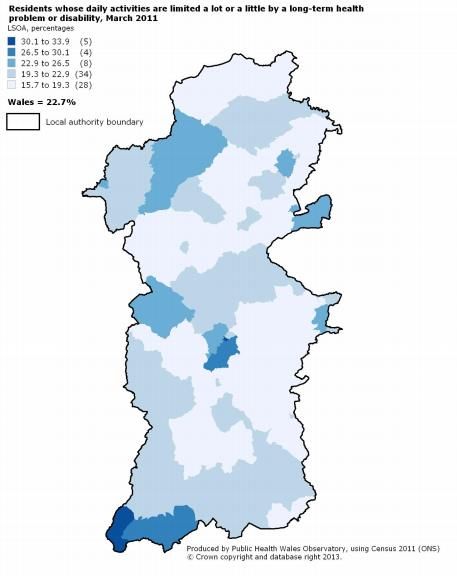
Powys County Council                                                         Local Toilet Strategy – Consultation Draft (January 2019)

Table of Contents
How to Comment .................................................................................................................................... 3
What Happens Next? .............................................................................................................................. 3
Acknowledgments................................................................................................................................... 4
Introduction ............................................................................................................................................ 4
Context .................................................................................................................................................... 4
Background ............................................................................................................................................. 6
Strategy Development ............................................................................................................................ 7
Current Provision .................................................................................................................................... 9
Assessment and Findings ...................................................................................................................... 12
Strategy ................................................................................................................................................. 22
Reviewing the Strategy ......................................................................................................................... 27
References ............................................................................................................................................ 28
Appendices............................................................................................................................................ 30
   Appendix 1 – Population Assessment ............................................................................................... 30
   Appendix 2 – Health Impact Assessment.......................................................................................... 34
   Appendix 3 – Engagement and Involvement .................................................................................... 37
   Appendix 4 – Location of Publicly Accessible Toilets in Powys (By Locality) .................................... 38
   Appendix 5 – Data Tables.................................................................................................................. 51

                                                                                                                                                            2
Powys County Council Local Toilet Strategy – Consultation Draft (January 2019)
How to Comment
Powys County Council is consulting on a Local Toilet Strategy for the period from 18/1/2019 to
22/4/2019.
Comments on the draft strategy should be submitted by 5pm on 22/4/2019 in the following ways:
online via www.powys.gov.uk/haveyoursay;
in writing to: Powys Local Toilet Strategy, Planning Policy, Powys County Council, The Gwalia,
Ithon Road, Llandrindod Wells, Powys, LD1 6AA.
by emailing consultation@powys.gov.uk.
What Happens Next?
After the consultation, Powys County Council will consider all the comments received and amend
the strategy as appropriate. It will be approved by the Council and then implemented in June 2019.
Data of existing toilet provision will be provided to Welsh Government who intend to place it on the
Lle1 online platform.
1
Lle is the Welsh Government geo-portal serving as a hub for data and information covering a wide spectrum
of topics. Lle will generate all Wales maps based on datasets provide by local authorities that can be
configured to focus on either the national picture, or on more local areas, Lle can be found at
http://lle.gov.wales/home.
3Powys County Council Local Toilet Strategy – Consultation Draft (January 2019)
Acknowledgments
Powys County Council acknowledge the previous work of Anglesey County Council, Caerphilly County
Borough Council, Bath and North East Somerset Council which has informed the production of this
document.
Introduction
Purpose
The provision of public conveniences provides infrastructure necessary to facilitate the enjoyment of
Powys by visitors; they can make a significant impact upon the comfort of individuals and families
who visit public spaces in Powys and their perception of the county as a desirable place to visit.
Wherever people live or visit, they expect to find good quality public toilets; and for some it is
fundamental to their health and comfort.
Public toilets are also an important factor in delivering an open and inclusive environment,
encouraging people to socialise, take exercise, and to be more physically active, as well as spend
time in our town centres.
Toilets for public use are an important issue for everybody when they are away from home.
However, their provision is even more important for certain members of society, including older
people, people with disabilities, people with particular medical needs, and families with young
children. Poor toilet provision can mean some are reluctant to leave their homes, which can
contribute to social isolation, inactivity, and people’s ability to maintain their own independence.
The purpose of the Powys Local Toilet Strategy is to review and assess toilet provision across Powys,
by place, and by type. As a result of undertaking a population assessment, stakeholder engagement,
and involvement, this document identifies gaps in toilet provision in Powys, before developing a
strategy with actions/steps to address any identified issues/gaps with provision.
Context
Part 8 of the Public Health (Wales) Act 2017 (Provision of Toilets) came into force on 31st May 2018
and places the responsibility on local authorities in Wales to:
Assess the need for toilet provision for their communities;
Plan to meet those needs;
Produce a local toilet strategy; and
Review the strategy, update, and publicise revisions.
It is important to note that the duty to prepare a local toilet strategy does not require local
authorities to provide and maintain public toilets directly, but rather it compels local authorities to
take a strategic view on how facilities can be provided by working in partnership with others and
accessed by their local population.
The Powys Local Toilet Strategy has been prepared, reviewed, consulted, and published showing due
regard to the five ways of working, as set out in the Well-being of Future Generations (Wales) Act
2015. The strategy has been prepared following the principles of co-production, as a wide range of
potential user groups, providers and other stakeholders have been engaged with as part of its
creation.
4Powys County Council Local Toilet Strategy – Consultation Draft (January 2019)
Aim and Objectives
The aim of this strategy is to meet the needs of residents and visitors to Powys by reviewing and
accounting for the number of publicly accessible toilets in Powys, and to facilitate the provision of
clean, safe, accessible, and sustainable toilets for residents and visitors where the need for such
facilities has been identified. Broadly the strategy seeks to achieve:
An identification of the provision of public toilets in Powys;
A consideration of the needs of the general population, and particular user groups for toilet
facilities in Powys;
A unified holistic county wide approach for the provision of publicly accessible toilets,
implemented and supported corporately;
Provision of publicly accessible toilets within council owned/run buildings;
Develop a partnership approach with the private sector to ensure an equity of publicly
accessible toilets throughout the county;
Greater use of technology leading to an increased awareness of the location of publicly
accessible toilets in Powys;
Set out the steps which Powys County Council proposes to take in order to meet the need
for publicly accessible toilets in Powys.
Council’s Role
Powys County Council currently owns and maintains two public conveniences, these are located at
the Brecon and Ystradgynlais Transport Interchanges. In recent years a total of 56 public
conveniences have been transferred to other organisations (five to community groups, two to
private businesses, and 49 to Town/Community Councils). A further five public conveniences have
been closed.
Although the Public Health Act, 1936, gives local authorities powers to provide toilets, the provision
of public conveniences is not a statutory duty, and due to limited funding and pressures on
resources Powys County Council faces a challenge to maintain toilet provision. This pattern repeats
itself across Britain, with the British Toilet Association (BTA) estimating that 40% of the UKs toilets
have closed in the last 10 years.
The historic role of Powys County Council in providing public conveniences has become less of an
imperative, one contributory factor is the regulatory provision of toilet facilities in private businesses
(for example cafes, supermarkets, public houses) which has reduced the demand for other facilities.
These private businesses tend to provide facilities that have a high standard of cleanliness,
accessibility, and safety.
All facilities provided by Powys County Council must be accessible to all residents and visitors to
Powys, all facilities provided must comply with the Disability Discrimination Act, Part M, and
guidance exists to support the Council and businesses in complying. As with other areas, public toilet
facilities in Powys can suffer from vandalism, anti-social behaviour, and drug use.
Powys has a number of large events which attract many people, who often stay for the evening
which can generate several night time local environmental quality concerns including urination and
defecating in the street. In 2018 for the Royal Welsh Agricultural Show, Powys County Council
installed temporary quadrat urinals and portaloos in Builth Wells Town Centre. Although these do
not enhance the street scene, and some negative reactions were received from residents and
daytime visitors, they did reduce the issue of public urination and defecation making the area more
hygienic and a more welcoming place in the evening. Historically in Powys the emphasis has been on
5Powys County Council Local Toilet Strategy – Consultation Draft (January 2019)
dealing with the effects of urination and defecation, through street cleansing following the event, by
the Highways, Transport and Recycling Team.
Powys County Council is committed to achieving the ambitions of its corporate improvement plan,
Vision 20252 and the Powys Local Toilet Strategy can contribute to this, by supporting a number of
the key objectives raised in the plan. Due to the cross-cutting nature of public toilets, and the fact
that their availability impacts on each and every resident and visitor to Powys, their provision
touches on almost every aspect of the Council’s work.
Background
Terminology
This strategy uses the following terms for different types of toilet facility:
Toilet(s): a toilet facility that the general public can use that may be in public or private ownership,
within a variety of premises and which does not require the user to be a customer or make a
purchase. Publicly accessible toilet is also used here.
Traditional public toilet(s): a purpose-built toilet facility provided for use by the public. Public toilet
is also used here.
Gender neutral toilet(s): a toilet that is not designated for exclusively male or female use, but can be
used by anyone.
Changing Place(s): these are fully accessible toilets with a height adjustable changing bench, a
hoisting system, a peninsular toilet, and enough space for a person with a disability, his/her
wheelchair and two carers.
Standard accessible toilet(s): these are specially designed cubicles in separate-sex toilets or a self-
contained gender neutral toilet. These may also be known as ‘disabled toilets’.
Toilet Providers
Traditionally, public toilets in Powys would have been provided by Powys County Council, however
due to reducing budgets, this is no longer the case. Within Powys there are three main types of
publicly accessible toilets in Powys, typically operated by one of the following methods:
Stand-alone Council Managed: these are the traditional public toilets, and are typically purpose built
buildings providing a separate area for ladies, gentlemen, and a standard accessible toilet. Powys
County Council is responsible for the maintenance, management and cleaning.
Within Council Facilities: with agreement from the relevant service area/building occupier, and
where circumstances allow, toilets within some Powys County Council buildings may be used by
members of the general public. For example, in libraries, leisure centres, and in the public facing
area offices.
Town/Community Council/Community Managed: these tend to be traditional public toilets, but a
town/community council/community group are responsible for the maintenance, management and
cleaning.
2
Vision 2025 is the Powys County Council Corporate Improvement Plan (2018 – 2023), and sets out the top
priorities and milestones for the Council. The full plan can be read at:
https://customer.powys.gov.uk/corporateplan.
6Powys County Council Local Toilet Strategy – Consultation Draft (January 2019)
Commercial Provision: many businesses provide toilets for the use of customers, and developments
such as supermarkets have tended to make provision for toilet facilities for all visitors. Tourist
attractions, entertainment venues and railway stations are also included in this category.
Strategy Development
A cross-service group was established to ensure that the strategy was developed taking into account
the views of the full local authority. This approach enabled us to capture all available data, and to
maximise internal engagement with all relevant council service departments to inform the strategy
development.
Data on existing toilet provision has been obtained, mapped, and analysed from existing internal
databases. This data is attached as Appendix 4 and 5, has been crossed checked using a targeted
public survey (see Involvement section below) and with local Elected Members. Some gaps in the
data still exist, and we need help, as part of this consultation to complete this.
Population
Assessment
and Health
Impact
Assessment
Powys Local
Toilet
Strategy
Identification
Involvement
and Mapping
Figure 1: Development of the Powys Local Toilet Strategy
Involvement - Early Engagement, Focus Groups and Survey Feedback
In developing the strategy, the council has sought insight and feedback from various toilet providers,
residents and some specific groups of people who are more likely to need to access a public toilet
than the general population.
All residents were invited to complete a generic public survey which was available bilingually online.
Paper copies were also available at all 18 branch libraries.
Focused face to face sessions were held with carers, older people, young people, parents of toddlers
and parents of children with some additional needs. The findings and feedback have informed the
actions of the Powys Local Toilet Strategy and are described here.
Stage 1 – Online form for external toilet providers
An online form was produced seeking relevant information from other toilet providers in the county
around their provision, type, opening times and accessibility. 47 forms were completed and returned
by the closing date. These were then cross referenced with the data held by Powys County Council
and attempts made to clarify and correct any irregularities, queries and missing details.
7Powys County Council Local Toilet Strategy – Consultation Draft (January 2019)
The Welsh Government require each council to submit a detailed spreadsheet listing all public toilets
so they can map them out. 94 toilets in total were identified during this process (this does not
include those that are owned/operated by private businesses). The majority of these are toilets that
were taken over by Town/Community Councils or a community group plus the two now maintained
by the council at the Brecon and Ystradgynlais bus interchanges.
Stage 2 – Online public survey
To support the strategy and clarify needs and perception around the current toilet provision in the
county an online survey was created and promoted via the council’s website, social media pages and
via the local media.
Questions were sought around usage of toilets in the county, their condition, any gaps, barriers to
use, payment, toilets in tourist spots and the view around an interactive app for a smart phone.
By the closing date 127 responses had been received.
Respondents consisted of primarily Powys residents, however when asked to categorise themselves,
responses were received from over 30 parents/carers of young children, 27 respondents with a long
term health condition, 4 visitors to the county, a handful of adults who are caring for both children
or adults with disabilities, a number of peripatetic workers, 4 Town/Community Councils and a
handful of community type groups including Age Cymru, Welshpool Canoe Club and Sports Care
Services.
The key findings from those responding were as follows:
People were accessing a mix of toilet provision in a range of buildings including
supermarkets, traditional type toilet blocks placed in car parks or in town centres – some
council run/some now run by community groups or Town/Community Councils, restaurants
and cafes, railway stations, leisure centres, village halls, community centres, craft centres,
tourist destinations, hotels and public houses.
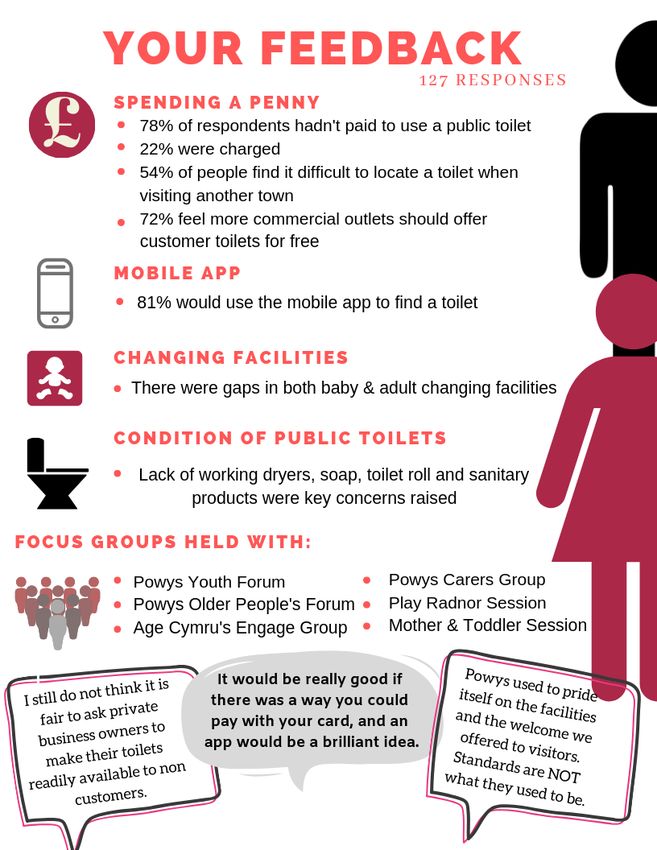
Some of the problems identified by respondents were the condition of some toilets with a
lack of toilet roll, paper towels, soap or dispensers and dryers being mentioned most
frequently. Some respondents felt door locks were often poor or broken, lighting could be
an issue, some toilets were dark and damp and unclean and had been vandalised. Not
having the correct change to access provision where a charge was made was a frustration
although a number of respondents understood why a charge was being made. A number
felt a donation box was a better option to help sustain toilets being run by a community
group especially if this was made clear in a notice on the facility.
In terms of the type of provision and gaps, two key findings came out from the survey.
o 1) baby changing facilities were often only located in the female toilets only and this
was deemed unacceptable and old fashioned.
o 2) there was a lack of adult changing facilities including items like hoists and space to
change etc. One person stated that a shelf and hooks to hang a colostomy bag
would be helpful.
The majority of respondents (78%) who had used a toilet had done so for free with just over
a fifth (22%) saying there had been a charge for those facilities used. Where a provider is
seeking payment, in Powys, this appears to be 20p.
81% of respondents felt an interactive app showing a map of all Powys public toilets would
be something they would use.
8Powys County Council Local Toilet Strategy – Consultation Draft (January 2019)
78 additional comments were given by respondents. The key themes given were around the
need for good quality provision across the county, consideration for tourism and visitors,
relevant opening times, the potential health risks that exist if provision is poor and several
comments about funding and where the responsibility lies for the provision going
forward. Another point raised by several residents was around those needing access to a
toilet being afraid and less likely to venture out if they didn’t know where to find a public
toilet.
Stage 3 – Focus Groups with core stakeholders
Six focus groups were held during October and November 2018 to capture the views of specific
stakeholders in Powys, including young people, parents of young children, carers, and older people.
Key findings of the six focus groups can be summarised as follows:
Commercial premises tend to provide a high standard of toilet facility. This is particularly the
case for those travelling through the county, who tend to use petrol filling stations.
However, some do state that their toilets are for customers only. This signage is a barrier for
some people who may be in need, and not have the confidence to ask.
Some traditional toilet blocks are unwelcoming, deemed to be unhygienic, poorly
maintained and/or vandalised. People are reluctant to use them at night due to safety
reasons.
Although people do not mind paying to use a toilet facility, this can become an issue if they
do not have the correct change. A donation box rather than a set fee has been suggested.
A number of people suggested that cosmetic improvements could be made to publicly
accessible toilets in Powys, for example hooks, shelves, mirrors, and air fresheners.
There is some confusion over which toilets in Powys, the public can use, and which are
private/for customers only.
Changing Places or larger accessible toilets are a large gap identified in the provision in
Powys.
Carers/those with additional needs tend to have to plan their journey carefully around
publically accessible toilets.
Toilets need to be promoted within town centres, and consideration could be given to using
digital noticeboards.
Good quality publicly accessible toilets are important to the visitor economy in Powys.
Current Provision
Mapping locations
Locations of the current provision of public toilets in Powys have been mapped (Appendix 4), so that
people who need to visit a toilet can easily access information about the location, opening times,
accessibility, and type of toilets available.
As per Welsh Government guidance, Powys County Council has produced, and made publicly
available a dataset consisting of the location and specified characteristics of the identified toilets
(Appendix 5). This information is available on the Powys County Council website, alongside this
9Powys County Council Local Toilet Strategy – Consultation Draft (January 2019)
strategy. This data will be joined by Welsh Government with information from other local authorities
to produce a national dataset for the Lle map3.
All data is considered to be open data, that is it can be used by third parties, either directly from the
Powys County Council website, or from the joint dataset forming the Lle map. The data is available in
Welsh and English.
Figure 2 below, shows the location of all publicly accessible toilets in Powys mapped as part of this
strategy, information on each facility is given in the data tables on pages 13 – 20:
3
Lle is the Welsh Government geo-portal serving as a hub for data and information covering a wide spectrum
of topics. Lle will generate all Wales maps based on datasets provide by local authorities that can be
configured to focus on either the national picture, or on more local areas, Lle can be found at
http://lle.gov.wales/home.
10Powys County Council Local Toilet Strategy – Consultation Draft (January 2019)
Figure 2: Location of publicly accessible toilets in Powys.
Stand-alone Council Managed Provision
Powys County Council directly provide toilet blocks at the following locations:
Brecon Interchange (map location 8);
Ystradgynlais Interchange (map location 88).
Powys County Council has responsibility for the maintenance, management and cleaning of these
toilet blocks.
11Powys County Council Local Toilet Strategy – Consultation Draft (January 2019)
Provision within Council Facilities
Although not currently promoted toilet facilities within Powys County Council buildings are available
to the general public where the individual location, access and circumstances allow. For example,
within libraries. These facilities ensure that all services offered are accessible by all members of the
community. The Powys County Council premises that provide toilet facilities are listed within this
strategy.
Town/Community Council/Community Provision
Excluding the two toilet blocks directly provided by Powys County Council (listed above), all
traditional public toilets within Powys are now operated by either by Town/Community Councils or
by community groups. These groups are wholly responsible for these toilet blocks, and these are
listed within this strategy.
Changing Places
According to the Changing Places Toilet Map4, there is only one changing place toilet in Powys that is
based in the privately owned and managed Corris Craft Centre in Machynlleth5. It is however known
that a Changing Place facility exists at Crickhowell Community Sports Centre (map location 17),
although this is unregistered. Further provision is planned at Y Gaer, Brecon and Welshpool Town
Council have secured funding to create facilities at the Berriew Street Car Park in the town.
Assessment and Findings
Existing Provision
The BTA recommend that publicly accessible toilets should be provided on both a population and
distance basis. The BTA recommended level is 1 cubicle per 550 female population and 1 cubicle or
urinal per 1100 male population, which is a ratio of 2:1 in favour of women. One accessible toilet
and also one baby change facility should be provided for every 10,000 population.
The number of individual cubicles/urinals is not available; however, the data tables below describe
the facilities available within each locality6 in Powys. Location maps for each locality are attached as
Appendix 4.
4
http://changing-places.org/
5
For the purposes of this strategy only traditional public toilets, and those accessible within Powys County
Council buildings have been mapped. Private facilities and those within commercial premises have been
excluded.
6
Powys is broken down by different geographical areas. These geographical hierarchies are designed to
improve reporting and understanding data in small areas. Postcodes are used to define these geographical
areas. There are 79 Lower Layer Super Output Areas (LSOA) in Powys, these made up the 19 Middle Layer
Super Output Areas (MSOA) which in turn make up the Powys 13 localities.
12Powys County Council Local Toilet Strategy – Consultation Draft (January 2019)
Question 1 – Data Accuracy
What gaps exist in the data?
Is any of our data inaccurate?
Are there any publicly accessible toilets we do not know about?
Can you provide us with any missing data?
Key
Male Gender Baby Baby
toilet neutral changing changing
toilet (gender (male)
neutral)
Female Disabled Baby Changing
toilet toilet changing place
(female)
Welshpool and Montgomery
Map ID Location Postcode Facilities
82 Berriew Street Car Park, SY21 7SQ
Oldford Lane, Welshpool
83 Church Street Car Park, SY21 7DD
Welshpool
84 Flash Leisure Centre, SY21 7DH
Welshpool
85 Welshpool Library SY21 7PH
94 Town Hall, Broad Street, SY21 7JQ
Welshpool
63 Market Square SY15 6PH
Montgomery
3 Adjacent to The Lion, SY21 8PQ
Berriew
13Powys County Council Local Toilet Strategy – Consultation Draft (January 2019)
Newtown
Map ID Location Postcode Facilities
65 Back Lane Car Park, SY16 2NZ
Newtown
66 The Gravel, Shortbridge SY16 1AB
Street, Newtown
67 Newtown Area Library SY16 1EJ
68 Maldwyn Leisure Centre, SY16 1LH
Newtown
26 The Gardens, Common SY16 4NX
Road, Kerry
Brecon
Map ID Location Postcode Facilities
4 Brecon Leisure Centre, LD3 9SR
Brecon
5 Brecon Library LD3 9AE
UNMAPPED Brecon Market Hall LD3 7LF
6 Lion Yard, Brecon LD3 7BA
7 Brecon Theatre LD3 7EW
8 Brecon Transport LD3 7BL
Interchange
9 Upper Meadow, Brecon LD3 9PG
Promenade
10 A470 Brecon Beacons, LD3 8NL
Storey Arms
41 Llanfrynach LD3 7AX
14Powys County Council Local Toilet Strategy – Consultation Draft (January 2019)
53 Llansantffraed, West of LD3 7JQ
Bwlch
55 A40 Layby, Llanspyddid LD3 8PB
80 High Street, Sennybridge LD3 8PG
93 Henderson Hall, Talybont LD3 7YQ
Llandrindod and Rhayader
Map ID Location Postcode Facilities
34 Llandrindod Library, The LD1 6AA
Gwalia
35 Lake Park, Llandrindod LD1 5HU
Wells
36 Station Crescent, LD1 5BB
Llandrindod Wells
58 Llanyre LD1 6DY
64 Newbridge on Wye LD1 6HU
74 Cemetery, Rhayader LD6 5DH
75 Dark Lane Car Park, LD6 5DG
Rhayader
76 Rhayader Leisure Centre, LD6 5BU
Rhayader
77 Rhayader Library LD6 5AB
78 Smithfield, Rhayader LD6 5BU
79 The Groe, Cwmdeuddwr, LD6 5AP
Rhayader
90 Claerwen Dam, Claerwen LD6 5HP
Valley, Rhayader
15Powys County Council Local Toilet Strategy – Consultation Draft (January 2019)
91 Graig Goch Dam, Elan LD6 5HS
Valley, Rhayader
Ystradgynlais
Map ID Location Postcode Facilities
86 Ystradgynlais Library SA9 1JJ
87 Station Road, SA9 1NT
Ystradgynlais
88 Ystradgynlais Transport SA9 1JJ
Interchange, Station Road,
Ystradgynlais
Knighton and Presteigne
Map ID Location Postcode Facilities
27 Knighton Cemetery, LD7 1HY
Knighton
28 Behind Knighton Hotel, LD7 1BL
Knighton
29 Bowling Green Lane Car LD7 1DR
Park, Knighton
30 Offa’s Dyke Centre, LD7 1EN
Knighton
31 Knighton Library LD7 1DR
69 Hereford Street Car Park, LD8 2AR
Presteigne
70 Presteigne Library LD8 2AD
71 Wilson Terrace, Presteigne LD8 2BW
32 A483 Llananno LD1 6TS
16Powys County Council Local Toilet Strategy – Consultation Draft (January 2019)
Llanfyllin
Map ID Location Postcode Facilities
42 High Street, Llanfyllin SY22 5AA
43 Llanfyllin Library & SY22 5DB
Community Centre
2 Lake Vyrnwy Road, SY10 0LT
Llanwddyn
20 Village Car Park, Mill Lane, SY21 0LQ
Dolanog
40 Car Park, School Lane, SY22 5JD
Llanfihangel yng Ngwynfa
48 Berwyn Street, Llangynog SY10 0EX
51 Market Square, SY10 0JH
Llanrhaeadr Ym Mochnant
52 Tan-Y-Pistyll, Waterfall SY10 0BZ
Road, Llanrhaeadr-ym-
Mochnant
62 Public car park, Meifod SY22 6BZ
Hay and Talgarth
Map ID Location Postcode Facilities
23 Nr Clock, Broad Street, HR3 5BX
Hay on Wye
24 Oxford Road Car Park, Hay HR3 5DG
on Wye
81 Town Hall, The Square, LD3 0AF
Talgarth
96 Talgarth Library LD3 0DQ
21 Erwood on A470 LD2 3EZ
17Powys County Council Local Toilet Strategy – Consultation Draft (January 2019)
22 Glas-Y-Bont, Glasbury HR3 5NW
Crickhowell
Map ID Location Postcode Facilities
17 Crickhowell Community NP8 1AW
Sports Centre
18 CRIC Crickhowell NP8 1AR
19 Crickhowell Library LD3 1BN
45 Llangattock Recreation NP8 1PA
Ground
46 Llangorse Common, LD3 7TR
Llangorse Lake
47 Llangynidr NP8 1HS
Builth and Llanwrtyd
Map ID Location Postcode Facilities
12 The Groe, Builth Wells LD2 3BG
13 Strand Street, Builth Wells LD2 3AA
14 Builth Library (Antur Gwy) LD2 3BA
44 Llangammarch Wells LD4 4BT
1 Village Hall, Abergwesyn LD5 4TP
56 Riverside, Llanwrtyd Wells LD5 4SP
18Powys County Council Local Toilet Strategy – Consultation Draft (January 2019)
57 Llanwrtyd Library LD5 4RA
Llanidloes
Map ID Location Postcode Facilities
49 The Gro, Llanidloes SY18 6EW
50 Nr Town Hall, Llanidloes SY18 6BN
89 A470 Llandinam SY17 5BZ
Llanfair Caereinion
Map ID Location Postcode Facilities
37 Bridge Street, Llanfair SY21 0RZ
Caereinion
39 Llanfair Caereinion Library SY21 0RY
15 Bridge Street, Caersws SY17 5HH
16 Spar Car Park, Caersws SY17 5LH
Road, Carno
Machynlleth
Map ID Location Postcode Facilities
59 Bro Ddyfi Leisure Centre, SY20 8ER
Machynlleth
60 Heol Maengwyn, SY22 5AA
Machynlleth
61 Machynlleth Library SY20 8DY
19Powys County Council Local Toilet Strategy – Consultation Draft (January 2019)
33 Car Park, Llanbrynmair SY19 7AA
Summary and assessment
The below table summarises the provision of publicly accessible toilets across Powys7, and the type
of facilities that exist across each locality.
Welshpool 6 6 1 3 1 1 1 0
and
Montgomery
Newtown 5 5 0 2 1 0 0 0
Brecon 11 11 2 9 4 3 2 0
Llandrindod 11 11 2 8 3 3 2 0
and Rhayader
Ystradgynlais 1 1 2 3 0 1 0 0
Knighton and 8 8 1 7 2 1 0 0
Presteigne
Llanfyllin 8 8 0 6 3 2 2 0
Hay and 5 5 0 3 0 0 0 0
Talgarth
Crickhowell 5 5 2 4 0 1 1 2
Builth and 6 6 2 5 1 0 0 0
Llanwrtyd
Llanidloes 2 2 0 3 0 0 0 0
Llanfair 3 3 2 3 0 2 0 0
Caereinion
Machynlleth 3 3 1 2 1 1 0 0
As demonstrated in the above tables, there are publicly accessible toilet facilities available
throughout the county, with at least one facility in each of the main towns in Powys. In addition to
this, taking the BTA recommendations, there is a sufficient number of standard accessible toilets
available within each locality in Powys. Although town centres are well catered for, a clear gap in
publicly accessible toilet provision can be seen in more rural areas, and along the vast road network
in Powys. Although Powys County Council provides toilet facilities at the main bus interchanges in
the county, no railway stations in the county have toilet facilities.
Although no guidelines or recommendations exist for changing places, there is a need for greater
facilities of this kind to be developed in Powys. As stated previously, there is only one changing place
toilet in Powys that is based in the privately owned and managed Corris Craft Centre in Machynlleth.
It is however known that a Changing Place facility exists at Crickhowell Community Sports Centre,
although this is unregistered. Further provision is planned at Y Gaer, Brecon and Welshpool Town
Council has secured funding to create facilities at the Berriew Street Car Park in the town.
7
The data presented in the Powys Local Toilet Strategy is based on information currently held by Powys
County Council, we are aware that there are a number of gaps in these findings, and this will be reviewed
following public consultation.
20Powys County Council Local Toilet Strategy – Consultation Draft (January 2019)
The above summary table also demonstrates a lack of baby changing facilities in Powys with no such
facilities being found in the Welshpool and Montgomery, Newtown, Hay and Talgarth, Llanidloes,
and Machynlleth. Furthermore, in Llanfair Caereinion and Ystradgynlais baby changing facilities are
only available within female toilets.
There is a considerable difference in type and quality of publicly accessible toilet facilities
throughout the county, with levels of facilities and cleanliness varying. Users do not mind paying,
should the facility be well maintained, however due to people often not carrying the correct change,
it has been suggested that a donation box might be a more suitable way of collecting payment.
These conclusions are based upon BTA population related provision recommendations. However,
Powys annually attracts 4.6. millions visitors (Powys County Council, 2017), a significant numbers of
tourists, particularly during the summer month which places considerable additional demand on
toilets in the county. This is especially so during large events in the county, such as the Royal Welsh
Show, Brecon Jazz, and the Hay Festival. As such using a standard simply based on resident
population is clearly not acceptable for Powys. The relevant population in an area when calculating
toilet need should include commuters, tourists, visitors, as well as residents. However, this data as a
whole is unavailable for Powys.
It is evident from the population assessment, involvement, and identification and mapping that
provision of publicly accessible toilets is a significant concern for both residents and visitors to
Powys. The provision of publically accessible toilets is essential to ensuring peoples wellbeing and
their overall enjoyment of Powys, therefore long term solutions need to be developed in order to
ensure future provision.
21Powys County Council Local Toilet Strategy – Consultation Draft (January 2019)
Strategy
The table below summarises the key findings and agreed actions as a result of the population assessment (Appendix 1), Health Impact Assessment
(Appendix 2), engagement activities (Appendix 3), and mapping (Appendix 4). Where an action is marked as ongoing, a performance update will be given
during each review of this strategy.
Question 2 – Actions
Do you agree that our proposed actions will improve access to public toilets in Powys?
Do you agree that our proposed actions will support the development of Changing Place facilities in Powys?
Do you agree that our proposed actions will support the development of further baby changing facilities in Powys?
Do you agree that working with other organisations will support and improve access to toilets in Powys?
Do you agree that Lle will support and improve access to toilets in Powys?
Do you have any further suggested actions?
Key finding Action(s) How will we know this has been achieved? By when will this Who will be responsible
be achieved? for this
Publicly accessible Opening up of The toilet facilities in Powys County Council buildings will May 2020 Powys County Council
toilets need to be toilet facilities in be opened up and promoted to the public. (Except for
better promoted Powys County schools, care homes, and other buildings where the
throughout Powys, Council buildings facilities are located in areas not accessible to the public).
particularly in rural Buildings will be signposted for public use, and the Welsh
areas where Government toilet logo displayed.
availability is limited Signposting of Awareness and knowledge of publicly accessible toilets will May 2020 Powys County
facilities have been improved. Up to date information will have Council/Town/Community
been provided on the Powys County Council website and Councils
Lle. Consideration will have been given to providing
additional physical signposting/use of existing noticeboards
to direct the public to facilities when they are in town
centres and other locations.
22Powys County Council Local Toilet Strategy – Consultation Draft (January 2019)
Use of the Great The Great British Toilet Map will be promoted, and publicly May 2020 Powys County
British Toilet accessible toilets in Powys will be registered on the Great Council/Toilet Providers
Map8 British Toilet Map website (www.toiletmap.org.uk).
Data sharing Powys County Council will have shared any relevant and May 2020 Powys County
specific data that has been captured within the Council/Toilet Providers
engagement and consultation exercises with relevant toilet
providers where helpful to the improvement of their toilet
facilities and with due regard to the General Data
Protection regulations. Where data is inaccurate, or a
situation changes, the toilet provider will have informed
the Council.
Participation in The ‘Use Our Loos’ campaign will have been promoted to May 2020 Powys County
the ‘Use Our Loos’ businesses, encouraging them to open up their loos to the Council/Town/Community
Campaign9 public. This will provide additional toilet facilities, whilst Councils/Private
allowing businesses to benefit from increased footfall, and Developers
will help to develop stronger communities. Powys County
Council will have promoted this scheme using a mix of
channels including its own website and social media and
where it can, encourage businesses to participate. In
addition, the national toilet logo will have been made
available on the Powys County Council website for
businesses to download and display on their premises.
Development of Working with partners and businesses, the national toilet Ongoing Powys County
commercial logo will have been made available on the Powys County Council/Town/Community
partnerships Council website for businesses to download and display on Councils/Private
their premises. These discussions will have included Developers
conversations around supporting those residents with long
term health conditions who have a Carers or other card
8
The Great British Public Toilet Map is the UK's largest database of publicly-accessible toilets, with over 11000 facilities listed. The database can be viewed at
www.toiletmap.org.uk.
9
The Great British Public Toilet Map in partnership with the BTA, and Domestos have launched a ‘Use Our Loos’ campaign, the first national community toilet scheme. This
scheme asks businesses to sign up, and welcome customers and non-customers to use their toilets. Domestos, in return, provides free cleaning products.
23Powys County Council Local Toilet Strategy – Consultation Draft (January 2019)
which will then allow them immediate access to a toilet
with no questions asked.
Lack of Changing Publicly Toilet facilities in any future Council building developments Ongoing Powys County Council
Place/larger accessible, or redevelopment will have considered publicly accessible
accessible toilet, and accessible toilet toilet and baby changing facilities included as part of their
baby changing and baby design and compliancy.
facilities changing facilities
in future Powys
County Council
developments
Development of The possibility of installing Changing Place toilets in all Ongoing Powys County
Changing Places Powys County Council buildings with a public function will Council/Town/Community
have been considered. Changing Places will have been Councils/Private
encouraged (where possible) in private developments, and Developers
working with partners potential funding sources will have
been identified. Efforts to develop Changing Places will be
focused on areas of high need, as identified in the Health
Impact Assessment.
Collaboration with The need for Changing Place facilities and improved baby May 2020 Powys County
toilet providers changing facilities across Powys will have been promoted Council/Town/Community
by Powys County Council. Where appropriate external Councils/Private
toilet providers will have been given support/advice to Developers
apply for (external) grant funding in order to provide
improved facilities.
Ensuring future Collaboration with Engagement will have continued with Town/Community Ongoing Powys County Council
provision Town/Community Councils in order to ensure that traditional public toilets
Councils are provided in as many locations as possible throughout
the county.
Engagement with If Business Improvement Districts are established in Brecon May 2021 Powys County
proposed and Newtown, a portion of the funding raised could have Council/Business
Business be used to develop new/improve existing public toilet Improvement Districts
Improvement provision.
Districts
24Powys County Council Local Toilet Strategy – Consultation Draft (January 2019)
Review of Powys County Council will have undertaken a review of its May 2021 Powys County Council
commercial commercial lettings policies. The possibility of introducing
letting policies an additional clause on Council let/leased commercial
property will have been explored, so that the toilets within
said premises are accessible to public.
Planning Large-scale commercial developments that are going to Ongoing Powys County Council/
recommendations include cafes, bars, shops, or entertainment venues for Brecon Beacons National
example, could have been required, as a planning Park Authority
condition, to allow general public access to any toilet
facilities that are being built in the premises.
Section 106 Section 106 Agreements may have been explored as a Ongoing Powys County Council/
Agreements one off way of funding additional public toilet provision Brecon Beacons National
within new or near new developments, on a need and Park Authority
demand driven basis.
Regulation Where applicable Powys County Council will have used Ongoing Powys County Council
their powers under the Local Government (Miscellaneous
Provisions) Act 1976 Section 20 to mandate that any
business which is classed as a place of entertainment, or
any business that sells food or drink to the public for
consumption on the premises, provide and maintain public
toilets for public use.
There is no specific Monitor annual Working with the Homelessness Prevention and Housing Ongoing Powys County Council
need for rough rough sleeper Options Lead, rough sleeper numbers will have been
sleepers in Powys count monitored and where appropriate options will have
explored to ensure that there are adequate facilities for
rough sleepers.
Significant numbers Provision at Working with the newly formed Events Board and the May 2020 Powys County Council/
of people visit Powys events relaunched Events Safety Advisory Group, as part of the Event Organisers
annually for tourism Powys Events Portal, guidance will have been produced for
purposes to attend event organisers around the provision of toilets at
events. temporary events.
25Powys County Council Local Toilet Strategy – Consultation Draft (January 2019)
Night time Trailing of temporary quadrat urinals and portaloo toilets May 2020 Powys County Council
economy during large events will have continued. Feedback will be
collected.
Lack of provision for Transport Hubs Discussions will have been held with Transport for May 2020 Powys County
those travelling Wales/Network Rail and Traws Cymru, to discuss the Council/Transport for
through Powys possibility of improving toilet facilities at key transport Wales/Network Rail/
hubs in Powys. Traws Cymru
Trunk Road and Through working with the Welsh Government and North May 2020 Powys County Council/
overnight and Mid Wales Trunk Road Agent (NMWTRA), Powys NMWTRA
provision County Council will have looked to ensure that public
conveniences currently provided at key points along the
trunk road network in Powys continue to receive adequate
funding to remain open.
The Collaboration with Where appropriate external toilet providers will have been Ongoing Powys County
quality/cleanliness of external toilet given support/advice to apply for (external) grant funding Council/Toilet Providers
toilet facilities vary providers in order to provide improved facilities. Schemes such as the
across the county ‘Use Our Loos’ will be promoted in order to try and get
providers to improve the quality of facilities.
People are willing to Collaboration with Town/Community Councils and other community groups May 2020 Powys County
give a donation Town/Community will have been informed of this finding. Council/Toilet Providers
where facilities are Councils and
operated by other community
community groups groups
26Powys County Council Local Toilet Strategy – Consultation Draft (January 2019) Reviewing the Strategy Powys County Council will prepare an interim progress report setting out the steps taken in line with their strategy every two years, commencing from the date of the last published strategy. The interim progress report will be published within six months of the end of end date of the two-year period. The first Powys Local Toilet Strategy will be published in May 2019, therefore it will be reviewed before the end of May 2021, with the progress report published before the end of November 2021. The Powys Local Toilet Strategy will also be reviewed within a year of each ordinary election for Powys. The next election is due to take place May 2022; therefore, a review will have been completed by May 2023. If no changes are made to the strategy following the post-election review, then an interim progress statement covering a two-year period commencing from the date of the last election will be published. Powys County Council may review its strategy at any time, following which it must publish a statement of the steps which it has taken in accordance with the strategy. If following a review Powys County Council decides to revise the strategy, it will publish the revised strategy and then prepare an interim progress report covering the two-year period commencing from the date of publication. A project management structure has been established within Powys County Council to oversee the development of the Local Toilet Strategy, this group will continue to meet quarterly to ensure the implementation of the actions contained in this strategy.
Powys County Council                              Local Toilet Strategy – Consultation Draft (January 2019)

References
All Wales Continence Forum (2011). The indignity of incontinence: Local information pack for
Assembly Members. Available from:
http://www.senedd.assembly.wales/documents/s43157/Consultation%20response%20RC%2016%2
0-%20All%20Wales%20Continence%20Forum%20AWCF.pdf [Accessed 6th December 2018].

British Toilet Association (2010). BTA Summary of Best Practice in ‘Away From Home’ Toilet
Provision. Available from: http://www.btaloos.co.uk/wp-
content/uploads/2014/01/BTABestPracticeAdvice.pdf [Accessed: 6th December 2018].

Daffodil (2018). Continence. Available from:
http://www.daffodilcymru.org.uk/index.php?pageNo=1048&PHPSESSID=t8497but2pnpenmqi3c6sb
hg77&at=a&sc=1&loc=1&np=1 [Accessed 6th December 2018].

Help The Aged (2007). Nowhere to go – Public Toilet Provision in the UK. Available from:
https://www.ageuk.org.uk/documents/en-gb/for-
professionals/research/nowhere%20to%20go%20public%20toilet%20provision%20(2007)_pro.pdf?d
trk=true. [Accessed 6th December 2018].

Help The Aged in Wales (2009). Public Toilet Closures. Available from:
http://www.ageuk.org.uk/cymru/professional-resources/facts-and-figures-about-older-
people/public-toilet-closures/. [Accessed 6th December 2018].

National Assembly for Wales (2012). Public health implications of inadequate public toilet facilities –
report of evidence. Available from:
http://senedd.assembly.wales/mgIssueHistoryHome.aspx?IId=2572 [Accessed: 6th December 2018].

Office for National Statistics (2015). Annual Survey of Hours and Earnings. Available from:
https://www.ons.gov.uk/employmentandlabourmarket/peopleinwork/earningsandworkinghours/bu
lletins/annualsurveyofhoursandearnings/2015provisionalresults [Accessed 6th December 2018].

Older People’s Commissioner for Wales (2014). Response from the Older People’s Commissioner for
Wales to the Welsh Government consultation on proposals for a Public Health Bill. Available from:
http://www.olderpeoplewales.com/Libraries/Consultation_Responses/140624_-
_Response_from_the_Older_Peoples_Commissioner_for_Wales_to_the_Welsh_Government_consu
ltation_on_proposals_for_a_Public_Health_Bill.sflb.ashx [Accessed 6th December 2018].

Powys Association of Voluntary Organisations (2015). Food Bank Overview. Unpublished report.

Powys County Council (2017). Powys Wellbeing Assessment 2017: Economy Key Findings. Available
from:
https://en.powys.gov.uk/media/7090/4_Powys_Wellbeing_Assessment_en/pdf/4_Powys_Wellbein
g_Assessment_en.pdf?m=1540808252177 [Accessed 6th December 2018].

Public Health Wales NHS Trust (2016). Measuring Inequalities 2016. Available from:
http://www.publichealthwalesobservatory.wales.nhs.uk/measuring-inequalities-2016-files
[Accessed: 6th December 2018].

Road Haulage Association (2018). Trucker’s Toilets. Available from: https://www.rha.uk.net/policy-
campaigning/the-road-haulage-industry/truckers-toilets [Accessed 6th December 2018].

                                                                                                         28
Powys County Council Local Toilet Strategy – Consultation Draft (January 2019)
StatsWales (2018). Rough Sleepers by local authority. Available from:
https://statswales.gov.wales/Catalogue/Housing/Homelessness/Rough-Sleepers/roughsleepers-by-
localauthority [Accessed 6th December 2018].
Welsh Government (2014). WIMD 2014 local authority analysis. Available from:
https://statswales.gov.wales/Catalogue/Community-Safety-and-Social-Inclusion/Welsh-Index-of-
Multiple-Deprivation/WIMD-2014/wimd2014localauthorityanalysis [Accessed 6th December 2018].
Welsh Government (2015). Welsh Health Survey 2015. Available from: https://gov.wales/statistics-
and-research/welsh-health-survey/?tab=previous&lang=en [Accessed: 6th December 2018].
29Powys County Council Local Toilet Strategy – Consultation Draft (January 2019)
Appendices
Appendix 1 – Population Assessment
As part of the needs analysis to discover the requirements for public conveniences in Powys a
community profile for the county has been produced. Unless otherwise stated all information in this
section of the strategy has been developed from the Well-being Assessment, undertaken by the
Powys Public Service Board, under the requirements of the Well-being of Future Generations
(Wales) Act, 2015.
Powys’s Demography
In 2015 the population of Powys was 132,642, covering 5180km2 with just 26 persons per square
kilometre, making Powys the sparest and most rural county in Wales. The population of Powys
peaked in 2011, and has been falling since. The latest projections for Powys has its population falling
by 8% in 2029, the largest fall among authorities in Wales. In 2015, 15% of the Powys population was
aged 15 or under, 59% were of working age, and 26% were aged 65 or over. There are a total of
59,138 households, of which 18,948 are single person households, with 19% of the population able
to speak Welsh.
The number of residents in Powys aged 65 or over is expected to increase by 12,890 (36%) between
2017 and 2035 whilst those of working age is expected to decrease by 10,300 (14%) providing a
number of key challenges to the county, one of which will be public toilet provision.
Travel Profile
Powys has 5,500km of roads, and relatively low traffic congestion. Most people use their own
vehicles for regular travel, only 1% of the population use public buses and people are dissatisfied
with the bus service. Powys has 2 railway lines (The Cambrian Line running through Welshpool and
Newtown towards Aberystwyth, and The Heart of Wales lines running from Craven Arms to Llanelli)
carrying 110,000 passengers a year. Due to the vast, and complex nature of the transport network in
Powys, it would be impractical to provide facilities throughout the network, and the Powys Local
Toilet Strategy will focus on the main transport routes in the county.
Powys sees an average of 4.6 million tourists per year, who in turn invest £615 million into the local
economy. Tourism accounts for 12% of all employment in Powys, however it is more predominant in
more rural areas. Food and drink (21%) has the largest economic impact on the tourism industry.
Tourists visiting the county tend to stay overnight more in the north of the county
(Montgomeryshire), whilst there are more day visitors to the South (particularly Brecon Beacons).
Deprivation Profile
Some areas of Powys are the most deprived areas of Wales according to Welsh Index of Multiple
Deprivation (WIMD), with Ystradgynlais being ranked in the lowest 10% in Wales, and Newtown
South and Welshpool Castle being ranked in the worst 20% in Wales (Welsh Government, 2014).
Powys has a poor WIMD score in terms of employment. Whilst the majority of the population are in
employment, many are in part time work and earn below average salaries. Young people,
particularly males, are also struggling to find work. Fuel poverty is high in Powys as a result of its
rural setting with lack of access to cheaper fuels such as gas and a high elderly population (Welsh
Government, 2014). There is a growing divide between least and most deprived in terms of life
expectancy, with long term health issues becoming more and more common in those less well off
(Public Health Wales NHS Trust, 2016). Powys is also one of the most expensive places to buy a
house. Fewer people are now owning a home outright or through mortgage. Instead, a large
30Powys County Council Local Toilet Strategy – Consultation Draft (January 2019)
proportion are renting. This may be linked to a below average weekly income. While it cannot be
fully determined, the reform of the welfare system is expected to impact more than half of Powys’
population, and as a result of benefit reductions or termination, see an average drop of 2% in Gross
Disposable Household Income (GDHI) (ONS, 2015). Homeless presentations have increased by 107%
in the Brecon area between 2014/15 to 2015/16 and in the same period the increases in Welshpool
has been 39%, Newtown 30% and Llandrindod 13%. There has been a reduction of 3% in
Ystradgynlais. The greatest number of homeless presentations are in Newtown and Welshpool,
however, the 2017 National Rough Sleeper Count (Statistics for Wales, 2018). found that no persons
were rough sleeping in Powys. Therefore, at the present time there is no specific need in any areas
of Powys for publicly accessible toilets for the homeless. This assessment will be revisited upon
review of the strategy.
Powys is ranked in the bottom 10% in terms of access to services, particularly in terms of access to
services by foot or public transport (Welsh Government, 2014). The county also has a larger than
average number of residents without access to a 2G signal. Lettings and waiting lists data shows that
we do not have sufficient supply to meet demand particularly for small households. Over the
previous 18 months there has been a rise in food banks in Powys, those now in existence are
supporting more and more people who are in work but still struggling to make ends meet (Powys
Association of Voluntary Organisations, 2015).
Powys Health Profile
Life expectancy in Powys is above the average for Wales and continues to improve. However, there
has been a growing inequality gap appearing between genders, with females tending to outlive
males, as well as between the least and most well off (not yet to levels of statistical significance).
This gap is expected to widen over the next 10 years. A child born in the least affluent parts of Powys
can expect to live 6 years less than a child born in the most affluent areas (Public Health Wales NHS
Trust, 2016).
The Welsh Health Survey (2015) revealed that 15% of people in Powys are currently being treated
for high blood pressure, 8% for heart conditions, 13% for respiratory illness, 10% for mental health
issues, 9% for arthritis, and 6% for diabetes. Furthermore, according to the 2011 Census 21.4% of
people in Powys have a long-term health problem of disability which limits their day-to-day activities
a lot or a little, whilst 5% of working age people claim Disability Living Allowance. This data indicates
a clear need for accessible toilets/change place facilities, throughout the county.
31You can also read


