Preliminary Analysis of the Government of Alberta's 2020 Budget February 28, 2020
←
→
Page content transcription
If your browser does not render page correctly, please read the page content below

Report | Preliminary Analysis of the Government of Alberta’s 2019 Budget

            Preliminary Analysis of the Government
                          of Alberta’s 2020 Budget

                                                   February 28, 2020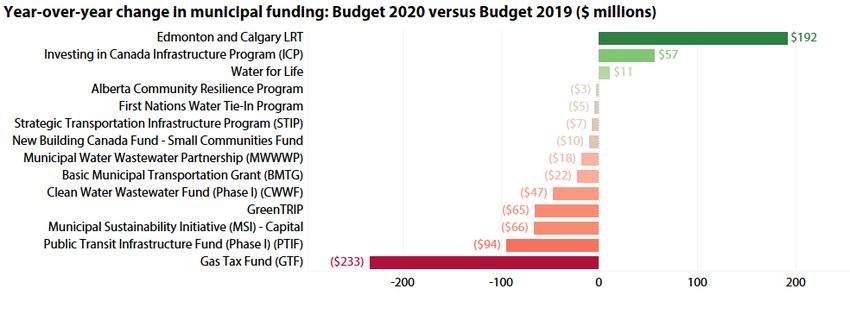
Report | Preliminary Analysis of the Government of Alberta’s 2020 Budget

Introduction
In a time of ongoing fiscal uncertainty, the province’s 2020 Budget continues the trends and themes
introduced in Budget 2019. This means that municipalities will need to keep managing the
cumulative impacts of funding reductions and downloaded responsibilities.

AUMA appreciates that the province has followed through on its commitment to adhere to a fixed
budget release timeline of February. For years, AUMA has advocated that the province adopt a fixed
annual budget date early in the calendar year to better align with municipal budgeting and property
tax cycles.

The following document includes AUMA’s preliminary analysis of Budget 2020 as it relates to
municipal priorities and the financial future of Alberta communities. In addition, it summarizes the
province’s fiscal outlook and includes highlights of the ministry business plans that most impact our
communities.

Priorities for Alberta’s Municipal Governments
Provincial Education Property Tax Increase
The province is increasing its education property tax requisition by 4.2%, which is expected to
generate an additional $102 million in 2020/2021 for the province. Most of this increased tax burden
will fall on Alberta’s residential property taxpayers.

Despite increasing financial pressures, municipalities are working hard to minimize property tax
increases through finding efficiencies. As AUMA emphasized in our recent letter to Premier Kenney,
this planned year-over-year increase to provincial taxes is unacceptable to municipalities and
ratepayers.

Grants in Place of Taxes (GIPOT)
Alberta property taxpayers are further impacted by reductions to the GIPOT program, which is being
reduced by 32% in 2020-21 on top of the 24% reduction in 2019. GIPOT is meant to cover the costs of
the services municipalities provide to Crown properties, which are exempt from tax. Municipalities will
need to look for ways to cover these costs through user fees or other mechanisms so that other
property owners don’t have to subsidize the costs of providing essential services such as policing, fire,
water and waste management, and transportation for provincial properties. This reduction was
announced in the province’s 2019 – 2020 fiscal plan.

Capital Investments
One of the primary themes of AUMA’s recent President’s Summit on municipal finances was the
importance of partnership in making the infrastructure investments needed to get Alberta back to
work. We are therefore pleased that the province commits to “collaborate in partnership with industry
and municipalities to identify critical investments and align our capital spending priorities
accordingly.” Municipalities look forward to engaging in implementation of the province’s Capital
Plan.

AUMA also looks forward to working out how the Local Government Fiscal Framework can maximize
the infrastructure investments needed to attract and retain investors and talent. Still, we remain
concerned that annual funding will only grow at half the rate of provincial revenues, making it
challenging for infrastructure investments to keep pace with population growth and inflation.

                                                                                                            2
Report | Preliminary Analysis of the Government of Alberta’s 2020 Budget
In addition, although AUMA advocated for the province to revisit planned reductions to the Municipal
Sustainability Initiative (MSI), the projected reductions announced in the last budget remain in place.
We will be monitoring the impact on the health of Alberta’s infrastructure and on Alberta’s
construction companies and workforce. We remain concerned about the long-term consequences of
under-investment in infrastructure, which could undermine economic development and lead to
increased costs for future maintenance and replacement.
AUMA would like to acknowledge that while the Basic Municipal Transportation Grant (BMTG) is
$28 million lower than forecast in Budget 2019 (due to lower than expected fuel sales), the province
has made up the difference by adding $28 million to MSI Capital. This will change the funding that
some municipalities receive, due to the difference in allocation formulas. Still, AUMA appreciates the
province providing overall stability to municipal capital funding.
Policing
Budget 2020 highlights the additional revenue the province will receive from all municipalities
contributing to policing costs. One of AUMA’s priorities is ensure that municipalities have a say in how
police resources will be distributed to ensure all Albertans are safe in their communities.
Fine Revenue
Budget 2020 also reflects last year’s change in fine revenue distribution for all offences under the
Traffic Safety Act. Previously, the province kept 26.6% of the fine amount for traffic violations, but as of
2020, this amount was increased to 40%. This means that municipalities receive less fine revenue;
instead of getting 74.4% of the fine revenue back, municipalities only get 60%. As a result, the
province will collect an estimated $267.3 million in fines and penalties in 2020-21, compared to $221
million in 2019-20 (21% increase).
Affordable Housing
AUMA is very concerned to see significant cuts to capital investment in affordable housing for both
the development of new units, as well as the maintenance and repair of existing units. Addressing
Alberta’s lack of affordable housing is a priority for municipalities. In addition to stimulating
employment and economic growth, capital investment in affordable housing yields long-term savings
for all levels of government due to decreased use of health services, police and justice services, child
welfare, and other services such as homeless shelters, income supports, and addictions and mental
health supports.
Investing in Canada Infrastructure Funding
The Government of Alberta has a bilateral agreement in place to access four pillars of funding under
the Investing in Canadian Infrastructure Plan. These pillars are Community Culture and Recreation,
Green Infrastructure, Rural and Northern Communities, and Public Transit. Under the agreement,
Alberta has been allocated $3.65 billion in cost-shared grants between the federal, provincial, and
municipal governments. Budget 2020 has identified specific funding for Investing in Canada
Infrastructure allocations by ministry. The total allocation identified for municipal support is
$57 million, as per page 160 of the fiscal plan. AUMA remains focused on advocating for a timelier flow
of this funding to municipalities.
3Report | Preliminary Analysis of the Government of Alberta’s 2020 Budget
The breakdown by ministry is as follows:
Ministry ICIP Funding 2020-21
($ millions)
Municipal Affairs 16.6
Transportation 30.8
Advanced Education 1.7
Culture, Multiculturalism and Status of Women 2.4
Energy 20.4
Indigenous Relations 11.7
Total 83.6
4Report | Preliminary Analysis of the Government of Alberta’s 2020 Budget
Planning for your community’s financial future
Core Capital Funding to Municipal Governments ($ millions)
2019-20 2020-21 2021-22 2022-23 2020 vs.
Capital Program
Budget Budget Forecast Forecast 2019
Municipal Sustainability Initiative (MSI) Capital 694 1 628 525 - (66)
Basic Municipal Transportation Grant (BMTG) 347 325 372 - (12)
Local Government Fiscal Framework (LGFF) - - - 860 -
Water for Life 40 51 50 50 11
Municipal Water and Wastewater Partnership (MWWWP) 32 14 22 22 (18)
Strategic Transportation Infrastructure Program (STIP) 22 15 21 25 (7)
Alberta Community Resilience Program 23 20 - - (3)
First Nations Water Tie-In Program 18 13 12 10 (5)
Subtotal 1,176 1,076 1,002 967 (100)
-8.5% -6.9% -3.5%
Capital Funding Linked to Federal Funding Programs
Gas Tax Fund (GTF) 477 244 255 255 (233)
GreenTRIP 125 60 5 - (65)
Public Transit Infrastructure Fund (PTIF) – Phase 1 138 44 - - (94)
Clean Water Wastewater Fund (CWWF) – Phase 1 77 30 - - (47)
New Building Canada Fund – Small Communities Fund 10 - - - (10)
Investing in Canada Infrastructure Program (ICIP) - 57 104 69 57
Edmonton and Calgary LRT 151 343 485 569 192
Subtotal 978 778 849 893 (200)
-20.4% 9.1% 5.2%
Total – Core Capital Funding 2,154 1,854 1,851 1,860 (300)
-13.9% -0.2% 0.5%
1
The 2019-20 figure includes 50% ($400 million) of the March 2018 advance of $800 million in MSI Capital. AUMA opted to present it in this format to
demonstrate the year-to-year comparison of funding even though 2019-20 MSI Capital was actually $294 million.
5Report | Preliminary Analysis of the Government of Alberta’s 2020 Budget
Investments in municipal capital infrastructure will be $300 million less than 2019-20; however, much of that reduction is linked to federal
funding and in most cases, the reductions were expected based on the forecasts presented in last year’s budget. It is also notable that while
BMTG is $28 million lower than forecast in Budget 2019 due to lower than expected fuel sales, the province has made up the difference by
adding $28 million to MSI Capital.
Growth in capital funding Reductions in capital funding
• The $192 million increase in Edmonton and Calgary’s LRT • The federal Gas Tax Fund (GTF) declined by $233 million
funding is a result of the unspent 2019 budget being carried because Budget 2019 included a one-time doubling of the GTF
forward to this year. investment across Canada.
• The Investing in Canada Infrastructure Program represents new • The $18 million reduction in the Municipal Water Wastewater
funding for municipalities in 2020. Partnership was higher than expected as Budget 2019 had
• The $11 million increase in Water for Life funding aligns with forecasted a $14 million reduction.
previous forecasts and will help ensure that Albertans have • Despite lower funding, the First Nations Water Tie-In Program is
access to safe and affordable drinking water. on schedule to deliver $100 million over six years and is
expected to deliver safe drinking water to seven First Nations.
• The reductions to all other programs aligned with the forecasts
that were presented in the 2019-20 budget.
6Report | Preliminary Analysis of the Government of Alberta’s 2020 Budget
Core Operating Funding to Municipal Governments ($ millions)
2019-20 2020-21 %
Operating Program Note
Budget Budget Change
Municipal Sustainability Initiative (MSI) – Operating 30.0 30.0 - 1
Alberta Community Partnership 16.5 16.5 - 2
Family and Community Support Services (FCSS) 100.0 100.0 - 3
Grants in Place of Taxes (GIPOT) 44.6 30.2 -32.2% 4
Fire Services Training Program 0.5 - -100.0% 5
Total – Core Operating Funding 191.6 176.7 -7.8%
Notes
1. Municipalities will appreciate that MSI Operating funding remained stable at $30 million and is
expected to remain at that level for the last year of the program in 2021-22.
2. The Alberta Community Partnership (ACP) was reduced by $2 million in 2019-20 and Budget 2020
maintains ACP at $16.5 million and is forecasted to remain at that level for the next three years.
This will help ensure that municipalities have the supports needed to implement the new
Intermunicipal Collaboration Frameworks (ICFs) and other regional collaboration projects.
3. FCSS funding remains stable at $100 million for the fourth year in a row.
4. Budget 2019 announced that GIPOT would be cut in half over two years. As such, the 32%
reduction in Budget 2020 was expected. More information about GIPOT is available on page 10.
5. Municipalities will now be responsible for a greater portion of fire training costs as 2019-20
represents the last year of funding through the Fire Services Training Program.
Municipal Sustainability Initiative – Now and Into the Future
Last year, the province announced that the 2020 MSI Capital funding would be reduced by $94 million
(-14%) compared to the province’s estimates in 2018. While that reduction was concerning to
members, Alberta Municipal Affairs has maintained its total combined forecasted funding for MSI and
the Basic Municipal Transportation Grant (BMTG) at $963 million. Due to lower-than-forecasted fuel
sales, BMTG funding is $28 million less than what was forecasted in Budget 2019; however, Municipal
Affairs has invested that difference into MSI Capital to ensure that municipalities receive the same
total amount of funding that was promised in Budget 2019. Due to differences in how BMTG is
allocated versus MSI, there will be some minor variations to how much each individual municipality
receives.
MSI Capital (excluding BMTG) ($ millions) 2020-21 2021-22 Total
Budget 2019 Forecast 600 525 1,125
Budget 2020 Forecast 628 525 1,153
Change ($) 28 - 28
Preparing your 5-year capital plan
As a result of AUMA’s advocacy in 2019, Municipal Affairs released an estimate of the MSI allocations
by municipality for 2020 and 2021. This eliminates the guesswork that municipalities have struggled
with over the years in estimating their individual portion of future funding. The estimates enable
municipalities to create accurate capital plans for 2020 and 2021; however, municipalities will be
forced to wait a little longer until funding allocations under the Local Government Fiscal Framework
7Report | Preliminary Analysis of the Government of Alberta’s 2020 Budget
(LGFF) are known. AUMA is still focused on working with the Rural Municipalities of Alberta and
Municipal Affairs to create a funding formula for when LGFF begins in 2022.
2020-22 Forecast for the MSI Program
($ millions) 2018-19 2019-20 2020-21 2021-22 2022-23
Capital Budget Budget Budget Forecast Forecast
MSI Capital 294 294 628 525 -
Advance in March 2018 400 400 - - -
BMTG 344 347 335 372 -
LGFF Capital - - - - 860
Subtotal Capital 1,038 1,041 963 897 860
Operating
MSI Operating 30 30 30 30 -
LGFF Operating 2 - - - - 30
Subtotal Operating 30 30 30 30 30
1,068 1,071 993 927 890
Local Government Fiscal Framework
Budget 2020 offers no new information about the Local Government Fiscal Framework (LGFF). Most
details were announced in the Local Government Fiscal Framework Act, which was approved in late
2019. AUMA looks forward to the roll out of the program as it will increase funding predictability for
municipalities; however, AUMA remains concerned that annual funding will only grow at half the rate
of provincial revenues. AUMA expects further conversations to occur but a primary concern is that the
growth constraint means that funding won’t keep pace with inflation on infrastructure construction
costs.
The Local Government Fiscal Framework will deliver 25% less funding than
the historical average of MSI and BMTG.
1,400
1,200
1,000 LGFF
$ Millions
800
BMTG
600
400 MSI (Capital & Operating)
200
Average of 2011-2019 MSI &
- BMTG
Source: Budget 2020 Fiscal Plan and Municipal Affairs’ MSI Allocation Tables
Note: Advances of MSI Capital in March 2014 and 2018 are presented in the year that funding was available to municipalities.
2
The LGFF Operating component is assumed based on figures in Municipal Affairs’ 2020 Business Plan, but will be clarified
with the ministry in the future.
8Report | Preliminary Analysis of the Government of Alberta’s 2020 Budget
Increases to Taxes
Education Property Tax
Provincial education property tax
Budget 2020 is increasing taxes on
Alberta’s property owners through a $3,000
4.2% increase to provincial education $2,500
property taxes. Provincial education tax $2,000
Millions
revenue will grow by approximately $1,500
$100 million up to $2.56 billion in 2020-
$1,000
21.
$500
The province indicates that the 2020 $-
education property tax requisition was
set based on a new approach involving
population growth and inflation.
The increase in provincial education taxes
comes at a time when education expense Provincial education property tax as a
is planned to remain flat. The chart to the percentage of budgeted K-12 education
right highlights how the share of expense
education operating costs covered by
education tax will rise from 29.2% in 2014- 36.0%
15 up to 33.5% in 2022-33. This plan shifts 34.0%
the burden of taxation onto municipalities 32.0%
who are responsible to collect the revenue
30.0%
on behalf of the province.
28.0%
Each municipality will be impacted to a 26.0%
different degree, with year-over-year 24.0%
changes in education tax requisitions
ranging from reductions of 12% up to tax
increases of 16%. Municipalities can view
their 2020 provincial education property
Source: Calculations based on budgeted figures the Government of
tax requisition by downloading the Alberta’s Fiscal Plans for 2014-15 to 2020-21
comparison listing on the province’s website.
2018-19 2019-20 2020-21 2021-22 2022-23
($ millions) Budget Budget Budget Forecast Forecast
Provincial education property tax 2446 2,455 2,559 2,652 2,766
Year-over-year % change 0.4% 4.2% 3.6% 4.3%
K-12 education expense 7,999 8,223 8,322 8,247 8,247
Year-over-year % change 2.8% 1.2% -0.9% 0.0%
9Report | Preliminary Analysis of the Government of Alberta’s 2020 Budget
Reconciling the 2019 education tax
Due to the timing of the 2019 provincial election and the Budget 2019 release, municipalities were
required to estimate their 2019 education property tax requisition.
If the actual requisition was greater than Provincial education property tax mill rates per $1,000
the amount estimated by the municipality, of equalized assessment
the municipality will need to recoup the
difference by adding the amount to the Year Residential/ Non-residential
2020 provincial education property tax farmland
calculation. 2019 $2.56 $3.76
2020 $2.64 $3.88
If the actual requisition was less than the
amount estimated by the municipality, the municipality should reduce the amount of education tax
collected from property owners in 2020 by the difference.
Grants in Place of Taxes (GIPOT)
As announced in Budget 2019, the province has looked to lower expenditures by reducing funding to
municipalities through the Grants in Place of Property Taxes (GIPOT) program. GIPOT is designed to
compensate municipalities for the costs to provide services to provincial properties that are exempt
from taxation. The province’s decision results in a download of costs onto local property taxpayers,
which is particularly problematic for property owners in communities where a high number of
provincial buildings are located.
Budget 2020 reduces GIPOT by $14.4 million to $30.2 million in 2020-21. The 32.2% reduction is
applied on top of the unexpected 24% reduction in 2019-20. Looking ahead, Alberta Municipal Affairs
plans to maintain GIPOT at $30 million per year for the next three years.
10Report | Preliminary Analysis of the Government of Alberta’s 2020 Budget
Good to Know: An Overview of Budget 2020’s Fiscal Plan
As per the government’s election promises, Budget 2020 outlines a plan to balance Alberta’s budget
by 2022-23. By holding spending on health, education, and social services, and reducing costs in other
ministries, Budget 2020 proposes that the province will post a surplus within three years. That surplus
is dependent on holding expenditures at $56 billion per year and generating an additional $7 billion
in revenue, primarily sourced from personal income tax and resource revenue.
Government of Alberta: Statement of Operations 3
($ millions) 2019-20 2020-21 2021-22 2022-23
Revenue Estimate Budget Forecast Forecast
Personal income tax 11,819 12,566 13,426 14,315
Corporate income tax 4,245 4,539 4,985 5,360
Other tax revenue 5,762 5,782 5,969 6,189
Resource revenue 6,671 5,090 6,705 8,536
Investment income 3,525 2,630 2,889 3,070
Premiums, fees, and licenses 3,947 4,194 4,299 4,407
Other own-source revenue 5,925 6,068 6,230 6,400
Federal transfers 9,054 9,110 9,533 9,784
Total revenue 50,948 49,979 54,036 58,061
Expense by function
Health 22,408 22,268 22,230 22,260
Basic/advanced education 14,971 14,731 14,570 14,462
Social services 6,203 6,211 6,220 6,241
Other program expenses 13,138 11,489 11,295 11,244
Total program expense 56,720 54,699 54,315 54,207
Debt servicing costs 2,078 2,505 2,780 2,970
Pension Provisions (310) (415) (354) (272)
Total Expense 58,488 56,789 56,741 56,905
Surplus / (Deficit) (7,540) (6,810) (2,705) 706
3
Source: Government of Alberta 2020-23 Fiscal Plan, pg. 222
11Report | Preliminary Analysis of the Government of Alberta’s 2020 Budget
Key Energy and Economic Assumptions
2019-20 2020-21 2021-22 2022-23
Fiscal Year Assumptions
Estimate Forecast Forecast Forecast
Crude Oil Prices
WTI (US$/bbl) 58.00 58.00 62.00 63.00
Light-Heavy Differential (US$/bbl) 14.70 19.10 20.60 16.40
WCS @ Hardisty (Cdn$/bbl) 57.70 51.20 54.50 60.60
Natural Gas Priceb
Alberta Reference Price (Cdn$/GJ) 1.40 1.70 1.80 2.10
Production
Conventional Crude Oil (000s barrels/day) 483 488 486 482
Raw Bitumen (000s barrels/day) 3,109 3,249 3,344 3,417
Natural Gas (billions of cubic feet) 4,083 4,144 4,199 4,233
Interest rates
3-month Canada Treasury Bills (%) 1.70 1.70 1.70 1.70
10-year Canada Bonds (%) 1.50 2.00 2.20 2.20
Exchange Rate (US¢/Cdn$) 75.5 76.5 77.0 77.5
Oil Price Benchmark 4
GoA Avg. Private Forecasts Actuals & Futures*
$70
$65 $64 $64
$63
$62
$61
$60 $59 $59
$58 $58
$57 $57
Per barrel
$55
$55
$51 $51 $51
$50
$45
$40
2019 2020 2021 2022 2023
4
2019 Actuals, 2020 calculated using average YTD price (as of February 24, 2020). Futures are standardized financial
contracts that have a value based on an underlying energy product, such as oil, natural gas, or electricity. Investors,
speculators, and hedgers trade energy futures on exchanges such as the New York Mercantile Exchange (NYMEX) and the
Intercontinental Exchange (ICE).
12Report | Preliminary Analysis of the Government of Alberta’s 2020 Budget
Expenditure trends by department 5
To achieve its financial targets, the province is reducing spending across most departments while
keeping expenditures flat for the Ministry of Health and Ministry of Education. The following graph
shows the average budgeted and forecasted change in expenditures by ministry between 2019-20
and 2022-23. The average reduction of 2.5% for Municipal Affairs is primarily attributed to this year’s
reduction in the federal government’s Gas Tax Fund and a $50 million reduction in spending for the
Alberta Emergency Management Agency. AUMA is seeking information on this reduction.
4-year average change in expenditures
(budgeted figures 2019-2022)
Legislative Assembly 2.8%
Children's Services 2.6%
Indigenous Relations 2.5%
Economic Development, Trade and Tourism 1.1%
Education 0.4%
Health 0.2%
Community and Social Services 0.0%
Seniors and Housing -0.1%
Legislative Assembly -0.2%
Justice and Solicitor General -0.9%
Advanced Education -1.1%
Infrastructure -1.4%
Labour and Immigration -2.3%
Municipal Affairs -2.5%
Environment and Parks -3.5%
Treasury Board and Finance -4.6%
Service Alberta -6.3%
Executive Council -7.2%
Energy -7.7%
Culture, Multiculturalism and Status of Women -11.5%
-14.8%
Agriculture and Forestry
5
Source: Calculations using budgeted figures from the Government of Alberta’s Fiscal Plans for 2019 and 2020
13Report | Preliminary Analysis of the Government of Alberta’s 2020 Budget
2020 Capital Plan – Spending by Category 6
Protect Quality
Health Care
14%
Road and Bridges
Capital Maintenance 13%
and Renewal
16%
Renewing
Educational
Infrastructure Streaming Service
9% Delivery
5%
Municipal Support Public Safety and
32% Emergency Services
3%
Agriculture and
Natural Resources
2%
Family, Social
Sports and Skills for Jobs Supports and
Recreation 2% Housing
2% 2%
Notable funding to community entities
2019-20 2020-21 %
Funding for Community Entities ($ millions) Note
Budget Budget Change
Community Facility Enhancement Program 25.0 25.0 - 1
Community Initiatives Program 23.6 19.7 -16.5%
Library Services – Operating 37.1 37.1 -
Legal Aid 101.8 94.3 -7.4%
Agricultural Service Boards 11.7 8.5 -27.4%
Agricultural Societies and Exhibition Grants 11.5 11.5 -
210.7 196.1 -6.9%
Note
1. The Community Facility Enhancement Program is forecasted to remain at $25 million per year the
next three years. Prior to Budget 2019, the program was forecasted to be $38 million per year.
6
Source: Government of Alberta 2020-23 Fiscal Plan, page 150.
14Report | Preliminary Analysis of the Government of Alberta’s 2020 Budget
Ministry Highlights
Advanced Education
Budget 2020 implements the expected 6% funding cuts to post-secondary institutions, as well as the
new, performance-based funding framework. Tuition fees are projected to increase by $290 million
from 2019 to 2023, an average of 6.9%. Student aid grants and scholarships are frozen at current levels
($47 million and $54 million, respectively). There is no new funding for capital projects, but Budget
2020 restores the $119 million in infrastructure maintenance funding that was cut in Budget 2019.
Agriculture and Forestry
Budget 2020 maintains support to rural communities and businesses. $18.8 million is maintained to
support agricultural societies and youth development program like 4H.
Children’s Services
Budget 2020 decreases funding for childcare from the $423.7 million budgeted in 2019-20 to $394.0
million in 2020-21, a reduction of 7%. Funding for early intervention services for children and youth,
which includes the new Family Resource Networks that are set to replace Parent Link Centres, also
decreases from the $108.4 million budgeted in 2019-20 to $95.8 million in 2020-21, a reduction of
nearly 12%.
The overall operating budget for the ministry will fall from $1,417.6 million (budgeted) in 2019-20 to
$1,371.1 million in 2020-21, a 3.3% decrease.
Community and Social Services
The 2020 budget for Community and Social Services includes several investments to support
Albertans impacted by domestic and sexual violence and Albertans with disabilities:
• In 2020-21, the budget for Sexual Assault Services funding increases by $1.2 million to a total
of $11.5 million.
• In 2020-21, $600,000 is allocated to partner with Justice and Solicitor General to develop
regulations and implement the Disclosure to Protect Against Domestic Violence (Clare's Law)
Act.
• In 2020-21, $500,000 is allocated to the Registered Disability Savings Plan (RDSP) Action Group
to help Albertans open RDSPs.
• In 2020-21, $5.0 million is allocated to build on successful partnerships supporting
employment opportunities for Albertans with disabilities.
Family and Community Support Services funding is maintained at $100 million annually. Funding for
homeless and outreach support services decreases slightly from $197.1 million in 2019-20 to $195.9
million in 2020-21, a reduction of less than 1%. The overall ministry operating budget will rise from
$3,946.6 (budgeted) in 2019-20 to $3,947 in 2020-21, an increase of less than 1%.
Notably, the ministry’s business plan refers several times to partnering with civil society organizations
and municipalities to provide Albertans with supports, and services. Funding arrangements for these
partnerships are not described; however, the budget does commit $7 million to a civil society fund to
support “innovative cost-sharing programs delivered by community groups”.
15Report | Preliminary Analysis of the Government of Alberta’s 2020 Budget
Culture, Multiculturalism, and Status of Women
Budget 2020 maintains Community Facility Enhancement Program funding at $25 million annually;
however, the Community Initiatives Program funding is decreased from $23.6 million (budgeted) in
2019-20 to $19.7 million in 2020-21, a reduction of 16.5%.
The ministry’s Business Plan does not specifically mention funding for historic resources. However, the
Fiscal Plan Indicates that while the Historic Resources Fund has been closed, spending on the fund’s
purposes will not change (page 200).
The overall operating budget for the ministry will fall from $271.5. million (budgeted) in 2019-20 to
$246.8 million in 2020-21, a 9.0% decrease.
Economic Development, Trade and Tourism
Budget 2020 does not mention the role that Regional Economic Development Agencies (REDAs) or
the Community and Regional Economic Support (CARES) program will play in furthering local
economic development priorities for communities.
From 2020-23, the Alberta Film and Television and Tax Credit will provide $97 million to attract
medium and large film and television to Alberta in support of the province’s cultural industries. The
ministry will also implement an Investment and Growth Strategy, including $75 million from 2020-
2023 to cultivate investment opportunities.
The Alberta government intends to extend the 4% provincial tourism levy to short-term rentals such
as Airbnb, with the exception for rentals where the purchase price is less than $30/day.
Various agencies fall under the budget of Economic Development, Trade and Tourism. The Alberta
Enterprise Corporation will receive $1.85 million in 2020-21 to attract venture capital to Alberta,
Alberta Innovates will provide $184 million in grants and funding to develop and grow talent and
emerging sectors while attracting investment to Alberta, and Travel Alberta will be provided with $38
million in 2020-21 to market Alberta as a tourism destination.
Education
Five months ago, the 2019 Capital Plan supported 25 school projects bringing the total number of
schools in various phases of planning and construction to over 200 schools across the province.
The 2020 Capital Plan invests $1.5 billion towards new schools and modernization projects across
Albert. The plan supports the construction of nine previously announced new schools, as well as two
new modernization school projects to help address building conditions.
Total operating expenses for K-12 education in Alberta is forecasted to be $8.3 billion in 2020-21, up
from $8.2 billion in 2019-20. The $121 million increase in funding will come from school boards’ own-
source revenue. Despite a predicted 2.2% increase in enrollment annually, the provincial contribution
to K-12 education funding will remain flat over the next three years. Budget 2020 also reflects a new
funding model that averages student numbers over three years, leading to a small increase in funding
for accredited private schools, up $3 million from last year to $177 million in Budget 2020. Capital
investment in school facilities is up 13.7%, from the 739. million budgeted in 2019-20 to $840.4 million
in 2020-21. However, this funding will decline to $577.7 million by 2022-23.
16Report | Preliminary Analysis of the Government of Alberta’s 2020 Budget
Energy
In Budget 2020, Energy will consider increasing the original loan of $235 million to the Orphan Well
Association by an additional $100 million to address the growing number of orphaned wells in
Alberta. Energy will also look at extending the term of the loan repayment period, which was originally
set at 10 years in 2017, to further accommodate the clean-up of orphaned oil and gas wells.
Environment and Parks
In Budget 2020, $10.2 million is allocated to support regional and sub-regional land-use planning. To
make sure Alberta is free from zebra and quagga mussels, $1.8 million is committed to the Aquatic
Invasive Species Inspection Program. The money will fund watercraft inspection stations on major
highways entering the province, develop early detection plans, and support awareness of aquatic
invasive species. $39.8 million is allocated to caribou recovery planning. This work is supported by the
three Caribou Sub-Regional Task Forces partnering with businesses, municipalities, and community
stakeholders ensuring a balanced approach in the development of a caribou recovery plan. $6 million
is allocated to the Wetland Restoration Program to enable the Government of Alberta to collect
wetland replacement fees and expend them on wetland restoration projects in priority areas.
The ministry’s business plan indicates the ministry plans to continue its red tape reduction initiative
and modernization of legislation and regulations in 2020.
Health
Health recently announced a new physician funding framework to be implemented starting March 31,
2020. $5.4 billion is budgeted in 2020-21 for physician compensation and development programs, and
this budget will be maintained over the following two years. However, one of the most concerning
aspects of the new funding framework is the changes to complex modifiers that apply when doctors
spend more time with patients with complex medical needs. The amount of time that doctors will
need to spend with a patient to bill for a complex visit will increase from 14 minutes to 25 minutes
over a phase-in period of two years. This change in physician compensation may encourage doctors to
see more patients faster in order to bill more and may further discourage doctors from working in
settings where patients numbers are lower, such as rural and smaller communities, or where more
patients have complex medical issues.
Health will continue to invest in Primary Care Networks. Health is budgeting $243 million in 2020-21 in
PCNs to support delivery of team-based primary care. Included in the 2020-21 PCN funding is
$3 million to increase the number of Nurse Practitioners working in PCNs and expand care options for
Albertans, particularly in rural/remote areas, and on reserve or settlement.
Indigenous Relations
The Alberta Indigenous Opportunities Corporation will work toward Indigenous groups’ ownership in
major resource projects. There is also $9.8 million allocated to the Litigation Fund, which is intended
to support Indigenous voices in legal actions that affect responsible resource development in Alberta.
Infrastructure
Infrastructure intends to pass the Alberta Infrastructure Act, which aims to strengthen transparency
and predictability around government capital funding decisions and release a 20-year Strategic
Capital Plan to ensure Alberta has a long-term view to meet infrastructure needs. Spending on
facilities in Alberta in 2020-21 will include $596 million for health facilities, $616 million for school
facilities, $75 million for government facilities, and $23 million in planning, design, and
implementation for these capital infrastructure projects.
17Report | Preliminary Analysis of the Government of Alberta’s 2020 Budget
Justice and Solicitor General
The 2020 budget for Justice and Solicitor General includes the following investments to help address
rural crime and alleviate pressures in the justice system:
• The creation of a Rural Alberta Provincial Integrated Defence Force (the RAPID Force) by
expanding the roles and authorities of 400 peace officers in the Fish and Wildlife Enforcement
Branch, Commercial Vehicle Enforcement Branch and the traffic arm of the Alberta Sheriffs,
with a budget of up to $10 million annually.
• $40 million in funding for Alberta Law Enforcement Response Teams in 2020-21.
• An investment of up to $5 million annually starting in 2020-21 to expand Drug Treatment
Court capacity in Edmonton and Calgary and engage medium-sized communities to identify
new sites for Drug Treatment Court services.
Victims of Crime funding will rise from $43.4 million in 2019-20 to $60.9 million in 2020-21, which
represents a 40.3% increase. The hiring of 50 new Crown prosecutors and support staff continues;
once complete, this will be an investment of approximately $10 million annually. Funding for Rural
Crime Reduction Units is maintained and the budget for policing assistance to municipalities is
increasing by $1 million from 2019-20 to 2021. However, AUMA is seeking clarification on whether this
increase represents new funding for Municipal Police Assistance and Police Officer Grants, or simply
reflects changes in growth and demand.
Labour and Immigration
Budget 2020 commits $9.0 million to fund newcomer settlement and integration programs. $11.4
million is allocated in Budget 2020 to support labour mobility programs, including the International
Qualification Assessment Service, Foreign Qualification Recognition, and the Fair Registration Practice
Office. The office’s mandate is to reduce red tape associated with the assessment of qualification, and
ensure that registration practices to regulated occupations and trades are transparent, objective, fair,
and impartial.
The ministry’s business plan highlights its commitment to achieve a one-third reduction in Labour and
Immigration regulatory requirements and the implementation of the Alberta Advantage Immigration
Strategy focusing on attracting and supporting newcomers to communities across Alberta.
Municipal Affairs
The Ministry of Municipal Affairs’ operational spending is anticipated to decrease by 5% in 2020-2021,
which is attributed to the reduction in the Grants in Place of Taxes program.
The 2020-23 Municipal Affairs Business Plan confirms the following as continuing objectives:
• Strengthening regional planning and service delivery through regional governance
mechanisms, such as intermunicipal collaboration frameworks and growth management
boards;
• Strengthening municipal accountability and transparency through the Municipal
Accountability Program, the municipal inspection process, and the annual Alberta
Municipalities Measurement Index;
• Working collaboratively with municipalities and municipal associations in continuing to
promote effective municipal asset management practices;
18Report | Preliminary Analysis of the Government of Alberta’s 2020 Budget
• Providing funding to municipalities to help them meet their strategic long-term infrastructure
needs, and implementing the new Local Government Fiscal Framework for municipal capital
funding;
• Continuing to provide operating grants to library boards and to invest in the province-wide
library network;
• Streamlining regulatory requirements in municipal legislation and regulation that are
hampering administrative efficiencies for municipalities, including a review of the regulations
governing regional services commissions;
• Completing the transition to the centralized model for designated industrial property
assessment; and
• Developing a new assessment model for wells, pipelines, and machinery and equipment for
implementation in the 2021 tax year in order to modernize the regulated assessment system.
The ministry’s Business Plan also identifies several new objectives, including:
• Working collaboratively with municipalities and municipal associations to develop strategies
to address unpaid linear property taxes;
• Working with and supporting communities in implementing recent changes to the
emergency management legislative framework to improve emergency preparedness at the
community-level;
• Improving community and individual-level disaster resilience by providing select on-line and
in-person emergency management training to municipalities and through public awareness
Campaigns; and
• Providing certification training and support to municipal Assessment Review Boards.
Seniors and Housing
Budget 2020 maintains or reduces operational funding for the following programs:
• $51.3 million is allocated to Family Community Housing in 2020-21, compared to $50.1 million
in 2019-20 (increase of 2.4%).
• $49.3 million is allocated for Seniors Community Housing in 2020-21, the same amount as in
2019-20.
• $56.8 million is allocated for Rental Assistance funding 2020-21, compared to $67.5 million in
2019-20 (decrease of 16.0%).
• $15.5 million will be allocated for Specialized Housing in 2020-21, the same amount as in
2019-20.
Notably, the 2020-23 capital plan shows significant reductions to provincial investment in affordable
housing over next three years, with total capital funding falling from $215.7 million in 2020-21 to
$123.1 million in 2021-22 and $77.9 million in 2022-23, which represents a reduction of 63.9% over
two years.
19Report | Preliminary Analysis of the Government of Alberta’s 2020 Budget
2019-20 2020-21 2021-22 2022-23
($ millions)
Budget Budget Forecast Forecast
Family and Community Housing
30 35 6 -
Development and Renewal
Indigenous Housing Capital 5 12 10 10
New Affordable and Specialized Housing 14 23 29 16
Seniors’ Housing Development and
63 93 61 31
Renewal
Service Alberta
Service Alberta plans to review the Mobile Home Sites Tenancies Act with a goal of better
understanding the issues experienced in mobile home communities, with $110,000 is allocated to this
initiative. $90,000 is allocated to support the introduction of prompt payment legislation that will
streamline adjudication and dispute resolution processes for contractors, speeding up payments in
Alberta’s construction and other industries. Although no funding is provided, Service Alberta wants
to collaborate with businesses and partners to develop a framework to support widespread access to
high-speed broadband.
Transportation
In addition to the grants for municipalities included in the previous section, the ministry is responsible
for several other transportation investments. Targets for investment in roads and bridges are outlined
in the following chart:
Investments in Key Roads and Bridges
($ millions) 2019-20 Budget 2020-21 Budget
Capital Investments 673 862
Capital Maintenance and Renewal 387 411
Budget 2020 invests significantly in roads and bridges, with increases in both capital projects and
maintenance compared to 2019. Highlighted projects include ring road upgrades in Edmonton and
Calgary, Highway 19, and the Peace River Bridge. Spending on roads and bridges will account for 13%
of provincial capital investment over the next three years.
Treasury Board and Finance
The province’s Fiscal Plan notes that while the Lottery Fund has been closed, spending on the fund’s
purpose will not change.
20Report | Preliminary Analysis of the Government of Alberta’s 2020 Budget
Next Steps
AUMA will continue to advocate for a provincial partnership focused on building a strong Alberta. Our
advocacy efforts will focus on key priorities, including but not limited to, advocating for:
• A Local Government Fiscal Framework (LGFF) that includes an adequate base amount, a
growth factor that keeps pace with provincial revenue, and an equitable allocation formula.
• Municipal input on the distribution of police resources related to the new police funding
model.
• A fair cannabis assessment and revenue model that recognizes the essential community
services that municipalities provide.
• Municipal input on the province’s 20-year capital plan to leverage and coordinate
investments to maximize benefits for Albertans and our economy.
• Greater restraint in the province’s education property tax requisition.
• Investment in affordable housing.
• Investment in the broadband internet required to power Alberta’s move to the modern
economy. Reliable broadband connections enable economic development in communities
across Alberta. Without it, communities can’t attract skilled workers and risk falling farther
away from sharing in the Alberta advantage.
We will reach out to the province to seek clarity and further details on funding for essential programs
Albertans rely on such as the Municipal Police Assistance and Police Officer Grants, which were
anticipated to be consolidated.
AUMA and our members remain committed to building a partnership with the province that gets
Alberta back to work, improves the lives of all Albertans, and stands up for Alberta.
21You can also read


