Mediterranean Corridor - CEF support to
←
→
Page content transcription
If your browser does not render page correctly, please read the page content below
CEF support to
Mediterranean Corridor

Innovation
and Networks
Executive Agency
Mediterranean
 FERBUARY 2018

       1
Table of Contents
1. Introduction ........................................................................................................................................................................... 3
2. Action portfolio: State of play ............................................................................................................................... 4
2.1. Operational Implementation ........................................................................................................................ 4
2.1.1. Inland Waterways ............................................................................................................................................ 5
2.1.2. Maritime ................................................................................................................................................................... 5
2.1.3. Multimodal ............................................................................................................................................................. 7
2.1.4. Rail ............................................................................................................................................................................... 8
2.1.5. Road ........................................................................................................................................................................ 12
2.2. Financial implementation............................................................................................................................. 13
3. Evolution of the Action portfolio ...................................................................................................................... 14
3.1. Funding variations after Grant Agreement signature .......................................................... 14
3.2. Challenges affecting the implementation of actions ........................................................... 14
4. Conclusion and Outlook ............................................................................................................................................ 15
5. Statistical Annex ............................................................................................................................................................ 16
6. List of Actions on the Mediterranean Corridor ..................................................................................... 18
21. Introduction
The Mediterranean Corridor is the main east-west axis in the TEN-T network south of the Alps,
linking the Iberian Peninsula with the Hungarian-Ukrainian border. It follows the Mediterranean
coastlines of Spain and France, crosses the Alps towards the east through Northern Italy, leaving
the Adriatic coast in Slovenia and Croatia towards Hungary. This Corridor - of about 3,000 km -
integrates former Priority Projects 3 and 6, ERTMS Corridor D and corresponds to the Mediterranean
Rail Freight Corridor.
Apart from the Po River and some other canals in Northern Italy, it mainly consists of road and rail.
The Work Plan also underlines the maritime dimension of the Corridor. Ports represent the main
gateways for passengers and freight transport to core network corridors and freight traffic is
expected to double by 2030 as compared to 2010 levels. Ports also lie within very important global
trade routes, such as traffics from the Sea of China through the Suez channel, traffic of short sea
shipping and RoRo (Ron-on/Ron-off) services among the Corridor’s countries, and between Europe
and Northern Africa.
Since the adoption of the first Mediterranean Core Network Corridor Plan in 2014, in line with the
TEN-T and CEF Regulations, the European Coordinator indicated that the Corridor is almost fully
compliant with the requirement of the EU regulation 1315/2013 for the main parameters of road,
ports and IWW, while airport and port connectivity to rail and some rail KPIs (e.g. ERTMS, axle load
and track gauge) are not yet fully compliant. In his work plan, the Coordinator recommended
technical improvements for rail and road, together with the completion of missing key sections, the
connectivity of maritime ports, bottlenecks, and finally to strengthen the governance for an
efficient functioning of the Mediterranean Corridor as economic and trade network.
This is the first INEA report aimed at presenting the contribution of CEF funded Actions to the
implementation of the Corridor.
120 Actions are co-funded along the Mediterranean Corridor following the 2014-2017 CEF
Transport calls for proposals, i.e. €2.9 billion in CEF funding for a total investment of €6.1 billion.
This amount includes €1.4 billion from the cohesion fund supporting Actions in Slovenia, Croatia
and Hungary. The largest share of funding is allocated to rail (more than €2.4 billion, i.e. 85%)
followed by projects aiming at making road transport cleaner and safer (nearly €148 million).
The large majority of the CEF co-funded Actions are ongoing (8 out of 120 are reported to be
finished). A large share of CEF support in the Mediterranean Corridor builds on previous TEN-T
programme.
As indicated in this report, CEF is expected to positively contribute to each Corridor priorities by
mode of transport. Ongoing works are implementing the UIC standard gauge in the southern
stretch of the Corridor, thus solving a major obstacle to cross-border rail services between Spain
and France and within the EU. Upgrading works along the Hungarian railway network are expected
to eliminate an important bottleneck and increase the capacity, service quality, safety and security
of the Corridor railway network. Ongoing works at the Port of Rijeka are expected to provide full rail
connectivity of this maritime port and ultimately contribute to strengthen the relevance of the
Corridor for the international trade of goods.
3The Corridor work plan also indicates a number of key projects, like the Lyon-Turin Cross border
section, ITS for road, GAIN4MOS. These projects are ongoing.
Finally, CEF contributes to improve governance. As recommended by the European Coordinator,
good cooperation between Member States in the frame of the corridor organizations is essential for
achieving the common goal of implementing the core network in Europe by 2030. CEF investments
support cross-border cooperation, like in the case of Lyon-Turin, Trieste-Divača and the
Mediterranean Rail Freight Corridor. As regards Lyon-Turin, setting up of the new public promoter
and the timely ratification of the Binational Treaty were major steps achieved with CEF support. As
regards the Trieste-Divača and Rail Freight Corridor, CEF supports the European Economic Interest
Grouping (EEIG) to coordinate activities and ensure the collaboration among stakeholders.
As outlined by the European Coordinator, developing the Mediterranean Corridor as the backbone of
international exchanges between the Eastern and Western parts of Europe will contribute to the
economic growth and competitiveness of these countries and facilitate their connection with third
countries (in particular with countries in North and West Africa as well as in the East).
This report presents how the projects listed in the Mediterranean Corridor Work Plan benefit from
CEF investments.
2. Action portfolio: State of play1
CEF Transport has so far funded grants worth €22.3 billion with a total investment in the European
economy of €46 billion. The current portfolio of actions in the Mediterranean corridor comprises
120 grant agreements2 allocating €2.9 billion of actual CEF Transport Funding (corresponding to
19% of total number of CEF Transport actions and 13% of total actual CEF Transport funding).
There have been no terminations or closures of these grant agreements so far.
2.1. Operational Implementation
For the Mediterranean Corridor, the Core Network Corridor priority (under Funding Objective 1)
represents 90% of actual CEF Transport funding. Other priorities, such as innovation under Funding
Objective 2 and ERTMS under Funding Objective 1, also contribute to the development of the
Corridor.
Nevertheless CEF funded Actions address all other priorities identified by the European coordinator.
For example, 43 Actions (representing in total about 4.4% of the total CEF funding to
Mediterranean corridor projects) in sectors such as intelligent transport systems or innovation will
contribute significantly to the efficient use of infrastructure and to the reduction of its congestion.
Due to its location, the funding for the Mediterranean portfolio is split evenly between the Cohesion
and the General envelopes. 32% of the funding goes to Actions involving beneficiaries from two or
more Member States. The remaining 68% go to Actions involving only beneficiaries of the same
Member State. 53% of the actual CEF Transport funding is linked with works Actions and another
43% is linked with mixed Actions involving both works and studies. The highest number of Actions
is under the rail transport mode, which also receives most of the actual funding (85%). Upon
1
As of February 2018.
2
Of which 108 have been signed following the 2014-2016 Calls, and 12 are under preparation following the 2017 Blending-1 Call.
4completion of the ongoing Actions, 41 bottlenecks, mainly concerning railway sections with cross-
border impact, will be addressed by CEF Actions in this Corridor.
Figure 1: Statistics by transport mode
Funding (€ million) Number of actions Number of bottlenecks
Air 0.0 0 0
Inland Waterways 10.7 2 3
Maritime 182.8 18 7
Multimodal 89.3 22 2
Rail 2,449.7 39 28
Road 148.1 39 1
2.1.1. Inland Waterways
As indicated in the Coordinator Work Plan, about 80% of the IWW network of the Mediterranean
Corridor meets basic requirements of TEN-T Regulation.
In total, the inland waterway portfolio in the Mediterranean Corridor is composed of 2 Actions,
receiving €10.7 million in CEF Transport funding. 87% of such support (2014-IT-TM-0543-W) is
invested into addressing 3 bottlenecks along the Northern Italy waterway system. This is where the
20% non-complying IWW network of the Corridor is mainly located. It also presents problems of
accessibility and navigability reliability, which the Coordinator identified as the most critical inland
waterways issues.
Built on previous TEN-T support, CEF contributes to the Corridor implementation by supporting the
Northern Italy Waterway System to reach the standards of the inland waterways class V. Ongoing
works to construc the Isola Serafini new navigation lock, Porto Levante new embankment and to updgrade the
Boicelli Canal are expected to allow the regulation of the Po river and waterway connecting the Adriatic Sea
to the upper basin of the river and improve the link with the rest of the Northern Italy Waterway System.
2.1.2. Maritime
The Work Plan underlines the maritime dimension of the Mediterranean Corridor. Ports represent
the main gateways for passengers and freight transport to core network corridors and freight
5traffic is expected to double by 2030 as compared to 2010 levels. Traffic of short sea shipping and
RoRo (Ron-on/Ron-off) services among the Corridor’s countries or between Europe and Northern
Africa is expected to grow rapidly along with the development of the motorways of the sea and the
economic and demographic growth of Africa. All ports of the Mediterranean Corridor are reported to
meet the basic requirements of TEN-T Regulation. In his work plan, the Coordinator indicates that a
full rail connectivity of maritime ports is key element for the success of the Corridor and underlines
that ports’ rail and road connections are key priorities by 2030.
18 CEF Actions are implemented in the maritime portfolio, receiving €182.8 million to address 7
bottlenecks in Croatia and Spain (74% of investments) and equip the ports of the Mediterranean
Corridor with supply points for alternative fuels.
5 Actions in this transport mode are implemented in Croatia. Ongoing works at the Port of Rijeka
include Brajdica new intermodal terminal for containers, Zagreb pier container terminal and General
cargo terminal at the Raša basin. They are expected to improve the railway connection of the Port
and ultimately to support North Adriatic Ports association (NAPA) which brings together Croatian,
Italian and Slovenian ports (Rijeka, Venice, Trieste and Koper) as a multiport gateway to the
markets of Central Europe.
In Spain, CEF investment in the Port of Valencia (2014-ES-TM-0272-M) is expected to improve the
rail connection of the port and its terminal to the corridor by enabling UIC gauge train and longer
(up to 750m) trains to reach the port terminals. This will contribute to the better integration of the
maritime transport in the logistic chain. Other CEF investments to improve the rail connectivity of
Spanish Ports of the Corridor are listed under multimodal transport.
The work plan identifies the provision of alternative fuels for maritime transport as another
bottleneck for the seaport of the Mediterranean Corridor and important reductions in GHG can be
expected with the development of LNG facilities in ports and the improvement of short-sea
services like Motorways of the Sea.
Within the GAINN global project three CEF Actions are implemented in the Mediterranean Corridor
to build LNG bunkering facilities at ports and equip them with supply points for alternative fuels.
GAINN4MOS (2014-EU-TM-0698-M; 2014-EU-TMC-0700-S) is listed as a key project bringing
innovative solutions that can generate clear benefits for users or/and society. These Actions
contribute to implement LNG bunkering project in the core ports of Koper, Venezia, Fos-Marseille
and are expected to provide initial pilot infrastructures required to comply with Directive
2014/94/EU on the deployment of alternative fuels infrastructure.
The implemented study, prototyping and roll-out start-up paved the way to a larger scale project.
This larger scale project is now co-funded under the CEF blending call (2017-EU-TM-0062-W) and
will implement a set of new LNG infrastructure. All this will foster the development of the LNG
cross-border and multi-modal transport and distribution chain along the Mediterranean, Baltic -
Adriatic and Scandinavian - Mediterranean Corridors.
Motorways of the Sea CEF investments further contribute to support the maritime dimension of the
Mediterranean Corridor. Ongoing CEF support to renew Pier VI in the port of Trieste (2015-EU-TM-
0310-M), Venice Ro Port terminal (2016-EU-TM-0342-M) and to improve Koper and Barcelona
Ports access and railways connections (2015-EU-TM-0250-M) are expected to enable modal shift
6from road to maritime transport and enhance the participation of Mediterranean ports to Motorway
of the Sea of South-East Europe and between Europe and Northern Africa.
2.1.3. Multimodal
As indicated in the work plan, fostering multimodal transport infrastructures for people and goods
is a primary objective for meeting the demand for mobility in highly populated and intense
economic developed areas of the Corridor. In total the multimodal portfolio in the Mediterranean
Corridor is composed of 22 Actions, receiving €89.3 million in CEF Transport funding.
Figure 2: Multimodal Connections (number of multimodal platforms)
3 3
2
1
New Rail-Maritime Port Improved Rail-Maritime Port Improved Rail-Inland Port Improved Rail-Road terminal
connections connections connections connections
Almost half of CEF support for multimodal connection is invested in Spain, where Actions will
connect three multimodal logistical platforms (Bahia de Algericas, Barcelona and Valencia) to the
railway. Activities (2015-ES-TM-0227-M) are expected to build a missing railway link to these
terminals, thus improving the connectivity and interoperability of the Spanish section of the
Corridor. The whole Mediterranean Core Network Corridor is expected to benefit from such
investment.
CEF is also funding a number of Actions due to provide standard gauge access to the logistics and
rail freight facilities in Barcelona and Tarragona ports. In particular, CEF support was allocated to
Action 2015-ES-TM-0227-M with the aim to equip the terminal in Barcelona with mixed rail
(Iberian gauge and standard gauge). Similarly, CEF support was granting to works (2014-ES-TM-
0481) aiming at equipping the new southern rail access of the Port with both UIC and Iberian
gauge to the mixed gauge railway network and more efficiently to the Can Tunis Marshalling Yard.
Works at the new intermodal terminal in Tarragona (2014-ES-TA-0026-M) are expected to
construct an open access intermodal rail-road terminal directly connected to the Mediterranean
Corridor and significantly improve the access of the regional industry to rail-road intermodal freight
transport to Central and northern Europe.
CEF Actions are implemented to improve the connection to the railway network at Lyon and Sevilla
ports. CEF support (2015-ES-TM-0251-W) upgrading the existing 2.3 km railway network and
constructing a new railway network around the port facilities are expected to improve the core
maritime and inland port of Sevilla.
7Finally, CEF investments are made to improve the rail-road terminals in Genova and Padova.
Ongoing works (2014-IT-TM-0591-M; 2015-IT-TM-0247-M) to improve the efficiency of the new
large container terminal of Interporto Padova SpA, ICT infrastructure, gate automation, rail tracks
and safe and security upgrading are expected to further develop the multimodal logistic platform
of Padova. In the port of Vado Ligure, works (2015-IT-TM-0312-M) installing 4 railway tracks with
a length of 450 m, an automatized Railway Gate and a bridge allowing road and rail access to the
terminal are expected to improve the last mile connection and interconnection with Short Sea
Shipment services.
2.1.4. Rail
Different track gauges, limited ERTMS deployment, restrictions in terms of train length and axle
load are hampering the development of the rail transport mode on the Mediterranean Corridor.
Actions in the Mediterranean Corridor expect to adapt, upgrade and improve several km of railway
lines. Furthermore, Actions belonging to this transport mode are expected to address 28
bottlenecks.
Figure 3: Improved railway lines (number of km)
Km of railway adapted to the European Nominal
625
Gauge standard
Km of line tracks and sidings electrified 206
Km of freight lines improved 773
In total the rail portfolio in the Mediterranean Corridor is composed of 39 Actions, receiving €2.5
billion in CEF Transport funding, almost totally (99%) invested to build cross-border infrastructures
and bridging missing links (Funding Objective 1). CEF funding will significantly contribute to
improve the corridor compliance with the technical parameters laid down in the TEN-T guidelines.
8Figure 4: Railway lines equipped with ERTMS (number of km)3
First Deployment 600
Upgrade 655
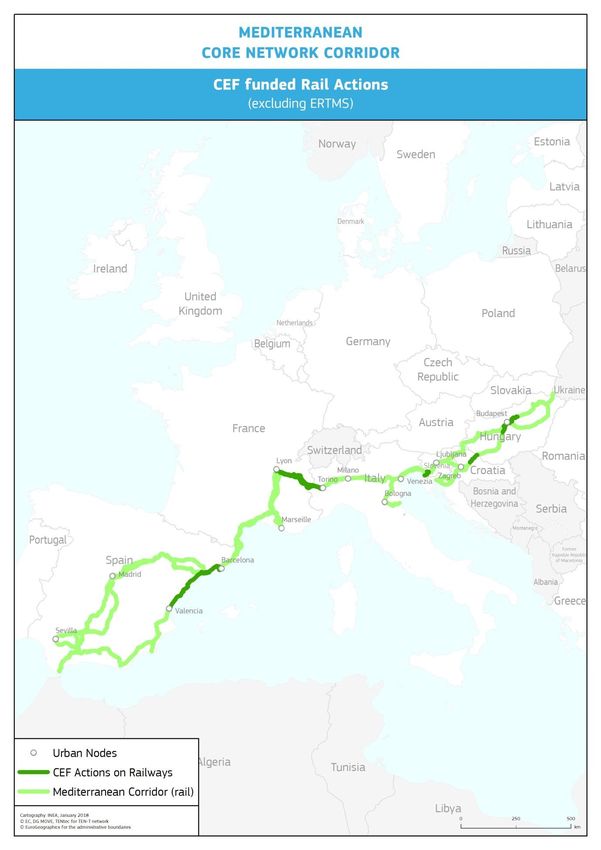
The largest rail Actions are located at the French-Italian cross border section, in Hungary and Spain.
The work plan underlines the strategic position of the Lyon-Turin 57km base tunnel. It is the main
missing link in the Corridor and a fundamental element to improve the connection between south-
western Europe and central/eastern European countries. CEF investment is granted through Action
(2014-EU-0401-M) that builds on previous TEN-T Actions. CEF funding is crucial to ensure the
transition of the project towards the the construction phase of the main tunnel tubes, expected to
start in 2017.
In his work plan, the Coordinator underlined the necessity to not only work on the tunnel itself but
also to improve the access to the tunnel. To that effect, CEF funded Actions (2015-FR-TM-0074-M;
2016-FR-TM-0190-W) at Lyon railway junction, European crossroads for freight and passenger
traffic, are expected to improve line capacity and safety. In addition, an Action (2017-FR-TM-0013-
W) funded under the CEF Blending Call will address 1 bottleneck thus improving operating
conditions on the existing network and relieve the pressures created by the bottleneck in the centre
of Lyon.
A CEF funding Action (2014-ES-TM-0438-W) that builds on previous TEN-T Actions, aims at
implementing the UIC standard gauge along the 489 km Valencia-Tarragona-Barcelona track
section. The Actions aim at removing a bottleneck and enhance interoperable rail connection to
Europe linking ports, logistical centres, individual branches and stations without interruptions at the
border.
In addition to the equipment of the Valencia-Tarragona-Barcelona track section a number of
Actions aim at supporting the UIC gauge connection of ports and terminals to this section. This
includes works (2014-ES-TM-0398-W) providing standard gauge access at the Constanti Logistical
Center, and the above mentioned works at the rail access of the port of Barcelona, port of Valencia
and at Tarragona intermodal terminal (see maritime section). This support is complementary to
ongoing CEF support for the deployment of the ERTMS signaling system at Barcelona urban node
(2014-ES-TM-0510-W) and along 2 stretches of approximately 655 km of Barcelona-Madrid
3
ERTMS first deployment means equipping a railway line section which was not equipped with the system before. ERTMS upgrade
means equipping, in compliance with the legally binding Baseline of a railway line, a section already equipped with the system, and
compliant with an older Baseline version.
9section. In addition an Action (2017-ES-TM-0063-W) received funding under the CEF Blending to
equip with UIC gauge the Castellbisbal- Nudo Vilaseca Section.
These investments are expected to significantly improve the access and interoperability along the
Corridor and within Europe. The corridor work plan also noted that these investments will contribute
to improve the use of the Figueres-Perpignan high speed line, along the Spain-France cross border
section.
6 Actions (€804 M funding) are implemented in Hungary to modernise the railway network and
eliminate critical bottlenecks identified by the Coordinator in his work plan. The upgrading of
Hungarian railway network to TEN-T standards is expected to ultimately contribute towards the
improvement of the cross border connection with Croatia. Works and Studies (2015-HU-TM-0003-
M) are expected to upgrade the 29.6 km double-track, Százhalombatta - Pusztaszabolcs section
and develop the Budapest Kelenföld - Croatian border railway line. Works (2014-HU-TMC-0493-W)
are also expected to upgrade 20.5 km Kelenfold-Szazhalombatta section and solve a current
bottleneck on the Hungarian section of the Corridor. Finally works (2015-HU-TM-0158-M) are
expected to modernized the 51.6 km long, double-track Budapest-Rakos-Hatvan section and
develop the Budapest-Zahony railway line.
The deployment of the European Rail Traffic Management System (ERTMS) is another priority
identified by the Coordinator for Hungary. Ongoing works (2015-HU-TM-0053-W) cover the second
and last stage of the deployment of the railway Global System for Mobile Communications (GSM-R)
on 956 km of the Hungarian railway network.
The work plan finally indicates the Budapest urban node as a relevant critical issue for the Corridor
regarding the lack of capacity, and overlapping of different types of rail traffic. CEF investment
(2015-HU-TM-0134-W) is expected to remove this rail bottleneck by upgrading the southern
Budapest Railway Bridge and the connected railway line.
5 Actions (€161M funding) are implemented in Slovenia to address major bottlenecks, improve the
rail network to TEN-T standards and ultimately contribute towards the improvement of the cross
border connection with Italy and Croatia.
Built on previous TEN-T support, CEF supports the upgrade of the Zidani Most–Celje railway section
(2015-SI-TM-0228-W) and of the three railway stations (Rimske Toplice, Laško, Celje, 2014-SI-
TMC-0301-M; 2016-SI-TMC-0151-M; 2016-SI-TMC-0153-M). CEF funding is also provided to
upgrade the Koper-Divača single-track railway line. Works (2014-SI-TMC-0537-W) upgrading the
Poljčane-Slovenska Bistrica double-track section are expected to increase the load capacity and
improve the interoperability of the railway line. In addition, an Action (2017-SI-TM-0016-W)
received funding under the CEF Blending to remove a current single-track bottleneck and provide an
important hinterland connection to the Port of Koper.
1011
2.1.5. Road

This section also includes information on Actions in the areas of ITS and clean fuels.

As indicated in the work plan, road is the dominant mode for trade flows between Corridor regions.
The Corridor compliance for road is about 100% and CEF supports to road projects focus on
fostering the development of secure parking, the availability of clean fuels as well as the
deployment of intelligent transport system.

In total the road portfolio in the Mediterranean Corridor is composed of 39 Actions, receiving
€148.1 million in CEF Transport funding.

14 Actions (38% of funding) deploy Intelligent Transport systems (ITS) for a total amount of €55.9
million. Built on previous TEN-T Actions, MedTIS II and III as well as Crocodile 2 and 3 Actions focus
on Road Safety solutions, Traffic Management and Traveller Information Services. Crocodile Actions
ensure an efficient cross-border communication among the various Traffic Management Centres,
the implementation of National Access Points and the use of DATEX II. Finally, complementary CEF
C-Roads investments deploy ITS services to improve freight traffic on the TEN-T road network
international truck drivers and hauliers.

21 Actions target innovation and are expected to install 448 supply points for alternative fuel for
road transport, 347 Electricity, 29 LNG, 39 CNG, 6 H2 and 24 LPG. They receive €47.7 million of
CEF funds.

Figure 5: Number of supply points for alternative fuel for road transport

                                                                  LNG          H2
                                                                   29           6

                                Electricity
                                   347

                                                                         CNG        LPG
                                                                          39         24

                             Electricity      LNG   CNG    H2      LPG

Finally, CEF (2015-HU-TM-0107-W) is expected to upgrade the M70 expressway between Letenye
and Tornyiszentmiklós to a full 2-lane dual-carriageway motorway, addressing 1 bottleneck along
the Lendava–Letenye pre-identified cross-border section currently limiting the traffic between
Hungary and Slovenia.

                                                    12
2.2. Financial implementation
The state-of-play of the financial implementation of the portfolio is shown in the figure below. The
effective payment4 (including pre-financing) corresponds to €487.8 million and therefore 17% of
the actual CEF Transport funding. As a consequence of the interim cost claims introduced by the
beneficiaries, costs corresponding to CEF-T funding of €166 million have been accepted so far (6%
of the actual CEF Transport funding).
Figure 6: Financial implementation ratios (€ million)
2,880.7
(100%)
487.8
(17%) 166
(6%)
Actual Funding Effective Payment Effective Accepted Contribution
Effective payments and effective accepted contribution as shown in the figure above may appear
as relatively low. This is due to a series of reasons:
Actions are due to submit interim payment claims every two years. As a consequence, the
"accepted contribution" by the end of 2017 corresponds to cost claims sent in 2017 for
some Actions and in 2016 for other Actions. Moreover, the cost claims received in 2017
include costs incurred until 31/12/2016 and those received in 2016 include costs incurred
until 31/12/2015.
The bulk of the funding goes to works (or major studies). These Actions usually start with a
study and/or a tendering phase during which the costs incurred are relatively low. For this
reason, the bulk of the costs are incurred in the last implementing years of these Actions
(see also figure 5 below).
Moreover, it has to be noted that effective payments are higher than effective accepted
contribution due to the fact that advance payment (pre-financing) are made.
Figure 7 gives an overview of the estimated financial progress, in terms of total estimated costs, of
the overall portfolio
4
(closed payments – recoveries)
13Figure 7: Estimated budget implementation (€ million)
1,977.3
(32%)
1,524.4
(24%)
943.7
701.6 (15%)
(11%)
277.5 568.8
77.6 159.5
(4%) (9%)
(01.2%) (3%)
2014 2015 2016 2017 2018 2019 2020 after 2020
3. Evolution of the Action portfolio
3.1. Funding variations after Grant Agreement signature
The actual CEF Transport funding allocated to Actions can differ from the initially allocated funding
depending on (1) Action closures and terminations and (2) certain types of amendments. Up until
now, amendments have triggered a funding reduction for 4 Actions (€13.3 million or 0.5% of the
initial CEF support to the Mediterranean corridor), while there have been no Action closures or
terminations so far. Experience from TEN-T implementation suggests that this figure will grow
later on in the implementation period due to the fact that some Actions will not be fully
implemented or because they will be implemented for less costs than initially expected.
Figure 8 : CEF Transport funding variations (€ million)
2,894 2,880.7
(100%) (100%)
Initial Funding Actual Funding
3.2. Challenges affecting the implementation of actions
In general terms, the most common implementation issues faced by Actions are related to
governance and the technical complexity of co-funded activities. Delays due to technical
complexities are recurrent in implementing large infrastructure projects and are a common
challenge for CEF Actions. This is for example the case for the implementation of the UIC gauge in
some stretches of the Spanish railway networks.
Administrative delays due to changes in public procurement legislation and the capacities of the
project stakeholders also affect the implementation of Actions. This is the case of some Actions in
Slovenia and Hungary. The complexity and length of permit and authorisation procedures is another
issue delaying the Actions implementation. For instance, in almost all countries public consultation
14had led to delays due to the sensitiveness of the foreseen works on environment, and some Actions
have been facing delays caused by permitting issues. Finally, political changes and French national
debate on infrastructure can be listed as governance challenges delayed some French projects.
Often, beneficiaries underestimated the effort needed to cope with administrative requirements
linked to specific procedures (permits, authorisation etc.). Beneficiaries in Slovenia and Hungary
noted that modifications of the legislation on public procurements delayed a number of Actions.
Similarly, beneficiaries often underestimated the time needed to carry out public consultations and
to implement modifications resulting from such public consultations. Finally, national policy
decisions (such as the French national debate on infrastructure) may affect some key Actions.
In the case of cross border projects, like the Lyon-Turin, different national legislation and
administrative procedures apply. Experience from the past shows that different infrastructure or
operating standards, different working methods could negatively affect cross border projects. CEF
investments support cross-border cooperation, like in the case of Lyon-Turin, Trieste-Divača and the
Mediterranean Rail Freight Corridor As regards Lyon-Turin, the setting up of the new public
promoter and the timely ratification of the Binational Treaty were major steps achieved with CEF
support. As regards the Trieste-Divača and Rail Freight Corridor, CEF supports the European
Economic Interest Grouping (EEIG) to coordinate activities and ensure the collaboration among
stakeholders.
4. Conclusion and Outlook
Built on the achievements of the TEN-T programme, the CEF funded Actions since 2014 contribute
to the implementation of the Corridor in general and, more particularly, to the key issues
highlighted by the coordinator in his work plan.
Ongoing works to standardise the Spanish railway network are expected to boost the rail traffic
flows between Spain and France and enhance rail interoperability within the EU. The new rail link
between France and Italy is the key section on which the optimal functioning of the whole Corridor
will hinge. Upgrading works along the Hungarian railway network are expected to eliminate an
important bottleneck and contribute to the modal shift of passengers and freights from road to rail.
Ongoing works at the Port of Rijeka are expected to strengthen the relevance of the Corridor for the
international trade of goods. The implementation of Intelligent Transport Systems for road (ITS)
and electric charging stations along the corridor will contribute to the optimisation of the use of the
Corridor motorways by reducing congestion and emission and by improving road safety.
In his work plan, the Coordinator insisted on the need to remove key bottlenecks and to meet a
number of technical parameters all along the corridor. For example, even if only a small section of
the corridor in the middle of the corridor is not equipped with ERTMS or can only accommodate
short trains, this will impact adversely the whole corridor. The CEF support is targeting these
objectives and INEA is monitoring very closely these Actions in light of their impact on the whole
corridor.
155. Statistical Annex
Corridor funding (€ million) per country Corridor funding (€ million) per type
HU 859.1 Studies
104.3
(45)
IT 570.9
FR 437.1
HR 364.2
Mixed
1,252.3 Works
ES 293.7 (21) 1,524.1
(54)
SI 278.4
Other 76.9
Number of Actions and corridor funding (€ million) by
Corridor funding (€ million) per section
national/multinational
Algeciras - Madrid
9.6 120
114 115 (100%)
110
Sevilla - Antequera - Granada -… 13.7 (95%) (96%)
(92%) Number of Actions Funding (€ million)
Madrid-Zaragoza-Barcelona 8.5
Valencia - Tarragona - Barcelona 195.8 86 National €1,957.1
Barcelona 50.7
Barcelona - Perpignan 2.9 34 Multinational €923.6
62
Perpignan - Montpellier
(52%) 11.9
Lyon 43.8
Lyon - Avignon - Marseille 3.5
30 - Torino
Lyon 813.8
(25%)
Milano - Brescia 4.0 Cumulative number of finalised Actions
Brescia -5Venezia - Trieste 50.6
1
(4%)
Milano - Cremona- Mantova -… 52.9
(1%)
Cremona, Mantova, Venezia,… 120
5.6 114 115
110 (100%)
(96%)
2016 2017Trieste
2018- Divaca
2019 0.5
2020 2021 2022 2023 (92%) (95%)
Koper - Divaca - Ljubljana -… 272.4
Rijeka - Zagreb - Budapest 733.4
Rijeka 96.7 62
(52%)
Ljubljana - Zagreb 5.7
Ljubljana node 0.5 30
Pragersko - Zalalövö 0 (25%)
Lendava - Letenye 40.8 5
1
Boba- Székesfehérvár 14.4 (1%) (4%)
Budapest-Miskolc-UA border 311.9
Vásárosnamény-UA border 0.0 2016 2017 2018 2019 2020 2021 2022 2023
Non pre-identified section 41.4
Disclaimer: The allocation of projects and funding to the corridor is based on the assessment done by INEA. In the chart per beneficiary country, the funding of multinational projects which are allocated to more
than one corridor is included in the "Other" category.
1617
6. List of Actions on the Mediterranean Corridor
                                                                                                                     Actual
  Transport                                                           Funding                                                  Actual Start   Actual End
                 Project Code                   Title                                   Priority           Type     Corridor                               Actual Funding   Actual Costs
    Mode                                                             Objective                                                    Date           Date
                                                                                                                     Share

                                    Improvement of the Northern
                                        Italy Waterway System:
                                          Removal of physical
  Inland
              2014-IT-TM-0543-W      bottlenecks on the Northern       FO 1      Core Network Corridors   Works      100%      01/01/2014     31/12/2017     9,282,800      46,414,000
 Waterways
                                      Italy Waterway System to
                                     reach the standards of the
                                       inland waterways class V

                                        AIRIS-PS. Advanced
                                   Implementation of RIS in Port
  Inland                            of Seville and Guadalquivir
              2015-ES-TM-0260-M                                        FO 3               RIS             Mixed      100%      01/01/2017     30/04/2019     1,425,000       2,850,000
 Waterways                           Euroway: the only in-land
                                    waterway of Spain in TENT
                                           Core Network

  Inland
 Waterways                                                                                                                                                  10,707,800      49,264,000
   Total

                                   Improvement of the hinterland
                                    rail connection to the Port of                Other sections of the
  Maritime    2014-ES-TM-0272-M                                        FO 1                               Mixed      100%      01/01/2014     31/12/2020     11,615,075     55,906,000
                                          Valencia (CONNECT                          Core Network
                                           VALENCIAPORT)

                                   CLEANPORT - Alternative Fuels
                                    and Solutions for Port's Cold-
                                     Ironing: Standardisation of
  Maritime    2014-ES-TM-0711-S                                        FO 2            Innovation         Studies    100%      01/01/2014     30/09/2017     3,174,529       6,349,058
                                     Regulatory Framework and
                                     Demonstration of Feasible
                                             Exploitation

  Maritime    2014-EU-TM-0531-S       FRESH FOOD CORRIDORS             FO 3               MoS             Studies    20%       01/09/2014     31/07/2018     2,011,167       4,022,333

                                   Sustainable LNG Operations for
  Maritime    2014-EU-TM-0698-M    Ports and Shipping - Innovative     FO 3               MoS             Mixed      100%      01/01/2015     30/09/2019     19,191,067     41,314,934
                                     Pilot Actions (GAINN4MOS)

                                   Sustainable LNG Operations for
  Maritime    2014-EU-TMC-0700-S   Ports and Shipping - Innovative     FO 3               MoS             Studies    100%      01/01/2015     30/09/2019     1,307,725       1,538,500
                                     Pilot Actions (GAINN4MOS)

                                                                                         18
Actual
Transport Funding Actual Start Actual End
Project Code Title Priority Type Corridor Actual Funding Actual Costs
Mode Objective Date Date
Share
Port of Rijeka multimodal
platform development and
Maritime 2014-HR-TMC-0144-W interconnection to Adriatic Gate FO 1 Core Network Corridors Works 100% 16/07/2015 31/12/2019 30,222,600 35,556,000
container terminal (POR2CORE-
AGCT)
Maritime 2014-IT-TM-0450-S GAINN4CORE FO 1 Core Network Corridors Mixed 22% 01/06/2015 30/09/2019 2,737,224 9,676,009
ELEMED – ELectrification of the
Eastern MEDiterranean area
Maritime 2015-EU-TM-0236-S (use of Cold Ironing and FO 3 MoS Studies 80% 01/04/2016 31/03/2018 60,640 121,280
electricity as a propulsion
alternative)
CarEsmatic – Supporting cars
and electric cars distribution
Maritime 2015-EU-TM-0250-M using Motorways of Sea’s FO 3 MoS Mixed 66% 01/03/2016 31/12/2018 3,451,985 11,314,301
solutions and promoting
sustainable shipping concepts
Adriatic MoS Upgrated Services
Maritime 2015-EU-TM-0310-M FO 3 MoS Mixed 38% 01/03/2016 20/12/2020 2,709,590 8,635,500
- Adri-Up
Upgrade of the Rijeka Port
infrastructure - Zagreb Pier
Maritime 2015-HR-TM-0032-W FO 1 Core Network Corridors Works 100% 01/10/2016 31/12/2020 26,849,056 31,587,125
container terminal (POR2CORE-
ZCT)
Upgrade of the Rijeka Port
Maritime 2015-HR-TM-0399-W infrastructure - General cargo FO 1 Core Network Corridors Works 100% 02/01/2017 31/12/2019 3,132,042 6,914,000
terminal (POR2CORE-GCT)
Removal of bottlenecks that
prevents Cartagena’s Port to
Nodes of the Core
Maritime 2016-ES-TM-0063-S connect core network and FO 3 Studies 100% 01/01/2017 31/12/2019 647,500 1,295,000
Network
improvement of urban traffic
(studies)
MoS Venice–Patras. Developing
and upgrading of the East-
Maritime 2016-EU-TM-0342-M FO 3 MoS Mixed 60% 01/07/2017 31/03/2020 1,698,780 6,028,000
Mediterranean Mos link Italy-
Greece
Upgrade of the Rijeka Port
Maritime 2016-HR-TMC-0067-W infrastructure - Rijeka Basin FO 1 Core Network Corridors Works 100% 02/10/2017 31/12/2020 28,614,466 33,664,078
(POR2CORE-Rijeka Basin)
19Actual
Transport Funding Actual Start Actual End
Project Code Title Priority Type Corridor Actual Funding Actual Costs
Mode Objective Date Date
Share
Upgrade of the Rijeka Port
infrastructure - Bakar bulk
Maritime 2016-HR-TMC-0171-W FO 1 Core Network Corridors Works 100% 02/10/2017 31/12/2019 5,180,464 6,094,664
cargo terminal (POR2CORE-
BCTB)
Maritime 2017-EU-TM-0037-W BClink: MoS for the future FO 3 MoS Works 66% 01/01/2018 31/12/2021 2,863,666 14,218,355
Ravenna Port Hub:
Maritime 2017-IT-TM-0044-W FO 1 Core Network Corridors Works 100% 01/07/2018 31/12/2023 37,377,000 186,885,000
infrastructural works
Maritime
182,844,577 461,120,137
Total
MEDAS 3.0 - Greening the
automotive supply chain with
trusted collaborative networks
Freight Transport
Multimodal 2014-DE-TA-0326-W to bundle cargo and operate a FO 2 Works 57% 01/01/2014 31/12/2016 601,518 3,007,588
Services
sustainable ‘just in time’
Mediterranean rail shuttle
service
Establishment of a new
intermodal terminal at BASF
Multimodal 2014-ES-TA-0026-M ESPAÑOLA, S.L. in Tarragona – FO 3 Multimodal Mixed 100% 01/10/2015 30/09/2019 5,520,000 25,500,000
Spain – for modal shift
between rail and road
Production of studies and plans
needed for the development of
an intermodal terminal and the
Multimodal 2014-ES-TM-0253-S associated Logistics Activity FO 3 Multimodal Studies 100% 01/01/2015 31/12/2018 970,450 1,940,900
Area for the integration of
goods transportation by road
and rail (Murcia LAA).
New Southern Rail Access to
Multimodal 2014-ES-TM-0481-W the Port of Barcelona - Phase 2 FO 1 Core Network Corridors Works 100% 01/07/2015 31/12/2018 36,129,470 120,431,565
- Connection Works
Mediterranean Corridor. Section:
Algeciras-Madrid-Zaragoza-
Multimodal 2014-ES-TM-0500-S Barcelona. Madrid-Vicálvaro FO 3 Multimodal Studies 100% 01/01/2016 31/12/2018 1,200,000 2,400,000
Freight Railway Terminal
Upgrade. Studies. Phase 1.
20Actual
Transport Funding Actual Start Actual End
Project Code Title Priority Type Corridor Actual Funding Actual Costs
Mode Objective Date Date
Share
LNG Technologies and
Innovation for Maritime
Transport for the Promotion of
Multimodal 2014-ES-TM-0593-S Sustainability, Multimodality FO 2 Innovation Studies 100% 01/01/2015 31/12/2018 7,512,782 15,025,564
and the Efficiency of the
Network (GAINN 4 SHIP
INNOVATION)
Viability analysis on the
harmonization of common data
Multimodal 2014-ES-TM-0674-S type categories for the road FO 2 Innovation Studies 50% 01/11/2015 31/10/2018 322,093 644,185
and public transport network
(HARMONY)
e-Freight Implementation
Multimodal 2014-EU-TM-0686-S FO 2 Innovation Studies 33% 01/07/2015 30/06/2018 643,500 1,287,000
Action (e-Impact)
CORE LNGas hive - Core
Multimodal 2014-EU-TM-0732-S Network Corridors and FO 2 Innovation Studies 50% 01/01/2014 31/12/2020 8,323,940 16,647,880
Liquefied Natural Gas
Enhancing the efficiency of the
Multimodal 2014-IT-TM-0591-M new container terminal of FO 3 Multimodal Works 100% 01/01/2014 31/12/2019 3,248,432 16,242,161
Interporto di Padova
Studies and works for
connections by rail of 4 existing
Multimodal 2015-ES-TM-0227-M freight terminals along the FO 3 Multimodal Mixed 100% 17/02/2016 31/12/2019 5,173,190 21,064,134
Mediterranean Corridor in Spain
by GRUPO ALONSO
Low-noise and low-carbon
freight delivery for Postal
Operators to ensure last mile Nodes of the Core
Multimodal 2015-ES-TM-0239-S FO 3 Studies 100% 17/02/2016 31/05/2019 1,033,272 2,066,544
connections through optimized Network
urban and long distance
transport (POSTLowCIT)
Improving the connections to
and development of the
Multimodal Logistics Platform
Multimodal 2015-ES-TM-0251-W FO 3 Multimodal Works 100% 01/01/2017 01/03/2019 2,680,630 16,226,573
in the Port of Seville, the sole
inland port of the Southern
Europe
21Actual
Transport Funding Actual Start Actual End
Project Code Title Priority Type Corridor Actual Funding Actual Costs
Mode Objective Date Date
Share
Standard gauge access
between Multimodal Platform
of La Llagosta and the
Multimodal 2015-ES-TM-0329-S FO 3 Multimodal Studies 100% 01/10/2016 31/12/2019 540,000 1,080,000
Mediterranean Corridor and
adaptation to 750 metres
lenght. Studies. Phase 1
Enhancing Interporto di Padova
- Step 2: ancillary measures
and ICT solutions for optimising
Multimodal 2015-IT-TM-0247-M FO 3 Multimodal Mixed 100% 01/03/2016 31/12/2020 1,352,120 5,935,600
terminal operations,
accessibility and
interconnections
Vado Multimodal Platform
rail/road terminal (core RRT
node of the TEN-T network)
Multimodal 2015-IT-TM-0312-M FO 3 Multimodal Mixed 100% 01/03/2016 31/07/2019 1,815,200 10,720,000
intermodal connections
optimization and Upgrading
(VAMP UP)
Study of gauges in Railway
Freight Transport
Multimodal 2016-ES-TA-0278-S Corridors for "Rail Motorways" FO 2 Studies 40% 01/07/2017 31/12/2020 300,000 600,000
Services
services
MiRO – Multimodal ROute Freight Transport
Multimodal 2016-FR-TA-0312-S FO 2 Studies 44% 01/07/2017 31/12/2020 1,787,455 3,574,910
connecting Barcelone to Paris Services
Upgrade of the Rijeka Port
Multimodal 2016-HR-TMC-0082-S infrastructure - Port Community FO 3 Multimodal Studies 100% 04/12/2017 31/12/2020 1,411,000 1,660,000
System (POR2CORE-PCS)
Multimodal 2016-IT-TM-0284-S GAINN4MED FO 2 Innovation Studies 18% 01/03/2017 31/03/2020 1,093,950 2,187,900
GAINN4MID -GAINN for Mobile
Multimodal 2017-EU-TM-0062-W FO 2 Innovation Works 20% 01/11/2017 31/08/2020 1,233,061 6,374,000
Infrastructure Deployment
GAINN4SEA - GAINN for South
Multimodal 2017-IT-TM-0066-W FO 1 Core Network Corridors Works 45% 01/03/2018 30/04/2022 6,448,826 34,977,924
Europe mAritime LNG roll-out
Multimodal
89,340,888 309,594,428
Total
Frigorail - Refrigerated rail
transport between Spain and Freight Transport
Rail 2014-ES-TA-0685-W FO 2 Works 39% 01/09/2015 31/03/2018 505,526 2,527,629
the Netherlands using TEN-T Services
corridors
22Actual
Transport Funding Actual Start Actual End
Project Code Title Priority Type Corridor Actual Funding Actual Costs
Mode Objective Date Date
Share
Intermodal Logistics Platform
Rail 2014-ES-TM-0398-W FO 3 Multimodal Works 100% 01/06/2015 31/12/2018 1,400,000 7,000,000
Constanti
MEDITERRANEAN CORRIDOR.
SECTION VALENCIA -
Rail 2014-ES-TM-0438-W TARRAGONA – BARCELONA. FO 1 Core Network Corridors Works 100% 01/01/2014 30/04/2019 124,491,191 311,227,977
IMPLEMENTATION OF UIC
GAUGE (PHASE 1)
ERTMS DEPLOYMENT ON
Rail 2014-ES-TM-0510-W FO 1 ERTMS Works 100% 30/11/2015 31/12/2019 5,200,000 10,400,000
BARCELONA COMMUTER LINES
Upgrade of Spanish High Speed
Lines to version 2.3.0.d. of
Rail 2014-ES-TM-0512-W FO 1 ERTMS Works 78% 01/04/2014 31/12/2018 3,268,200 6,536,400
ERTMS (ETCS+GSMR) 2nd
Phase
ATLANTIC CORRIDOR. SUPPLY,
ELECTRICAL FACILITIES AND
ACOUSTIC WORKS ON THE
Rail 2014-ES-TM-0518-W SECTION CHAMARTÍN-ATOCHA- FO 1 Core Network Corridors Works 50% 01/05/2015 31/03/2018 5,387,279 17,957,597
TORREJÓN DE VELASCO OF THE
HSRL MADRID-LISBOA AND
MADRID-BOBADILLA
Cross Border Section of the
Rail 2014-EU-TM-0401-M New Lyon-Turin Rail Link Mont FO 1 Core Network Corridors Mixed 100% 01/01/2014 31/12/2019 813,781,900 1,915,054,750
Cenis Base Tunnel (TBM)
Studies for the proposed new
railway line between
Rail 2014-FR-TM-0476-S FO 1 Core Network Corridors Studies 100% 01/01/2014 31/12/2019 11,650,000 23,300,000
Montpellier and Perpignan
(LNMP)
Contournement Ferroviaire de
l'Agglomération Lyonnaise
(CFAL) partie Sud et Nouveau
Franchissement du Rhône –
Rail 2014-FR-TM-0488-S FO 1 Core Network Corridors Studies 100% 01/01/2014 31/12/2018 1,308,750 2,617,500
Préparation de l’Enquête
Préalable à la Déclaration
d’Utilité Publique (EPDUP) -
étape 2
23Actual
Transport Funding Actual Start Actual End
Project Code Title Priority Type Corridor Actual Funding Actual Costs
Mode Objective Date Date
Share
Preparation for construction of
second track, upgrade and
Rail 2014-HR-TMC-0316-S FO 1 Core Network Corridors Studies 100% 01/10/2015 31/12/2019 8,500,000 10,000,000
modernisation on railway line
section Škrljevo-Rijeka-Jurdani
Upgrading the Kelenföld-
Pusztaszabolcs railway line,
Stage I (Upgrading the
Rail 2014-HU-TMC-0493-W FO 1 Core Network Corridors Works 100% 01/05/2015 31/12/2020 136,831,274 160,977,969
Kelenföld-Százhalombatta
section and installation of ETCS
level 2)
Upgrade and Strengthening of
Rail Freight Corridor 6 -
Rail 2014-IT-TM-0089-S FO 1 Rail interoperability Studies 100% 01/01/2015 31/12/2018 2,400,000 4,800,000
Mediterranean Corridor
including Extension to Croatia.
Bottleneck rehabilitation in the
Rail 2014-SI-TMC-0301-M area of Bivje on the Divača– FO 1 Core Network Corridors Mixed 100% 05/01/2015 27/02/2019 14,187,107 16,690,714
Koper railway line
Upgrading of the railway line
Rail 2014-SI-TMC-0537-W FO 1 Core Network Corridors Works 100% 01/05/2015 30/06/2020 11,937,879 27,317,800
Poljčane - Slovenska Bistrica
ATLANTIC CORRIDOR. HIGH-
SPEED RAIL SINES/LISBOA -
MADRID. MADRID URBAN NODE.
Nodes of the Core
Rail 2015-ES-TM-0173-S STUDIES OF IMPROVED AND FO 3 Studies 100% 01/05/2016 30/06/2018 500,000 1,000,000
Network
INTERMODAL ADAPTING OF
CHAMARTÍN STATION AND HSL
ACCESS TO MADRID AIRPORT
Atlantic Corridor. High-speed
rail Sines/Lisboa - Madrid.
Nodes of the Core
Rail 2015-ES-TM-0181-S Madrid urban node. Study of FO 3 Studies 100% 01/12/2016 31/12/2019 1,100,000 2,200,000
Network
the Railway Complex of Atocha
Station (Phase 2)
Core Network - Lyon urban
Nodes of the Core
Rail 2015-FR-TM-0074-M node - elimination of the FO 3 Mixed 100% 16/02/2016 15/06/2020 7,770,000 20,880,000
Network
railway bottleneck
24Actual
Transport Funding Actual Start Actual End
Project Code Title Priority Type Corridor Actual Funding Actual Costs
Mode Objective Date Date
Share
Upgrade of existing and
construction of second track on
Rail 2015-HR-TM-0106-W FO 1 Core Network Corridors Works 100% 01/07/2016 31/12/2020 241,346,218 283,936,727
the Križevci - Koprivnica - state
border railway line section
Upgrade of the Százhalombatta
- Pusztaszabolcs railway
Rail 2015-HU-TM-0003-M FO 1 Core Network Corridors Works 100% 05/01/2016 31/12/2020 231,538,522 272,398,261
section, including installation of
ETCS Level 2
Stage 2 of deployment of the
GSM-R system on the TEN-T
Rail 2015-HU-TM-0053-W FO 1 Core Network Corridors Works 80% 01/09/2016 30/12/2020 39,593,454 46,580,534
Railway Core Network in
Hungary
Upgrade of the Budapest South
Rail 2015-HU-TM-0134-W FO 1 Core Network Corridors Works 100% 01/01/2017 31/12/2020 97,105,657 114,241,949
Railway Bridge
Upgrade of the Budapest,
Rákos – Hatvan railway section,
Rail 2015-HU-TM-0158-M FO 1 Core Network Corridors Mixed 100% 01/03/2016 31/12/2020 297,588,420 350,104,023
including installation of ETCS
Level 2
Design of the railway
Nodes of the Core
Rail 2015-IT-TM-0144-S connection with the Venice FO 3 Studies 100% 09/03/2016 30/09/2017 4,000,000 8,000,000
Network
airport
ERTMS trackside equipment on
Italian sections of the
Rail 2015-IT-TM-0168-W ERTMS/Core Network Corridors FO 1 ERTMS Works 42% 02/01/2017 31/12/2020 19,198,200 38,396,400
in compliance with the
Breakthrough Program
Deployment of ERTMS/ETCS on
the Dobova-Zidani Most and
Rail 2015-SI-TM-0111-W FO 1 ERTMS Works 62% 01/12/2016 31/12/2020 3,952,499 4,649,999
Pragersko-Maribor-Šentilj
railway lines
Upgrade of the Zidani Most -
Rail 2015-SI-TM-0228-W FO 1 Core Network Corridors Works 100% 17/02/2016 31/12/2020 90,575,881 158,626,761
Celje railway line
FPSII. Advanced deployment of
innovative solutions to improve
Rail 2016-ES-TM-0058-S FO 2 Innovation Studies 100% 01/09/2017 30/12/2020 1,175,584 2,351,167
railway traffic management &
operation on the Core Network
25Actual
Transport Funding Actual Start Actual End
Project Code Title Priority Type Corridor Actual Funding Actual Costs
Mode Objective Date Date
Share
LINKING ZARAGOZA: URBAN
Nodes of the Core
Rail 2016-ES-TM-0133-S CONNECTIVITY WITH THE CORE FO 3 Studies 100% 15/02/2017 30/08/2019 589,839 1,179,677
Network
NETWORK
Remodelling of the Madrid
Nodes of the Core
Rail 2016-ES-TM-0271-S Chamartin railway complex to FO 3 Studies 100% 07/02/2017 31/12/2020 1,600,000 3,200,000
Network
adapt it to high speed services
CFAL – New Rhone crossing:
Nodes of the Core
Rail 2016-FR-TM-0189-S Studies in preparation for the FO 3 Studies 100% 07/02/2017 31/12/2020 1,150,000 2,300,000
Network
Public Interest Enquiry
Lyon urban node – Elimination
Nodes of the Core
Rail 2016-FR-TM-0190-W of the railway bottleneck FO 3 Works 100% 07/02/2017 30/06/2020 2,790,600 13,953,000
Network
(preparatory works)
Relieving congestion at the
Marseille railway node by Nodes of the Core
Rail 2016-FR-TM-0201-S FO 3 Studies 50% 07/02/2017 31/12/2020 1,250,000 2,500,000
increasing capacity on coastal Network
railway lines - Detailed Studies
Designs for the upgrade of the
Rail 2016-HR-TMC-0070-S railway section Oštarije – FO 1 Core Network Corridors Studies 100% 14/02/2017 31/12/2020 5,950,000 7,000,000
Škrljevo
Budapest Railway Node
Rail 2016-HU-TMC-0319-S FO 1 Core Network Corridors Studies 100% 01/01/2018 29/02/2020 1,266,500 1,490,000
Strategic Development Study
ERTMS on strategic sections of
Rail 2016-IT-TM-0244-W FO 1 ERTMS Works 65% 07/02/2017 31/12/2020 17,712,500 35,425,000
3 CNCs
Second track "Divača-Koper" –
Surveys, executive design,
Rail 2016-SI-TMC-0151-M construction of access roads FO 1 Core Network Corridors Mixed 100% 01/10/2017 30/06/2021 44,333,766 52,157,372
and structures for bridging
Glinščica Valley
Implementation of UIC gauge in
Rail 2017-ES-TM-0063-W Mediterraean Corridor. Section FO 1 Core Network Corridors Works 100% 14/07/2017 31/12/2023 56,992,264 284,961,321
Castellbisbal- NudoVilaseca
Core Network - Elimination of
Rail 2017-FR-TM-0013-W FO 1 Core Network Corridors Works 100% 15/07/2017 31/12/2023 30,760,000 153,800,000
Lyon railway bottleneck
Second track "Divača-Koper" –
Rail 2017-SI-TM-0016-W FO 1 Core Network Corridors Works 100% 01/04/2018 31/12/2023 109,026,725 545,133,626
Construction of tunnels T1-T7
Rail Total 2,449,715,732 4,922,874,153
26Actual
Transport Funding Actual Start Actual End
Project Code Title Priority Type Corridor Actual Funding Actual Costs
Mode Objective Date Date
Share
Road 2014-EU-TM-0563-W CROCODILE 2 FO 3 ITS Works 20% 01/01/2015 31/12/2018 1,651,400 8,257,000
Road 2014-EU-TM-0579-M UNIT-E FO 2 Innovation Mixed 26% 01/07/2015 31/12/2017 463,632 927,264
Road 2014-EU-TM-0588-W MedTIS II FO 3 ITS Works 100% 01/01/2014 31/12/2018 10,650,234 53,251,168
Boosting Energy Sustainable
fuels for freight Transport in
Road 2014-EU-TM-0729-S FO 2 Innovation Studies 20% 01/09/2014 30/06/2018 771,327 1,542,653
European motorWays
(BESTWay)
TIMELY [INTER-NETWORKS
Nodes of the Core
Road 2014-FR-TA-0566-W TRAFFIC MANAGEMENT ON FO 3 Works 50% 01/06/2015 31/05/2018 1,214,000 6,070,000
Network
LYON METROPOLITAN AREA]
Road 2014-HU-TMC-0629-M PAN-LNG Project FO 2 Innovation Mixed 40% 02/06/2015 30/06/2018 5,774,319 6,793,316
Deployment of autogas
refuelling stations in different
Road 2015-ES-TM-0030-W FO 2 Innovation Works 53% 16/02/2016 31/12/2018 261,025 1,305,125
metropolitan areas between
Spain and Portugal
SOLRED C-ITS Monitoring
Road 2015-ES-TM-0079-S FO 3 ITS Studies 42% 01/03/2016 30/06/2019 380,310 760,620
Network (SolC-ITS)
Nodes of the Core
Road 2015-ES-TM-0274-S INMAB FO 3 Studies 100% 01/04/2016 11/09/2020 1,250,000 2,500,000
Network
Road 2015-EU-TM-0104-S SiLNGT Small Scale TRANSPORT FO 2 Innovation Studies 100% 01/10/2016 30/09/2019 1,237,700 2,475,400
Road 2015-EU-TM-0204-S EAST-E FO 2 Innovation Studies 10% 01/03/2016 31/12/2018 505,580 594,800
Creation of LNG road HAulage
Road 2015-EU-TM-0292-S FO 2 Innovation Studies 100% 17/02/2016 30/06/2019 1,364,575 2,729,150
MArket in a smart & quick way
Road 2015-EU-TM-0409-S CIRVE Project FO 2 Innovation Studies 50% 01/07/2016 31/12/2020 880,808 1,761,616
EVA+ (Electric Vehicles Arteries
Road 2015-EU-TM-0415-S FO 2 Innovation Studies 24% 01/07/2016 31/03/2019 1,016,795 2,033,590
in Italy and Austria)
LNG motion: Fuelling trucks
Road 2015-EU-TM-0422-S with LNG/CNG along the core FO 2 Innovation Studies 14% 16/02/2016 31/12/2020 3,887,114 7,774,228
network
Road 2015-HR-TM-0114-W Crocodile II Croatia FO 3 ITS Works 100% 01/05/2016 30/09/2019 9,312,600 10,956,000
Upgrading the M70 expressway
to a 2-lane, dual carriageway,
Road 2015-HU-TM-0107-W motorway between Letenye FO 1 Core Network Corridors Works 100% 16/02/2016 30/09/2019 40,355,945 49,395,282
and Tornyiszentmiklos at HU-SL
border
27Actual
Transport Funding Actual Start Actual End
Project Code Title Priority Type Corridor Actual Funding Actual Costs
Mode Objective Date Date
Share
Road 2015-HU-TM-0315-M CNG Clean Fuel Box Project FO 2 Innovation Mixed 48% 01/10/2016 31/12/2018 4,738,961 5,575,248
Road 2015-HU-TM-0358-W CROCODILE_2.0_HU FO 3 ITS Works 50% 16/02/2016 31/12/2018 2,522,577 2,967,738
Traffic Management Integration
Road 2015-SI-TM-0303-W in the National Traffic FO 3 ITS Works 73% 30/06/2016 29/11/2019 1,951,416 2,295,784
Management Centre
Road 2016-EU-TM-0044-M URSA MAJOR neo FO 3 ITS Mixed 19% 07/02/2017 31/12/2020 6,104,584 28,397,725
High speed electric mobility
Road 2016-EU-TM-0121-W FO 2 Innovation Works 8% 01/07/2017 31/12/2020 813,440 4,067,200
across Europe
ECO-GATE: European COrridors
Road 2016-EU-TM-0126-S for natural GAs Transport FO 2 Innovation Studies 39% 07/02/2017 31/12/2019 3,845,563 7,691,125
Efficiency
Road 2016-EU-TM-0163-W CROCODILE 3 FO 3 ITS Works 34% 01/01/2018 31/12/2020 935,340 4,676,700
Road 2016-EU-TM-0275-W MedTIS III FO 3 ITS Works 100% 08/02/2017 31/12/2020 14,105,115 70,525,573
Road 2016-EU-TM-0327-S CONCORDA FO 3 ITS Studies 40% 01/10/2017 30/06/2020 4,000,000 8,000,000
E-VIA – FLEX-E mobility in ES,
Road 2016-EU-TM-0337-S FO 2 Innovation Studies 43% 01/07/2017 31/12/2019 1,438,350 2,876,700
FR, IT
Comprehensive fast-charging
Road 2016-EU-TMC-0344-W corridor network in South East FO 2 Innovation Works 23% 01/05/2017 31/12/2020 788,523 985,654
Europe
Road 2016-EU-TMC-0350-S NEXT-E FO 2 Innovation Studies 41% 01/03/2017 31/12/2020 7,726,245 9,089,700
URBAN-E: e-Mobilty,
Infrastructure and Innovative
Nodes of the Core
Road 2016-EU-TMC-0351-S Intermodal Services in FO 3 Studies 33% 01/03/2017 31/12/2020 1,254,693 1,476,110
Network
Ljubljana, Bratislava and
Zagreb
Road 2016-HR-TMC-0162-W CROCODILE 3 Croatia FO 3 ITS Works 50% 01/01/2018 31/12/2020 2,080,800 2,448,000
C-ROADS Hungary
Road 2016-HU-TMC-0216-M („Infrastructure for Connected FO 3 ITS Mixed 50% 07/02/2017 31/12/2020 848,058 997,716
and Automated driving”)
Road 2016-HU-TMC-0300-W CROCODILE 3 HU FO 3 ITS Works 50% 01/01/2018 31/12/2020 890,461 1,047,601
Traffic Management Integration
Road 2016-SI-TM-0229-W in the National Traffic FO 3 ITS Works 74% 03/01/2018 31/12/2020 828,800 4,144,000
Management Centre 2
EUROP-E: European Ultra-
Road 2017-DE-TM-0064-W Charge Roll Out Project - FO 2 Innovation Works 13% 15/07/2017 31/12/2021 5,083,699 25,418,496
Electric
28You can also read


