PROPOSED ALDI DEVELOPMENT MOSS LANE GARSTANG SUSTAINABLE TRAVEL PLAN - ALDI FOOD STORES
←
→
Page content transcription
If your browser does not render page correctly, please read the page content below
PROPOSED ALDI DEVELOPMENT
MOSS LANE
GARSTANG
SUSTAINABLE TRAVEL PLAN
August 2014
ALDI FOOD STORES
Turner Lowe Associates TRAFFIC ENGINEERING CONSULTANTS
22 Guest Road. Manchester. M25 3DL. Tel. 0161 798 7898 Fax. 0161 798 6642
TLA
Proposed Aldi Development
Moss Lane. Garstang
Sustainable Travel Plan
PROPOSED ALDI DEVELOPMENT
MOSS LANE
GARSTANG
SUSTAINABLE TRAVEL PLAN
August 2014
ALDI FOOD STORES
Job. No. 140601
Authorised By: J. Lowe
Position: Partner
Signed:
Date: 6 August 2014
This report is for the sole use of Aldi Food Stores (the Client) and Turner Lowe Associates in connection
with the above project. No undertaking or responsibilities are given to any other party. Reproduction of
any part of this report is expressly forbidden without the approval of Turner Lowe Associates and the
Client.
Turner Lowe Associates.
Turner Lowe Associates
TLA
Proposed Aldi Development
Moss Lane. Garstang
Sustainable Travel Plan
Contents Page
1. Introduction 1
2. Details of Proposed Development and Existing Accessibility 3
i. The Development 3
ii. Location 3
iii. Existing Travel Patterns in Garstang 5
iv. Pedestrian Accessibility 7
v. Public Transport Accessibility 8
vi. Pedal Cycle Accessibility 9
3. Objectives and Content of the Travel Plan 10
i. Stage 1 10
ii Stage 2 11
Employee Initiatives 11
i. Employee Travel Survey 11
ii. Travel and Travel Plan Information Provision 11
iii. Personalised Travel Planning 12
iv. Walking 12
v. Pedal Cycling 12
vi. Public Transport 13
vii Motor Car Users 13
Customer Initiatives 14
i. Customer Travel Survey 14
4. Implementation and Monitoring 15
i. Travel Plan Co-ordinator 15
ii. Responsibilities 15
iii. Key Travel Plan Administration Tasks 15
iv. Travel Plan Monitoring 16
v. Marketing 16
vi. Targets 16
vii Reporting 17
5. Conclusions 20
Turner Lowe Associates
TLA
Proposed Aldi Development
Moss Lane. Garstang
Sustainable Travel Plan
Figures
Appendices
Drawings
Turner Lowe Associates
TLA
Proposed Aldi Development
Moss Lane. Garstang
Sustainable Travel Plan
1. Introduction
1.1 This Sustainable Travel Plan has been prepared on behalf of Aldi Stores Ltd as part
of the proposed development by Morbaine Ltd on Moss Lane, Garstang.
1.2 This Travel Plan will be applied to both Aldi staff and customer policies.
1.3 The Plan has been prepared in accordance with guidance contained in the following
original DETR documents:
i. Green Transport Plans
ii. The Benefits of Green Transport Plans: The Guide
iii. The Benefits of Green Transport Plans: A Literature Review
iv. Guide to Green Transport Plans: Advice for Government Departments.
subsequently issued DfT documents:
v. Preparing Your Organisation for Transport in the Future: The Benefits of
Green Transport Plans: The Guide. 1999
vi. Making Travel Plans Work. 2000
vii. Travel Plan Resource Pack for Employers. 2000
viii. Using the Planning Process to Secure Travel Plans. 2005
ix. Good Practice Guidelines: Delivering Travel Plans through the Planning
Process. April 2009
and:
x. NHS National Institute for Clinical Excellence (NICE) Public Health
Guidance Report 8: Promoting and Creating Built or Natural
Environments that Encourage and Support Physical Activity. January
2008.
1.4 In 1998, the Government published its White Paper entitled "A New Deal for
Transport, Better for Everyone". This document sets out the Government's current
transport policy which promotes a greater integration of the transport and land use
planning processes, and a priority for sustainable modes of transport.
1.5 The Government’s White Paper on the future of transport entitled “The Future of
Transport – a network for 2030” July 2004, sets out the Governments continued
commitment to sustainable transport.
1.6 The increased dominance of the private motor car contributes to congestion,
pollution, social barriers, increased risk of accidents and can affect the health and
fitness of people. Current travel patterns are unsustainable and future demands for
travel cannot be satisfactorily met, particularly by car, unless they are managed
more efficiently.
Turner Lowe Associates
-1-
TLA
Proposed Aldi Development
Moss Lane. Garstang
Sustainable Travel Plan
1.7 Aldi are well aware of current transport issues and the need for sustainable
development. Aldi are actively taking action to reduce the impact of their stores
and other operations and activities.
1.8 This Sustainable Travel Plan is consistent with the National policies and will thus
help to achieve the Government's objectives of reducing reliance on the private car,
reducing traffic emissions, and the promotion of sustainable transport. The Plan
embraces national and local transport policy objectives to reduce the number and
length of motorised journeys and will help to encourage alternative means of
transport.
1.9 To achieve these aims a two stage approach will be adopted as summarised below:
Stage 1
To provide a number of measures from the outset as part of the development to
provide Aldi shoppers and employees with safe and viable transport alternatives to
the car for accessing the store.
Stage 2
To continually monitor the travel patterns of customers and employees, and
implement any additional selective measures that may be identified to encourage
sustainable travel.
Turner Lowe Associates
-2-
TLA
Proposed Aldi Development
Moss Lane. Garstang
Sustainable Travel Plan
2. Details of Proposed Development and Existing Accessibility
i. The Development
2.1 The development site is located on the G B Oils depot site on Moss Lane (Figure 1).
2.2 The development will consist of an Aldi Discount Foodstore with a gross floor area
of 1699 sq m. The site layout and access arrangements are shown on Drawing No:
140601/01 Rev A, a copy of which is provided in the Drawings section of this
report.
2.3 The site has an existing substandard access that will be replaced by an access to
current standards.
2.4 The existing (Oil Depot) use rights of the site have the potential to generate
significant HGV activity. An Aldi store usually has no more than 5-6 deliveries a
day at off peak times. Delivery routes are planned with vehicles often delivering to
several stores to minimise distances travelled by each vehicle and maximise
efficiency of goods delivery. This practice is not only economically beneficial for
Aldi but achieves greatest sustainability.
2.5 The proposed development will therefore result in the removal of significant HGV
activity in this area; the closure of a sub-standard access point; and the creation of a
new access to modern design standards.
ii. Location
2.6 The site in relation to the surrounding highway network is shown in Figure 2.
2.7 The proposed redevelopment site is located to the north of Moss Lane on an
existing Oil Depot site. As outlined above, the existing site has access only from
Moss Lane. This is a sub-standard access for commercial uses with the site’s
existing use rights capable of generating high volumes of HGV traffic.
Turner Lowe Associates
-3-TLA
Proposed Aldi Development
Moss Lane. Garstang
Sustainable Travel Plan
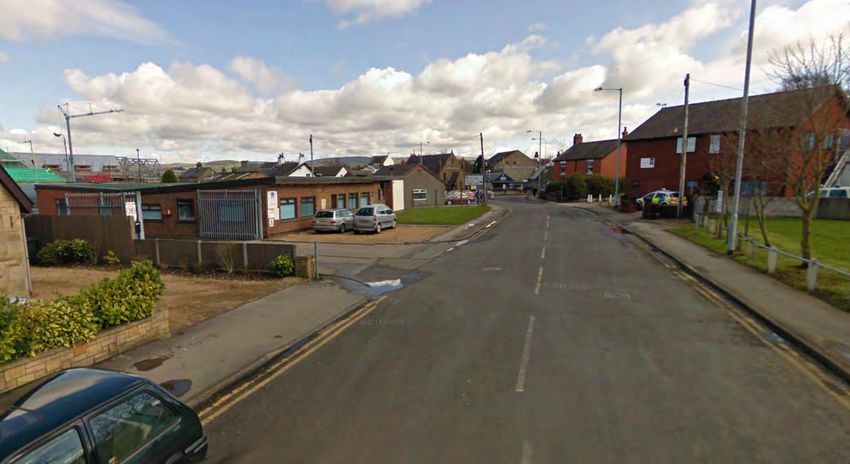
View of Moss Lane Access Looking West
View of Moss Lane Access Looking East
2.8 Moss Lane is an unclassified local distributor road which connects to the A6 to the
west (and to the M6 Junction 33 to the north) and to Park Hill Road to the east (Park
Hill Road and High Street / Market Place form part of the B6430 providing a one-
way clockwise gyratory around the town centre).
2.9 The immediate vicinity is subject to a blanket 20 mph speed limit introduced as part
of the highway authority’s policy for residential areas, with waiting restrictions to
protect the existing access junction and other sections of carriageway. In other
sections there is on-street parking which helps to keep vehicle speeds in line with
Turner Lowe Associates
-4-TLA
Proposed Aldi Development
Moss Lane. Garstang
Sustainable Travel Plan
the 20 mph limit. Moss Lane is a single carriageway around 8.5 m wide in the
vicinity of the development.
2.10 The site has good vehicle and alternative mode accessibility to the surrounding area.
iii. Existing Travel Patterns in Garstang
2.11 The National Trip End Model (Tempro V6.2 / Dataset 62) has been used to derive
the modes of transport used in Garstang for Shopping and Employment Trip
purposes in comparison with the County and National travel patterns at 2014 levels.
The results are shown in Tables 2.1 and 2.2 below.
2.12 As can be seen weekday and Saturday shopping trips on foot in Garstang are very
slightly less than the County and National averages. As will be seen in Section 4 of
this report, the proximity of existing residential development in relation to the
proposed development is likely to be conducive to higher percentages of trips on
foot being made to the development.
2.13 Weekday and Saturday Shopping trips by cycle in Garstang are again slightly lower
than the County and National averages. The ease of cycling on Moss Lane and the
provision of cycle parking within the development should result in the development
generating a higher level of cycle trips than is currently being experienced in
Garstang.
2.14 Weekday and Saturday shopping trips by car are higher in Garstang than the County
and National averages but the likely increase in trips on foot and by cycle will be
balanced by a reduction in trips by car so this should reduce for the development.
2.15 Shopping trips using Public Transport are lower in Garstang than the County and
National Averages but with services passing by or close to the site higher
percentages would be expected in this location than the Garstang average.
2.16 Both weekday and Saturday employment trips made on foot in Garstang are slightly
lower than the County and National averages. Employment trips by cycle are also
slightly lower. The large area of population within easy walking and cycling
distance of the development from where employment trips for a Discount Foodstore
could originate, however, should result in greater percentages being achieved,
2.17 Employment trips made by car are higher in Garstang than the County and National
averages but as in the case of customer trips, the likely increase in trips on foot and
by cycle will be balanced by a reduction in trips by car.
2.18 As in the case of shopping trips, Employment trips using Public Transport are lower
in Garstang than the County and National Averages but with services directly
Turner Lowe Associates
-5-TLA
Proposed Aldi Development
Moss Lane. Garstang
Sustainable Travel Plan
passing or passing close to the site, and stops within easy walking distance, a higher
level of use would be expected by the staff to be employed at the proposed
foodstore.
Table 2.1 Modes of Travel for Shopping Trips in Garstang,
Lancashire and Nationwide (2014)
Mode Garstang Lancashire GB
Weekdays
Walk 32.99% 34.26% 34.87%
Cycle 1.15% 1.23% 1.17%
Car Driver 40.67% 37.79% 36.83%
Car Passenger 19.95% 20.96% 20.40%
Bus 4.89% 5.12% 5.75%
Rail 0.39% 0.64% 1.0%
Saturdays
Walk 28.27% 28.67% 29.02%
Cycle 0.95% 1.01% 0.97%
Car Driver 38.23% 36.05% 35.29%
Car Passenger 27.79% 28.94% 28.37%
Bus 4.34% 4.65% 5.23%
Rail 0.42% 0.68% 1.12%
Table 2.2 Modes of Travel for Employment Trips in Garstang,
Lancashire and Nationwide (2014)
Mode Garstang Lancashire GB
Weekdays
Walk 12.25% 12.68% 12.87%
Cycle 2.26% 2.67% 2.54%
Car Driver 67.51% 65.32% 63.26%
Car Passenger 11.94% 12.22% 11.52%
Bus 4.73% 4.82% 5.51%
Rail 1.31% 2.29% 4.30%
Saturdays
Walk 13.07% 13.50% 13.58%
Cycle 2.80% 3.44% 3.53%
Car Driver 63.51% 61.25% 59.26%
Car Passenger 15.45% 15.99% 15.72%
Bus 4.59% 4.69% 5.58%
Rail 0.58% 1.13% 2.33%
Turner Lowe Associates
-6-TLA
Proposed Aldi Development
Moss Lane. Garstang
Sustainable Travel Plan
2.19 The location of the development is clearly well suited to encourage trips, both by
shoppers and staff to be made by alternative modes of travel to the private car.
iv. Pedestrian Accessibility
2.20 The site is within easy walking distance of a wide surrounding catchment area.
2.21 The DTLR publication “By Design: Better Places to Live, A companion guide to
PPG3” advises that when considering new residential development the area within
10 minutes walking time or 800 m walking distance should be examined to
determine the range of facilities which residents could access comfortably on foot.
Whilst the parent document PPG3 has now been superseded this advice is still valid.
The same logic would therefore be appropriate to determine the area which would
be within a comfortable walking distance or time of the proposed development. This
is also the preferred maximum walking distance for town centre journeys on foot as
advised by the Institution of Highways and Transportation in their publication
‘Guidelines for Providing for Journeys on Foot’.
2.22 Whilst now superseded by the National Planning Policy Framework, the advice in
the former PPG13 is still relevant and advised that walking is the most important
mode of travel at the local level and offers the greatest potential to replace short car
trips, particularly under 2 kilometres. Assuming a round trip of 2 km for a shopping
trip, a single walking distance of 1 km would, therefore, be considered acceptable.
2.23 The site location and the areas within an 800 m and 1 km radius are shown in Figure
3. As can be seen, virtually the whole of Garstang would be within these
comfortable walking distances. This and the following diagram indicates “as the
crow flies” distances. The science behind the derivation of these distances is far
from exact and any more detailed catchment areas would not have any greater
reliability (in fact less by indicating with what may appear to be accuracy, areas that
would not be within walking distance from where pedestrians could easily walk to
the site).
2.24 The site is also adjacent to the Booths foodstore and car park (which also acts as a
general car park for the town centre). There is a strong likelihood of there being
linked trips between the two foodstores in line with current Transport Planning
policies.
2.25 For employment trips a 2 km walk in each direction would be appropriate and this is
also the preferred maximum walking distance for commuting journeys on foot as
advised by the Institution of Highways and Transportation in their publication
‘Guidelines for Providing for Journeys on Foot’. The area within such a catchment
is shown in Figure 4. This covers the whole of Garstang and Bowgreave from
where staff who could walk to the development on foot could be recruited.
Turner Lowe Associates
-7-TLA
Proposed Aldi Development
Moss Lane. Garstang
Sustainable Travel Plan
2.26 Footways in the area are relatively good and there should be no need for any
improvements to accommodate the expected pedestrian traffic that will be generated
by the development.
2.27 The site is clearly accessible on foot and the location in relation to the surrounding
areas is likely to encourage trips to the development to be made on foot and a
potential reduction in car use.
v. Public Transport Accessibility
2.28 The site is well served by public transport with several services passing close to the
site on the Park Hill Road gyratory system or on Moss Lane as detailed in Table 2.3.
.
Table 2.3 Bus Service Details.
Service Frequency Area Covered
40 60 min Mon - Sat Preston – Garstang – Lancaster - Morecambe
06.15 – 23.39
60 min Sundays
09.44 – 21.48
40a 1 service Mon - Fri Preston – Garstang – Lancaster
07.55
1 service Mon - Fri
17.20
41 60 min Mon - Fri Preston – Garstang – Lancaster - Morecambe
08.07 – 18.19
60 min Saturdays
09.42 – 18.12
42 60 min Mon - Fri Blackpool – Garstang – Lancaster
07.43 – 23.29
60 min Saturdays
10.20 – 23.29
120 min Sundays
12.19 – 21.19
2.29 The routes of these services are shown in Figure 5
2.30 The closest stop on Moss Lane is a simple “standard” stop. The Park Hill Road
stops have raised boarding points and high standard shelters with timetable displays.
Turner Lowe Associates
-8-TLA
Proposed Aldi Development
Moss Lane. Garstang
Sustainable Travel Plan
2.31 It is clear that the site has good public transport accessibility and is well located in
accordance with current transportation planning policies.
vi. Pedal Cycle Accessibility
2.32 There are no defined cycle routes in the immediate vicinity of the development but
the western end of Moss Lane is used for a recreational cycle route that follows the
canal. There are other planned cycle routes for the area as shown in Figure 6.
2.33 On Park Hill Road to the south of Moss Lane cycle lanes have been provided but
elsewhere the traffic flows are such that specific cycle facilities are not needed.
2.34 Within the site secure cycle parking facilities will be provided to encourage this
mode of transport for small shopping trips. Staff will be further encouraged to use
cycles as an alternative to the car through the provision of secure long stay cycle
parking facilities and lockers.
2.35 It is usual to assume a maximum cycle distance of 5 km for shopping trips and
employment trips. Assuming a total cycle distance of 5 km (i.e. 2.5 km each way)
for shopping trips gives the cycling catchment area indicated in Figure 7. As can be
seen the whole of Garstang is within easy cycling distance of the development site.
2.36 For employment trips it would be reasonable to assume a 5 km distance each way.
Such a catchment area would have 2x the radius of the Figure 7 catchment area and
4x the area. Cycling would clearly be an appropriate form of travel from a wide
surrounding area for employment trips.
2.37 The site is clearly accessible by this mode of transport and the development will
encourage this mode for shopping and employment trips as an alternative to the car.
Turner Lowe Associates
-9-TLA
Proposed Aldi Development
Moss Lane. Garstang
Sustainable Travel Plan
3. Objectives and Content of the Travel Plan
3.1 The Travel Plan is primarily aimed at reducing the dependence of Employees on
travel by car. The main objectives of the Travel Plan can therefore be defined as
follows:
i. Discourage the use of unsustainable modes of transport and enable
employees to make travel choices that benefit themselves and their
community.
ii. Introduce a package of physical and management measures that will
facilitate employee travel by sustainable modes; and
iii. Raise awareness of alternative modes of transport and thus encourage a
modal shift towards more sustainable travel modes.
3.2 The secondary objectives of the Travel Plan are to:
iv. To increase customer awareness of the advantages and availability of
sustainable modes; and
v. To reduce unnecessary and unsustainable use of the car by customers,
particularly in the case of short trips.
3.3 The objectives will be achieved through reference to information on travel patterns
at the site which will be analysed to identify and establish baseline conditions, the
propensity for future travel change and to assist in the selection / refinement of
individual Travel Plan measures.
STAGE 1
3.4 The first stage in the process of implementing the Sustainable Travel Plan is the
introduction of measures forming part of the development proposals, which will
encourage sustainable travel from the outset. The design of the proposed
development takes full account of the aims of the Sustainable Travel Plan and
introduces a number of measures which will improve sustainable transport for
people travelling to and from the store. These measures include:
i. The provision of pedestrian routes within the site linking the site to Moss
Lane, and with agreement, the Booths store / car park and the northern
part of the town centre beyond.
ii. The provision of pedal cycle parking facilities within the site in close
proximity to the store entrance in accordance with the local planning
authority’s parking standards.
Turner Lowe Associates
- 10 -TLA
Proposed Aldi Development
Moss Lane. Garstang
Sustainable Travel Plan
iii. The display of any bus timetable and other public transport promotion
literature and displays that may be provided by the Passenger Transport
Executive in the store and staff area.
STAGE 2
3.5 The second stage will involve carrying out surveys to understand travel patterns and
implementing selective measures to encourage sustainable travel. Measures that
will be investigated and considered in detail will include the following:
EMPLOYEE INITIATIVES
i. Employee Travel Survey
3.6 Once the store is operational the Travel Plan Coordinator (see Section 4.1) will
organise an Employee Travel Survey to understand the travel needs of staff to be
employed at the store to help to ascertain:
i. The suitability of existing public transport services to meet the needs of
employees
ii. To plan the most effective additional services to meet employee needs
iii. Employee attitude towards sustainable modes of transport
iv. Employee preferences to their intended mode of transport
v. Employee attitude to changing their preferred mode of transport if
necessary
vi. Cost effective measures to induce a shift from private car usage to other
sustainable modes of transport
3.7 An example of the Travel Survey Questionnaire that has been used in other Aldi
Travel Plans is reproduced in Appendix A
ii. Travel and Travel Plan Information Provision
3.8 All employees will be provided with Introduction Packs which will include the
following information:
i. Name and contact details of the Travel Plan Co-ordinator;
ii. An introduction to the Travel Plan and its purpose;
Turner Lowe Associates
- 11 -TLA
Proposed Aldi Development
Moss Lane. Garstang
Sustainable Travel Plan
iii. Bus route maps and timetables; and
iv. Location and access arrangement to lockers, changing facilities
and cycle parking.
3.9 This information will be available to all new employees as part of their induction.
Information will be reviewed as part of the Travel Plan to ensure the most up to
date employees information is provided to employees.
iii. Personalised Travel Planning
3.10 The Travel Plan Co-ordinator will offer a personalised Travel Planning service for
all new employees. The free online journey planning information that is available
to plan journey from door to door will be promoted to employees, including:
http://www.transportdirect.info/ and http://www.traveline- northwest.co.uk/.
3.11 For journeys on foot the walking journey planner www.walkit.com will be
promoted amongst employees. The transport direct website detailed above also
offers information on planning cycle routes.
iv. Walking
3.12 It is accepted that the shift patterns of the workforce may not be conducive to the
promotion of walking on a daily basis, and that such modes are generally less
attractive during the winter months; however, given appropriate incentive/
encouragement there is potential to encourage additional staff member to do so.
3.13 The Travel Plan Co-ordinator will:
i. Liaise with staff living within nearby residential areas with the aim of
encouraging them to walk, even if only occasionally;
ii. Liaise with the Highway Authority to ensure that pedestrian routes are
properly maintained;
iii. Promote the benefits of walking.
3.14 Employees will be provided with information and advice concerning safe
pedestrian routes to the store.
v. Pedal Cycling
3.15 The store encompasses a significant population catchment within an acceptable
cycling distance of five kilometres that is defined within PPG13. The Travel Plan
Turner Lowe Associates
- 12 -TLA
Proposed Aldi Development
Moss Lane. Garstang
Sustainable Travel Plan
Co-ordinator will:
i. Liaise with employees living within a accessible cycle distance, with the
aim of encouraging them to cycle, even if occasionally;
ii. Promote the benefits of cycling; and
iii. Promote websites offering information on cycling.
3.16 Employees will be provided with information and advice concerning safe cycle
routes to the store.
3.17 Secure parking will be available for employees.
3.18 Changing and Locker facilities will be available for employees
3.19 Bicycles are regularly available as ‘special purchases’ within Aldi stores. This
provides an opportunity for staff to purchase bicycles at greatly discounted rates,
thus encouraging this mode of transport.
vi. Public Transport
3.20 The area surrounding the site has good public transport links, with several bus
stops located close to the store. The frequency of bus services and the range of
destinations served from these stops should provide a realistic alternative travel
mode to the private car.
vii. Motor Car Users
3.21 Due to the limited number of staff, and the potential non-coincidence of shift
patterns, it is considered that there is little merit in providing a formalised car
share scheme to employees at Aldi Food Stores.
3.22 The Travel Plan Co-ordinator will, however, recommend to employees the web-
based Lift Share schemes (www.carsharegm.com) and the national Lift Share
scheme (www.liftshare.org).
3.23 Support will be given any staff member wishing to find a car share partner by the
Travel Plan Co-ordinator.
3.24 In the event that an employee’s ride home becomes unavailable, employees will
be guaranteed a free taxi home.
Turner Lowe Associates
- 13 -TLA
Proposed Aldi Development
Moss Lane. Garstang
Sustainable Travel Plan
CUSTOMER INITIATIVES
3.25 The primary focus on influencing customer travel will be by raising awareness
of the benefits and opportunities for travel by sustainable modes, as follows:
i. Information on bus routes and timetables along with walk and cycle
routes will be displayed within store;
ii. Information on the benefits of walking and cycling will also be
promoted within store.
3.26 Discussions have been held with management at Aldi Stores Limited to determine
the best way of displaying this information within the store. It has been agreed
that a folder will be provided within the customer packing area containing all
relevant information of travel by sustainable modes. Timescales for implementation
of this information would be within six months of the store opening.
i. Customer Travel Survey
3.27 When the new store has become established and has a reasonable stable customer
patronage, The Travel Plan Co-ordinator will organise a customer questionnaire
travel survey. By interrogating the results (in conjunction with the local and
highway authorities) it will be possible to establish the travel characteristics of the
customers. It will then be possible to tailor future transport initiatives and focus on
addressing the travel patterns of the established customer base.
3.28 In understanding modal choices and travel behaviour of customers the following
will be investigated.
i. areas of residence
ii. purpose of trip
iii. frequency of visits to store
iv. main mode of transport used
v. Reason for use of car if that mode used
3.29 An example of the Customer Travel Survey Questionnaire that has been used in
other Aldi Travel Plans is reproduced in Appendix B
3.30. The findings of the customer travel survey will form the basis for the formulation
and development of further transport initiatives.
Turner Lowe Associates
- 14 -TLA
Proposed Aldi Development
Moss Lane. Garstang
Sustainable Travel Plan
4. Implementation and Monitoring
i. Travel Plan Co-ordinator
4.1 The administration of the Travel Plan is the responsibility of the Travel Plan
coordinators (TPC). To ensure the effective implementation of the Travel Plan,
the TPC responsibilities are usually assigned to the store manager.
4.2 Contact details of the Travel Plan Co-ordinator will be supplied to the Local
Planning Authority before the development opens and any changes afterwards will
be notified.
4.3 The TPC is the main contact for the Travel Plan and is responsible for
implementing Plan measures, involving new staff and visitors to the site and
monitoring the effects of implementation. A full set of the duties and
responsibilities of the TPC is set out below.
4.4 The TPC is the main liaison with the Local Planning Authority with respect to
Travel Plan matters. The TPC is the first point of contact for staff/ visitors on site
and other external organisations in all matters regarding employee and visitor
travel and the management of physical and operational travel measures.
ii. Responsibilities
4.5 The key roles and responsibilities of the TPC are as follows:
i. Managing the development and implementation of the Travel Plan;
ii. Co-ordinating the Travel Survey exercise on an annual basis in conjunction
with the Highway Authority;
iii. Liaising with public transport operators and Local Planning/ Highway
Authority officers to ensure up-to-date transport information is available at
the site; and
iv. Monitoring the operation of the Travel Plan and undertaking an annual
review of the Travel Plan.
iii. Key Travel Plan Administration Tasks
4.6 As part of the on-going operation of the Travel Plan, the following key
administrative tasks will need to be undertaken by the TPC:
i. Inform the Local Planning Authority of contact details should the TPC role
be transferred to an alternative staff member/ management company/
Turner Lowe Associates
- 15 -TLA
Proposed Aldi Development
Moss Lane. Garstang
Sustainable Travel Plan
transportation consultancy within the lifetime of the Plan;
ii. Formulate a ‘key contacts’ file of appropriate personnel for all company
representatives on the development site and key personnel at other
organisations such as the Local Planning Authority, Local Highway
Authority, public transport operators, etc.;
iii. Undertake an annual Travel Survey of all Aldi store employees and
maintain a staff database. New staff should be made aware of the existence
of the Travel Plan, ideally at the time of appointment, but within at least
two weeks of beginning work; and
iv. Ensure that Travel Plan information is readily available to staff members
to include up-to-date public transport information and details of travel
initiatives such as National Cycling Week, the ‘10,000 steps’ challenge,
healthy living information, etc.
v. Travel Plan Monitoring
4.7 The TPC will liaise with the Local and County Council Travel Plan officer(s) on an
annual basis with regard to the review of travel patterns against stated targets.
vi. Marketing
4.8 The success of the Travel Plan will rely on the support of employees. As such,
the store manager as Travel Plan Co-ordinator is in an ideal situation to retain close
contact with management and employees. The role also involves responsibility for
liaising with key stakeholders, including the local and County Council planning
and highway officers.
4.9 Regular liaison with officers at the authorities will also be necessary.
vii. Targets
4.10 National Guidance r e c o m me n d s t h e s e t t i n g of realistic targets to measure
progress against the stated outcome objectives listed above.
4.11 The primary target will be to reduce single occupancy employee car trips by 5%
over a 5 tear period. Experiences at other Aldi stores show that beyond Year 3
modal share values will plateau as travel habits by employees become established
and change is less likely. It should also be acknowledges that the exact targets will
change over time as the results of on-going monitoring surveys become available.
Consequently final targets for Year 4 and 5 will be set in Year 3 following
discussions with the respective authorities Travel Planning Officers.
4.12 As shown in Table 2.2, car employment trips currently account for 67.5% of all
Turner Lowe Associates
- 16 -TLA
Proposed Aldi Development
Moss Lane. Garstang
Sustainable Travel Plan
weekday employment trips in Garstang. Assuming that the trips made as car
passengers are on the basis of one passenger per car (not necessarily the case but
any different figures cannot be derived from the National Travel Survey published
information), single occupancy car trips would account for around 55.57% of all
employment trips on weekdays.
4.13 The aim would therefore be to reduce these single occupancy car staff trips to
52.8%. The development has no control over customer trips but the aim will be to
achieve as great a reduction in car usage as possible with the effectiveness of the
customer measures being reported in the Travel Plan Monitoring Reports (para 4.9
below).
v. Reporting
4.14 A report presenting the findings of the initial surveys will compare the observed
modal split of trips made to the development with current travel patterns in
Garstang from Section 2 part iii. to determine the effects that measures provided
from the outset may have had on modes of travel.
4.15 The Travel Plan Co-ordinator will agree in conjunction with the local planning and
highway authorities whether the initial targets set out in 4.13 above should be
revised following the analysis of the initial surveys.
4.16 The Travel Plan Co-ordinator will agree the timescales for further surveys (unless
agreed otherwise to be on an annual basis).
4.17 The Travel Plan Co-ordinator will produce and submit to the local planning and
highway authorities a Travel Plan Monitoring Report on an annual basis (unless
agreed otherwise) within 3 months of the undertaking of the follow-up surveys.
4.18 In the event that the Monitoring Report indicates that the staff trip target reductions
are unlikely to be achieved, additional incentives will be discussed in the
Monitoring Report, and if necessary where input from the local planning and
highway authorities is required, agreed with the authorities.
Turner Lowe Associates
- 17 -TLA
Proposed Aldi Development
Moss Lane. Garstang
Sustainable Travel Plan
5. Conclusions
5.1 This Sustainable Travel Plan will promote the aims of the Sustainable Transport
Policies of the local authority.
5.2 The information obtained from the travel surveys, together with information on
public transport services, cycle facilities, and pedestrian accessibility will provide
the substance for the implementation of the Sustainable Travel Plan with achievable
targets set for the realisation of the plan.
5.3 There will be a continuous improvement process including monitoring and
measuring against the targets set. The whole process will then be reviewed on a
regular basis and modified where appropriate.
5.4 Efforts will be made to control and influence the associated travel characteristics of
customers and employees. The introduction of sustainable travel measures within
the Sustainable Travel Plan, in association with the care that has been taken in
selecting the location of the store, will ensure that this objective is met.
5.5 A two stage approach will be adopted by Aldi to ensure that the aim is achieved.
This involves providing a number of measures from the outset as part of the
development, and measures to follow in the future based on the monitoring of
customer and employee travel behaviour. The continual annual monitoring of travel
patterns will ensure that any new initiative that is to be provided will be tailored to
the specific travel characteristics of the store's customer base and employees.
5.6 The development’s location benefits from good access to existing public transport
and walking facilities. The measures proposed in this Sustainable Travel Plan are
designed to maximise the number of trips to and from the store that are made by
these sustainable modes.
5.7 This Sustainable Travel Plan is part of an on-going commitment by Aldi to
encourage customers and employees to travel to their developments in the most
sustainable way practical.
Turner Lowe Associates
- 18 -TLA
Proposed Aldi Development
Moss Lane. Garstang
Sustainable Travel Plan
Figures
Turner Lowe AssociatesN
SITE
Job Title Proposed Development
Turner Lowe Associates
22 Guest Road. Manchester. M25 3DL Moss Lane. Garstang
Tel: 0161 798 7898 Fax: 0161 798 6642 Drawing Title
E-mail: turnerlowe@btinternet.com Site Location
Client Scale 1/25000 Date June 2014 Doc Sheet No.
Aldi Stores Ltd Drawn By J.L. Checked Approved
Job No. 140601 Drg. No. Figure 1 Rev.N
BOOTHS
SITE
BUS
STOP
Job Title Proposed Development
Turner Lowe Associates
22 Guest Road. Manchester. M25 3DL Moss Lane. Garstang
Tel: 0161 798 7898 Fax: 0161 798 6642 Drawing Title
E-mail: turnerlowe@btinternet.com Surrounding Highway Network Details
Client Scale NTS Date June 2014 Doc Sheet No.
Aldi Stores Ltd Drawn By J.L. Checked Approved
Job No. 140601 Drg. No. Figure 2 Rev.N
SITE
1 km Walking Catchment Area
800 m Walking Catchment Area
Job Title Proposed Development
Turner Lowe Associates
22 Guest Road. Manchester. M25 3DL Moss Lane. Garstang
Tel: 0161 798 7898 Fax: 0161 798 6642 Drawing Title
E-mail: turnerlowe@btinternet.com Customer Walking Catchment Area
Client Scale N.T.S. Date June 2014 Doc Sheet No.
Aldi Stores Ltd Drawn By J.L. Checked Approved
Job No. 140601 Drg. No. Figure 3 Rev.N
SITE
2 km Walking Catchment Area
Job Title Proposed Development
Turner Lowe Associates
22 Guest Road. Manchester. M25 3DL Moss Lane. Garstang
Tel: 0161 798 7898 Fax: 0161 798 6642 Drawing Title
E-mail: turnerlowe@btinternet.com Employee Walking Catchment Area
Client Scale N.T.S. Date June 2014 Doc Sheet No.
Aldi Stores Ltd Drawn By J.L. Checked Approved
Job No. 140601 Drg. No. Figure 4 Rev.N
SITE
Job Title Proposed Development
Turner Lowe Associates
22 Guest Road. Manchester. M25 3DL Moss Lane. Garstang
Tel: 0161 798 7898 Fax: 0161 798 6642 Drawing Title
E-mail: turnerlowe@btinternet.com Garstang Bus Routes
Client Scale N.T.S. Date June 2014 Doc Sheet No.
Aldi Stores Ltd Drawn By J.L. Checked Approved
Job No. 140601 Drg. No. Figure 5 Rev.N
SITE
Job Title Proposed Development
Turner Lowe Associates
Moss Lane. Garstang
22 Guest Road. Manchester. M25 3DL
Tel: 0161 798 7898 Fax: 0161 798 6642 Drawing Title
E-mail: turnerlowe@btinternet.com Pedal Cycle Routes
Client Scale N.T.S. Date June 2014 Doc Sheet No.
Aldi Stores Ltd Drawn By J.L. Checked Approved
Job No. 140601 Drg. No. Figure 6 Rev.N
SITE
2.5 km Cycling Catchment Area
Job Title Proposed Development
Turner Lowe Associates
Moss Lane. Garstang
22 Guest Road. Manchester. M25 3DL
Tel: 0161 798 7898 Fax: 0161 798 6642 Drawing Title
E-mail: turnerlowe@btinternet.com Pedal Cycle Catchment Area
Client Scale N.T.S. Date June 2014 Doc Sheet No.
Aldi Stores Ltd Drawn By J.L. Checked Approved
Job No. 140601 Drg. No. Figure 7 Rev.TLA
Proposed Aldi Development
Moss Lane. Garstang
Sustainable Travel Plan
Appendix A
Example Staff Travel Survey Questionnaire
Turner Lowe AssociatesAldi, Market Site, Salford
Employee Travel Survey
As part of the Travel Plan, an employee survey is being undertaken so we can
understand your travel patterns, any issues you may have with your journey to and
from the Store and how this could be improved.
1 What is your home postcode?
2 Are you…
Full Time
Part Time
3 What was your MAIN mode of transport to work (i.e. mode for the longest part
of the journey)?
Car driver
Car driver with passenger
Car passenger
Bus
Motorcycle
Bicycle
Walk
Other (please specify)
4 Do you have a disability that affects your travel arrangements?
Yes
No
If you DRIVE A CAR to the Store please complete questions 5 - 6, if not please go to
question 7.
5 What are your main reasons for driving to the Store? (circle as many as
relevant)
Car essential for job
School run
Give lifts to others
Health reasons
Lack of alternative
Comfort
Safety
Cheap
Reliable
Convenient
Other (please specify)
1 of 2Aldi, Market Site, Salford
Employee Travel Survey
6 Where do you usually park?
Customer car park
Nearby street
7 Which of the following would encourage you to car share?
Finding partner/s with similar work patterns
A guaranteed ride home if let down by the driver
I do not want to car share
Prime parking spots reserved for car sharers
Other (please state)
8 Which of the following changes would MOST encourage you to cycle to work?
Safer, better lit cycle paths near workplace
Improved cycle paths of your route
Improved cycle parking at workplace
Improved locker/ changing facilities at workplace
None, live to far away
Other (please specify)
9 Which of the following changes would MOST encourage you to use public
transport to get to work? (if you already use public transport, which would
you most like to see?)
More direct bus routes
More frequent bus services
Better lit safer bus shelters
Discount season tickets for bus
Interest free season ticket loan
Public transport information
None, live to far away
Other (please specify)
10 Gender 11 Age
Male Under 18
Female 18 - 24
25 - 34
35 - 45
45+
Thank you for taking the time to complete this questionnaire. Please return your
completed questionnaire to the store manager or place it in the survey return box in the
staff room
2 of 2TLA
Proposed Aldi Development
Moss Lane. Garstang
Sustainable Travel Plan
Appendix B
Example Customer Travel Survey Questionnaire
Turner Lowe AssociatesAldi, Market Site, Salford
Customer Travel Survey
This survey is being undertaken to get an overview of customer travel patterns and
their understanding of alternative methods of travel and shopping. The questionnaire
will only take a few minutes to complete and we would appreciate your assistance.
1 Where have you travelled from today and where are you travelling to
afterwards?
From To
Home
Work
Another Shop
Another Origin/ Destination
2 What is the main purpose of your trip today?
Weekly shop
Top up shopping
Snack/ lunch
3 How often do you visit the store?
Infrequent/ less than once a week
Once a week
More than once a week
Daily
4 What was your MAIN mode of transport to the store (i.e. mode for the longest
part of the journey)?
Car driver
Car driver with passenger
Car passenger
Bus
Motorcycle
Bicycle
Walk
Other (please specify)
5 If you drove to the store, was there a particular reason?
To much to carry
Duration of bus journey
Too far to walk/ cycle
Unaware of alternative
OtherTLA
Proposed Aldi Development
Moss Lane. Garstang
Sustainable Travel Plan
Drawings
Turner Lowe AssociatesYou can also read


