Prepared by: Lone Star College, Division of Public Safety - 20515 SH 249 Houston, Texas 77070
←
→
Page content transcription
If your browser does not render page correctly, please read the page content below
Lone Star College
                                        Annual Security Report: 2021

      In accordance with the Jeanne Clery Disclosure of Campus Security Policy and Campus Crime Statistics Act of 1998

Prepared by:

                         Lone Star College, Division of Public Safety
                                       20515 SH 249
                                   Houston, Texas 77070
Lone Star College
                                        Annual Security Report: 2021

Table of Contents

1.0         Welcome                                                             6

2.0         About Lone Star College                                             7

3.0         Preparing the Annual Disclosure of Crime Statistics                 8

4.0         Reporting Criminal Activities, Emergencies & Other Incidents        9

      4.1      Reporting a Crime or Emergency                                   9

      4.2      Police Response                                                  9

      4.3      Reporting Fire or Medical Emergencies                            11

      4.4      Using 911                                                        11

      4.5      Campus Security Authorities                                      12

      4.6      Voluntary Confidential Reporting                                 14

      4.7      False Reporting                                                  15

5.0         Notifications and Daily Crime Log                                   16

      5.1      Timely Warnings                                                  16

      5.2      Emergency Procedures                                             16

      5.3      Emergency Notifications / Lone Star College Alert                17

      5.4      Daily Crime Log                                                  18

6.0         Facility Access, Security & Maintenance                             20

      6.1      Residential Facilities                                           20

      6.2      Parking Lots and Garages                                         21

      6.3      Libraries                                                        21

      6.4      Commercial Tenants, Conference Centers, and Education Partners   21

                                                                                Page 2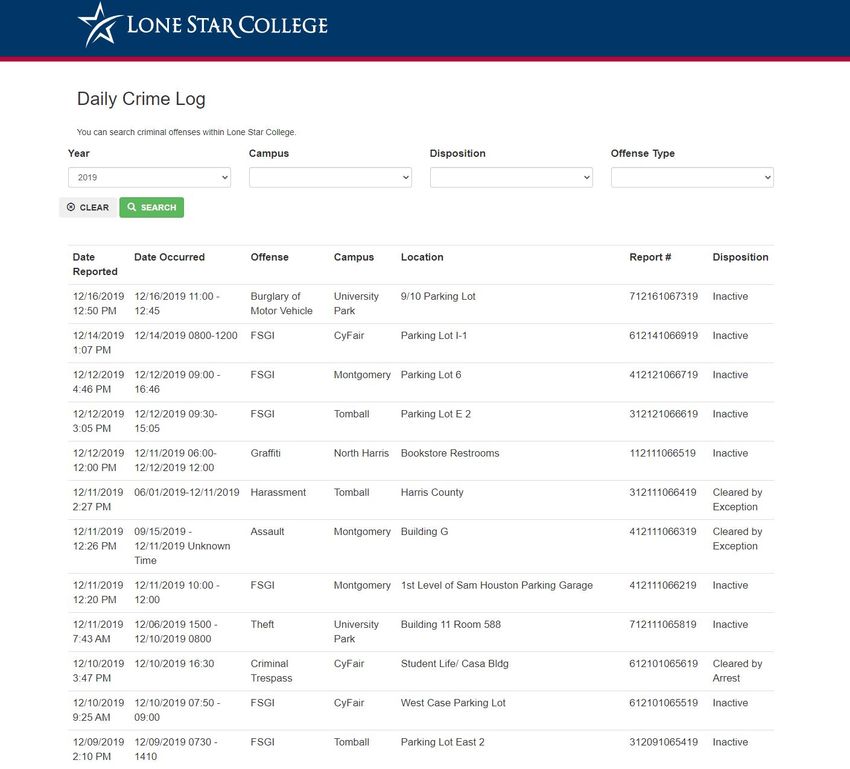
Lone Star College
                                        Annual Security Report: 2021

      6.5      Non-LSC Owned or Managed Facilities                     21

      6.6      Security and Facility Maintenance                       22

      6.7      Access Card Requests                                    22

7.0         Campus Law Enforcement                                     23

      7.1      Police Department Mission Statement and Core Values     25

      7.2      Working Relationships with Other Agencies               25

8.0         Crime Prevention and Security Awareness Programs           27

      8.1      Prevention and Awareness Education Programs             27

      8.2      Your Role in Campus Safety                              28

      8.3      Risk Reduction Tips                                     29

      8.4      How to be an Active Bystander                           29

      8.5      Rape Awareness / Rape Aggression Defense                30

      8.6      Active Shooter                                          31

      8.7      Behavioral Intervention Teams                           31

      8.8      Safety Enhancement Services                             32

9.0         Protecting Minors on Campus                                33

      9.1      Missing Student Notification Procedure                  33

10.0        Fire Safety and Education                                  34

      10.1     In the Event of a Fire                                  34

      10.2     Plans for Future Improvement                            35

      10.3     Safety and Security Audits                              35

11.0        Crime Statistics                                           36

                                                                       Page 3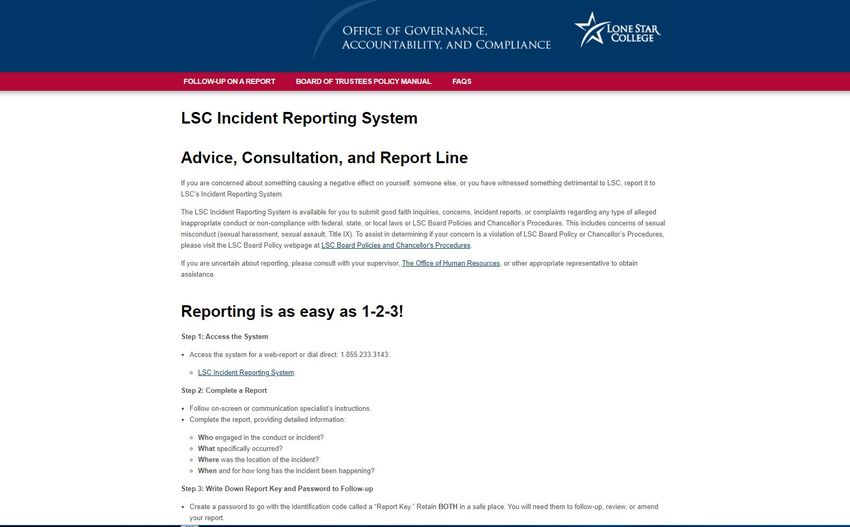
Lone Star College
                                  Annual Security Report: 2021

   11.1   Applicable Crimes                                                 36

   11.2   Applicable Reporting Locations                                    37

   11.3   Definitions                                                       37

12.0   Clery Reportable Crime Statistics                                    42

13.0   Alcohol & Illegal Drug Policy                                        65

   13.1   Prohibited Behavior                                               65

   13.2   Assistance                                                        65

   13.3   Confidentiality                                                   66

   13.4   Shared Responsibility                                             66

   13.5   Communication                                                     66

   13.6   Student Alcohol and Drug Policy                                   66

   13.7   Domestic and International Field Trips                            66

   13.8   Alcohol and Substance Use / Abuse Education                       67

   13.9   Medical Amnesty Act and Overdose Prevention and Immunity          67

   13.10 Disciplinary Action                                                68

   13.11 Parental Notification                                              68

   13.12 Assistance for Students                                            68

   13.13 Assistance for Employees                                           69

   13.14 Reporting Requirements                                             69

   13.15 Helpful Resources                                                  70

14.0   Firearms and Weapons Policy                                          71

   14.1   Chancellor’s Procedures | Concealed Carry of Handguns on Campus   71

                                                                            Page 4
Lone Star College
                                   Annual Security Report: 2021

15.0   Sex Offender Registration                                          76

16.0   LSC Sexual Violence Policy and Procedure Overview                  77

   16.1   Reporting Sexual Violence                                       77

   16.2   Reporting to CSAs or Responsible Employee                       77

   16.3   Administrative Review and Investigation                         78

   16.4   Privacy                                                         78

   16.5   Formal Hearing                                                  78

   16.6   Sanctions                                                       79

   16.7   Administrative Services to Assist a Complainant or Respondent   79

   16.8   Compliance Concerns                                             79

17.0   Suggested Guidance Following Sexual Violence                       81

   17.1   Reporting to LSC Police Department or Other Law Enforcement     82

   17.2   Victim Assistance Services                                      82

   17.3   Victim Assistance Online Resources                              82

   17.4   Medical Resources                                               82

18.0   Important Contact Information                                      84

                                                                          Page 5
Lone Star College
                                  Annual Security Report: 2021

1.0    Welcome

Dear Reader:

Lone Star College (LSC or the College) is committed to providing the members of the campus
community and visitors with the safest and most secure environment possible. With this in mind,
even the most extensive initiatives cannot succeed without awareness and cooperation from the
community members who work and study on campus.

The Jeanne Clery Disclosure of Campus Security Policy and Campus Crime Statistics Act requires
all postsecondary institutions participating in Title IV HEA federal student financial aid programs
to disclose campus crime statistics and security information. The Act was passed into law in 1990
as the Crime Awareness and Campus Security Act. A 1998 amendment renamed the Act, the
Jeanne Clery Disclosure of Campus Security Policy and Campus Crime Statistics Act, in memory of
a student who was slain in her dorm room in 1986 (the catalyst for the original legislation). The
Clery Act requires higher education institutions to give timely warnings of crimes that represent
a threat to the safety of students or employees and to make public their campus security policies.
It also requires the collection, reporting, and dissemination of crime and fire data to the campus
community and to the Department of Education. The Act is intended to provide current and
prospective employees, students, and their families, as higher education consumers, with
accurate, complete, and timely information about safety on campus so that they can make
informed decisions.

In compliance with this Act, the College’s designated Clery Compliance Officer is LSC Senior
Associate Vice Chancellor of Public Safety Paul S. Willingham. This Annual Security Report (ASR)
is prepared in collaboration with a cross-section of LSC departments: Office of Human Resources,
Student Success, Campus Police, Department of Emergency Preparedness, Department of
Environmental Health and Life Safety, and the Office of the General Counsel. The ASR is part of
the College’s ongoing effort to inform you of the safety programs and services available and the
steps you can take to maintain your safety and the security of others. We continue to seek new
ways to improve campus safety every year and are confident that with our dedicated team of
professionals and continued community support, we are creating a safer LSC.

To learn more about LSC campus safety visit the LSC Police Department website,
www.lonestar.edu/police, and the LSC Department of Emergency Preparedness website,
www.lonestar.edu/emergency-preparedness. We encourage you to use the information
contained in this report to promote your own safety awareness and continue to make the LSC
community a place where education flourishes in a caring learning and working environment.

Sincerely,

Mario K. Castillo, J.D.                                     Paul S. Willingham, MS, LCC
Chief Operating Officer                                     Senior Associate Vice Chancellor
Lone Star College                                           Division of Public Safety

                                                                                            Page 6
Lone Star College
                                   Annual Security Report: 2021

                                                              Lone Star College

2.0    About Lone Star College

Lone Star College System (also referred to as Lone Star College) is the largest institution of higher
education in the Houston area and one of the fastest-growing community colleges in the United
States. LSC is a key driver and a growing contributor to the local and regional economy. LSC
remains steadfast in its commitment to student success and credential completion. Founded in
1972, LSC today has a student enrollment of over 95,000 students. Stephen C. Head is the
College’s Chancellor.

The Lone Star College System is composed of seven colleges, including thirteen centers and six
program specific locations, throughout Harris and Montgomery Counties with a 1,400 square
mile service area. The seven colleges are: LSC-CyFair, LSC-Houston North, LSC-Kingwood, LSC-
Montgomery, LSC-North Harris, LSC-Tomball, and LSC-University Park. Also, among those
properties include the Lone Star College System Office in The Woodlands, Texas.

Lone Star College is an open-enrollment institution. Most students are accepted once they
complete the admissions process. Credits earned at Lone Star College transfer to any public
college or university in the state.

Lone Star College Accelerated College, Early College High School, and Dual Credit programs
provide high school students the opportunity to earn an associate degree and or up to two years
of transferable college credit by the time they graduate high school. Accelerated College is
available at LSC-Kingwood, LSC-Montgomery, LSC-North Harris, and LSC-University Park. One
Early College High School is available at LSC-North Harris Victory Early College High School.
iSchool High, a public charter school, provides high school students early college programs at LSC-
Montgomery and LSC-University Park.

During the summer months, LSC offers “Discovery College” for children 6 to 17 years of age. This
program provides science, technology, engineering, math-based, performing arts, and physical
activity camps. These are one-week camps located at each of the LSC campuses.

LSC uses a master plan to fully align with the needs of the community by offering innovative and
transformative opportunities from education to careers. LSC is a model community college of the
21st century with commercial leasing opportunities that include multiple college partners, two
executive state-of-the-art conference centers, public libraries, and wellness centers.

                                                                                              Page 7
Lone Star College
                                  Annual Security Report: 2021

3.0    Preparing the Annual Disclosure of Crime Statistics

The Lone Star College Senior Associate Vice Chancellor of Public Safety is the designated LSC Clery
Compliance Officer and is responsible for the preparation and distribution of the LSC Annual
Security Report. The Report includes information reported from all Campus Security Authorities
as well as crimes reported to other law enforcement agencies that may have jurisdictional control
over Clery-defined properties (Campus Property, Non-Campus Property, and Public Property).
The Clery Compliance Officer completes the Report in compliance with the Clery Act and
publishes the Report by October 1st of each year. A link to the Report is emailed at the time of
publication to all Lone Star College students and employees via their Lone Star College email
address. The Report is subsequently emailed again in the spring and summer semesters. The
Report is accessible in PDF formal to the general public throughout the year on the LSC Police
Department website (www.lonestar.edu/police). A direct link to the police department page
exists at the footer of every Lone Star College website. Anyone wanting a hard copy of the LSC
Annual Security Report should make a written request through Public Records at
publicrecords@lonestar.edu.

                                                                                            Page 8
Lone Star College
Annual Security Report: 2021
4.0 Reporting Criminal Activities, Emergencies, & Other Incidents
This section includes the College’s policies and procedures by which students, employees, and
others may and should report criminal actions or other emergencies occurring on campus. This
section also includes policies concerning the College’s response to such reports.
4.1 Reporting a Crime
The Lone Star College Police Department is the primary agency for reporting and investigating
crimes that occur on Lone Star College property. Any criminal or suspicious acts occurring on the
Lone Star College campuses should be reported to the LSC Police Department regardless of how
seemingly insignificant the incident. LSC Police operates a live 24-hour Dispatch Center staffed
by state-licensed police dispatchers. The LSC Police Dispatch Center can be reached at 281-290-
5911 (or 5911 from a campus phone). For hearing impaired individuals, dial the TTY/TDD number
at 832-813-0712.
Clery crimes may also be reported to Campus Security Authorities (CSAs) who are required to
immediately report said crimes to the LSC Police Department. If the reporting person does not
wish for the police to investigate the crime, then the CSA may skip contacting the LSC Police
Department but must either immediately report the Clery crime directly to the Senior Associate
Vice Chancellor (SAVC) of Public Safety or submit a CSA Clery Crime Report via the CSA website
designed for that purpose: http://www.lonestar.edu/CSAReporting.htm. The CSA must include
the pertinent facts of the incident without the victim’s name. The SAVC of Public Safety will
review the reported incident to determine if a timely warning to the community is necessary and
maintain a record of reported incidents for the Annual Security Report. A police report will not
be initiated through this process unless the reporting person requests a police investigation.
When making a report to the SAVC of Public Safety, the CSA should include the following
information:
• Type of crime;
• Location of crime;
• Date and time of crime;
• LSC affiliation of the complainant, suspect, or witnesses;
• A brief narrative of the events;
• Disposition of crime (whether the case will be handled administratively).
The name and contact number of the complainant may also be provided, but such information is
not required. This information helps with follow up questions for reporting clarity.
4.2 Police Response
LSC Police Department personnel will respond as quickly as possible to any request for assistance,
whether it is an emergency or not. Response times are based on current activity load and the
Page 9Lone Star College
Annual Security Report: 2021
urgency of the call. Crimes in progress, medical emergencies, and life-threatening calls have a
higher priority than other types of calls. The LSC Police Department’s average response time for
high priority calls is under two minutes.
When you call the police to report a crime, the police dispatcher will need certain information.
For your safety, be prepared to answer all the questions the dispatcher asks you and be specific.
Do not downplay the importance of your call. Here are points to immediately consider:
• Is anyone’s life or safety threatened?
• Does anyone need medical assistance or an ambulance?
• Is the suspect(s) still there? If so, make sure the dispatcher knows this.
• Does the suspect(s) have a weapon?
Crimes in progress or those involving life-threatening circumstances receive the highest priority
response. If the crime is still in progress, do what you can to ensure your own safety first before
calling the police. If you are not at home, get to a public area—an open store, a restaurant, or
other well-populated location. If at home, an apartment, your office, or in a classroom, move to
a safe area, then call the police and tell the dispatcher where you are.
Officers responding to a call will need the following types of information:
Where:
• Where are you now?
• Where did the crime happen?
• If the suspects are gone, where did they go? In what direction?
• Did they use a car or some other transportation? Do you know
the suspect’s license plate number?
What:
• What exactly happened or is happening? Describe the situation
in complete detail. (e.g., “Someone has just broken my window and is inside my room.”)
• What is the suspect(s) physical characteristics (sex, height, weight, hair color, race,
etc.)?
• What was the suspect wearing (distinctive color of clothing or graphics)?
When:
• When did the crime happen? Is it still in progress (this is very important, as it may
determine the level of response)?
Who:
• Who are you? What phone number are you calling from?
Don’t hang up the phone until the dispatcher tells you to do so. You may be put on hold while
the dispatcher contacts emergency responders. Make sure you always give the dispatcher your
call back number.
Page 10Lone Star College
Annual Security Report: 2021
When you call the LSC Police Department to report a crime, a police officer will meet with you to
gather information (including answers to the questions posed above) and prepare an official
police report. The police officer will conduct a thorough investigation, collect and document all
facts, and secure evidence if any. If possible, the officer will take any immediate steps necessary
for public safety. Afterwards, the police officer will review the report and evidence, if any, to
determine the next steps. These steps could include but are not limited to further criminal
investigation, administrative referral, and or criminal prosecution. In all instances of criminal
activity where there is a complainant willing to press charges, the LSC Police Department will
work the case until leads are exhausted in an attempt to identify the perpetrator(s), make an
arrest, and work with the Harris County or Montgomery County District Attorney’s Office for
prosecution. The LSC Police Department will also refer criminal activity perpetrated by College
personnel or students to the appropriate administrator for internal review and action. The
College’s administrative action and any county criminal prosecution are mutually exclusive.
4.3 Reporting Fire or Medical Emergencies
Fires and medical emergencies should be reported to the jurisdictionally appropriate fire
department or emergency medical service. By dialing 911 from a campus or cell phone, the 911
Operator will route your call to the appropriate response agency. After calling 911, you should
also call the LSC Police, if possible, to notify them of the emergency so they can provide
immediate first aid, fire suppression, and or escort the fire department or emergency medical
services to your location. The LSC Police can be reached by dialing 281-290-5911 (or 5911 from
a campus phone). For hearing impaired individuals, dial the TTY/TDD number at 832-813-0712.
If you call LSC Police first, they will contact the fire department or emergency medical services
on your behalf.
4.4 Using 911
The Lone Star College Police Department is a participating member of the Harris County 911
Network and the Montgomery County 911 Network. You are welcome to report emergencies to
the LSC Police via 911, but it is important to understand how these calls are routed and how you
can save precious time. This section details how the 911 Networks work.
• 911 is for Emergency Calls ONLY.
• Dialing 911 from a hardline phone on campus: If you dial 911
from a hard line (traditional) phone on campus, you will be
connected to the Harris or Montgomery County 911 Operator,
depending on which county your campus is located. The 911
Operator will ask whether you need medical, fire, or police
assistance. If you state you need police assistance, the
operator’s computer will signify you are calling from campus,
and the call will be transferred to the LSC Police Dispatch Center. You will then be
Page 11Lone Star College
Annual Security Report: 2021
connected to the LSC Police Dispatcher. If you are on campus and dial 911 in need of
medical or fire service, the 911 Operator will transfer the call to the appropriate fire or
emergency medical service. When the call is transferred, the 911 Operator will
subsequently send a follow-up notification to LSC Police Dispatch of the transfer.
• Dialing 911 from your cell phone (whether on campus or not): If you dial 911 from your
cell phone, the call will be routed to the 911 Operator who will answer and send your
call to the police, fire, or medical service associated with the cell tower location from
which your call signal was transmitted. This means if you call 911 from your cell phone
on campus, you will not be forwarded to the Lone Star College Police Department
because LSC campuses do not have dedicated cell towers. In these cases, you need to
specifically instruct the 911 Operator that you are on a Lone Star College campus (the
specific campus, if possible) and that you would like your call transferred to the Lone
Star College Police Department.
The LSC Police will always be able to respond to a campus emergency or significant
event faster than the city or county police. By following these instructions, you will
expedite your call to our dispatcher.
The Lone Star College Police Dispatch Center will accept emergency calls via its regular
phone number. If you prefer to skip the 911 Operator as an intermediary, you may call
281-290-5911 from your cell for LSC Police assistance. Make sure you advise the
dispatcher immediately that you are in an emergency.
4.5 Campus Security Authorities
Faculty, staff, and students are encouraged to report any criminal offenses within the campus
environment directly to Lone Star College Police Department. However, as an option, you may
also report criminal offenses that you do not want to be investigated by the Police Department
to any Lone Star College Campus Security Authority.
A Campus Security Authority (CSA) is a Clery-specific term that encompasses groups of individuals
associated with an institution whose functions involve relationships with students and campus
activities. CSAs can include public safety officers, law enforcement officers, academic and
advising counselors, student activities personnel, athletic coaches, Vice Presidents of Student
Success, Vice Presidents of Instructions, Deans (or other senior administrative personnel who
deal regularly with students), student orientation staff, overseers and advisors to student clubs
and organizations, study abroad faculty and staff, human resource managers, and staff involved
in student discipline and campus judicial proceedings. CSAs who receive a Clery crime report will
provide options to the reporting person and properly report Clery crimes and Title IX offenses to
the appropriate institutional authorities.
Page 12Lone Star College
Annual Security Report: 2021
CSAs must report all Clery crimes immediately to the Clery Compliance Officer (SAVC of Public
Safety). CSAs have an important role in complying with the law. CSA crime reports are used by
LSC to:
• fulfill its responsibility to annually disclose Clery crime statistics, and
• to issue timely warnings for Clery crimes that pose a serious or continuing threat to the
campus community.
If a reporting party needs assistance, a CSA will explain how to get help and let a victim know that
help is available even if he or she does not want a police investigation. The decision to act on this
option is the victim’s. However, during an emergency situation, such as a physical assault in
progress, a CSA must contact campus police or call 911 immediately.
Instructions to all Campus Security Authorities, as well as a reporting form, can be found at
http://www.lonestar.edu/CSAReporting.htm.
Other important contacts are listed below:
Title Contact Information
Clery Compliance Officer / Senior Associate 281-655-3712
Vice Chancellor of Public Safety paul.willingham@lonestar.edu
Paul Willingham
Lone Star College Police Department 281-290-5911 (5911 from a campus phone)
Title IX Coordinator 832-813-6614
Karen Miner LSC-TitleIX@lonestar.edu
Campus Representatives Call (832) 813-6500 to connect to one of the
Vice Presidents – Student Success LSC Campus Operators.
Deans involved in student discipline
Human Resource Directors
Student Success
Advising Staff
Athletic Directors
Student Activities Personnel
Student Orientation Staff
Student Organization Advisors
Professional and pastoral counselors are exempt from the reporting requirement while working
within the scope of a license or certification. LSC, however, does not have professional or pastoral
counselor positions. Counseling services at LSC are limited to academic and career counseling,
disability services, and self-help referral resources. Services provided by LSC counseling are not
intended to replace professional counseling services. LSC counselors, functioning within their
assigned duties, are classified as CSAs and are NOT exempt from the reporting requirements of
the Clery Act.
Page 13Lone Star College
Annual Security Report: 2021
4.6 Voluntary Confidential Reporting
Voluntary Confidential Reporting is when the victim of a crime does not want to pursue action
within the College’s internal system or the criminal justice system but still wishes to anonymously
report the crime.
If someone tells a CSA about an incident that may be a Clery crime, the CSA must contact the
Clery Compliance Officer. With the permission of the complainant(s), the CSA may contact LSC
Police Dispatch by calling 281-290-5911 and request an officer take a police report. If the
complainant reports a crime to a CSA but does not want a police investigation, the CSA shall make
the report to the SAVC of Public Safety, who in turn will document the crime for Clery compliance
purposes and make necessary timely warnings, but not initiate a formal police report or
investigation.
Lone Star College strongly encourages reporting all crimes on campus to the Lone Star College
Police Department. There are very good reasons to promptly report a crime:
• Timely notification of the crime may affect the safety of others. When LSC Police
receives reports of crimes that may affect the safety of the community, they will quickly
post campus notices (while protecting the victim’s identity) to warn other community
members of possible risks.
• When you make your report, you assist LSC Police in initiating an investigation, which in
turn could lead to an arrest, which means a possible dangerous offender and or
situation is removed from campus.
If you would rather remain anonymous while reporting a crime, or any other violation of campus
compliance or ethics, Lone Star College has two options available. Anonymous reports can be
made through the LSC Police website (www.lonestar.edu/police). From the website, click on the
“Send us Crime Tips” button and a
submission form will appear that
gives the sender the option to
identify him or herself. A second
option is available through the
Ethics Point anonymous incident
reporting system. In order to
make a report, simply visit
www.lonestar.ethicspoint.com
and follow the prompts. If you
prefer using the telephone, you
may call 1-855-233-3143 to make
your report. Again, you may
submit these reports confidentially if you do not want to pursue criminal investigative action or
Page 14Lone Star College
Annual Security Report: 2021
a College internal investigation. If you wish criminal charges to be filed and prosecution of the
offender, you must call LSC Police to make a report.
Note: By state law, victims of sexual assault may file a complaint with the police department while
protecting their identity from the public using a pseudonym. In addition, LSC Police makes every
effort to protect the privacy of all crime victims.
4.7 False Reporting
Making a false report to any emergency responder is a serious matter that also happens to be a
criminal offense. False reporting creates a false sense of urgency and wastes the time of first
responders, taking those valuable resources away from where they are needed. Examples of false
reports include but are not limited to claiming a false crime against another, calling in a fake
bomb threat, pulling a fire alarm when no fire exists, and activating a burglar or panic alarm on
purpose without a crime being in progress.
Making a false report or alarm is a violation of Texas Penal Code 42.06. It is a felony and
punishable by both fines and imprisonment. The LSC Police Department will seek criminal charges
for all instances of false reporting on Lone Star College campuses.
Page 15Lone Star College
Annual Security Report: 2021
5.0 Notifications and Daily Crime Log
Lone Star College endeavors to keep its community informed about safety and security issues.
Communication takes various forms depending on the circumstances. Safety and security
communications are intended to inform the community of possible risks and prepare them to
respond in support of their own safety.
5.1 Timely Warnings
Lone Star College issues timely warnings to the LSC community for reported Clery crimes the
institution considers serious or continuing threats to students and employees occurring on or
adjacent to LSC campuses or on properties otherwise
controlled by the College or officially recognized
student organizations. The purpose of these warnings
is to aid in the prevention of similar crimes and to
enable the LSC community to better protect
themselves.
Upon receipt of a crime report that includes a Clery
crime, the CSA or police officer taking the report will
immediately notify the Clery Compliance Officer
(SAVC of Public Safety). The Clery Compliance Officer,
or designee, will immediately determine if the
situation represents a serious or continuing threat to
the campus community. If it is determined that there
is a threat, the Clery Compliance Officer, or designee,
will send a mass e-mail to all Lone Star College email
addresses. Other media sources, such as web
postings, campus television, social media, mass
communication texting, and flyers may also be used
as needed. The Clery Compliance Officer, or designee, in most cases, will release timely warnings
within an hour of confirming the reported Clery crime.
5.2 Emergency Procedures
The Lone Star College Emergency Management Plan addresses the College’s response to
emergencies by taking an all-hazards approach to both natural and human-caused hazards.
Departments and offices should familiarize themselves with the information in this plan and
other preparedness resources available from the Lone Star College Department of Emergency
Preparedness intranet site and as described in LSCS Board Policy, Section IV.F.8. Employee Safety
and Health. The LSC Department of Emergency Preparedness (DEP) staff, LSC police personnel,
and other LSC employees are trained in the National Incident Management System (NIMS)
Page 16Lone Star College
Annual Security Report: 2021
Incident Command System (ICS), which is to respond, mitigate, and recover from incidents
involving multiple departments or outside agencies.
The LSC Department of Emergency Preparedness partners with the LSC Environmental Health
and Life Safety Department to conduct tests of its emergency plans and capabilities throughout
the year. These tests include drills, tabletops, functional exercises, and full-scale simulations for
different types of scenarios, e.g., armed intruder (active shooter) and fire exit drills across LSC.
These tests are designed to assess and evaluate the emergency plans and capabilities of LSC.
General information about the emergency response and evaluation procedures for LSC is
publicized each year as part of LSC’s Clery Act compliance efforts. This information is available
online at www.lonestar.edu/Emergency-Preparedness.
5.3 Emergency Notification / Lone Star College Alert
In the event of an emergency, such as a sudden weather event or criminal act that presents an
immediate or impending threat to the health and safety of Lone Star College students and
employees, Lone Star College will make an emergency notification
to all and or the affected portions of the campus community.
Emergency notifications are typically made via the College’s Mass
Communication System that includes public-address speakers in
each building, emails, and texting. All current LSC students and
employees are automatically opted-in to the College’s emergency
alert system (called LoneStarCollegeAlert) with their LoneStar.edu
email address as the primary communication source. Personal
contact information must be updated in MyLoneStar to receive
emergency text messages or notifications to a personal cell or
personal email account. Please update your personal information
record in MyLoneStar with the following information:
o cell phone
o personal email
o home phone
Updates to contact information in LoneStarCollegeAlert occur within 24 hours of the changes
being made. Community members, parents, and Lone Star College commercial tenants may also
go to this website, https://lscsalert.lonestar.edu, to set up an account and self-register to receive
emergency notifications via LoneStarCollegeAlert.
Email and text messages that require immediate reading due to imminent life safety threats start
with the term LoneStarCollegeAlert in the subject line. When a message is received with this
subject line, the community is asked to stop what they are doing to read and heed the message
immediately.
Page 17Lone Star College
Annual Security Report: 2021
The Lone Star College Department of Emergency Preparedness tests the LoneStarCollegeAlert
system every semester to assure its operability. You may opt-out of text messages by simply
replying “STOP”; however, you cannot opt-out of the emails. It is not recommended for students
and employees to opt-out of receiving important lifesaving text messages via the
LoneStarCollegeAlert system.
For more information on LoneStarCollegeAlert and to review the latest emergency messages,
please visit www.lonestar.edu/LoneStarAlert
Another element of the LSC Mass Communication System is public-address speakers in each
campus building. If needed, the Lone Star College Police Department will activate the public-
address speakers in the affected emergency area(s) and provide safety instructions.
To supplement the Mass Communication System, the College also uses its social media accounts.
Employees and students are encouraged to follow Lone Star College’s and their respective Lone
Star College campus’ social media feeds to facilitate information sharing.
The Lone Star College Police Department sends out emergency notifications as soon as a threat
has been confirmed. In the event the Police Department cannot send out these messages, the
Department of Emergency Preparedness and the Office of Marketing and Communication can
send out the alerts. The Lone Star College Police Department tests the Mass Communication
System monthly to assure it remains operational.
5.4 Daily Crime Log
The Lone Star College Police Department maintains a Daily Crime Log that records by
chronological date any crime reported to
the Police Department or CSA that occurs
on or near LSC campuses, so that the
community and media may have access to
this information. This log includes the
incident’s title, date, time, general
location, and disposition. The Daily Crime
Log will not include reports made to other
police agencies. The Lone Star College
Police Department updates the log within
one business day of a crime’s report. The
last six years of the Daily Crime Log are
available for public view via the Lone Star
College Police Department’s Webpage:
www.lonestar.edu/police.
The Lone Star College Police Department
maintains a seven-year archive of Daily
Crime Logs available upon request by emailing publicrecords@lonestar.edu.
Page 18Lone Star College
Annual Security Report: 2021
Note: If there is clear and convincing evidence that the release of crime report information would
jeopardize an ongoing criminal investigation, endanger the safety of an individual, cause a
suspect to flee or evade detection, or result in the destruction of evidence, such information may
be withheld from the Daily Crime Log until that damage is no longer likely to occur.
Page 19Lone Star College
Annual Security Report: 2021
6.0 Facility Access, Security & Maintenance
Lone Star College facilities are located in the northern sections of the City of Houston, Harris
County, and Montgomery County. These facilities are home to the majority of LSC’s classrooms,
libraries, conference centers, daycares, and administrative offices. General public hours for most
Lone Star College facilities are 8 a.m. to 10 p.m., Monday through Friday, except for the System
Office, whose business hours are 8 a.m. to 5 p.m., Monday through Friday. Certain areas may
have restricted access due to security necessity. Access to these areas is controlled by card
readers and or monitored by security cameras.
LSC police officers and public safety officers patrol LSC academic and administrative buildings on
a regular basis.
Hours of operations may vary at different times of the year and for specific buildings. For
information about the hours and or access protocol for a specific building, contact the
appropriate campus operator and or review the respective college website.
CAMPUS OPERATOR PHONE NUMBER
LSC-CyFair 281-290-3200
www.lonestar.edu/cyfair
LSC-Houston North 281-810-5602
www.lonestar.edu/houstonnorth
LSC-Kingwood 281-312-1600
www.lonestar.edu/kingwood
LSC-Montgomery (including 936-273-7000
LSC-University Center) www.lonestar.edu/montgomery
LSC-North Harris 281-618-5400
www.lonestar.edu/northharris
LSC-Tomball 281-351-3300
www.lonestar.edu/tomball
LSC-University Park (including 281-290-2600
LSC-System Office at University www.lonestar.edu/universitypark
Park)
LSC-System Office 832-813-6500
www.lonestar.edu
LSC-Police Department 281-290-5911
TTY/TDD: 832-813-0712
www.lonestar.edu/police
6.1 Residential Facilities
Lone Star College does not own or operate any residential facilities. Students and employees are
not permitted to use Lone Star College facilities as a domicile. All Lone Star College facilities are
monitored by police patrol, security cameras, and or burglar alarms during non-business hours.
Page 20Lone Star College
Annual Security Report: 2021
6.2 Parking Lots and Garages
Students and visitors do not require a permit to park in the open parking areas designated as
student parking.
However, all Lone Star College employees and commercial tenants, who wish to park in areas
reserved specifically for employees and commercial tenants, are required to register their vehicle
with the Lone Star College Parking Office and obtain a free parking permit, which must be
displayed when parked in these reserve areas. The College reserves the right to require proof of
ownership of any registered vehicle. To register a vehicle, visit www.lonestar.edu/parking.
Permits do not constitute a guarantee of available spaces in reserved areas. If reserved lot spaces
are filled, employees may use the student parking areas.
For parking questions, please email parking@lonestar.edu or call 281-765-7836.
Panic buttons are located in the LSC-Montgomery and LSC-Fairbanks Center parking garages on
each level near stairwells and are visible by their bright blue light and signage. LSC-University
Park deploys security cameras that monitor the parking garages. Parking lots and garages
throughout each College campus are routinely patrolled by police officers and public safety
officers. If assistance is needed in a parking lot, call the LSC Police 24/7 at 281-290-5911.
6.3 Libraries
Library hours for each campus vary throughout the year. It is best to check the library schedule
of each campus via their campus webpage to determine operating hours.
6.4 Commercial Tenants, Conference Centers and Education Partners
Some Lone Star College campuses house commercial tenants, conference centers, and other
educational partners (e.g., Four-year schools that provide programs and classes in Lone Star
College-owned facilities). Campus security and access varies by client and location and is under
the control of each client. These services are typically multi-tiered where the client’s safety and
security services are augmented by LSC Police who may provide limited mutually agreed upon
services. For information on building hours and specific safety and security measures, contact the
respective client entity directly.
6.5 Non-LSC Owned or Managed Facilities
Lone Star College may provide instruction at the facilities of corporate college clients, dual credit
education courses at local independent school district buildings, and other community facilities
(e.g., museums and community centers). Access control and security at these locations are
maintained by the facility owner.
Page 21Lone Star College
Annual Security Report: 2021
6.6 Security and Facility Maintenance
Facilities and landscaping are maintained in a manner that minimizes hazardous conditions. Lone
Star College Police regularly patrols all LSC owned and managed facilities and reports
malfunctioning lights and other unsafe physical conditions to facilities management for repair.
Any employee may submit a work order by calling their respective campus maintenance
department (see phone numbers below). For more information on Facilities and Construction,
visit www.lonestar.edu/planning-construction.
CAMPUS FACILITIES PHONE NUMBER
LSC-CyFair 281-290-5960
LSC-Houston North 281-813-6557 or 281-290-2928
LSC-Kingwood 281-312-1694
LSC-Montgomery (including LSC-University Center) 936-273-7311
LSC-North Harris 281-618-5551
LSC-Tomball 281-351-3350
LSC-University Park 281-290-2929
LSC-System Office, The Woodlands 832-813-6557
LSC-System Office, University Park 281-290-2928
6.7 Access Card Requests
Employees may request an LSC access card or changes to their current access card by contacting
their supervisor. Visitors or commercial tenants should contact their LSC representative. Upon
approval from one of these LSC entities, an access card can be processed at the respective
campus badging area. Department heads control who has permission to enter into their
respective suites. For certain high security access points and or to get access to all facilities, the
Chief of Police must give written approval.
For assistance or information related to LSC access cards, email accesscontrol@lonestar.edu.
Page 22Lone Star College
Annual Security Report: 2021
7.0 Campus Law Enforcement
Lone Star College Police Department
The Lone Star College Police Department (LSCPD) protects and serves LSC by providing
professional law enforcement services and actively promoting community
involvement through progressive community policing strategies and a
commitment to education. Lone Star College has on-duty police officers on
duty 24 hours a day, every day of the week.
LSCPD is a full-service State of Texas law enforcement agency certified
through the Texas Commission on Law Enforcement. College Police Officers
are skilled professionals that balance the special needs of an educational
environment with those of law, order, and the application of criminal justice.
While service and education are a mainstay of campus law enforcement, College Police Officers
are trained and equipped to handle criminal activity equal to their county and municipal
counterparts.
Lone Star College Police Officers are fully empowered state peace officers commissioned under
the authority of the State of Texas Education Code Section 51.203. The primary jurisdiction of
Lone Star College Police Officers includes all counties in which Lone Star College owns, leases,
rents, or otherwise maintains control of property. Within this primary jurisdiction, Lone Star
College Police Officers:
1. Are vested with all powers, privileges, and immunities of a Texas peace officer,
2. May arrest any person who violates a law of the state, and
3. May enforce all traffic laws on streets and highways.
Outside of a Lone Star College Police Officer’s primary jurisdiction, the officer maintains the
vested powers, privileges, and immunities of a Texas peace officer and may arrest any person
who violates any state law if the officer:
1. Witnesses a felony,
2. Witnesses a breach of public peace,
3. Is summoned by another law enforcement agency to aid,
4. Is assisting another law enforcement agency, or
5. Is otherwise performing their duties as a police officer for the institution of
higher education that employs the officers.
All Lone Star College Police Officers must:
1. Take and file an oath of office with the State of Texas, and
2. Be a certified police officer under the requirements of the Texas Commission
on Law Enforcement.
Page 23Lone Star College
Annual Security Report: 2021
While the LSCPD maintains county-wide jurisdiction in Harris and Montgomery counties, the
agency focuses its law enforcement efforts on Lone Star College
campuses and properties. The LSCPD will act as needed to aid other law
enforcement agencies and to protect college personnel and assets in the
areas adjacent to and or near LSC locations. Lone Star College Police
Officers provide police and security services for all LSC owned and
managed facilities. Supplementing the police force, LSCPD uses trained
non-sworn public safety officers (security guards) as authorized under the
Texas Occupations Code to increase visibility, provide access control
security, and report suspicious activity for police action. LSCPD personnel
utilize numerous methods to conduct patrols including foot, bicycle, Segway, and car patrols.
LSCPD personnel deploy to all Lone Star College properties. LSCPD provides some security
services at locations not owned by Lone Star College but that host Lone Star College classes or
events. These services are meant to augment the city, county, or school district law enforcement
agency principally responsible for that location.
The Chief of Police leads the LSCPD and reports directly to the Lone Star College Chief Operating
Officer, who in turn reports directly to the Chancellor of the Lone Star College System. The Police
Department is organized into two major components: The Operations Bureau and the Support
Bureau.
The Operations Bureau is led by a Deputy Chief of Police who reports directly to the Chief of
Police and serves as the agency’s third in command. The Operations Bureau is arguably the most
visible component of the police department. They are the men and women in uniform who patrol
the buildings and streets of Lone Star College. The Operations Bureau consists of four districts,
geographically situated to provide appropriate leadership to patrol personnel. Each district is led
by a Police Captain who is charged with leading a team of sergeants, officers, and public safety
officers to provide proactive patrol, law enforcement response services, basic investigations,
parking enforcement, and community outreach. Each of these District Captains partner with the
seven college Presidents and senior staff to proactively address safety issues and quality of life
concerns before they grow into major problems.
The Support Bureau is led by a Deputy Chief of Police who reports directly to the Chief of Police
and serves as the agency’s chief of staff and second in command. The Support Bureau is tasked
with all behind the scenes functions that are equally important, if not as visible as Operations.
The Support Bureau includes professional development and training, fleet management, special
investigations, threat mitigation, recruiting, internal affairs, accreditation, public information,
records maintenance, finance, clerical support, human resources, and police communications
(Dispatch).
In 2019, the LSC Police Department entered into an agreement with the
Commission on Accreditation for Law Enforcement Agencies (www.calea.org) to
seek international accreditation. Less than 5% of United States law enforcement
Page 24Lone Star College
Annual Security Report: 2021
agencies attain this credential. The LSC Police is taking this voluntary step to ensure it operates
within best practice standards and provides the highest quality law enforcement and security
services to its community. The agency’s initial onsite assessment towards accreditation is
scheduled for Spring 2022 after it completes the three-year self-assessment process.
7.1 Police Department Mission Statement and Core Values
Mission Statement
The mission of the Lone Star College Police Department is to provide a safe and secure
environment where education can thrive.
Core Values
The Lone Star College Police
Department provides quality law
enforcement services while being a
fully integrated partner with the
Lone Star College community. Its
core values specifically reflect the
LSC Focus cultural beliefs
(www.lonestar.edu/LSCFocus.htm).
The agency is driven by its five core
values in everything it does:
Seek Excellence – We strive to be the best we can at our profession by staying current with best
practices and seeking new innovative ways to police.
Build Trust through Integrity – We will do what we say, modeling trustworthy behavior and
preserving the public trust.
Serving Focused – We will seek out ways to serve, solve problems, and be an asset to our
community.
Leave Nothing to Chance – We will not assume or do things haphazardly. We will follow up,
persevere, work hard, and not leave our success to chance.
Preserve Dignity – We will respect the public and our teammates. Even when the other person
may not behave in a likewise manner, we will always give respect and dignity.
7.2 Working Relationships with Other Agencies
The Lone Star College Police Department (LSCPD) maintains an exceptional working relationship
with each campus’ Student Success Office and the LSC Office of Human Resources. All criminal
Page 25Lone Star College
Annual Security Report: 2021
offenses involving a student perpetrator are referred to Student Success for campus
administrative disciplinary action. All criminal offenses involving an employee perpetrator are
referred to Human Resources for administrative disciplinary action. Administrative disciplinary
action is taken separately from the Police Department’s criminal prosecutorial action. For some
minor offenses, the Police Department may waive criminal prosecution in lieu of administrative
disciplinary action; however, only the Police Department may make this determination. By law,
Lone Star College personnel (including leadership) cannot instruct the Police Department to
waive viable criminal prosecution where there is a complainant. Statistics for cases not
prosecuted, but forwarded to College officials, will still appear in the Police Department’s Daily
Crime Log and the annual statistical summaries included in this report.
The LSCPD maintains a close working relationship with local agencies having entered into written
Memorandums of Understanding (Mutual Aid Agreements) with the Houston Police Department,
Harris County Sheriff’s Office, and Montgomery County Sheriff’s Office. The agency also
communicates and works seamlessly with the Harris
County Precinct 4 Constables Office, Montgomery
County Precinct 3 Constables Office, Tomball Police
Department, Conroe Police Department, University of
Houston-Downtown Police Department, and Sam
Houston State Police Department. The LSC Police
Department also works collegially with area Independent
School District Police Departments, other local Constable
Offices, Texas Department of Public Safety, Metro Transit
Authority Police Department, Department of Homeland
Security, and the Federal Bureau of Investigation. The
LSCPD is an active member agency of the Houston Regional Intelligence Service Center (also
known as the Houston Fusion Center), a criminal intelligence collection and sharing bureau.
For incidents requiring resources beyond the capabilities of LSCPD, a unified command is
established with the Harris or Montgomery County Sheriff’s Departments, other law
enforcement agencies, fire, or public health departments within the jurisdiction of the incident.
Relationships on both the individual and organizational levels improve our opportunity for
success and build trust among fellow professionals. The LSC Police Department shares
information as allowed by law with other agencies for prosecution enhancement, crime
prevention, and community problem-solving. In addition to working with other law enforcement
agencies, the LSCPD strives to improve its relationships with other functional areas of the College.
These relationships are cultivated to enhance the LSCPD’s role as emergency first responders.
Page 26Lone Star College
Annual Security Report: 2021
8.0 Crime Prevention & Security Awareness Programs
Lone Star College offers many programs designed to inform the LSC community about campus
security procedures and practices. A common theme of all awareness and crime prevention
programs is to encourage students, employees, and guests to be responsible for their own safety
and for the safety of others on campus. Crime prevention programs on personal safety and
security are sponsored by LSC Police, LSC Department of Emergency Preparedness, various
campus organizations, and outside agencies throughout the year. The programs include general
crime prevention, security awareness, and safety education discussions about topics such as
alcohol abuse, domestic violence, self-defense, fire safety, emergency response, evacuation
procedures, sexual assault prevention, theft prevention, and general crime prevention.
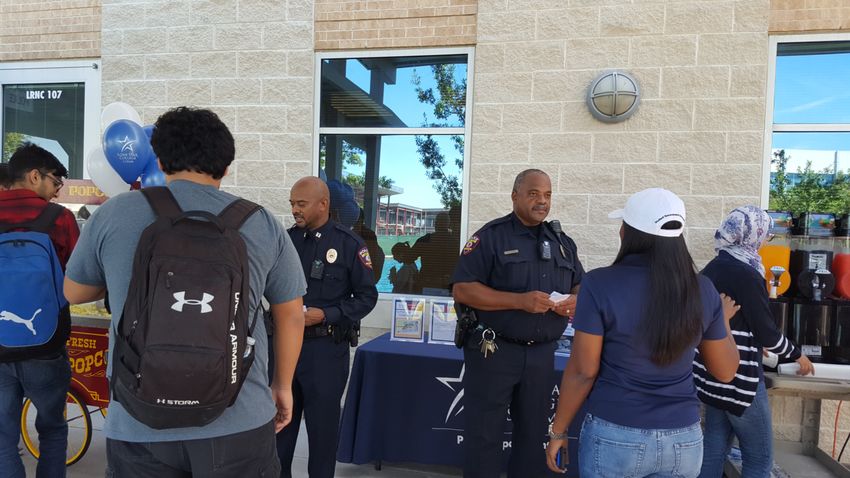
The Office of Student Success on each campus includes events involving the LSC Police and the
Department of Emergency Preparedness. During 2019–2020, LSC Student Success also presented
programs on drug and alcohol awareness and abuse prevention.
The LSC Department of Emergency Preparedness (LSC DEP), in partnership with the LSC
Environmental Health and Life Safety Department, conducts fire exit drills, armed
intruder/lockdown drills and exercises, and National Incident Management System training. The
LSC Police Department, through its website (www.lonestar.edu/police), provides online training
materials for all students and employees on
dating and domestic violence, sexual assault,
and stalking. New student and employee
orientations include the distribution of crime
prevention and fire safety materials and
covers sexual assault, domestic violence,
dating violence, and stalking training. LSCPD
provides crime prevention sessions each
semester at each campus and assault
prevention classes upon request. LSCPD and
LSC DEP participate in campus fairs and
expos and are active members of the Greater Houston Local Emergency Planning Committee
(GHLEPC) and the Gulf Coast Higher Education Emergency Management Consortium.
For more information visit www.lonestar.edu/police, or to schedule a program, contact the LSC
Police Department at LSC-Police@lonestar.edu or the LSC Department of Emergency
Preparedness at EmergencyPreparedness@lonestar.edu.
8.1 Prevention and Awareness Education Programs
In addition to LSC’s ongoing efforts to prevent sexual violence on its campuses and in connection
with its programs and activities, LSC has included on each LSC student’s webpage (through
MyLoneStar) access to an online training module providing information on prevention and
awareness relating to dating violence, domestic violence, sexual assault, and stalking. LSC Police
Page 27Lone Star College
Annual Security Report: 2021
also delivers campus training upon request and has information available online at
www.lonestar.edu/police.
The various LSC campuses and their respective Offices of Student Services also conduct ongoing
prevention and awareness campaigns for students, staff, and faculty on issues related to
domestic violence, dating violence, sexual assault, and stalking.
8.2 Your Role in Campus Safety
A secure environment is made possible through community involvement in crime prevention.
The purpose of community crime prevention is simple: to help you recognize your own
vulnerability to crime and reduce your risk through preventive action and cooperation with the
police.
Theft is the most common crime on Lone Star College campuses. Most thefts occur during the
daylight hours, where thieves enter our public structures without forced entry. It is important to
watch out for one another. In your study and work spaces, exchange information about your
schedule with colleagues. Observe your neighbors’ study and work areas. Do not leave valuable
items unsecured or unattended. Call the police when something or someone is suspicious.
A high percentage of campus crimes are incidents of opportunity. Often, we contribute to the
crime rate by needlessly placing our property or ourselves at risk. The lifeblood of criminal activity
contains three elements, called the Crime Triangle.
The Crime Triangle elements are:
1. Desire of a criminal to commit a crime.
2. Target of the criminal’s desire.
3. Opportunity for the crime to be committed.
We are limited in our ability to impact the first two elements. However, removing or reducing
the criminal’s opportunity is a viable defense. Like a fire feeding on oxygen, crime feeds on
opportunity. Prevention efforts can be effective in reducing these opportunities. You play an
essential role in crime prevention. Be cautious, careful, and alert to your own safety. Protect your
possessions and college property. Keep property locked up if possible. Lock your office door when
leaving and do not leave valuables unattended. Walk to your vehicle with another person or in a
group. Use common sense and always stay alert. Trust your self-preservation instincts. And
always remember to call the police to report suspicious persons or activity as soon as it is safe
for you to do so. Enter the LSC Police Department’s phone number in your cell phone and save it
as a favorite or speed dial: 281-290-5911.
Remember, Awareness is the key to your safety!
Page 28Lone Star College
Annual Security Report: 2021
8.3 Risk Reduction Tips
The following are some strategies to reduce the risk of being a victim of a crime.
• Be aware of your surroundings.
• Try to avoid isolated areas.
• Walk with purpose. Even if you don’t know where you are going, act like you do.
• Try not to load yourself down with packages or bags as this can make you appear more
vulnerable.
• Make sure your cell phone is with you and charged.
• Know your transportation options in advance.
• Don’t allow yourself to be isolated with someone you don’t trust or know.
• Avoid putting music headphones in both ears so that you can better hear your
surroundings.
• Go with a group of friends when attending a social gathering. Arrive together, check-in
with each other throughout the evening, and leave together.
• Trust your instincts. If you feel unsafe in any situation, go with your gut. If you see
something suspicious, contact law enforcement immediately.
• Don’t leave your drink unattended. If you’ve left your drink alone, get a new one.
• Don’t accept drinks from people you don’t trust. At parties, avoid the punch bowls or
other large, common open containers.
• Watch out for your friends and vice versa. Contact law enforcement immediately if you
suspect you or a friend has been drugged.
If you need to get out of an uncomfortable or scary situation here are some things that you can
try:
• Remember that being in this situation is not your fault.
• Be true to yourself. Don’t feel obligated to do anything you don’t want to do.
• Have a code word with your friends or family so that if you don’t feel comfortable you can
call or text them and communicate your discomfort without the person you are with
knowing.
• Always have a secondary escape route.
• If you and or the other person have been drinking, you can say that you would rather wait
until you both have your full judgment before doing anything you may regret later.
• Use a cab or ride share program to leave the situation.
8.4 How To Be An Active Bystander
Bystanders play a critical role in crime prevention including that of sexual and relationship
violence. Bystanders are individuals who observe violence or witness the conditions that
perpetuate violence. They are not directly involved but have the choice to intervene, speak up,
or do something about it. Lone Star College promotes a culture of community accountability
Page 29You can also read


