Prognosis of autoimmune thyroid disease associated with hereditary thrombophilia during pregnancy
←
→
Page content transcription
If your browser does not render page correctly, please read the page content below
EXPERIMENTAL AND THERAPEUTIC MEDICINE 20: 2429-2433, 2020

              Prognosis of autoimmune thyroid disease associated
               with hereditary thrombophilia during pregnancy
               FLORINA‑PAULA PĂULEȚ1, NATALIA ȚURCAN1, FLORENTINA GHERGHICEANU2,
              ROXANA ELENA BOHÎLȚEA3, DRAGOS NEMESCU4 and MONICA MIHAELA CÎRSTOIU3

        1
          Department of Obstetrics Gynecology, ‘Carol Davila’ University of Medicine and Pharmacy Doctoral School,
         University Emergency Hospital Bucharest, 050098 Bucharest; 2Department of Marketing and Medical Technology,
       ‘Carol Davila’ University of Medicine and Pharmacy, 050474 Bucharest; 3Department of Obstetrics Gynecology,
      ‘Carol Davila’ University of Medicine and Pharmacy, University Emergency Hospital Bucharest, 050098 Bucharest;
    4
      Department of Obstetrics Gynecology, University of Medicine and Pharmacy ‘Grigore T. Popa’, 700115 Iasi, Romania

                                      Received March 26, 2020; Accepted April 27, 2020

                                                  DOI: 10.3892/etm.2020.8785

Abstract. Autoimmune thyroid pathology has been                    Introduction
connected with several systemic autoimmune disorders,
namely hereditary thrombophilia and antiphospholipid               An autoimmune disease (AID) is marked by tissue damage,
syndrome. In an iodine‑replete country, these diseases need        inflicted by the self‑reactivity of the various mechanisms of
to be evaluated simultaneously. This study was conducted to        the immune system, antibodies and T cells. Its on‑set could
assess the connection between acute and chronic thyroiditis        be associated with genetic and/or environmental triggers.
and inherited thrombophilia and their potential implica-           Although, individually, each AID is present in a small number
tions in pregnancy. In the analysis of the cases admitted to       of individuals, overall, its prevalence is estimated to be between
the Department of Obstetrics Gynecology of the University          7.6 and 9.4% (1). All autoimmune diseases, to some extent, have
Emergency Hospital Bucharest from January 2015 up to               repercussions for obstetrics and not only. For example, in the
September 2019, we identified pregnancies marked by                general population, ~80% of the abortions happen during the
autoimmune hypothyroidism and hyperthyroidism associ-              first 12 weeks of pregnancy, and the risk of spontaneous abor-
ated with hereditary thrombophilia, by standard statistical        tion in women aged 40 years is exceeding 45% (2,3). Clinical immunology studies
of immunological markers specific for thrombophilia and            have shown that autoimmune thyroiditis is associated with high
against thyroid antigens in pregnant women, and explored           rates of infertility and early miscarriages due to associated
whether they associate with distinct clinical phenotypes.          hormonal changes and instability. The presence of anti‑thyroid
Besides the well‑accounted impact of hereditary thrombo-           antibodies may react against the structures of the placenta or
philia during pregnancy ‑ which is emphasized in our study         fertilized egg and may cause embryo implantation problems (4).
by the incidence of moderate preeclampsia ‑ we also account             The need for systematic thyroid function and TAb evaluation
for a direct and statistically significant relationship between    in early pregnancy may seem fairly obvious, but this is far from
thrombophilia and moderate intensity autoimmune diseases           being a unanimous opinion (5,6). It is 8 years since we called for
(including autoimmune thyroiditis). Moreover, if these two         thyroid function screening in pregnancy and 5 years since the
pathologies are combined there is an increased risk of the         American Association of Clinical Endocrinologists (AACE)
presence of another autoimmune disease.                            recommended thyroid function screening in all women during
                                                                   the first trimester of pregnancy. The most recent joint guideline
                                                                   published by the Endocrine Society recommends an aggres-
                                                                   sive case‑finding approach during early pregnancy in high‑risk
                                                                   populations rather than routine screening.
                                                                        In the present analysis, data were pooled from the clinical
Correspondence to: Dr Roxana Elena Bohîlțea, Department of
Obstetrics Gynecology, ‘Carol Davila’ University of Medicine and
                                                                   database that spans over 57 months of the Department of
Pharmacy, University Emergency Hospital Bucharest, 169 Splaiul     Obstetrics Gynecology of the University Emergency Hospital
Independenței, 050098 Bucharest, Romania                           Bucharest, in order to evaluate the connection between AIDs
E‑mail: r.bohiltea@yahoo.com                                       (autoimmune thyroiditis and inherited thrombophilia) in a
                                                                   sufficiently large sample of pregnant women.
Key words: autoimmune, inherited, iodine‑replete, thrombophilia,
thyroid, pregnancy                                                 Patients and methods

                                                                   In the present retrospective analysis, it was aimed to deter-
                                                                   mine the prognosis, regarding fetal and maternal morbidity,
2430 PĂULEȚ et al: AUTOIMMUNE THYROID DISEASE AND THROMBOPHILIA IN PREGNANCY Figure 1. Distribution in pregnant women diagnosed with thyroid pathology and inherited thrombophilia during 57 months in the Department of Obstetrics Gynecology of the University Emergency Hospital Bucharest. when autoimmune thyroid pathologies associate with The frequency for each studied group and their comparative inherited thrombophilia, simultaneously throughout the reproduction is shown in Fig. 4. pregnancy. The patients that met our criteria were divided into three groups ‑ pregnancies associating only autoimmune Results thyroid pathology (mainly autoimmune thyroiditis), pregnan- cies affected only by inherited thrombophilia, and cases In the analysis conducted above, of the cases admitted to marked by the two diseases simultaneously. The inclucion the Department of Obstetrics Gynecology of the University criteria for the first two groups were based on the presence Emergency Hospital Bucharest from January 2015 up to of a gene mutation such as Factor V Leiden (FVL) muta- September 2019, we identified 171 pregnancies marked by tion (C677T), hyperhomocysteinaemia mutation (A506G), hypothyroidism and 8 cases with hyperthyroidism. prothrombin mutation (G20210A) or prothrombin II (PTII) Twenty‑seven cases of autoimmune thyroiditis also asso- mutation, or protein S and/or C deficiency detected according ciated hereditary thrombophilia, compared with one case of to the guidelines of the American College of Obstetricians hyperthyroidism (Fig. 1). This is also reflective of the fact that and Gynecologists Practice Bulletin No. 124 (7,8) for the Romania belongs to an iodine‑replete area. first group, and the presence of thyroid antibodies (ATAs) Regarding the comparative analysis of the three studied [anti‑thyroglobulin (anti‑TG) and anti‑thyroid peroxi- groups and the implications of the studied pathologies in dase (anti‑TPO)], on two or more occasions, at least 6 weeks pregnancy a significant and direct statistical significant rela- apart, for the second group. Thus, the studied population tion between thrombophilia and mild preeclampsia were consisted of 82 pregnancies marked only by autoimmune obtained, P=0.007 (
EXPERIMENTAL AND THERAPEUTIC MEDICINE 20: 2429-2433, 2020                                                      2431

Figure 2. Distribution of fetal gestational age and weight at birth from mothers suffering of autoimmune thyroid pathology in the Department of Obstetrics
Gynecology of the University Emergency Hospital Bucharest. Study duration 57 months.

Figure 3. Distribution of fetal gestational age and weight at birth from mothers suffering of autoimmune thyroid pathology and inherited thrombophilia in the
Department of Obstetrics Gynecology of the University Emergency Hospital Bucharest. Study duration 57 months.

Figure 4. Distribution in pregnant women diagnosed with complications during pregnancies associating autoimmune thyroid pathology and inherited throm-
bophilia in the Department of Obstetrics Gynecology of the University Emergency Hospital Bucharest. Study duration 57 months.
2432                    PĂULEȚ et al: AUTOIMMUNE THYROID DISEASE AND THROMBOPHILIA IN PREGNANCY

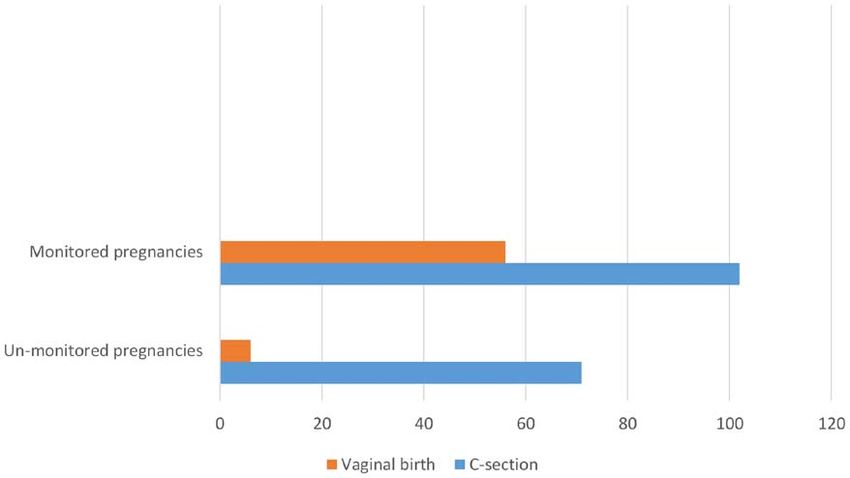
Figure 5. Comparison between C‑section and vaginal birth of monitored and un‑monitored pregnancies associating autoimmune thyroid pathology and
hereditary thrombophilia during 57 months in the Department of Obstetrics Gynecology of the University Emergency Hospital Bucharest.

    Consequently, we also observed that out of the 27 pregnan-               A point of discussion worth pursuing is the link
cies associating thyroid pathology and inherited thrombophilia,          between autoimmune thyroid pathology and pregnancy loss.
in 24 cases the pregnancy was not monitored by any kind of               Autoimmune factors seem to play a pivotal role in infertility.
health care provider (Fig. 5). This is a major factor in a devel-        The prevalence of antiphospholipid antibodies (aPL), ANA,
oping country, and a continuous source of monetary loss for              and antithyroid antibodies was found to be particularly
our health care system.                                                  higher in women with unknown infertility. Implantation
                                                                         is a process based on immunologic tolerance and requires
Discussion                                                               cross‑talk between the embryo and the maternal immune
                                                                         system. Impaired implantation and high pregnancy loss
Regarding the statistics of the two pathologies affecting the            rates in women with autoimmune antibodies could be
pregnant woman, the data collected in Romania is scarce. The             caused by injury to the syncytiotrophoblasts, endothelial
prevalence and incidence of thyroid dysfunction are difficult            cells of the spiral veins, superficial/glandular epithelial cells
to compare across countries due to differences in diagnostic             of the decidua or autoantibody inflammatory processes.
thresholds, assay sensitivities, population selection and fluxes         These biological events result in impaired implantation and
in iodine nutrition and population dynamics.                             disturbed fetal perfusion (17). During the analysis presented
    A meta‑analysis of European studies estimated a mean                 above, we also observed 25 cases of autoimmune hypothy-
prevalence rate for autoimmune thyroiditis of 0.75% for                  roidism associated with spontaneous abortions at gestational
males and females combined and an incidence rate of                      ages ranging between 8 and 22 weeks, out of which 4 cases
51 cases per 100,000 per year (9). However, a database for               also suffered from inherited thrombophilia. Although exact
this pathology associated with pregnancy is not yet available.           screening and management protocols for infertile patients
Thyrotoxicosis in pregnancy has an estimated incidence                   positive for autoimmune antibodies have not been established,
of 0.2% for overt thyrotoxicosis and 2.5% for subclinical                it seems reasonable to devise a patient‑centered, individual-
thyrotoxicosis (10‑12).                                                  ized approach for these patients.
    Iodine deficiency and autoimmune disease (Hashimoto                      The present analysis had several limitations. Due to finan-
thyroiditis) are responsible for the majority of cases of primary        cial and geographic limitations, a few of the pregnant women
hypothyroidism (13). A third of the world's population lives             did not report to the outpatient clinic regularly, in order to be
in iodine‑deficient areas, and the devastating consequences              tested. After giving birth, some of the patients did not return to
of severe iodine deficiency on the neurological development              the 6-week check‑up, in order to evaluate their state of health
of fetuses and children are well recognized. In addition, the            outside the stress of the pregnancy. We did not pursue the impli-
possible effects of less severe grades of iodine deficiency              cations of the AIDs during pregnancy on the foetus (weight,
during pregnancy on offspring cognitive development are                  neurological and morphological features). Furthermore, the
also becoming recognized (14). In Europe, 44% of school‑age              small number of patients, the retrospective design of the study,
children still have insufficient iodine intake. The prevalence           and that it reflects the experience of a single center. However,
of overt hypothyroidism in the general population ranges from            this study was designed to stress the importance of knowing
between 0.2 and 5.3% in Europe (15,16).                                  the immunological background of the pregnant woman.
EXPERIMENTAL AND THERAPEUTIC MEDICINE 20: 2429-2433, 2020 2433
This analysis pointed to the need to consider also testing Competing interests
for other AIDs such as antiphospholipid syndrome. Although
the presence of antiphospholipid antibodies in patients with The authors declare that they have no competing interests.
autoimmune thyroiditis has been previously reported (18),
only a small study highlights the prevalence of antibodies References
against thyroid antigens in patients with antiphospholipid
1. Cooper GS, Bynum ML and Somers EC: Recent insights in
syndrome (APS). Moreover, the increasingly recognized the epidemiology of autoimmune diseases: Improved prev-
association of thyroid autoimmunity with central nervous alence estimates and understanding of clustering of diseases.
system (CNS) disease and pregnancy morbidity features, J Autoimmun 33: 197‑207, 2009.
2. Hurt KJ, Guile MW, Bienstock JL, Fox HE and Wallach EE
which can both be found in the APS (19), prompts us to further (eds): The Johns Hopkins Manual of Gynecology and Obstetrics
investigate the connection between thyroid autoimmunity, (Lippincott Manual Series). 4th, North American edition.
APS and pregnancy. In addition, continued vigilance against Lippincott Williams and Wilkins, Philadelphia, PA, pp73‑77, 2011.
3. Pearce EN, Andersson M and Zimmermann MB: Global iodine
iodine deficiency remains essential in developed countries, nutrition: Where do we stand in 2013? Thyroid 23: 523‑528, 2013.
particularly in Europe. Universal thyroid screening associ- 4. Grassi G, Balsamo A, Ansaldi C, Balbo A, Massobrio M and
ated with thrombophilia screening in pregnancy is therefore Benedetto C: Thyroid autoimmunity and infertility. Gynecol
Endocrinol 15: 389‑396, 2001.
contentious in iodine‑replete areas, although it has been shown 5. Abalovich M, Amino N, Barbour LA, Cobin RH, De Groot LJ,
to be cost‑effective in analytical economic models. Glinoer D, Mandel SJ and Stagnaro‑Green A: Management
Besides the well‑accounted impact of hereditary throm- of thyroid dysfunction during pregnancy and postpartum: An
Endocrine Society Clinical Practice Guideline. J Clin Endocrinol
bophilia during pregnancy, which is emphasized in our study Metab 92 (Suppl): S1‑S47, 2007.
by the incidence of moderate preeclampsia, we also account 6. American College of Obstetrics and Gynecology: ACOG practice
for a direct and statistically significant relationship between bulletin. Thyroid disease in pregnancy. Number 37, August 2002.
Int J Gynaecol Obstet 79: 171‑180, 2002.
thrombophilia and moderate intensity autoimmune diseases 7. Negro R, Formoso G, Mangieri T, Pezzarossa A, Dazzi D and
(including autoimmune thyroiditis). Furthermore, if these two Hassan H: Levothyroxine treatment in euthyroid pregnant
pathologies are combined there is an increased risk of the women with autoimmune thyroid disease: Effects on obstetrical
complications. J Clin Endocrinol Metab 91: 2587‑2591, 2006.
presence of another autoimmune disease. 8. Lockwood C and Wendel G; Committee on Practice Bulletins ‑
Obstetrics: Practice bulletin no. 124: Inherited thrombophilias in
pregnancy. Obstet Gynecol 118: 730‑740, 2011.
Acknowledgements 9. Stevens SM, Woller SC, Bauer KA, Kasthuri R, Cushman M,
Streiff M, Lim W and Douketis JD: Guidance for the evaluation
Not applicable. and treatment of hereditary and acquired thrombophilia.
J Thromb Thrombolysis 41: 154‑164, 2016.
10. Innocencio RM, Romaldini JH and Ward LS: High prevalence
Funding of thyroid autoantibodies in systemic sclerosis and rheumatoid
arthritis but not in the antiphospholipid syndrome. Clin
Rheumatol 22: 494, 2003.
No funding was received. 11. Garmendia Madariaga A, Santos Palacios S, Guillén‑Grima F and
Galofré JC: The incidence and prevalence of thyroid dysfunction
Availability of data and materials in Europe: A meta‑analysis. J Clin Endocrinol Metab 99: 923‑931,
2014.
12. Turcan N, Bohîlțea R, Neacsu A, Baros A and Cîrstoiu MM: The
The datasets used and/or analyzed during the current study role of anticoagulant therapy in the prevention of preeclampsia
are available from the corresponding author on reasonable pharmacokinetic and pharmacodynamic mechanisms. Rev
Chim 70: 1424‑1428, 2019.
request. 13. Asvold BO, Vatten LJ and Bjøro T: Changes in the prevalence
of hypothyroidism: The HUNT Study in Norway. Eur J
Authors' contributions Endocrinol 169: 613‑620, 2013.
14. Bohîlțea RE, Zugravu CA, Neacsu A, Navolan D, Berceanu C,
Nemescu D, Bodean O, Turcan N, Baros A and Cîrstoiu MM:
FPP, REB and NT collected, analyzed and interpreted The prevalence of vitamin D defficiency and its obstetrical
the patient data regarding the testing for ATAs, anti‑TG, effects. A prospective study on Romanian patients. Rev Chim 70:
1228‑1233, 2019.
anti‑TPO, TSH, freeT3 and freeT4. FPP, REB and NT also 15. Okosieme OE and Lazarus JH: Important considerations in the
collected the data of immunological and genetic markers management of Graves' disease in pregnant women. Expert Rev
Clin Immunol 11: 947‑957, 2015.
specific for thrombophilia and antiphospholipid syndrome of 16. Taylor PN and Vaidya B: Side effects of anti‑thyroid drugs and
the pregnant women included in the present study. FG, DN their impact on the choice of treatment for thyrotoxicosis in
and MMC substantially contributed to the conception of the pregnancy. Eur Thyroid J 1: 176‑185, 2012.
17. Chaker L, Bianco AC, Jonklaas J and Peeters RP: Hypothyroidism.
study, the interpretation of the data and the writing of the Lancet 390: 1550‑1562, 2017.
manuscript. All authors read and approved the final version 18. Bohîlțea R, Turcan N, Ionescu C, Toader O, Nastasia S, Neculcea D,
of the manuscript. Movileanu I, Munteanu O and Cîrstoiu M: The incidence of
prematurity and associated short‑term complications in a multi-
disciplinary emergency hospital from Romania. In: Proceedings
Ethics approval and consent to participate of the 5th Congress of the Romanian Society of Ultrasound in
Obstetrics and Gynecology, Filodiritto Editore, pp105‑112, 2017.
19. Nabriski D, Ellis M, Ness‑Abramof R, Shapiro M and Shenkman L:
Informed consent was obtained from all patients. Autoimmune thyroid disease and antiphospholipid antibodies. Am
J Hematol 64: 73‑75, 2000.
Patient consent for publication
This work is licensed under a Creative Commons
Attribution-NonCommercial-NoDerivatives 4.0
Not applicable. International (CC BY-NC-ND 4.0) License.You can also read


