Progressive Education: Early Intervention Strategy to Improve Postsecondary Outcomes for Youth with Disabilities
←
→
Page content transcription
If your browser does not render page correctly, please read the page content below
Progressive Education: Early Intervention
Strategy to Improve Postsecondary
Outcomes for Youth with Disabilities

April 30, 2021

Tara Howe,* Christine McCarthy,** James Smith,* and Richard Tulikangas*

* Vermont Division of Vocational Rehabilitation
** Vermont Association of Business Industry and Rehabilitation

The U.S. Department of Labor’s Office of Disability Employment Policy funded the SSI Youth Solutions
Initiative. The project sought potential solutions to improve employment outcomes for young adults ages
14 to 24 who apply for or receive Supplemental Security Income. This report is one of 12 developed for
this project.
This page has been left blank for double-sided copying.
Progressive Education

       Acknowledgements
       This report was prepared for the U.S. Department of Labor (DOL), Office of Disability
       Employment Policy (ODEP), by Mathematica, under contract number 1605DC-18-A0020. The
       views expressed are those of the authors and should not be attributed to DOL, nor does mention of
       trade names, commercial products, or organizations imply endorsement of same by the U.S.
       Government.

       The authors thank Vermont vocational rehabilitation staff who shared their stories and experiences
       in working with youth that informed the progressive education model. They individually
       acknowledge Diane Dalmasse, Brian Guy, Marianne Langello, and William Sugarman for their
       efforts toward this publication. In addition, they appreciate the comments and support of staff from
       ODEP and its federal partners, Mathematica project staff, and two anonymous peer reviewers who
       reviewed earlier drafts.

                                                                                                              iii
This page has been left blank for double-sided copying.
Progressive Education

       Abstract
       Youth and adults with disabilities, particularly youth receiving Supplemental Security Income (SSI),
       are far less likely than their peers without disabilities to participate in or complete postsecondary
       education and training. As a result, they face a major disadvantage in entering higher-wage, higher-
       quality employment over their life span. Progressive education is a comprehensive model for public
       vocational rehabilitation programs that is designed to increase participation in postsecondary
       education and training among youth with disabilities. Progressive education builds on the premise
       that maximizing the experience of postsecondary opportunities for students with disabilities during
       high school leads to higher participation rates in postsecondary education and training programs.
       These supports might be particularly useful for youth receiving SSI, given their additional needs and
       barriers to transition.

       The progressive education model offers a graduated series of activities for students with disabilities
       to experience postsecondary opportunities well before they exit high school. These activities include
       campus tours and informational interviews, career assessments, auditing classes, work-based learning
       experiences linked to credentials, dual high school and college enrollment, contracted college classes
       that focus on college and career preparation, pre-apprenticeship programming, and enrollment in
       career and technical education courses. Progressive education also provides a menu of supports to
       promote youth’s success in postsecondary programming, such as coaching or tutoring,
       collaborations with school staff and agency partners, and access to assistive technology. For youth
       receiving SSI, these supports also include benefits planning to leverage work incentives that support
       postsecondary education.

                                                                                                                v
This page has been left blank for double-sided copying.
iiProgressive Education
I. Introduction
People with disabilities work less, earn less, and have lower educational attainment than people
without disabilities. The labor force participation rate for 16- to 19-year-olds with disabilities was 25
percent in July 2020 (compared with 37 percent for those without a disability) and 44 percent for 20-
to 24-year-olds with disabilities (compared with 71 percent for those without a disability; Office of
Disability Employment Policy n.d.). Youth with disabilities are more than twice as likely as those
without disabilities to drop out of high school (Loprest and Wittenburg 2007). For child
Supplemental Security Income (SSI) beneficiaries, one-third drop out of school before they reach
the age of 18 (Hemmeter, Kauff, and Wittenburg 2009). Dropping out not only impedes youth’s
ability to continue their education and training but also excludes them from opportunities to explore
careers and determine what might be a good match for both their skills and their interests.
It is rare for students with disabilities to participate in or complete postsecondary education and
training (PSET). Nationally, 1 in 10 students with disabilities reported that it was likely that they
would attend PSET (Wagner et al. 2007). In Vermont, there is a clear discrepancy in dual-enrollment
participation between students who have individualized education programs (IEPs) and those who
do not. According to the Vermont Agency of Education (VT AOE), only 3 percent of students
accessing dual enrollment (taking a college course while in high school) had an IEP (Bouchey 2017).
Although low socioeconomic status may impact this data, it does not account for all of this
discrepancy.
We believe the different rates of PSET participation are a function not simply of the youth’s
disability but also of systemic barriers to accessing PSET. For example, high school students with
disabilities are far less likely than their nondisabled peers to participate in PSET preparation
activities as part of vocational rehabilitation (VR) in Vermont. These VR activities may include
visiting college campuses, attending college fairs, or participating in introductory college courses to
learn more about academic PSET expectations. Also, reports from VR youth practitioners indicate
that students may underestimate their ability to prepare for and pursue PSET. Some students and
families have internalized the belief that because of the students’ disability, PSET is not an option.
As a result, students face barriers to postsecondary opportunities beyond the functional barriers
related to their disability.
The goal of progressive education (PEd) is to overcome these systemic barriers by providing
graduated opportunities to explore PSET. PEd is designed to be an intentional, planned approach to
providing youth with hands-on exposure to PSET, different from traditional VR pre-employment
transition services. The intentional aspect of this approach involves students getting a greater
amount of both opportunity and support to engage in these activities to ensure that they truly
consider their PSET options. Reports from counselors indicate that students need support not only
around accessing information about opportunities, but assistance in engaging in these activities to
ensure to a positive, beneficial learning experience. Our working hypothesis is that incremental
exposure to PSET early in students’ high school careers increases the likelihood that those students
will build the skills, experiences, and confidence to succeed. Although earlier exposure in middle
school (or even before) would be beneficial, the target population for PEd is youth and young adults
1Progressive Education
with disabilities starting at age 14, continuing into their postgraduation plans. This age aligns with
the provision of pre-employment transition services provided by VR. 1
PEd employs the following basic principles:
• Every student is ready for some type of experience related to postsecondary exploration.
• Students would benefit from a series of graduated options based on their interest, experience,
and grade level.
• PEd helps to satisfy the requirement to provide exposure to postsecondary opportunities
through pre-employment transition services.
PEd provides postsecondary exploration and engagement activities early and often, with targeted
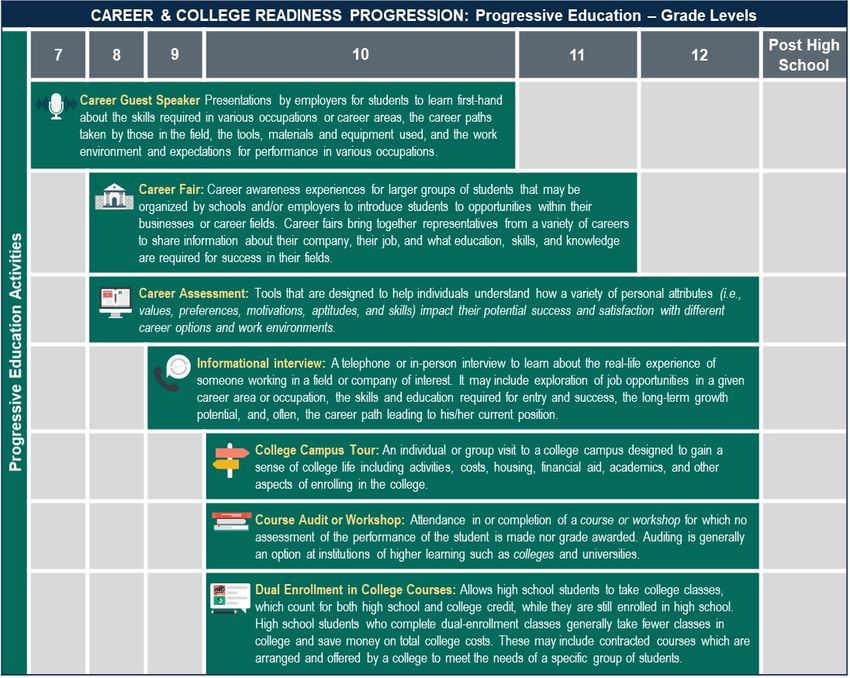
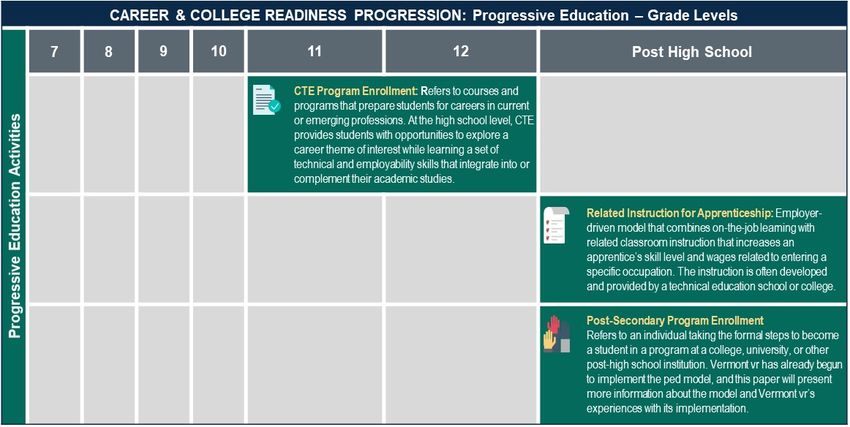
support and outreach to ensure that individuals with disabilities access these opportunities. Figure 1
shows the varied activities that would be provided in this model, including definitions for each
activity and in which grade levels it would be offered.
1Pre-employment transition services include career exploration, postsecondary counseling and exploration, self-
advocacy and workplace readiness training, and work-based learning experiences.
2Progressive Education
Figure 1. Career and college readiness progression
3Progressive Education
CTE = career and technical education; VR = vocational rehabilitation.
4Progressive Education
II. Background
A. Need for systemic change in how youth with disabilities are introduced to
postsecondary and career opportunities
Youth with disabilities do not engage in or complete PSET at rates anywhere near their peers
without disabilities. As mentioned above, the VT AOE reported that only 83 individuals with IEPs
across the state accessed dual-enrollment courses in 2017, a very small percentage of the 2,660 total
students who participated in the courses that year (Newton, Pendlebury, and Tulikangas 2018). The
VT AOE also indicated that 77 percent of students who participated in dual enrollment went on to
enroll in postsecondary programs (Bouchey 2017, fall 2014 data). These data suggest that if more
students with disabilities engaged in dual enrollment, students with disabilities might have higher
enrollment in postsecondary programs. There are no specific data related to students with disabilities
enrolling in college after participating in dual enrollment. However, there are correlations with other
populations, such as disadvantaged students, that suggest the positive benefits of additional
education supports. For example, the U.S. Department of Education’s TRIO programs encourage
postsecondary enrollment and completion for disadvantaged students, such as those from low-
income households and first-generation college students. Its Upward Bound programs offer a
variety of education supports, such as tutoring, academic instruction, and financial literacy, and
exposure to postsecondary education options to high school students, and more than 80 percent of
participants enroll in postsecondary education and more than half of them obtain a degree (Student
Service 2016). The National Center for Education Statistics (2018) indicated that only 15 percent of
individuals with disabilities participated in some type of PSET up to eight years after graduating
from high school. Of those individuals, only 48 percent had graduated from any type of
postsecondary program in 2010. Only 16 percent of individuals with disabilities ages 25 or older had
obtained bachelor’s degrees, which is less than half of the rate among those without disabilities (35
percent; U.S. Bureau of Labor Statistics 2015).
A review of the literature suggests that much of the focus of preparation for postsecondary
programs is on teaching both self-advocacy and student rights under the Americans with Disabilities
Act in relation to college accommodations (Eckes and Ochoa 2005; Gil 2007). There is no question
that these are vital components of being ready for the college experience. However, students cannot
self-advocate if they do not even know they want to consider postsecondary options. Exposure to
real experiences so that students may make an informed choice is the critical first step. As Cavendish
and others (2019) described, “research that highlights students’ voices related to the transition
process has been limited” (p. 2). Many college activities, such as trips to potential universities, were
out of reach to students with disabilities because they were not financially feasible or were for
seniors only, even though exposing students to college activities as early as middle school can be
important. One program, College Student for a Day, involves activity-based learning and mentoring
opportunities for low-income freshmen with disabilities (Novakovic and Ross 2015). This program
represents many positive opportunities for youth, but it selects students based on their expressed
interest in going to college. An important barrier is that students might not consider the possibility
of postsecondary education if it is not discussed with them or offered as an option to explore.
5Progressive Education
Students with disabilities cannot ask for and engage in activities when they do not even know that
they are a possibility.
A significant percentage of youth with disabilities leave high school without being employed or
connected to PSET. The VT AOE compiles data for Indicator 14, which includes information on
the percentage of youth who are no longer in secondary school, had IEPs at the time they left
school, and were enrolled in higher education, competitively employed, or in a training program
within one year of leaving high school. Individuals who were either enrolled in higher education or
competitively employed within one year of leaving high school represented 70 percent of the
population (VT AOE 2017). Thus, 30 percent of individuals who had graduated were not working
or going to school. A substantial number of such individuals are not able to work toward a greater
level of self-sufficiency, which could lead to dependence on public benefits such as SSI.
Studies show that early work and career exploration positively affects post-school outcomes.
Luecking and Luecking (2015) report that students who have a competitive integrated employment
experience and are connected to postsecondary support services before graduation have more
successful transition outcomes. Mamun and others (2018) found that having an early work
experience increased the chance that youth were employed two years later by 17 percentage points
(which could result in reduced SSI benefits throughout their lives). Integration of work experiences
within a successful program is imperative so that not only are students learning about the
requirements, rigor, and skills needed to succeed in PSET, but these skills also align with being
valued and effective workers in careers of their choice. How school staff and VR counselors
perceive a student’s potential is a significant factor in what they share with students and families
about opportunities for exploration and pursuit of postsecondary options. However, an assessment
of a student’s potential is subjective. Considerations include the student’s social experience in high
school, how much the student has been challenged and supported academically, and that a disability
diagnosis does not mean the same thing for every student with that diagnosis. When a professional
decides that a student is not college material, it does a disservice to the student, limiting the student’s
growth and evolution. The belief that all students are ready for something, both work and career
related, empowers youth to imagine career possibilities.
Despite several ways in which students with disabilities may hear about postsecondary options, this
information may not reach them. Information sources include guidance/school counselors, special
educators, family members, community providers, and VR counselors. However, many students are
not directly involved in early or frequent postsecondary exploration and planning. The current dual-
enrollment guidance provided by the VT AOE for students with IEPs does not include any
recommendations or alternative opportunities for students and IEP teams to prepare for dual-
enrollment courses (VT AOE 2019). Furthermore, if a student is struggling emotionally,
academically, or socially at the time of his or her annual IEP meeting, then the topic of dual
enrollment may be pushed aside. It could be another year before the discussion occurs again, and
the student will have lost a year of opportunities to explore career and PSET possibilities. The
rationale that the student is struggling with high school and therefore cannot handle any additional
responsibilities is a limiting one. As a result of this belief, students do not hear about available
options and so cannot make an informed choice. Rather, adults determine for them what is best and
6Progressive Education
what they can manage. This rationale is faulty and results in many students not even being aware of
programs such as introductory college classes, Early College, career days at colleges, or dual
enrollment.
Although agencies, schools, and community partners work hard to provide services collaboratively
in the best interest of students and their families, interagency collaboration is still a challenge. Several
mechanisms in Vermont, including the Core Transition Teams, exist to foster this collaboration.
However, professionals have competing priorities and time commitments, which limits their
opportunity to communicate with others about students. As a result, students may not receive all of
the information from the professionals with whom they interact about available postsecondary
programs that might meet their unique needs or services that help prepare students to be successful
in these programs.
Students with a disability who are not offered the supports needed to be successful in their lives
after high school have an increased probability of unemployment or underemployment. Loprest and
Wittenburg (2007) note that one-third of those who were no longer on SSI after redetermination
were below the poverty level: “It is possible that, in the long run, deterioration of health and inability
to sustain family support will lead some of these young people to again obtain SSI” (p. 606). Youth
with disabilities are more likely to report that they are not sure whether they will have a job that will
allow them to be financially independent (Wagner et al. 2007). Families can also be at a disadvantage,
as the adult services world can be a challenge to navigate even for those who are well informed.
Additionally, students with disabilities who do not receive the supports needed to be successful in
PSET are likely to either drop out or not return because of poor performance. This is based on
counselors’ reports of working with youth whose families often refer them to VR one to three years
after graduation because they are not working or going to school. The PEd model provides
opportunities for students to learn about what is necessary to be successful in PSET and how to
access the supports that are available on college campuses. The model allows students to learn early
about PSET and make informed choices about what is most appropriate for their career interests
and learning styles.
Another argument for increasing PSET for youth and young adults relates to the Workforce
Innovation and Opportunity Act (WIOA). The passage of the WIOA in 2014 required VR programs
to implement substantial programmatic changes. The WIOA has driven VR program restructuring
in two significant ways. First, the new pre-employment transition services mandate required VR
programs to reserve at least 15 percent of the Title I VR award to serve exclusively high school
students with a disability. (VR agencies received no new funds to implement these services, so in
most cases, they had to shift resources from the adult program to serve high school students.) As a
result, VR programs serve substantially more students and youth than they did before the WIOA.
For the program years 2010 through 2014 (immediately before the passage of the WIOA), the VR
national caseload of participants was 35 percent students and youth up to age 24. In program year
2018, this percentage increased to 51 percent (Rehabilitation Services Administration 2020).
7Progressive Education
The second major change that the WIOA brought to the VR program is a focus on credential
attainment and measurable gains in skills, especially in postsecondary programs. Before the WIOA,
VR performance was measured simply in terms of employment outcomes for participants (the
number employed, their hourly and weekly earnings, etc.). Most of the measures were point-in-time
measures at case close. The WIOA’s common performance measures placed a much greater
emphasis on long-term career outcomes. These outcomes include measurable skills gains and
credential attainment in PSET programs. To meet these new measures, VR programs have had to
rethink their service design. It is no longer acceptable to simply place consumers into jobs and
support them in achieving entry-level employment. VR programs must assist individuals’ move to
higher-level employment that often requires credentials. Therefore, agencies have had to restructure
and redesign services so that more participants enter into and succeed in credentialed programs.
Vermont VR worked hard to determine the best way to provide the services mandated by the
WIOA. VR transition counselors working in schools to provide transition services had often
discussed postsecondary planning and worked collaboratively with schools and community partners
to assist students in exploring options. However, counselors found that they would either be
introduced to students too late to make a real impact on their planning or would encounter students
who had already chosen a path but may not have considered all the options they had the potential to
achieve. Furthermore, students would report to counselors that they “were not college material” or
had been told somewhere along their academic career that PSET was not an option for them.
Not only are just over 50 percent of those served by VR agencies annually under the age of 25
(Rehabilitation Services Administration 2020), one of the required services for pre-employment
transition services is to provide postsecondary exploration opportunities (Workforce Innovation
Technical Assistance Center n.d.). According to data from the Rehabilitation Services
Administration (2020), counseling on enrollment opportunities for higher education was the least
common of the five required pre-employment transition services in 2018, representing only 16.1
percent of services provided. Therefore, VR agencies nationwide could benefit from strategies and
models to increase PSET participation for youth. We propose that PEd is a model to help address
this need.
B. The origins and evolution of the progressive education model
In October 2016, Vermont VR was awarded one of five state Disability Innovation Fund five-year
grants by the Rehabilitative Services Administration at the U.S. Department of Education. The
primary purpose of these awards was to expand work-based learning (WBL) opportunities for high-
school-aged youth with disabilities and assess the impact of designed interventions over the course
of the grant period. Vermont VR proposed to go further with its project, titled Linking Learning to
Careers (LLC), by incorporating significant elements of postsecondary exploration and engagement
of students enrolled in the project.
LLC, now in its fourth year, enrolled 800 high school students with disabilities. Half of these
students were randomly assigned to a treatment group and received additional WBL, postsecondary
exploration, and assistive technology supports. The remainder were assigned to a control group and
8Progressive Education
received standard VR and other services available in the community, including pre-employment
transition services. The randomization took place at student enrollment into the program and was
managed by Vermont VR’s evaluation partner, Mathematica, through their selection assignment
platform.
LLC students who are interested in PSET can
attend informational sessions and college tours, Box 1. Example of LLC’s impact
receive educational counseling to learn about A student in the LLC program indicated that she
college courses, and participate in a module on was not the student she could be in high school
accessibility under the Americans with (barely getting by and trying to be anonymous)
Disabilities Act. LLC also piloted a mentoring and therefore was never introduced to
postsecondary options. It was not until LLC
program with a small group of LLC students.
offered her possibilities and the supports to
The mentors were Community College of
succeed that she engaged in PEd opportunities,
Vermont (CCV) work-study students who
including completing four dual-enrollment courses,
shared their personal experiences transitioning earning a Licensed Nursing Assistant certificate,
to PSET, discussed career goals, and helped and pursuing a career in the health care field. With
LLC students navigate their WBL and college exposure to these opportunities, she made a
exploration experiences. According to LLC different choice than she otherwise would have, a
staff, these services can demystify the college story that is similar to those of other LLC students
process for students and make PSET seem that counselors have shared.
more accessible and attainable. (Students
receiving usual VR services can access CCV information sessions and resources on their own but do
not participate in the mentoring program.) Also, as part of its enhanced services, LLC offers
students the opportunity to participate in four dual-enrollment courses, exclusive contracted college
courses at CCV, and a pre-course module on self-advocacy skills. These services may be particularly
valuable to LLC students who had not considered college as an option before their involvement in
the project.
The PEd model originates from much of what is being learned from Vermont’s LLC demonstration
project. Though the long-term impacts of this increased access to PSET experiences (such as taking
an Introduction to College and Careers [ICC] course or other dual-enrollment or contracted
courses) are yet to be measured, VR youth staff report significantly higher levels of interest and
engagement in pursuing PSET directly linked to career pathways among those in the treatment
group having these experiences. Through July 2020, there was a fivefold increase in engagement in
such postsecondary activities (20 percent of students in the LLC intervention group versus 4 percent
of those in the control group). As another point of comparison, 64 percent of students in the LLC
intervention group received counseling on postsecondary options, compared with 38 percent in the
control group. Although LLC youth were encouraged to consider PSET exploration and
engagement activities, their actual participation in these activities was completely voluntary.
At this time, overall student outcomes from participating in LLC are being assessed through an
impact study conducted by Mathematica. It will include analyses of follow-up surveys with students
and their parents or guardians at 24 months after enrollment and of administrative data on actual
9Progressive Education
participation in services and outcomes collected throughout the program’s implementation. The
impact report will likely be completed by summer 2021.
Through experience with LLC, we have seen how even relatively low-intervention exploratory
activities can open youth up to new possibilities. For example, a tour of a community college
campus may encourage a student to consider a dual-enrollment class while in high school. A tour of
a modern manufacturing facility may prompt a student to think about a pre-apprenticeship or
registered apprenticeship program. The LLC experience suggests that hands-on experiences have a
profound impact on some students’ perceptions of themselves and their potential.
III. Description and Application of the Progressive Education Model
A. Program overview
The PEd intervention would provide a greater level of support than students typically receive in
both exploring and experiencing postsecondary activities as part of their VR experience. PEd
activities are more substantial in number and intensity and involve more team-based coordination
relative to the usual VR services available to students. Table 1 describes how services related to
postsecondary exploration are currently being provided at Vermont VR compared with how PEd
would enhance and increase the services available.
Table 1. PEd compared with current Vermont VR services
Current Vermont VR services Vermont VR services with PEd implementation
Exploration of postsecondary options is driven by Every student is considered for exploratory postsecondary
the student’s interest and family support but may be activities. The VR counselor makes assertive efforts to
a potential service as part of pre-employment engage the youth and family in exploring postsecondary
transition services. options.
The VR counselor provides standard counseling and The VR counselor role is redesigned to provide ready
guidance for students related to PSET. Participation access to a variety of program tools for the student to
in exploratory activities are largely driven by the explore postsecondary options, including the following:
student. 1. Campus tours and informational interviews
2. Opportunities to audit college classes.
3. Contracted courses with CCV focused on career
preparation and WBL experiences
4. College Compass supports for students in dual-
enrollment courses at several Vermont state colleges
5. WBL experiences linked to potential credentials
6. Pre-apprenticeship experiences for students
7. Enrollment in CTE programs
The VR counselor has no specific role in dual The VR counselor assertively promotes dual enrollment in
enrollment. This role is left to school guidance staff. postsecondary classes while the student is still in high
school.
The VR counselor has limited options to support The VR counselor has a menu of supports to promote
students and youth in postsecondary programs. youth’s success, including coaching and tutoring, peer
mentor supports, and access to assistive technology.
10Progressive Education
Current Vermont VR services Vermont VR services with PEd implementation
Referral to benefits counseling is ad hoc and not The VR counselor links all students receiving SSI with a
necessarily linked to postsecondary options. benefits counselor, who provides intentional benefits
planning information on work incentives that support PSET,
such as the Plan to Achieve Self-Support or the Student
Earned Income Exclusion.
CCV = Community College of Vermont; CTE = career and technical education; PSET = postsecondary education and
training; SSI = Supplemental Security Income; VR = vocational rehabilitation; PEd = progressive education, WBL =
work-based learning.
A core premise of PEd is that VR supports all enrolled youth in considering their options for
postsecondary training and education, including those with the most significant disabilities and those
participating in supported employment programs. This expectation essentially reorients the
counseling process to default to exploration of PSET options. It is our hypothesis that this inclusive
approach will eventually increase the proportion of youth who both participate in and complete
PSET programs.
B. Services available to youth
A youth participating in PEd would expect to hear about PSET opportunities during the VR referral
process, when VR transition counselors begin to discuss services. Referrals may come from the
school, family, or a community provider. (About 30 percent of youth on the VR caseload receive
SSI.) As with any new referral, VR transition counselors spend much of the first few meetings
establishing a relationship with the student and reviewing services that could aid in the student’s
current and future career success. An important aspect of this model is also offering a menu of
options from which students can choose based on their interest and knowledge about postsecondary
opportunities. These initial meetings in which the counselor learns about the student are pivotal to
reinforce multiple options, not just one, to determine the right path. The student chooses when and
where to engage these PEd options.
Services available in the PEd model would be on a continuum (as described in Figure 1). Students
could enter at any point for which they are prepared and do not necessarily participate in the entire
progression. The intention is that the students’ interests and needs would be the determining factor
for which activities to consider. These activities—which could include campus tours, informational
interviews with college staff, audited classes, or introductory, noncredit college courses or credited
dual-enrollment classes—would be offered potentially as early as age 14 to ensure ample opportunity
for students to access all of the activities they are interested in. Additional courses could be available
for students through a contract with CCV or other state colleges.
PSET comprises a range of options. More traditional options include taking college courses,
matriculating into a two- or four-year college program, enrolling in technical education or training
programs, and participating in pre-apprenticeships, apprenticeships, or other “earn while you learn”
options that align with the student’s area of interest. Therefore, some of the available contracted
courses include an integrated work experience or internship. WBL activities matched with
postsecondary coursework provide both academic exposure and hands-on experience to help
students make informed choices about the best next steps after graduation.
11Progressive Education
For many VR students, securing financial aid resources to support PSET is essential. Connecting
students and families with the information, counseling, and financial assistance needed to work
toward career and postsecondary goals is an important element of an effective PEd system.
Another integral part of the PEd model is ensuring that students and families eligible to receive
benefits have access to benefits counseling. The Vermont VR program has benefits counselors on
staff to provide both a helpline and individualized services for students and families. VR transition
counselors report that students under the age of 18 who receive SSI or other public benefits may not
know that they have those benefits; instead, a family member or guardian who receives the SSI
checks may be the only one with knowledge of the benefits and associated processes. Providing
benefits planning for youth receiving SSI is important so that they take advantage of work incentives
that support PSET, such as Plan to Achieve Self-Support or the Student Earned Income Exclusion.
This information needs to be provided both before and after redetermination for those receiving SSI
so that they understand the implications of the continuation, reduction, or elimination of benefits.
Benefits counseling before redetermination could also help families understand Section 301, if they
do not continue to receive SSI, through accessing VR services.
Effective PEd services require interagency collaboration among VR, high schools and CTE centers,
postsecondary institutions, and other community partners supporting youth with planning and
determining their career path. Adult professionals involved in PSET planning need to create systems
for coordinating their communications and activities with students and families that ultimately
support making informed decisions. In Vermont, VR has taken the lead with establishing Core
Transition Teams in every district of the state (as well as a state-level team) that serve precisely this
purpose.
C. Definition of target population and recruitment
The PEd model is intended for all youth with disabilities, regardless of their career goals or past
experiences. The intervention acknowledges that many youth (and their families) do not know what
choices are out there, which could leave many students behind. The PEd philosophy is that all
students are ready for some type of experience related to PSET. The target population for this
intervention comprises students and youth with disabilities, including SSI recipients, between the
ages of 14 and 25. The spread in ages allows the program to support both those who are early on in
their process of determining postsecondary possibilities and those who may have already been
missed but still deserve the same opportunities. This population includes individuals who dropped
out of school and high school graduates whose postsecondary plan was never formulated or was not
successful.
The eligibility definition used for the PEd model aligns with the definition of a student with a
disability used for delivering pre-employment transition services. 2 Specifically, a student with a
2In Vermont, there are currently more than 5,000 high school students who are eligible for pre-employment transition
services, according to unpublished suppressed data reports on numbers of students, grades 9 to 12, on IEPs and 504
plans from the VT AOE.
12Progressive Education
disability is defined as an individual with a disability in a secondary, postsecondary, or other
recognized education program who:
• is not younger than the earliest age for the provision of transition services;
• is not older than 21;
• is eligible for and receives special education or related services under Part B of the Individuals
with Disabilities Education Act; or
• is an individual with a disability, for purposes of Section 504 (Workforce Innovation Technical
Assistance Center n.d.).
For the most effective implementation, students would begin PEd activities as early as ninth grade
to build on learned experiences that will help inform their next step in exposure to PSET. Referrals
would be primarily from school staff or designated agencies already assisting families through
developmental services or mental health services. Currently, most referrals for pre-employment
transition services are from professionals who have discussions with and provide support to
students to determine a career path and postsecondary plan, such as school staff (special educators,
WBL coordinators, employment coordinators, or guidance/school counselors). As a crucial part of
this model, school staff and VR transition counselors need to collaborate to support participating
students. IEP teams ultimately need to give their approval for a student to participate in dual-
enrollment opportunities.
Although all students could benefit from PEd opportunities, some may need more targeted outreach
to help them become engaged in these opportunities. One type of student that reflects this idea is
someone who has not identified any path of interest. Despite being asked regularly what they want
to do for a career, such students may not respond or may show ambivalence regarding next steps.
As WBL opportunities can expose students to career possibilities, PEd can offer similar exposure to
help students envision where they might fit in. VR transition counselors in the field have noted the
significant impact, for example, of going to visit a college campus to demystify any assumptions
about what a typical student looks like.
Special considerations for recruiting youth SSI recipients. Individuals who are currently on SSI,
either before or after the age-18 redetermination, are an important part of the target population.
About 30 percent of youth served by the Vermont Division of Vocational Rehabilitation (DVR)
receive SSI, and they are unlikely to have conditions that are so severe that they cannot work. Most
youth on SSI in Vermont have severe special health care needs but have been able to participate in
modified PSET programs. However, without an understanding of SSI, a family may not plan for the
student to have any career or employment pursuits after the redetermination process. Furthermore,
families who have relied on SSI for their income before redetermination may be hesitant to have
their child begin working out of fear that it could affect benefits (Loprest and Wittenburg 2007).
This situation can result in poor outcomes for youth who have not been supported in experiencing
work and PSET opportunities before redetermination and are then found ineligible. Whether or not
they receive SSI as adults, the students are at a disadvantage. There is no opportunity for the youth
to explore postsecondary options, and without an educator or counselor to support and navigate the
13Progressive Education
process with the student and family, the student is already going to struggle, leading to increased
likelihood of dependence on benefits and/or public assistance.
In practice, it is difficult to engage youth receiving SSI for participation in PEd because this
information may not be available to schools or VR. Students who are on SSI may not know what
benefits they or their families receive. When parents fill out the application for VR services, they
may not share information about the student’s SSI receipt because they fear that any state agency
knowing this information may negatively impact their benefits. To provide outreach to families who
receive SSI, interagency collaboration is an essential component of this model. It is important for
agency partners to share how students and families could benefit from the opportunity to engage
with VR services and access benefits counseling through knowledge from the school staff or partner
agencies that may be aware of the families’ benefits status.
Given the above, when recruiting SSI youth specifically for PEd, we would recommend the
following strategies:
• Pair the benefits counselor with the VR counselor when conducting outreach. Youth and
their families will often have major concerns about the effects of employment and PSET on
their benefits. This includes all benefits received by the family, not just the youth’s SSI. Having a
skilled and knowledgeable benefits counselor to address concerns with accurate information is
essential to building trust.
• Focus primarily on the family and building their support for the youth’s career
ambitions. Often the youth’s SSI benefit is an essential component of the family budget. The
VR counselor and benefits counselor must take the family’s concerns to heart and align with
both the youth and the family. For example, they could point out incentives such as the Student
Earned Income Exclusion that can financially benefit the youth and family.
• Develop materials specific to the needs of youth receiving SSI. These materials should be
designed to explain in accessible ways the opportunities and risks involved in supporting a
youth’s career paths.
• Work with partner agencies to engage youth on SSI. Often youth receiving SSI are engaged
in other service systems, such as developmental disability programs, community mental health
programs, and health care programs. These programs often have long and well-established
relationships with youth and their families and can be allies in supporting youth in engaging in
their career paths.
D. Implementation
A statewide infrastructure is required to support youth and young adults for the successful
implementation of PEd. This infrastructure comprises multiple components and involves several
agencies.
School-based VR transition counselors. VR transition counselors work directly with high schools
and community partners to provide pre-employment transition services to potentially eligible
14Progressive Education
students starting at age 14. These services are connected to the PEd model through WBL, work
readiness skills, self-advocacy, career exploration, and postsecondary exploration. VR transition
counselors provide postsecondary exploration activities as required by the WIOA. Implementing
this model successfully would require that VR counselors provide targeted outreach and support
efforts for students starting early in their high school career.
Because VR transition counselors work directly in schools, their relationships with students and
awareness of those who might qualify for U.S. Department of Labor (DOL) services could assist in
connecting students to services. Connecting students and school programs to their local DOL
offices increases the likelihood that students will access those services. Contracted courses can also
be provided with DOL support of pre-apprenticeships and apprenticeships for students. Not every
student will benefit from or want to attend college; other career paths that require an apprenticeship
in industry sectors with significant job opportunities can be an option.
VR transition counselors also need to consider the past school experience of both youth and young
adults. For some individuals, school has been not a positive experience but one in which they felt
frustrated and did not get the assistance that they needed to be successful. It is important to ensure
that VR transition counselors are aware of these experiences and that beginning exploration aligns
with the individual’s readiness. Further, some students may benefit from PEd but are not referred by
the school staff or are in a situation where a referral through another community partner or through
the family would be better. Collaboration with community partners and families working with youth
and young adults who would benefit from participating in PEd is also important in this model.
Strong relationships with IEP and 504 teams. Solid interagency relationships are integral to
ensuring that students hear about PEd options and receive support to participate in them. Without a
strong partnership, students could hear differing information about options based on what each
organization believes to be a good fit. This causes confusion and frustration for everyone involved,
especially the student. Therefore, IEP and 504 teams need to work together, with the VR transition
counselor also at the table, to support the student and clarify what role each member of the team has
in this process.
VR transition counselors are integral to informing students and IEP/transition teams about PEd
options. They can also provide reminders about the importance of having conversations regarding
PEd opportunities early and often in team meetings, individual student meetings, and family
meetings. VR staff can partner with school staff to engage students in opportunities and connect
them to events outside of the school, some of which may meet requirements for credit or
proficiency-based graduation. VR counselors also have the benefit of being outside of potential
conflicts between the school and family. Having members of the team who believe in a student’s
potential when the student may not can be a critical support.
Dual enrollment and contracted classes. A strong working relationship with the state college
system is inherent in the PEd model, including the postsecondary transition programs for students
who qualify for developmental services. Early implementation of support programs for students
looking to attend state colleges may make the transition into college successful through providing
15Progressive Education
academic, social, and career supports. One of the components of the PEd model includes auditing a
course or taking an introductory college course that offers career and postsecondary exploration and
information. One example is the ICC course, which is currently being offered regularly by CCV.
Since the beginning of the pandemic, VR has collaborated with CCV to offer the course virtually
statewide to increase the number of students in the course and support their ability to participate.
Job coaching and tutoring support. Coaching and tutoring supports have proved to be valuable
to assist students’ successful participation in introductory college courses and dual-enrollment
classes. The Vermont VR has learned this directly from ICC classes run recently through CCV. As
students attempt to figure out the application and registration process, log in to the online platform,
and access and complete required assignments, assistance can ensure a strong start to this course
experience. The students’ VR counselors help them determine the level of support needed and make
referrals for assistive technology assessments.
Support through benefits counseling. Ensuring that students and families eligible to receive
benefits access VR benefits counselors is an important element of PEd. Benefits counselors can
provide essential information to youth and their families to make sure that they can take advantage
of all supports for which they may be eligible, including work incentives that support PSET.
Cost of implementing PEd. It is difficult to estimate the cost of the PEd intervention because of
its individualized approach. The cost related to youth depends on individual consumers’ support
needs and their potential postsecondary choices. For example, a youth receiving SSI who needs
extensive tutoring and benefits counseling may cost more to serve than another youth who does not
need those supports. Generally speaking, the PEd intervention is designed for public VR programs
that are already funded to offer these services through pre-employment transition services and
standard VR services. Our goal with PEd is to implement a more effective approach to using these
resources within the national VR program. The PEd intervention would also require program costs
related to infrastructure, such as developing management and implementation teams for the VR
agency and for the state, training staff on the PEd model, and ensuring that program staff have time
to collaborate with their peers from other programs.
E. Challenges to implementation
Our experience with statewide LLC service delivery points to potential challenges to full
implementation of the PEd model. LLC career consultants expressed challenges and frustration with
changing the perceptions of students, family members, and special educators about the students’
exploration or pursuit of postsecondary options. Many participating youth with disabilities had been
led to believe, over time, by school personnel or parents or guardians (often through school reports
and IEP meetings) that they were not college material. These beliefs led to students’ having little or
no exposure to exploration of postsecondary options.
Another specific challenge evident in a rural environment like Vermont is transportation to college
campuses and other training program sites. (LLC provides funding for transportation to these as
well as WBL sites for enrolled students). Many communities have no available public transportation
options, and paying for private transportation is not a viable option for students with limited
16Progressive Education
resources. In addition, some students encounter access issues because of their disabilities.
Interestingly, this challenge has been mitigated to a degree during the current pandemic as all
learning has moved to a virtual environment. Still, access to needed technology and reliable Internet
connections to take advantage of virtual learning remains a barrier for many.
PSET costs for youth can be prohibitive, especially if families are not provided with supports to
access programs through grants or other entities that assist with the costs. VR transition counselors
report that students may decide not to pursue additional training because of affordability issues. It is
only through support from school counselors, VR, or other postsecondary entities (including the
Vermont Student Assistance Corporation) that students and families can navigate requirements such
as the Free Application for Federal Student Aid. Enrolling in free dual-enrollment courses or other
subsidized training programs in high school can significantly reduce the potential debt from
pursuing training and education after graduation.
F. Relationships between interventions and outcomes (theory and evidence)
By maximizing the chance for students with disabilities to experience direct postsecondary
opportunities in high school, PEd will encourage access to PSET programs. This access will lead to
improved long-term educational attainment and better career outcomes for participating youth over
their lives. PEd also offers, by the nature of the activities and support that is provided, skill building
for future success in postsecondary programs. Ultimately, we want every youth engaged with VR to
have access to a series of PSET opportunities and have hands-on exposure to postsecondary options
while still in high school or soon after high school exit. Our working hypothesis is that, just as early WBL
experiences for youth with disabilities have been shown to increase postsecondary employment,
early PSET experiences will increase educational attainment and, ultimately, economic success.
However, we know that students with disabilities are far less likely to participate in PSET activities
or preparatory activities while in high school. On the basis of field experience, we believe there are
multiple, interrelated reasons for this deficiency. These barriers are listed in the left column of Table
2. We hypothesize that the PEd model is sufficient to address each of these barriers in a
comprehensive and coordinated way. Because PEd consists of a series of activities incorporated into
a holistic model, it is flexible enough to apply to students with a variety of strengths and needs. It
also addresses some of the systemic barriers that may further reduce the participation of youth with
disabilities in PSET, as shown in the right column of Table 2.
17Progressive Education
Table 2. Barriers addressed by PEd
Barrier How the barrier is addressed by PEd
Youth do not consider PSET as an Vermont’s experience with the LLC project shows that relatively low-risk
option because they have had little exploratory activities can introduce youth to PSET possibilities. For
exposure to the college experience. example, a tour of a community college campus may open a student up to
a dual-enrollment class while in high school. A tour of a modern
manufacturing facility may open a student up to a pre-apprenticeship or
registered apprenticeship program. Evidence from LLC suggested that
hands-on experiences had a profound impact on some students’
perceptions of themselves and their potential. Based on this experience,
PEd provides very low-risk, graduated options to systematically expose
youth to postsecondary opportunities through real experiences.
Youth come from family backgrounds Just as youth do not see themselves going to college, often neither do their
in which PSET is not encouraged or family members. Offering graduated low-risk options to explore PSET gives
expected. family members an opportunity to see the student in a different way. It
reduces family concerns about the youth failing at the experience, costs,
impact on SSI benefits, and other issues that may otherwise undermine the
youth’s efforts.
In high school, youth are The PEd model requires the VR counselor to take an assertive role in
systematically not included in college supporting students to take advantage of college preparation or
preparation or postsecondary postsecondary exploration activities. Under PEd, part of the VR counselor’s
exploration activities. role is to ensure that students on their caseloads are given these
opportunities through the school or directly through VR.
Professionals across systems (such as PEd starts with the premise that every high school student with a disability
VR, high school, and community can benefit from some PSET. PEd reorients the VR counseling approach
rehabilitation providers) do not have to assume the student can be successful. By offering graduated low-risk
postsecondary expectations for many options, PEd offers an on-ramp for students to, at a minimum, try out PSET
youth with disabilities. options despite others’ low expectations.
Even if youth are engaged with VR, VR PEd provides a practice framework and tools for VR counselors to provide
staff often lack the practice framework a graduated series of opportunities. Although the individual elements of
to engage youth in meaningful PEd are not new, the systemic way they are delivered under PEd is a new
exploration of potential options. model. PEd offers a clear and easy-to-follow menu of supports for the VR
counselor to maximize opportunities for a student.
Youth with disabilities initially need PEd offers a menu of supports to assist youth’s success, including
more support than their peers without coaching/tutoring, peer mentor supports, and access to AT. Many youth
disabilities to succeed in with disabilities need such supports to be successful in postsecondary
postsecondary settings. programs. For example, a well-designed AT intervention can make a big
difference in a student’s success or failure in a dual-enrollment class, and a
tutor can provide the academic support for the student to complete related
instruction for a pre-apprenticeship program.
Youth receiving SSI face additional PEd includes benefits planning for youth receiving SSI to access work
issues pursuing PSET opportunities incentives. Benefits issues can be deal breakers for youth receiving SSI
related to their benefits. and their families. Although education and work incentives are beneficial
for students, fear and lack of information may prevent a youth receiving
SSI from moving forward.
AT = assistive technology; LLC = Linked Learning to Careers; SSI = Supplemental Security Income; PEd =
progressive education; PSET = postsecondary education and training; VR = vocational rehabilitation.
18You can also read


