Provider Transition to Medicaid Managed Care 101 - March 28, 2019 - NC.gov
←
→
Page content transcription
If your browser does not render page correctly, please read the page content below
Provider Transition to
Medicaid Managed Care 101

March 28, 2019
Contents

   Medicaid Transformation Vision and Context

   Overview of Key Initiatives

   Deep Dive: Managed Care

   More Opportunities for Engagement

   Q&A

                                                2
Medicaid Transformation Vision
“ To improve the health of North Carolinians
through an innovative, whole-person centered,
and well-coordinated system of care
which addresses both medical and
”
non-medical drivers of health.
3Context for Medicaid Transformation
In 2015, the NC General Assembly enacted Session Law 2015-245, directing the transition of
Medicaid and NC Health Choice from predominantly fee-for-service to managed care.
Since then, the North Carolina Department of Health and Human Services (DHHS) has
collaborated extensively with clinicians, hospitals, beneficiaries, counties, health plans, elected
officials, advocates, and other stakeholders to shape the program, and is committed to ensuring
Medicaid managed care plans:
Deliver whole-person care through coordinated physical health, behavioral health,
intellectual/developmental disability and pharmacy products and care models
Address the full set of factors that impact health, uniting communities and health care
systems
Perform localized care management at the site of care, in the home or community
Maintain broad provider participation by mitigating provider administrative burden
4Medicaid Transformation Timeline
Timeline Milestone
October 2018 1115 waiver approved
February 2019 PHP contracts awarded
EB sends Phase 1 enrollment packages; open
June - July 2019
enrollment begins
PHPs contract with providers and meet network
Summer 2019
adequacy
Managed care Standard Plans launch in selected
November 2019
regions; Phase 2 open enrollment
Managed care Standard Plans launch in remaining
February 2020
regions
5Contents
Medicaid Transformation Vision and Context
Overview of Key Initiatives
Managed Care
Deep Dive: Managed Care Advanced Medical Homes
More Opportunities for Engagement Quality and Value
Behavioral Health Integration
Q&A
Opioid Strategy
Healthy Opportunities
6Advanced Quality and Behavioral Health Healthy
Managed Care Opioid Strategy
Medical Homes Value Integration Opportunities
Overview of Managed Care
The majority of Medicaid and NC Health Choice beneficiaries will receive Medicaid
through Prepaid Health Plans (PHPs).
NC Medicaid providers will contract with and be reimbursed by PHPs rather
than the State directly
Two types of PHPs: Note: Certain populations will
continue to receive fee-for-
Commercial plans
service (FFS) coverage on an
Provider-led entities ongoing basis.
Two types of products:
Standard Plans for most beneficiaries; scheduled to launch in 2019–2020
Tailored Plans for high-need populations; will be developed in later years
Continued focus on high-quality, local care management
7Advanced Quality and Behavioral Health Healthy
Managed Care Opioid Strategy
Medical Homes Value Integration Opportunities
Beneficiary Eligibility for Managed Care
The majority of Medicaid beneficiaries will transition to standard plans beginning in
November 2019. Other populations will have delayed enrollment or will be exempt or
excluded from managed care (remaining in FFS coverage):
Excluded from Medicaid Managed Care: Delayed until Behavioral Health
Partial dual eligibles Intellectual/Developmental Disability (BH I/DD)
Qualified aliens subject to the five-year bar Tailored Plan launch:
Undocumented aliens Qualifying beneficiaries with a serious mental
Medically needy illness, a serious emotional disturbance, a severe
Presumptively eligible, during the period of substance use disorder, an
presumptive eligibility intellectual/developmental disability, or a
Health Insurance Premium Payment (NC HIPP) traumatic brain injury*
program
Family planning Temporarily excluded for up to 5 years:
Inmates of prisons Beneficiaries with long-term nursing facility stays
Community Alternatives Program for Children Dual eligibles
(CAP/C)**
Community Alternatives Program for Disabled Exempt from Medicaid Managed Care:
Adults (CAP/DA)** Members of federally recognized tribes, including
Program of All-Inclusive Care for the Elderly members of the Eastern Band of Cherokee Indians
(PACE) (EBCI)
*DHHS is in the process of finalizing eligibility criteria for the BH I/DD TPs; **Will require legislative change 8Advanced Quality and Behavioral Health Healthy
Managed Care Opioid Strategy
Medical Homes Value Integration Opportunities
PHPs for NC Medicaid Managed Care
Four Statewide PHP Contracts
• AmeriHealth Caritas North Carolina, Inc.
• Blue Cross and Blue Shield of North Carolina, Inc.
• UnitedHealthcare of North Carolina, Inc.
• WellCare of North Carolina, Inc.
One Regional Provider-Led Entity
• Carolina Complete Health, Inc. (Regions 3 and 5)
9Advanced Quality and Behavioral Health Healthy
Managed Care Opioid Strategy
Medical Homes Value Integration Opportunities
NC Medicaid Managed Care Regions and Rollout Dates
REGION 2 REGION 4 REGION 6
NOV. 2019 NOV. 2019 FEB. 2020
ALLEGHANY
NORTHAMPTON
ASHE SURRY GATES
STOKES ROCKINGHAM CASWELL PERSON WARREN
GRANVILLE
VANCE HERTFORD
REGION 1
HALIFAX
WATAUGA WILKES
YADKIN
ALAMANCE
FORSYTH
DURHAM
ORANGE
AVERY GUILFORD FRANKLIN BERTIE
FEB. 2020 MADISON
YANCEY
CALDWELL
ALEXANDER DAVIE
NASH
EDGECOMBE
IREDELL DAVIDSON MARTIN WASHINGTON
WAKE TYRRELL DARE
BURKE CHATHAM WILSON
RANDOLPH
MCDOWELL CATAWBA ROWAN
BUNCOMBE PITT BEAUFORT
HAYWOOD
JOHNSTON
SWAIN LINCOLN GREENE HYDE
RUTHERFORD LEE
CABARRUS
HENDERSON HARNETT WAYNE
GRAHAM
JACKSON STANLY MOORE
POLK CLEVELAND GASTON
LENOIR CRAVEN
MECKLENBURG MONTGOMERY
MACON TRANSYLVANIA
CHEROKEE
CLAY CUMBERLAND PAMLICO
SAMPSON JONES
REGION 3
RICHMOND HOKE
UNION
ANSON
DUPLIN
ONSLOW CARTERET
SCOTLAND
FEB. 2020 ROBESON BLADEN
PENDER
REGION 5
COLUMBUS
BRUNSWICK
FEB. 2020
Rollout Phase 1: Nov. 2019 – Regions 2 and 4
Rollout Phase 2: Feb. 2020 – Regions 1, 3, 5 and 6
Contract Year 1 runs through June 30, 2020 for all regions
10Advanced Quality and Behavioral Health Healthy
Managed Care Opioid Strategy
Medical Homes Value Integration Opportunities
Advanced Medical Homes
The AMH program provides a pathway for practices to have a larger role in managing
the health outcomes and cost for their patient populations.
Goals of AMH Program
Preserve broad access to primary care services for Medicaid enrollees
Strengthen the role of primary care in care management, care
coordination, and quality improvement
Allow practices to implement a unified approach to serving Medicaid
beneficiaries, minimizing administrative burden
Provide clear financial incentives for practices to become more focused
on cost and quality outcomes for populations, increasing accountability
over time
11Advanced Quality and Behavioral Health Healthy
Managed Care Opioid Strategy
Medical Homes Value Integration Opportunities
Overview of the AMH Program
The AMH Program will serve as the primary vehicle for delivery of
local care management under Medicaid managed care.
Tiers 1 and 2
PHP retains primary responsibility for care management AMH Payments
Practice requirements are the same as for Carolina ACCESS
PMPM Medical Home Fees
Practices will need to interface with multiple PHPs, which may employ Same as Carolina ACCESS
different approaches to care management Minimum payment floors
Tier 3
PHP delegates primary responsibility for care management to the AMH
AMH Payments
Practice must meet all Tier 1 and 2 requirements, plus additional Tier 3
care management responsibilities PMPM Medical Home Fees
o Same as Carolina ACCESS
Practices will have the option to provide care management in-house or o Minimum payment floors
through a single CIN/other partner across all Tier 3 PHP contracts PMPM Care Management Fees
o Negotiated between PHP and practice
PHPs should attempt to contract with all certified Tier 3 AMHs and Performance Incentive Payments
must demonstrate a contract with at least 80% of certified Tier 3 AMHs o Negotiated between PHP and practice
in each of the PHP’s regions. o Based on AMH measure set
Note: Tier 4 will launch on a later date and will allow practices to enter more innovative, advanced payment arrangements. 12Advanced Quality and Behavioral Health Healthy
Managed Care Opioid Strategy
Medical Homes Value Integration Opportunities
Working with CINs and Other Partners in the AMH Program
AMHs may choose to work with Clinically Integrated Networks (CINs) or other
partners* to assist in the fulfilment of AMH practice requirements.
CINs/Other Partner May:
Provide local care coordination and care Although the majority of
management functions and services AMH Tier 3 practices may
elect to contract with
Support AMH data integration and CINs/other partners for
analytics tasks from multiple PHPs and support, practices are not
other sources, and providing actionable required to do so.
reports to AMH providers Contracting with CCNC (or
any CIN or other partner) is
Assist in the contracting process on behalf not a requirement of
of AMHs participation in the AMH
program at any tier level.
* Regardless of whether such organizations meet federal standards for clinical integration. 13Advanced Quality and Behavioral Health Healthy
Managed Care Opioid Strategy
Medical Homes Value Integration Opportunities
Shift to Value-Based Payment is Well Underway Nationally and in
North Carolina
North Carolina Medicaid’s increasing focus on value-based payment (VBP) is part of
a broader shift in payment models across payers.
National Landscape North Carolina
34% of U.S. healthcare payments were “value-based” in 2017, up Major NC health systems are signing
from 23% in 2015, according to research conducted by the value-based arrangements across
Healthcare Payment Learning and Action Network (HCP-LAN).* payers.
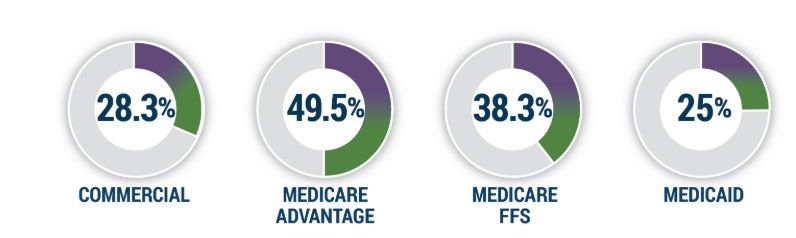
Value-based arrangements were most common in Medicare but
“Blue Cross NC and Five Major Health
are widespread across payers.
Systems Announce Unprecedented Move to
Percentage of Healthcare Payments in Level 3 or 4 Payment Models by Payer (2017) Value-Based Care”
-BCBSNC, 1/2019
“Blue Cross NC, UNC Health Alliance
Agreement Lowers Triangle ACA Rates by
More Than 21 Percent”
- Business Wire, 8/2018
“Duke Physician-Led Network Exceeds
Quality Standards, Saves Medicare Millions”
*Payments categorized as level 3 (alternative payment models built on FFS architecture with -Duke Health, 9/2018
upside/downside risk) or 4 (population based payment) under the Healthcare Payment Learning and Action
Network (HCP-LAN) alternative payment model framework.
Source: “APM Measurement: Progress of Alternative Payment Models”, HCP-LAN, 2018. Survey responses were voluntary. 14Advanced Quality and Behavioral Health Healthy
Managed Care Opioid Strategy
Medical Homes Value Integration Opportunities
Promoting Value, Quality and Population Health
DHHS is developing a longer-term VBP Roadmap and expects that more advanced
providers and systems will take advantage of opportunities to build infrastructure
for higher-risk arrangements in the early years of managed care implementation.
Value-Based Payments
By end of Year 2, PHPs’ expenditures governed under VBP arrangements must:
Increase by 20 percentage points, OR
Represent at least 50% of total medical expenditures
State’s expectations related to VBP and capabilities of AMH practices will increase over
time
The AMH program represents an opportunity for providers—especially larger practices
and those affiliated with health systems—to fund population health investments that
will be critical in a VBP environment
Ensuring Quality
Though the Quality Strategy, PHPs will be monitored on 33 priority quality measures
against national benchmarks and state targets
DHHS will require that PHPs implement annual Quality Improvement Projects
15Advanced Quality and Behavioral Health Healthy
Managed Care Opioid Strategy
Medical Homes Value Integration Opportunities
Behavioral Health Integration
As part of Medicaid transformation, physical and behavioral health benefits will be
administered by one managed care plan, under two types of products:
Standard Plans and BH I/DD Tailored Plans.
Behavioral Health Integration in Standard Plans
Rationale for Integration
Standard plans will offer integrated physical and behavioral health Currently, NC Medicaid beneficiaries
services upon managed care launch. have their behavioral health benefit
administered separately from their
The majority of Medicaid and NC Health Choice enrollees, including physical health benefit through LME-
adults and children with lower-intensity behavioral health needs, will MCOs.
receive integrated physical health, behavioral health, and pharmacy
services through Standard Plans when managed care launches. Integrating behavioral and physical
health benefits will better enable
Standard Plans will offer a robust set of benefits, but certain higher- care managers and providers to
intensity behavioral health, I/DD, and TBI benefits will only be offered deliver coordinated, whole-person
care.
under Tailored Plans.
16Advanced Quality and Behavioral Health Healthy
Managed Care Opioid Strategy
Medical Homes Value Integration Opportunities
What is a BH/IDD Tailored Plan (TP)?
North Carolina will launch specialized managed care plans, called BH/IDD Tailored Plans,
starting in 2021; design of these plans is just beginning.
Key Features of BH/IDD Tailored Plans:
TPs are designed for those with significant behavioral health (BH) needs
and/or intellectual/developmental disabilities (I/DDs)
TPs will also serve other special populations, including Innovations and
Traumatic Brain Injury (TBI) waiver enrollees and waitlist members
TP contracts will be regional, not statewide
LME-MCOs are the only entities that may hold a TP contract during the first
four years; after the first four years, any non-profit PHP may also bid for
and operate a TP
LME-MCOs operating TPs must contract with an entity that holds a prepaid
health plan (PHP) license and that covers the same services that must be
covered under a standard benefit plan contract
TPs will manage State-funded behavioral health, I/DD, and TBI services for
the uninsured and underinsured
17Advanced Quality and Behavioral Health Healthy
Managed Care Opioid Strategy
Medical Homes Value Integration Opportunities
TP Design and Launch Timeline
DHHS is currently conducting intensive planning for both Standard Plans (SPs) and
TPs. After SPs launch, DHHS will continue implementation planning for TPs.
Aug. Jan. Feb. Nov. Feb. May July
2018 2019 2019 2019 2020 2020 2021
BH I/DD TP design BH I/DD TP implementation planning
(8/2018-2/2020) (2/2020-7/2021)
SP implementation planning
(8/2018-2/2020)
DHHS awards BH
DHHS released Begin implementing IMD SPs launch in initial BH I/DD TPs
I/DD TP contracts
SP RFP waiver for SUD regions
(tentative) launch
(i.e., receiving Medicaid
reimbursement for services (tentative)
delivered in IMDs to
individuals with SUD)
SPs launch in remaining
regions;
DHHS issues SP DHHS releases BH I/DD
contracts TP RFA
(tentative)
18Advanced Quality and Behavioral Health Healthy
Managed Care Opioid Strategy
Medical Homes Value Integration Opportunities
Opioid Strategy
Description
As part of the State’s comprehensive strategy to address the opioid crisis, North Carolina will:
(1) Increase access to inpatient and residential substance use disorder treatment by
expanding reimbursement for SUD services provided in institutions of mental disease
(IMDs), and
(2) Expand the SUD service array to ensure the State provides the full continuum of
services.
Impact
Strengthens the State’s ability to improve care quality and outcomes for patients with substance
use disorders, including by decreasing the long-term use of opioids and increasing the use of
medication-assisted treatment (MAT) and other opioid treatment services.
19Advanced Quality and Behavioral Health Healthy
Managed Care Opioid Strategy
Medical Homes Value Integration Opportunities
Healthy Opportunities in Medicaid Transformation
North Carolina is committed to improving health outcomes and lowering healthcare
costs by delivering “whole person” care and addressing non-medical factors of
health.
Embedding Healthy Opportunities in the Managed Care Program:
All PHPs will have a role in addressing non-medical factors that drive health outcomes and costs,
including:
Screening for non-medical needs
Connecting beneficiaries to community resources using North Carolina’s new platform for
closed loop referrals, NCCARE360
Providing additional support for high-need cases, such as assisting members who are
homeless in securing housing
Healthy Opportunities Pilots:
PHPs in two to four geographic areas of the state will work with their communities to implement
the “Healthy Opportunities Pilots,” as approved through North Carolina’s 1115 waiver.*
Pilots will test evidence-based interventions designed to reduce costs and improve health by more
intensely addressing housing instability, transportation insecurity, food insecurity, interpersonal
violence, and toxic stress for eligible Medicaid beneficiaries.
*For additional detail on North Carolina’s Approved 1115 waiver, please visit DHHS informational 1115 wavier website, available at:
20
https://www.ncdhhs.gov/assistance/medicaid-transformation/proposed-program-designContents
Medicaid Transformation Vision and Context
Overview of Key Initiatives
Deep Dive: Managed Care
Standardization
More Opportunities for Engagement Plan and PCP Selection
Q&A Credentialing
Network Adequacy
Oversight
Payment
21Plan and PCP Network
Standardization Credentialing Oversight Payment
Selection Adequacy
Standardization
DHHS has worked to mitigate administrative burden for clinicians.
PHPs will be subject to requirements designed to ease clinician administrative burden,
including:
Standardizing and simplifying processes and standards across PHPs wherever appropriate
Incorporating a centralized, streamlined enrollment and credentialing process
Ensuring transparent payments for PHPs and fair contracting and payments for clinicians
Standardizing quality measures across PHPs
Using standard prior authorization forms
Establishing a single statewide preferred drug list that all PHPs will be required to use
Covering the same services as Medicaid Fee-for-Service (except select services carved out
of managed care)
Requiring PHPs to use DHHS’ definition of “medical necessity” when making coverage
decisions and set FFS benefit limits as a floor in managed care
22Plan and PCP Network
Standardization Credentialing Oversight Payment
Selection Adequacy
Plan Selection and Auto-Assignment
DHHS will conduct extensive outreach to encourage beneficiary plan selection and will auto-assign those
that do not choose a plan according to a transparent process.
Plan Selection
DHHS, in partnership with enrollment broker (Maximus), will provide choice counseling, enrollment assistance and education
to beneficiaries. Maximus will work with county departments of social services to educate beneficiaries at local level.
Plan Auto-Assignment
The State will auto-assign all beneficiaries who do not select a plan according to the following algorithm:
Beneficiary’s geographic location Equitable plan distribution with enrollment
Beneficiary’s membership in a special subject to:
population (e.g., member of federally PHP enrollment ceilings and floors, per
recognized tribes or BH I/DD Tailored Plan PHP, to be used as guides
eligible) Increases in a PHP’s base formula based
PCP/AMH selection upon application and on their contributions to health-related
PCP/AMH historic relationship resources
Plan assignments for other family members Intermediate sanctions or other
Previous PHP enrollment during previous 12 considerations defined by the Department
months (for those who have “churned” on/off that result in enrollment suspensions or
Medicaid managed care) caps on PHP enrollment
Beneficiaries have 90 days after PHP enrollment to switch PHPs “without cause.” After 90 days, beneficiaries may switch
PHPs at annual redetermination.*
Note: *Certain populations may be able to change PHPs more frequently. Additionally, beneficiaries may change PHPs “with cause” at any time. More details available in enrollment
23
broker RFP, available at: https://files.nc.gov/ncdma/documents/Transformation/RFP%2030-180090%20-%20Enrollment%20Broker%20Services%20-%20Final%20%283-2-18%29.pdfPlan and PCP Network
Standardization Credentialing Oversight Payment
Selection Adequacy
AMH/PCP Selection and Auto-Assignment
Under managed care, enrollees may choose their AMH/primary care
provider (PCP) or they will be auto-assigned.
AMH/PCP Selection
The enrollment broker (Maximus) will provide beneficiaries with information and assistance in selecting
their AMH/PCP at the time of PHP enrollment.
Subsequent changes to AMH/PCP assignment are managed by the beneficiary’s PHP. Enrollees can change
their AMH/PCP without cause within 30 days of notification of assignment, and up to one additional time
every 12 months; enrollees may change their AMH/PCP with cause at any time.
AMH/PCP Auto-Assignment
Enrollees that do not select a AMH/PCP during AMH/PCP auto-assignment will consider:
the plan selection period will be assigned a Enrollee claims history
AMH/PCP by the PHP in which they enroll. Family member PCP assignment
All enrollees will have a 30-day “grace period” Geography
after notification of their AMH/PCP assignment to Special medical needs
change their AMH/PCP without cause. Language/cultural preference
24Plan and PCP Network
Standardization Credentialing Oversight Payment
Selection Adequacy
Provider Enrollment and Credentialing
Credentialing is a critical part of the federally regulated screening and enrollment process.
A centralized approach will reduce administrative burden on providers and
maximize efficiency among plans.
Enrollment process similar to today
Centralized credentialing and recredentialing policies uniformly applied
Nationally recognized, third-party credentials verification organization (CVO)
Providers must be enrolled as a Medicaid or NC Health Choice
provider to be paid for services to a Medicaid beneficiary*
*Source: 2016 Medicaid Managed Care Final Rule; 21st Century Cures Act 25Plan and PCP Network
Standardization Credentialing Oversight Payment
Selection Adequacy
Centralized Credentialing
APPLICATION & VERIFICATION PROCUREMENT & CONTRACTING
DHHS Process PHP Process
Provider applies PDM/CVO verifies PHP PNPC reviews & PHP and provider
credentials approves/denies negotiate contract
Application is PDM/CVO PHP Provider Network PHP network
single point-of- certified by Participation development
entry for all national Committee (PNPC) staff secures
credentialing accrediting Established and contracts with
information organization (e.g., maintained by PHP providers
Medicaid NCQA, URAC) Reviews and makes credentialed and
Managed Care Ensures objective quality enrolled in
and Medicaid meaningful, determinations Medicaid
Fee-for-Service rigorous, and fair Cannot request more
processes information for quality
determinations
Meets nationally
recognized accrediting
organization standards
26Plan and PCP Network
Standardization Credentialing Oversight Payment
Selection Adequacy
Network Adequacy
Network adequacy standards help ensure beneficiaries have access to
providers and care.
North Carolina’s network adequacy standards Provider
Urban Standard Rural Standard
vary by geographic area and include time and Type
distance standards* and appointment wait-time ≥ 1 hospital within 30 ≥ 1 hospital within
minutes or 15 miles 30 minutes or 30
standards Hospitals
for at least 95% of miles for at least
PHPs are required to contract with “any willing members 95% of members
provider” unless the provider refuses to accept ≥ 2 providers within ≥ 2 providers within
Primary 30 minutes or 10 30 minutes or 30
the PHP’s rates or does not meet the PHP’s Care miles for at least 95% miles for at least
quality standards of members 95% of members
≥ 2 providers (per ≥ 2 providers (per
The PHP’s network must provide adequate
specialty type) within specialty type)
access for all beneficiaries, including those with Specialty 30 minutes or 15 within 60 minutes or
limited English proficiency or physical or mental Care miles for at least 95% 60 miles for at least
disabilities of members 95% of members
Inpatient ≥ 1 provider of each inpatient behavioral
BH health service within each PHP region
*Partial list of standards listed in table; complete list can be found in PHP RFP, available at: https://www.ncdhhs.gov/request-information 27Plan and PCP Network
Standardization Credentialing Oversight Payment
Selection Adequacy
Oversight
The State will perform rigorous oversight of PHPs.
PHPs are required to report on compliance with network access, claims payment, and other
programmatic requirements that ensure high quality care delivery.
DHHS will monitor for compliance, identify trends, and impose corrective actions where needed. PHP
contracts will include penalties for noncompliance, from corrective action plans/training to sanctions,
liquidated damages, and contract termination.
DHHS must approve each PHP’s provider appeals and grievances process, and PHPs must share
information with DHHS on provider appeals and grievances, once implemented.
A State provider ombudsman will be available to assist when a grievance is still unresolved after
exhausting the PHP’s appeals process.
28Plan and PCP Network
Standardization Credentialing Oversight Payment
Selection Adequacy
Oversight, Continued
The State will closely monitor PHP utilization management policies to ensure
beneficiaries receive needed services and that providers are paid appropriately.
PHPs are required to report claims submitted and denied payment as part of
encounter data. DHHS will analyze denied payments for patterns suggesting
inappropriate denials.
DHHS will monitor PHP prior authorization on a regular basis (e.g. volume, # of
adverse determinations, etc.)
PHP UM policies must use Medicaid FFS benefit limits as a floor and must leverage
nationally recognized clinical practice guidelines and decision support methodologies.
PHPs will submit UM policies to DHHS for approval and will be subject to NCQA review
as part of plan accreditation.
Department seeks ongoing feedback from providers flagging whether certain plans or
codes are related to higher denial rates.
29Plan and PCP Network
Standardization Credentialing Oversight Payment
Selection Adequacy
Provider Payment
PHPs will be required to contract with “any willing qualified provider.”
PHP payment rates to most in-network providers will be subject to rate floors.
In-Network Payment
PHPs are required to contract with “any willing qualified provider” unless the provider refuses to accept the PHP’s
rates or does not meet the PHP’s objective quality standards.
Payment to in-network hospitals, physicians, and physician extenders must be no less than 100% of the Medicaid
fee-for-service rate, unless the PHP and provider mutually agree to an alternative reimbursement arrangement.
Special payment provisions apply to certain provider types, such as local health departments, public ambulance
providers, and FQHCs; additional details will be provided in future webinars.
Out-of-Network Payment
PHPs are prohibited from paying out-of-network providers that refused to accept a PHP contract or failed to
meet objective quality standards more than 90% of the Medicaid FFS rate.
This excludes emergency and post-stabilization services, which are to be reimbursed at no more than 100% of
the Medicaid FFS rate.
PHPs must reimburse out-of-network providers 100% of the Medicaid FFS rate if the provider was excluded for
reasons other than the above.
30Plan and PCP Network
Standardization Credentialing Oversight Payment
Selection Adequacy
Gradually Transitioning Hospital Payments to Value
The current system of Medicaid supplemental payments is not permitted in managed care and is not
aligned with value. As a first step toward value-based payment, most supplemental payments will be
carved into base rates, directly tying most hospital payments to utilization.
Dollars previously paid through supplemental payments will be reinvested in higher
hospital base payment rates to preserve payment levels.*
Medicaid managed care plans will be required to pay no less than these new, higher base
rates for at least the first three contract years (longer for hospitals in economically
distressed counties.)**
Hospitals receive an additional amount in the form of directed or pass-through payments
to offset approximately 40% of projected utilization losses due to uncertainty during the
transition to managed care. These additional payments phase out over the first three
contract years.
North Carolina hospitals have played a leading role in developing the new approach,
including the methodology to set higher base rates, the approach to graduate medical
education payments, and changes to hospital assessments.
*Note: Does not include DSH or GME payments, which will be paid directly from the State to hospitals.
31
**Note: The rate floor for in network, out-of-state hospitals will remain at the current Medicaid FFS rate of $2,704.50.Contents
Medicaid Transformation Vision and Context
Overview of Key Initiatives
Deep Dive: Managed Care
More Opportunities for Engagement
Q&A
32More Opportunities for Engagement
DHHS values input and feedback and is making sure stakeholders have the opportunity to
connect through a number of venues and activities.
Ways to Participate
Regular webinars, conference calls, meetings, and conferences
Comments on periodic white papers, FAQs, and other
publications
Regular updates to website:
https://www.ncdhhs.gov/assistance/medicaid-transformation
Comments, questions, and feedback are all very welcome at
Medicaid.Transformation@dhhs.nc.gov
Providers will receive education and support
during and after the transition to managed care.
33Upcoming Events
Upcoming Managed Care Webinar Other Upcoming Events
Topics
• Virtual Office Hours: Weekly,
• Provider Payment and Contracting beginning in Spring, 2019
• Overview of Quality and Value • Provider/PHP Meet and Greets:
Initiatives beginning in Spring, 2019
• Clinical Policies
• Provider Policies
• Beneficiary Policies
• Behavioral Health Services: Standard
Plans and Transition Period
Look out for more information on upcoming events and webinars distributed regularly
through special provider bulletins.
34Q&A
You can also read


