Public Hearing: New Regulations Affecting State Waters Groundfish, Squid, and Scup - 6PM January 6, 2022 Virtually Via Zoom
←
→
Page content transcription
If your browser does not render page correctly, please read the page content below

Public Hearing:
 New Regulations Affecting State
Waters Groundfish, Squid, and Scup
                    6PM
             January 6, 2022
            Virtually Via Zoom
Public Hearing and Comment
Under the provisions of M.G.L. c. 30A, and pursuant to the authorities
found at M.G.L. c. 130 §§ 17A, 80 and 104, the Division of Marine
Fisheries (DMF) is taking public comment and holding public hearings on
proposed amendments to regulations at 322 CMR 4.00, 6.00, 8.00 and
12.00.

Written public comment will be accepted through Friday, January 14,
2022. Please send written public comment via e-mail to
marine.fish@mass.gov or by post to the attention of Director McKiernan
at 251 Causeway Street, Suite 400, Boston, MA 02114.

  January 7, 2022       Division of Marine Fisheries    Slide 2

Virtual Rules of Engagement
•   Purpose of the hearing is to afford interested parties an opportunity to submit data, opinions,
    comments, or arguments on the specific amendments being proposed, or to offer how the proposed
    amendment can be changed to minimize the impact on those affected while still achieving goals.
•   Comment on other matters will be accommodated upon the conclusion of the hearing if time permits.
•   The public will be muted throughout the presentation. At its conclusion, DMF will first accept and
    answer clarifying questions regarding the proposals, and then invite public comment on the
    proposals.
•   The written “chat” and “question and answer” functions have been disabled in favor of verbal
    questions. You can also follow up with DMF staff after the hearing by e-mail (marine.fish@mass.gov).
•   When participating in the question and comment forums, the public is required to use the "raise
    hand" function. DMF will recognize and unmute individuals in order when it is their turn to speak.
    Individuals will be provided two (2) minutes for questions and comments per hearing item. Follow-up
    comments may be allowed after all other persons have had an opportunity to speak.
•   It is not necessary for you to provide verbal comment during this public hearing. You may use this
    virtual hearing for informational purposes and submit written comments later. In fact, submitting
    written public comment is recommended.
•   DMF prefers that written comment be submitted by e-mail (marine.fish@mass.gov). All written
    comment is to be submitted by January 14, 2022. Written comment will be shared with the MFAC in
    advance of the January 20, 2022 business meeting.
•   This public hearing will be recorded, and questions and comments are part of the public record. The
    recording of the public hearing will also be posted to DMF’s YouTube Channel.

       January 7, 2022                Division of Marine Fisheries                  Slide 3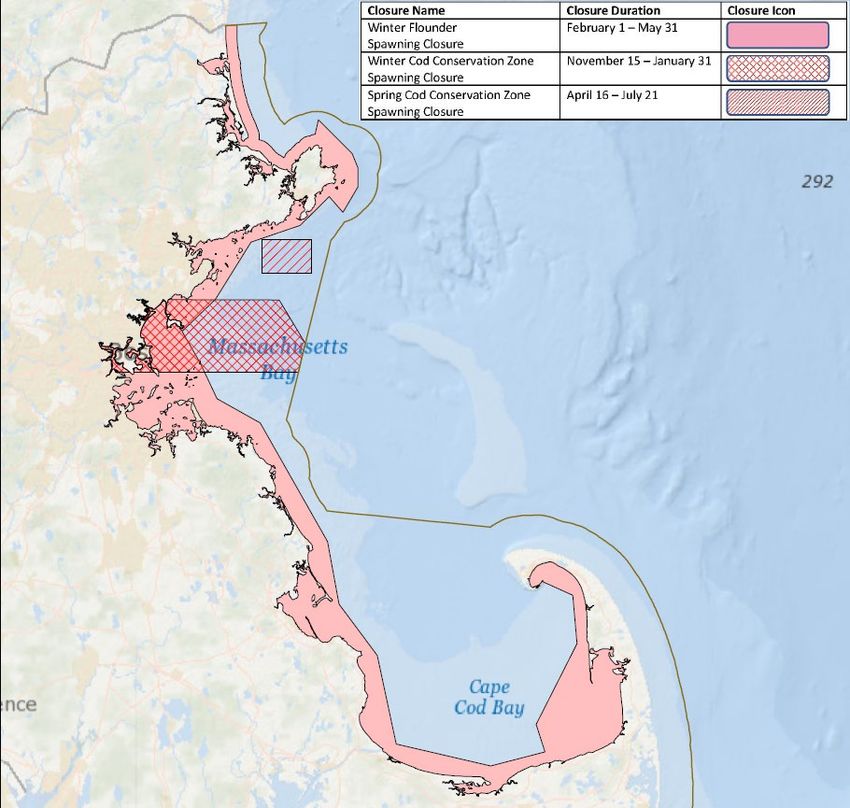
Overview of Proposals
•   State Waters Gillnet Closure to Protect Right Whales (322 CMR 12.04). Expand existing January 1 – May 15
    gillnet closure in Cape Cod Bay to all state waters. Allow for dynamic opening or extension of closure based on
    the observed presence and absence of right whales in state waters.

•   Commercial Groundfish Closure to Protect Spawning Cod (322 CMR 8.05). Adopt an April 15 – April 30 closure to
    commercial groundfish fishing in state waters between Plymouth and the MA/NH maritime border. Does not apply
    to shellfish dredges.

•   Rescind April Conditional Commercial Groundfish Closure (322 CMR 8.05). With proposed expansion of gillnet
    closure and new cod spawning closure, rescind the existing April conditional groundfish mortality closure.

•   Rescind Outer Boston Harbor Gillnet Closure (322 CMR 4.04). Eliminate the May 15 – November 1 Outer Boston
    Harbor gillnet closure implemented in 1980s to address user group conflicts with lobster trap fishery.

•   Groundfish Trip Limits (322 CMR 6.03). Adjust trip limits for certain groundfish stocks at times and places where
    spawning cod and right whales are limited, increase the GOM cod trip limit from 200 pounds to 300 pounds and
    GOM yellow tail flounder trip limit from 250 pounds to 300 pounds.

•   Small Mesh Squid Trawl Season (322 CMR 4.06 and 6.39). Extend small mesh squid trawl season from April 23
    – June 9 to April 23 – June 15. With this six-day extension, DMF would also eliminate the provision allowing the
    Director to discretionally extend the season on an annual basis.

•   Winter I and Winter II Scup Limits (322 CMR 6.27). Establish a 2,000-pound retention limit for scup taken from
    state waters during these periods and allow federal vessels fishing lawfully in federal waters to land quantities of
    scup consistent with federal regulation.

        January 7, 2022                    Division of Marine Fisheries                        Slide 4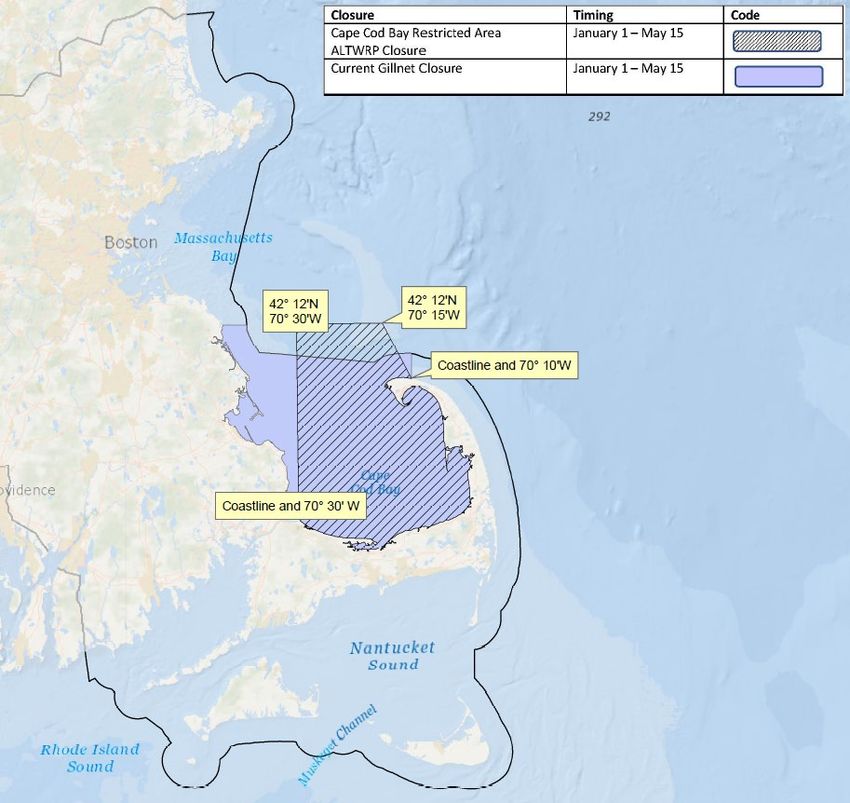
History of Gillnet Closure to Protect Right Whales

•   1997 – Cape Cod Bay Critical Habitat is
    closed by DMF to gillnet fishing activity
    January 1 – May 15.

•   Critical Habitat closure was later adopted as
    Cape Cod Bay Restricted Area under the
    federal Atlantic Large Whale Take Reduction
    Plan (ALWTRP).

•   ALWTRP is promulgated under Marine
    Mammal Protection Act (MMPA) and applies
    to all commercial fishing, whether state or
    federally permitted.

•   Early 2000s – DMF closes waters to the west
    of the Critical Habitat (70°30’W) in Cape Cod
    Bay south of Plymouth (42°00’N).

•   2021 – DMF closes waters to the west of the
    Critical Habitat (70°30’W) in Cape Cod Bay
    between Plymouth (42°00’N) and Scituate
    (42°08’N).

        January 7, 2022                  Division of Marine Fisheries   Slide 5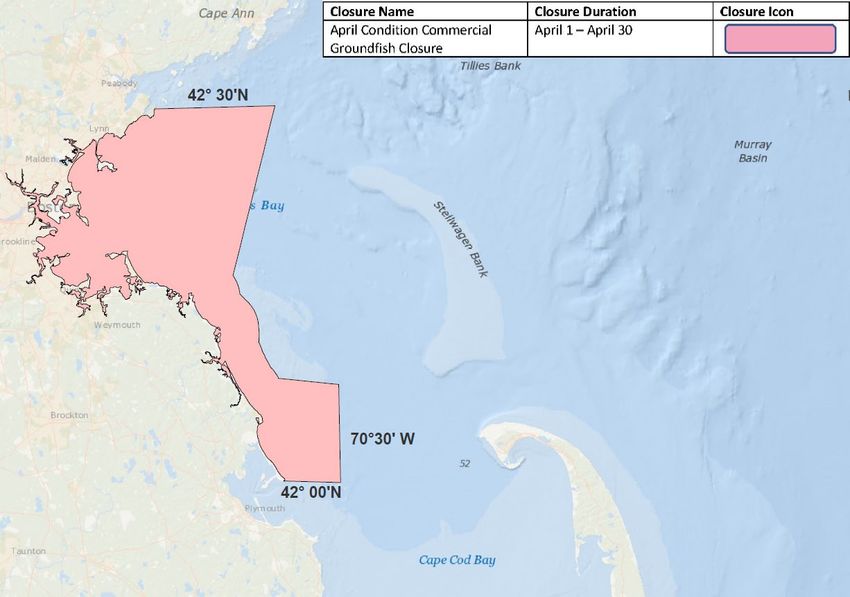
Proposal to Expand Gillnet Closure
                to Protect Right Whales
                                 Proposal:
                                 • Expand existing January 1 – May 15 closure to all state
                                    waters.
                                 • Allow for closure outside ALWTRP closure to be lifted
                                    after May 1 if whales migrate out.
                                 • Allow for closure to be extended should whales remain.
                                 Rationale:
                                 • Spatially expands gillnet closure into areas right whales
                                    are known to seasonally use.
                                 • Reduces risk of entanglement in April and May,
                                    particularly in MA Bay.
                                 • Addresses federal mandate under ALWTRP to reduce
                                    entanglement risk to right whales by gillnet gear.

January 7, 2022     Division of Marine Fisheries                   Slide 6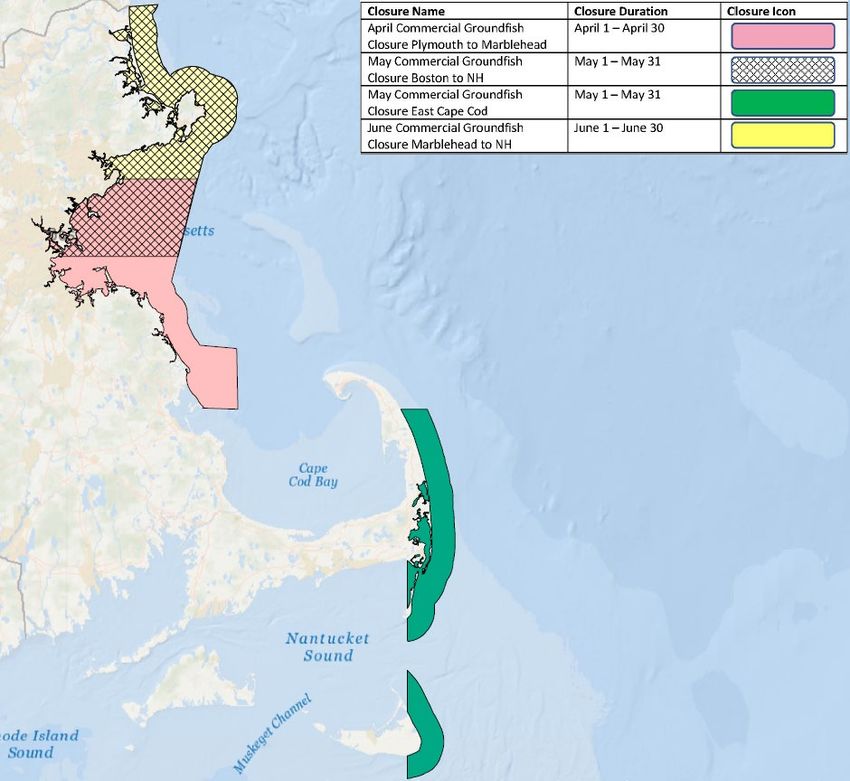
Existing Groundfish Spawning Closures in State Waters
Winter Flounder Spawning Closure
•  1986 – Adopted February 1 – April 30
   closure.
•  1990 – Month of May added to closure.
•  Winter flounder spawn in nearshore waters
   during late winter and spring. Closure
   prohibits commercial groundfish fishing in
   nearshore waters of GOM during the
   spawning period.
•  Exempts use of longlines for cod using j-
   hooks with a gape of 11/16” or greater or
   circle hooks with a gape of ½” or greater.

Cod Conservation Zones (CCZ)
•  2005 – Winter CCZ established off Nahant.
   Closed to the retention of cod and the use
   of certain gears while fishing during
   November 15 – January 31. Northeastern
   boundary modified in 2011 to open some
   area to flounder fishing.
•  2009 – Spring CCZ established off
   Marblehead. Closure prohibits the retention
   of cod and the use of certain gears while
   fishing. Timing of closure was modified in
   early 2010s, but since 2011 it has been
   April 16 – July 21.

         January 7, 2022                        Division of Marine Fisheries   Slide 7
Federal Spring MA Bay Spawning Protection Area

Background
• In 2017 (OHA2), NOAA Fisheries adopted the
   Spring MA Bay Spawning Protection Area.
• Spring MA Bay Spawning Area is closed
   annually from April 15 – April 30.
• Closure is within federal Statistical Reporting
   Area 125.
• This 10-minute square includes those state
   waters between 42°00’N and 42°30’ N and
   71°00’W and 70°30’W.
• Purpose of closure is to “improve spawning
   protection for various groundfish species
   (including cod) in the Gulf of Maine.”
• DMF did not immediately move to match this
   closure.

        January 7, 2022                 Division of Marine Fisheries   Slide 8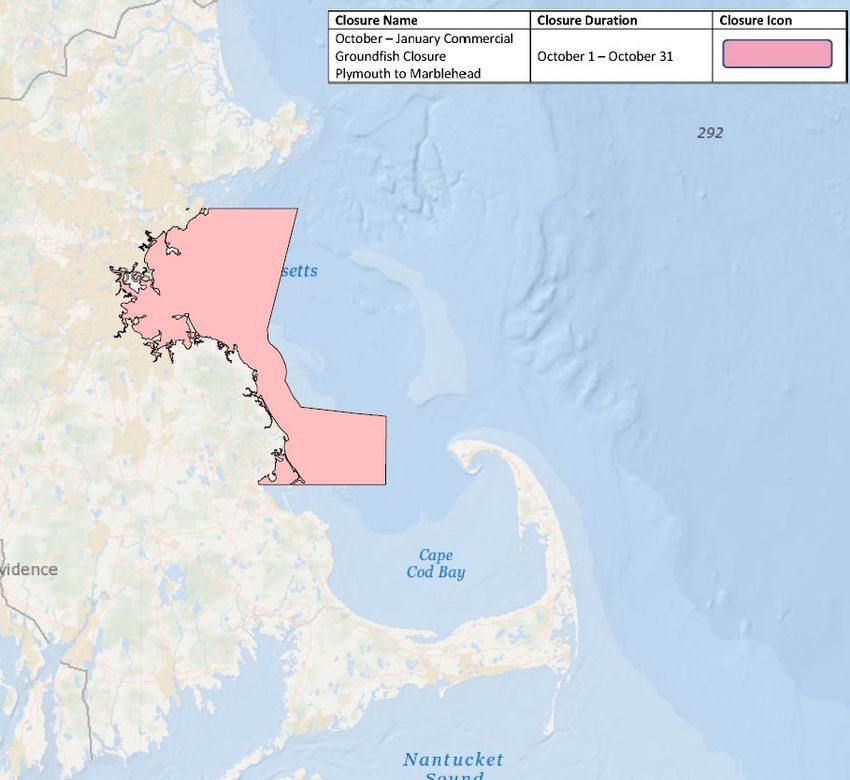
Findings from IBS2 Survey
Overview
• DMF conducted its second Cod Industry-Based Survey (IBS2) from October 2016 – January 2019.
• Expanded coverage of both winter and spring cod spawning seasons compared to IBS1.
• Enhanced DMF’s understanding of cod spawning behavior.

Findings
• Presence of spring spawning cod has declined overall. Nearly all current recruitment comes from winter
   spawners
• Timing of spring spawning season has shifted. May is still peak spawning month, but April is now almost
   as important as May.
• Importance of two spawning cohorts has changed overtime. Ensuring both sub-populations continue to
   persist is critical for the recovery of GOM cod.

      January 7, 2022                Division of Marine Fisheries                  Slide 9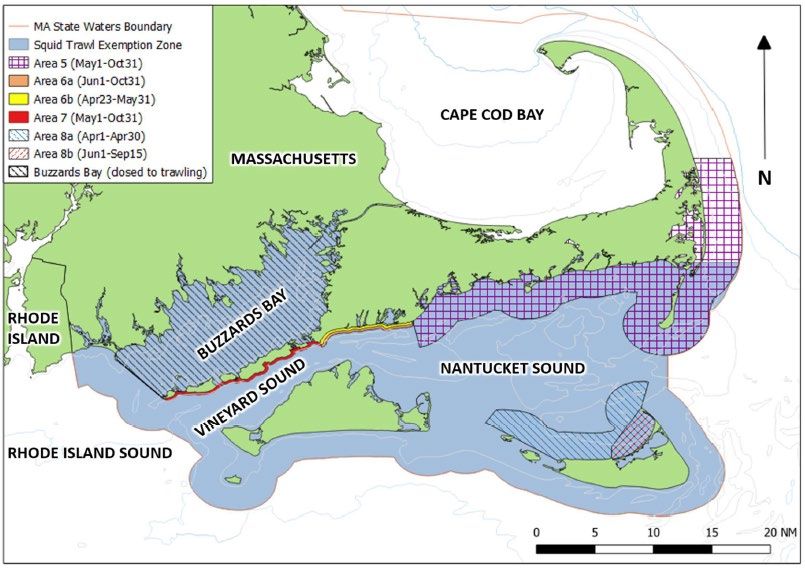
Proposal to Adopt April 15 – April 30 Commercial
      Groundfish Closure to Protect Spawning Cod
Proposal:
•  Prohibit the use of commercial
   fishing gears capable of catching
   groundfish and the commercial
   retention of groundfish within state
   waters from Plymouth (42°00’N) to
   the MA/NH border west of 70°30’W.
•  Exempt from the use of shellfish
   dredge gear, including sea scallop
   dredges.

Rationale:
•   Addresses evolving knowledge of
    spring cod spawning activity
    and importance of seasonal
    cohorts.
•   Provides more broad scale
    seasonal spawning cod protection
    in GOM, including areas where
    spawning cod were observed
    during IBS1 when sub-population
    was more robust (e.g., Cape Ann,
    Ipswich Bay).
•   Compliments federal Spring MA
    Bay Spawning Protection Area

       January 7, 2022                    Division of Marine Fisheries   Slide 10
Spring Commercial Groundfish Mortality Closures
• Late-1990s: DMF matched federal rolling closures for commercial groundfish. Designed to control mortality and landings.
Given seasonality, also provide broad-scale spawning protections.
• 2016: Most recent modification to seasonal closures occurred, resulting in shifts in the area boundaries.
• May 1 – May 31 between Boston (42°20’N) and MA/NH Border and East of Cape Cod south of 42°00’N.
• June 1 – June 30 between Marblehead (42°30’N) and MA/NH Border
• October 1 – January 31 between Plymouth (42°00’N) and Marblehead (42°30’N) west of 70°24’W.
• 2019: Adopted the April conditional closure between Plymouth (42°00’N) and Marblehead (42°30’N) west of 70°30’W.
• Fail-safe to prevent GE fleet from causing overages of the ACLs set by NOAA and triggering AMs affecting federal
permit holders.
• Closure has been lifted each of the 3 years since its implementation.
January 7, 2022 Division of Marine Fisheries Slide 11Proposal to Rescind April Conditional Closure
Conditional April Mortality Closure
Proposal:
• Rescind conditional April 1 –
April 30 commercial
groundfish closure from
Plymouth to Marblehead
west of 70°30’
Rationale
• Will be mostly redundant if
implement new gillnet closure
to protect right whales and
commercial groundfish
closures to protect spawning
cod.
• Less need for a fail-safe with
new closures, continued
attrition in fishery and
underutilization.
January 7, 2022 Division of Marine Fisheries Slide 12Proposal to Increase Commercial Groundfish Trip Limits
Proposal
1. Increase GOM cod trip limit from 200 to 300 pounds.
2. Increase GOM yellowtail flounder trip limit from 250 to 300 pounds.
Rationale
• With expanded spatio-temporal closures, increased trip limits at times and in areas where right whales and
spawning groundfish are less of a concern may help ameliorate reduction in commercial landings for state
waters fleet.
• State waters fleet not achieving set-asides for cod and yellowtail flounder at present.
• Cannot increase trip limit for GOM winter flounder because backstopped by Interstate FMP.
• Haddock currently not subject to a limit; grey sole limit (750 pounds) is sufficient as species is not typically
caught within state waters in large quantities.
• May reduce regulatory discarding.
Background
• Under federal FMP, catch of groundfish stocks by non-federal permits holders in state waters is assigned to
a "state waters sub-component”.
• Sub-components cover commercial and recreational state waters fisheries for all New England states,
except where a specific recreational sub-ACL has been allocated (e.g., GOM cod and haddock).
• MA is principal participant for GOM stocks, as other GOM states (ME and NH) do not have substantial
groundfish fisheries in their state waters.
• DMF establishes trip limits to control groundfish catch consistent with recent participation and the state-
waters subcomponent.
• Trip limits also apply to federal vessels fishing in state waters.
January 7, 2022 Division of Marine Fisheries Slide 13Proposal to Rescind Boston Harbor Gillnet Closure
Proposal
Rescind the May 15 – November 1 gillnet
closure in Outer Boston Harbor.
Background
• Adopted in 1988 to address an emerging
gillnet fishery for lobsters in Boston
Harbor and ameliorate a user group
conflict.
• Lobster bycatch in gillnets is limited to
100 count in LCMA 1.
Rationale
• Purpose of closure is no longer valid.
Inefficient to target lobsters with
gillnets given bycatch limit and most
gillnet permit holders are also lobster
trap fishermen.
• Enhances fishing opportunities at times
and in places where there are not
spawning cod and protected species
concerns.
January 7, 2022 Division of Marine Fisheries Slide 14Current State Waters Small Mesh Squid Fishery Season
Existing Rule:
Small mesh trawls may be used in Squid Trawl Exemption Zone from April 23 – June 9. Director has
discretion to extend the season beyond June 9. Access to Squid Trawl Exemption Zone spatially limited by
seasonal mobile gear closures (Area 5 – 8B) and Buzzards Bay year-round net fishing closure.
January 7, 2022 Division of Marine Fisheries Slide 15Recent Small Mesh Squid Fishery Seasons and Activity
Seasonal Extensions 2015 – 2021
Year Season Extension Length
June Heat Map of Starting Points
of Observed Hauls from 2013 - 2017
2015 April 23 – June 18 9 days
2016 April 23 – June 16 7 days
2017 April 23 – June 9 No extension
2018 April 23 – June 9 No extension
2019 April 23 – June 16 7 days
2020 April 23 – June 9 No extension
Source: Unpublished NEFOP Data
2021 April 23 – June 9 No extension
January 7, 2022 Division of Marine Fisheries Slide 16Proposal to Adjust Timing of
State Waters Squid Trawl Season
Proposal
1. Extend the regulatorily set season of April 23 – June 9 to April 23 – June 15.
2. Eliminate Director’s discretion to extend season beyond what is set by regulation.
Rationale
• Current system is imperfect and administratively burdensome.
• Commercial fishermen and dealers will be able to better structure their operations around a firm end date.
• Recreational fishing interests would be assured of a certain end date.
• Reduces user group conflicts and frustration related to annual decision.
• Provides a week of additional fishing opportunities should there be a strong run of squid that DMF would
typically work to accommodate through a seasonal extension.
Background
• State waters squid season was adopted in early 1990s. In early years, closure dates were frequently
amended moving the season backwards and forwards in June.
• Season end date tried to find balance between commercial access to the resource; bycatch and discarding
of scup, black sea bass and summer flounder – FMPs had just been developed for these species to rebuild
them; and address forage concerns from recreational anglers.
• Initially, season would be extended based on sea sampling data. By early 2010s, state observer program
was nominal and DMF became reliant on federal observer data which is not available in real-time. DMF
became increasingly reliant on anecdotal evidence to inform decision.
• Scup, black sea bass, and summer flounder currently rebuilt and in good condition.
January 7, 2022 Division of Marine Fisheries Slide 17Winter I and Winter II Scup Limits
Background
Period Quota Trip Limits
• Winter periods are predominantly an
offshore fishery, managed with coastwide Winter I Coastwide
45.11%
quota and federally-set trip limit. (Jan–Apr) (50,000-lb since 2012)
• DMF sets complimentary state waters limit
Summer 38.95%
by Declaration, with MFAC approval, once State-by-state
(May–Sep) (with state shares)
federal rules established.
• Federal rules often not published until late Winter II 15.94% plus Winter Coastwide
December and late September. (Oct–Dec) I underage (12,000-lb* since 2014)
* Winter II trip limit increased by 1,500 lb for every 500,000 lb of Winter I quota rolled over.
Proposal
1. Adopt a 2,000-pound limit for scup caught and retained in state waters during Winter I and Winter II.
2. Exempt vessels fishing lawfully in federal waters from this limit when offloading in MA ports.
Rationale
• Reduces administrative burden of declaratory action currently used to set Winter period scup trip limits.
DMF typically compliments federal trip limits to allow vessels fishing in federal waters to land lawfully
harvested quantities of scup in state ports.
• Interactions with scup in state waters during the Winter periods and with large mesh gear are limited; the
large federal waters trip limits are not needed for state waters large mesh fishery.
• Scup caught in trawl netsWritten Public Comment Written public comment will be accepted through Friday, January 14, 2022. Please address written by e-mail to marine.fish@mass.gov or by post to the attention of Director McKiernan at 251 Causeway Street, Suite 400, Boston, MA 02114. Recording of public hearings will be published on DMF’s YouTube Channel January 7, 2022 Division of Marine Fisheries Slide 19
You can also read


