Public Sphere and Misinformation in the U.S. Election: Trump's Audience and Populism Indicators in the COVID-19 Context - MDPI
←
→
Page content transcription
If your browser does not render page correctly, please read the page content below
Article
Public Sphere and Misinformation in the U.S. Election: Trump’s
Audience and Populism Indicators in the COVID-19 Context
Concha Pérez-Curiel 1, * , Ricardo Domínguez-García 1                          and Gloria Jiménez-Marín 2

                                          1   Journalism II Department, Faculty of Communication, University of Seville, 41012 Seville, Spain;
                                              ricdomgar@alum.us.es
                                          2   Audiovisual and Advertising Department, Faculty of Communication, University of Seville,
                                              41012 Seville, Spain; gloria_jimenez@us.es
                                          *   Correspondence: cperez1@us.es

                                          Abstract: (1) In a context of an unprecedented global pandemic, an analysis of the effects of political
                                          disinformation on audiences is needed. The U.S. election process culminating in the official procla-
                                          mation of Joe Biden as president has led to an increase in the public’s distrust of politics and its
                                          leaders, as public opinion polls show. In this context, the change in the electorate’s attitude towards
                                          Donald Trump, throughout the legislature and especially after the elections, stands out. So, the
                                          objective of this research was to determine, through the measurement of surveys, the views of the
                                          electorate on the behavior of the Republican candidate and the possible causes that determine the
                                          loss of confidence in his speeches and comments. (2) The methodology, a comparative quantitative-
                                qualitative approach, analyzed the responses collected by Pew Research waves 78 and 80 (2020 and
                                   2021). Specifically, the surveys analyzed were 11,818 U.S. adults in the case of the American Trends
Citation: Pérez-Curiel, Concha,           Panel 2020 and 5360 in the case of the same panel for 2021. (3) Results showed the change of position
Ricardo Domínguez-García, and             of the electorate, especially Republicans, in the face of the policy of delegitimization of the process
Gloria Jiménez-Marín. 2021. Public        and Trump’s populist messages on Twitter. (4) Conclusions pointed in two directions: society has
Sphere and Misinformation in the U.S.     decided not to trust Trump, while at the same time showing distrust about the correct management
Election: Trump’s Audience and            of the electoral ballot.
Populism Indicators in the COVID-19
Context. Journalism and Media 2:          Keywords: audience; disinformation; elections; media; polls; populism; politics; speech; Twitter
335–350. https://doi.org/10.3390/
journalmedia2030020

Academic Editor: Jacob Groshek
                                          1. Introduction
Received: 19 April 2021                         Post-election polls of the US presidential election (3 November 2020) state that 60%
Accepted: 17 June 2021                    of Americans think that Biden legitimately won the election; however, the same poll
Published: 24 June 2021                   also asserts that 70% of Republicans pointed out that the Democratic candidate was not
                                          legitimately elected (Balz et al. 2021). These data reflect the polarization of citizen opinions
Publisher’s Note: MDPI stays neutral      (Bennett and Pfetsch 2018) and the distrust of voters towards politicians and institutions
with regard to jurisdictional claims in   (Waisbord 2018a). The direct consequences are related to the instability of representative
published maps and institutional affil-   democracy (Mounk 2018) and of constitutional rights in a pandemic context, which favors
iations.                                  the increase of misinformation (Salaverría et al. 2020). In this context, the rise of fake news
                                          in social networks (Van Der Linden et al. 2020) has occurred in parallel with the primacy of
                                          extreme political populism (Román-San-Miguel et al. 2020; Kissas 2019).
                                                The most immediate antecedents happened during the legislature of Donald Trump
Copyright: © 2021 by the authors.         (Waisbord 2018a), a leader who criticizes elites and appeals to emotions (Schneiker 2020;
Licensee MDPI, Basel, Switzerland.        Block and Negrine 2017), relying on Twitter as a tool for political tactics (Persyli and Tucker
This article is an open access article    2020; Roth 2018). He is also a leader who advocates negationism, as opposed to reason,
distributed under the terms and           appeals to emotion and defends anti-intellectualism and politically incorrect language,
conditions of the Creative Commons        vindicating the simple man (Almansa Pérez 2019). In this context, the theory of the multi-
Attribution (CC BY) license (https://     modal use of the network stands out (Bracciale and Martella 2017), with a key role in the
creativecommons.org/licenses/by/          development of electoral campaigns (Campos-Domínguez 2017).
4.0/).

Journal. Media 2021, 2, 335–350. https://doi.org/10.3390/journalmedia2030020                            https://www.mdpi.com/journal/journalmedia
Journal. Media 2021, 2 336
The differential factor that has marked the 2020 elections has been the denunciation
of fraud of the results and the lack of recognition of Biden’s triumph that Trump has
maintained until his departure from the White House. We put the focus on the final phase
of a political process that was dominated by the effects of platforming, polarization and
conspiracies of the leader. This process stood out in the social networks, and especially
on Twitter, a thread of messages, with a combination of textual marks of hate, threats,
stereotypes and lies (Van-Dijk 2015) that, to say the least, have permeated citizen attitudes.
The high point of rejection could be visualized with the riots of the assault on the Capitol
by a sector of Republican supporters and the decision of Twitter to close Donald Trump’s
account (@realDonaldTrump), sanctioning the leader’s disinformation and his discourse
against institutional stability.
From this perspective, the following objectives were put forward:
O1. To find out the causes of the fall in the electorate’s confidence in Donald Trump after
the U.S. elections.
O2. To find out, from the opinion polls, the electorate’s opinion on Donald Trump’s
populist discourse based on the delegitimization of the electoral results.
O3. To understand the change of attitude of the Republican electorate following the events
related to the attack on the Capitol.
2. Background
2.1. Leadership and Cyber Populism’s Influence at Election Time
There are several reasons that encourage approaching the rise of populism as an
alternative to the failure of savage capitalism and hyper globalization (Cox 2018). However,
populism represents, above all, a communicative and discursive staging, beyond being
a symptom of the political, social and economic reality of the moment. So, this research
is based on the conception and meaning of populism insofar as it represents a political
tendency that seeks to attract the popular classes through any propagandistic or commu-
nicative discourse or action (Bracciale and Martella 2017). As such, for this study, we opted
for a definition of a populist communication style, since we started from the theory of
discursive approaches already launched by Cox (2018), Bracciale and Martella (2017), Block
and Negrine (2017) and, more recently, from the contributions of Pich and Newman (2020)
or Schneiker (2020).
In modern democratic societies, populists, both on the left and on the right, pretend to
adopt empathy with the people, whom they theoretically represent (Moffitt and Tormey 2014).
However, this connection with society, with voters, can be stylistic and rhetorical (Kissas 2019)
and can also be ideological, in that it focuses on the content of the messages sent with
a political and/or propagandistic character. In this line, Donald Trump represents this
combination of traits that define him as an influencer and macro-strategist of political
marketing (Pérez-Curiel and Limón-Naharro 2019).
As Pich and Newman affirm in their study, a political leader is, therefore, a brand. be-
cause the precepts of political marketing, in fact, are based on this idea (Ahmed et al. 2017).
Additionally, in brand management, everything communicates discourse, image, message
and actions (Jiménez-Marín et al. 2021). The figure of the media politician, the celebrity
politician (Street 2012), generates a connection with a disaffected public (Wood et al. 2016)
and shows himself to be a superhero, (Block and Negrine 2017) and savior before the
system. After the elections concluded, Donald Trump’s campaign remained active and
an emphatic succession of messages about the delegitimization of the results proliferates
on Twitter. Cyber populism, as a current linked to the use of technology and the Internet
is installed behind a message of hate, threat, stereotypes and lies, with democratic con-
sequences that can be very harmful (Gerbaudo 2018). Personalization, victimhood and
spectacularization with doses of satire and ridicule of the other (Milner and Phillips 2016)
have allowed him to gain supporters among Republicans while provoking strong opposi-
tion among conservatives (De las Heras Pedrosa et al. 2017). From this approach, Donald
Trump has thus embodied, as a political figure, an extreme model on social, political andJournal. Media 2021, 2, FOR PEER REVIEW 3
Journal. Media 2021, 2 Phillips 2016) have allowed him to gain supporters among Republicans while provoking 337
strong opposition among conservatives (De las Heras Pedrosa et al. 2017). From this ap-
proach, Donald Trump has thus embodied, as a political figure, an extreme model on so-
cial, political and economic issues. Since his first electoral campaign, and until the end of
economic
his only termissues. Since he
in office, hishas
first electoral
shown campaign, and
an authoritarian until
style basedtheonend of hisunusual
biased, only term and in
office, he has shown
unsubstantiated an authoritarian
messages style based
on race, gender, sexualityon biased, unusual
and foreign and unsubstantiated
policy. He has imple-
messages
mented a on race, gender,
discourse sexuality and foreign
with groundbreaking, policy.provocative,
irreverent, He has implemented
insulting, aaggressive
discourse
with
and offensive language (Plantic et al. 2017) combined with simple, impulsive andlanguage
groundbreaking, irreverent, provocative, insulting, aggressive and offensive uncivil
(Plantic
language et (Ott
al. 2017)
2017). combined with simple, impulsive and uncivil language (Ott 2017).
Since
Since the 2016 2016campaign
campaignininthe the USA,
USA, Donald
Donald TrumpTrump hashasshown shown a political
a political profile
profile that
that defines
defines him as him an as an influencer
influencer (Montoya (Montoya and Vandehey
and Vandehey 2009; Pérez2009; Pérez2014),
Ortega Ortega 2014),
a role thata
role that
refers to refers
a set oftoexternal
a set of personal
external perceptions
personal perceptions
that condenses that condenses the expectations,
the expectations, promises
promises and experiences
and experiences that a personthat aoffers
personbefore
offersothers
before (Vos othersand(Vos VanandAelst
Van Aelst
2018).2018).
SocialSocial
net-
networks, especially Twitter, uncover a candidate with
works, especially Twitter, uncover a candidate with a personalized brand (Vázquez a personalized brand (Vázquez
Sande
Sande 2017)
2017) that notthat
only not only provokes
provokes his political
his political adversaries adversaries but also
but also voters, voters,
parties andparties
mediaand of
media of related ideologies. This is a personalization that
related ideologies. This is a personalization that is considered as the main characteristic is considered as the main of
characteristic
democratic politicsof democratic
in the 21stpolitics
centuryin the 21st century
(MacAllister (MacAllister 2007).
2007).
This capacity to
This capacity toattract
attractcitizens’
citizens’ attention
attention reached
reached relevant
relevant heights
heights in hisinsecond
his second
elec-
electoral appointment.
toral appointment. However,However, the intensity
the intensity of the of the conspiracy
conspiracy and fraud anddiscourse
fraud discourse
against
against the development
the development of the electoral
of the electoral process, in process,
addition in to
addition to citizen disagreements
citizen disagreements regarding
regarding the management of the pandemic or
the management of the pandemic or the international confrontation, the international confrontation,
may havemay beenhave
the
been the cause of a division of public opinion in the post-electoral
cause of a division of public opinion in the post-electoral polls (Pew Research’s American polls (Pew Research’s
American
Trend Panel Trend
2020),Panelwhich2020), which confirmed
confirmed a change of a change
attitudeofinattitude in the electorate,
the electorate, as well as as a
well as a decrease in the support of Republicans, which were
decrease in the support of Republicans, which were largely sympathetic to the candidate. largely sympathetic to the
candidate.
There is an There
arithmetic is anprogression
arithmetic of progression of falling
falling confidence confidence
and criticism of andthecriticism
leader’s ofman-the
leader’s management, as can be observed thanks to the data
agement, as can be observed thanks to the data provided by Gallup Poll (2021), due to provided by Gallup Poll (2021),
due
whichto which
it could it could be observed
be observed how Trump’s
how Trump’s approval approval fell exponentially
fell exponentially and almost
and almost con-
constantly. It was clearly seen how this increased as populist
stantly. It was clearly seen how this increased as populist messages harangued the masses messages harangued the
masses to mobilization (Bevelander and Wodak 2019), as we
to mobilization (Bevelander and Wodak 2019), as we can see in Figure 1. In this regard, it can see in Figure 1. In this
regard,
should be it should
remembered be remembered
that the 2020 that the
U.S. 2020 U.S. presidential
presidential elections tookelections
place ontook place on
3 November,
3and
November, and the Pew Research survey was conducted
the Pew Research survey was conducted between 8 and 12 January 2021, which means between 8 and 12 January 2021,
which
that 65means that 65between
days passed days passed between
the two the two
processes, processes,
a little over two a little over two months.
months.
Figure 1.
Figure 1. President
President Donald
Donald Trump’s
Trump’s Job
Job Approval
Approval Ratings,
Ratings, Full
Full Trend.
Trend. Source:
Source: (Gallup
(Gallup Poll
Poll 2021).
2021).
Other polls
Other polls (Gallup Poll 2021) show
show Trump’s
Trump’s loss
loss of
of support
support with
with respect
respectto to other
other
American presidents
American presidents in the post-election period
period and
and underline
underline that
thathehe isis the
the leader
leaderwhowho
leaves the
leaves the White
White House
House with
with the most
most negative −12points),
negative score of all ((−12 points),aafact factlinked
linkedto to
factors such
factors such asas the delegitimization of the elections, the effects of the assault on the Capitol
effects of the assault on the Capitol
(January 2021)
(January 2021) or
or the
the second
second impeachment process (February
(February 2021),
2021), as
as we
we can canobserve
observein in
Figure 2.
Figure 2.Journal. Media 2021, 2 338
Journal. Media 2021, 2, FOR PEER REVIEW 4
Figure2.2.Changes
Figure Changesinin Presidential
Presidential JobJob Approval
Approval During
During the Lame-Duck
the Lame-Duck Period.
Period. Source:
Source: (Gallup
(Gallup Poll
Poll 2021).
2021).
2.2. Audience Activism against Trump’s Infodemic in Times of Crisis
2.1. The
Audience
2020 Activism against Trump’s
U.S. presidential Infodemic
elections were in Times of
a focus of Crisis
world interest, together with
The 2020
the health crisisU.S. presidential
caused elections were
by the coronavirus. Botha focus
eventsof converged
world interest,in a together
climate of with the
confu-
health
sion andcrisis
publiccaused by the
reaction coronavirus. BothAt
to misinformation. events convergedofinApril
the beginning a climate
2020,of113 confusion
million
and public
unique reaction
authors to misinformation.
had shared messages onAtTwitter the beginning of April 2020,
about COVID-19 (Heidi1132020).
million unique
Freedom
authors had shared messages on Twitter about COVID-19
of speech allows social networks to spread any unverified misinformation and fake news (Larson 2020). Freedom of
speech allows
(Rosenberg et al.social
2020).networks
Some messagesto spread areany unverified
apocalyptic andmisinformation
produce a fearand fake
effect news
that ac-
(Rosenbergthe
companies et al. 2020). Some
infectious diseasemessages are apocalyptic and
(Aleixandre-Benavent produce
et al. 2020). aInfearthiseffect that ac-
framework,
companies
Trump’s the infectious
conspiracy narrative,disease
which(Aleixandre-Benavent
accuses China of causing et al. the
2020). In this disease,
pandemic framework, the
Trump’s conspiracy
promotion of drugs such narrative, which accuses China
as hydroxychloroquine withoutof causing
scientificthe pandemic
backing disease,and
(Chadwick the
Cereceda
promotion 2020) or his such
of drugs attitude of politicizing and downplaying
as hydroxychloroquine the virus
without scientific stood(Chadwick
backing out. This
contributed
and Cereceda to the
2020)increase in citizen
or his attitude ofcriticism
politicizing of the
andgovernment’s
downplaying management
the virus stood of out.
the
pandemic.
This contributed to the increase in citizen criticism of the government’s managementthe
Positive opinions of support for Biden and rejection of Trump’s behavior in of
face
the of the situation
pandemic. the country
Positive opinionsstood out. The
of support for Pew
BidenResearch Center’s
and rejection November
of Trump’s 12-17
behavior
American
in the face Trends
of thePanel survey
situation the found
country muchstood greater
out. Theagreement on the Center’s
Pew Research need for November
additional
government
12-17 American assistance
Trends inPanel
response to the
survey foundcoronavirus
much greateroutbreak. A largeon
agreement majority
the need offor
Amer-
ad-
icans (80%)
ditional recognized
government the needinfor
assistance the president
response and Congress
to the coronavirus to approve
outbreak. more
A large aid to
majority
tackle the virus(80%)
of Americans in addition to thethe
recognized $2need
billion forpackage enacted
the president andinCongress
March. Atowholeapprove chain
moreof
events
aid tothat may
tackle explain
the virus intheaddition
decline in to support for Trump’s
the $2 billion package policies
enactedandinthe animosity
March. of a
A whole
growing
chain ofelectorate
events that thatmaywas expressing
explain its disagreement
the decline in support for with Trump’s
Trump’s tacticsand
policies andtheuseani-
of
lies in social
mosity of a networks.
growing electorate that was expressing its disagreement with Trump’s tactics
andAs useaof general thesis,networks.
lies in social in election periods there is an arithmetic increase in invented
news (Waisbord
As a general 2018b) which
thesis, in the case
in election of Donald
periods thereTrump constitutedincrease
is an arithmetic the common thread
in invented
ofnews
his messages
(Waisbordon2018b) Twitter. As in
which in the
the 2016
case elections,
of DonaldTrump Trumpstood out for the
constituted his constant
common
appeal
threadtoofsentiment,
his messages xenophobic
on Twitter. statements
As in theagainst minorities
2016 elections, (Fuchs
Trump 2017),
stood outhisforrupturist
his con-
domestic
stant appeal to sentiment, xenophobic statements against minorities (Fuchs 2017), his2020).
policy with the past and his grandiloquent foreign policy (Ramírez Nárdiz rup-
Aturist
dynamic
domesticof fake
policynews
withpropagation
the past and his wasgrandiloquent
reproduced and a climate
foreign of polarization
policy (Ramírez Nárdiz
(Graham
2020). A et al. 2013),
dynamic of spectacularization
fake news propagation (Baym was2010) and social
reproduced andchaos is looming.
a climate Cyber-
of polarization
rhetoric
(Graham (López Meri 2016)
et al. 2013), is defined as(Baym
spectacularization a marketing
2010) and strategy of theisincumbent.
social chaos looming. Cyber- The
naturalness
rhetoric (López and Meri
spontaneity of the messages,
2016) is defined as a marketing imitating the of
strategy television format,The
the incumbent. with an
natu-
authentic
ralness and style, more amateur
spontaneity of thethan professional
messages, imitating (Enli
the2017) and unorthodox
television format, with(Berger 2017),
an authentic
brought Trump
style, more support
amateur thanfrom his followers
professional (Enlion Twitter.
2017) and Paradoxically,
unorthodox (Berger Trump breaches
2017), the
brought
rules of use of this network and emphasizes a discourse of political
Trump support from his followers on Twitter. Paradoxically, Trump breaches the rules of controversy and denial
ofuse
theofresults that proliferated
this network and emphasizesuntil the end of hisof
a discourse mandate.
political controversy and denial of the
Already
results throughout the
that proliferated until2020
the campaign, a decrease in citizen support was observed in
end of his mandate.
the face of a policy of disinformation, active since Trump’s beginnings as a candidate in theJournal. Media 2021, 2 339
USA (Gallup Poll 2021). An accumulation of antecedents can explain the animosity of a
part of the electorate towards the figure of the president. In the election arena, Trump’s dis-
cursive strategies regarding the production of fake news exceeds that of previous elections
in 2016 (Kaiser 2020), generating a confrontation with the media that was been maintained
throughout his administration. The Washington Post’s verification blog awarded him the
maximum score on the dishonesty scale—four “Pinocchios”—by observing that 64% of his
statements were totally false (Pérez-Curiel and Limón-Naharro 2019). Data revealed that
fabricated stories favoring Donald Trump were shared 30 million times, quadrupling the
number of shares in favor of Hillary Clinton (Allcott and Gentzkow 2017).
In parallel, the increasing rates of fake news on social networks had already alerted
public institutions and social platforms of the potential consequences of a hyper-connected
audience with a disinterest in public affairs (Lee and Xenos 2019) and ignorance of hard
news (Williams and Delli-Carpini 2011). This makes it a target for misinformation (Bennett
and Livingston 2018), polarization (Neudert and Marchal 2019) and political fallacies
(Pérez-Curiel and Molpeceres 2020). Along these lines, international bodies (European
Comission 2018) promote the creation of an independent group of experts (digital platforms
and technology companies, fact-checkers, media, academics or members of civil society) in
order to study possible legal ways to combat disinformation. Similarly, digital platforms
such as Facebook, Google, Mozilla Firefox or Twitter have showed their commitment
to contributing by designing standards of self-regulation and transparency for the 2019
European election campaign and other future elections (Tuñón Navarro et al. 2019). From
this initiative derives a Twitter commitment published on its personal blog (Roth 2018),
prior to the 2020 presidential elections, to warn of sanctions to users who generate the
dissemination of false content.
Trump’s incisive behavior against the electoral system provoked the reaction of the
institutions and the media itself. A post-election poll conducted between November 3 and
9 (El Español 2020) confirmed that 70% of Republican voters did not think the elections
were free and fair. In fact, 78% of Republicans thought, according to this poll, that it was
the mail-in ballot that led to massive voter fraud. In fact, 72% of Trump supporters thought
those mail-in ballots were rigged, and as many as 84% thought that manipulation occurred
to Joe Biden’s benefit. These percentages contrast sharply with other pre-election polls,
with only 18% of Republicans showing distrust in the electoral system prior to November
3. Trump’s conspiracy theory continues its course while from the institutions and the
American electoral system categorically deny that there has been any attempt to rig the
result. The New York Times set out to investigate the credibility of these accusations and
made a query to each of the secretaries of the 50 U.S. states. None of them pointed out any
problems in their recounts or the slightest suspicion of fraud in their respective territories
(Corasaniti et al. 2020).
In short, post-election polls indicate that even those who until now had been President
Trump’s fan community are speaking out against the narrative of destabilization of the
system that he maintains on Twitter. The confusion of public opinion noted in the first
polls (Pew Research’s American Trend Panel 2020) contrasts with the response of the polls
conducted after the incidents on Capitol Hill (Pew Research’s American Trend Panel 2021)
and opens a debate on the participation of citizens in the fight against disinformation.
3. Materials and Methods
In the context of unprecedented political polarization in the U.S., and in the face of
Trump’s and his followers’ attempts to delegitimize the outcome of the 2020 presidential
election, it is necessary to analyze the evolution of public opinion from Election Day,
3 November 2020, to the certification by the Congress of Joe Biden as president-elect, on
6 January 2021.Journal. Media 2021, 2 340
3.1. Research Questions and Hypotheses
In this context, it is worth studying the opinion of audiences regarding the strategy
of the previous president and Republican candidate, Donald Trump. In his discourse,
a constant appears related to the overturn of the constitutional process of certification
of the results, through lawsuits, parliamentary filibustering and a narrative based on
disinformation. Considering all the above, and in accordance with the objectives of the
study, the following research questions were posed:
Q1. What have been the causes of the loss of confidence in Trump manifested by a part of
the American electorate after the U.S. elections?
Q2. What is the electorate’s opinion of Trump’s populist strategy in the post-election phase?
Q3. How have Trump’s fraud speech and the incidents of the Capitol attack influenced
the change of attitudes of the U.S. electorate?
Thus, we started from the main hypothesis that:
MH. Populism emerges as a communicative and discursive strategy in the context of
management systems based on capitalism and globalization.
From this conjectural framework, we specified the secondary hypotheses on which
this study is based. So:
SH1. Political populism, when perceived as such, generates rejection and distrust in
the electorate.
SH2. The attack on the Capitol and Donald Trump’s reaction after learning the polling data
generated a change in the attitude of the Republican electorate.
3.2. Methodology
For this purpose, a quantitative-qualitative methodology based on the comparative
analysis of secondary data was employed. Specifically, for this research, the responses of
11,818 respondents collected by Pew Research’s American Trend Panel (2020) were analyzed,
to which we added 5360 corresponding to Pew Research’s American Trend Panel (2021).
In essence, we drew on data published by two waves of the Pew Research’s American
Trends Panel (78 and 80):
- Wave 78 of the American Trends Panel (Pew Research’s American Trend Panel 2020): De-
veloped by Pew Research Center, it is an online survey panel that, through a national
and random sampling, seeks to understand the attitudes of the American electorate
after the 2020 presidential election. The survey was conducted on 12–17 November
2020, among 11,818 U.S. adults, including 10,399 U.S. citizens who reported voting in
that election. The survey, which had a margin of sampling error of ±1.6 percentage
points, was weighted to be representative of the U.S. adult population by gender, race,
ethnicity, political affiliation, education and other categories
- Wave 80 of the American Trends Panel (Pew Research’s American Trend Panel 2021):
The Pew Research Center conducted this new survey to examine the public’s reactions
to the aftermath of the 2020 presidential election, including Americans’ views of Biden
as president-elect, also for ratings on the Capitol Hill assault. The survey, conducted
8–12 January 2021, consults 5360 U.S. adults recruited through random sampling
with weighting, as above, to ensure representativeness of the U.S. adult population
based on the variables: gender, race, ethnicity, political affiliation, education and other
categories. The margin of error for this survey is ±1.9 percentage points.
With all data published by the two studies, a comparative analysis of the items corre-
sponding to the three research questions and addressed by these surveys was proposed
(Table 1). Thus, the results of the study are based on the selection of data, the interpreta-
tion of the results by items and the comparison of responses related to Trump’s political
management and the discourse of delegitimization of the elections. We can note this in
Table 1.Journal. Media 2021, 2 341
Table 1. Research questions and proposed analysis.
Research Questions American Trend Panel 2020 American Trend Panel 2021
What have been the causes of the loss Figure 3. Trump and Biden’s
Figure 9. Evolution of the evaluation
of confidence in Trump manifested by post-election conduct evaluation
RQ1 of Trump’s and Biden’s behavior after
a segment of the American electorate Figure 7. Trust in the candidates’ ability
the presidential election
after the US election? to manage the COVID-19 health crisis.
Figure 4. Percentage of voters who
believe that the U.S. elections have been
How do voters view Trump’s Figure 10. Percentage of Americans
well managed
RQ2 populist strategy in the who incorrectly think Trump won
Figure 5. Percentage of voters who are
post-election phase? the election
convinced that their vote has been
counted correctly
How have Trump’s fraud speech and Figure 8. Citizens who consider that
the incidents of the Capitol attack Figure 6. Evolution of trust in the correct Trump bears at least part of the
RQ3
influenced the changing attitudes of recounting of the vote responsibility for the
the American electorate? Capitol disturbances
The referenced figures data can be seen in the results section. In any case, they are a consequence of the immersion in waves 78 and 80 of
the research conducted by the Pew Research Center.
4. Results
In this research, then, we wanted to delve deeper into the results of this Pew report
because we were interested in knowing the opinion of the audiences and comparing how
the rejection of Trump’s policies had worsened. Likewise, the study serves as a precedent
for others that are already being developed on the role of Twitter and the media as verifiers
of information on the electoral process in the U.S., in a context of maximum disinformation
also manifested in the opinion polls.
Once the elections were held, Donald Trump’s campaign remained active, especially
on the social network Twitter, and disseminated a whole series of messages with which it
constructed the story of electoral fraud. The successive waves of the American Trends Panel
(ATP) elaborated by the think tank Pew Research Center throughout the post-electoral
period showed a series of changes of opinion among the electorate and, especially, a
decrease in the support of the Republican sector for its candidate, Donald Trump.
In this context, wave 78 of the ATP conducted by Pew Research Center noted a marked
divide between Democratic and Republican voters (Figure 3). Although the states were
several weeks away from finalizing the 2020 election results, Donald Trump was receiving
very negative ratings for his conduct since Election Day. In fact, nearly seven in ten voters
(68%) said the Republican front-runner’s conduct has been only fair or poor, including
many voters who believe it has been bad (54%). In contrast, Joe Biden gets positive marks
for his behavior since the 2020 presidential election. Overall, 62% of respondents note that
it has been good or excellent, while 37% rate it as fair or poor. Still, nearly three times as
many voters say Biden’s conduct is excellent, in contrast to what they say about Trump’s
behavior (38% vs. 13%, respectively), as we can observe in Figure 3.
However, the high degree of polarization in this political scenario is reflected in the
great divergences between Republican and Democratic voters. Thus, Trump has a third
of his supporters (34%) who reject his conduct and almost all of Biden’s voters (99%) in
favor of this rejection. In contrast, the attitude of the winner of the election is supported
by almost all his voters (96%), but only by one in four Republican voters (25%). So far,
there is still a significant degree of division between the supporters of one side or the other,
which is a typical feature of electoral processes in which ideology takes precedence over
other factors.Poor Only Fair Good Excellent
5% 4%
31% 28%
21%
38%
Journal. Media 2021, 2 18% 342
Journal. Media 2021, 2, FOR PEER REVIEW 8
71%
31%
24% 34% 37%
94%
Poor Only Fair Good Excellent
17%
54% 42% 24%
25% 5% 4%
20% 31%
4% 21% 10%
28%
38%
BIDEN'S TRUMP'S BIDEN'S TRUMP'S BIDEN'S TRUMP'S
CONDUCT 18%
CON DUCT CONDUCT CONDUCT CONDUCT CONDUCT
71%
AMONG ALL VOTERS AMONG BIDEN VOTERS 31%
AMO NG TRUMP VOTERS
24% 34% 37%
94%
Figure 3. Trump and Biden’s post-election conduct evaluation. Source: Own elaboration from Pew
Research’s
17%American Trend Panel (2020).
54% 42% 24%
25%
However,
20% the high degree of polarization in this political scenario is reflected in the
great divergences between Republican 4% and Democratic voters. Thus, 10%
Trump has a third
of hisB supporters
IDEN'S (34%)
TRUMP'S who reject
BIDEN'S his conduct
TRUMP'S and almost all
BIDEN'S of Biden’s
TRUMP'Svoters (99%) in
C O N D U C T C O N D U C T C O N D U C T C O N D U C T C O N D
favor of this rejection. In contrast, the attitude of the winner of the election is supported U C T C O N D U C T
by almost
A M O Nall G Ahis
L L voters
V O T E R S(96%), AM but
O N only
G B I DbyE N one
V O T in
E R SfourA MRepublican
O N G T R U Mvoters
P V O T E(25%).
RS So far,
there is still a significant degree of division between the supporters of one side or the
Figure 3.
other,
Figure 3. Trump
whichTrump aand
is and Biden’s
typical
Biden’s post-election
feature of electoral
post-election conduct
conduct evaluation.
processes
evaluation. Source:
in which
Source: Own elaboration
ideology
Own elaboration from Pew
takes precedence
from Pew
Research’s
over other American
factors. Trend
Research’s American Trend Panel (2020). Panel (2020).
After we analyzed the elements related to the construction of the electoral fraud the-
However,
ory, After
we could the highthe
we analyzed
highlight degree
that of polarization
elements
while arelated
majority ofinvoters
to the this political
construction
(59%) of scenariothatisthe
the electoral
affirm reflected
fraud in the
theory,
presidential
election in the United States is managed correctly (Figure 4), only 21% of Trump’s third
great
we divergences
could highlight between
that while Republican
a majority and
of Democratic
voters (59%) voters.
affirm that Thus,
the Trump
presidential has a
election
sup-
of the
in his United
porters supporters
showStates (34%) who
viewreject
is managed
a positive of his the
correctly
how conduct
(Figure
process and
4), is almost
only 21%all
developing.of of Biden’s
Trump’s voters
Thus, supporters
the (99%)
discourse show in
of
favor of
aconspiracy this
positive view rejection.
and of howof
denial In contrast,
theresults
process the
that attitude
is powers
developing. of
Trump the
Thus,winner of the
the discourse
in social election
networksofbecame is supported
conspiracy and
the main
by almost
denial of all
results his voters
that powers(96%),
Trumpbut only
in by
social one
networksin four Republican
became
foreshortening of the change in the attitude of the Republicans themselves in the final the voters
main (25%).
foreshortening So far,
of
there
the is
change stillin a
phase of the process. significant
the attitude ofdegree
the of division
Republicans between
themselves thein supporters
the final of
phase one
of side
the or
process.the
other, which is a typical feature of electoral processes in which ideology takes precedence
over other factors.
After we analyzed the elements Veryrelated Somewhat
to the construction of the electoral fraud the-
ory, we could highlight that while a majority of voters (59%) affirm that the presidential
election in the United States is managed correctly (Figure 4), only 21% of Trump’s sup-
porters show a positive view of how the process is developing. Thus, the discourse of
conspiracy and denial of results that powers Trump in social networks 30% became the main
foreshortening of the change in the attitude of the Republicans themselves in the final
phase of the process.
24%
Very Somewhat
64%
35%
16%
30%
5%
ALL VOTERS TRUMP VOTERS BIDEN VOTERS
24% of voters who believe that the U.S. elections have been well managed. Source:
Figure 4. Percentage
Own elaboration from Pew Research’s American Trend Panel (2020).
64%
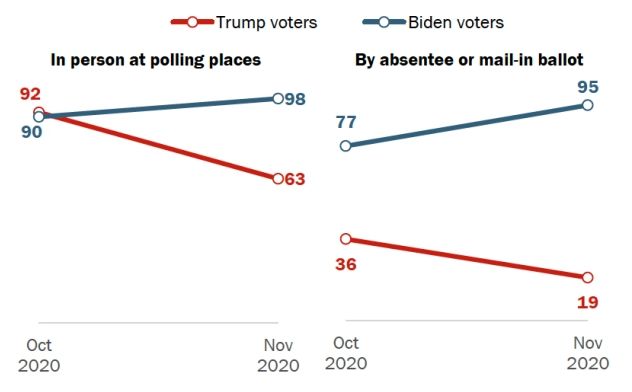
In line with the polarization and political division detected, it is noteworthy that 78%
of Democratic35%supporters who went to the polls in person are very confident that their
vote has been counted accurately (Figure 16%5), while in the case of Republicans it is only
19%. These divergences are even greater 5%in the case of absentee voting, as Biden voters
are overwhelmingly
ALL VOTERS confident in the
T R U M P V O T Esystem
counting RS (95%), Bwhile
I D E N only
V O T Eone
R S in five Trump
voters are (19%). The functioning of the electoral system was the focus of the RepublicanOwn elaboration from Pew Research’s American Trend Panel (2020).
In line with the polarization and political division detected, it is noteworthy that 78%
of Democratic supporters who went to the polls in person are very confident that their
Journal. Media 2021, 2
vote has been counted accurately (Figure 5), while in the case of Republicans it is only 343
19%. These divergences are even greater in the case of absentee voting, as Biden voters
are overwhelmingly confident in the counting system (95%), while only one in five Trump
voters are (19%). The functioning of the electoral system was the focus of the Republican
leader’s
leader’s attacks
attackssince
sincethe
theday
dayafter
afterthe elections
the were
elections wereheld, andand
held, thethe
polls reflect
polls the influence
reflect the influ-
that
encethis
thatdiscourse has achieved
this discourse among
has achieved the like-minded
among electorate.
the like-minded electorate.
Very Somewhat
21%
30%
32%
23%
44% 78%
65%
50%
36%
19% 16%
4%
ALL VOTERS TRUMP BIDEN ALL VOTERS TRUMP BIDEN
VOTERS VOTERS VOTERS VOTERS
IN PERSON AT POLLING PLACES BY ABSENTEE OR MALL-IN BALLOT
Figure 5.
Figure 5. Percentage
Percentage of
of voters
voters who
who are
are convinced
convinced that
that their
their vote
vote has
has been
been counted
counted correctly. Source:
correctly. Source:
Own elaboration from Pew Research’s American Trend Panel (2020).
Own elaboration from Pew Research’s American Trend Panel (2020).
Trump’srhetoric,
Trump’s rhetoric,ononthe
theone
onehand,
hand, and
and the
the media’s
media’s role
role as fact-checkers,
fact-checkers, on the other,
other,
make these divisions
make divisionseven
evenmore
moreacute
acuteafter thethe
after election. In this
election. regard,
In this PewPew
regard, Research (Fig-
Research
(Figure 6) notes that Biden voters’ confidence in a correct vote count is higher (+8%) thanit
ure 6) notes that Biden voters’ confidence in a correct vote count is higher (+8%) than
itwas
wasa month
a month before
beforeElection Day.
Election In contrast,
Day. Trump
In contrast, voters’
Trump confidence
voters’ in theinvote
confidence thecount
vote
count
was lower
Journal. Media 2021, 2, FOR PEER REVIEW (−29%)(−
was lower 29%)
than inthan in the pre-election
the pre-election survey.survey. As the process
As the process progressed,
progressed, the
the balance
10
balance
in favor inoffavor of the legality
the legality of the recount
of the recount strengthened,
strengthened, to the detriment
to the detriment of Trump’sof Trump’s
delegiti-
delegitimization
mization slogan slogan
againstagainst the electoral
the electoral system.system.
It is essential to analyze the results considering the context of the COVID-19 pan-
demic and its influence on public opinion. The polls show a lack of confidence in the man-
agement of the government and its president. In this context, it can be observed (Figure
7) that positive opinions of support for Biden and rejection of Trump’s behavior in the
face of the crisis the country would stand out.
Figure 6. Evolution of trust in the correct recounting of the vote. Source: Pew Research’s American
Figure 6. Evolution of trust in the correct recounting of the vote. Source: Pew Research’s American
Trend Panel (2020).
Trend Panel (2020).
It is essential to analyze the results considering the context of the COVID-19 pandemic
and its influence on public opinion.
Not at all
The pollsSomewhat
Not too
show a lackVery
of confidence in the management
of the government and its president. In this context, it can be observed (Figure 7) that
positive opinions of support for Biden and rejection
4% of Trump’s
3% behavior in the face of the
crisis the country would stand out. 9% 13%
23%
31%
47%
29% 58%
19%
27%Journal. Media 2021, 2 344
Figure 6. Evolution of trust in the correct recounting of the vote. Source: Pew Research’s American
Trend Panel (2020).
Not at all Not too Somewhat Very
4% 3%
23% 9% 13%
31%
47%
29% 58%
19%
27%
11%
86%
15% 36%
55%
37% 38%
26% 13%
4% 4%
BIDEN TRUMP BIDEN TRUMP BIDEN TRUMP
AMONG ALL VOTERS AMONG BIDEN VOTERS AMONG TRUMP VOTERS
Figure
Figure 7. Trustin
7. Trust inthe
thecandidates’
candidates’ability
ability
to to manage
manage thethe COVID-19
COVID-19 health
health crisis.
crisis. Source:
Source: Own
Own elabo-
ration fromfrom
elaboration Pew Pew
Research’s American
Research’s Trend
American Panel
Trend (2020).
Panel (2020).
Once
Once again, Joe Joe Biden
BidenandandDonald
DonaldTrump
Trump voters
voters expressed
expressed greater
greater trusttrust in their
in their can-
candidate
didate than than in his
in his opponent.
opponent. However,
However, BidenBiden voters
voters werewere especially
especially critical
critical of theof still-
the
still-president, with 86% having no confidence at all in Trump’s ability
president, with 86% having no confidence at all in Trump’s ability to manage the health to manage the
health impact of the pandemic, while Republicans who have no trust in
impact of the pandemic, while Republicans who have no trust in Biden were down to 55%. Biden were down
to
In55%. In addition,
addition, 58% of 58%Bidenof voters
Biden voters
showed showed
a lot ofa lot of in
faith faith in their
their candidate’s
candidate’s ability
ability to dealto
deal with the coronavirus, while the figure dropped to 47%
with the coronavirus, while the figure dropped to 47% for Trump voters. for Trump voters.
Against
Against this
this survey,
survey,ititisisworth
worthbearing
bearingin inmind
mindthe the 80th
80th wave
wave of the American
of the American Trends
Trends
Panel,
Panel, produced by Pew Research days after the incidents surrounding the assault on on
produced by Pew Research days after the incidents surrounding the assault the
the Capitol
Capitol (6 January
(6 January 2021)2021) by Donald
by Donald TrumpTrump followers.
followers. For many,
For many, Trump’s Trump’s strategy
strategy of en-
of encouraging
couraging his supporters
his supporters to revolt
to revolt againstagainst Joe Biden’s
Joe Biden’s certification
certification of victory
of victory and to and
par-
to participate in riots against Congress tarnished Trump’s final days as
ticipate in riots against Congress tarnished Trump’s final days as president. In this regard, president. In
this regard, the data indicate that three-quarters of the public believed
the data indicate that three-quarters of the public believed the president bears at least the president
bears at least some responsibility for the events and 52% said that he bears a great deal of
some responsibility for the events and 52% said that he bears a great deal of responsibility
responsibility for the unfolding of these incidents. However, nearly a quarter (24%) thought
for the unfolding of these incidents. However, nearly a quarter (24%) thought that Trump
that Trump bears no responsibility for these events. In addition, it is noteworthy that about
bears no responsibility for these events. In addition, it is noteworthy that about half of
half of Republicans (52%) recognized that Trump has some responsibility for the violence
unleashed in the Capitol, a figure that rose to almost all Democrats (95%). In this context,
the opinions collected by the polls shows the relevance that the riots against a public
institution, a symbol of representative democracy, reached for the American electorate. It
is from this moment on that voters, both Trump supporters and non-Trump supporters,
shared in a more evident way the reaction of rejection and disagreement with his policies.
We can observe this trend in Figure 8.
On the other hand, the data also show that the assessment of Joe Biden’s conduct was
mostly positive, with six in 10 respondents (64%) that considered it good or very good, and
even this figure rose by 2% since Election Day. In contrast, the proportion of voters who
rate Trump’s conduct as negative rose from 68% in November to 76% in January. Moreover,
approval among Republican voters fell to 60%, when during his entire term in office it
remained between 74% and 85% (Figure 9).observe this trend
Republicans (52%)inrecognized
Figure 8. that Trump has some responsibility for the violence un-
leashed in the Capitol, a figure that rose to almost all Democrats (95%). In this context, the
opinions collected by the pollsA shows
lot the relevance
Some None at that
al l the riots against a public institu-
tion, a symbol of representative democracy, reached for the American electorate. It is from
Journal. Media 2021, 2 this moment on that voters, both Trump supporters and non-Trump 5% supporters, shared345
in a more evident
24% way the reaction of rejection and disagreement with
14% his policies. We can
observe this trend in Figure 8.
46%
23% A lot Some None at al l
5%
81%
24% 34% 14%
52% 46%
23%
18%
TOTAL REP/ LEAN REP DEM/ LEAN DEM
81%
34%
Figure 8. Citizens who consider Trump bears at least part of the responsibility for the Capitol dis-
52%
turbances. Source: Own elaboration from Pew Research’s American Trend Panel (2021).
On the other hand, the data also show 18%that the assessment of Joe Biden’s conduct was
mostly positive, with six in 10 respondents (64%) that considered it good or very good,
and even this T Ofigure
TAL R E P / Election
rose by 2% since L E A N R E PDay. In contrast,
D E M / Lthe
E A Nproportion
DEM of voters
who rate Trump’s conduct as negative rose from 68% in November to 76% in January.
Figure 8.
8. Citizens
Citizens who consider
whoamong
considerTrump
Trumpbearsbears atatleast part
least of of
part thethe
responsibility
responsibilityfor the the
Capitol dis-
Figure
Moreover, approval Republican voters fell to 60%, when during hisfor entire Capitol
term in
turbances. Source:
disturbances. Own elaboration
Source:between
Own elaborationfrom Pew Research’s American Trend Panel (2021).
office it remained 74% andfrom85%Pew Research’s
(Figure 9). American Trend Panel (2021).
On the other hand, the data also show that the assessment of Joe Biden’s conduct was
mostly positive, with six Poor
in 10 respondents
Only Fair (64%) that
Good considered it good or very good,
Excellent
and even this figure rose by 2% since Election Day. In contrast, the proportion of voters
who rate Trump’s conduct as8% negative rose from 68% in November to 76% in January.
13%
Moreover, approval among Republican voters fell to 60%, when during his entire term in
15% 37%
office it remained
18% between 74% and 85% (Figure 38%9).
14%
14% Poor Only Fair Good Excellent
24% 27%
13% 8%
62%
15% 17%
54% 38% 37%
20%
18%
14%
20% 15%
14%
NOV. 2020 JAN. 2021 N O V24%
. 2020 J A N27%
. 2021
TRUMP'S CONDUCT BIDEN'S CONDUCT
62% 17%
54% 20%
Figure9.
Figure 9. Evolution
Evolution of
of the
the evaluation
evaluation of
of Trump’s and Biden’s
Trump’s and Biden’s behavior
behavior after
after the
the presidential election.
presidential election.
Source: Own elaboration from Pew Research’s American Trend Panel
Source: Own elaboration from Pew Research’s American Trend Panel (2021).(2021).
20% 15%
Despite the scenes of violence on Capitol Hill and the deterioration of Donald Trump’s
NOV. 2020 JAN. 2021 NOV. 2020 JAN. 2021
image, even among his own voters, Pew Research’s American Trend Panel (Pew Research’s
TRUMP'S CONDUCT BIDEN'S CONDUCT
American Trend Panel 2021) reflects (Figure 10) that one-third (34%) of U.S. voters believed
that the Republican representative won the election, a figure that rose to 75% among his
Figure 9. Evolution of the evaluation of Trump’s and Biden’s behavior after the presidential election.
constituents. In fact, it is noteworthy that only two in 10 (22%) recognized Joe Biden’s
Source: Own elaboration from Pew Research’s American Trend Panel (2021).
victory in the 2020 presidential election. However, the electoral delegitimization narrative
lacked traction among Democratic voters (1%).
In short, the exploitation and comparison of data extracted from the two waves (78
and 80) of the American Trend Panel of Pew Research highlighted the process of changes
in the electorate’s opinion about the narrative that Donald Trump has championed on the
fraud of the elections. While it can be considered normal that the entire Democratic sector
does not share this discourse of delegitimization of the results, what is exceptional is that a
part of the Republicans disapproves of the management of their candidate and recognizesJournal. Media 2021, 2, FOR PEER REVIEW 12
Journal. Media 2021, 2
Despite the scenes of violence on Capitol Hill and the deterioration of Donald 346
Trump’s image, even among his own voters, Pew Research’s American Trend Panel (Pew
Research’s American Trend Panel 2021) reflects (Figure 10) that one-third (34%) of U.S.
voters believed that the Republican representative won the election, a figure that rose to
his
75%responsibility in the attackIn
among his constituents. onfact,
the it
Capitol. In any case,
is noteworthy that the
onlylevels of 10
two in polarization remain
(22%) recognized
in
Joeforce between
Biden’s the in
victory two
thepositions, although the
2020 presidential set of However,
election. responses points to a shared
the electoral reaction
delegitimiza-
to thenarrative
tion disinformation.
lacked traction among Democratic voters (1%).
Definitely Trump Probably Trump Probably Biden Definitely Biden
7%
15%
54%
35%
95%
11%
17%
40%
17%
4%
ALL VOTERS TRUMP VOTERS BIDEN VOTERS
Figure 10.
Figure 10. Percentage
Percentage of
of Americans
Americans who
who incorrectly
incorrectly think
think Trump
Trumpwon
wonthe
theelection.
election.Source:
Source: Own
Own
elaboration from Pew Research’s American Trend Panel (2021).
elaboration from Pew Research’s American Trend Panel (2021).
5. Discussion
In short, theandexploitation
Conclusionsand comparison of data extracted from the two waves (78
and 80) of the American
In modern democratic Trend Panel of
societies, Pew Research
populists, left or highlighted
right, pretendthe
toprocess of changes
adopt empathy in
with
the people,
the electorate’s
whom opinion about the narrative
they theoretically represent.thatButDonald Trump has
this connection championed
with society, with on the
the
fraud of
voters, canthebeelections.
stylistic, While
insofaritascan be considered
it focuses on the normal
form of that the entirethrough
the messages Democratic sector
rhetorical
does not share
resources, this discourse
as Kissas (2019) alreadyof delegitimization
pointed out, orofideological,
the results,insofar
what isasexceptional
it focuses on is that
the
a part of the Republicans disapproves of the management of their
content of the messages sent with a clearly propagandistic character, as Pasitselska, and candidate and recog-
nizes his
Baden pointresponsibility
out (Pasitselska in the attack
and Badenon2019).
the Capitol. In any case,ofthe
A (re)negotiation levelspower
existing of polarization
relations
remain
is pursued.in force between the two positions, although the set of responses points to a shared
reaction to the disinformation.
Populism, in addition to being anti-elitist and anti-pluralistic, is a strategic tool for
achieving political power and exercising it, which, in recent times, has found a truly
5. Discussion
valuable tool inand Conclusions
social networks, since they provide individuals and the masses with
information
In modern democraticinsocieties,
and resources a fast, shocking andleft
populists, persuasive
or right, way, coated
pretend with aempathy
to adopt halo of
truthfulness that is not always real. The increase of disinformation
with the people, whom they theoretically represent. But this connection with society, within social networks is
evident,
the voters,particularly, as hasinsofar
can be stylistic, been studied in this on
as it focuses case,
theon Twitter.
form of the messages through rhe-
torical resources, as Kissas (2019) already pointed out, or ideological,Trump’s
Data from a previous research were added that demonstrates insofar asuse, based
it focuses
on lies and fallacy, of Twitter as a platform to deploy his rhetoric of
on the content of the messages sent with a clearly propagandistic character, as Pasitselska, delegitimization
of
andtheBaden
electoral
pointresult. Taking advantage
out (Pasitselska and Baden of this
2019).basis, Trump has launched,
A (re)negotiation of existingfrom his
power
official account,
relations is pursued. a not inconsiderable number of messages that permeated the electorate.
In previous
Populism, research (Pérez-Curiel
in addition to beingand Domínguez-García
anti-elitist 2021) analyzing
and anti-pluralistic, the tool
is a strategic tweets
for
published by the US president after his defeat in the 2020 presidential
achieving political power and exercising it, which, in recent times, has found a truly val- election and it
was
uableshown
tool inthat
socialTrump bases since
networks, his discourse on Twitter
they provide on disinformation,
individuals and the massesdenouncing
with infor-
the alleged electoral theft (31.3%), confronting (24.8%) and defending his alleged victory
mation and resources in a fast, shocking and persuasive way, coated with a halo of truth-
(17%). In addition, the authors reflected that the Republican relies on a massive use of the
fulness that is not always real. The increase of disinformation in social networks is evident,
propagandistic resource of fallacy (88.9%).
particularly, as has been studied in this case, on Twitter.
The rhetoric of persuasion used in this social network is based, in many political ac-
Data from a previous research were added that demonstrates Trump’s use, based on
counts, on lies and defamation. It should not be forgotten that populist political communi-
lies and fallacy, of Twitter as a platform to deploy his rhetoric of delegitimization of the
cation revolves around charismatic leaders, who launch supposed theoretical authenticities
in their personality by appealing to the empathy and sympathy they are able to arouse in
the people. Taking advantage of this base, Trump has launched, from his official account,
a not inconsiderable number of messages that have permeated the electorate. Also, asYou can also read


