Putin's Choice for Russia - By S.R. Covington Foreword by Kevin Ryan - August 2015
←
→
Page content transcription
If your browser does not render page correctly, please read the page content below
Defense and Intelligence

Putin’s Choice
for Russia
By S.R. Covington
Foreword by Kevin Ryan

                         August 2015
Belfer Center for Science and International Affairs
Harvard Kennedy School
79 JFK Street
Cambridge, MA 02138
Fax: (617) 495-8963
Email: belfer_center@harvard.edu
Website: http://belfercenter.org

Design & Layout by Andrew Facini

Copyright 2015, President and Fellows of Harvard College
Digital Edition
Defense and Intelligence

Putin’s Choice
for Russia
By S.R. Covington
Foreword by Kevin Ryan

                         August 2015
Foreword
This paper by Stephen R. Covington exposes the roots of
Russian President Vladimir Putin’s policies toward Europe,
his challenge to European security, and the consequences for
Russia’s own future.
“Previous Russian approaches could be characterized as
attempting to ‘break into” the European security system to
politically divide and overrule. In contrast, Putin’s current
approach attempts to ‘breakout’ of the European security system,
divide Europe, and establish new rules. This is a fundamental
change of approach that reflects a fundamental change of policy.”
Stephen Covington has advised nine NATO Supreme Allied
Commanders over a quarter of a century on strategic and
international affairs. His insights and understanding of the
Eurasian strategic landscape are based on years of study and
firsthand experience in dealing with regional leaders—military
and civilian. Serious students of Russia and NATO will find
Covington’s assessment of President Putin and the impact of his
policy decisions on Russia most helpful.
BG Kevin Ryan (U.S. Army retired),
Director, Defense and Intelligence Projects
Belfer Center for Science and International Affairs | Harvard Kennedy School vTable of Contents
Foreword...................................................................................................... v
1. Introduction: Gorbachev’s and Putin’s Different
Strategic Choices to Enhance Global Competiveness........... 1
2. ‘Strategic Encirclement’ and Breaking Out
to Break Up the European Security System............................... 8
3. Implications of Putin’s Breakout Strategy for Russia.............15
4. Implications of Putin’s Breakout Strategy for Europe...........20
Endnotes.......................................................................................................................26
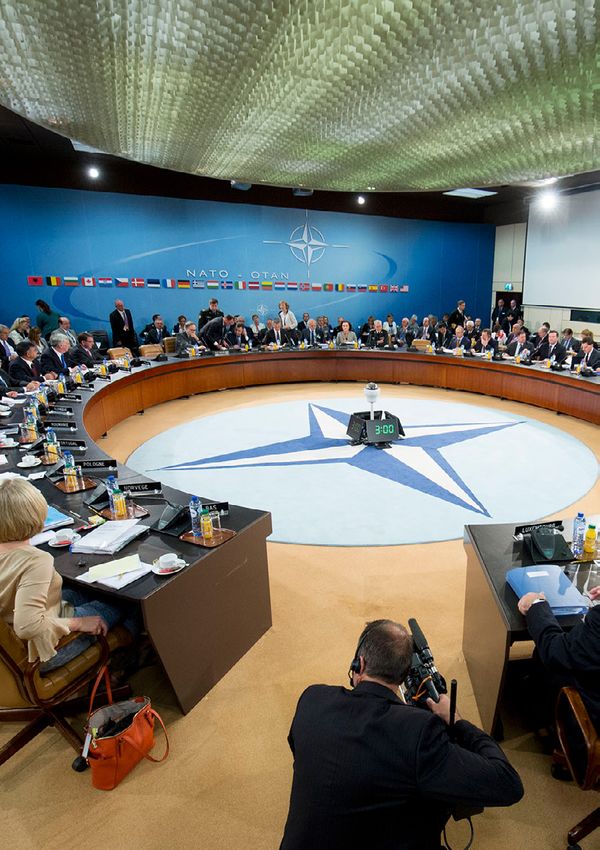
Belfer Center for Science and International Affairs | Harvard Kennedy School viiGeneral meeting of defence ministers for the NATO–
Ukraine Commission, Brussels, 24-25 June 2015
Courtesy NATO1. Introduction: Gorbachev’s and Putin’s Different Strategic Choices to Enhance Global Competiveness In 1985, a Soviet leader came to power, leading one of the two superpowers in a bi-polar world, commanding a powerful mil- itary, and leading a party mandated with changing the world. Mikhail Gorbachev was also equipped with something far more powerful than the weapons in the Soviet arsenal—forecasts of the USSR’s future inability to compete with the United States in economic, technological, and military terms. Gorbachev was convinced that the Soviet war economy and its priorities would constrain and exhaust its national capacity to compete success- fully at the end of the 20th century—and that the internal system needed change for the USSR to sustain itself as a competitive, global power. Gorbachev decisively chose economic reforms and disengage- ment from strategic confrontation with the West to address Soviet non-competitiveness. Internal political and economic changes to the Soviet system were intended to strengthen the USSR and renew its economic and technological base for sus- tained global competition in the 21st century. He disengaged the Soviet Union from external strategic confrontation through conventional and nuclear arms reductions, changed Soviet security and defense policies, and reduced arms expenditures. Gorbachev’s choice ended decades of direct military confronta- tion between the Soviet Union and NATO, and Eastern Europe’s Belfer Center for Science and International Affairs | Harvard Kennedy School 1
political revolutions ultimately led to the geographic separa-
    tion of Soviet and NATO military forces. In 1991, Gorbachev
    was swept from power by the political and economic forces
    unleashed by his attempted internal reform of the USSR.

    30 years later, another Russian leader driven by similar concerns
    about future strategic non-competitiveness has set this country
    on a path to address and reverse its non-competitive position in
    the world. Vladimir Putin’s Russia today, however, is on a very
    different course from Gorbachev. After implementing liberal
    economic reforms aimed at strengthening Russia’s sovereignty in
    the early years of his rule, Putin has rejected structural, internal
    economic and political reforms, fearing that like Gorbachev he
    too could be swept from power. Putin’s choice reflects a view
    that Russia can only address its non-competitiveness by chang-
    ing the world around Russia, and most critically, by changing
    the European security system. In Putin’s view, any solution
    short of changing the European security system—including full
    integration, separation by erecting new walls, freezing the status
    quo around Russia, or partnering with other countries to count-
    er-balance the powers in the European system—only means
    Russia’s inevitable loss of great power status and the loss of his
    personal power at home.

    Consequently, Putin is rearming Russia, remilitarizing Russia’s
    overall approach to security, changing Russia’s defense concepts,
    adopting continuous destabilization strategies against neighbor-
    ing states, and returning to old policy formulas for internal and
    external security—all justified and rationalized by the perceived
    threat posed by the U.S./European security system around
    Russia. His policy requires a changed Europe to enhance Rus-
    sian strategic competitiveness and requires a changed Europe

2   Putin’s Choice for Russia
to avoid political change inside Russia. These two Russian cam-
paigns—one external and one internal—are interfused. Success
in one campaign is dependent on success in the other. More
importantly, failure in one campaign is perceived as prompting
failure in the other.
President Putin’s decision is influ-
enced by Russia’s experiences since
“Putin’s decision
the end of the Cold War—internal is influenced by
coup attempts, terrorist attacks, Russia’s experiences
‘colored revolutions’ around Russia, since the end of the
wars inside and outside of Russia, Cold War.”
unfinished reforms, and perceptions
of Russia’s natural vulnerability to a fate similar to that of the
USSR given its one-dimensional economic base and political
superstructure. However, Putin’s policy is driven mostly by
concerns about Russia’s inability to compete on almost any level
and in almost any sphere with the world’s greatest powers absent
fundamental changes to the security, energy, economic, and
financial systems around Russia.
Russia does have long-standing critical views of the European
security architecture. U.S. and NATO Ballistic Missile Defense
programs, a variety of NATO and EU policies and actions, and
U.S. security and defense integration on the continent have
been a few of the many points of criticism from Moscow over
the years. Dimitri Medvedev, then the President of Russia, pro-
posed a new European security architecture shortly after the
Russian conflict with Georgia in 2008 to change the European
security system. While Putin’s policy is consistent with well-doc-
umented Russian criticisms of Europe’s security architecture, his
actions differ substantially from previous Russian approaches.
Belfer Center for Science and International Affairs | Harvard Kennedy School 3Previous Russian approaches could be characterized as attempt-
ing to ‘break into” the European security system to politically
divide and overrule. In contrast, Putin’s current approach
attempts to ‘breakout’ of the
“Putin’s current approach European security system,
attempts to ‘breakout’ divide Europe, and establish
of the European security new rules. This is a fundamen-
tal change of approach that
system, divide Europe,
reflects a fundamental change
and establish new rules.” of policy.
Russian political and military experts also have long envied the
Chinese security model. In many ways, Putin’s Russia seeks a
security system in Europe that resembles the security environ-
ment China has in the Pacific. For the Chinese, there is no real
Asian-wide architecture of transpacific security akin to Europe’s
transatlantic security that collectively counter-balances national
power. China is able to use its economic and military strengths
with a wider range of freedom, acting opportunistically, wield-
ing its power to divide and overrule, protect territories and
interests, and navigate its strengths in a security environment
with strategic, but isolated pockets of US-Pacific defense inte-
gration. Simultaneously China has integrated economically,
gained access to technology, modernized its economic system,
and maintained continuity in political control over the internal
system. Russian security experts also have admired the fact that
China has evolved and grown into a great economic power with-
out the political and economic turmoil Russia suffered in the
1990s—turmoil that has cost Russia time, money, energy, and
opportunity.
4 Putin’s Choice for RussiaRussia’s leadership wants a Europe without strategic Alliances, without multi-national organizations, and without a U.S.-Eu- rope Transatlantic link that can through collective policies and action offset the national strengths Russia would hold over any one European nation. It would be a European security environ- ment that would allow the Russia to apply its national strengths to great effect without challenge and competition - enhancing its power abroad and at home. This is the end-state of Putin’s strat- egy, and it requires changing the European security system—the rules of the game—to sustain Russia’s capability to compete with Europe and other regional powers poles outside Europe. Con- versely, the policy strictly seeks to freeze the political rules of the game inside Russia, and end meaningful political competition at home. Russia’s leaders have concluded that the European system is both vulnerable and unjust.1 In the Russian view, the European secu- rity system is vulnerable because it is weakened by a diffusion of global power, political devolution, sapped of economic wealth, and attacked by forces of disorder in other parts of the world. Putin also has concluded that the current European security system is unjust because it confines and restricts Russia’s ability to exercise her inherent national strengths, inflicting a modern form of multi-dimensional, multi-level strategic encirclement of Russia. Russia’s leaders claim the European security system is part of a global system whose purpose is to advance a unipolar, US-dominated global order.2 Moreover, Russia’s leaders assert that preventing Russia from attaining its proper place in a just global order is a prerequisite to sustain the current unjust global order. Russia’s policy seeks to change first the principles and rules upon which Europe and other countries have prospered and grounded their economic and military security, then replace Belfer Center for Science and International Affairs | Harvard Kennedy School 5
them with new principles and new rules that would enhance the
    strengths of an unreformed, Putin-led Russia and compensate
    for its weaknesses.

    As Russia’s campaign against Ukraine has demonstrated, this is
    a ‘rule breaker to be rule maker’ strategy, and the strategy relies
    on a variety of internal and external means to achieve its ends.
    Internally, the strategy feeds nationalism, familiarity, and orien-
    tation to the disempowered Russian people, offers the prospect
    for greater profit to the powerful rich, and promises purpose,
    identity, and resources to the power ministries (e.g., Ministry
    of Defense, Ministry of Interior.). Externally, the strategy relies
    on the use of all elements of power—including military—to dis-
    credit, devalue, and delegitimize the current European security
    system.

    The roots of this strategy have many antecedents in Soviet
    policy, yet his policy is not that of the Soviet Union. Nor is it
    a policy that strictly and narrowly follows nationalist aims for
    redrawing borders to revive a Novorossiya or rebuild the Soviet
    empire. His policy is a mixture of the very old, old, and new
    in a completely different global strategic context. Putin needs
    the Russian people, the country’s powerful rich, and the power
    ministries to support his policy. The Soviet-inspired symbols,
    messaging, and parades, the nationalism associated with a Great
    Russia, the rearmament, increased defense budgets, the decla-
    rations of an unjust peace at the end of the Cold War, and the
    accommodation of the narrow financial interests through new
    energy contracts with China and others are used to fuel support
    for his policy at home and attempt to legitimize it abroad.

6   Putin’s Choice for Russia
President Putin has merged these three lines of ideas, ideals, and vision for Russia into a single system of thought, policy, and action to drive his strategy and build support internally for his agenda. Righting the perceived wrongs inflicted on Russia and rebuilding Russia’s power, prestige, and place in the former Soviet space after its perceived humiliation at the end of the Cold War are the public lines of Russian policy. Away from public view, Putin constructs unchallengeable political control over Russia that is built on the narrow aims of a Kremlin lead- ership interested in obtaining more wealth and more power. Individually, these public and non-public lines of effort are single elements of Putin’s policy, each with their own appeal to their targeted audience. However, these three lines of Putin’s policy are mixed together into a single political and strategic military logic for breaking out of the perceived strategic encir- clement of the European security system around Russia to establish a stronger, more globally competitive Russia. Belfer Center for Science and International Affairs | Harvard Kennedy School 7
2. ‘Strategic Encirclement’
       and Breaking Out to
       Break Up the European
       Security System
    Russian military and civilian leaders make reference to the
    encirclement of Soviet cities in World War II. “Breaking out” to
    “break up” the integrity of an opponent’s system of defense was
    a classic element of Soviet military strategy in World War II to
    end strategic encirclement. In the strategic defense operations of
    that time, Soviet political and military leaders relied on breakout
    operations to create ruptures in their opponent’s encirclement.
    Some breakout operations were tactical in scope and limited to
    the purpose of demonstrating resolve to not accept encirclement
    and defeat. Other breakout operations were operational and
    strategic in scale and purpose. Operational-strategic break out
    actions were designed to change the overall strategic situation
    with decisive large-scale actions. These breakout actions quickly
    broke the opponent’s defense lines on a large scale, and moved
    to greater depths to damage the integrity of the opponent’s
    system of defense, ultimately creating advantages that allowed
    for a transition to more offensive action. These large-scale
    operations ended the encirclement and reversed a fundamental,
    operational-strategic disadvantageous situation into one more
    advantageous for the Soviet Union.

    Russia’s political and military leaders describe their current
    security environment as one of strategic encirclement.3 Break-
    ing out to break up the integrity of the European security system
    appears to be an integral part of Putin’s grander strategy to

8   Putin’s Choice for Russia
address this perceived encirclement. In this modern context
of perceived strategic encirclement, Russia’s strategic nuclear
aviation flights and maritime deployments can be seen as the
modern day versions of tactical breakout actions from World
War II, designed to demonstrate the Kremlin’s resolve to not
accept encirclement. Russia’s comprehensive destabilization
campaign in Ukraine—including the use of the military—can
be seen as the modern day version of an operational-strategic
breakout operation designed to breakout of encirclement per-
manently by breaking up the European security system.
In this context as well,
Ukraine’s destabili-
“A frozen conflict in Ukraine
zation is an end, and would effectively freeze
a means to the much Russia’s strategic-scale
more strategic end of instrument for bringing about
breaking up the Euro- the fundamental changes to
pean security system. Europe’s security system.”
Russia requires a
continuous, inconclusive process of destabilization of Ukraine—
not a frozen conflict - to achieve its grander objectives. A
frozen conflict in Ukraine would effectively freeze Russia’s
strategic-scale instrument for bringing about the fundamental
changes to Europe’s security system. The Russians would fear
that a frozen conflict in Ukraine would lead the more powerful
West to build a new wall of reinforced, sustained containment
(encirclement) around Russia on top of this new frozen conflict,
effectively undercutting and countering Putin’s overall break-
out strategy—and placing Russia in a significantly weakened
post-crisis situation, still unable to compete strategically and less
capable, with fewer options to challenge the European security
system in the future. Additionally, a frozen conflict in Ukraine
Belfer Center for Science and International Affairs | Harvard Kennedy School 9also would compel Russia to pay for eastern Ukraine and its
reconstruction, and shift its focused destabilization actions to
other geographic areas with more direct, less ambiguous means
to achieve the overall aims of its strategy, risking direct, inten-
sified strategic competition and confrontation with the West.
Consequently, Ukraine represents an operational-strategic
breakout opportunity that serves the aims of an overall Rus-
sian breakout strategy. In the framework of Russia’s broader
breakout strategy, the resolution of the conflict with Ukraine—
political, military, economic—without a change to the European
security system would not be in Moscow’s interest.
Russia’s breakout strategy is supported by many other actions
that break with, and break out of the European security system.
Russia’s breakout actions include the use of force in Crimea,
withdrawal from the CFE treaty, military, financial, and political
support to separatists in eastern Ukraine, direct financial, polit-
ical, and military actions to destabilize Ukraine on a broader
scale, a military rearmament program, the buildup of military
capabilities in the Arctic, Black Sea, and Baltic Sea, sudden
large-scale military exercises that shift forces to higher combat
readiness involving long-range deployments, nuclear force exer-
cises designed to posture and intimidate, and energy, financial,
and informational pressure on European countries. All of these
political and military actions break with the norms, rules, and
practices of the post-Cold War period and destabilize the cur-
rent security system.
In March and April of this year, Russia conducted a strategic
command staff exercise for multi-theater war, a tactical snap
exercise involving the Baltic and Arctic regions, and an inter-
nal Interior Ministry (MVD) exercise in the West, Northwest,
10 Putin’s Choice for RussiaCentral, and Southern sections of Russia in coordination with
the FSB to respond to Maidan-type unrest in Russia.4 In June,
the Russian military conducted snap exercises of their mobile
nuclear intercontinental ballistic missiles.5 The Russian military
has adopted an approach to conflict in peace, crisis, and war that
couples large-scale conventional and nuclear forces to the appli-
cation of non-attributable, ambiguous means of destabilization.
This Russian model of hybrid warfare differs fundamentally
from other models in this latter respect. No other nation in
Europe is implementing such an array of actions that break with
post-Cold War European norms and practices. If Russia pro-
duces and fields a missile system that violates the Intermediate
Nuclear Forces,, Russia’s reversal on this agreement would be
the final move in Putin’s restoration of most, if not all, of the
major military lines of the pre-Gorbachev military competition
with Europe, ending the
single most important
“No other nation in Europe is
Gorbachev-era military implementing such an array
agreement, and one that of actions that break with
sparked the unwinding post-Cold War European
of the Cold War. norms and practices.”
Moscow’s reframing of strategic competition with Europe sup-
ports and justifies Putin’s breakout policy. In the Cold War,
East-West confrontation was a central part of a contest between
two socio-economic systems, the outcome of which would
determine a just or unjust world social order. Putin’s policy
now frames today’s strategic competition with Europe as a con-
test between two security systems, one supposedly designed to
trap, marginalize, and disempower Russia in an unstable global
security system. Routinely, the Russian leadership describes the
Belfer Center for Science and International Affairs | Harvard Kennedy School 11current European system as one that offers a future with Russia
on the periphery, while a new system offers a future with Russia
at the center. In Putin’s view, the existing European system offers
a future with Russia under control and influenced by others,
the other offers a future with Russia in control and influencing
others. Russia’s goal is to breakout of a perceived unjust security
system, and to liberate and expand Russia’s power. This mod-
ernized ideological framework resonates with the people, the
powerful rich, and the power ministries, uniting them in sup-
port of Putin. It also sets the overall justification for the decision
to breakout and the strategy to do so. In turn, this creates accep-
tance for the wielding of power externally, the employment of
forces to achieve diverse aims, and the posturing of conventional
and nuclear forces in an intimidatingly way to reinforce ambigu-
ous destabilization actions or demonstrate Russian power.
The main focus of the
breakout strategy now
“Breaking Europe’s political
is the political cohesion cohesion is the fundamental
of the transatlantic prerequisite for changing
community. Breaking Europe’s security rules,
Europe’s political cohe- principles, and norms.”
sion is the fundamental
prerequisite for changing Europe’s security rules, principles, and
norms. Russian political and military leaders have a long history
of expertly exploiting gaps in their competitor’s strengths, and
exploiting gaps between allies on policy has been, and remains,
a common tactic of Russian diplomatic, economic, energy, and
military pressure. The Soviet military attempted to exploit the
Fulda Gap and the gaps between Allied corps boundaries in
NATO’s Cold War military strategy. The Russians exploited
the gap between NATO member states over the 2008 Georgia
12 Putin’s Choice for Russiaconflict, and this gap allowed for the anchoring of Russia deeper into Georgia’s security and the displacement of Western influ- ence. Russian direct pressure on European cohesion remains centered on Ukraine and Europe’s responses to this crisis. At the same time, Moscow has expanded sharply its campaign to undermine political cohesion in NATO and the European Union over the last year. Vladimir Putin’s regional breakout strategy is set against the backdrop of a global security system the Russians see to be under assault by the forces of disorder in many parts of the world, punctuated by a perception of decreasing U.S. power and influence.6 Those forces of disorder are attempting to stake their claims and attain their interests now as the basis for negotiating a new order for the future. The Russian leadership thinks those other forces of disorder will produce changes in the regional and global security order. Putin’s regime also may be betting on the forces of disorder globally to occupy Europe’s attention as ISIS, Al Shabaab, Boko Haram, Al-Qaeda, and other organizations attempt to dismantle national and regional elements of the cur- rent global system. Europe’s occupation with this second, very critical, different strategic challenge from the South, effectively gives Putin the opportunity and flexibility of having a second strategic flank unconnected to Putin’s direct campaign against Europe, but one that allows Russia to maintain the strategic initiative, increase or decrease pressure, and to move more decisively or move more cautiously as the security situation permits in Europe and other challenges play out to Europe’s south. This Russian strategy against Europe attempts to profit from the West’s occupation with other challenges to the global security system, challenges that consume the time, energy, and resources of the West and allow Russia to create regional power Belfer Center for Science and International Affairs | Harvard Kennedy School 13
advantages with Europe that do not exist on a global scale. This
     is a critical element in Putin’s strategy given Russia’s inability
     to compete directly with the stronger, richer, technologically
     advanced West.

     Post-Soviet Russia is no longer a status quo power centered on
     preserving Russia’s place in the security order through static, no
     change policies and the static presence of forces in frozen con-
     flicts. Russia today is a system change power. Putin’s breakout
     strategy is designed to destabilize, and the approach seeks to
     unfreeze frozen conflicts, break rules, and foster tensions where
     useful to accelerate the melting away of Europe’s proven secu-
     rity principles and rules. Putin gains little for Russia’s security
     today from these actions. It is a carefully developed policy and
     strategy. It is not a carefully balanced strategy. It shows scant
     regard for the instability created by this policy—that is the intent
     of the policy. It is a strategy designed to test wills and determine
     who will tire first and compromise on the principles of security.
     These actions set Russia, and consequently Europe with it, on a
     course to compete over Europe’s future security arrangements.

14   Putin’s Choice for Russia
3. Implications of Putin’s Breakout Strategy for Russia In 1991, President Yeltsin proclaimed in his inaugural address that Russia was rising from her knees, rising from a Soviet past and Soviet system that had weakened and deformed Rus- sia’s place in the world. Twenty-four years later, Putin’s Russia is breaking out of a European security system he claims is designed to weaken and subjugate Russia’s sovereignty. President Putin has made a choice for Russia, a choice that is dangerous for Europe and ruinous for Russia. Putin has chosen a path intended to strengthen Russia’s internal, regional, and ultimately global position in the world, ending a two-decade long internal struggle over Russia’s security orientation. This is Putin’s strategic choice for Russia, and it is a flawed choice. His choice prioritizes preserving personal power inter- nally and is based on a distorted understanding of the world around Russia. Putin’s policy strategists like to believe they are bridging to a new future and have Europe’s security on a correc- tive course that will return Russia to greatness. In reality, Putin has embraced a set of solutions to Russia’s insecurity that was identified as the source of the USSR’s weakness and non-com- petitiveness in the Gorbachev period—measures that may very well compound inherent weaknesses, narrow alternative avenues to building security, and undermine Russia’s competitiveness. Putin’s choice ignores the fact as well that most of the Belfer Center for Science and International Affairs | Harvard Kennedy School 15
fundamental strategic dilemmas challenging strategic com-
     petitiveness that Gorbachev wanted to solve with his reforms
     30 years ago are still in place. At the same time, Putin’s policy
     does not address the real source of Russia’s insecurity and
     weakness - the incomplete modernization, built on sufficient
     political, economic, and military reforms that align with 21st
     century realities. This lack of completed reform and a com-
     mitment to modernizing a large conventional and nuclear
     military on a regional power economic base, combined with a
     political system designed to solely preserve Putin’s power is a
     significantly flawed formula to readdress Russia’s weakness and
     non-competitiveness.

     The decision to finance the rearming of a very large conven-
     tional and nuclear equipped military is more than a decision
     about specific capabilities and levels of defense spending. It is a
     move away from a political and economic course of moderniza-
     tion, diversification, and liberalization. This policy will produce
     a Russia with reduced economic strength, less stability, and a
     national security policy shaped even more by distorted percep-
     tions of an unjust security order, military imbalance, and hostile
     neighbors. Russian economic integration with the world around
     Europe and global partnership will only suffer from these pol-
     icies. This policy actually squanders Russia’s natural strategic
     geo-political, economic, and military advantages, and turns nat-
     ural strengths into weaknesses.

     President Putin’s campaign against Europe thus far has led to
     Russia forfeiting these advantages and acquiring a long list
     of toxic assets. Paying for Crimea, the cost of ‘breaking and
     owning’ eastern Ukraine and its separatist military, damaged
     relations with neighbors in the former Soviet space, diminished

16   Putin’s Choice for Russia
standing and power status
“President Putin’s campaign
in their relationship with
China, and the price of
against Europe thus far has
losing trust and strategic led to Russia forfeiting these
cooperation with the advantages and acquiring a
West that Russia so badly long list of toxic assets.”
needs to compete with
China and other emerging powers are a few of the results of
Russia’s campaign that are damaging to Russia’s current and
future stability.
These are the results of the Russian campaign without factoring
in any of the measures that have been taken by the G-7, EU,
NATO and other bodies to demonstrate collective opposition
to Putin’s policy. The Russian leadership has bundled together
these toxic assets and resold them to the Russian people as suc-
cess on the path to strengthening Russia. However, when policy
failure can no longer be hidden from the Russian people, the
Russian leadership describes the outcomes of Moscow’s policy
as the direct result of hostile Western policy and intent. Russia’s
future policy failures also will be blamed on the West, and this
will lead in turn to a potential vicious cycle of heightened threat
perceptions of the “West” as policies fail and Russia weakens.
Putin’s policy also negates many of the advantages Russian
policy had built over the last 25 years, notably the acceptance
by most EU members to accord a dominant role for Russia
in the energy sphere and the willingness to pursue strategic
partnerships to solve the most pressing challenges of global
security together. Fundamentally, Moscow’s policy jeopardizes
the most crucial element of Russia’s security and one that has
been the source of the power and wealth it has developed in
Belfer Center for Science and International Affairs | Harvard Kennedy School 17the post-Cold War period—the overarching umbrella of stra-
tegic cooperation with the West. There are many implications
as well for a policy that embeds strategic competition inside
the Vancouver to Vladivostok strategic space, and attempts
to undermine the most stable component of the global secu-
rity system. Russia’s policy will inhibit political agreement on
common solutions with the West to global problems and reduce
the collective capacity of the global security system to address
other fundamental threats and issues. Removing the fundamen-
tal dimension of strategic cooperation from Russia’s policy and
replacing it with one of strategic competition with the West sets
Russia on a completely different azimuth, requiring completely
different, and extremely challenging ways to sustain, let alone
develop and strengthen its power and security in the future
These are destabilizing
“Putin’s worldview has set a political formulas the
new purpose and identity Russian leadership holds
and they shape the views
for the Russian military.”
of Russia’s power minis-
tries, and in particular the
military. Putin’s worldview has set a new purpose and identity
for the Russian military, one built on a sense of humiliation
from the end of the Soviet Army and the Russian political lead-
ership’s defunding and disempowering of the military internally
in the 1990s. This new Russian military identity and purpose is
connected directly to the task of breaking out of perceived stra-
tegic encirclement and protecting Russia during a very unstable
period of regional and global transition. The Russian military
has embraced a vanguard role in the competition between two
security systems, just as the Soviet military framed its pur-
pose as a leading institution for the Soviet Union in the Cold
18 Putin’s Choice for RussiaWar contest between two social systems. This reframing of the Russian military’s identity and purpose under Putin has many destabilizing implications for Russia’s future national security policy and military strategies for the conventional and nuclear defense of the Russian homeland. Putin’s policy places enormous stress on a Russia society and economy that lacks the inherent capacity to sustain competi- tion with the West. Russia’s initiation of even selective strategic competition with the U.S. and Europe to reverse the realities of an ever-shrinking core of Russian national power is a path that will accelerate the decline Putin hopes to arrest. Putin’s policy is likely to damage Russia’s security more acutely than Western security in the mid-term and long-term. This strategy will make Russia weaker, less secure, less stable, and more unpredictable. Belfer Center for Science and International Affairs | Harvard Kennedy School 19
4. Implications of Putin’s
        Breakout Strategy for
        Europe
     Putin’s course is a decisive turn against the European security
     system, with practices and language that clearly differentiate
     Russia from Europe. When economic integration is labeled
     encirclement, balance of interests is labeled loss of statehood,
     when consultation is criticized as ‘diktat’ by others, when Rus-
     sia’s own policies fail and are called conspiracies by the West,
     and when securing personal power is labeled protecting Russia
     - there is little in common between Russia and modern Euro-
     pean democratic countries’ approaches to security. There is also
     little in common with a Russia that conducts military campaigns
     against neighboring states and destabilizes a carefully developed
     military balance in Europe with an overly ambitious military
     rearmament program, large-scale, short notice rehearsal military
     exercises, and military buildup in the Arctic, Baltic, and Black
     Sea regions.

     Europe’s strategic environment is completely different today
     from the Cold War and immediate Post-Cold War period, with
     Russia holding radically different strategic aims, capacities, and
     timelines. Russia’s non-competitiveness is the prime motivator
     for President Putin’s policy and action. This is a core, funda-
     mental if not, existential, campaign for Putin and the challenge
     from Russia is more about the stabilization of the continent
     from a power that is opportunistically employing a variety
     of means—including military means—to reverse its strategic
     non-competitiveness. Europe’s policies also must reflect an
     understanding that Russia is a competitor intent on pursuing a

20   Putin’s Choice for Russia
policy that requires both the destabilization of Europe to achieve
its aims, and a changed Europe to avoid change inside Russia.
Only in understanding Russia’s main aim to change the Euro-
pean security system, why and how Russia competes in the 21st
century, and how Russia employs its means and strengths for
this competition will a modern 21st century transatlantic con-
cept of protection from Russia’s new challenge emerge.
This new environment requires different ways of thinking to
address this challenge when compared to the Cold War. The
question of what deters Russia—or what alters Russia’s policy
course—in the multi-polar, fluid 21st century will not be
answered solely by the solutions of the 20th century. Political,
economic, and military deterrence measures of the 20th century
will have a place in the 21st century. However, relying exclusively
on formulas for deterring and containing an expansionist super-
power in the 20th century bi-polar, linear confrontation with
the USSR may not produce the desired results if implemented
wholesale.
The Russians do not want a war
“The Russians do
with the West. Putin cannot
achieve his overall strategic aims
not want a war
through direct conflict and con- with the West.”
frontation with a more powerful
West. However, the Russian leadership wants a new security
system in Europe and have demonstrated a willingness to
use power and use force to achieve it. Russia is attempting to
achieve its aims indirectly and without sparking a mobilization
of that superior Western power that could be concentrated on
the Russia challenge. Consequently, Europe’s security responses
must be more strategic, more multi-dimensional, and more
Belfer Center for Science and International Affairs | Harvard Kennedy School 21enduring than the policy adopted by Moscow. This requires
flexible responsiveness across economic, political, military,
informational, and financial lines of power to offset Moscow’s
opportunism in these very same spheres and the maintenance of
core capabilities that strengthen Europe’s strategic stability, resil-
ience, and depth.
Europe should be persuasive in its communication to Moscow
that their campaign will succeed neither in rewriting Europe’s
security principles, nor in restoring its strategic competitiveness
by the means and measures it is currently employing. At the
same time, European security policy should seek to dissuade Rus-
sia’s destabilizing approaches to attain these aims. Appropriate,
balanced, meaningful and sustained political, economic, and mil-
itary measures that devalue Russia’s investment in anachronistic
approaches to security, deflate tensions, and deflect deliberate acts
of destabilization will be of greatest value to Europe in this period
of renewed competition from Moscow.
President Putin’s worldview and associated priorities now are
more deeply institutionalized into the Russian power ministry
system, shaping threat perceptions and strategies. As demon-
strated in Ukraine, the Russian military designed a military
strategy to achieve the political aims of the overall campaign.
Russia’s emerging military strategy, capabilities, and practice in
support of Putin’s grander aims—and specifically Russian military
strategies to address their perceived encirclement - will be a chal-
lenge for Europe.7 Over the mid-term, however, the main source
of potential crisis with Europe will be Russian misperception of
threats from abroad and extreme assessments of threats to power
at home. Both forms of miscalculation by Moscow—internal and
external - can rapidly and unpredictably complicate and escalate
22 Putin’s Choice for Russiaa crisis into conflict. European crisis management efforts will be
stressed to prevent destabilized regions from transitioning into
crisis and potential conflict.
Europe will be compelled to
deal with Russia’s buildup “Counter-balancing
of regional tensions and
Russia’s non-attributable,
instability caused by both
ambiguous destabilization
ambiguous means of
destabilization and the
efforts ... is critical to
non-ambiguous destabili- Europe’s stability.”
zation caused by Russian
military buildups in the Arctic, Baltic, and Black Sea regions.
Moscow has designed, programmed, resourced, and operation-
alized its strategies. Counter-balancing Russia’s non-attributable,
ambiguous destabilization efforts around Europe by denying
Russia decisive political, economic, informational, and financial
advantages in their campaigns is critical to Europe’s stability. At
the same time, diffusing key geostrategic military power buildup
points in the Arctic, Baltic, and Black Seas - potential Russian
military power flex points in Russia’s campaign against Europe -
will be a major line of effort for Europe. Preventing Russia from
achieving decisive conventional military advantage in these key
military buildup regions from being attained will be fundamen-
tal to Europe’s overall political and military equilibrium.
Europe’s future will be heavily influenced by the unpredictability
of Moscow’s decision-making as it seeks to attain the strategic
aims of its policy. Russian strategists advance stark alternative
futures for Russia - one where Russia either achieves a changed
European security system or one where Russia experiences a
colored revolution that replaces Putin. This false choice logic
Belfer Center for Science and International Affairs | Harvard Kennedy School 23frames Putin’s world, priorities, and choices and sustains his
priority to preserve power at home. President Putin’s choice is
not necessarily irreversible, and further crisis and conflict are
not inevitable. In fact, a different Russian policy change could
emerge over time that does not equate the need to protect
against a colored revolution at home by remaking Europe’s secu-
rity system on a Russian model. However, Putin’s inability to
think beyond these two sharply contrasting, alternative futures
for Russia reinforces Moscow’s unwillingness to amend its policy
course, and portends a worsening of the European security envi-
ronment in the future.
For over two decades, transatlantic security was built on an
approach that sought the development of common strategies
with Russia to address global and regional security issues, not
competitive strategies against Russia to resolve regional security
issues. The breakout, breakup, and buildup elements of Putin’s
strategy constitute a fundamental change of Russian policy and
a fundamental, enduring, strategic challenge to Europe. This is
a strategic course for Russia, a decision taken and a strategy “in
play”, and one that is deeply rooted in both the Russian mind-
set and Russian institutions of power, that is shaping how that
power will be developed and employed over the months and
years ahead. Consequently, this is not only a crisis management
challenge for Europe, but a broader strategic challenge with
potential for multiple, diverse forms of crises to arise as this
Russian strategy is implemented.
Vladimir Putin’s policy takes European and other countries
into an unpredictable period with the potential for heightened
tensions sparked by destabilizing Russian military strategies
nested in unstable political frameworks designed to reassert
24 Putin’s Choice for RussiaRussia’s place in the world and amend her non-competive- ness. Europe’s security policy and associated strategies must be aligned to the new realities of Moscow’s strategy. Protecting Europe from the indirect instability caused by a Russian lead- ership that in the pursuit of a flawed change agenda for Europe, damages and destabilizes Russia in the process is as important as protecting Europe from Russia’s direct and deliberate actions to breakup the European security system. European countries and European security organizations will require clear, deliber- ate, creative, and collaborative 21st century strategic approaches to protect and uphold the principles, rules, and structure of Europe’s security—all now challenged by Putin’s choice for Russia. Belfer Center for Science and International Affairs | Harvard Kennedy School 25
Endnotes

     1.   The author wishes to acknowledge the extremely valuable
          contributions to this paper by Mr. John Lough, Dr. Andrew
          Monaghan, and Mr. Mark Voyger.

          For example, see Putin’s speech on Crimea, 18 March 2014
          where he describes a multi-century policy of containment
          imposed on Russia by the West and criticizes US, NATO, and
          European policy and security for ignoring Russian interests.
          These themes are also reflected in the revised Russian military
          doctrine, amended in December 2014 and numerous other
          official Russian statements including the Foreign Ministry’s
          annual assessment of Russia’s foreign policy in 2014; and see
          Putin’s October 2014 Valdai Speech under the theme “New Rules
          or a Game with No Rules”.

     2.    See Putin’s Comment on the strategic purpose of the Ukrainian
          Armed Forces in Путин: Киев использовал мирную
          передышку для перегруппировки сил Политика 26
          января, 16:08, TASS; and see Putin’s comments on the
          international security environment at the Victory Day Parade
          in Putin warns against ‘bloc mentality’ in his Victory Day
          parade speech Moscow Rossiya 1 Television in Russian 0700
          GMT 09 May 15: “…in recent decades the basic principles of
          international cooperation have been increasingly frequently
          ignored. Those principles that mankind has achieved through
          suffering after the global ordeals of the war. We have seen
          attempts to create a unipolar world. We see how military bloc
          mentality is gaining momentum. All this is undermining the
          stability of world development. Our common task should be
          the development of a system of equal security for all states, a
          system that is adequate to modern threats, a system built on
          regional and global, non-bloc basis. Only then we shall ensure
          peace and tranquility on the planet.” and see National Security
          Adviser Patrushev’s comments on U.S. objectives toward Russia
          in his interview for Kommersant Daily “Destabilizing Ukraine
          Hides an Attempt to Radically Weaken Russia” on 22 June 2015.

26   Putin’s Choice for Russia
3. See Putin’s Speech to the FSB Management Board on 26 March
2015.
4. See http://ria.ru/defense_safety/20150409/1057475626.htm on
Operational-Strategic Exercixe “Zaslon 2015” and see Minister of
Defense Shoigu and Chief of General Staff Gerasimov outbrief
to Putin on the March 2015 operational-strategic command
staff exercise for an example of evolving Russian military
thinking, Встреча с Министром обороны Сергеем Шойгу и
начальником Генштаба Валерием Герасимовым 24 марта
2015 года, 17:10 Москва, Кремль
5. See Interfax Report, 1 June, “Every third Strategic Nuclear Force
Exercise will be Sudden (Combat Readiness Check Exercise)—
Ministry of Defense”.
6. See Chief of General Staff Gerasimov’s speech on “Military
Dangers and Threats to the Russian Federation in Contemporary
Conditions”, April 16 2015 at the 4th Moscow Conference on
International Security where he asserts the world order is
experiencing a sudden rapid destruction and the regional and
global security systems have just stop functioning.
7. See “Встреча с Министром обороны Сергеем Шойгу и
начальником Генштаба Валерием Герасимовым” 24 марта
2015 года, 17:10 Москва, Кремль and see “Putin Orders North-
ern Fleet to Full Alert for Combat Readiness Drills, Sputnik News,
Military and Intelligence, 16.03.2015.
Belfer Center for Science and International Affairs | Harvard Kennedy School 27Belfer Center for Science and International Affairs Harvard Kennedy School 79 JFK Street Cambridge, MA 02138 Fax: (617) 495-8963 Email: belfer_center@hks.harvard.edu Website: http://belfercenter.org Copyright 2015 President and Fellows of Harvard College
You can also read


