Realising our Rights: Women Organising for change - Women's Conference Irish Congress of Trade Unions - Irish ...
←
→
Page content transcription
If your browser does not render page correctly, please read the page content below
Realising our Rights:
 Women Organising
         for change

       Irish Congress of Trade Unions
          Women’s Conference
                    5/6 March 2020
              White’s Hotel, Wexford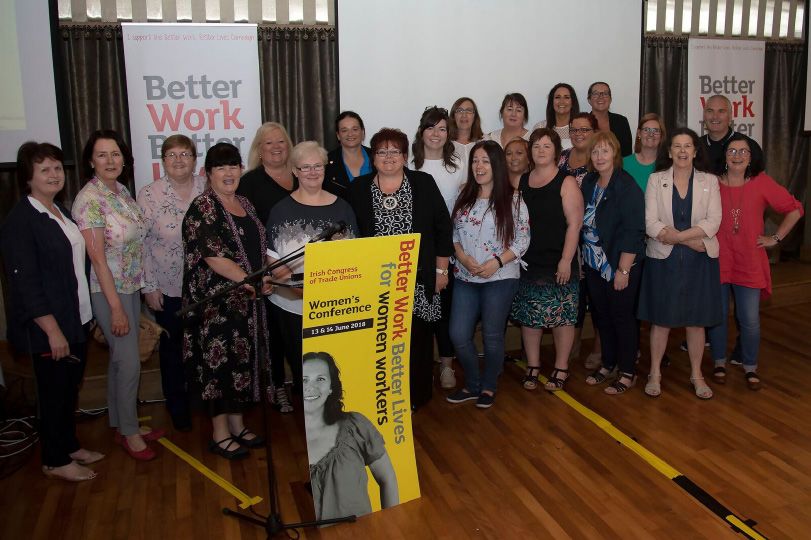
3

Report for Women’s
        Conference
   April 2018 – March 2020

   Irish Congress of Trade Unions Women’s Conference 2020
4

    Programme

    Thursday 5th March
    10.00     Registration and Tea/Coffee                    Session 2 Women and Work
    Session 1 Opening Session                                12.00   Motions on Women and Work
    11.00     Welcome and Introduction –                     			EC Report

                                                                Appropriate Sections/Paragraphs

       Margaret Coughlan and
       Geraldine Alexander, Joint                            			Report of Women’s Committees
       Women’s Committee Chairs
                                                                Appropriate Sections/Paragraphs

       Chair of Conference                                   			Voting on Motions and Agree
       Arrangements Committee                                    Sections of Reports
    			Civic welcome                                         13.00   Lunch and Fringe Events
    			Wexford Mayor,
    			Cllr George Lawlor                                    			Sandwiches and Tea and coffee
                                                                 will be available in each of the

       Sororal Greetings, Wexford                                Fringe meetings. (see separate
       Trades Council                                            documentation on Fringe
                                                                 meetings):
    11.15		 General Secretary’s address:
    			Patricia King, ICTU                                   			 1.	Work Life Balance –
    			General Secretary.                                            implementing the EU Directive,
                                                                     Marina Monaco, ETUC
                                                             			 2.	A Just Transition – Nevin
                                                                     Economic Research Institute

                                                                3.
                                                                  Women Leading the
                                                                  Resistance: Irish Palestine
                                                                  Solidarity Campaign
    Irish Congress of Trade Unions Women’s Conference 2020
5

                                      Friday 6th March
Session 3 Women and Work              Session 4 Women and Society
14.30     Motions on Women and Work   09.30 Motions on Women and Society
			EC Report                          			Intro to second day -

   Appropriate Sections/                  Alison Millar, ICTU Vice President
   Paragraphs
                                      			Guest Speaker:
			Report of Women’s Committees
                                         Noelle O’Connell, Executive

   Appropriate Sections/                 Director European Movement
   Paragraphs                            Ireland
			Voting on Motions and Agree       			EC Report
    Sections of Reports
                                         Appropriate Sections/Paragraphs
15.45		   Coffee Break                10.45     Coffee Break
16.00     Session 3 resumes           			Guest Speaker:
                                         How Choice was Won in
17.30		   End of Day 1                   Northern Ireland: Alliance for
19.30     Dinner followed by Disco       Choice
                                         Report of Women’s Committees

                                         Appropriate Sections/
                                         Paragraphs
                                      			Voting on Motions and Agree
                                          Sections of Reports
                                      13.00     Close of Conference

                                      Irish Congress of Trade Unions Women’s Conference 2020
6

    Introduction

    A warm welcome to the 2020 Irish                         ICTU General Secretary Patricia King addresses the ICTU
                                                             BDC with An Taoiseach looking on
    Congress of Trade Unions Women’s
    Conference:                                              2020 also marks the anniversaries
                                                             of important international human
    Realising our Rights,                                    rights protections for women: the
    Women Organising for Change.                             40th anniversary of the Convention
    The period covered by this report has                    for the Elimination of Discrimination
    seen momentous change across the                         Against Women (CEDAW) and the 25th
    island, from the yes vote in the Repeal                  anniversary of the Beijing Platform
    the 8th Amendment referendum in                          for Action. As we mark these, it is
    May 2018, to realisation of rights for                   important that we reflect on how far we
    LGBT+ people and women in Northern                       have come in relation to gender equality
    Ireland with the introduction of same                    but also that we remember and send
    sex marriage and reform of Northern                      solidarity to women trade unionists
    Ireland’s punitive abortion laws in 2020.                internationally who are still struggling to
                                                             achieve basic human rights.
    Trade Unions have played a crucial
    role in these historic campaigns                         I want to finish by commending the
    and it is proper that these victories                    Women’s Committee of ICTU North
    are celebrated in the theme of this                      and South for their work in promoting
    conference – Realising our Rights.                       gender equality in work, in trade unions
                                                             and in society and wish you well for this
    While doing so, we must also remember                    important conference.
    that there is still work to be done. In
    both the Republic of Ireland and in
    Northern Ireland, we face considerable
    challenges, not least in relation to the
    rise of insecure work and attacks on                     Patricia King
    worker’s rights.                                         General Secretary.

    Irish Congress of Trade Unions Women’s Conference 2020
7

Motions to the Congress
  Women’s Conference
                                            2020

       Irish Congress of Trade Unions Women’s Conference 2020
8

    Motions for the Women’s Conference 2020

    Women and the Work
    1. Tackling Sexual Harassment at Work
       ICTU Women’s Committee, Northern Ireland
    A survey examining the experience of trade union members in relation to sexual
    harassment at work was conducted by the Irish Congress of Trade Unions in late 2019,
    revealing shocking statistics. The survey sought to gain a deeper understanding of
    workers’ experience of sexual harassment at work - the types of incidents experienced,
    the perpetrators and location, the barriers to reporting, and the impact sexual
    harassment has on the lives of those affected.
    More than 600 trade union members in Northern Ireland with experience of sexual
    harassment and sexual assault in the workplace responded.
    Shockingly, 3 out of 4 (75 %) of respondents did not report the unwanted sexual
    behaviour to their employer, while of those who did report 62% felt that it was not
    dealt with satisfactorily and in some instances reported that they had been treated less
    favourably as a result of reporting sexual harassment.
    Those polled were asked to choose from several options describing the effect that the
    harassment had on them. Over half reported that they felt embarrassed, while 50%
    reported that they avoid certain work situations as a result. 38% reported that they
    felt less confident at work, with a further 21% saying it had a negative impact on their
    performance at work.
    Around a third reported that the harassment had a negative impact on their mental
    health, and a further 13% reported that there was a negative impact on their physical
    health.

    Irish Congress of Trade Unions Women’s Conference 2020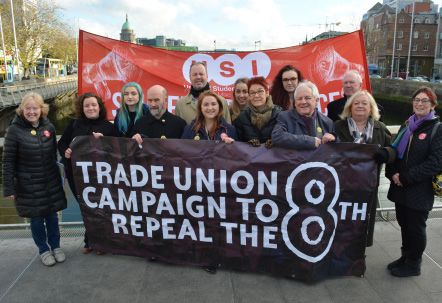
9

1. Tackling Sexual Harassment at Work continued
While the #MeToo movement has shed light on the hidden problem of sexual harassment
and sexual assault at work and empowered women to speak out, the fear of a negative
impact on careers or of not being believed or taken seriously are clearly still reasons for
not pursuing a complaint. The Equality Commission for Northern Ireland has said that
complaints in relation to workplace sexual harassment are still worryingly prevalent.
Given the scale of the problem and the impact that it has on workers and work, this
conference calls on the Irish Congress of Trade Unions to launch a comprehensive
campaign to address the root causes of workplace sexual harassment including:
•	Ensuring that the Northern Ireland Executive produce a robust Gender Equality
   Strategy which tackles gender related workplace issues, including sexual harassment.
•	Ensure the UK Government ratifies the ILO Convention 190 which mandates
   government to take proactive steps to address violence against women including in
   the world of work.
•	Campaign for the introduction of proactive duties on employers, supported by a Code of
   Practice which outlines employer responsibility to ensure that workplaces are harassment
   free zones. To include, among other areas of action, mandatory and comprehensive
   training for all staff, particularly managers and Human Resource personnel.

                                                  Irish Congress of Trade Unions Women’s Conference 2020
10

     Motions

     2. Intimidation & Sexual Harassment
        Cork Council of Trade Unions
     a)	All employees have a right to a workplace free from intimidation and sexual harassment.
     b) All workers are able to experience this right.
     c) Intimidation and sexual harassment will not be tolerated at work.
     UNISON Amendment
     At end add “Consequently conference calls on the Executive Council to:
     •	continue to make the eradication of workplace harassment a priority,
     •	with the assistance of the Women’s Committee, develop guidelines for negotiators on
        the establishment of sexual harassment policies and procedures particularly aimed at
        anti trade union workplaces, and
     •	request affiliates to share examples of best practice and achievements in the
        operation of existing anti-harassment workplace policies and procedures.”
     3. Sexual Harassment
        NASUWT
     Conference is deeply concerned by the compelling evidence of the increasing incidence
     of sexual harassment in the workplace, including sexist ‘jokes’ and ‘banter’, unwanted
     touching and the growing objectification of women and girls.
     Congress notes that the NASUWT’s research indicates that one in five members has
     experienced sexual harassment in the workplace by a colleague, manager, parent or
     pupil since becoming a teacher.

     Irish Congress of Trade Unions Women’s Conference 2020
11
3. Sexual Harassment continued
Conference is concerned by the widespread reluctance among teachers and other staff
to report harassment for fear of not being believed by employers and that even when
this abuse is reported, in the majority of cases, little or no effective action is taken by
employers to address the harassment.
Conference asserts that this is not only having a damaging impact on the physical
and mental health and wellbeing of women teachers, but is also creating a climate of
premature sexualisation of children, and in particular young girls.
Conference affirms that schools should be places of safety and must be supported in
tackling the problem of sexual harassment or violence towards either pupils or staff.
Conference therefore calls upon the ICTU to campaign for:
(i) a mandatory requirement on employers to record and report incidents of sexual
harassment and abuse against staff in schools;
(ii) schools to foster an environment in which individuals can be confident that when
reporting incidents of sexual harassment, such complaints will be taken seriously
and acted upon;
(iii) increased awareness among employers that sexual harassment can intersect with
other forms of prejudice and discrimination, including on grounds of age, class,
community background, disability, gender identity, race/ethnicity, religion/belief or
sexuality;
(iv) affiliates to work with other civil society organisations to end sexual harassment in
the workplace and wider society and
(v) the introduction of legislation to give wider protection from third party harassment
to all employees with protected characteristics.
Irish Congress of Trade Unions Women’s Conference 202012
Motions
4. Reconciling Caring Responsibilities with Work
ICTU Women’s Committee, Republic of Ireland
Family carers are the main source of care provision for those in need of care due to a
long-term illness, disability or frailty living in the community.
Noting that:
• Approximately 4.1% of the Irish population are carers (CSO 2016).
• 54.6% of carers are in the labour force(CSO, 2016).
• 61% of carers are female, 39% male.
• An ageing population will mean increased demand for care will soon exceed supply.
• Consequently, balancing work with care obligations will become an increasingly
important health, social and economic issue.
• Acknowledges the need for more public investment in our care infrastructure.
While there are existing entitlements in the Carer’s Leave Act 2001, conference urges
Congress and affiliates to seek improved terms and conditions for carers seeking to
reconcile work with caring responsibilities, which would enable carers to remain in
touch with the labour market to the greatest extent possible.
The transposition of the EU Work Life Balance Directive which provides for:
• A minimum of 5 days carers leave per year, per worker.
• Right for carers & parents to request flexible work arrangements.
• And ‘Significant room for manoeuvre’ regarding implementation provides a useful
context for the promotion of such an approach. Conference notes that the Directive
is a minimum standard and urges Congress and affiliates to strive for more ambition,
including payment to avoid it remaining an option for the better off only.
Irish Congress of Trade Unions Women’s Conference 202013
5. Reproductive Leave
ASTI
This conference calls on the Irish Congress of Trade Unions to seek statutory leave
for workers who are engaged in medical and/or related treatments in relation to
reproduction and family formation.
6. Valuing Women’s Work
CWU UK
The gender pay gap in Northern Ireland is a pervasive and systemic problem. The current
gap between men and women’s hourly earnings (of all workers, excluding overtime),
stands at almost 10%.
Much of the gap can be attributed to the ‘part time effect’ i.e. the fact that women are
more likely to work part time and these jobs tend to be lower paid than full time jobs.
This part time effect is further illustrated by assessing the gender gap in terms of the gap
in gross weekly and gross annual earnings between men and women. Gross weekly
earnings are 27% below that of men whilst gross annual earnings are almost 30% below
that of men.
This conference recognises that a whole range of measures will be required to eliminate
the gender pay gap and ensure that women’s work is valued and paid properly.
Irish Congress of Trade Unions Women’s Conference 202014
Motions
6. Valuing Women’s Work continued
This conference calls for the ICTU to press the Northern Ireland Executive to introduce,
without delay:
• Gender Pay Gap reporting regulations which take into account the particular
circumstances of the NI economy and which include fines for employers who flout
the law;
• A comprehensive Gender Pay Gap strategy and resourced action plan which
addresses the fundamental issues associated with the GPG;
• A properly resourced childcare strategy which prioritises investment in childcare
infrastructure;
• A family leave system which includes, among other measures, properly remunerated
parental leave which is reserved for both parents.
7. Flexible Working in the Performing Arts
EQUITY
Parents and carers in the performing arts often require flexible family support, due to
the unpredictable nature of their careers. Short term work contracts, precarious work,
atypical work hours and a necessity to travel for engagements are examples of the
particular challenges our members face. Access to flexible, reliable childcare is essential
if women are to have equal access to work, continuity and longevity in their careers and
if workforces in the entertainment industry are to be more diverse.
Equity calls upon the ICTU to support our work campaigning for greater awareness and
recognition of flexible working arrangements amongst employers and publicly funded
arts and entertainment organisations.
Irish Congress of Trade Unions Women’s Conference 202015
8. Domestic Violence Leave
ESU
That legislation to provide for a statutory entitlement to domestic violence paid leave
be introduced. Providing for leave is an important strand in a wider strategy to create
workplace awareness of domestic violence. Co-workers may be aware of a colleague’s
abuse but in the absence of a workplace policy are unsure on how best to support
them. Managers need guidance on how to recognise the signs of Domestic abuse and
how to respond to a staff member’s disclosure. Abusers can focus efforts on a partner’s
workplace for the purpose of ending their employment. Workplace awareness policies
ensure employees feel valued whilst working in a safe and supportive environment and
address unpredictable absenteeism and reduced productivity for employers.
9. The Future of Work
FSU
This conference recognises that the digital revolution is dramatically changing the business
environment. And while employers may embrace revolutionising the way business works
it also means a more complex role for employees. The impact and speed of diffusion and
change at which data collection, automation and digital analysis have become vital parts of
industry, including the financial services sector, seem unprecedented.
The workforce will be expected to learn new skills, individual targets may be increased
and there will be a shift on operations staff to acquire more ‘value-added’ roles. We can
already see how employers are pushing for more adaptability and flexibility and this can
have a disproportionately negative impact on women. While digitalisation will potentially
bring employers vast new profits in the form of reduced costs, global labour arbitrage
and commodification of data, for workers it threatens to bring redundancies,
Irish Congress of Trade Unions Women’s Conference 202016
Motions
9. The Future of Work continued
job insecurity, job precarity, workplace monitoring and surveillance, increased work
intensification and ‘techno stress’.
This conference notes the findings of a research study, commissioned by FSU and
undertaken by the University of Limerick, on “Technology, Work and Skills: The Impact
of Technology on Employees” which reveals that women and men had some different
experiences of workplace technology. Women were more likely to expect that there
would be a significant level of automation of their role and that their work was being
monitored through technology. The study recommends that greater attention needs to
be paid to possible gender implications of workplace technology.
Conference recognises that while there may be some advantages to technology in
regards to work-life balance (WLB), e.g. in facilitating homeworking, there is evidence
that the emergence of organisational cultures which either demand or institutionalise
the use of technology to remain engaged with work outside of working hours erode the
advantages that technology creates in relation to WLB.
Conference supports ICTU and affiliate unions in their work to protect workers from the
negative impacts of future technology on work, which includes legislation to provide
workers for the right to disconnect and to end the informal extension of the working
week and the over-use of technology for work purposes. Conference further calls
for further analysis and action on the gender implications of workplace technology,
particularly in those sectors and jobs which are most at risk.
Irish Congress of Trade Unions Women’s Conference 202017
10. Women in Education and Research Need Secure Jobs, not the false hope of “flexibility”
IFUT
This Conference calls on Congress to engage with unions representing workers in
Higher Education Institutions to urgently address the growing problem of increasingly
precarious employment across the sector.
Many studies have shown that women are disproportionately affected by the negative
impact of precarious and casual employment as researchers, tutors, lecturers, and other
crucial roles in Higher Education.
Precarity can be seen as part of the bigger picture of the commodification of education
and research. Commodification of higher education and research institutions, and even
research in general, is a significant concern for IFUT and for academic trade unions
across the world.
The current conditions of precarity and instability suit the model of an underfunded
Higher Education system where HEIs are pitted against each other and researchers
compete for the next big funding opportunity in the hope of security.
The positive spin often put on insecure work is that it offers “flexibility”, but there is a
balance to be struck between flexibility and security. Flexibility is of little use if you
cannot get a mortgage, cannot buy a house, cannot even get a small loan. Keeping
working women on casual and precarious contracts is not only immoral but it is bad for
quality education and teaching.
This Conference calls on Congress to lobby government and employers to reveal the
true extent of staff numbers on casual and precarious contracts and to tell the parents of
students in the colleges and universities exactly how many of their lecturers and tutors
have no idea if they will be kept on to teach their subjects in the next academic year or
even next term.
Irish Congress of Trade Unions Women’s Conference 202018
Motions
11. Pension Age and Female Workers
INMO
Conference recognises that the extension of the age for receipt of a state old age
pension to 67 in 2021 and 68 in 2028 will have a significant impact on female workers.
Conference further recognises that these increases will create an impossible burden
for female workers who work in occupations which require considerable physical and
psychological resilience, such as in the health services where the majority of front-line
care workers and professionals are women.
Women in the health services will not be capable of working to the threshold of
receiving the state pension in light of the demands of the care environment, which is
perpetually understaffed, physically and emotionally demanding, and where they are
experiencing increasing levels of psychological and physical abuse.
Conference calls on the Government to review these measures which will have a
disproportionate effect on women workers, who already on average receive lower
occupational pensions, and to create exceptions to recognise the particular needs of
women workers in physically and psychologically demanding occupations.
12. Stop the Pension Age Increase
SIPTU
This conference notes that the Government in the Republic intends to raise the state
pension age to 67 in 2021 and 68 in 2028; that these pension age increases are rising
faster than any other EU country (despite having the youngest population); that these
increases were introduced without any consultation with the trade union movement and
other civil society actors.
Irish Congress of Trade Unions Women’s Conference 202019
12. Stop the Pension Age Increase continued
Conference further notes that these increases will disproportionately impact on women
who are more likely to have interrupted contribution records and caring duties which
means they could be trapped in means-tested unemployment payments between
retirement age and the age they can access the state pension.
Conference therefore calls on the Government to stop the increase in the pension
age in 2021 and establish a forum whereby all relevant parties (employees, employers,
civil society groups, government) can work to achieve a consensus on the pension
age and age discrimination, living standards in retirement, sustainable finances and the
restoration of full pension rights.
13. Financing Parent’s Leave
INTO
Conference welcomes the introduction of two weeks’ parent’s leave in respect of babies
born on or after 1 November 2019, to be taken within a year of the birth. However,
Conference condemns the fact that the state benefit payable in respect of the parent’s
leave is not topped up to normal salary levels for public sector employees who avail of
the leave, and across much of the private sector. Conference considers that this failure
to top up the state benefit payment of €245 per week will result in many new parents
being unable to avail of the leave for financial reasons. Conference urges the ICTU
to engage with the government on this matter, in order to secure a top-up payment
in respect of parent’s leave across the public sector. Conference also calls upon all
employers to top up the state benefit to enable their employees to avail of the leave.
Irish Congress of Trade Unions Women’s Conference 202020
Motions
14. Parental Rights and Maternity Pay
UTU
Conference is gravely and increasingly concerned about the lack of progress made by the
relevant political bodies to address the inadequate provision of and funding for parental
leave and maternity pay entitlements. Despite claims to increasing equality in society, the
current arrangements are leaving women and families across Northern Ireland in often very
difficult circumstances, especially compared to women and families in most other OECD
countries. Conference demands that a comprehensive review be undertaken to adequately
support and value women in their role in the family and society as well as in the workplace.
15. Equality - Gender Pay Gap
MANDATE
This conference notes with dismay the continued gender pay gap in Ireland and the
prevalence of low pay and precarious type employment amongst women in large
sections of the economy. This conference calls on the ICTU to launch an equality for
women campaign to include the following:
1. Annual mandatory gender pay gap reporting by all companies and State bodies
employing more than one hundred (100) employees.
2. All companies to be legally obliged to top up the difference between State Maternity
Benefit to the average net take home pay for all female workers.
3. The State to provide a fully funded State childcare service up to the age of four (4).
4. Noting that the lack of robust collective bargaining legislation is a major contributory
factor to low pay and poor conditions in many sectors of female employment which
therefore adds to the gender pay gap, this conference calls for primary legislation
which confers the right to collectively bargain to all workers.
Irish Congress of Trade Unions Women’s Conference 202021
Women and Society
16. Safe Access to Abortion
Belfast & District Trades Council
Conference calls on both the British and Irish Governments to fulfil their full obligations
in ensuring access to safe abortion for women and pregnant people in Northern Ireland
and the Republic of Ireland without delay.
This includes creating safe access zones to protect the mental and physical health of
patients, medical staff, and the community at large. In jurisdictions without safe access (or
‘buffer’) zones, patients and staff members are routinely harassed. A range of studies and
research has demonstrated how such harassment has been shown to have a profoundly
negative effect on both patients and providers, as well as the broader community.
Beyond the fact that the mere presence of protestors serves as a source of intimidation
and stigma for many, it is important to note that many of the demonstrations that take
place outside of abortion providing facilities are not contained to ‘peaceful’ protests.
One study of abortion clinics in the United States found that only 6% of facilities had
experienced ‘peaceful’ picketing alone. The overwhelming majority of facilities were
subjected to a wide array of severely disruptive or even violent demonstrations such
as abortion opponents falsely booking large numbers of ‘no-show’ appointments,
clinics being invaded or blockaded by demonstrators, vandalism, death threats to staff
members, and picketing physicians’ homes. Anti-abortion protestors in Great Britain
have recently adopted many of the more aggressive tactics deployed by their American
counterparts, including toting signs with grisly imagery, blocking clinic entrances or
driveways, and engaging in ‘pavement counselling,’ a tactic in which protestors attempt
to physically intercept arriving patients and ‘persuade’ them not to have an abortion.
Irish Congress of Trade Unions Women’s Conference 202022
Motions
16. Safe Access to Abortion continued
People’s right to express an opinion does not include a right to damage property,
harass and threaten people, or physically obstruct the path of people attempting to
access healthcare. Safe access zones are therefore required to ensure patients and staff
members are able to freely and safely enter a healthcare facility.
Both Governments now have the opportunity to implement an effective end to end
model of abortion provision, which prioritises the well-being and safety of patients when
accessing and egressing abortion healthcare facilities in both jurisdictions.
17. New Maternity Hospital
Bray & District Council of Trade Unions
• The lengthy delay in progressing the building of the new maternity hospital while the
State awaits Vatican sign-off on the transfer of the site owned by the Religious Sisters
of Charity.
• That Papal approval of this land transfer for purposes prohibited in canon law, such as the
provision of abortion services, is unlikely to be granted.
• That the projected 99-year lease in entirely unprecedented and wholly inadequate to
a building project of this scale
• That the 2013 estimated cost of €100m of the hospital has ballooned, just like the
National Children’s Hospital, and is now expected to cost a multiple of €350m.
• That, despite being publicly funded, the new hospital is to be owned and managed by a
private Catholic healthcare company currently owned by the Religious Sisters of Charity.
Demands that, to exclude the possibility of canon law governance of the new hospital, the
facility be built on State-owned land, and, to guarantee the provision of a secular maternity
service, the new hospital company be placed in public ownership.
Irish Congress of Trade Unions Women’s Conference 202023
18. Women’s Healthcare
FÓRSA
That this Conference notes that just one year after the Minister for Health, Simon Harris,
gave the go ahead for the first phase of the new National Maternity Hospital to be built
at St Vincent’s Hospital the project has stalled as it, apparently, awaits the approval of the
Vatican for the sale of the land.
Conference further notes that at the time the Minister authorised the project to proceed
he refused to take on board serious concerns regarding the future ownership and status
of the new National Maternity Hospital raised by members of the medical profession,
campaigners, political parties and civil society groups.
Conference shares the concerns of Dr. Peter Boylan, the former Master of Holles Street
Hospital who resigned from the board of the national maternity hospital, that the
hospital, like other hospitals on land owned by the Catholic Church, will be obliged to
follow Catholic teaching and Canon Law on medical practices and procedures.
Conferences calls on the Executive Council of ICTU to support the ongoing campaign to
ensure that the ownership and control of the new maternity hospital will not impede its
complete clinical independence, that women’s healthcare will remain its priority and that
the hospital will provide all healthcare services available under Irish law.
Irish Congress of Trade Unions Women’s Conference 202024
Motions
19. The Impact of Homelessness on Women and Children
CWU
Conference recognises the work done by Congress to date to raise awareness of the
plight of the homeless through the Congress Charter of Housing Rights, through their
coalition with the Raise the Roof Campaign as well as their interaction with government
and housing activists. Conference also notes nonetheless that the homeless crisis in
Ireland has continued to escalate.
As trade unionists we are aware of the significant burden for those who are homeless. We
must also recognise the burden on women and children. In Ireland our number of homeless
women is significantly higher than in EU states with most homeless families headed by
female lone parents. Homelessness has a serious impact on women’s physical and mental
health. Furthermore, domestic violence has been cited as a cause of homelessness for
women with many relying on informal arrangements or temporary refuge.
The harmful effect on children in emergency accommodation has also been reported.
The lack of space and facilities can have a serious impact on child development.
Irish homelessness is not just a challenge, it is an epidemic and one that may cause long
term serious damage to men, women and children. We cannot allow this to become an
acceptable norm in our society.
Therefore, this conference calls on ICTU to seek a review of government housing policy
and for ICTU to put pressure on the government to implement appropriate strategies to:
• Reflect the increasing number of families caught in emergency accommodation.
• Reduce living periods in emergency accommodation.
• Ensure that those who are subjected to domestic violence can secure appropriate housing.
• Develop health care plans with a focus on child development.
Irish Congress of Trade Unions Women’s Conference 202025
20.Child Poverty and Homelessness
UNITE
This conference notes data showing that over 300,000 children on the island of Ireland
are living in poverty, with rates of child homelessness rising, including babies being
born into homelessness, and many children living in substandard accommodation or in
precarious housing situations. Conference further notes that high rates of low pay in
both the Republic of Ireland and Northern Ireland mean that children of parents in work
may experience housing need.
Conference also notes the finding of a study carried out by London’s Royal Holloway
University at the request of Dublin City Council examining the impact of homelessness
on children forced to live in hotels or similar accommodation for an extended period
of time, which found significant impacts in terms of physical and mental health, and
developmental delay.
This conference therefore instructs the Irish Congress of Trade Unions to develop a
comprehensive policy to address the causes and consequences of child poverty and
homelessness, and to lobby government in Northern Ireland and the Republic of Ireland
for implementation of that.
Irish Congress of Trade Unions Women’s Conference 202026
Motions
21. Intimate Partner Violence (IPV)
Galway Council of Trade Unions
Predominantly committed by a male partner against a female partner - is a major social
issue requiring greater government intervention.
IPV has devastating effects on women and children (as inadvertent victims) and can end
in femicide and child murder.
This conference calls on the Irish government (and the Northern Assembly) to urgently
legislate for formal reviews of domestic killings.
Learning from such domestic homicide reviews will help save lives as without them
statutory and other relevant agencies lack the ‘whole picture’ and are unlikely to see the
full pattern of male violence against women and children.
The introduction of domestic homicide reviews will better aid governmental
programmes and service provision designed to lower our rates of domestic violence.
22. The Impact of Welfare Cuts on Women
GMB
From late 2008, the UK Government set out a programme of austerity that has
continued for over 10 years. Cuts in public spending have been shown to have particular
impact on certain groups in society. In 2011, 270,000 public sector jobs were cut as
austerity measures started to bite. Research from the Runnymede Trust and Women’s
Budget Group in 2016 showed that women, people of colour and particularly women of
colour were impacted by job cuts, as they were more likely to be employed in the public
sector, be in low-paid jobs and insecure work, and have higher levels of unemployment.
Irish Congress of Trade Unions Women’s Conference 202027
22. The Impact of Welfare Cuts on Women continued
The unemployment budget was frozen, which has led to increased difficulties due to
rising inflation. Benefit claimants affected by budget cuts and sanctions led to increased
use of food banks, with over one million people in the UK using a food bank between
2014 and 2015. With an increase in zero hour contracts, part time work and low paid
work, there is a new generation of working poor who are also dependent on benefits.
Universal Credit and the draconian welfare cuts imposed on working people, as well as
those in search of employment or that due to ill health are unable to work, are having
a devastating effect on women. They create more problems, pushing women and their
families into poverty.
In Northern Ireland, the £500 million mitigation package established by the Northern
Ireland Executive against welfare cuts is set to run out in March 2020, and its expiration
could have dire consequences for women living in poverty, leading to a ‘cliff edge’
unless alternative arrangements are put in place urgently.
Working mothers in Northern Ireland further struggle to access affordable childcare. In
Northern Ireland we have the highest weekly expenditure on childcare and therefore
the highest weekly childcare element of Child Tax Credits. As Universal Credit payments
are paid in arrears of up to 5 weeks, this places greater financial burdens on families
accessing childcare. Children in Northern Ireland do not receive up to 30 hours of
childcare as is the case in other regions, creating deep unfairness that results in negative
impacts on women.
Conference calls on the ICTU Women’s Committee to campaign on the following issues:
• To avoid the “cliff-edge” of the ending of welfare mitigations in Northern Ireland in
March 2020;
Irish Congress of Trade Unions Women’s Conference 202028
Motions
22. The Impact of Welfare Cuts on Women continued
• To end practices where victims of the crime, domestic violence and abuse must
choose whether they can survive with no money for at least 5 weeks, maybe with
children, or stay with abuser;
• To scrap the disgraceful two-child benefit cap, which is neglecting our children,
pushing women into deeper poverty and creating inequalities within families;
• The vile “Rape Clause” must be removed as it forces women to disclose or lose
benefits, when women in violent relationships are not in a position to do so. Benefit
officers are not equipped to process disclosures on rape or violent sexual crime and
do not have capacity to manage these disclosures;
For affordable, accessible, high quality childcare in Northern Ireland, including the 30
hours childcare that is available in other parts of the UK.
23. Women, Poverty and Austerity
NIPSA
The cumulative impact on women’s everyday lives as a result of 10 years of the
government’s austerity and welfare reform policies has been major. This is due to a
range of societal factors that make women more vulnerable to these policies – women
are more likely to claim social security benefits, more likely to use public services,
more likely to be in low-paid, part-time and insecure work, more likely to be caring
for children/family members and more likely to have to make up for cuts to services
through unpaid work. Women often bear the brunt of poverty in households managing
household budgets to shield their children from its worst effects. Women act as the
‘shock absorbers’ of poverty going without food, clothes or warmth in order to meet the
needs of other family members when money is tight.
Irish Congress of Trade Unions Women’s Conference 202029
23. Women, Poverty and Austerity continued
In total, it is estimated that austerity since 2010 will have cost women a total of £79bn,
against £13bn for men. It shows that, by 2020, men will have borne just 14% of the total
burden of welfare cuts, compared with 86% for women. Furthermore, the group with
the highest poverty throughout the last decade and worst impacted by welfare reform
have been lone parents in Northern Ireland; of which 91% are women.
Conference calls on the government to:
• Create a gender impact assessment of Universal Credit to assess the disproportionate
impact on women; including the relationship between Universal Credit and increased
domestic violence.
• Protect those most impacted by welfare reform and austerity and provide tailored
advice and support to ensure maximum uptake.
• Abide by CEDAW recommendations to abolish the two-child cap on child tax credits.
• Implement and adopt a strategy to tackle poverty, social exclusion and patterns of
deprivation on the basis of objective need; with a particular focus being placed on
disabled women, lone parents and single women pensioners.
• Strengthen gender equality of outcomes across all public expenditure and
government departments by progressing towards gender responsive budgeting.
• Promote equality in procurement including that linked to the reduction in corporation
tax and how this impacts on women.
• Create appropriate measures to effectively tackle wide-spread discrimination based
on pregnancy or maternity.
• Protect and provide financial guidance and support as women approach retirement,
particularly as the age of qualification for state pensions rises.
Irish Congress of Trade Unions Women’s Conference 202030
Motions
24. Access to Education for Asylum Seekers
TUI
The ongoing barriers faced by migrants, refugees, and asylum seekers who wish to pursue
education or training in Ireland include the lack of availability of affordable childcare and
transport, the uncertainty or short-term nature of their visa or residential status, the lack of
recognition of their existing qualifications, and the limited availability of beginner or upskilling
English language classes. This conference recommends that the State implements a policy
similar to the Pilot Student Support Scheme to facilitate undocumented people’s access
to third-level education. It also recommends that the State introduce practical supports
to increase the accessibility of apprenticeships to people from minority ethnic groups,
including the adoption of specific measures for women.
This conference further recommends that all measures introduced to support
participation in further education and third-level institutions are evaluated in line with
the Public Sector Equality and Human Rights Duty and the CERD (UN) recommendations
to ensure their accessibility to minority ethnic groups and address any remaining
administrative and financial barriers.
25. Brexit and the Impact on Women in Northern Ireland
UNISON
At the time of writing, whilst Boris Johnston has struck a new agreement with the EU, it
is not clear whether or not that agreement will be passed by the UK parliament. Major
uncertainties remain around the impact that Brexit will have on the island of Ireland,
North and South, however, it is clear that particular issues will be faced by women as a
result.
Irish Congress of Trade Unions Women’s Conference 202031
25.Brexit and the Impact on Women in Northern Ireland continued
Women in Northern Ireland are greatly under-represented in public and political life. This
was clearly evident in the lead up to the Brexit referendum and remains a worrying issue
in the current Brexit negotiations. Under-representation in political negotiations and
decision-making, alongside several other areas lacking in gender parity such as access
to education, training, work, affordable childcare and more, highlight the profoundly
negative impact Brexit is set to have on women in Northern Ireland.
This is compounded with the political instability creating several barriers to women
having their voices heard. Many areas of women’s human rights have yet to be achieved,
and Brexit has added a new threat to existing, hard-fought rights women currently have.
Northern Ireland faces unique constitutional complexities meaning Brexit presents a
unique threat to this region.
Many of the rights we enjoy today have come through membership of the EU over the
past four decades; particularly in areas of economic activity and employment law. For
women, there are great concerns that Brexit will erode many of these protections. Some
of these protections include:
• Equality between men and women
• The right to equal pay for equal work
• Protection against discrimination on the ground of pregnancy and maternity
• Introducing measures to provide specific advantages to the under- represented gender
• Prohibition of discriminations on the grounds of sex
• Introduction of paid holidays.
Furthermore, the EU recognises the need for wide-spread structural change to deal with
systematic gender discrimination through their commitment to Gender Mainstreaming
and the Gender Recast Directive 2006.
Irish Congress of Trade Unions Women’s Conference 202032
Motions
25. Brexit and the Impact on Women in Northern Ireland continued
Other areas of EU legislation, representation and funding that are relevant to the
protection and enhancement of women’s rights and participation include the European
Protection order, which is significant in recognising women’s rights as they cross the
border; the Rural Development Programme, which NIRWN highlight as significant
given historic government underinvestment in rural women; the European Social Fund,
which is important to increasing women’s access to the workforce; the European
Parliamentary Committee on Women’s Rights and Gender Equality, alongside various EU
funding streams that support the voluntary and community sector in Northern Ireland.
It is deeply concerning that limited guarantees have been made to protect, or enhance,
the rights mentioned above post-Brexit. However, the UK Government has already
taken steps to remove the EU Charter of Fundamental Rights, which contains numerous
specific rights relevant to women; future case law of the Court of Justice of the
European Union (CJEU) will no longer be binding in UK courts post-Brexit; and the
Human Rights Act 1998 remains under threat of repeal from the Tories.
There have been worrying misinterpretations of the Belfast/Good Friday Agreement by
the current Prime Minister. With Northern Ireland still the crux of disagreements on how
the UK should leave the EU, and ongoing political instability growing as a concern, it is
essential to point out the importance of avoiding a divergence of rights on either side
of the border. For example, areas of protections such as violence against women, or
child maintenance payments, rely on EU wide measures to ensure the legal systems on
the island of Ireland are co-ordinated to protect vulnerable people through the criminal
justice and family law systems. This is essential to ensure that people cannot avoid the
repercussions of violence against women, or refusing to pay child maintenance, by
simply crossing the border.
Irish Congress of Trade Unions Women’s Conference 202033
25. Brexit and the Impact on Women in Northern Ireland continued
All aspects of the Belfast/Good Friday Agreement need to be protected and
implemented; including a Bill of Rights for Northern Ireland where specific focus can be
given to the rights of women.
It is evident that women in Northern Ireland are in line to face the brunt of the impact
of Brexit. The UK Women’s Budget Group maintains that women will be adversely
impacted by the economic impacts of Brexit. This can only get worse for the women of
Northern Ireland, who have greatly suffered from the past decade of austerity and are
deeply concerned about the impact of welfare reform and future austerity on gender
equality. The economic consequences of Brexit are set to have disproportionately
negative impacts on rural women, disabled women, LGBTQ+ women, women of colour,
women living on the border, migrant women and more as they lose many human rights
protections and funding streams supporting their participation and empowerment.
Women in Northern Ireland are already facing great barriers due to political instability, an
arguably failed peace process, a collapsed Assembly, the lack of implementation of the
UNSCR 1325, an outdated Northern Ireland Gender Strategy, unprecedented levels of
poverty and having limited representation in Brexit negotiations. With all the hard fought
women’s rights protections won at an EU level now at risk, and many human rights still
failing to have been implemented at all, there are many reasons to be deeply concerned
about the impact of Brexit on the women on Northern Ireland.
Conference calls on the ICTU Women’s Committee to continue to campaign for the
protection of the particular circumstances that women in Northern Ireland are facing as
a result of Brexit. This should include calling for greater recognition and participation of
women within the Brexit process; and ensuring that women’s rights are protected and
enhanced, rather than being eroded, by Brexit.
Irish Congress of Trade Unions Women’s Conference 202034
FÓRSA members Committee
Irish Congress of Trade Unions Women’s Conference 202035
Conference
Report
April 2018 - March 2020
Irish Congress of Trade Unions Women’s Conference 202036
Conference Report 2020
Women’s Committee
The Officers of the Women’s
Committee during the period covered
by the report were:
Northern Ireland:
Chairperson
Geraldine Alexander (NIPSA)
Vice Chairperson
Margaret McKee (UNISON)
Secretary
Eileen Gorman (FSU)
Republic of Ireland:
ICTU Women’s Committee
Chair The Women’s Committee is one of the
Margaret Coghlan (FÓRSA) longest standing formal committees
Vice Chair to September 2019 of Congress and has an important to
Betty Tyrell Collard (Dublin Trades play in identifying issues that are a
Council) priority for working women across all
sectors and in so doing makes a positive
Vice Chair from September 2019 contribution to Congress policy.
Alison Regan (SIPTU); and
Secretary
Melissa Brennan (FÓRSA)
Irish Congress of Trade Unions Women’s Conference 202037
Women’s Committee Chairs with ICTU General Secretary Women’s Committee members Danielle McCusker and Cllr
Patricia King, ITUC Chidi King and Chair of Fermanagh Alison Gilliland together with Claire Hanna MLA
Council
The constitution of the Committee sets out the functions to be:
t he co-ordination of policy or action by affiliated organisations catering for
women workers on matters relating to the interests of women; the investigation
of problems arising from the employment of women in industry, services and
the professions; the preparation of reports on aspects of women’s employment,
conditions of work, remuneration etc.
Irish Congress of Trade Unions Women’s Conference 202038
A Work programme based on the The major initiatives of the Women’s
motions that were passed at the 2018 Committee during the period were the
Women’s Conference, the 2018 NIC organisation of a National Women’s
ICTU Biennial Conference and the 2019 Conference in 2018 and National
ICTU Biennial conference was adopted Women’s Seminar in 2019 as well as
by the committee. participation in the Women’s Council
of the Isles, an initiative that brings
Priority issues North and South included: together the TUC, STUC, WTUC and
1. Highlighting the issues affecting ICTU Women’s Committees on an
women in the workplace including annual basis.
insecure work, gender pay gap,
workplace harassment.
2. Tackling violence against women,
including domestic violence and
abuse, human trafficking and
combatting sexual harassment at
work.
3. Campaigning for reform of
legislation on reproductive rights,
including abortion.
4. Highlighting the disproportionate
impact of austerity on women and
supporting gender budgeting.
Chairs of the womens committee with Owen Reidy, ICTU AGS
5. Campaigning for comprehensive,
quality affordable childcare systems.
Irish Congress of Trade Unions Women’s Conference 202039
Standing ovation for Repeal the 8th campaign co-ordinator ICTU Women’s Committee Chair J White and Ailbhe Smyth
Ailbhe Smyth
The Women’s Conference 2018
The Women’s Conference took place
in Enniskillen in June 2018 and had the
theme of Better Work Better Lives for
Women Workers.
Some 170 delegates gathered to debate
21 motions relating to Women and
Work, Women in Unions and Women in
Society.
Speakers included Congress General
Secretary, Patricia King who told
delegates that gender equality is no Trade Union Campaign to Repeal the 8th
longer simply the right thing to do, but
is an economic imperative – with the The conference also included an address
IMF claiming that up to 10% of GDP is by Ailbhe Smyth of the Together for
lost as a result of gender inequality in Yes campaign, fresh from the historic
our labour market. referendum result that repealed the 8th
amendment to the constitution and paved
Dr Caitriona Crowe spoke about the the way for women’s reproductive rights to
Centenary of the Representation of the be respected in the Republic of Ireland.
People Act which extended the vote to
include some women. Fringe meetings
were held on topics including Women
and Precarious Work, Abortion as a
Workplace Issue, Sling the Mesh and the
Women’s Pledge.
Irish Congress of Trade Unions Women’s Conference 202040
Delegates to the Women’s Seminar March 2019
The Women’s Seminar 2019
The Seminar took place in Newcastle,
Co Down in March 2019. The theme of
the seminar was Women’s Leadership
in work and in society – challenges and
opportunities.
Some 150 delegates gathered to listen
to keynote speakers including Chidi
King, Director of Equality at the ITUC
and Esther Lynch, Confederal Secretary
with the ETUC.
As a result of those discussions
Congress is now running a Women in
Leadership course for delegates from
affiliates North and South. The course
explores what leadership means in the
context of the trade union movement
and particularly focusses on how
women can be supported to take on
leadership roles within their trade
unions – more below.
Dr Lisa Wilson, NERI at the Women’s Seminar in 2019
Irish Congress of Trade Unions Women’s Conference 202041
Women’s Council of the Isles Women and Leadership in the
Members of the Committee participated movement
in the Women’s Council of the Isles Supporting women to take on
meetings in 2018 and 2019. leadership roles within their unions and
The Council of the Isles in 2018 took elsewhere has been a long standing
place in Dublin and presentations priority for the women’s committee.
included the ICTU Assistant General At the 2018 Women’s Conference, a
Secretary on Brexit, the TUC on motion from TUI on Women in Unions
stereotyping and violence in work, the was overwhelmingly supported. The
Wales TUC on hidden disabilities and motion said:
gender and the ICTU on the gender pay
gap and abortion as a workplace issue. Women of all ages are currently under-
represented in Leadership positions in
In 2019, the Council of the Isles took trade unions.
place in London and discussions
centred around the rise of the far right, In order to encourage more women
a delegation of trade union women who to take up leadership roles at all levels
visited Palestine as well as focusing on within their unions…this conference
the significant equality and human rights calls on ICTU to organise a mentoring/
victories gained in Northern Ireland. training programme for trade union
Delegates also discussed the landmark members in the regions in order to
ILO convention on protection against empower, encourage and enable more
Violence and Harassment at work, women to take up leadership roles in
particularly focusing on ratification by their unions.
the UK and Irish Governments.
Irish Congress of Trade Unions Women’s Conference 202042
This was subsequently considered by Rozanne’s appointment will mean that
the ICTU Executive Committee and all of the trade union Centres in Ireland
debated further at the Women’s Seminar and Britain will be led by women,
in 2019 when it was agreed that the with Frances O’Grady as the General
initial courses should be restricted to Secretary of the TUC; Shavanah Taj
women. recently announced as the acting
Secretary of the Wales TUC and of
The pilot Women and Leadership course course Patricia King as General Secretary
will be run over three days in Feb/March of the Irish Congress of Trades Unions.
2020. There was a huge response to
the course, so much so that it was well
oversubscribed with consideration
being given to running a further three
days.
Women leading Congresses
The Scottish Trades Unions Congress
has announced that Rozanne Foyer
is to replace Grahame Smith as its
General Secretary. Foyer will be the
first woman to hold the position, the
most senior representative of Scotland’s ICTU Vice President Alison Millar
540,000 trade union members, in the
organisation’s 123-year history. She will
take up the post when Grahame Smith
retires later this year.
Irish Congress of Trade Unions Women’s Conference 202043
A task and finish group to redraft
guidelines for employers on workplace
policies was established and Chaired by
the NI Equality Officer. The resultant
Guidelines were published in Autumn
2018 and launched at an event in Belfast
City Hall to mark the international Day
for the Elimination of Violence against
Women and the 16 days of action
campaign.
Speakers from a range of trade unions
and statutory agencies spoke at the
event to highlight the importance
of addressing issues raised for the
NIC Women’s Committee workplace by domestic and sexual
International Day for the Elimination of violence and abuse.
Violence against Women – Congress is now working with a range
November 2018 of affiliates and with the Equality
As part of ongoing work to establish Commission for NI to promote the
domestic and sexual violence as a Guidelines to employers, particularly in
workplace issue, the Equality Officer the private sector.
(NI) participates in a Strategic Advisory
Group to the Departments of Health
and Justice. Lobbying by Congress has
ensured that this issue has been included
in annual action plans overseen by the
Departments.
Irish Congress of Trade Unions Women’s Conference 2020You can also read


