ROGER WILLIAMS UNIVERSITY FACILITIES MANAGEMENT EMPLOYEES ASSOCIATION NEARI/NEA CONTRACT BOARD OF TRUSTEES ROGER WILLIAMS UNIVERSITY BRISTOL ...
←
→
Page content transcription
If your browser does not render page correctly, please read the page content below
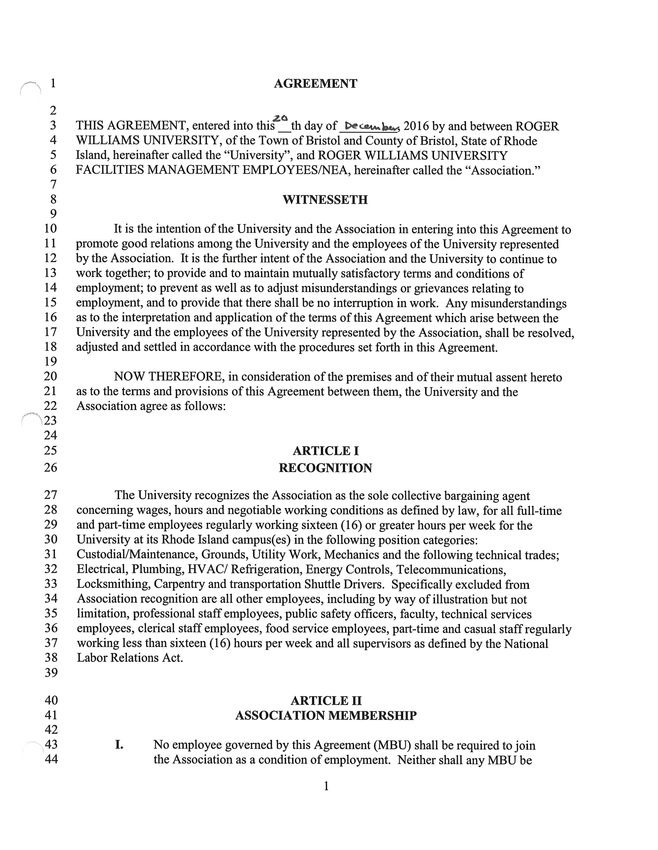
ROGER WILLIAMS UNIVERSITY
FACILITIES MANAGEMENT EMPLOYEES
            ASSOCIATION
             NEARI/NEA

            2016-2020
          CONTRACT
             with the
      BOARD OF TRUSTEES
                of
   ROGER WILLIAMS UNIVERSITY

              In

     BRISTOL, RHODE ISLAND
TABLE OF CONTENTS

                                                                               Page

AGREEMENT                                                                      1

ARTICLE I RECOGNITION                                                          1

ARTICLE II ASSOCIATION MEMBERSHIP                                              1-3

ARTICLE III RIGHTS OF MANAGEMENT                                               4

ARTICLE IV STRIKE-LOCKOUT                                                      4

ARTICLE V DISPUTE RESOLUTION & DISCIPLINE                                      4-8
Section 5.A. Labor/Management Forum                                            4-5
Section 5.B. Grievance                                                         5-7
Section 5.C. Discipline and Discharge                                          7-8

ARTICLE VI HEALTH & SAFETY                                                      8-11
Section 6.A. Compliance & Enforcement                                           8
Section 6.B. Employee Identification                                            8
Section 6.C. University Safety Committee                                        8
Section 6.D. Maintenance & Storage of Equipment & Materials                     9
Section 6.E. Emergency Closing Policy                                           9-10
Section 6.F. No Smoking Policy                                                 10-11

ARTICLE VII EMPLOYMENT                                                         11-24
Section 7.A. Pledge Against Discrimination, Coercion & Conflicts of Interest   11-12
Section 7.B. Probationary Employment                                           12
Section 7.C. Seniority                                                         12-16
Section 7.D. Bargaining Unit and Non-Bargaining Unit Employment                16-19
Section 7.E. Shift Transfer                                                    19
Section 7.F. Regular Work Week                                                 20
Section 7.G. Working Hours                                                     20
Section 7.H. Overtime                                                          20-22
Section 7.I. Call-Back & Call-In                                               22-23
Section 7.J. Performance Evaluations                                           24

ARTICLE VIII SUBCONTRACTING                                                    25

ARTICLE IX BENEFITS                                                            25-51
Section 9.A. Family Leave Policy & Procedure                                   25-33
Section 9.B. Sick Leave                                                        33-38
Section 9.C. Court Required Service             38
Section 9.D. Vacation                           39-40
Section 9.E. Bereavement Leave                  40-41
Section 9.F. Workers’ Compensation              41-42
Section 9.G. Military Leave                     42
Section 9.H. Holidays                           42-43
Section 9.I. Extraordinary Leave                43-44
Section 9.J. Leave for Association Activity     44-45
Section 9.K. Absence without Leave              45
Section 9.L. Health Insurance                   45-48
Section 9.M. Life Insurance                     48
Section 9.N. Retirement                         48-49
Section 9.O. Short-Term Disability Insurance    49
Section 9.P. Long-Term Disability Insurance     49
Section 9.Q. Business Travel Insurance          49
Section 9.R. Insurance Carrier                  49
Section 9.S. Tuition Remission                  49-51

ARTICLE X WAGES                                 51-55
Section 10.I. Salary Program                    51-55

ARTICLE XI MISCELLANEOUS                        56
Section 11.A. Chief Steward                     56
Section 11.B. Payroll                           56
Section 11.C. Gender Neutrality                 56
Section 11.D. Shuttle Driver Handbook           56

ARTICLE XII ENTIRE AGREEMENT & PAST PRACTICES   56

ARTICLE XIII EFFECTIVE DATE AND DURATION OF
AGREEMENT                                       57-58

APPENDIX A Roster of Positions                  59

APPENDIX B Shuttle Driver Handbook              60-64
45          discriminated against by either the University or the Association on
46          account of membership or non-membership in the Association. The University
47          agrees that a statement explaining the rights and obligations of MBUs under the
48          terms of this section will be included in all offers of employment. Additionally,
49          both the University and the Association agree to provide an opportunity to newly
50          hired MBUs, for a full explanation of the rights and obligations under the terms of
51          this section in a scheduled or special orientation forum where both the University
52          and the Association designees are invited to be present.
53
54   II.    The terms of employment of all MBUs are covered by the collective
55          bargaining agreement negotiated by the University and the Association. The
56          parties recognize, additionally, that the Association is legally required to fairly
57          and fully represent all individuals included in the bargaining unit, whether they
58          are Association members or not. The negotiation and administration of this
59          Agreement entails expenses for all MBUs covered by this Agreement. Therefore,
60          an MBU who does not choose to join the Association, shall pay an Agency Fee
61          Charge, representing the cost of collective bargaining, as determined by the
62          National Education Association of Rhode Island, providing that such charge shall
63          be calculated to include only such costs and not other expenses/activities of the
64          Association or its affiliates, and provided that membership in the Association has
65          not been denied to the MBU for reasons other than non-payment of dues
66          uniformly required as a condition of membership. Payment of this Agency Fee
67          Charge by such MBU shall be a condition of employment and shall be formally
68          noticed by the Association, including the amount of the charge, to each MBU,
69          with copy to the University, through its Executive Vice President for Finance &
70          Administration (EVPF&A) or EVPF&A’s express designee.
71
72   III.   Each time the Association Dues or Agency Fee Charges are adjusted, the
73          notice must be renewed to all MBUs with copy to University through its
74          EVPF&A. The collection of either Association Dues or Agency Fee Charges
75          shall be from payroll deduction by University’s Payroll Division of the
76          Department of Human Resources (HR), acting for University and on behalf of the
77          Association as follows:
78
79          A. Following completion of the standard one hundred twenty (120) calendar day
80             probationary period of employment for full-time MBUs and the standard one
81             hundred fifty (150) day probationary period of employment for part-time
82             MBUs, or the first two hundred ten (210) calendar days following date of hire
83             for part-time MBUs, whichever first occurs, Agency Fee Charges will
84             commence in the first, full payroll, and that Agency Fee Charge will be
85             ratably apportioned on a biweekly basis as set up by the Association and
86             delivered to HR. This deduction procedure shall continue until Association
87             Dues are voluntarily invoked by the MBU in accordance with provision B.
88             below.
89

                                             2
90 B. New Association members’ Dues will commence being deducted in the first
91 full pay period following both successful completion of the standard
92 probationary period of employment, or specified period of employment for
93 part-time MBUs, referenced above and the University Payroll Division of
94 Human Resources’ receipt of a written, signed authorization by an MBU to
95 deduct Association Dues, including the amount to be deducted on a biweekly
96 basis for each Association member as designated in provision A. above.
97
98 All Association Dues deductions will continue, unless and until the
99 University Payroll Department receives written,
100 duly-signed notification from either the Association member or the
101 Association itself that it no longer authorizes Association Dues
102 deduction, in which case the Agency Fee Charges will commence
103 being deducted and will continue unless and until the MBU opts to
104 rejoin the Association.
105
106 C. Implementation by Human Resources of changes in directed
107 deductions as invoked by the Association in accordance with this
108 ARTICLE, shall be made as soon as practicable but no later than the
109 second full payroll following formal notice of a change in the
110 biweekly Association Dues or Agency Fee Charge. Upon Association
111 notice, Human Resources will inform all members of the bargaining
112 unit of the charges invoked by the Association.
113
114 D. All Association Dues and Agency Fee Charges, deducted in
115 accordance with this provision will be deposited in the Association-
116 directed account on a monthly basis with a corresponding report of said
117 activity provided to the Association’s Treasurer. The monthly report
118 shall identify payors of all Association Dues and Agency Fee Charges,
119 along with the individual and composite amounts deducted. The report
120 will also identify all newly hired employees, with their position title,
121 wage rate and date of hire.
122
123 IV. University, through its EVPF&A, and the Association, through its Chief
124 Steward and/or Treasurer will, in good faith, entertain and respond to
125 questions and concerns from MBUs as to policy and procedure
126 concerning Association Dues and Agency Fee Charges.
127
128 V. The Association and University agree that any and all liability and costs incurred
129 as a result of University’s good faith, intended compliance with this section shall
130 be borne exclusively by the Association. This means that, except in the case of
131 intentional misconduct or wanton reckless disregard for the liabilities and
132 associated costs of noncompliance, the Association holds University harmless for
133 any and all liabilities and costs incurred as a result of its administration of this
134 ARTICLE of the collective agreement.
135
3136 ARTICLE III
137 RIGHTS OF MANAGEMENT
138
139 Subject to the provisions of this Agreement, the University shall have the right to
140 exercise the regular and customary functions of management; including the right to hire,
141 discharge, promote, demote, layoff and discipline employees; the right to determine how, when,
142 where and by whom work is to be performed; the determination of job content; the judgment as
143 to the ability of an employee to handle a particular job and the right to make and enforce rules
144 and regulations. Any of the rights, powers, functions or authorities which the employer had,
145 prior to the signing of any Agreement with the Association, are retained by the employer except
146 as those rights, powers, functions or authorities are specifically abridged or modified by this
147 Agreement. It is further agreed that the rights of management are not subject to arbitration under
148 any circumstances except as otherwise specifically provided for in this Agreement. The
149 University, at its discretion, may employ students of Roger Williams University, providing it
150 does not layoff or dismiss a regular employee as a result of student employment, nor use a
151 student to permanently fill a vacancy.
152
153
154 ARTICLE IV
155 STRIKE-LOCKOUT
156
157 It is agreed between the Association and the University that during the term of this
158 Agreement or any renewal, or extension hereof, whether or not there be a grievance dispute
159 pending, there shall be no strike, lockout, slow down, or stoppage of work, sit-in, demonstration,
160 display, banner, picketing or advertisement.
161
162 ARTICLE V
163 DISPUTE RESOLUTION & DISCIPLINE
164
165 Section 5.A. Labor/Management Forum
166
167 I. A committee consisting of University and Association representatives may
168 meet for the purpose of reviewing the administration of this Agreement
169 and to discuss problems which may arise.
170
171 II. Either party to this Agreement may request a meeting and shall submit a
172 written agenda of topics to be discussed seven (7) days prior to such meeting.
173 Request by the Association for such a meeting will be made to the Office of
174 General Counsel.
175
176 Quarterly, on March 1st, June 1st, September 1st and December 1st, the
177 University and Association will meet to review issues of importance
178 and/or concern to seek proactive resolution to those issues.
179
180
181 These meetings are not intended to bypass the grievance procedure,
4182 the normal administrative structure, or to be considered collective
183 negotiating meetings, but are intended as a means of fostering good
184 employee relations through an exchange of views between the parties
185 to this Agreement. Amendments to this Agreement may be discussed
186 as a proactive measure for potential dispute resolution.
187
188 III. A maximum of three (3) employee representatives of the Association may
189 attend such meetings. Employee representatives who attend such
190 meetings, during their scheduled work shift, shall be granted time off to
191 attend without loss of pay.
192
193
194 Section 5.B. Grievance
195
196 I. Definition of Grievance
197
198 A grievance is a complaint by one or more employees or the National Education
199 Association that there has been a misinterpretation, misapplication or definitive
200 violation of any term(s) of this Agreement or that one (1) or more employees have
201 been treated so inequitably that such treatment constitutes a violation of this
202 Agreement.
203
204 A. Inequitable treatment is defined, for purposes of this Agreement, as an
205 application of the provisions of this Agreement that are both inconsistent with
206 the terms of this Agreement and wholly inconsistent with established
207 managerial precedents without reasonable justification.
208
209 II. Grievance Procedure
210
211 This Agreement sets forth the basic terms and conditions of employment, (and is
212 intended to continue the present good relations) between the University, its
213 employees and the Association; the representatives of both agree to make prompt
214 and earnest efforts to settle grievances.
215
216 In the event that an employee or the Association feels that they have a basis for a
217 grievance, in accordance with the above definition, and have informally discussed
218 the situation giving rise to the grievance with his/her supervisor or the Director of
219 Facilities Management (or, as appropriate, the Director of Public Safety), the
220 following procedure shall be used:
221
222 Step 1: The Association Steward and the employee shall submit the grievance to
223 the Director of Facilities Management (or, as appropriate, the Director of Public
224 Safety) within ten (10) calendar days after the occurrence first giving rise to the
225 grievance. The written grievance shall explain, as specifically as possible, the
226 nature of the complaint and the contract provision affected. The Director shall
227 have the option to meet with the grievant and/or Union for clarification and
5228 resolution and/or to give a written answer to the written grievance within ten (10)
229 calendar days of receipt of the written grievance.
230
231 Step 2: If the matter is not settled at Step 1, the Association, within ten (10)
232 calendar days after receipt of the written answer from the supervisor or within ten
233 (10) calendar days after the answer is due, may request, in writing, a meeting with
234 the Chief Human Resource Officer or the Officer’s designee to take place within
235 seven (7) calendar days of said request. The grievant may attend this meeting at
236 the request of either party. The Step 2 request must state the reason the Step 1
237 decision is not satisfactory. The University’s decision shall be given in writing
238 within ten (10) calendar days after the meeting.
239
240
241 Step 3: If the Association is not satisfied with the disposition of the grievance at
242 Step 2, or if no disposition has been made within ten (10) business days after the
243 meeting, the grievance will be referred to the Federal Mediation and Conciliation
244 Service (FMCS) for grievance mediation, which will begin as soon as can be
245 mutually scheduled. Any discussions or communications that occur between the
246 parties during such mediation shall be confidential and shall not be cited to or
247 offered as evidence and admissible in any court or arbitration proceeding. Either
248 party may, upon written notice to the other, elect to waive the requirements of
249 Step 3 and proceed directly to arbitration as outlined below.
250
251 Step 4: If settlement is not reached at Step 3, the Association only may, within
252 thirty (30) working days after the mediation’s closure (or, if mediation waived by
253 the parties, within thirty (30) working days of the date of the Step 2 decision’s
254 issuance, or within thirty (30) working days of the date that disposition should
255 have been rendered, whichever is sooner), demand arbitration before an impartial
256 arbitrator under the rules of the American Arbitration Association. , Subject to
257 those limitations stated herein, the appointed arbitrator’s decision shall be final
258 and binding upon both parties. The arbitrator shall be selected pursuant to the
259 rules and procedures of the American Arbitration Association whose rules shall
260 likewise govern the arbitration procedure. The arbitrator shall not add to, subtract
261 from, change or disregard any of the terms or provisions of this Agreement. The
262 fees and other charges of the arbitrator shall be equally divided between the
263 parties.
264
265
266 III. Employee’s and University’s Right to Settle Individual Grievances
267 Without Precedent
268
269 The Association and the University jointly acknowledge the right of any
270 of the employees involved to present individual grievances directly to their
271 supervisor or the Director of Facilities Management as appropriate and,
272 without precedent or persuasive authority of any kind whatsoever, to work
273 out the settlement of such individual grievances. Proposed but failed
6274 settlement of any such grievance may not be used as evidence of any kind
275 in any proceeding. Further, individual employees shall not have the right
276 to proceed to, or demand, arbitration under this Agreement.
277
278 IV. Pay for Grievance Time
279
280 Where Steps 1, 2 and 3 of the grievance procedure take place during working
281 hours, time incurred during a scheduled work shift of the Chief Steward or any
282 grievant as a result of their attending a grievance hearing or formal arbitration
283 hearing during work hours will be fully paid release time from their work shift.
284
285 Section 5.C. Discipline and Discharge
286
287 I. A disciplinary measure imposed upon an employee may be processed as a
288 grievance as set out above.
289
290 II. Discipline under this Agreement is the formal imposition upon an employee of a
291 written reprimand, a suspension without pay or discharge for cause.
292
293 III. The University will not discharge a non-probationary employee without just
294 cause. An employee who is discharged may file a grievance at Step 2 of the
295 grievance procedure set out above.
296
297 IV. Where circumstances warrant, including the nature and severity of an employee’s
298 unacceptable conduct, progressive discipline will be utilized. However, there are
299 no prescribed sanctions in number or severity prior to termination.
300
301 V. It shall be the University’s responsibility to demonstrate a level of misconduct or
302 competency of service, including non-performance, warranting the discipline
303 imposed.
304
305 VI. Pre-disciplinary warnings that are committed to an employee’s personnel file will
306 be removed from such file if there are neither any recurrences of pre-disciplinary
307 or disciplinary offenses over a nine (9) month period of time from the insertion of
308 the warning in an employee’s personnel file nor any similar, specifically
309 identified performance deficiencies in an employee’s filed, official evaluation
310 during that same time period.
311
312 VII. Every employee shall have one (1) official personnel file (“OPF”), which shall be
313 kept and maintained by the Department of Human Resources. The OPF shall
314 constitute the singular repository of all formal University personnel records
315 pertaining to an employee’s appointment, disciplinary record (if any), and
316 evaluated job performance. Employees shall be given notice or copies of all
317 documents related to discipline or job performance that are added to the OPF.
318 An employee may review the contents of his/her personnel file at any time upon
7319 reasonable notice to the Department of Human Resources and under procedures
320 reasonably invoked by the Department of Human Resources.
321
322 Nothing herein shall preclude the University from creating and/or maintaining
323 managerial records kept or used only by the employer.
324
325
326 ARTICLE VI
327 HEALTH & SAFETY
328
329
330 Section 6.A. Compliance & Enforcement
331
332 The University shall continue to enforce, and all employees shall continue to comply with
333 all legal regulations governing the health and safety of working conditions at the University.
334 Employees must observe, as a condition of continuing employment, the University’s published
335 safety rules. Employees shall immediately report, to their supervisor or designated chair of the
336 University Safety Committee, any condition that they are aware of and believe to be unsafe or in
337 violation of standing health and safety regulations of the University. Additionally, employees
338 shall report any injuries sustained or witnessed at the University in accordance with direction
339 given by the University.
340
341 Section 6.B. Employee Identification
342
343 Employees shall wear, as provided and directed, identification tags/badges for both
344 security and identification purposes. The cost of initial issuance of identification tags/badges
345 shall be borne by the University. The cost of lost, destroyed or misplaced identification
346 tags/badges shall be borne by the employee. Discipline for unintentionally lost, destroyed or
347 misplaced identification tags/badges will not be invoked until at least the third occurrence in a
348 twelve (12) month period and will first consider all relevant facts on a case by case basis, subject
349 to the grievance/arbitration procedure. Reasonable wear and tear over time is expected and will
350 not be cause for discipline.
351
352 Section 6.C. University Safety Committee
353
354 The Association may appoint a member of the bargaining unit to the University Safety
355 Committee to represent the interests of the bargaining unit.
356
357
8358 Section 6.D. Maintenance & Storage of Equipment & Materials
359
360 Properly maintained equipment and properly stored equipment and materials utilized in
361 the performance of work at the University is essential to the safety of all and the productivity of
362 University’s “Facilities Division” of operations. The University will make available, adequate
363 space and facility for both use and storage of equipment and materials. Employees will follow
364 all direction given for proper use, maintenance and storage of all equipment and materials
365 utilized in the performance of their job(s).
366
367 I. At least annually, the Labor/Management Forum, convened under Section 5.A. of
368 this Agreement, will address the adequacy of space and the facilities for storage of
369 equipment and materials as well as the maintenance of equipment and materials
370 entrusted to the Facilities Division of operations.
371
372 Section 6.E. Emergency Closing Policy
373
374 I. The University may, from time to time, officially close its operations in
375 whole or in part, following procedures outlined in the Contingency Plans for
376 Emergency Closing, in response to unusual conditions such as inclement weather
377 or unanticipated occurrences emanating from internal or external factors and
378 rendering the University, or a part thereof, unfit for regular operation. The
379 authority to close operations is vested in and restricted to, the President, and as
380 permanent designee, the Executive Vice President for Finance and
381 Administration.
382
383 A. An emergency closing may, but need not be affected University-wide.
384 It may also be regional to a building, area or part thereof and/or it may
385 be functional to a group, operation or event.
386
387 II. An emergency closing may be declared at any hour of the day, with immediate
388 notification to the Chief Steward, and shall remain effective for the period
389 specified by said authority or in the absence of a specified period, for eight (8)
390 hours from the time the closing is declared.
391
392 III. When the closing as defined by the University is effected, those employees
393 specifically released as nonessential services personnel by the declaration shall be
394 released from reporting to work and shall be compensated at their regular rate of
395 pay for such released period. All essential services personnel, except as notified
396 that they are released from reporting to work, are to report or remain at work
397 during an emergency closing, and shall receive double their regular rate of pay for
398 that period of actual work reporting, during the University-declared emergency
399 closing.
400
401 IV. When closing is regional to a building, area, or part thereof, and the
402 University provides alternative work site(s) for affected individuals, those
9403 employees are expected to remain at the alternative work site(s) and will receive
404 their regular rate of pay for the regular shift(s) worked at the alternative work
405 site(s). A regional closing or a functional closing (such as the early closing of
406 scheduled classes), does not of itself enable the work release of any employees.
407
408 V. Facilities personnel are essential services personnel unless otherwise specifically
409 notified.
410
411 A. Specific circumstances and operational needs may dictate express designation,
412 on a case-by-case basis, of personnel released from said designation. All new
413 employees shall be notified at the time of hire of their designation as essential
414 services personnel.
415
416 Unless employees designated herein as “essential services personnel” are
417 specifically and expressly relieved of that designation in writing, they are and
418 shall remain, essential services personnel.
419
420 Section 6.F. No Smoking Policy
421
422 I. Preface: Roger Williams University takes pride in providing an atmosphere
423 where students, employees and guests can breathe easy. In addition to
424 outstanding academic programs, a beautiful scenic bayside campus and pleasant
425 environment for study and work, the University continues to enhance a healthful
426 environment for all in the University community.
427
428 The University is committed to providing wellness opportunities for all students,
429 faculty and staff. Whether it is cardiovascular, emotional or respiratory fitness,
430 the total health of each student and employee is important to Roger Williams
431 University. Part of the emphasis on wellness includes a clean, healthy respiratory
432 environment for all in the University community. To ensure a healthier
433 atmosphere for everyone on campus, and following input and recommendation
434 from a special University committee comprised of representatives from faculty,
435 staff and students, the University adopts the following policy:
436
437 II. Policy Statement: In compliance with the State of Rhode Island’s Smoking Law,
438 and except as specifically provided for herein, smoking of any materials is
439 prohibited on University premises, including all residence halls, offices and
440 University vehicles. As a reasonable accommodation to individuals desiring to
441 smoke, the University has established designated, outside smoking areas as the
442 exclusive venue for smoking while on University premises. These areas were
443 designated to remove the reasonable likelihood of second hand smoke migrating
444 back into a building, as this is a requirement of the law.
445
446 III. Implementation: In accordance with Rhode Island Law, smoking is prohibited
447 outside of any doorway or area where smoke could migrate back into a building.
10448 Accordingly, signs have been placed at the entrance to buildings, informing
449 individuals that smoking is prohibited in the building and the entryway.
450
451 Smoking at and only at designated areas is allowed. All smoking material must
452 be extinguished and disposed of within the designated area at a receptacle
453 provided.
454
455 IV. Information & Compliance: It is the responsibility of every
456 member of the University community to observe and uphold this policy,
457 informing visitors of its existence and parameters, and except as set out
458 immediately below, directing questions, concerns and reports of violations, to the
459 Department of Environmental Health and Safety (ext. 3189). Concerns by or
460 involving all students (other than students of the law school) should be directed to
461 the University’s Student Affairs Division. Students who are found smoking in the
462 residence halls are immediately subject to judicial action and/or may be assessed a
463 fine.
464
465 Incoming students and new personnel shall be informed of the smoking policy
466 during orientation.
467
468 A map of the University, marking the designated smoking areas will be made
469 available to those who request it through the Department of Environmental Health
470 and Safety (EHS). To request a map, please call EHS at ext. 3189.
471
472
473 ARTICLE VII
474 EMPLOYMENT
475
476 Section 7.A. Pledge Against Discrimination, Coercion & Conflicts of Interest
477
478 I. The provisions of this Agreement and all correlative employment practices shall
479 be applied equally to all employees without regard to age, ethnicity, disability,
480 marital status, national origin, race, religion, gender, sexual orientation, veteran
481 status or political affiliation as defined by law and unless otherwise prohibited by
482 applicable law.
483
484 II. All references to employees in this Agreement designate both sexes, and wherever
485 one gender is used, it shall be construed to include both male and female
486 employees.
487
488 III. The Association recognizes its responsibility as bargaining agent and agrees to
489 represent all employees in the bargaining unit without discrimination,
490 interference, restraint or coercion regardless of membership or lack of
491 membership in the Association.
492
11493 IV. The University agrees there shall be no discrimination, interference, restraint or
494 coercion against or involving any employee because of Association membership
495 or lack of membership or because of employee activity or lack of activity
496 concerning any legal activities of the Association, except that both parties to this
497 Agreement understand and agree that employees of University have a primary
498 employment responsibility to University and employees may not engage in
499 activity that conflicts with that primary employment responsibility; specifically
500 and primarily; including by way of example, the abuse of accruals to pursue other
501 employment.
502
503 Section 7.B. Probationary Employment
504
505 I. Full-time employees, new to the bargaining unit shall, upon hire into an
506 Association-recognized and represented position, serve a probationary period of
507 employment of one hundred twenty (120) calendar days during which the
508 provisions of this Agreement do not apply. The University may extend the
509 probationary period; one time only; at its discretion for up to a maximum of thirty
510 (30) additional calendar days upon at least one (1) week’s notice to the
511 Association and employee, prior to expiration of the probationary period. During
512 an extension of the probationary period, the provisions of this Agreement apply
513 except that the probationary employee may be terminated “at will” by University
514 and the probationary employee shall have no recourse to termination including
515 utilization of the grievance procedure. Part-time employees’ probationary period
516 shall be one hundred and fifty (150) days. All other provisions as set out
517 immediately above in this provision apply to part-time employees.
518
519 II. Full-time employees who successfully bid into another position classification
520 within the bargaining unit serve a performance-based probationary period of thirty
521 (30) calendar days during which University will evaluate the employee’s ability
522 and performance in the new position. If the employee is unable to demonstrate, to
523 the satisfaction of the University, their ability to satisfactorily perform all
524 responsibilities of the position, the employee will be returned to his former
525 position. The University’s decision as to ability and commitment to successfully
526 perform in the new position shall not be arbitrary nor capricious. In the case of an
527 unsuccessful internal promotion, there will be no loss of classification-based
528 seniority in the position to which the unsuccessful employee returns.
529
530 Section 7.C. Seniority
531
532 I. Definition of Seniority / Computation of Seniority
533
534 Seniority shall be defined as the length of time an MBU has been continuously
535 employed by the University in this bargaining unit. Seniority shall be calculated as
536 date of entry into an Association-recognized and represented position within the
537 bargaining unit. Employees new to the bargaining unit will not earn seniority credit
538 during the probationary period as defined under Article VII, Section 7.B. above, but
12539 upon completion of one’s probationary period, seniority credit will be gained,
540 retroactive to the date of entry into a recognized bargaining unit position. The
541 University shall maintain a seniority roster consistent with this provision. The
542 University will, on each October 1 and April 1, post and furnish to the Union a
543 seniority list and will correct such lists from time to time as may be necessary.
544
545 In cases where two or more MBUs have the same bargaining unit seniority date (as
546 defined by date of entry into an Association-recognized and represented position
547 within the bargaining unit), the seniority tie shall be broken by reference to the last
548 digit of the affected employees’ social security numbers. The employee having the
549 highest last single digit in his/her social security number will be granted a higher
550 seniority ranking than the other(s) with whom he/she is tied. In the event any tied
551 employees have both identical bargaining unit seniority dates and the same single
552 last digit in his/her social security number, ties shall be broken by reference to the
553 last two digits of those affected employees’ social security numbers, with the
554 employee having the highest last two digits being granted the higher seniority
555 ranking.
556
557 The seniority of an MBU who, without a break in University service, transfers into
558 the bargaining unit from another University position shall be calculated and defined
559 as set forth this section, and bargaining unit seniority shall be applied to those MBUs
560 in a manner consistent with the provisions of this Article. However, such MBUs’
561 eligibility (and where applicable, caps and rates of accrual) for paid-time time off
562 and retirement benefits as set forth and provided for in this Agreement shall be
563 determined based upon the length of continuous University service.
564
565
566 II. Loss of Seniority: Seniority shall be terminated for the following reasons:
567
568 1. Voluntary resignation/retirement.
569
570 2. Termination for cause.
571
572 3. Layoff for a period exceeding eighteen (18) months.
573
574 4. Failure to return following notice of recall (see III.B. below).
575
576 5. Transfer to a position outside the bargaining unit.
577
578 6. Termination during an extended probationary period.
579
580 7. Death.
581
582
583
584
13585 III. Application of Seniority
586
587 A. Layoff
588
589 1. In the event that a layoff becomes necessary due to lack of
590 work, monetary conditions, other legitimate circumstances or
591 some combination of the foregoing, employees shall be laid off
592 on the basis of inverse seniority in the job classification from
593 which the reduction in force is affected.
594
595 2. The University shall simultaneously provide the Association
596 and the non-probationary employee(s) affected, either a two (2)
597 week notice of layoff or two (2) weeks of pay at the then
598 current rate and schedule of regular hours of the employee(s).
599 The Association may request and have scheduled, a meeting
600 with the Chief Human Resource Officer or his/her designee, to
601 discuss possible alternatives; however, the final decision is at
602 the discretion of the University.
603
604 3. When an employee is scheduled for layoff due to reduction or
605 reorganization in the workforce, prior to any bumping
606 permitted pursuant thereto, the non-probationary employee shall
607 be considered for transfer into a vacancy in a bargaining unit-
608 recognized position, if one exists, and if determined qualified
609 by the University, transferred into said vacancy. Transference
610 into the vacant position carries a ninety (90) day performance-
611 based probationary period. During said period, if the University
612 is not satisfied with the probationary employee’s performance
613 but no earlier than thirty (30) days into the probationary period,
614 it will then place such employee on layoff. An employee thus
615 laid off shall remain entitled to recall into his/her job
616 classification only for the remainder of the recall period but
617 shall not be entitled to transfer into another vacancy if one
618 exists at the time of layoff. Discharge of the transferred
619 employee during his/her probationary period is not grievable.
620
621 4. When an employee is scheduled for a layoff due to a reduction
622 or reorganization in the workforce, he/she shall be permitted to
623 exercise his/her seniority rights to replace (bump) the least
624 senior employee in a classification for which he/she is deemed
625 qualified, provided the employee with greater seniority is, under
626 reasonable assessment by the University, deemed qualified to
627 perform the work and provision 3. above has been followed, if
628 applicable. As layoff is job classification based, the only
629 bumping permitted hereunder is as follows:
630
14631 a. An employee with greater bargaining unit seniority as
632 recognized by this Agreement, may bump a
633 fellow member of the bargaining unit even if the
634 employee laid off is not working in the job classification
635 for which seniority has been accumulated, subject to the
636 reasonable assessment of qualifications by and at the
637 discretion of the University. The University’s findings
638 concerning qualifications of the employee seeking to
639 bump a less senior bargaining unit member may not
640 be arbitrary nor capricious.
641
642 b. There is a reasonable presumption that an employee laid
643 off from a lower paid classification than another
644 classification in which that employee holds seniority, is
645 not qualified to bump the higher paid classification.
646 That presumption is rebuttable with the burden of
647 rebuttal on the employee seeking to “bump up” this
648 Agreement’s position-based pay scale.
649
650 B. Recall
651
652 1. Only non-probationary employees are eligible for recall.
653
654 2. The recall period shall be for eighteen (18) months from date of
655 layoff.
656
657 3. Recall shall take place with the most senior employee on layoff
658 in the job classification recalled, first recalled.
659
660 4. Recall shall be served upon an employee to be recalled by
661 certified mail, return receipt requested at employee’s last known
662 address. The recalled employee must respond to the notice of
663 recall within one (1) week of receipt of the notice or recall
664 rights shall be forever waived. Response must be either by
665 personal or certified mail delivery of acceptance of recall in a
666 signed writing. Employee accepting recall must return to work
667 as instructed, within two (2) weeks of receipt of the recall
668 notice.
669
670 C. Qualifications Evaluation for Position Openings
671
672
673
674 All vacant positions in the bargaining unit will be posted for a minimum
675 of one (1) week prior to University formally filling the vacancy. The posted
676 position shall be in one (1) or more conspicuous locations and shall include the
15677 job title, primary assignment location if there is one, rate of pay, summary of
678 responsibilities and its initial, scheduled shift. Upon the conclusion of the posting
679 period, the University shall review the applications from bargaining unit members
680 and, if there are pre-qualified applicants, a job fair will be convened and the most
681 senior pre-qualified candidate will be awarded a position, leaving an opening that
682 may be filled by the most qualified candidate, if one exists. Pre-qualification
683 shall be established by identifiable assessment standard(s) (as outlined by position
684 description and/or published qualification standards or state licensure as required
685 in position description). If there are no pre-qualified bargaining unit members,
686 the hiring process reverts to an unrestricted search from within and outside the
687 bargaining unit and the most qualified candidate, as determined by the rational
688 judgment of the University, will be selected. Any member of the bargaining unit
689 who has formal disciplinary status of record and consisting of a suspension is
690 disqualified from bidding on any position within the bargaining unit for a period
691 of nine (9) months from the date of the last disqualifying infraction, or until
692 voluntarily removed by the University or removed in accordance with the formal
693 dispute resolution process governed by this Agreement, following the imposition
694 of the disciplinary sanction.
695
696 The parties agree to, on a case-by-case basis, confer and negotiate with regard to
697 the setting of rates of pay for individuals who voluntarily bid into lower-paying
698 job classifications. Employees who successfully bid on and are awarded such
699 positions will have the opportunity to be advised of the applicable pay rate of the
700 new position prior to accepting it.
701
702 D. Other Applications
703
704 Please see ARTICLE VII, Section 7.D.II., 7.E., 7.F., 7.I. and 7.J. and
705 ARTICLE IX, Section 9.D.II.E.
706
707
708 Section 7.D. Bargaining Unit and Non-Bargaining Unit Employment
709
710 I. Full and Part-time Positions
711
712 All positions whose incumbents are regularly and continually scheduled for forty
713 (40) hours of work per week, year round, are full-time positions. All positions
714 which average at least sixteen (16) hours per week over the course of each six (6)
715 month period are considered regular, part-time positions, except that all Shuttle
716 Drivers’ positions which average at least eight (8) hours per week over the course
717 of each six (6) month period are considered regular, part-time positions. All part-
718 time Shuttle Drivers who average at least eight (8) hours per week but less than
719 sixteen (16) hours per week of service have secondary bid preference to regular
720 part-time bargaining unit employees when qualifications are deemed equal and
721 seniority governs as a tie breaker. Regular full-time and part-time employees
16722 occupying such positions are members of the bargaining unit.
723
724 II. Temporary Positions
725
726 All positions, which at their creation are intended to be of limited duration and
727 utilized to supplement the regular contingent of full-time and part-time positions
728 of the University are temporary positions. These positions are not recognized as
729 part of the bargaining unit covered by this Agreement. Except for emergency
730 situations or urgent need to immediately supplement the work force on what is
731 reasonably expected to be a temporary basis, temporary positions shall be first
732 offered to bargaining unit members who seek to attain the learning and skills of
733 another job classification, and whom the University deems at least minimally
734 qualified. These positions shall not continue beyond six (6) months. Any
735 temporary position which continues beyond six (6) months and is at least funded
736 at sixteen (16) hours per week on average, over that time, becomes a bargaining
737 unit position as set out above. Upon becoming a bargaining unit position, the
738 position will be considered vacant for purposes of competitive bidding on the job
739 from within or outside the bargaining unit.
740
741 A. An employee from within the bargaining unit or outside the bargaining
742 unit who fills a regular full or part-time vacancy during the search for
743 a permanent hire or during an authorized leave of absence of a member
744 of the bargaining unit from a regular full or part-time position are not
745 considered temporary employees and those vacancies are not
746 considered temporary positions under this Agreement. If an employee
747 filling such temporary vacancy is otherwise a member of the
748 bargaining unit, he/she shall remain a member of the bargaining unit.
749 If the employee filling such temporary vacancy is not otherwise a
750 member of the bargaining unit, he/she shall not become a member of
751 the bargaining unit by filling the temporary vacancy.
752
753 B. Both temporary positions and temporary vacancies in regular full or
754 part-time positions shall; when neither disruptive of operations nor
755 University efficiency in facilities service delivery; be temporarily
756 filled by at least minimally qualified, interested bargaining unit
757 members, in seniority order, in order to improve skills and provide
758 experience qualifying them for promotion opportunities in regular full
759 and part-time positions. Bargaining unit members who are formally
760 pre-qualified for promotion will, in seniority order, be considered the
761 most qualified candidate for the position in accordance with Section
762 7.C.III.C. above. Annually, on July 1st, University will provide the
763 Association with a report of all bargaining unit members who have
764 been provided an opportunity to fill a temporary vacancy in a more
765 highly paid position, and will denote those who have been pre-
766 qualified for promotion.
767
17768 C. Pre-qualification shall be established by identifiable assessment standard(s)
769 (as outlined by position description and/or published qualification standards or
770 state licensure as required in position description) and will be available for
771 assessment of an employee, upon reasonable notice and following any
772 employee’s request. Further, any employee desiring to pre-qualify for a
773 position shall, upon request, be given an outline of the standards expected
774 which may be the job description or an abstract of the job description
775 encompassing the work and skills expected, as well as recommendations of
776 pertinent reference material where said information is in the possession of the
777 supervisor at the time of the request. MBU’s who have continuously served in
778 a temporary assignment for a period of 120 days or longer shall be considered
779 pre-qualified to perform the duties of the position associated with such
780 temporary assignment.
781
782 III. Roger Williams University Student Employment
783
784 University students may work up to twenty (20) hours per week in the
785 Facilities Department during the academic year, as assigned by the University.
786 This employment is not recognized as bargaining unit employment. A complete
787 list of all University student’s names who have been hired to perform work
788 regularly performed, during the academic year, by MBUs and their collective
789 hours of work over the previous thirty (30) days, shall be submitted to the
790 Association Chief Steward on the first work day of each month, commencing with
791 the first full month following ratification of this Agreement.
792
793 RWU will, for between every one (1) and four (4) non-bargaining unit employees
794 temporarily hired under Article VII to supplement its summer (i.e., non-academic
795 year) groundskeeping workforce per summer, offer one (1) interested, minimally
796 qualified MBU the opportunity to be temporarily reassigned to a higher level
797 developmental opportunity in a position under the terms outlined in Article
798 VII.D.II. Consistent with the considerations outlined in Article VII.D.II, and
799 after good faith consultation with the Association, and after considering seniority
800 and equitable distribution of developmental opportunities amongst MBUs, RWU
801 shall make the final determination as to which MBU(s) will be offered the
802 temporary reassignment(s) referenced in the immediately preceding paragraph.
803 RWU further retains the right and prerogative to determine whether, when, and/or
804 with whom to backfill the permanent position held by any temporarily reassigned
805 MBU during the period that (s)he is temporarily reassigned pursuant to the terms
806 outlined in the immediately preceding paragraph.
807
808 The University will make its best good faith efforts to commence the assignment
809 of any MBU(s) selected for the higher level developmental opportunity referenced
810 herein by the first or second pay period within the month of June. Higher level
811 developmental assignments made pursuant to this section will be of a minimum
812 duration of six weeks.
813
18814 IV. Casual Employment
815
816 Employees who work less than sixteen (16) hours per week on average,
817 calculated each six (6) months of employment in the Facilities Department are not
818 members of the bargaining unit. This threshold of employment is defined as
819 casual employment.
820
821 A. Shuttle Drivers who work less than eight (8) hours per week on average,
822 calculated each six (6) months of employment in the Department of Public
823 Safety are not members of the bargaining unit. This threshold of employment
824 is defined as “casual employment”.
825
826 V. Supervisors & Bargaining Unit Work
827
828 Non-bargaining unit, supervisory employees shall not perform bargaining unit
829 work at a level, including continuity and volume of work, that causes
830 displacement of a bargaining unit position or would otherwise prevent, subject to
831 ARTICLE VIII SUBCONTRACTING, a feasible, recognized, Association-
832 represented position from being created.
833
834 Supervisors who perform bargaining unit work, estimated to be at least one hour,
835 shall notify the Association Steward when and as soon as practicable.
836
837 VI. Periodic Review
838
839 In order to track proper administration of the foregoing, University will provide
840 the Association with a monthly report indicating temporary employment and
841 duration and casual employment and duration. Any non- bargaining unit
842 employee who works at least six (6) months and exceeds the sixteen (16) hour per
843 week work average, will become a non-probationary member of the bargaining
844 unit thereafter unless such employee is dismissed on or before the end of the sixth
845 month of non- bargaining unit employment.
846
847
848 Section 7.E. Shift Transfer
849
850 When shift transfers are determined as necessary by the University and the transferred
851 shift will be for more than one (1) week, prior to directed transfers, the University will seek and
852 accept qualified volunteers to change shifts. If there is more than one (1) volunteer deemed
853 equally qualified by the University for the transfer, the most senior volunteer will be transferred.
854 If there are no volunteers, the most junior qualified employee in the transferred job classification
855 will be transferred. Except in the case of emergency, the employee transferred involuntarily will
856 be given ten (10) days’ notice (from date of reassignment) to rearrange his/her personal schedule
857 and commence the new shift. The Association will be copied on all such notices.
858
19859 Section 7.F. Regular Work Week
860
861 The regular workweek shall consist of five (5) eight (8) hour days, making a total of forty
862 (40) hours per week. All work in excess of forty (40) hours within the employee’s scheduled
863 workweek, or in excess of eight (8) hours per day shall be paid at the rate of time and one-half
864 (1½) of the individual employee’s straight-time hourly rate. Full-time employees will be entitled
865 to have two (2) consecutive days off per week; such days off to be scheduled by management.
866 No employee shall receive overtime pay unless overtime work has been authorized by the
867 designated supervisor. The pay period shall be Saturday to Friday, inclusive.
868
869 Section 7.G. Working Hours
870
871 I. Basic Rule
872
873 Hours of work for all non-probationary, regular, full-time and part-time
874 employees, shall be continuous with the exception of an unpaid lunch period.
875 Subject to the foregoing, and Section 7.F. Shift Transfer, the University retains its
876 prerogative to set and change the work hours and work shifts of all employees.
877 However, such adjustments shall neither be arbitrary nor capricious nor utilized as
878 a disciplinary measure.
879
880 II. Lunch Period
881
882 Every member of the bargaining unit who is scheduled to work at least six
883 (6) hours in a given day is entitled to a one-half (½) hour lunch period to be taken
884 as set out by University.
885
886 III. Paid Break Period(s)
887
888 One (1) fifteen (15) minute, paid break period shall be granted to each
889 employee for each scheduled and worked four (4) hour period. Therefore, a full-
890 time regular employee shall be entitled to two (2) fifteen (15) minute paid break
891 periods per eight (8) hour work shift. With the consent of the University, which
892 shall not be unreasonably denied, one (1) or more paid breaks, as set out herein,
893 may be combined with the unpaid lunch period to permit a longer lunch break
894 period and ensure that the one-half (½) hour lunch period isn’t extended without
895 authorization.
896
897 Section 7.H. Overtime
898
899 I. Basic Rule
900
901 All work in excess of forty (40) hours within the assigned workweek, in
902 excess of eight (8) hours per day or on an employee’s regular days off each week,
903 shall be paid at the rate of time and one-half (1½) the individual employee’s
904 straight-time hourly rate. Time off for holidays and paid sick leave under this
20905 Agreement will be considered hours worked for purposes of computing weekly
906 overtime compensation. Overtime is not a matter of entitlement under any
907 circumstances, but a pay rate when work beyond the eight (8) hour day, forty (40)
908 hour week or an employee’s regular days off is available and either offered or
909 directed by the University.
910
911 MBU’s may, at the University’s discretion, be offered the opportunity to
912 volunteer for and be assigned to work overtime opportunities outside of his or her
913 position classification provided that such assignments do not conflict with the
914 MBU’s assigned primary work schedule and/or duties associated with the MBU’s
915 primary job classification. Overtime opportunities shall be offered to employees
916 within the subject job classification prior to extending such opportunities to
917 MBUs whose primary position is outside of the subject classification. For
918 purposes of offering and extending overtime opportunities to MBUs outside of the
919 subject job classification, the University retains the sole discretion to determine
920 whether or not the MBU who seeks the additional assignment outside of his or her
921 classification is qualified, provided such determinations are neither arbitrary nor
922 capricious. The hourly wage for overtime assignments granted under this
923 paragraph shall be calculated based upon the hourly base wage rate for the
924 position classification in which the overtime opportunity arises.
925
926 In the case of snow-removal and other storm-related emergency closure details to
927 which MBUs are assigned, the rate of pay for MBUs who work in such
928 assignments will be calculated based upon the hourly wage rate of an MBU’s
929 position of record. If, however, a Maintenance Specialist or Custodian is both
930 licensed and assigned to operate heavy snow removal equipment, then s/he shall
931 be paid at the Grounds rate.
932
933
934 II. Overtime Equalization
935
936 A. An overtime tally shall be prepared for each job classification and
937 utilized for offering overtime to employees. Overtime shall be offered,
938 within the affected classification to the member with the least amount
939 of overtime. If the member(s) with the least amount of overtime on
940 the tally sheet is/are not available or initially refuses to work, overtime
941 will be charged each such employee for that time and it will be next
942 offered to the next member on the overtime list.
943
944 B. An employee out on authorized leave, including but not limited to sick
945 leave, family leave and vacation leave is considered not available and
946 accordingly will be charged. An individual out on leave who wishes
947 to work overtime and can provide such clearance to return to work as
948 required by University, may so inform his supervisor and if overtime
949 assignment on an involuntary basis is directed by the University, the
950 individual will be the first individual called prior to overtime
21951 assignment in inverse seniority order.
952
953 C. An overtime list will be maintained and posted in each department on
954 the bulletin board. The Association will be given a biweekly list of
955 all overtime worked by members of the bargaining unit.
956
957 D. Overtime shall be equalized, to the extent reasonably practicable, on
958 an annual basis, with differences carried over into a subsequent year.
959 The annual review shall be conducted in July of each year and to the
960 extent reasonably practicable, equalization of the prior year will be
961 effected before January 1st of the following year. Issues concerning overtime
962 equalization, except for the covenants set out above, are grievable and may be
963 submitted to the Labor/Management Forum as set out in this Agreement.
964
965 E. Overtime, Including Equalization for Shuttle Drivers Only
966
967 Overtime opportunities and equalization will continue to be managed at the
968 reasonable discretion of University with quarterly utilization reports shared
969 with Association and reasonable opportunities afforded Shuttle Drivers who
970 received less opportunities over the past quarter year. There will be no
971 payment of overtime for time not worked following the reviews and
972 information sharing with the Association.
973
974 Issues concerning overtime equalization, except for the covenants set out
975 above, are grievable and may be submitted to the Labor/Management Forum
976 as set out in this Agreement.
977
978 Section 7.I. Call-Back & Call-In
979
980 I. Any employee recalled to the University to do overtime work after having
981 completed their shift and after having physically departed from the University,
982 shall be paid a minimum of four (4) hours of overtime whether or not the
983 employee is required to work the full four (4) hours. The University will not
984 manufacture work in order to keep the employee the entire four (4) hours but it
985 may call-back or call-in an employee to handle multiple tasks which do result in
986 up to four (4) full hours of work.
987
988 II. If an employee is contacted no more than an hour and one-half (1½)
989 before the start of his/her shift and asked to report one hour (1) or less
990 early, this will constitute regular overtime for the time worked and will not
991 constitute call-back or call-in.
992
993 III. Employees will cooperate with the University in responding to call-back
994 to work directives. Subject to the right of the University to require call-
995 back and call-in of employees without restrictions in the event of an emergency
996 and otherwise first on a qualified volunteer basis, and failing adequate response
22You can also read


