Regional Jobs and Investment Packages Latrobe Valley Local Investment Plan - September 2017 - Business ...
←
→
Page content transcription
If your browser does not render page correctly, please read the page content below
Regional Jobs and Investment
Packages

Latrobe Valley
Local Investment Plan
September 2017

RJIP Local Investment Plan - Latrobe Valley   September 2017   1 of 24
Table of Contents
1            Introduction ................................................................................................................ 5
2            Regional overview and analysis.................................................................................. 6
3            Investment Sectors and Strategic Priorities................................................................. 7
3.1          Investment Sector: Advanced Manufacturing, Aerospace and Defence....................... 7
3.2          Investment Sector: Education & Training – Research & Development ......................... 8
3.3          Investment Sector: Energy and Resources ............................................................... 10
3.4          Investment Sector: Food and Fibre ........................................................................... 11
3.5          Investment Sector: Health and Social Assistance ..................................................... 12
3.6          Investment Sector: Professional Services ................................................................. 13
3.7          Investment Sector: Visitor Economy ......................................................................... 14
Attachment 1........................................................................................................................... 15
Attachment 2........................................................................................................................... 23
Bibliography ............................................................................................................................ 24

RJIP Local Investment Plan - Latrobe Valley                   September 2017                                                            2 of 24
Forward The Australian Government has committed $220 million to the Regional Jobs and Investment Packages (RJIP) to help regions in Australia diversify their economies, stimulate long-term economic growth and deliver sustainable employment. The Latrobe Valley is one of ten regions which have been chosen to be a part of the RJIP and will be receiving $20 million. RJIP funding will be available through three streams: Business innovation grants Local infrastructure grants Skills and training grants The Latrobe Valley Local Planning Committee has been established to assess the Latrobe Valley’s economic opportunities and competitive advantages by developing the Latrobe Valley Local Investment Plan, an investment partnership between local communities, business and the Australian Government. The Latrobe Valley Local Investment Plan identifies investment sectors and strategic priorities to assist the creation of sustainable industries and jobs into the future. The Plan provides an economic and strategic overview of the region based on an assessment of the Latrobe Valley’s competitive advantages and potential areas of growth. Strategic priorities are associated with each investment sector. These priorities focus on specific activities as exemplars designed to enhance current markets, unlock new markets, and create opportunities in the Latrobe Valley. The attention of grant applicants is drawn to the Regional Jobs and Investment Package (RJIP) Guidelines and the requirement to exhibit local procurement best practice and local labour commitment, including to disadvantaged cohorts, so that the Latrobe Valley can gain the maximum benefit from its Local Investment Plan. Funding available through the Latrobe Valley Regional Jobs and Investment Package will reflect the investment sectors and strategic priorities set out in this Plan. Investment sectors reflect broad industry areas to drive economic growth and create jobs in the Latrobe Valley. All applications for Regional Jobs and Investment Package (RJIP) funding must align with one or more of the priorities included in the Latrobe Valley Local Investment Plan. The first RJIP merit criterion requires applicants to demonstrate the linkages between their project and the Region’s Local Investment Plan. RJIP Local Investment Plan - Latrobe Valley August 2017 3 of 24
RJIP Local Investment Plan - Latrobe Valley August 2017 4 of 24
1 Introduction The Minister for Regional Development, Senator the Hon Fiona Nash, appointed the following persons to Latrobe Valley Local Planning Committee to develop the Latrobe Valley Local Investment Plan, which identifies strategic industry priorities for the region, including industry growth sectors, new market opportunities and future workforce needs. The Latrobe Valley Local Planning Committee is: Mr Peter Ceeney (Chair) Ms Sue Abbott Ms Mary Aldred Mr Richard Elkington Mr Brian Stevens Mr Gary Van Driel The following Government representatives had an advisory role on the Committee: Mr Luke Arber, Commonwealth Department of Employment Ms Leigh Kennedy, Regional Development Victoria Meetings of the Committee were held at Latrobe City Council’s headquarters as follows: Wednesday 12 July 2017 Tuesday 25 July 2017 Wednesday 9 August 2017 In developing the Latrobe Valley Local Investment Plan, including the strategic priorities for each of the seven investment sectors, the Committee considered existing strategic documents including the Gippsland Investment Prospectus (Committee for Gippsland, 2015), the Gippsland Regional Plan 2015-2020 (RDA - Gippsland, 2015), Gippsland Regional Workforce Plan (KPMG, May 2016), Gunaikurnai Whole-of-Country Plan (GLaWAC, 2015) Our Region Our Future: Securing a low emissions future for Gippsland and Latrobe Valley (Committee for Gippsland, 2016), Tharamba Bugheen Aboriginal Business Strategy (Aboriginal Victoria (AV), 2017), Council Plan 2017-2021 (Baw Baw Shire Council, 2017), Economic Development Strategy 2016-2020 (Latrobe City Council, 2016) and Economic Development Strategy 2016-2022 (Wellington Shire Council, 2016). As all these documents were prepared with extensive input from stakeholders it was not considered appropriate to initiate widespread consultation in the development of the Latrobe Valley Local Investment Plan. However, strategic partners including the Baw Baw Shire Council, Latrobe City Council, Wellington Shire Council, the Committee for Gippsland (C4G), Regional Development Australia (RDA) Gippsland and the Gippsland Regional Partnership (GRP) were given the opportunity to comment on the draft Latrobe Valley Local Investment Plan. Data and statistics were provided by the Department of Infrastructure and Regional Development (DIRD), and additional data was extracted from the REMPLAN database. The Regional Snapshot – Latrobe Valley (Department of Infrastructure & Regional Development, 2017), is included as Attachment 1 to this Plan. The support provided by Latrobe City Council and its officers to the Latrobe Valley Local Planning Committee and in the development of the Latrobe Valley Local Investment Plan is acknowledged. RJIP Local Investment Plan - Latrobe Valley September 2017 5 of 24
2              Regional overview and analysis
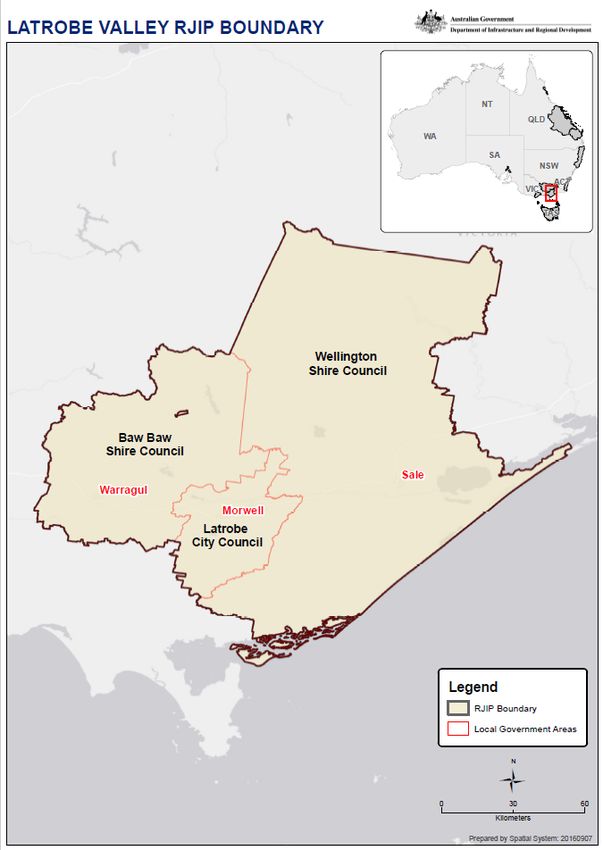
The Latrobe Valley comprises three Local Government areas: Baw Baw Shire Council, Latrobe City
Council and Wellington Shire Council.
The Latrobe Valley is well known for its energy generation, natural gas and oil reserves, timber,
food production, manufacturing and tourism. It has a skilled workforce and a strong work ethic,
built particularly around oil & gas production, power production, coal extraction, paper
manufacturing, defence, agriculture, food production & manufacturing, agribusiness, tourism and
support industries, including engineering.
As a society the Latrobe Valley is welcoming of major projects especially those which build on the
Region’s resources.
The Latrobe Valley is currently facing significant structural economic challenges as it looks to move
away from traditional industries, such as coal fired power generation, to a sustainable future
through diversification and development of industry and business.

The Latrobe Valley Local Planning Committee has identified key opportunities based on existing
strengths to create a sustainable diversified economy. The following industry sectors have the
potential to generate investment and jobs into the future:
1. Advanced Manufacturing, Aerospace and Defence
2. Education & Training and Research & Development
3. Energy and Resources
4. Food and Fibre
5. Health and Social Assistance
6. Professional Services
7. Visitor Economy
The Latrobe Valley Local Planning Committee wishes to support research & development,
innovation, commercialisation, collaborative approaches and strengthening entrepreneurial culture
and business experience for indigenous and non-indigenous young people; and enabling
infrastructure to increase productivity across the identified priority sectors to drive the Latrobe
Valley’s transition to its sustainable future.

RJIP Local Investment Plan - Latrobe Valley       August 2017                                  6 of 24
3 Investment Sectors and Strategic Priorities
3.1 Investment Sector: Advanced Manufacturing, Aerospace and
Defence
Advanced manufacturing is a broad set of enabling technologies, processes and practices that
businesses from a wide range of industry sectors can adopt to improve their productivity and
competitiveness. The Latrobe Valley has the opportunity to build on its strong, diversified
manufacturing base to further develop into the advanced manufacturing, aerospace and defence
industries.
Already Aerospace manufacturing is the highest manufacturing export from Gippsland after food
and paper. Mahindra Aerospace, trading as GippsAero based at Latrobe Regional Airport,
manufactures and exports the only aircraft of its kind in Australia.
The RAAF Base East Sale is a major training facility and location of several specialist schools,
including the Central Flying School. It supports approximately 700 personnel on site. The RAAF
Base East Sale is about to undergo a major expansion of pilot training programs and is expected to
reach full operational status by 2019. The RAAF Base East Sale is supported by a number of
internationally significant private sector defence and aerospace firms.
This sector is supported by the Latrobe Valley’s significant engineering capability and skilled
workforce plus higher education, research & development capacity and vocational training
capability provided through Federation University and Federation Training.
3.1.1 Strategic priorities
To encourage Advanced Manufacturing, Aerospace and Defence sector development in the
Latrobe Valley through initiatives such as those which:
Support Advanced Manufacturing opportunities including aerospace, bio-manufacturing, food,
paper and steel
Encourage clustering of manufacturing firms, including the Latrobe Manufacturing Network
Leverage defence programs and procurement to create new business opportunities
Develop and deliver aerospace and defence training and development initiatives, including
those which assist in the achievement of indigenous and apprenticeship and trainee targets
Encourage collaborative indigenous business entities to tender for defence goods and services
in accordance with Commonwealth Procurement Rules Division Two Exemption 17
Expand and create opportunities for the manufacture of high quality aerospace and defence
equipment
Support the development plans for the Latrobe Regional Airport, West Sale Aerodrome and
RAAF Base East Sale
Create opportunities to utilise local engineering capabilities, skills and knowledge
RJIP Local Investment Plan - Latrobe Valley August 2017 7 of 243.2 Investment Sector: Education & Training – Research &
Development
It is widely accepted that a skilled and educated community increases wellbeing and leads to a
more productive community. The report Research into Educational Aspiration for Regional Victoria
(Regional Policy Advisory Committee, 2013) noted that a single additional year of education
increases life expectancy by 0.18 years and raises earnings by approximately ten per cent.
Federation University’s Churchill Campus represents a significant opportunity for Gippsland to
improve access to tertiary education. Federation Training’s Campuses at Morwell, Sale, Traralgon
and Yallourn provide access to vocational training across the Latrobe Valley.
The Gippsland Regional Workforce Plan (KPMG, May 2016) is designed to ensure that all key
regional industry sectors have access to an appropriately skilled workforce and remain competitive
in the face of structural adjustment. The challenge facing the region is to capitalise on its existing
assets and resources – both natural and human – to build thriving communities, supported by a
diverse and strong economy. Responding to this challenge requires the joint efforts of industry, the
education sector and government to deliver a strategic approach to workforce planning that takes
into account Gippsland’s assets, in addition to the broader structural and demographic trends that
will drive further industry change and workforce demand.
Innovation-led growth is in the hands of business, communities and individuals in collaboration with
education and research institutions, and supported by government. To be successful the local
business environment must foster a culture of innovation. However, researchers and innovators
need assistance to translate their ideas into successful products and services. This can include
new forms of public investment.
Locally-based businesses need access to talent with skills in high-end technology. Hence the
priority in education and training to support jobs-rich emerging industries, and improving access to
new markets.
The Latrobe Valley Hi-Tech Precinct, based at Federation Training’s Morwell site, brings together
the new Morwell Tech School with Federation University, Federation Training, and private tenants
into purpose-built facilities that promote innovation, productivity and job creation with a focus on
growing sectors including new energy, health, food & fibre and professional services.
Research & Development, as well as industry leadership, is a key driver in the Latrobe Valley. The
Ellinbank Dairy Research Farm in West Gippsland has produced results that have helped develop
Australia as one of the most competitive and efficient dairy producing countries in the world. In
2016, the Commonwealth Government partnered with the C02CRC and Federation University to
base a world leading carbon capture and storage test laboratory at Federation University’s
Gippsland campus. This will provide opportunities for industry and research collaboration to assist
in driving Carbon Capture & Storage technologies to commercial development and deployment
capabilities.
International education has maintained its place as Victoria’s largest services export industry for
over a decade. In particular, regional Victoria can play a pivotal role in helping to drive further
opportunities in this sector. The Latrobe Valley has the capacity to provide international students
with an authentic Australian lifestyle experience, while accessing a first class education. With
increasing population in capital cities like Melbourne leading to congestion and infrastructure
challenges, the Latrobe Valley can play an important role in continuing to welcome international
students with affordable accommodation and welcoming and inclusive communities. (Source:
Committee for Gippsland, 2015)
RJIP Local Investment Plan - Latrobe Valley August 2017 8 of 243.2.1 Strategic priorities
To encourage Education & Training - Research & Development sector development in the Latrobe
Valley through initiatives such as those which:
Implement the cross-industry actions and industry-specific actions contained in the Gippsland
Regional Workforce Plan (KPMG, May 2016)
Enhance nationally significant Latrobe Valley based Research & Development such as Carbon
Capture & Storage and Bio-Manufacturing
Provide high quality education & training opportunities to support existing and emerging
industries
Support industry, education & training and research & development cluster initiatives
Provide trades training to support existing and emerging industries
Enhance workforce capabilities, particularly in Science, Technology, Engineering and
Mathematics (STEM), to support investment, new technology and emerging industries
Actively encourage the attraction of international students to the Latrobe Valley
RJIP Local Investment Plan - Latrobe Valley August 2017 9 of 243.3 Investment Sector: Energy and Resources
This sector includes the Latrobe Valley’s important energy production capabilities and its significant
resources including oil & gas, minerals and timber resources.
Energy production is currently one of the Latrobe Valley’s major industries with the region
producing around 85% of Victoria’s electricity, 97% of Victoria’s natural gas and 14% of Australia’s
oil.
The Statement on Future Uses of Brown Coal (Victorian Government, 2017) provides a framework
for the use of Victoria’s brown coal resources for alternative high value, low emission products for
domestic and international markets.
The Latrobe Valley is very well placed to support New Energy initiatives as it has the necessary
support infrastructure including an extensive and robust transmission network, significant
engineering support capability and skilled workforce well used to operating 24 hours 7 days a week
for 365 days each year. The recent Independent Review into the Future Security of the National
Electricity Market (Dr Alan Finkel AO, June 2017) assessed the growth of distributed energy
resources (DER) in the Australian energy landscape and included suggestions for the future
'orchestration' of DER. These suggestions have raised a number of considerations and
opportunities, particularly in relation to the pioneering of business and government programs and
partnerships to incentivise DER. The Latrobe Valley is considered to be well placed to be a pilot
region for DER.
The Latrobe Valley timber resource is comprised of natural forest and plantation estates, providing
timber and fibre for building materials, pulp and paper production; and employment for local
communities. Nearly one-quarter of Victoria’s plantation estate is located within the Latrobe Valley.
Strategic priorities
3.3.1 Strategic priorities
To encourage Energy and Resources sector development in the Latrobe Valley through initiatives
such as those which:
Support new and emerging low carbon energy production including technologies such as
biogas, bio-mass, geothermal, solar, waste to energy and wind
Incentivise participation in distributed energy resources (DER), including pilot schemes
Create new opportunities for coal and coal derivative businesses, and low emission coal
energy and resources projects
Support Carbon Capture and Storage opportunities
Support new investment and research opportunities into projects using resources including
coal, gas and timber
Support the expansion and development of hardwood and softwood timber plantations, and
other sources of fibre, to ensure security of supply
Support collaborative workforce training initiatives such as in silviculture
RJIP Local Investment Plan - Latrobe Valley August 2017 10 of 243.4 Investment Sector: Food and Fibre
The Latrobe Valley, already a major producer and exporter of food and fibre products, is well
positioned to build on its excellent reputation for quality, safety and reliability to supply the
increasing domestic market and rising global demand, including to the fast growing middle class
population in Asia.
The Latrobe Valley has the opportunity to build on its existing strong food production, food
manufacturing and agribusiness base. For example, dairy product manufacturing already
contributes $374.6 million to regional exports; and Sheep, Grains, Beef and Dairy Cattle contribute
more than $476.8 million to regional exports (Source: REMPLAN).
In the Latrobe Valley this sector is dominated by Australia Paper’s Maryvale Mill which contributed
$451 million in gross regional product, $216 million in household income, and 2,387 Full Time
Equivalent (FTE) jobs, when flow-on effects are taken into account (Western Research Institute,
2017).
3.4.1 Strategic priorities
To encourage Food and Fibre sector development in the Latrobe Valley through initiatives such as
those which:
Increase brand recognition and promote the Latrobe Valley’s clean, green food culture; and
increase export opportunities
Support improved access for producers to get product to market
Support the production of high quality agricultural products
Create opportunities in intensive agriculture
Support existing, and create new, opportunities in food processing and manufacturing,
including bottling and beverages
Support the development of critical infrastructure, such as the expansion of the Southern Rural
Water system and enhancements to the Macalister Irrigation District
Facilitate greater efficiency in timber milling
Support high quality product including timber engineered products
Support the innovative use of timber and fibre derivative products
RJIP Local Investment Plan - Latrobe Valley August 2017 11 of 243.5 Investment Sector: Health and Social Assistance
The Latrobe Valley is the major centre for Health and Social Assistance services for Gippsland,
which has a population of over 270,000. It has a comprehensive range of primary, secondary and
tertiary care services.
The Latrobe Valley is a designated Health Zone; supported by the Latrobe Health Assembly, which
has the job of identifying health priorities and innovating health services.
The Latrobe Valley’s primary care services include community health services, mental health
services, health planning, coordination organisations and networks.
The Latrobe Valley’s secondary care services include a major regional hospital, the Latrobe
Regional Hospital; and hospitals located in Sale/Maffra, Warragul and Yarram.
Health Care and Social Assistance is the single highest employing industry in the Latrobe Valley
employing an estimated 14.03% of all employed people in December 2016. (Source: REMPLAN).
The report, Jobs and growth, how are the gains being distributed (Office of the Chief Economist,
2017), notes that health care is the fastest growing sector for employment across Australia in the
ten years to 2014-15.
3.5.1 Strategic priorities
To encourage Health and Social Assistance sector development in the Latrobe Valley through
initiatives such as those which:
Attract and develop health technology businesses, and the formation of health-technology
clusters
Support the establishment of innovative health and social assistance cluster initiatives
Support education and training programs for health care professionals
Increase the size and capacity of the skilled workforce in the health and social assistance
sector in the Latrobe Valley
Support primary care services
Support Central Gippsland Health Service, Latrobe Regional Hospital, West Gippsland Health
Care Group and Yarram & District Health Service developments
Support tertiary care services
Support the establishment of an Aged Care Hub of Excellence
Support the development of aged care and retirement facilities
RJIP Local Investment Plan - Latrobe Valley August 2017 12 of 243.6 Investment Sector: Professional Services
Professional Services is an important industry in its own right, as well as a key enabler of activity
across a wide array of areas. This sector includes firms that operate in banking, funds
management, legal and accounting services, management consulting, engineering, architecture
and urban design.
The report, Jobs and growth, how are the gains being distributed (Office of the Chief Economist,
2017) notes that across Australia job growth has been concentrated in service industries, with the
strongest growth in middle-wage industries such as Health Care, Professional Services,
Construction and Education. See also Attachment 2 – Structural change has increased
employment and earnings.
Professional services activities require high degrees of expertise and training, and are vital as the
Latrobe Valley transitions to a knowledge economy. Professional services jobs are highly skilled,
well paid and a stimulus for investment in new and emerging industries.
Regionalisation of Commonwealth Government agencies is a familiar tool to assist communities
facing economic transition with the Commonwealth having located the headquarters of the National
Disability Insurance Scheme (NDIS) to Geelong.
Likewise, Traralgon is home to Commonwealth agencies, including the Australian Securities &
Investments Commission (ASIC) Registry, and the Latrobe Smart Centre, which is a Centrelink call
centre. Our understanding that these Centres are understood to be amongst the best performing
Commonwealth Agencies located anywhere in the nation.
In May 2017 the Victorian Government announced plans for a new Latrobe Valley GovHub office
complex, as a base for up to 300 staff. The Federal Government has initiated its own
decentralisation program, which is to build on the recent Senate Inquiry into the operation,
effectiveness and consequences of the Public Governance, Performance and Accountability
(Location of Corporate Commonwealth Entities) and the more recent House of Representatives
Inquiry into Regional Development and Decentralisation.
3.6.1 Strategic priorities
To encourage Professional Services sector development through initiatives such as those which:
Encourage professional services enterprise development
Attract and develop professional services businesses in the Latrobe Valley
Support the formation of professional services clusters, including engineering services
Encourage the location of private sector professional services to support Government agencies
located within the Latrobe Valley
RJIP Local Investment Plan - Latrobe Valley August 2017 13 of 243.7 Investment Sector: Visitor Economy
The Visitor Economy is the production of goods and services for consumption by visitors, which
includes the industries which directly serve visitors, such as hotels, transport providers, tour
companies and as well as those involved indirectly, such as retail and food production.
Gippsland’s visitor economy has significant opportunities for growth. Destination Gippsland
estimates that more than 10.8 million domestic and international visitors per annum are attracted to
the region’s significant nature-based experiences and its significant range of events and sporting
activities. The Latrobe Valley’s natural tourism product is augmented by food related experiences
which leverage the region’s agricultural producers and are central to a wide range of arts and
cultural events.
The current level of visitation to the Gippsland region supports 3,000 businesses and generates
more than 15,000 direct and indirect jobs.
3.7.1 Strategic priorities
To encourage Visitor Economy sector development in the Latrobe Valley through initiatives such as
those which:
Facilitate private sector developments built around the Latrobe Valley’s unique attractions
Improve infrastructure and transport to support the Latrobe Valley’s attractions including
events, food, culture and nature-based tourism
Develop and promote regional Gippsland Aboriginal tourism offerings
Improve access for visitors such as the South Face Road to Mount Baw Baw
Increase events opportunities through the provision of facilities such the proposed motorsport
complex
Support the development of tourism related infrastructure such as tourism trails and signage
Enhance agribusiness tourism through initiatives such as FarmGate
RJIP Local Investment Plan - Latrobe Valley August 2017 14 of 24Attachment 1 Regional Snapshot Latrobe Valley April 2017 This statistical snapshot provides a quick reference guide to the Local Government Areas that make up the Latrobe Regional Jobs and Investment Packages (RJIP) region. The Regional Jobs and Investment Packages (RJIP) region includes: Baw Baw Shire Council Wellington Shire Council Latrobe City Council RJIP Local Investment Plan - Latrobe Valley August 2017 15 of 24
Table of Contents
Demographic data
Estimated resident population
Population projections
Age profile
Net internal migration
Overseas arrivals
Economic data
Employed persons
Three largest employing industries
Unemployment rate
Labour force participation
Structural change index
Employment in knowledge intensive industries
Qualifications and skills
Actively trading businesses
International visitors
Demographics
Estimated resident population
The estimated resident population refers to the number of usual residents in a region.
Table 1 Estimated resident population
Local Government Area Population 2011 Population 2011-2016
2016p average annual
growth rate
Baw Baw Shire Council 43,389 48,072 2.1%
Latrobe City Council 73,788 74,026 0.1%
Wellington Shire Council 42,068 42,266 0.1%
Latrobe RJIP region 159,245 164,364 0.6%
Victoria 5,537,817 6,069,636 1.9%
Australia 22,340,024 24,128,876 1.6%
Source: ABS Regional Population Growth 2017 (Cat. No. 3218.0)
Note: Population estimates are final for 2011, but preliminary for 2016 (p)
RJIP Local Investment Plan - Latrobe Valley September 2017 16 of 24Figure 1 Population change
Source: ABS Regional Population Growth 2017 (Cat. No. 3218.0)
Note: Population estimates are final for 2011 and earlier, but subject to revision (r) from 2012 to
2015 and are preliminary for 2016 (p)
Population projections
Population projections provide a measure of the expected population growth path for a region.
Table 2 Population projections
Local Government Area Population Projected Projected Annual
2011 population Population % change Annual
2021 2031 2011-2021 % change
2021-2031
Baw Baw Shire Council 43,400 54,300 67,700 2.3% 2.2%
Latrobe City Council 73,800 75,000 81,200 0.2% 0.8%
Wellington Shire Council 42,100 42,700 45,200 0.1% 0.6%
Source: Victoria in Future 2016 Population and household projections to 2051
RJIP Local Investment Plan - Latrobe Valley August 2017 17 of 24Age profile
This indicator provides a guide to the differences in the age makeup of regions, which can
influence the demand for infrastructure and services into the future.
Table 3 Age profile
Local Government Area 0-14 15-24 25-64 65-84 85 years
years years years years and over
Baw Baw Shire Council 19% 12% 50% 17% 2%
Latrobe City Council 19% 13% 51% 15% 2%
Wellington Shire Council 18% 11% 51% 17% 2%
Latrobe RJIP region 19% 12% 50% 16% 2%
Victoria 18% 13% 53% 13% 2%
Australia 19% 13% 53% 13% 2%
Source: ABS, Population by Age and Sex, Regions of Australia, 2015 (Cat. No. 3235.0).
Net internal migration
Net internal migration is a measure of the movement of people between different regions of
Australia. It is measured by the difference between the number of people who moved into and the
number of people who moved out of a region over a period of time.
Table 4 Net internal migration
Local Government Area 2008-09 2011-12 2014-15
Persons Persons Persons
Baw Baw Shire Council 682 878 721
Latrobe City Council 172 -214 -409
Wellington Shire Council 39 43 -171
Latrobe RJIP region 893 707 141
Victoria 1533 1439 10190
Australia n/a n/a n/a
Source: ABS 2015, Customised report within the DIRD 2016 Yearbook
Overseas arrivals
The number of overseas born arrivals in the last five years provides a measure of the inward
migration of people from overseas. This does not include those people leaving Australia.
Table 5 Overseas arrivals
Local Government Area 2006 2011 2006-2011
persons(a) persons(b) change
persons
Baw Baw Shire Council 244 436 192
Latrobe City Council 713 1,358 645
Wellington Shire Council 345 559 214
Latrobe RJIP region 1,301 2,352 1,051
Victoria 196,350 315,216 118,866
Australia 752,194 1,185,179 432,985
Source: ABS 2011 Census, presented within the DIRD 2016 Yearbook
Note: (a) Persons who were usually resident outside Australia at the time of the 2001 Census. (b)
Persons who were usually resident outside Australia at the time of the 2006 Census.
RJIP Local Investment Plan - Latrobe Valley August 2017 18 of 24Economy
Employed persons
This indicator is based on the place of usual residence of the employed person and not the location
of work.
Table 6 Employed persons
Local Government Area 2001 2006 2011 2001-2011 2001-2011
persons persons persons persons average
change annual
growth
Baw Baw Shire Council 15,162 16,842 19,856 4,694 2.7%
Latrobe City Council 25,745 28,314 30,161 4,416 1.6%
Wellington Shire Council 15,790 17,029 17,905 2,115 1.3%
Latrobe RJIP region 56,697 62,185 67,922 11,225 1.8%
Victoria 2,092,791 2,274,447 2,530,634 437,843 1.9%
Australia 8,298,606 9,104,187 10,058,325 1,759,719 1.9%
Source: ABS 2011 Census, presented within the DIRD 2016 Yearbook
Note: Persons aged 15 years and over. (a) Excludes Migratory – Offshore – Shipping regions.
Three largest employing industries
Local Government Area Highest employing 2011
industry Employment per cent
Baw Baw Shire Council Health Care and Social Assistance 11.5
Latrobe City Council Health Care and Social Assistance 13.1
Wellington Shire Council Health Care and Social Assistance 12.6
Latrobe RJIP region Health Care and Social Assistance 12.5
Victoria Health Care and Social Assistance 11.7
Australia Health Care and Social Assistance 11.7
Local Government Area 2011
2nd Highest employing Employment per cent
industry
Baw Baw Shire Council Construction 11.4
Latrobe City Council Retail Trade 12.7
Wellington Shire Council Agriculture, Forestry and Fishing 11.9
Latrobe RJIP region Retail Trade 11.6
Victoria Retail Trade 10.9
Australia Retail Trade 10.6
Local Government Area 2011
3rd Highest employing Employment per cent
industry
Baw Baw Shire Council Retail Trade 10.0
Latrobe City Council Construction 10.0
Wellington Shire Council Retail Trade 11.4
Latrobe RJIP region Construction 10.0
Victoria Manufacturing 10.8
Australia Manufacturing 9.1
Source: ABS 2011 Census, presented within the DIRD 2016 Yearbook
Note: Calculations includes inadequately described responses in the denominator.
RJIP Local Investment Plan - Latrobe Valley August 2017 19 of 24Unemployment rate
This indicator is based on the place of usual residence of the employed person and not the location
of work.
Table 8 Unemployment rate
Local Government Area Dec 2014 Dec 2015 Dec 2016
per cent per cent per cent
Baw Baw Shire Council 3.9% 4.2% 5.4%
Latrobe City Council 7.3% 8.3% 11.2%
Wellington Shire Council 4.9% 5.4% 7.1%
Latrobe RJIP region 5.7% 6.3% 8.4%
Victoria 6.6% 6.1% 5.8%
Australia 6.1% 6.1% 5.7%
Source: Department of Employment, Small Area Labour Markets publication, March 2017
Note: As a proportion of persons aged 15 years and over who are either employed or unemployed
(the labour force). The annual figures are calculated as a four quarter average across the calendar
year.
Labour force participation
The labour force participation rate indicates the size of the labour force relative to the population in
a region.
Table 9 Labour force participation
Local Government Area 2001 2006 2011 2001-2011
per cent per cent per cent percentage
point
change
Baw Baw Shire Council 60.7% 60.6% 60.8% 0.1
Latrobe City Council 56.1% 56.3% 56.3% 0.2
Wellington Shire Council 55.8% 56.4% 56.2% 0.3
Latrobe RJIP region 57.2% 57.4% 57.5% 0.3
Victoria 60.4% 60.4% 61.4% 1.0
Australia 60.3% 60.4% 61.4% 1.1
Source: ABS 2001, 2006 and 2011 Census, presented within the DIRD 2016 Yearbook Note:
Persons aged 15 years and over.
Structural change index
The Structural Change Index is a measure of the extent of structural change occurring in a region,
based on the change in the industry mix of employment between two points in time. The index can
be thought of as the total number of percentage points of economic activity that has moved
between industries within a given time period.
Relatively high index values will be evident for regions that are going through a very pronounced
phase of industry transition, irrespective of whether that transition relates to major industry decline
or growth.
The index provides useful contextual information on the extent to which a region’s economy is
impacted by a changing industry base. This indicator is based on the place of usual residence of
the employed persons and not the location at which they work.
RJIP Local Investment Plan - Latrobe Valley August 2017 20 of 24Table 10 Structural change index
Local Government Area 2006-2011 index
Baw Baw Shire Council 4.8
Latrobe City Council 4.5
Wellington Shire Council 4.6
Latrobe RJIP region 4.2
Victoria 4.1
Australia 3.8
Source: ABS 2006 and 2011 Census, presented within the DIRD 2016 Yearbook
Note: Structural Change Index based on the methodology used in the Productivity Commission,
Aspects of Structural Change in Australia, Research Paper, 1998.
Employment in knowledge intensive industries
Employment in knowledge intensive industries indicates the number of people working in high and
medium-high technology manufacturing or knowledge intensive services.
Table 11 Knowledge intensive industries
Local Government Area 2006 per cent 2011 per cent 2006-2011
percentage
point change
Baw Baw Shire Council 25.4% 25.7% 0.3
Latrobe City Council 25.4% 25.2% -0.2
Wellington Shire Council 23.9% 25.0% 1.1
Latrobe RJIP region 25.0% 25.3% 0.3
Victoria 32.9% 33.9% 1.0
Australia 30.4% 31.7% 1.3
Source: ABS 2011 Census, presented within the DIRD 2016 Yearbook
Qualifications and skills
The proportion of people who have at least a certificate III qualification or who are employed in a
skilled occupation provides an indication of the capacity of people in a region to capitalise on job
opportunities.
Table 12 People with a Certificate III or above, or employed in a skilled occupation
Local Government Area 2006 2011 2006-2011
per cent per cent percentage
point change
Baw Baw Shire Council 55.1% 59.9% 4.8
Latrobe City Council 47.1% 51.5% 4.4
Wellington Shire Council 50.6% 54.2% 3.6
Latrobe RJIP region 50.1% 54.5% 4.4
Victoria 55.9% 61.6% 5.7
Australia 54.5% 59.8% 5.3
Source: ABS 2011 Census, presented within the DIRD 2016 Yearbook
Note: persons aged 25-64 years; Occupation was coded to the Australian and New Zealand
Standard Classification of Occupations (ANZSCO) First Edition; Skilled occupations include
Managers, Professionals and Technicians and Trade Workers.
RJIP Local Investment Plan - Latrobe Valley August 2017 21 of 24Actively trading businesses
This is a count of the number of businesses which actively traded goods and services over the
financial year.
Table 13 Actively trading businesses
Local Government Area 2013 2014 2015 2013-2015
businesses businesses businesses average
annual
growth
Baw Baw Shire Council 4,819 4,918 4,919 1.0%
Latrobe City Council 4,326 4,282 4,242 -1.0%
Wellington Shire Council 3,872 3,877 3,947 1.0%
Latrobe RJIP region 13,018 13,077 13,108 0.3%
Victoria 533,350 541,347 549,934 1.5%
Australia 2,048,203 2,074,154 2,095,116 1.1%
Source: ABS, Counts of Australian Businesses, including Entries and Exits (Cat. No. 8165.0)
Note: Does not include actively trading businesses which have not registered for an ABN, either
because they do not have any obligations under the Goods and Services Tax (GST) legislation or
are under the threshold for registration and have chosen not to register.
International visitors
The ratio of overseas visits to residents indicates the extent of economic engagement with
international visitors in the region. Overseas visitors are those people visiting Australia for less than
12 months for holidays, businesses, visiting friends and relatives, and education.
Table 14 International visitors
Local Government Area 2007 2011 2015
visits per visits per visits per
1,000 1,000 1,000
residents residents residents
Baw Baw Shire Council 113 123 166
Latrobe City Council 97 116 81
Wellington Shire Council 185 269 355
Latrobe RJIP region 125 158 176
Victoria 451 457 623
Australia 732 639 724
Source: BITRE estimates based on Tourism Research Australia, presented within the DIRD 2016
Yearbook
DISCLAIMER: The data in this snapshot is indicative only. The snapshot is intended as a starting
resource for a region’s local planning committee in the development of the Local Investment Plan.
RJIP Local Investment Plan - Latrobe Valley August 2017 22 of 24Attachment 2 RJIP Local Investment Plan - Latrobe Valley September 2017 23 of 24
Bibliography
Aboriginal Victoria (AV), 2017. Tharamba Bugheen Aboriginal Business Strategy 2017-2021,
Melbourne VIC 3000: State of Victoria.

Baw Baw Shire Council, 2017. Council Plan 2017-2021, Warragul VIC 3820: s.n.

Committee for Gippsland, 2015. Gippsland Investment Prospectus, Warragul VIC 3820: s.n.

Committee for Gippsland, 2015. Submission - Victorian Government Future Industries International
Education discussion paper, Warragul VIC 3820: s.n.

Committee for Gippsland, 2016. Our Region Our Future: Securing a low emissions future for
Gippsland and the Latrobe Valley, Warragul VIC 3820: s.n.

Department of Economic Development Jobs Transport & Resources, 2016. Food and Fibre Sector
Strategy, Melbourne VIC 3000: State of Victoria.

Department of Infrastructure & Regional Development, 2017. Regional Snapshot - Latrobe Valley,
Canberra ACT 2600: Commonwealth of Australia.

Department of Prime Minister and Cabinet, 2015. Commonwealth Indigenous Procurement Policy,
Canberra ACT 2600: Commonwealth of Australia.

Dr Alan Finkel AO, C. S. C. o. t. E. P., June 2017. Independent Review into the Future Security of
the National Electricity Market, Canberra ACT 2600: Commonwealth of Australia.

GLaWAC, 2015. Gunaikurnai Whole-of-Country Plan, Bairnsdale VIC 3875: Gunaikurnai Land and
Waters Aboriginal Corporation (GLaWAC).

KPMG, May 2016. Gippsland Regional Workforce Plan, Melbourne VIC 3000: KPMG.

Latrobe City Council, 2016. Economic Development Strategy 2016-2022, Morwell VIC 3840: s.n.

Office of the Chief Economist, 2017. Jobs and Growth, how are gains being distributed, Canberra
ACT 2600: Australian Government.

RDA - Gippsland, 2015. Gippsland Regional Plan 2015-2020, Traralgon VIC 3844: Regional
Development Australia (RDA) - Gippsland.

Regional Policy Advisory Committee, 2013. Research into Educational Aspiration for Regional
Victoria, Melbourne VIC 3000: Regional Development Victoria.

REMPLAN, 2014. Economic Impact - Australian Securities and Investments Commission, Bendigo
VIC 3550: s.n.

Victorian Government, 2017. Statement on Future Uses of Brown Coal, Melbourne Vic 3000: s.n.

Wellington Shire Council, 2016. Economic Development Strategy 2016-2022, Sale VIC 3850: s.n.

Western Research Institute, 2017. Economic & Government Revenues - Australian Paper, Bathurst
NSW 2795: s.n.

RJIP Local Investment Plan - Latrobe Valley   September 2017                                 24 of 24
You can also read


