Releasing our potential - Hertfordshire Skills Strategy to 2020 - Hertfordshire LEP
←
→
Page content transcription
If your browser does not render page correctly, please read the page content below

Releasing
our potential
Hertfordshire Skills Strategy to 2020

Councillor David Williams,                     James Snelling,                                Mark Bretton,
Leader of Hertfordshire                        District Manager of                            Chair, Hertfordshire Local
County Council and Executive                   Bedfordshire and                               Enterprise Partnership
Member with responsibility                     Hertfordshire, Department
for Resources, Property &                      for Work and Pensions                          It is three years since the first Skills
the Economy                                                                                   Strategy for Hertfordshire was published.
                                                                                              During that time, excellent progress
                                               I believe that the work done by the            has been made in implementing its
Significant progress has been made             partnerships formed under the last             recommendations at a time of significant
implementing the first Hertfordshire Skills    Skills Strategy has shown great benefits       change in the wider political and economic
Strategy during the last three years and       for the residents and customers of             landscape. Brexit, technological advances
there is evidence to show recruitment          Hertfordshire. With the additional             in Artificial Intelligence and Big Data,
difficulties have eased in Hertfordshire.      challenges and uncertainties faced as          increasingly fluid work patterns and the
While lack of skills remains a factor in       we look to the next few years, the idea of     demands of an ageing society; all have the
the county, the percentage of hard to          refreshing and refocusing our joint focus      potential to impact on the skills agenda in
fill vacancies that are a result of skills     is a good one, and an opportunity for the      the years to come. This coupled with the
shortages has reduced. The need remains        new Skills Strategy to look proactively        opportunity to deliver a local Industrial
for a partnership approach to progress         and progressively is very welcomed. I          Strategy that reflects business needs
this important work and I am delighted to      am excited by what the partnership has         means we are in a position to respond
introduce the second Hertfordshire Skills      enabled to be delivered to date, and           positively to these changes. To that end,
Strategy tailored to our county’s particular   believe that this Skills Strategy will build   following a wide consultation process, we
needs. The strategy makes clear our            on that success and ensure the growth          have revised our Skills Strategy to 2020
approach, and commitment, of how we            of Hertfordshire’s economy with the            so that we remain agile in our approach
will grow and develop our workforce to         expansion of Universal Credit being a key      and ensure that everyone has a stake in
support a strong economy within which          enabler to this outcome.                       Hertfordshire’s growing economy.
businesses can thrive, whilst enabling all
residents of Hertfordshire to maximise
their own individual potential and share in
Hertfordshire’s prosperity.

                                                                                                            Hertfordshire Skills Strategy 2020   2
Contents
Executive Summary                                                                     04

Introduction		                                                                        05
Why do we need a Skills Strategy?                                                     05
Working in partnership                                                                06
Key themes		                                                                          06
Planned actions                                                                       07
Monitoring progress                                                                   07

Theme 1:     Developing our future workforce                                          08
Theme 2:     Towards fuller employment                                                10
Theme 3:     Enhancing opportunities through lifelong learning                        12
Theme 4:     A leading economy; skills to drive growth                                14
Theme 5:     Skills to grow small and medium size businesses                          16

Action Plan		                                                                         18

Contact details                                                                       27

                                                         Hertfordshire Skills Strategy 2020   3
Executive Summary                               The strategy is arranged into five themes:            • Skills to grow small and medium sized
                                                                                                        businesses (SMEs), providing targeted
                                                • Developing our future workforce - supporting          support to SMEs and their workforce in
Skills contribute significantly                   young people aged 16-24 years in the                  order to facilitate growth
                                                  transition from education to employment
to the economic output of an                    • Towards fuller employment - supporting              Hertfordshire Local Enterprise Partnership,
area and are a dynamic driver                     vulnerable adults into employment, increasing       Hertfordshire County Council and the
of enterprise, investment and                     the available workforce and enabling priority       Department for Work and Pensions are
                                                  groups to fulfil their potential                    working together to implement and drive this
new industries. Employers in
                                                • Enhancing opportunities through lifelong            strategy. The influences, views and needs of
Hertfordshire view the overall                    learning, adopting a culture of lifelong            employers, training providers, schools, colleges
proficiency of their workforce                    learning to benefit individuals as well as          and public sector organisations remains vital
as key to their performance and                   local businesses                                    and have been incorporated in this strategy.
                                                • A leading economy; skills to drive growth.          Partner organisations across Hertfordshire
business competitiveness.                                                                             are encouraged to refer to this strategy and
                                                  Working with businesses and training
                                                  providers to improve the skills of both the         reflect it in their individual planning, knowing
Significant progress has been made                                                                    that we will be working towards the same
                                                  existing workforce and the future labour
implementing the first Skills Strategy;                                                               strategic outcomes.
                                                  market in order to sustain economic growth
recruitment difficulties have eased in
Hertfordshire and the percentage of hard
to fill vacancies that are a result of skills   Our shared interest has enabled a collaborative approach which we favour and promote in Hertfordshire,
shortages has reduced significantly.            and this graphic demonstrates how we work together to support the county’s workforce:
However, there is still a need to increase
and develop our workforce and the aim
remains; to increase and develop our
workforce to ensure we can support a
strong economy within which businesses
can thrive, whilst enabling all residents
of Hertfordshire to maximise their
own individual potential and share in
Hertfordshire’s prosperity.

                                                                                                                       Hertfordshire Skills Strategy 2020   4
Introduction   Why do we need a Skills
               Strategy?
                                                             a key factor behind recruitment difficulties in the
                                                             county, the percentage of hard to fill vacancies
                                                             that are a result of skills shortages has reduced
                                                             significantly.
               Skills contribute significantly to the
               economic output of an area and
                                                             Over the life of the first Skills Strategy
               are a dynamic driver of enterprise,
                                                             we have seen major changes to the skills
               investment and new industries.
                                                             agenda: apprenticeship reforms including
               Employers in Hertfordshire view the
                                                             introduction of the Apprenticeship Levy, the
               overall proficiency of their workforce as
                                                             government’s Industrial Strategy proposals
               key to their performance and business
                                                             and rapid technological changes. Looking to
               competitiveness.
                                                             the future we anticipate further developments:
                                                             government’s School Careers Strategy and
               The original Skills Strategy published
                                                             plans for T (Technical) Level courses, with a
               in 2015 was developed to address the
                                                             need to be mindful of any implications of Brexit,
               growing appetite for a strategy attuned to
                                                             the devolution agenda and the impact on the
               the county’s particular needs and brings
                                                             workforce from an ageing population.
               together key stakeholders’ strategic plans
               into a coherent whole; a Skills and Labour
                                                             Since the start of the 21st century with
               Market review in 2014 of Hertfordshire
                                                             inventions such as artificial intelligence, 3D
               businesses showed that nearly half of
                                                             printing, autonomous vehicles, technology
               employers identified skills gaps in their
                                                             and biotechnology, commentators have
               existing workforce. This second Skills
                                                             identified that we are experiencing the ‘Fourth
               Strategy is a refreshed version of the
                                                             Industrial Revolution’. These rapidly developing
               first and the aim remains to increase and
                                                             technologies are changing the way we work
               develop our workforce to ensure we can
                                                             and the jobs and skills required to do them.
               support a strong economy within which
                                                             The useful skills in the workplace of the future
               businesses can thrive, whilst enabling all
                                                             are likely to be different from those needed
               residents of Hertfordshire to maximise
                                                             today. We are mindful of the need to remain
               their own individual potential and share in
                                                             agile and this strategy is deliberately
               Hertfordshire’s prosperity.
                                                             short-term to 2020 to ensure we allow for
                                                             further future proofing.
               Significant progress has been made
               implementing the first Skills Strategy
               and the Hertfordshire Skills and Labour
               market update from March 2016 reports
               favourably on a number of areas that the
               Skills Strategy has strived to address;
               recruitment difficulties have eased in
               Hertfordshire. While lack of skills remains
                                                                              Hertfordshire Skills Strategy 2020   5
Working in partnership healthy, fulfilling lives in thriving, prosperous them to turn their lives around and ensuring
communities. It wants Hertfordshire to be that everyone who is able to work is given all
Hertfordshire Local Enterprise Partnership, recognised as a great place to do business, the support they need to do so, while those who
Hertfordshire County Council and the with a skilled workforce and infrastructure cannot are protected.
Department for Work and Pensions are working that supports the developing needs of the local
together to produce, implement and drive this economy. At the same time, it seeks to give We work in partnership; all three organisations
strategy. Incorporating the influences, views and every Hertfordshire resident the opportunity to aspire to support a strong economy within
needs of employers, training providers, schools, maximise their potential and live a full life as a which businesses can thrive, whilst enabling all
colleges and public sector organisations confident and resilient citizen. residents of Hertfordshire to maximise their own
remains vital and a second Skills Summit held individual potential and share in Hertfordshire’s
in October 2017 provided an opportunity for all The Department for Work and Pensions prosperity. Partner organisations across
stakeholders to be involved. Findings from the (DWP) works to provide security, extend Hertfordshire such as the District and Borough
Summit have been analysed, considered and opportunity, and give people the support they councils and training providers are encouraged
incorporated into this Skills Strategy. need to transform their lives; helping the most to refer to this strategy and reflect it in their
vulnerable people in our society by addressing individual planning, knowing that we will be
Ensuring our workforce has the right skills the root causes of disadvantage and supporting working towards the same strategic outcomes.
to encourage future economic growth lies
at the heart of delivering the Hertfordshire Key themes
Local Enterprise Partnership (LEP) Strategic
Economic Plan (SEP) which has defined the Our key themes and aspirations remain:
following vision: ‘by 2030 Hertfordshire will be
among the UK’s leading economies, helping
to realise the full economic potential of the
assets and opportunities within the ‘Golden Enhancing Skills to grow
A leading
Developing our Towards fuller opportuni3es small and
Triangle’ of London – Cambridge – Oxford.’ future workforce employment through lifelong
economy; skills
medium size
Developing the STEM (Science, Technology, to drive growth
learning businesses
Engineering and Mathematics) skills of both
our future and existing workforce will be key to Suppor3ng young
Suppor3ng
Working with
businesses and
Providing targeted
people aged 16 to training providers to
improving the economic growth of the county. 24 years in the
vulnerable adults
into employment,
Suppor3ng adults to
adopt a culture of
improve the skills of
support to SMEs and
their workforce in
transi3on from both the exis3ng
In addition, the provision of both qualification educa3on to
employment
increasing the
available workforce
lifelong learning
workforce and the
future labour
order to facilitate
growth
and non-qualification based provision to develop market
the leadership and management skills of our
workforce are an important element in achieving Our aspira3on is Our aspira3on is to Our aspira3on is to Our aspira3on is to
this vision; more and better workforce skills that all young
people will develop
maximise our pool
of available labour
Our aspira3on is for
adults to maintain
improve the
matching of skills to
assist SMEs to
access the support
the knowledge and and enable priority core skills and a business needs in they need for their
are essential. skills to flourish in groups to maximise desire to learn order to sustain workforce to
the workforce their poten3al economic growth develop
Hertfordshire County Council’s (HCC) vision of
a ‘County of Opportunity’; envisages a county
where people have the opportunity to live
Hertfordshire Skills Strategy 2020 6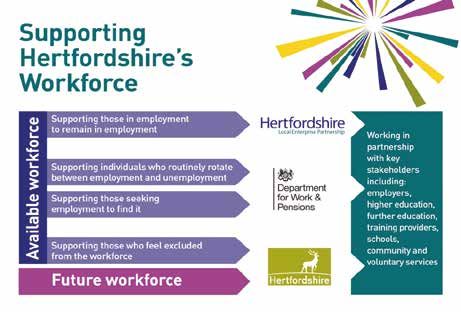
Planned actions                                    • We will organise annual ‘Voice of the            • We will increase the number of advanced/
                                                     Customer’ forums within Hertfordshire              higher and degree level apprenticeship starts
                                                     Jobcentres to understand the challenges that       from 2757 in 2016 to 3697 in 2020
This strategy includes a detailed action plan
                                                     people with disabilities face in the modern
from page 18 identifying the planned work
                                                     labour market                                    • We will promote the take up of STEM
programme for each of the three organisations
responsible for implementing this strategy.                                                             apprenticeships in 2018 to increase starts to
                                                   • We will organise one Jobs Fair per quarter in      1394 in 2019 and 1492 in 2020
                                                     all Hertfordshire Jobcentres
Monitoring progress                                                                                   • We will hold 2 sector based skills events
                                                   • We will organise a joint LEP/DWP employer’s        per year to encourage greater collaboration
The progress of the action plan and the              workshop to explore the needs and attitudes        between employers and local skills providers
performance measures will be monitored               to retaining/retraining and recruiting 50+         to meet business needs
by Hertfordshire County Council Resources,           workers
Property & the Economy Cabinet Panel and the                                                          • We will increase the percentage of SME
Skills and Employment Programme Board of           • We will increase the number of Sector Based        businesses that undertake formal training
the Hertfordshire LEP, which includes senior         Work Academy placements year on year of            and development of their workforce from 65%
representation from Department of Work and           which 25% will be for those who are aged 50+       in 2016 to 67% in 2020
Pensions. It is also reported to Hertfordshire
Forward, the county Local Strategic Partnership.   • We will maintain the number of learning          • We will increase the number of SMEs
A review of this strategy is planned for 2020.       opportunities (accredited or non-accredited)       supported by the Skills Advisors at the
                                                     funded by the Education and Skills Funding         Hertfordshire Growth Hub from 229 in 2017
Our performance measures are:                        Agency (ESFA) taken up by unemployed or            to 750 in 2018
                                                     economically inactive adults aged 19-65 at
• We will increase the percentage of young           22,000 per year                                  We will also continue to report the performance
  people (16 and 17 years old) opting to stay in                                                      of our overarching ambitions including:
  education and training from 97.9% in 2017 to     • We will maintain the number of residents
  98.3% in 2020                                      aged 19-65 passing successfully English,         • Percentage of unemployed residents
                                                     maths and digital skills provision (accredited
• We will decrease the lost contact and Not in       or non-accredited) each year (9974 in            • Percentage unemployed residents aged 50+
  Education, Employment or Training (NEET)           2015/16)
  3 month average for 16 and 17 year olds from
                                                                                                      • Percentage of working age residents with no
  3.39% (December 2016 - February 2017) to         • We will engage with 7000 residents aged 19+        qualifications
  3.0% in 2020                                       per year with complex barriers to learning
                                                     and employment to take part in community         • Percentage of working age residents with
• We will increase the number of young people        engagement activities to improve their             level 2+ qualifications
  (16 – 18 years) who start an apprenticeship        aspirations and resilience
  pathway from 1955 in 2016 to 2255 in 2020.
                                                                                                      • Skills shortages as reported by Hertfordshire
                                                                                                        businesses
                                                                                                                      Hertfordshire Skills Strategy 2020   7
Theme 1:                           Current situation                                     • Access to a range of activities that inspire
                                                                                           young people, including employer talks,

Developing our                     Research tells us that for young people the
                                   transition from education to work can be
                                                                                           careers fairs, motivational speakers, colleges
                                                                                           and university visits, coaches and mentors

future workforce                   difficult; Backing Soft Skills (McDonalds UK,
                                   2015) stresses that                                   • Building strong links with employers, who
                                                                                           can help to boost young people’s attitudes
                                   “this is especially challenging for young               and employability skills, inform pupils about
Young people have an essential                                                             the range of roles and opportunities available
                                   people who are disadvantaged in some
part to play in the future         way, such as those with disabilities or                 and help them understand how to make this a
prosperity of Hertfordshire        behavioural difficulties.”                              reality
and our aspiration is that
                                   Further we know that employers have concerns          However the extent of this depends on a school
they develop and acquire the                                                             prioritising the delivery of these activities and
                                   about young people’s employability skills;
knowledge and skills to flourish   Results for Life, (Princes Trust, 2017) highlighted   on the whole having the ability to pay for it.
in the workforce:                  that 72% of employers believe that young people       The financial landscape is becoming more
                                   do not have the soft skills to do well when           challenging.
                                   they first start work, most typically lacking:
                                   confidence, communication and reliability.            The delivery of the Careers & Enterprise
                                   The report proposes that on the whole pupils do       programme in Hertfordshire is progressing
                                   not leave school with these skills.                   well and aims to support these objectives.
                                                                                         Ninety schools have received an audit of their
                                   Statutory guidance requires governing bodies          careers, enterprise and employer engagement
                                   to ensure all registered pupils are provided with     but we need to do more in recruiting Enterprise
                                   independent careers guidance from years 8 to          Advisers from businesses and in engaging with
                                   13. The guidance states schools should consider       each school’s strategic direction. We can also do
                                   the following principles for good practice when       more to provide quality opportunities for young
                                   developing their strategy:                            people to engage with employers in the priority
                                                                                         skills areas as identified by Hertfordshire LEP
                                   • High quality work experience that properly          and improve on imbalances like the lack of
                                     reflects an individual’s studies and strengths,     young women in STEM related fields: in 2015/16,
                                     and supports the academic curriculum                only 7.2% of the 485 STEM work experience
                                                                                         placements provided by YC Hertfordshire
                                                                                         [formerly Hertfordshire Youth Connexions] were
                                   • Face to face advice and guidance to build
                                                                                         held by young women.
                                     confidence and motivation

                                                                                                          Hertfordshire Skills Strategy 2020   8
The 16-18 year old Not in Education, • For employers to provide and education
Employment or Training (NEET) rate reached providers to promote, opportunities for
a record low of 3.2% in January 2017. We also young people to undertake apprenticeships,
know that 96% of young people receive an offer traineeships and workplace training,
of a confirmed place in learning following year particularly at higher skill levels such as
11 or 12 and that those without one are targeted advanced apprenticeships and degree
to support their progression and prevent them apprenticeships
becoming NEET.
• To identify those at risk of becoming NEET
This data is encouraging but it does hide a and those who are NEET and maintain,
number of underlying issues which need to be develop and co-ordinate programmes to
addressed as part of this Skills Strategy. There move them into education, employment and
are still over 1000 young people not in any form training. There will be a particular focus on
of learning, this includes jobs without training. those from vulnerable groups
Those in this group tend to be young people
with additional needs or those from vulnerable • To promote quality learning provision that
groups all of whom are the most likely to be reflects the needs of both the young people
NEET beyond their 18th birthday. There are and the economic growth of Hertfordshire
also significant differences between areas: building on existing best practice and creating
Broxbourne and Welwyn Hatfield have 16-18 new education and training opportunities
NEET rates over 4%, Stevenage over 5% whilst
St Albans is under 2%. • To promote opportunities for work related
learning and employment within the STEM
Our goals sectors and an increase in work placements
taken by young women
• That all young people have access to
impartial Careers Education and independent
advice and guidance and are made aware
of all the learning pathways that exist in
Hertfordshire
• To raise awareness of employers, through
the Careers and Enterprise programme and
other initiatives, of the potential of young
people and forge stronger links between
employers and education providers to
provide young people with face to face
learning opportunities, work experience and
employer events
Hertfordshire Skills Strategy 2020 9Theme 2: Current situation A number of organisations work with adults
across priority groups in Hertfordshire including
Towards fuller Hertfordshire’s labour market profile has seen
a reduction in the number of unemployed
HCC’s Hertfordshire Adult Family Learning
Service (HAFLS) and Work Solutions, Herts Mind
Network, DWP, and other organisations from
employment Jobseeker claimants of around 20% between
January 2016 and January 2017. This reduction the Voluntary and Community Sector (VCS).
has been most marked in the 18-24 age By working in partnership, these organisations
categories with a drop of 46%. The lowest look to reduce the barriers that vulnerable
In Hertfordshire approximately adults face in competing in the labour market.
drop has been in the 50+ age category with a
80% of working age residents are reduction of 3%. The 50+ age category, as a Support will include working on improving skills
in employment. Maximising our percentage of the total unemployed Jobseekers set, confidence building, and access to work
register, is increasing. experience, sector based work academies,
pool of available labour will both apprenticeships, work trials and volunteering.
support an increasing demand
Hertfordshire has a number of people who are
for labour and create a strong out of work for reasons including poor health, It is recognised that volunteering provides
economy; our aspiration is to aim disability, ex- offenders, caring responsibilities, valuable real life experience as well as
families with multiple problems, care leavers supporting community initiatives. DWP
for full employment to support Jobcentre Plus in partnership with local
and being homeless. Whilst it is difficult to
a strong economy within which categorise a whole group as being vulnerable, employers also offers initiatives such as Work
businesses can thrive: as individual circumstances will vary, it is Experience, Work Trials and Sector Based
acknowledged that the barriers to employment Work Academies. Jobcentre Plus works with
for certain groups tend to be more complex. employers to put in place workplace adaptations
Jobcentre Plus (JCP) will support every to help support and retain vulnerable adults,
vulnerable adult looking to re-join the labour with health conditions, in employment.
market with a named Work Coach to help the
claimant design a package of support to help
them overcome any barriers and meet their
individual needs to gain full employment.
A significant issue facing vulnerable adults is
not only securing employment, but retaining
this status, as their personal circumstances
or resilience may cause issues that can lead
to individuals rotating between employment
and unemployment. This can only be overcome
by working with employers to identify these
triggers and increasing in-work support.
Hertfordshire Skills Strategy 2020 10Our goals
• We aim to increase the number of
economically active individuals in the
community by supporting those most
vulnerable in work and into work
• We will encourage continued and greater
co-ordination between key agencies i.e. JCP,
HAFLS and the VCS in order to promote the
positive impact that sustained employment
has on many health and social issues
• We will work to reduce the differential
between the numbers of 50+ aged Jobseekers
and other age groups
• We will work with partner organisations
to promote volunteering opportunities to
enhance the personal skillset, attitudes and
knowledge of the hardest to help jobseekers
in the labour market
Hertfordshire Skills Strategy 2020 11Theme 3: Current situation respectively.
Enhancing Lifelong learning is about personal fulfilment
and enterprise; employability and adaptability;
Further Education Colleges, private training
providers and Higher Education Institutions
opportunities active citizenship and social inclusion. are the most common and largest providers
It encompasses post-compulsory education, of lifelong learning opportunities. However,
informal community-based learning plays a
through lifelong learning and covers the whole range of learning:
formal, informal, workplace, and the skills, crucial role in supporting people to engage in, or
return to, learning. Informal learning can often
learning knowledge, attitudes and behaviours that
people acquire in day-to-day experiences. be a first step back into more formal further or
It plays an important role supporting a person higher education for people who have become
in changing circumstances to be flexible in their disengaged from learning. HCC’s Adult and
With an ever changing workplace career choices, which means that they are less Family Learning Service, community centres,
environment, residents are likely to become unemployed and therefore can local learning providers (e.g. VCS) and local
likely to face a number of contribute positively to Hertfordshire’s economy. libraries play an important role in supporting
Government strategy for adult learning now learning in less formal settings, through the use
career changes and therefore of community education approaches, to address
includes digital literacy in addition to English
having core skills and a desire and maths as a free entitlement to education. people’s interests and concerns. Hertfordshire
to learn is a requirement for employers report that their skills gaps are
having a negative impact on the business and
the management of careers. In Hertfordshire there is a gap in participation
that job applicants are frequently not fully
in learning between those in low skilled
Adopting a culture of lifelong proficient in oral and written communications.
employment and those in high skilled jobs and
learning will benefit individuals between the skills of those in work and those
as well as local businesses. It who are not. Evidence shows that a greater
will provide greater choices and percentage of those individuals who struggle
to secure sustainable employment have little
opportunities for both individuals or low skill levels. Encouraging this group to
in the workplace and those invest time and effort in learning will increase
seeking employment. There is a the number of individuals likely to remain in
need for our workforce to aspire sustainable employment.
to and remain agile, digitally Whilst many Hertfordshire residents have high
competent and adaptable to levels of qualifications, labour market profiles
changes in the workplace. show that there are quite significant variations
across the county with the St Albans area
having the highest percentage of adults with
level 2 qualifications or above (85.9%) whilst
other areas such as Broxbourne and Welwyn
Hatfield show the lowest with 71.6% and 71.3%
Hertfordshire Skills Strategy 2020 12Our goals
• We will work to raise the level of literacy
and numeracy of Hertfordshire’s adult
population, focusing initially on adults with no
qualification in English and maths or below
level 2 and residents with English as a second
language; in addition we will support the
delivery of digital literacy skills
• We will support the development of learning
programmes with Community Learning
providers, including the voluntary and
community sector, to design and deliver
discreet provision for those residents with
complex barriers to learning and employment
and who are hard to engage
• We will deliver more targeted programmes to
support those who are unemployed, and more
specifically those claiming benefits, to help
gain access to and retain employment
• We will support partnership working
between learning providers and employers
to promote the benefits of work-based
learning and apprenticeships up to level 5 and
degree level
• We will continue to work with the voluntary
and community sector to improve the
provision of Community Learning, mindful
of the Hertfordshire Compact; a written
understanding between the voluntary and
community sector and statutory sectors
about how we will co-operate and continue
to develop positive working relationships for
the benefit of Hertfordshire’s communities
Hertfordshire Skills Strategy 2020 13Theme 4: A leading Therefore our primary focus will be on developing
skills within the following priority sectors;
Hertfordshire has a growing productivity gap
with productivity rates significantly below peer
economy; skills to • Science/technology
economies in the south of England. It seems
unlikely that the supply of qualified workers is
behind this trend. However, a contributing factor
drive growth • Engineering & manufacturing may be that Hertfordshire’s employers are less
likely to train their staff than the leading local
• Film & media economies.
The Hertfordshire economy
has been relatively resilient to • Financial & business services It is clear that employers responding to the
recession. There are now clear Hertfordshire Businesses’ Skills Gap Survey
have accepted a responsibility for upskilling
signs that both labour and skills • High end logistics
staff, both new and existing. This is particularly
demands in Hertfordshire have true of larger and medium sized businesses
• Built environment
and will continue to increase with 65% of businesses having a training plan/
with further demand pressures budget. Of those businesses who offer little
Current situation or no training, the majority of whom are small
ahead. Developing skills for or micro sized businesses; the two main
growth will be an important Hertfordshire continues to show signs of labour cited reasons are financial costs and lack of
element in Hertfordshire market pressures. Participation in employment knowledge of available training provision.
is high and growing, and unemployment is low.
becoming a leading economy Vacancies have increased sharply over recent The introduction of the Apprenticeship Levy
at the heart of the UK’s years and the London economy has created a in April 2017 is expected to both encourage
‘Golden Triangle’. high number of jobs over the past 10 years. A greater investment in training and development
number of Hertfordshire districts (St Albans, of staff by Levy payers and increase the
Watford and Welwyn Hatfield) have enjoyed number of apprenticeships at higher or
strong employment growth. Hertfordshire’s degree level. Research on the introduction
working age residents have higher than national of the apprenticeship levy on behalf of the
average skills levels, however the skills levels Department for Education, Chartered Institute
of Hertfordshire’s workforce is in line with the of Personnel and Development, the Institute
national average. for Fiscal Studies, and City & Guilds have found
that although knowledge of employers around
Hertfordshire’s population has grown apprenticeships is low the introduction of the
significantly over the past decade, and this is levy is likely to increase the number, range and
projected to continue. Whilst this goes some way levels currently available.
towards meeting future labour market demand
in the county, a high proportion of the additional
workforce are likely to be attracted to work in
London.
Hertfordshire Skills Strategy 2020 14Our goals
• We will work with businesses, Higher
Education (HE), Further Education (FE) and
other training providers to improve the skills
of both the existing workforce and the future
labour market ensuring a better matching of
skills to business needs in order to sustain
economic growth with a particular focus on
STEM related skills
• We will upskill the workforce to ensure it has
the skills required to address technological
change and to grow our economy prioritising
those in the key growth sectors
• We will strengthen succession planning
for our business base ensuring we are
developing the leaders and managers of
tomorrow
• We will sustain employment opportunities for
new entrants to the workforce and support
vulnerable individuals who routinely rotate
between employment and unemployment
• We will invest in the capacity of local delivery
partners to meet the needs of employers and
individuals alike
Hertfordshire Skills Strategy 2020 15Theme 5: Skills Current situation large businesses at less than 5%.
to grow small and Hertfordshire has a sound economy with around
50,000 businesses which collectively generate
Both the HBSGS and national data indicate that
micro sized businesses (55%) and small sized
medium sized Gross Value Added (GVA) in the region of £27 businesses (12%) are less likely to either have
billion, with approximately 530,000 employees. a training plan/budget or offer formal training
to their staff, whilst 14% of medium sized
businesses Approximately 99% of all businesses in businesses only produce a training plan/budget
Hertfordshire are categorised as being small every two years. Of those SMEs that provide no
or medium sized enterprises; micro sized formal training to their employees, 27% cited
The growth of small and medium financial costs as a reason whilst a further
businesses (1-9 employees) account for 90.8%
sized businesses (SMEs) is key of the total, small sized businesses (10-49) 20% cited a lack of knowledge of available
to the economic prosperity of account for 7.4% of the total and medium sized training provision as the reason for not training
businesses (50-249) account for 1.4% of the employees. SMEs in Hertfordshire are more
Hertfordshire. Studies show likely to report that skills gaps have a negative
total number of businesses in Hertfordshire.
that 55% of all employment in Our percentage of small and medium sized impact on their business compared to the rest
Hertfordshire is within SMEs and businesses is lower than our neighbours in the of England, i.e. 75% of SMEs in Hertfordshire
that economic growth as well as East of England and lower than the rest of the compared to 63% in England.
employment growth rates within UK and therefore growing this base is a key
priority within Hertfordshire LEP’s Strategic Recent developments with regards to
SMEs are greater than within Economic Plan. apprenticeships should provide beneficial
micro sized or larger businesses. opportunities for SMEs to engage, however
Countywide there are small and Nationally 50% of SMEs were predicting greater clarity with regards to such benefits
a moderate rate of annual growth that is is required. Research by City & Guilds
medium sized businesses that identified that SMEs are often confused by
less than 10% whilst a further 20% of SMEs
struggle to access the support were predicting a significant annual growth apprenticeships, preferring to communicate in
they need to grow. of more than 20%. Locally results gathered person rather than by using IT solutions only.
from the Hertfordshire Businesses’ Skills Gap
Survey (HBSGS) indicate that 62% of small
sized businesses and 22% of medium sized
businesses recorded more than 5% increase
in turnover in the past 12 months which is
comparable to the increase in turnover achieved
by larger businesses.
Equally according to the findings of HBSGS 55%
of SMEs reported an increase in the recruitment
of new staff over the past 12 months, far greater
than micro sized businesses at 20% and even
Hertfordshire Skills Strategy 2020 16Our goals
• We will focus support including aligning funds
from the European Structural Investment
Fund (ESIF) on supporting the development
of the skills that SMEs require for both their
current and future workforce needs
• We will introduce independent online and
face to face advisory support that will assist
SMEs to identify training and development
needs for their employees, to assist them
to prioritise identified needs and to identify
appropriate solutions to ensure their skills
and development needs are met. Whilst we
wish to address the skills needs of all
growth potential SMEs we realise that
improving the skills of SMEs within our
priority sectors will have a greater impact
on the GVA of the county and ensure greater
business economic growth
• We will promote increasing training and
development spends per employee; the
number of SMEs that allocate annual
training plan/budgets will be a key
aspiration as well as increasing the
percentage of SME businesses that employ
at least one apprentice
• We will seek to increase the number of
SME businesses that employ higher level
apprentices. This will support our aspiration
to reduce the number of SMEs citing skills
gaps as having a negative impact on their
ability to grow their business
Hertfordshire Skills Strategy 2020 17Hertfordshire Skills Strategy Action Plan
Developing our future workforce
Ref no Action How Lead Source of funding
1 Promote, and where possible, increase the Promote statutory duties and responsibilities HCC HCC / Schools / National
delivery of impartial independent advice and to all education and training providers. Lottery / ESIF
guidance (IAG) and careers education for young
people. Target young people at risk of not progressing
to a suitable and sustained positive outcome
e.g. further education or work with training.
2 Build greater links between employers and Use the Careers and Enterprise Company HCC HCC / Careers &
education to promote the progression of young programme to provide an analysis of ongoing Enterprise Company/
people within education and training and their activity and promote opportunities for Schools
transition to the labour market. employer engagement with schools.
Define a framework for Hertfordshire
responding to the skills employers require for
a successful economy and that young people
need for successful futures. Promote these
to employers, young people and education
providers.
Evaluate the impact of work experience
through the Careers and Enterprise
programme.
Hertfordshire Skills Strategy 2020 18Developing our future workforce
Ref no Action How Lead Source of funding
3 Increase the number of young people who Delivery of the LEP’s revised Apprenticeship LEP ESFA / ESIF / NCS
undertake an apprenticeship pathway. Strategy with actions.
Promote opportunities within STEM sectors
and awareness of pathways to these
particularly to young women.
Work to establish a Hertfordshire Young
Apprentice Ambassador Network to be
a key element in presenting benefits of
apprenticeships to schools and parents.
4 Increase the % of young people who are in Delivery of the 16-24 EET Participation Plan, HCC HCC / Schools / ESIF/
education and training until their 18th birthday with particular focus on vulnerable groups. ESFA
and that those from vulnerable groups make a
successful transition into employment. Identify those at risk of not progressing and
those that are NEET and provide support
to engage them in education, training or
employment.
Hertfordshire Skills Strategy 2020 19Toward fuller employment, supporting vulnerable adults into sustainable employment
Ref no Action How Lead Source of funding
5 Encourage, support and help residents with Develop with partners a joint offer to support DWP DWP / ESIF
health conditions remain and compete in the vulnerable adults with health conditions fulfil
labour market. their potential in the work environment.
Develop package of support to include building
resilience to life events that may lead to the
loss of employment.
Support employers in the retention of staff with
health conditions.
6 Support 50+ Jobseekers to remain and Target JCP resources to deliver 50+ Job fairs. DWP DWP / LEP / ESIF
compete in the modern labour market. Source and promote vacancies for older
workers.
Manage employer’s needs and attitudes
to retaining/retraining and recruiting 50+
Jobseekers.
Promote the benefits of Sector Based Work
Academies and Work Experience with
employers.
Hertfordshire Skills Strategy 2020 20Toward fuller employment, supporting vulnerable adults into sustainable employment
Ref no Action How Lead Source of funding
7 Support key sectors that face recruitment Build greater links with employers and trade DWP DWP
issues in recruiting and retaining sufficient associations to identify barriers to recruitment
staff to meet business needs, e.g. health & and retention.
social care, retail, leisure etc.
Develop a programme to promote the
opportunities that exist, working in key sectors,
including career progression.
8 Determine current and future initiatives that Map current initiatives that support vulnerable DWP DWP
support vulnerable adults into employment to adults into employment.
ensure a joined up approach.
Hertfordshire Skills Strategy 2020 21Enhancing opportunities through lifelong learning
Ref no Action How Lead Source of funding
9 Improve basic skills within adult population, Map the current discreet education provision in HCC ESFA / DCLG
i.e. in English, ESOL, maths and digital literacy. Hertfordshire in English, maths and ESOL. ESIF
Encourage education providers to deliver
digital literacy skills provision.
10 Help promote the availability of IAG for Liaise with existing IAG services currently HCC NCS / HCC
adult learners through a gateway for funded in Hertfordshire and work in
information to learners. partnership to deliver effective IAG more widely
to adults.
Continue to promote the use of and maintain
the Hertfordshire Directory with up to date
signposting for learning and progression
routes.
11 Encourage greater focus on training in both Set up a referral system from Jobcentre DWP DWP /
specific geographical areas and specific Plus (JCP) to key learning providers to ESIF / ESFA
sectors e.g. health & social care, retail, leisure target specific geographical areas or profiles
etc. of adults who would benefit from discreet
provision.
Hertfordshire Skills Strategy 2020 22A leading economy; skills to drive growth
Ref no Action How Lead Source of funding
12 Establish the Hertfordshire Apprenticeship Review and revise an Apprenticeship action LEP LEP / ESFA
Plan as a focus for the growth of plan for Hertfordshire.
Apprenticeships in Hertfordshire.
Determine annual targets for Hertfordshire in
line with local Area Review action plan and the
Strategic Economic Plan.
13 Encourage greater investment in higher Promote greater take up of STEM related LEP ESFA / ESIF
skills development to meet skills gaps in higher level (L3-5) apprenticeships amongst
growth sectors. business base and in particular SMEs, creating
career progression pathways to Degree
Apprenticeships/HE.
Work in partnership with University of
Hertfordshire (UH) and other local HE
providers to promote and increase the take
up of degree apprenticeships.
14 Encourage investment in estate and equipment Establish a joined up approach to providing LEP LEP / ESIF
to ensure excellence in the delivery of key high quality industry led skills provision
growth related higher level skills i.e. working in partnership with key stakeholders
i.e. FE, UH and private training providers.
• Advanced manufacturing
• Enviro Tech
• Life sciences
• Film & media
• Advanced IT skills
• High-end Logistics
• Built Environment
Hertfordshire Skills Strategy 2020 23
A leading economy; skills to drive growth
Ref no Action How Lead Source of funding
15 Maximise the introduction of the Promote to businesses to invest in LEP ESFA / ESIF
Apprenticeship Levy in Hertfordshire in order apprenticeships/work based learning at levels
to increase the number of businesses that 2, 3 and 4+.
undertake formal training and development of
their workforce. Introduce an incentive for SMEs to recruit both
trainees and apprentices. Allocate ESF funding
as an incentive pot for SMEs.
Encourage greater collaboration between
levy paying organisations i.e. public sector,
vocational sectors etc.
Hertfordshire Skills Strategy 2020 24Skills to grow small and medium sized businesses (SMEs)
Ref no Action How Lead Source of funding
16 Continue with employment of Skills Advisors, Allocate funding via Local Growth Fund/ESF for LEP LEP / ESIF
based within Hertfordshire Growth Hub (HGH) recruitment of Advisors.
to provide generic and sector skills support.
17 Increase take up of training by SMEs with Allocate ESF for up-skilling of existing LEP ESIF / ESFA
a particular focus on employment growth workforce within SMEs.
sectors (e.g. health & social care, retail, leisure
etc.) as well as economic growth sectors Work with local FE Colleges and private
(e.g. science/technology, engineering & training providers to ensure provision meets
manufacturing, film & media etc.). local needs of SMEs.
18 Address Leadership & Management skills gaps Develop supply side to provide solutions that LEP ESIF / ESFA
within SMEs. meet specific needs of SMEs.
Promote availability of both qualification based
and non-qualification based provision.
Allocate ESF funding to support take up of
agreed provision.
19 Investigate the establishment of an online Build on the Skillmakers pilot to develop an LEP ESIF / LEP
Hertfordshire Skills & Apprenticeship Hub online information portal.
i.e. a one stop shop, to provide information to
businesses and individuals. Work in partnership with the Hertfordshire
Growth Hub to host the portal and provide
follow up advisory support.
Identify potential start up and running
budget funds.
Hertfordshire Skills Strategy 2020 25Skills to grow small and medium sized businesses (SMEs)
Ref no Action How Lead Source of funding
20 Promote the need for a regular updated To seek funding from partners and LEP LEP and partners
version of the Hertfordshire Skills and Labour stakeholders to commission an updated
Market review. version of the Hertfordshire Skills and Labour
Market review.
Hertfordshire Skills Strategy 2020 26Releasing our potential Hertfordshire Skills Strategy to 2020 Contacts Hertfordshire Local Enterprise Partnership Email: info@hertfordshirelep.co.uk www.hertfordshirelep.com Hertfordshire County Council Email: corporate.policyteam@hertfordshire.gov.uk www.hertfordshire.gov.uk
You can also read


