Research Administrators Monthly Meeting May 2018 - Peggy Diskin, Associate Director (Proposals) Office of Research Services Etzer Cantave ...
←
→
Page content transcription
If your browser does not render page correctly, please read the page content below

Research Administrators
        Monthly Meeting
            May 2018
    Peggy Diskin, Associate Director (Proposals)
    Office of Research Services

    Etzer Cantave, Assistant Director
    Grants & Contracts Office

    Tiara Kimp, Assistant Director
    Grants & Contracts Office

1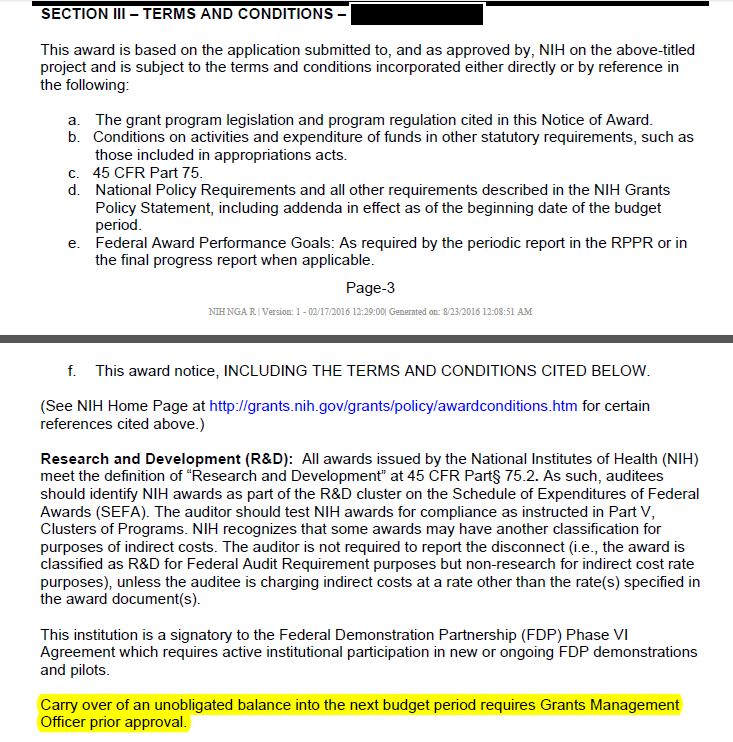
Demystifying
           the
    Carryover Process

2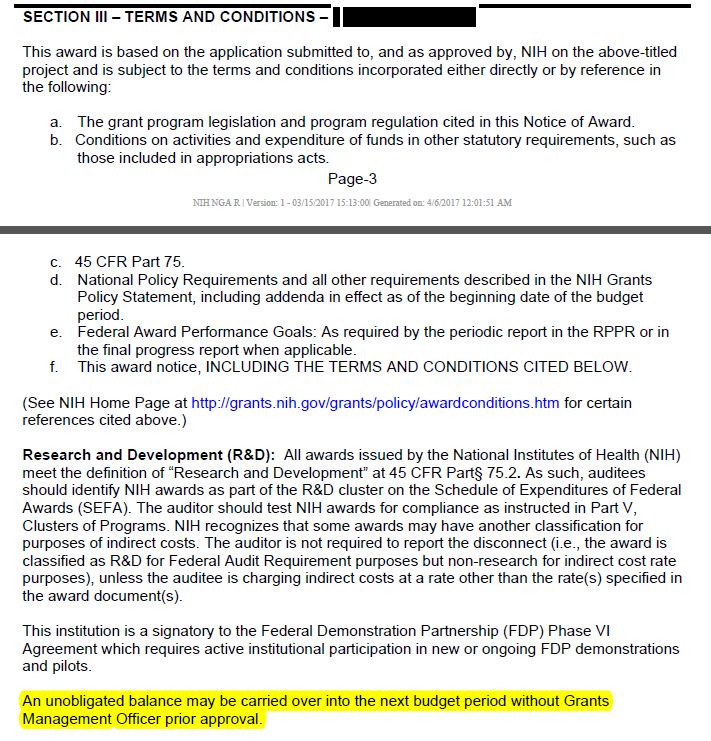
Agenda
    ▪ Carryover Presentation
    ▪ Questions/Discussion

3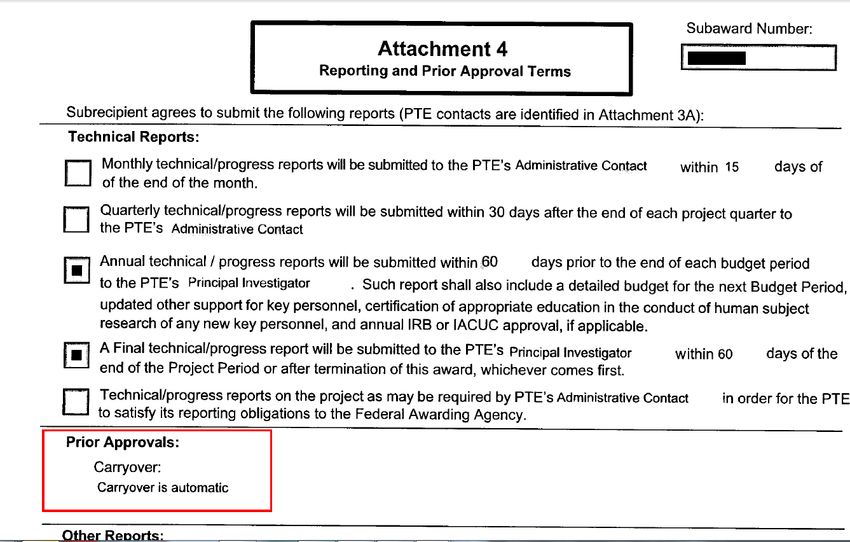
Learning Objectives
Participants will
    ❖ understand the importance of knowing the terms and
       conditions (T&C) of a sponsored award
    ❖ grasp the concept of the unobligated balance (UOB),
       its components and how to manage them
    ❖ understand such concepts as the UOB automatic
       carryover, prior approval, offset, restriction and how
       these affect a sponsored award
    ❖ learn the submission process of the carryover
       request
    ❖ receive a list of resources to help further their
       knowledge of the carryover process

4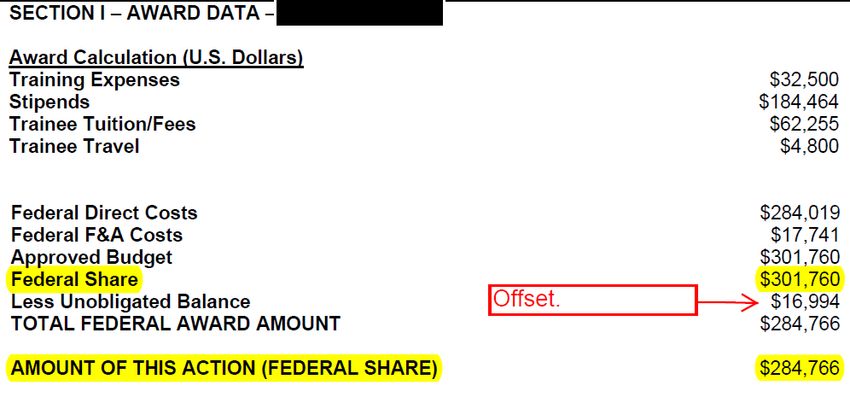
Unobligated Balance (UOB)
    ❖ Unspent funds or budget remaining at the end of the budget
      or project period

    ❖ UOB = Budget - Expenditures - Unliquidated/Pending
      Obligations

    ❖ Managing each component of the UOB is key to a correct
      figure

    ❖ Goal is to keep UOB as low as possible

UOB is the official balance reported on a financial report or final
invoice at the end of the budget year or project period.

5
.
Managing UOB Components
❖ Budget (What makes up the period budget)
    ➢ Awarded funds -- Make sure they are properly reflected in Banner
    ➢ Automatic carryover, or approved carryover/offset from prior
      period(s) per NGA
    ➢ Carryover from prior institutions upon relinquishing grant to UIC
    ➢ Unliquidated obligations per prior year financial report
❖ Expenditures
    ➢ Allowable costs incurred in budget period and posted to ledger,
       per UG (2 CFR 200), scope of work, budget narrative, etc.
    ➢ Make sure internal shadow systems reconcile to Banner
    ➢ Make sure all subrecipient and consultant invoices are tracked
      and accounted for in Banner.
❖ Unliquidated Obligations
    ➢ Allowable costs incurred/pending claims not yet paid or satisfied
       ■ Subrecipient/consultant outstanding charges
       ■ Outstanding travel charges, etc.

6
Official UOB per FFR ❖ UOB = Authorized Budget - Expenditures - Unliquidated Obligations 7
Unobligated Balance Treatment
❖ UOB Treatment Determined by (in increasing order):
    ➢ Uniform Guidance (UG) 2 CFR 200.308
       ■ Section (d)(3) waives prior approval to carry forward UOB to
         subsequent periods
    ➢ Agency Policy and Terms & Conditions
    ➢ Program Requirements
    ➢ Award Terms & Conditions

❖ UOB Treatment
    ➢ May be available for spending
       ■ Automatic Carryover
       ■ UOB not restricted
    ➢ May be unavailable for spending
       ■ Prior approval required
       ■ UOB restricted
8
Example I: Notice of Grant Award
Automatic Carryover (NIH)
9Example I-a: Federal Pass-through Agreement
Automatic Carryover
10Example II: Notice of Grant Award
No Automatic Carryover (NIH)
11Example II-a: Federal Pass-through Agreement
No Automatic Carryover
12NIH Awards
❖ Streamlined Non-Competing Award Process (SNAP)
➢ Research awards (Rxx) except R35, and Career awards (Kxx)
➢ FFR due at end of segment (4-5 year project period)
➢ Have expanded authorities
■ UOB carries over automatically to next segment
■ GCO does not restrict UOB in Banner
Note: UOB >25% may require explanation
❖ Non-SNAP
➢ Generally other than Rxx and Kxx awards
➢ Includes, but not limited to: center grants (Pxx), cooperative
agreements (Uxx), training grants (Txx)
➢ Annual FFR due at end of each budget period
➢ Generally excluded from expanded authorities, unless
otherwise stated in award T&C’s
■ PI/Dept must request approval to carry over UOB
■ GCO restricts UOB in Banner until approval is obtained
Note: Agency approval MUST be issued via NGA/NoA
13Restrictions, Carryovers,
Offsets...OH MY!
14Restriction
❖ Applicability
➢ Prior approval for carryover required per T&C’s
❖ Implications
➢ Banner budget at the end of budget period is
reduced by UOB amount
➢ UOB is unavailable for use
➢ PI must submit request to use all or part of UOB
➢ UOB remains restricted until an NGA/NOA indicates
carryover has been approved
15Carryover
❖ Automatic (Fully)
➢ No need to submit carryover request.
➢ UOB is available in full--none of it is restricted (NSF,
DOE, USDA, NASA, DED)
Re NIH, if the balance is greater than 25% of the
budget there may be a need to provide a justification
to the GMS.
❖ Automatic (with varying degrees)
➢ Some sponsors allow automatic carryover up to 25%
of budget (HRSA, AHRQ)
➢ Others allow up to 10% (SAMHSA)
➢ Others set a monetary ceiling (up to $10K, AHA)
16How to Calculate UOB Threshold ❖ Total budget multiplied by sponsor threshold 17
Offset
❖ The GMO/GMS can decide to reduce the
  current or future level of funding. Reasons for
  that include:
     ➢ Large unobligated balances
     ➢ No carryover requests submitted
     ➢ Change in scope of work

18
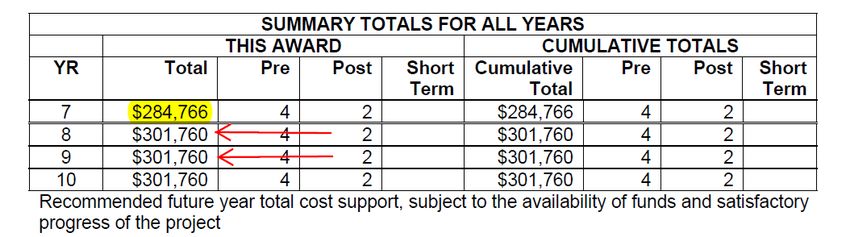
Offset (con’t.) 19
NIH Awards - Section IV
Section IV - Special Terms and Conditions
discloses the action taken regarding the
UOB, whether carryover or offset.

20
Carryover vs. Offset
          Carryover                                 Offset
Reallocation of funding from one       Cut in funding over project
period to another: no loss of funds    period
 ❖ Section I of NGA shows some          ❖ Section I of NGA shows some
   action is taken re UOB                 action is taken re UOB
 ❖ Section IV of NGA (T&Cs)             ❖ Section IV of NGA explains
   explains nature of action --           nature of action -- offset
   carryover                            ❖ Upon receipt of the FFR, the
 ❖ Amount of carryover is added to        GMO/GMS will determine if an
   current year’s authorized funds        offset will occur
   (award) to form total budget. So,    ❖ Budget = Reduced New money +
   Budget = New money (as                 “recycled dollars” from prior
   projected) + “recycled dollars”        year(s) UOB
   from prior year(s) UOB               ❖ Once UOB is offset, those dollars
                                          are no longer available to request
                                          as carryover.

21
Carryover vs. Offset Illustration 22
Why Does This Matter?
❖ Do you know which provision is applicable to
  the unobligated balance on your award?
❖ Can you afford to lose funds that could be
  spent towards the original goals and
  objectives of the program?
❖ Who wants to leave funds on the table that
  they need to further their research???
❖ Is the balance on your grant CFOP due to an
  oversight in budget restriction by GCO or is it
  a true balance available for you to spend?
23
When to Request Carryover

❖ Carryover requests are made
  ➢ at the time of immediate need
  ➢ and only when the amount requested can
    and will be spent within the budget period
    in which the carryover request was made

❖    Prior to submitting a request, discuss it with
     the sponsor

24
How to Request Carryover
❖ Include the following in an email request
to awards@uic.edu
➢ Grant number and PI name
➢ Amount of funds to be carried over
➢ Explanation for the unobligated balance
➢ Plan for use of carryover funds
➢ Include a detailed budget and justification for all
items, including any subcontract costs
➢ name and email address of sponsor contact
25Justifying the Request for
Carryover
❖ When preparing a justification for a carryover request, grantees
should answer the following questions:
❖ Why were the funds not spent in the past year?
❖ What additional work will be done during the current grant year
that is not possible with the budget currently allotted to this
year?
❖ Is the request essential? Are costs reasonable, allowable,
necessary and in line with the existing budget? Are there new
costs that were previously unforeseen? How will the work be
impacted if the funds are not carried over?
26Submitting the Request for
Carryover
❖ ORS will review the request and forward it
with institutional approval to the sponsor
❖ If the request is approved, a revised
Notice of Award will reflect the additional
authorized funds for the current budget
period
27In Summary ❖ When in doubt, please consult with Office of Research Services, Grants and Contracts, or your Grant Management Officer at the awarding agency ❖ Partnership among Investigators, Business Managers, ORS, and GCO is key to successful management of the award! 28
Resources
❖ Uniform Guidance 2 CFR 200 https://www.ecfr.gov/cgi-bin/text-
  idx?tpl=/ecfrbrowse/Title02/2cfr200_main_02.tpl
❖ HHS Grants Policy Statement
    ➢ https://www.hhs.gov/sites/default/files/grants/grants/policies-
       regulations/hhsgps107.pdf
❖ NIH Grants Policy Statement
    ➢ https://grants.nih.gov/policy/nihgps/index.htm
    ➢ Section 8 Administrative Requirements
❖ University of Illinois - Sponsored Projects Cost Principles
    ➢ https://www.obfs.uillinois.edu/bfpp/section-16-grants-research-
       contracts/cost-principles
❖ Terms and Conditions of your grant or contract
❖ Prior Approval Matrix (NSF, DOE, NIH, USDA, DOC, NASA)
    ➢ https://www.nsf.gov/bfa/dias/policy/fedrtc/appendix_a.pdf
❖ Department of Education - EDGAR Expanded Authorities
    ➢ https://www2.ed.gov/about/offices/list/oela/expandau.html

29
Questions/Discussion 30
Next Meeting

     Wednesday, June 20 from 1-2pm

                     Topic:
     State Contracting and Small Business
                Subcontracting

31
You can also read


