Responsible RestartOhio - Child Care Guiding Principles - Ohio.gov
←
→
Page content transcription
If your browser does not render page correctly, please read the page content below
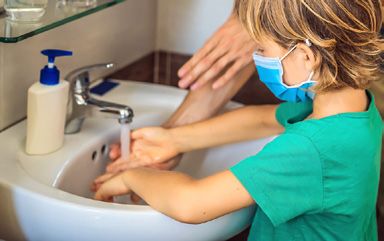
Responsible RestartOhio
Child Care

Guiding Principles
Since the beginning of the pandemic the goal and focus for the child care industry was to:
  1. Ensure parents that provide essential functions and services to restart Ohio’s economy have a safe and healthy place for their
		 children to go while working.
  2. Protect the safety and well-being of the children and families we serve and the professionals we depend on.

Health & Safety Guidance for Ohio Child Care Programs
  • Practice Social Distancing – Ratio & Class Size             • Physician Referral at First Sign of Symptoms
  • Wash and Sanitize Hands and Equipment                       • Notification & Coordination with the Local Health Department
  • Vigilantly Assess for Symptoms                              • Facial Coverings for Staff and Children

Background
Transitional pandemic rules and best practice guidance has been updated to assist with ensuring every effort is being made to
mitigate and prevent the spread of COVID-19.

Transitional pandemic rules are licensing requirements established as Ohio transitions to normal class sizes when/if appropriate.
Child Care programs must follow all guidelines set by the Governor of Ohio or the Director of the Ohio Department of Health.

This document summarizes the rules, best practices, and any associated tips.

Note: “employee” includes all administrators, employees and child care staff members (CCSM). These requirements and all new procedures
established by the program should be reviewed with all employees.

                              Mandatory
                                                                                           Recommended Best Practices

Practice Social            Effective Sunday, August 9, 2020 Ohio will return to regular     • Review back-up staffing plan that ensures background
                           ratio and class sizes with the strong recommendation that          check requirements are followed.
Distancing -               the class size not exceed the number of children that can        • Maintain stable grouping:
Ratio/Class                safely socially distance in the classroom. Each provider’s
                           setting is different and will allow for a different number of
                                                                                              • Same group of children each day.
                                                                                              • Same staff with same children each day.
Size                       children to safely be served never to exceed the below.            • Keep siblings together, when possible.
                                                                                              • Keep children whose parents/guardians have the
                                                                                            		 same employer together, when possible.
                                                                                              • Groups should not be combined at times when
                                                                                            		 fewer children are present, even if appropriate staff/
                                                                                            		 child ratios are maintained.
                                                                                            Tip: Revise the daily schedules to ensure outdoor play/
                                                                                            indoor large motor play at staggered times.
Mandatory                                               Recommended Best Practices

Practice Social                                                             In the event a county reaches a Level 4 (PURPLE)
                                                                            Public Emergency on the Ohio Public Health Adviso-
Distancing -                                                                ry System, the Ohio Department of Job and Family
Ratio/Class                                                                 Services STRONGLY encourages all providers to return
                                                                            to serving ONLY essential service families at the below
Size (cont.)                                                                ratio and class sizes:

                  Type A Family Child Care maintains a ratio of 1:6 (no
                  more than 3 children under the age of 2) with a maximum
                  group size of 12.
Mandatory                                                      Recommended Best Practices

Handwashing   • Follow all handwashing procedures pursuant to rule, with        • Employees and children should frequently wash their
                the following additions:                                          hands.
                • All employees shall wash their hands upon entering a 		       • Teach children and employees appropriate
              		 classroom and prior to leaving for the day.                      handwashing practices.
                • All children shall wash their hands upon arrival and 		       • Require anyone entering the program to wash and/or
              		 prior to leaving for the day.                                    sanitize their hands.
              Centers and family child care homes may use non-perma-            • Wash hands carefully with soap and water for at least
              nent sinks to meet the handwashing requirements.                    20 seconds.
                                                                                • Wash hands after coughing, sneezing, or using a tissue.
                                                                                • Provide a hand washing/sanitizing station at the
                                                                                  program’s entrance.

                                                                                Tips:
                                                                                  • Create a sanitation backpack that includes items
                                                                                		 such as cleaner, sanitizer, gloves, paper towels, and/
                                                                                		 or a small trash bag to take when you are caring for
                                                                                		 the children outside.
                                                                                  • Teach children a 20-second song to sing as they
                                                                                		 wash their hands.
                                                                                  • Please see “Portable Sinks in Child Care” for
                                                                                		 additional information at:
                                                                                		 http://jfs.ohio.gov/cdc/CoronavirusAndChildcare/.
                                                                                  • Communicate with families about the new hand
                                                                                		 washing practices in place in the program so they
                                                                                		 can reinforce with their children as well.
                                                                                  • Display handwashing posters to encourage proper
                                                                                		 washing, available on the provider pandemic page:
                                                                                		 http://jfs.ohio.gov/cdc/CoronavirusAndChildcare/.
                                                                                  • Watch YouTube videos with the children about
                                                                                		 proper handwashing:
                                                                                		 http://jfs.ohio.gov/cdc/CoronavirusAndChildcare/.
                                                                                  • Require employees to watch a video on proper
                                                                                		 handwashing: https://www.youtube.com/watch?v=L
                                                                                		 Wmok9avzr4&feature=youtube.

Symptom       • Assess all administrators, employees, child care staff and 		   • Refer those displaying symptoms of COVID-19 to an
                children for the COVID-19 related symptoms listed below 		        appropriate health care professional (i.e. primary care
Screening &     prior to or as soon as they arrive each day.                      physician or pediatrician). Local health professionals
Physician       • A temperature of at least 100 degrees Fahrenheit
                • Fever or chills
                                                                                  can help to identify potentially infected or exposed
                                                                                  individuals and assist with appropriate notifications.
Referral        • Cough                                                         • Incorporate social distancing while screening or use
                • Shortness of breath or difficulty breathing                     physical barriers to minimize exposure.
                • Fatigue                                                       • Provide appropriate personal protective equipment
                • Muscle or body aches                                            (PPE) for employees who conduct screenings.
                • Headache                                                      • Conduct health screening of any visitors to your
                • New loss of taste or smell                                      program.
                • Sore throat                                                   • Request parents/guardians and/or visitors wear a mask
                • Congestion or runny nose                                        at arrival and screening.
                • Nausea or vomiting                                            • Request that children not eat, drink, or have physical
                • Diarrhea                                                        activity immediately prior to screening.
              • Anyone with a fever of at least 100 degrees Fahrenheit 		       • Teach employees how to:
                must stay home or be sent home.                                   • Take a temperature.
              • Individuals who potentially have been exposed should 		           • Read a thermometer.
                follow quarantine and other recommendations from local            • Sanitize a thermometer.
                public health officials.                                          • Properly put on and take off PPE.
                                                                                • Modify drop off and pick up to ensure social distancing.
                                                                                  Examples:
                                                                                  • Stagger times.
                                                                                  • Curbside drop-off and pick up.
                                                                                  • Request same parent/guardian drop off and pick up
                                                                                		 child.
                                                                                  • Provide physical guides (6 ft apart), such as tape on
                                                                                		 ground, for waiting in line.

                                                                                In addition to testing available through healthcare pro-
                                                                                viders, the state has implemented an initiative to provide
                                                                                testing with no out-of-pocket costs to any individuals of
                                                                                any age at pop-up sites in local communities. Updated
                                                                                testing information and availability can be found at
                                                                                https://coronavirus.ohio.gov.
Mandatory Recommended Best Practices
Symptom
Child care providers are encouraged to refer symptomatic
staff or children to an appropriate healthcare provider or
Screening & testing site.
Physician Tips:
Referral (cont.) • Remind parents/guardians to keep their child home
when they are sick
• Communicate with families about the new symptom
screening process you have in place. Have them
talk with their child prior to arrival about this new
process.
• Talk with the children during the day about the new
symptom screening process that will happen every
day when they arrive.
Exclusion • Immediately send home any child or employee who has • When a child meets the COVID-19 exclusion criteria:
any of the symptoms listed in rule. • Isolate the child in a separate room or space until
• Individuals sent home shall not return until they have they are taken home.
been symptom free for 24 hours without the use of • Put a mask on the child, if possible and if appropriate.
medication. • CCSM supervising the child should wear protective
• If the individual who had the symptoms has had clothing and should wash hands often.
known contact with someone confirmed or probable
to have COVID-19, they must complete isolation or Tips:
quarantine procedures for COVID-19 in coordination • Review and test emergency contact numbers.
with the local health department prior to returning to • Communicate with families about the program’s
the program. isolation and discharge process.
• The above requirements also apply to anyone whose
symptoms are taken to be observed after arrival. For the most up-to-date information on when a teacher
• If an employee or a child tests positive for COVID-19, or child can be with others safely after a diagnosis of
they must complete isolation or quarantine procedures for COVID-19, visit the CDC’s website at https://www.cdc.gov/
COVID-19 in coordination with the local health department coronavirus/2019-ncov/if-you-are-sick/end-home-isolation.
prior to returning to the program. html.
Dividers • If a program wishes to use dividers to divide a room
into smaller spaces to serve multiple groups of children,
it is recommended that the dividers meet the following
requirements:
• At least 6 ft high.
• Made from nonporous material or material which
may be sanitized.
• Meet requirements set by:
• Department of Commerce.
• Local building department.
• State Fire Marshal.
• Local fire safety inspector.
• Please see “Using Dividers to Create Separate Spaces
in Child Care Settings” at:
http://jfs.ohio.gov/cdc/CoronavirusAndChildcare/.
Face Face coverings are required for employees and for all Some situations where face shields would be useful
children in 3rd grade or above. Face coverings should cover include:
Coverings both the mouth and nose to maximize effectiveness. Face • When interacting with students, such as those with
shields that wrap around the face and extend below the chin disabilities, where communication could be
can be considered as an alternative where cloth face cover- impacted.
ings would hinder the learning process. • When interacting with English-language learners or
when teaching a foreign language.
• Settings where cloth masks might present a safety
hazard.
• For individuals who have difficulty wearing a cloth
face covering.
• Consider requiring children to wear masks while
being transported.Mandatory Recommended Best Practices
Face All employees, staff, administrators and in-home aides are
• Programs can consider establishing a facial covering
required to wear a face mask, unless not medically appropri- policy for younger children.
Coverings ate, while indoors. • Programs should work to reduce any social stigma for
(cont.) • Employees who care for individuals with symptoms
must use appropriate PPE, provided by the program, in
a child who, for medical or developmental reasons,
cannot and should not wear a face covering.
accordance with OSHA standards. • Face covering should not be worn on:
• Children younger than 2 years of age.
• Anyone who has trouble breathing or is
unconscious.
• Anyone who is unable to remove the face covering
without assistance.
Additional Increased Sanitation and Social Distancing
• Thoroughly clean and sanitize program environment
Best Practice to limit spread on shared surfaces.
Recommenda- • Supplement handwashing by providing hand
sanitizer (60% to 95% alcohol based) in high traffic
tions to align areas including entrances to buildings and class
rooms instructing staff and children to use the
with COVID-19 sanitizer.
Health and • Employees, children, and volunteers should avoid
touching their mouths, noses, and eyes since the
Prevention virus easily enters the body through these
membranes.
Guidance for • Employees should try when possible to
Ohio K-12 maintain 6-foot social distance among children,
employees, and volunteers in all program
Schools. environments, including classrooms, hallways,
restrooms, cafeteria, playground, drop-off and
pick-up locations, and buses.
• Limit the number of visitors to a program and
consider eliminating field trips or large group events
where intermingling often occurs.
Additional Assessing Symptoms, Risk Assessment and
Mitigation
• Consider monitoring daily absences of students and
employees for trends.
• It is recommended that sick leave and absence
policies should not penalize employees or children
for staying home when symptomatic or in
quarantine or isolation.
• Consider requiring that employees, volunteers, and
children who have suspected to have COVID-19
cannot return to the program until they meet the
CDC criteria for return. Be prepared with appropriate
plans for absences.
Please note: Additional information regarding COVID-19
Health and Prevention Guidance for Ohio K-12 Schools
may be found at:
http://education.ohio.gov/Topics/Reset-and-Restart
Please find additional best practices and tips at: http://jfs.ohio.gov/cdc/CoronavirusAndChildcare/. Revised 7/30You can also read


