RHODE ISLAND CORE STANDARDS FOR MATHEMATICS - March 2021 Rhode Island Department of Education, 2021
←
→
Page content transcription
If your browser does not render page correctly, please read the page content below
RHODE ISLAND CORE
                                STANDARDS FOR
                                 MATHEMATICS
                                                                   March 2021

                   Rhode Island Department of Education, 2021
Adapted from © 2017 Massachusetts Department of Elementary & Secondary Education.
The Standards for Mathematical Practice
The Standards for Mathematical Practice describe expertise that mathematics educators at all levels should seek
to develop in their students. The Standards for Mathematical Practice describe ways in which developing
student practitioners of the discipline of mathematics engage with the subject matter as they grow in
mathematical maturity and expertise throughout the elementary, middle, and high school years. These practices
rest on two sets of important “processes and proficiencies” that have longstanding importance in mathematics
education—the National Council of Teachers of Mathematics (NCTM) process standards and the strands of
mathematical proficiency specified in the National Research Council’s Report “Adding It Up.”
Designers of curricula, assessments, and professional development should endeavor to connect the
mathematical practices to mathematical content in instruction.
1. Make sense of problems and persevere in solving them.
Mathematically proficient students start by explaining to themselves the meaning of a problem and looking for
entry points to its solution. They analyze givens, constraints, relationships, and goals. They make conjectures
about the form and meaning of the solution and plan a solution pathway rather than simply jumping into a
solution attempt. They consider analogous problems, and try special cases and simpler forms of the original
problem in order to gain insight into its solution. They monitor and evaluate their progress and change course if
necessary. Older students might, depending on the context of the problem, transform algebraic expressions or
change the viewing window on their graphing calculator to get the information they need. Mathematically
proficient students can explain correspondences between equations, verbal descriptions, tables, and graphs or
draw diagrams of important features and relationships, graph data, and search for regularity or trends. Younger
students might rely on using concrete objects or pictures to help conceptualize and solve a problem.
Mathematically proficient students check their answers to problems using a different method, and they
continually ask themselves, “Does this make sense?” They can understand others’ approaches to solving
complex problems and identify correspondences among different approaches.
2. Reason abstractly and quantitatively.
Mathematically proficient students make sense of the quantities and their relationships in problem situations.
Students bring two complementary abilities to bear on problems involving quantitative relationships: the ability
to decontextualize—to abstract a given situation and represent it symbolically, and manipulate the representing
symbols as if they have a life of their own, without necessarily attending to their referents—and the ability to
contextualize, to pause as needed during the manipulation process in order to probe into the referents for the
symbols involved. Quantitative reasoning entails habits of creating a coherent representation of the problem at
hand; considering the units involved; attending to the meanings of quantities, not just how to compute them;
and knowing and flexibly using different properties of operations and objects.
3. Construct viable arguments and critique the reasoning of others.
Mathematically proficient students understand and use stated assumptions, definitions, and previously
established results in constructing arguments. They make conjectures and build a logical progression of
statements to explore the truth of their conjectures. They are able to analyze situations by breaking them into
cases, and can recognize and use counterexamples. They justify their conclusions, communicate them to others,
and respond to the arguments of others. They reason inductively about data, making plausible arguments that
take into account the context from which the data arose. Mathematically proficient students are also able to
Rhode Island Department of Education, 2021
Adapted from © 2017 Massachusetts Department of Elementary & Secondary Education. 2compare the effectiveness of two plausible arguments, distinguish correct logic or reasoning from that which is
flawed, and—if there is a flaw in an argument—explain what it is. Elementary students can construct arguments
using concrete referents such as objects, drawings, diagrams, and actions. Such arguments can make sense and
be correct, even though they are not generalized or made formal until later grades. Later, students learn to
determine domains to which an argument applies. Students at all grades can listen or read the arguments of
others, decide whether they make sense, and ask useful questions to clarify or improve the arguments.
4. Model with mathematics.
Mathematically proficient students can apply the mathematics they know to solve problems arising in everyday
life, society, and the workplace. In early grades, this might be as simple as writing an addition equation to
describe a situation. In middle grades, a student might apply proportional reasoning to plan a school event or
analyze a problem in the community. By high school, a student might use geometry to solve a design problem or
use a function to describe how one quantity of interest depends on another. Mathematically proficient students
who can apply what they know are comfortable making assumptions and approximations to simplify a
complicated situation, realizing that these may need revision later. They are able to identify important quantities
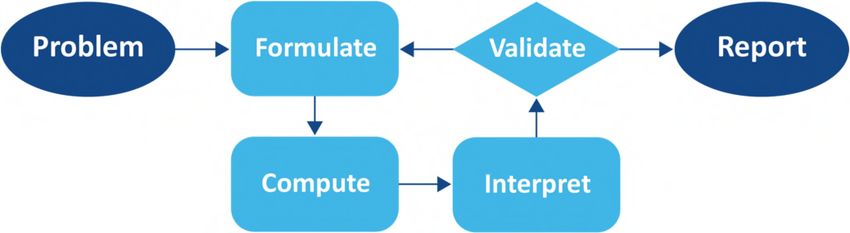
in a practical situation and map their relationships using such tools as diagrams, two-way tables, graphs,
flowcharts and formulas. They can analyze those relationships mathematically to draw conclusions. They
routinely interpret their mathematical results in the context of the situation and reflect on whether the results
make sense, possibly improving the model if it has not served its purpose.
5. Use appropriate tools strategically.
Mathematically proficient students consider the available tools when solving a mathematical problem. These
tools might include pencil and paper, concrete models, a ruler, a protractor, a calculator, a spreadsheet, a
computer algebra system, a statistical package, or dynamic geometry software. Proficient students are
sufficiently familiar with tools appropriate for their grade or course to make sound decisions about when each of
these tools might be helpful, recognizing both the insight to be gained and their limitations. For example,
mathematically proficient high school students analyze graphs of functions and solutions generated using a
graphing calculator. They detect possible errors by strategically using estimation and other mathematical
knowledge. When making mathematical models, they know that technology can enable them to visualize the
results of varying assumptions, explore consequences, and compare predictions with data. Mathematically
proficient students at various grade levels are able to identify relevant external mathematical resources, such as
digital content located on a website, and use them to pose or solve problems. They are able to use technological
tools to explore and deepen their understanding of concepts.
6. Attend to precision.
Mathematically proficient students try to communicate precisely to others. They try to use clear definitions in
discussion with others and in communicating their own reasoning verbally and/or in writing. In problem solving
they state the meaning of the symbols they choose, including using the equal sign consistently and
appropriately. They are careful about specifying units of measure and labeling axes to clarify the
correspondence with quantities in a problem. They calculate accurately and efficiently, expressing numerical
answers with a degree of precision appropriate for the problem context. In the elementary grades, students give
carefully formulated explanations to each other. By the time they reach high school, they have learned to
examine claims and make explicit use of definitions.
Rhode Island Department of Education, 2021
Adapted from © 2017 Massachusetts Department of Elementary & Secondary Education. 37. Look for and make use of structure.
Mathematically proficient students look closely to discern a pattern or structure. Young students, for example,
might notice that three and seven more is the same amount as seven and three more, or they may sort a
collection of shapes according to how many sides the shapes have. Later, students will see 7 8 equals the well-
remembered 7 5 + 7 3, in preparation for learning about the distributive property. In the expression x2 + 9x +
14, older students can see the 14 as 2 7 and the 9 as 2 + 7. They recognize the significance of an existing line in
a geometric figure and can use the strategy of drawing an auxiliary line for solving problems. They also can step
back for an overview and shift perspective. They can see complicated things, such as some algebraic
expressions, as single objects or as being composed of several objects. For example, they can see 5 – 3(x – y)2 as
5 minus a positive number times a square, and use that to realize that its value cannot be more than 5 for any
real numbers x and y.
8. Look for and express regularity in repeated reasoning.
Mathematically proficient students notice if calculations are repeated, and look both for general methods and
for shortcuts. Upper elementary students might notice when dividing 25 by 11 that they are repeating the same
calculations over and over again, and conclude they have a repeating decimal. By paying attention to the
calculation of slope as they repeatedly check whether points are on the line through (1, 2) with slope 3, middle
school students might abstract the equation (y – 2)∕(x – 1) = 3. Noticing the regularity in the way terms cancel when
expanding (x – 1)(x + 1), (x – 1)(x2 + x + 1), and (x – 1)(x3 + x2 + x + 1) might lead them to the general formula for
the sum of a geometric series. As they work to solve a problem, mathematically proficient students maintain
oversight of the process, while attending to the details. They continually evaluate the reasonableness of their
intermediate results.
Rhode Island Department of Education, 2021
Adapted from © 2017 Massachusetts Department of Elementary & Secondary Education.
4K
Kindergarten
Introduction
In kindergarten, instructional time should focus on two critical areas: (1) representing, relating, and operating on
whole numbers, initially with sets of objects; and (2) describing shapes and space. More learning time in
kindergarten should be devoted to number than to other topics.
1. Students use numbers, including written numerals, to represent quantities and to solve quantitative
problems, such as counting objects in a set; counting out a given number of objects; comparing sets or
numerals; and modeling simple joining and separating situations with sets of objects, or eventually with
equations such as 5 + 2 = 7 and 7 – 2 = 5. (Kindergarten students should see addition and subtraction
equations, and student writing of equations in kindergarten is encouraged, but it is not required.)
Students choose, combine, and apply effective strategies for answering quantitative questions, including
quickly recognizing the cardinalities of small sets of objects, counting and producing sets of given sizes,
counting the number of objects in combined sets, or counting the number of objects that remain in a set
after some are taken away.
2. Students describe their physical world using geometric ideas (e.g., shape, orientation, spatial relations)
and vocabulary. They identify, name, and describe basic two-dimensional shapes, such as squares,
triangles, circles, rectangles, and hexagons, presented in a variety of ways (e.g., with different sizes and
orientations), as well as three-dimensional shapes such as cubes, cones, cylinders, and spheres. They use
basic shapes and spatial reasoning to model objects in their environment and to construct more
complex shapes.
The Standards for Mathematical Practice complement the content standards so that students increasingly
engage with the subject matter as they grow in mathematical maturity and expertise throughout the
elementary, middle, and high school years.
Rhode Island Department of Education, 2021
Adapted from © 2017 Massachusetts Department of Elementary & Secondary Education. 5Kindergarten Overview
Counting and Cardinality
A. Know number names and the counting sequence. Standards for
B. Count to tell the number of objects. Mathematical Practice
C. Compare numbers. 1. Make sense of problems and
persevere in solving them.
2. Reason abstractly and
Operations and Algebraic Thinking quantitatively.
A. Understand addition as putting together and adding to, 3. Construct viable arguments and
and understand subtraction as taking apart and taking critique the reasoning of others.
from. 4. Model with mathematics.
5. Use appropriate tools
Number and Operations in Base Ten strategically.
A. Work with numbers 11–19 to gain foundations for place 6. Attend to precision.
value. 7. Look for and make use of
structure.
Measurement and Data 8. Look for and express regularity in
A. Describe and compare measurable attributes. repeated reasoning.
B. Classify objects and count the number of objects in each
category.
Geometry
A. Identify and describe shapes (squares, circles, triangles, rectangles, hexagons, cubes, cones, cylinders,
and spheres).
B. Analyze, compare, create, and compose shapes.
Rhode Island Department of Education, 2021
Adapted from © 2017 Massachusetts Department of Elementary & Secondary Education. 6Kindergarten Content Standards
Counting and Cardinality K.CC
A. Know number names and the count sequence.
1. Count to 100 by ones and by tens.
2. Count forward beginning from a given number within the known sequence
(instead of having to begin at one).
3. Write numbers from 0 to 20. Represent a number of objects with a written numeral 0–20 (with 0
representing a count of no objects).
B. Count to tell the number of objects.
4. Understand the relationship between numbers and quantities; connect counting to cardinality.
a. When counting objects, say the number names in the standard order, pairing each object with
one and only one number name and each number name with one and only one object.
b. Understand that the last number name said tells the number of objects counted. The number of
objects is the same regardless of their arrangement or the order in which they were counted.
c. Understand that each successive number name refers to a quantity that is one larger. Recognize
the one more pattern of counting using objects.
5. Count to answer “how many?” questions about as many as 20 things arranged in a line, a rectangular
array, or a circle, or as many as 10 things in a scattered configuration; given a number from 1–20, count
out that many objects.
C. Compare numbers.
6. Identify whether the number of objects in one group is greater than, less than, or equal to the number
of objects in another group for groups with up to 10 objects, e.g., by using matching and counting
strategies.
7. Compare two numbers between 1 and 10 presented as written numerals.
Operations and Algebraic Thinking K.OA
A. Understand addition as putting together and adding to, and understand subtraction as taking apart and
taking from.
1. Represent addition and subtraction with objects, fingers, mental images, drawings,3 sounds (e.g., claps),
acting out situations, verbal explanations, expressions, or equations.
2. Solve addition and subtraction word problems, and add and subtract within 10, e.g., by using objects or
drawings to represent the problem.
3. Decompose numbers less than or equal to 10 into pairs in more than one way, e.g., by using objects or
drawings, and record each decomposition by a drawing or equation (e.g., 5 = 2 + 3 and 5 = 4 + 1).
4. For any number from 1 to 9, find the number that makes 10 when added to the given number, e.g., by
using objects or drawings, and record the answer with a drawing or equation.
5. Fluently add and subtract within 5, including zero.
Number and Operations in Base Ten K.NBT
A. Work with numbers 11–19 to gain foundations for place value.
1. Compose and decompose numbers from 11 to 19 into ten ones and some further ones, e.g., by using
objects or drawings, and record each composition or decomposition by a drawing or equation (e.g., 18 =
10 + 8); understand that these numbers are composed of ten ones and one, two, three, four, five, six,
seven, eight, or nine ones.
3
Drawings need not show details, but should show the mathematics in the problem.
Rhode Island Department of Education, 2021
Adapted from © 2017 Massachusetts Department of Elementary & Secondary Education. 7Measurement and Data K.MD
A. Describe and compare measurable attributes.
1. Describe measurable attributes of objects, such as length or weight. Describe several measurable
attributes of a single object.
2. Directly compare two objects with a measurable attribute in common, to see which object has “more
of”/“less of” the attribute, and describe the difference. For example, directly compare the heights of two
children and describe one child as taller/shorter.
B. Classify objects and count the number of objects in each category.
3. Classify objects into given categories; count the numbers of objects in each category (up to and
including 10) and sort the categories by count.
Geometry K.G
A. Identify and describe shapes (squares, circles, triangles, rectangles, hexagons, cubes, cones, cylinders, and
spheres).
1. Describe objects in the environment using names of shapes, and describe the relative positions of these
objects using terms such as above, below, beside, in front of, behind, and next to.
2. Correctly name shapes regardless of their orientation or overall size.
3. Identify shapes as two-dimensional (lying in a plane, “flat”) or three-dimensional (“solid”).
B. Analyze, compare, create, and compose shapes.
4. Analyze and compare two- and three-dimensional shapes, in different sizes and orientations, using
informal language to describe their similarities, differences, parts (e.g., number of sides and
vertices/“corners”) and other attributes (e.g., having sides of equal length).
5. Model shapes in the world by building shapes from components (e.g., sticks and clay balls) and drawing
shapes.
6. Compose simple shapes to form larger shapes.
For example, “Can you join these two triangles with full sides touching to make a rectangle?”
Rhode Island Department of Education, 2021
Adapted from © 2017 Massachusetts Department of Elementary & Secondary Education. 8Grade 1
Introduction
In grade 1, instructional time should focus on four critical areas: (1) developing understanding of addition,
subtraction, and strategies for addition and subtraction within 20; (2) developing understanding of whole
number relationships and place value, including grouping in tens and ones; (3) developing understanding of
linear measurement and measuring lengths as iterating length units; and (4) reasoning about attributes of, and
composing and decomposing geometric shapes.
1. Students develop strategies for adding and subtracting whole numbers based on their prior work with
small numbers. They use a variety of models, including discrete objects and length-based models (e.g.,
cubes connected to form lengths), to model add-to, take-from, put-together, take-apart, and compare
situations to develop meaning for the operations of addition and subtraction, and to develop strategies
to solve arithmetic problems with these operations. Students understand connections between counting
and addition and subtraction (e.g., adding two is the same as counting on two). They use properties of
addition to add whole numbers and to create and use increasingly sophisticated strategies based on
these properties (e.g., “making tens”) to solve addition and subtraction problems within 20. By
comparing a variety of solution strategies, children build their understanding of the relationship
between addition and subtraction.
2. Students develop, discuss, and use efficient, accurate, and generalizable methods to add within 100 and
subtract multiples of 10. They compare whole numbers (at least to 100) to develop an understanding of
and solve problems involving their relative sizes. They think of whole numbers between 10 and 100 in
terms of tens and ones (especially recognizing the numbers 11 to 19 as composed of a ten and some
ones). Through activities that build number sense, they understand the order of the counting numbers
and their relative magnitudes.
3. Students develop an understanding of the meaning and processes of measurement, including underlying
concepts such as iterating (the mental activity of building up the length of an object with equal-sized
units) and the transitivity principle for indirect measurement.4
4. Students compose and decompose plane or solid figures (e.g., put two triangles together to make a
quadrilateral) and build understanding of part-whole relationships as well as the properties of the
original and composite shapes. As they combine shapes, they recognize them from different
perspectives and orientations, describe their geometric attributes, and determine how they are alike
and different, to develop the background for measurement and for initial understandings of properties
such as congruence and symmetry.
The Standards for Mathematical Practice complement the content standards so that students increasingly
engage with the subject matter as they grow in mathematical maturity and expertise throughout the
elementary, middle, and high school years.
4
Students should apply the principle of transitivity of measurement to make indirect comparisons, but they need not use this technical term.
Rhode Island Department of Education, 2021
Adapted from © 2017 Massachusetts Department of Elementary & Secondary Education. 9Grade 1 Overview
Operations and Algebraic Thinking
A. Represent and solve problems involving addition and
subtraction.
B. Understand and apply properties of operations and the Standards for
relationship between addition and subtraction. Mathematical Practice
C. Add and subtract within 20. 1. Make sense of problems and
D. Work with addition and subtraction equations. persevere in solving them.
2. Reason abstractly and
Number and Operations in Base Ten quantitatively.
A. Extend the counting sequence. 3. Construct viable arguments and
B. Understand place value. critique the reasoning of others.
C. Use place value understanding and properties of 4. Model with mathematics.
operations to add and subtract. 5. Use appropriate tools
strategically.
Measurement and Data 6. Attend to precision.
A. Measure lengths indirectly and by iterating length units. 7. Look for and make use of
B. Tell and write time. structure.
C. Represent and interpret data. 8. Look for and express regularity in
D. Work with money. repeated reasoning.
Geometry
A. Reason with shapes and their attributes.
Rhode Island Department of Education, 2021
Adapted from © 2017 Massachusetts Department of Elementary & Secondary Education. 10Grade 1 Content Standards
Operations and Algebraic Thinking 1.OA
A. Represent and solve problems involving addition and subtraction.
1. Use addition and subtraction within 20 to solve word problems involving situations of adding to, taking
from, putting together, taking apart, and comparing, with unknowns in all positions, e.g., by using
objects, drawings, and equations (number sentences) with a symbol for the unknown number to
represent the problem.5
2. Solve word problems that call for addition of three whole numbers whose sum is less than or equal to
20, e.g., by using objects, drawings, and equations with a symbol for the unknown number to represent
the problem.
B. Understand and apply properties of operations and the relationship between addition and subtraction.
3. Apply properties of operations to add. 6
For example, when adding numbers order does not matter. If 8 + 3 = 11 is known, then 3 + 8 = 11 is
also known (Commutative property of addition). To add 2 + 6 + 4, the second two numbers can be
added to make a ten, so 2 + 6 + 4 = 2 + 10 = 12 (Associative property of addition). When adding zero to
a number, the result is the same number (Identity property of zero for addition).
4. Understand subtraction as an unknown-addend problem.
For example, subtract 10 – 8 by finding the number that makes 10 when added to 8.
C. Add and subtract within 20.
5. Relate counting to addition and subtraction (e.g., by counting on 2 to add 2).
6. Add and subtract within 20, demonstrating fluency for addition and subtraction within 10. Use mental
strategies such as counting on; making 10 (e.g., 8 + 6 = 8 + 2 + 4 = 10 + 4 = 14); decomposing a number
leading to a 10 (e.g., 13 – 4 = 13 – 3 – 1 = 10 – 1 = 9); using the relationship between addition and
subtraction (e.g., knowing that 8 + 4 = 12, one knows 12 – 8 = 4); and creating equivalent but easier or
known sums (e.g., adding 6 + 7 by creating the known equivalent 6 + 6 + 1 = 12 + 1 = 13).
D. Work with addition and subtraction equations.
7. Understand the meaning of the equal sign, and determine if equations involving addition and
subtraction are true or false.
For example, which of the following equations are true and which are false? 6 = 6, 7 = 8 – 1, 5 + 2 =
2 + 5, 4 + 1 = 5 + 2.
8. Determine the unknown whole number in an addition or subtraction equation relating three whole
numbers.
For example, determine the unknown number that makes the equation true in each of the equations 8
+ ? = 11, 5 = – 3, 6 + 6 = .
Number and Operations in Base Ten 1.NBT
A. Extend the counting sequence.
1. Count to 120, starting at any number less than 120. In this range, read and write numerals and represent
a number of objects with a written numeral.
B. Understand place value.
2. Understand that the two digits of a two-digit number represent amounts of tens and ones. Understand
the following as special cases:
a. 10 can be thought of as a bundle of ten ones—called a “ten.”
b. The numbers from 11 to 19 are composed of a ten and one, two, three, four, five, six, seven,
eight, or nine ones.
5
See Glossary, Table 1.
6
Students need not use formal terms for these properties.
Rhode Island Department of Education, 2021
Adapted from © 2017 Massachusetts Department of Elementary & Secondary Education. 11c. The numbers 10, 20, 30, 40, 50, 60, 70, 80, 90 refer to one, two, three, four, five, six, seven,
eight, or nine tens (and 0 ones).
3. Compare two two-digit numbers based on meanings of the tens and ones digits, recording the results of
comparisons with the symbols >, =, andGrade 2
Introduction
In grade 2, instructional time should focus on four critical areas: (1) extending understanding of base-ten
notation; (2) building fluency with addition and subtraction; (3) using standard units of measure; and (4)
describing and analyzing shapes.
1. Students extend their understanding of the base-ten system. This includes ideas of counting in fives,
tens, and multiples of hundreds, tens, and ones, as well as number relationships involving these units,
including comparing. Students understand multi-digit numbers (up to 1,000) written in base-ten
notation, recognizing that the digits in each place represent amounts of thousands, hundreds, tens, or
ones (e.g., 853 is 8 hundreds + 5 tens + 3 ones).
2. Students use their understanding of addition to develop fluency with addition and subtraction within
100. They solve problems within 1,000 by applying their understanding of models for addition and
subtraction, and they develop, discuss, and use efficient, accurate, and generalizable methods to
compute sums and differences of whole numbers in base-ten notation, using their understanding of
place value and the properties of operations. They select and accurately apply methods that are
appropriate for the context and the numbers involved to mentally calculate sums and differences for
numbers with only tens or only hundreds.
3. Students recognize the need for standard units of measure (centimeter and inch) and they use rulers
and other measurement tools with the understanding that linear measure involves an iteration of units.
They recognize that the smaller the unit, the more iterations they need to cover a given length.
4. Students describe and analyze shapes by examining their sides and angles. Students investigate,
describe, and reason about decomposing and combining shapes to make other shapes. Through
building, drawing, and analyzing two- and three-dimensional shapes, students develop a foundation for
understanding area, volume, congruence, similarity, and symmetry in later grades.
The Standards for Mathematical Practice complement the content standards so that students increasingly
engage with the subject matter as they grow in mathematical maturity and expertise throughout the
elementary, middle, and high school years.
Rhode Island Department of Education, 2021
Adapted from © 2017 Massachusetts Department of Elementary & Secondary Education. 13Grade 2 Overview
Operations and Algebraic Thinking
A. Represent and solve problems involving addition and
subtraction.
B. Add and subtract within 20.
C. Work with equal groups of objects to gain foundations for
Standards for
multiplication.
Mathematical Practice
Number and Operations in Base Ten 1. Make sense of problems and
A. Understand place value. persevere in solving them.
B. Use place value understanding and properties of 2. Reason abstractly and
operations to add and subtract. quantitatively.
3. Construct viable arguments and
Measurement and Data critique the reasoning of others.
A. Measure lengths indirectly and by iterating length units. 4. Model with mathematics.
B. Relate addition and subtraction to length. 5. Use appropriate tools
C. Work with time and money. strategically.
D. Represent and interpret data. 6. Attend to precision.
7. Look for and make use of
Geometry structure.
8. Look for and express regularity in
A. Reason with shapes and their attributes.
repeated reasoning.
Rhode Island Department of Education, 2021
Adapted from © 2017 Massachusetts Department of Elementary & Secondary Education. 14Grade 2 Content Standards
Operations and Algebraic Thinking 2.OA
A. Represent and solve problems involving addition and subtraction.
1. Use addition and subtraction within 100 to solve one- and two-step word problems involving situations
of adding to, taking from, putting together, taking apart, and comparing, with unknowns in all positions,
e.g., by using drawings and equations with a symbol for the unknown number to represent the
problem.8
B. Add and subtract within 20.
2. Fluently add and subtract within 20 using mental strategies.9 By end of grade 2, know from memory all
sums of two single-digit numbers and related differences.
For example, the sum 6 + 5 = 11 has related differences of 11 – 5 = 6 and 11 – 6 = 5.
C. Work with equal groups of objects to gain foundations for multiplication.
3. Determine whether a group of objects (up to 20) has an odd or even number of members, e.g., by
pairing objects or counting them by 2s; write an equation to express an even number as a sum of two
equal addends.
4. Use addition to find the total number of objects arranged in rectangular arrays with up to five rows and
up to five columns; write an equation to express the total as a sum of equal addends.
Number and Operations in Base Ten 2.NBT
A. Understand place value.
1. Understand that the three digits of a three-digit number represent amounts of hundreds, tens, and
ones; e.g., 706 equals 7 hundreds, 0 tens, and 6 ones. Understand the following as special cases:
a. 100 can be thought of as a bundle of ten tens—called a “hundred.”
b. The numbers 100, 200, 300, 400, 500, 600, 700, 800, 900 refer to one, two, three, four, five, six,
seven, eight, or nine hundreds (and 0 tens and 0 ones).
2. Count within 1,000; skip-count by 5s, 10s, and 100s. Identify patterns in skip counting starting at any
number.
3. Read and write numbers to 1,000 using base-ten numerals, number names, and expanded form.
4. Compare two three-digit numbers based on meanings of the hundreds, tens, and ones digits, using >, =,
and < symbols to record the results of comparisons.
B. Use place value understanding and properties of operations to add and subtract.
5. Fluently add and subtract within 100 using strategies based on place value, properties of operations,
and/or the relationship between addition and subtraction.
6. Add up to four two-digit numbers using strategies based on place value and properties of operations.
7. Add and subtract within 1,000, using concrete models or drawings and strategies based on place value,
properties of operations, and/or the relationship between addition and subtraction; relate the strategy
to a written method. Understand that in adding or subtracting three-digit numbers, one adds or
subtracts hundreds and hundreds, tens and tens, ones and ones; and sometimes it is necessary to
compose or decompose tens or hundreds.
8. Mentally add 10 or 100 to a given number 100–900, and mentally subtract 10 or 100 from a given
number 100–900.
9. Explain why addition and subtraction strategies work, using place value and the properties of
operations.10
8
See Glossary, Table 1.
9
Strategies such as counting on; making tens; decomposing a number; using the relationship between addition and subtraction; and creating equivalent
but easier or known sums.
10
Explanations may be supported by drawings or objects.
Rhode Island Department of Education, 2021
Adapted from © 2017 Massachusetts Department of Elementary & Secondary Education. 15Measurement and Data 2.MD
A. Measure and estimate lengths in standard units.
1. Measure the length of an object by selecting and using appropriate tools such as rulers, yardsticks,
meter sticks, and measuring tapes.
2. Measure the length of an object twice, using length units of different lengths for the two
measurements; describe how the two measurements relate to the size of the unit chosen.
3. Estimate lengths using units of inches, feet, centimeters, and meters.
4. Measure to determine how much longer one object is than another, expressing the length difference in
terms of a standard length unit.
B. Relate addition and subtraction to length.
5. Use addition and subtraction within 100 to solve word problems involving lengths that are given in the
same units, e.g., by using drawings (such as drawings of rulers) and equations with a symbol for the
unknown number to represent the problem.
6. Represent whole numbers as lengths from 0 on a number line diagram with equally spaced points
corresponding to the numbers 0, 1, 2, …, and represent whole-number sums and differences within 100
on a number line diagram.
C. Work with time and money.
7. Tell and write time from analog and digital clocks to the nearest five minutes, using a.m. and p.m.
a. Know the relationships of time, including seconds in a minute, minutes in an hour, hours in a
day, days in a week; days in a month and a year and approximate number of weeks in a month
and weeks in a year.
8. Solve word problems involving dollar bills, quarters, dimes, nickels, and pennies (up to $10), using $ and
¢ symbols appropriately and whole dollar amounts.
For example, if you have 2 dimes and 3 pennies, how many cents do you have? If you have $3 and 4
quarters, how many dollars or cents do you have? (Students are not expected to use decimal
notation.)
D. Represent and interpret data.
9. Generate measurement data by measuring lengths of several objects to the nearest whole unit, or by
making repeated measurements of the same object. Organize and record the data on a line plot (dot
plot) where the horizontal scale is marked off in whole-number units.
10. Draw a picture graph and a bar graph (with single-unit scale) to represent a data set with up to four
categories. Solve simple put-together, take-apart, and compare problems,11 using information presented
in a bar graph.
Geometry 2.G
A. Reason with shapes and their attributes.
1. Recognize and draw shapes having specified attributes, such as a given number of angles or a given
number of equal faces.12 Identify triangles, squares, rectangles, rhombuses, trapezoids, pentagons,
hexagons, and cubes.
2. Partition a rectangle into rows and columns of same-size squares and count to find the total number of
them.
3. Partition circles and rectangles into two, three, or four equal shares, describe the shares using the words
halves, thirds, half of, a third of, etc., and describe the whole as two halves, three thirds, four fourths.
Recognize that equal shares of identical wholes need not have the same shape.
11
See Glossary, Table 1.
12
Sizes are compared directly or visually, not compared by measuring.
Rhode Island Department of Education, 2021
Adapted from © 2017 Massachusetts Department of Elementary & Secondary Education. 16Grade 3
Introduction
In grade 3, instructional time should focus on four critical areas: (1) developing understanding of multiplication
and division and strategies for multiplication and division within 100; (2) developing understanding of fractions,
especially unit fractions (fractions with numerator 1); (3) developing understanding of the structure of
rectangular arrays and of area; and (4) describing and analyzing two-dimensional shapes.
1. Students develop an understanding of the meanings of multiplication and division of whole numbers
through activities and problems involving equal-sized groups, arrays, and area models; multiplication is
finding an unknown product, and division is finding an unknown factor in these situations. For equal-
sized group situations, division can require finding the unknown number of groups or the unknown
group size. Students use properties of operations to calculate products of whole numbers, using
increasingly sophisticated strategies based on these properties to solve multiplication and division
problems involving single-digit factors. By comparing a variety of solution strategies, students learn the
relationship between multiplication and division.
2. Students develop an understanding of fractions, beginning with unit fractions. Students view fractions in
general as being built out of unit fractions, and they use fractions along with visual fraction models to
represent parts of a whole. Students understand that the size of a fractional part is relative to the size of
the whole. For example, 1∕2 of the paint in a small bucket could be less paint than 1∕3 of the paint in a
larger bucket, but 1∕3 of a ribbon is longer than 1∕5 of the same ribbon because when the ribbon is
divided into 3 equal parts, the parts are longer than when the ribbon is divided into 5 equal parts.
Students are able to use fractions to represent numbers equal to, less than, and greater than one. They
solve problems that involve comparing fractions by using visual fraction models and strategies based on
noticing equal numerators or denominators.
3. Students recognize area as an attribute of two-dimensional regions. They measure the area of a shape
by finding the total number of same-size units of area required to cover the shape without gaps or
overlaps; a square with sides of unit length being the standard unit for measuring area. Students
understand that rectangular arrays can be decomposed into identical rows or into identical columns. By
decomposing rectangles into rectangular arrays of squares, students connect area to multiplication, and
justify using multiplication to determine the area of a rectangle.
4. Students describe, analyze, and compare properties of two-dimensional shapes. They compare and
classify shapes by their sides and angles, and connect these with definitions of shapes. Students also
relate their fraction work to geometry by expressing the area of part of a shape as a unit fraction of the
whole.
The Standards for Mathematical Practice complement the content standards so that students increasingly
engage with the subject matter as they grow in mathematical maturity and expertise throughout the
elementary, middle, and high school years.
Rhode Island Department of Education, 2021
Adapted from © 2017 Massachusetts Department of Elementary & Secondary Education. 17Grade 3 Overview
Operations and Algebraic Thinking
A. Represent and solve problems involving multiplication
and division.
B. Understand properties of multiplication and the Standards for
relationship between multiplication and division. Mathematical Practice
C. Multiply and divide within 100. 1. Make sense of problems and
D. Solve problems involving the four operations, and persevere in solving them.
identify and explain patterns in arithmetic. 2. Reason abstractly and
quantitatively.
Number and Operations in Base Ten 3. Construct viable arguments and
A. Use place value understanding and properties of critique the reasoning of others.
operations to perform multi-digit arithmetic. 4. Model with mathematics.
5. Use appropriate tools
Number and Operations—Fractions strategically.
6. Attend to precision.
A. Develop understanding of fractions as numbers.
7. Look for and make use of
Measurement and Data structure.
A. Solve problems involving measurement and estimation of 8. Look for and express regularity in
intervals of time, liquid volumes, and masses of objects. repeated reasoning.
B. Represent and interpret data.
C. Geometric measurement: understand concepts of area
and relate area to multiplication and to addition.
D. Geometric measurement: recognize perimeter as an attribute of plane figures and distinguish between
linear and area measures.
Geometry
A. Reason with shapes and their attributes.
Rhode Island Department of Education, 2021
Adapted from © 2017 Massachusetts Department of Elementary & Secondary Education. 18Grade 3 Content Standards
Operations and Algebraic Thinking 3.OA
A. Represent and solve problems involving multiplication and division.
1. Interpret products of whole numbers, e.g., interpret 5 7 as the total number of objects in five groups
of seven objects each.
For example, describe a context in which a total number of objects can be expressed as 5 7.
2. Interpret whole-number quotients of whole numbers, e.g., interpret 56 8 as the number of objects in
each share when 56 objects are partitioned equally into 8 shares, or as a number of shares when 56
objects are partitioned into equal shares of 8 objects each.
For example, describe a context in which a number of shares or a number of groups can be expressed
as 56 8.
3. Use multiplication and division within 100 to solve word problems in situations involving equal groups,
arrays, and measurement quantities, e.g., by using drawings and equations with a symbol for the
unknown number to represent the problem.13
4. Determine the unknown whole number in a multiplication or division equation relating three whole
numbers.
For example, determine the unknown number that makes the equation true in each of the equations 8
? = 48, 5 = 3, 6 6 = ?.
B. Understand properties of multiplication and the relationship between multiplication and division.
5. Apply properties of operations to multiply.14
For example, when multiplying numbers order does not matter. If 6 4 = 24 is known, then 4 6 = 24
is also known (Commutative property of multiplication); The product 3 5 2 can be found by 3 5 =
15 then 15 2 = 30, or by 5 2 = 10 then 3 10 = 30 (Associative property of multiplication); When
multiplying two numbers either number can be decomposed and multiplied; one can find 8 x 7 by
knowing that 7 = 5 + 2 and that 8 5 = 40 and 8 2 = 16, resulting in 8 (5 + 2) = (8 5) + (8 2) = 40 +
16 = 56 (Distributive property); When a number is multiplied by 1 the result is the same number
(Identity property of 1 for multiplication).
6. Understand division as an unknown-factor problem.
For example, find 32 8 by finding the number that makes 32 when multiplied by 8.
C. Multiply and divide within 100.
7. Fluently multiply and divide within 100, using strategies such as the relationship between multiplication
and division (e.g., knowing that 8 5 = 40, one knows 40 5 = 8) or properties of operations. By the end
of grade 3, know from memory all products of two single-digit numbers and related division facts.
For example, the product 4 x 7 = 28 has related division facts 28 ÷ 7 = 4 and 28 ÷ 4 = 7.
D. Solve problems involving the four operations, and identify and explain patterns in arithmetic.
8. Solve two-step word problems using the four operations for problems posed with whole numbers and
having whole number answers. Represent these problems using equations with a letter standing for the
unknown quantity. Assess the reasonableness of answers using mental computation and estimation
strategies, including rounding.15
9. Identify arithmetic patterns (including patterns in the addition table or multiplication table) and explain
them using properties of operations.
For example, observe that 4 times a number is always even, and explain why 4 times a number can be
decomposed into two equal addends.
13
See Glossary, Table 2.
14
Students need not use formal terms for these properties. Students are not expected to use distributive notation.
15
Students should know how to perform operations in the conventional order when there are no parentheses to specify a particular order (Order of
Operations).
Rhode Island Department of Education, 2021
Adapted from © 2017 Massachusetts Department of Elementary & Secondary Education. 19Number and Operations in Base Ten 3.NBT
A. Use place value understanding and properties of operations to perform multi-digit arithmetic. 16
1. Use place value understanding to round whole numbers to the nearest 10 or 100.
2. Fluently add and subtract within 1,000 using strategies and algorithms based on place value, properties
of operations, and/or the relationship between addition and subtraction.
3. Multiply one-digit whole numbers by multiples of 10 in the range 10–90 (e.g., 9 80, 5 60) using
strategies based on place value and properties of operations.
Number and Operations—Fractions 3.NF
A. Develop understanding of fractions as numbers for fractions with denominators 2, 3, 4, 6, and 8.
1. Understand a fraction 1∕bas the quantity formed by 1 part when a whole (a single unit) is partitioned into
b equal parts; understand a fraction a∕bas the quantity formed by a parts of size 1∕ b.
2. Understand a fraction as a number on the number line; represent fractions on a number line diagram.
1
a. Represent a unit fraction, ∕b, on a number line diagram by defining the interval from 0 to 1 as
the whole and partitioning it into b equal parts. Recognize that each part has size 1b∕ and that
the fraction 1∕bis located 1∕ of
b a whole unit from 0 on the number line.
b. Represent a fraction a∕bon a number line diagram by marking off a lengths 1∕ from b 0. Recognize
a a
that the resulting interval has size ∕b and that its endpoint locates the number ∕ bon the
number line.
3. Explain equivalence of fractions in special cases, and compare fractions by reasoning about their size.
a. Understand two fractions as equivalent (equal) if they are the same size, or the same point on a
number line.
1 2 4 2
b. Recognize and generate simple equivalent fractions, e.g., ∕2 = ∕4, ∕6 = ∕3. Explain why the
fractions are equivalent, e.g., by using a visual fraction model.
c. Express whole numbers as fractions, and recognize fractions that are equivalent to whole
numbers.
For example, express 3 in the form 3 = 3∕1; recognize that 6∕1 = 6; locate 4∕4 and 1 at the same point of a
number line diagram.
d. Compare two fractions with the same numerator or the same denominator by reasoning about
their size. Recognize that comparisons are valid only when the two fractions refer to the same
whole. Record the results of comparisons with the symbols >, =, orB. Represent and interpret data.
3. Draw a scaled picture graph and a scaled bar graph to represent a data set with several categories. Solve
one- and two-step “how many more” and “how many less” problems using information presented in
scaled bar graphs.
For example, draw a bar graph in which each square in the bar graph might represent five pets.
4. Generate measurement data by measuring lengths of objects using rulers marked with halves and
fourths of an inch. Record and show the data by making a line plot (dot plot), where the horizontal scale
is marked off in appropriate units—whole numbers, halves, or fourths. (See Glossary for example.)
C. Geometric measurement: understand concepts of area and relate area to multiplication and to addition.
5. Recognize area as an attribute of plane figures and understand concepts of area measurement.
a. A square with side length of one unit, called “a unit square,” is said to have “one square unit” of
area, and can be used to measure area.
b. A plane figure which can be covered without gaps or overlaps by n unit squares is said to have
an area of n square units.
6. Measure areas by counting unit squares (square cm, square m, square in., square ft., and non-standard
units).
7. Relate area to the operations of multiplication and addition.
a. Find the area of a rectangle with whole-number side lengths by tiling it, and show that the area
is the same as would be found by multiplying the side lengths.
b. Multiply side lengths to find areas of rectangles with whole-number side lengths in the context
of solving real-world and mathematical problems, and represent whole-number products as
rectangular areas in mathematical reasoning.
c. Use tiling to show in a concrete case that the area of a rectangle with whole-number side
lengths a and b + c is the sum of a b and a c. Use area models to represent the distributive
property in mathematical reasoning.
d. Recognize area as additive. Find areas of rectilinear figures by decomposing them into non-
overlapping rectangles and adding the areas of the non-overlapping parts, applying this
technique to solve real-world problems.
D. Geometric measurement: recognize perimeter as an attribute of plane figures and distinguish between
linear and area measures.
8. Solve real-world and mathematical problems involving perimeters of polygons, including finding the
perimeter given the side lengths, finding an unknown side length, and exhibiting rectangles with the
same perimeter and different areas or with the same area and different perimeters.
Geometry 3.G
A. Reason with shapes and their attributes.
1. Understand that shapes in different categories (e.g., rhombuses, rectangles, and others) may share
attributes (e.g., having four sides), and that the shared attributes can define a larger category (e.g.,
quadrilaterals). Compare and classify shapes by their sides and angles (right angle/non-right angle).
Recognize rhombuses, rectangles, squares, and trapezoids as examples of quadrilaterals, and draw
examples of quadrilaterals that do not belong to any of these subcategories.
2. Partition shapes into parts with equal areas. Express the area of each part as a unit fraction of the
whole.
For example, partition a shape into four parts with equal areas and describe the area of each part as ¼
of the area of the shape.
Rhode Island Department of Education, 2021
Adapted from © 2017 Massachusetts Department of Elementary & Secondary Education. 21Grade 4
Introduction
In grade 4, instructional time should focus on three critical areas: (1) developing understanding and fluency with
multi-digit multiplication, and developing understanding of dividing to find quotients involving multi-digit
dividends; (2) developing an understanding of fraction equivalence, addition and subtraction of fractions with
like denominators, and multiplication of fractions by whole numbers; (3) and understanding that geometric
figures can be analyzed and classified based on their properties, such as having parallel sides, perpendicular
sides, particular angle measures, and symmetry.
1. Students generalize their understanding of place value to 1,000,000, understanding the relative sizes of
numbers in each place. They apply their understanding of models for multiplication (equal-sized groups,
arrays, area models), place value, and properties of operations, in particular the distributive property, as
they develop, discuss, and use efficient, accurate, and generalizable methods to compute products of
multi-digit whole numbers. Depending on the numbers and the context, they select and accurately apply
appropriate methods to estimate or mentally calculate products. They develop fluency with efficient
procedures for multiplying whole numbers; understand and explain why the procedures work based on
place value and properties of operations; and use them to solve problems. Students apply their
understanding of models for division, place value, properties of operations, and the relationship of
division to multiplication as they develop, discuss, and use efficient, accurate, and generalizable
procedures to find quotients involving multi-digit dividends. They select and accurately apply
appropriate methods to estimate and mentally calculate quotients, and interpret remainders based
upon the context.
2. Students develop understanding of fraction equivalence and operations with fractions. They recognize
that two different fractions can be equal (e.g., 15∕9 = 5∕3), and they develop methods for generating and
recognizing equivalent fractions. Students extend previous understandings about how fractions are built
from unit fractions, composing fractions from unit fractions, decomposing fractions into unit fractions,
and using the meaning of fractions and the meaning of multiplication to multiply a fraction by a whole
number.
3. Students describe, analyze, compare, and classify two-dimensional shapes. Through building, drawing,
and analyzing two-dimensional shapes, students deepen their understanding of properties of two-
dimensional objects and the use of them to solve problems involving symmetry.
The Standards for Mathematical Practice complement the content standards so that students increasingly
engage with the subject matter as they grow in mathematical maturity and expertise throughout the
elementary, middle, and high school years.
Rhode Island Department of Education, 2021
Adapted from © 2017 Massachusetts Department of Elementary & Secondary Education. 22Grade 4 Overview
Operations and Algebraic Thinking
A. Use the four operations with whole numbers to
solve problems. Standards for
B. Gain familiarity with factors and multiples. Mathematical Practice
C. Generate and analyze patterns.
1. Make sense of problems and
persevere in solving them.
Number and Operations in Base Ten 2. Reason abstractly and
A. Generalize place value understanding for multi-digit quantitatively.
whole numbers less than or equal to 1,000,000. 3. Construct viable arguments and
B. Use place value understanding and properties of critique the reasoning of others.
operations to perform multi-digit arithmetic on 4. Model with mathematics.
whole numbers less than or equal to 1,000,000. 5. Use appropriate tools
strategically.
Number and Operations—Fractions 6. Attend to precision.
A. Extend understanding of fraction equivalence and 7. Look for and make use of
ordering for fractions ordering for fractions with structure.
denominators 2, 3, 4, 5, 6, 8, 10, 12, and 100. 8. Look for and express regularity in
B. Build fractions from unit fractions by applying and repeated reasoning.
extending previous understandings of operations on
whole numbers for fractions with denominators 2,
3, 4, 5, 6, 8, 10, 12, and 100.
C. Understand decimal notation for fractions, and
compare decimal fractions.
Measurement and Data
A. Solve problems involving measurement and conversion of measurements from a larger unit to a smaller
unit.
B. Represent and interpret data.
C. Geometric measurement: Understand concepts of angle and measure angles.
Geometry
A. Draw and identify lines and angles, and classify shapes by properties of their lines and angles.
Rhode Island Department of Education, 2021
Adapted from © 2017 Massachusetts Department of Elementary & Secondary Education. 23Grade 4 Content Standards
Operations and Algebraic Thinking 4.OA
A. Use the four operations with whole numbers to solve problems.
1. Interpret a multiplication equation as a comparison, e.g., interpret 35 = 5 7 as a statement that 35 is 5
times as many as 7 and 7 times as many as 5. Represent verbal statements of multiplicative comparisons
as multiplication equations.
2. Multiply or divide to solve word problems involving multiplicative comparison, e.g., by using drawings
and equations with a symbol for the unknown number to represent the problem, distinguishing
multiplicative comparison from additive comparison.19
3. Solve multi-step word problems posed with whole numbers and having whole-number answers using
the four operations, including problems in which remainders must be interpreted. Represent these
problems using equations with a letter standing for the unknown quantity. Assess the reasonableness of
answers using mental computation and estimation strategies including rounding.
a. Know multiplication facts and related division facts through 12 x 12.
B. Gain familiarity with factors and multiples.
4. Find all factor pairs for a whole number in the range 1–100. Recognize that a whole number is a multiple
of each of its factors. Determine whether a given whole number in the range 1–100 is a multiple of a
given one-digit number. Determine whether a given whole number in the range 1–100 is prime or
composite.
C. Generate and analyze patterns.
5. Generate a number or shape pattern that follows a given rule. Identify apparent features of the pattern
that were not explicit in the rule itself.
For example, given the rule “Add 3” and the starting number 1, generate terms in the resulting
sequence and observe that the terms appear to alternate between odd and even numbers. Explain
informally why the numbers will continue to alternate in this way.
Number and Operations in Base Ten 4.NBT
A. Generalize place value understanding for multi-digit whole numbers less than or equal to 1,000,000.
1. Recognize that in a multi-digit whole number, a digit in any place represents 10 times as much as it
represents in the place to its right.
For example, recognize that 700 70 = 10 by applying concepts of place value and division.
2. Read and write multi-digit whole numbers using base-ten numerals, number names, and expanded
form. Compare two multi-digit numbers based on meanings of the digits in each place, using >, =, and <
symbols to record the results of comparisons.
3. Use place value understanding to round multi-digit whole numbers to any place.
B. Use place value understanding and properties of operations to perform multi-digit arithmetic on whole
numbers less than or equal to 1,000,000.
4. Fluently add and subtract multi-digit whole numbers using the standard algorithm.
5. Multiply a whole number of up to four digits by a one-digit whole number, and multiply two two-digit
numbers, using strategies based on place value and the properties of operations. Illustrate and explain
the calculation by using equations, rectangular arrays, and/or area models.
6. Find whole-number quotients and remainders with up to four-digit dividends and one-digit divisors,
using strategies based on place value, the properties of operations, and/or the relationship between
multiplication and division. Illustrate and explain the calculation by using equations, rectangular arrays,
and/or area models.
19
See Glossary, Table 2.
Rhode Island Department of Education, 2021
Adapted from © 2017 Massachusetts Department of Elementary & Secondary Education. 24You can also read


