Rita Dixit Indian Miniatures Gods and Gardens: Divinity, Magic and Faith - CONTACT - Asian Art in London
←
→
Page content transcription
If your browser does not render page correctly, please read the page content below
Rita Dixit
Indian Miniatures
Gods and Gardens: Divinity,
Magic and Faith
CONTACT                                         FURTHER INFORMATION
Rita Dixit                                                Business Address
Phone +44 (0)771 325 4677               By appointment only – Notting Hill,
Email: r.dixit@indianminiatures.co.uk                          London W2.

Gods And Gardens:                                             Acknowledgement
Divinity, Magic And Faith

Dear Enthusiast,                                                        For my friends

I present my first catalogue around the theme                For those present and those in spirit
of Gods and Gardens. I exhibit virtually
artworks on three themes; the cosmic                   The hymns of the Vedas evoke an ever-present
landscape of the Gods (India’s great legends),         theme – religious awe of nature, scenery, trees
the sacred spaces of forests and groves and                               and water:
gardens in poetry and design. In doing so, I
hope to convey to you the wonderful breadth               May Peace radiate in the whole sky in
of styles and periods that is the                                  The vast ethereal space,
Indian miniature.                                      May peace reign all over this earth, in water,
                                                                 In all herbs and the forests,
A sentiment so eloquently expressed by the               May peace flow over the whole universe,
artist and collector Alice Bonner. “The most               May peace be in the Supreme Being,
perfectly formed Indian miniature contains the           May peace exist in all creation, and peace
quintessence of an entire world in an area no bigger                         alone,
than the human hand. And if not an entire world,                   May peace flow into us.
then at least a certain aspect of its mysterious,                Aum- peace, peace, peace!
hidden meaning….It is an inexhaustible fount
of revelations, which gradually unfold from the
thoughts captured in the image. This is what makes     Yajur Veda Samhita (36:17)
the miniature so valuable, more valuable than the
outstanding technique, the colours and the gold
with which it is executed”. Diaries 1956.

(Dialogues on Alice Bonner, International
Symposium, Museum Rietberg, Zurich, 2018).

Rita Dixit                                             Hindusim and Nature – Nanditha Krishan

Indian Miniatures                                      Penguin, Random House, India 2017

London, October 2020

2                                                                                                     3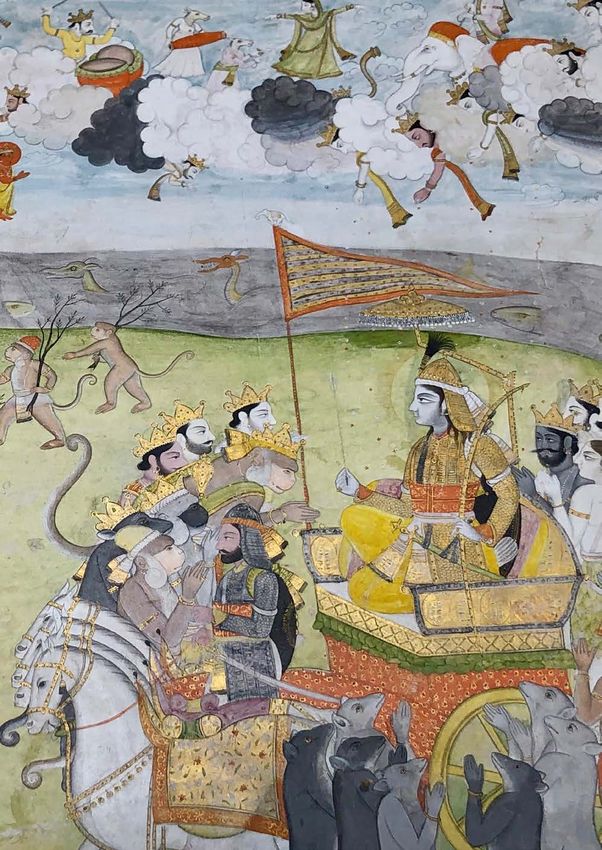
Landscape Of The Gods                                                                                                                                             Email: r.dixit@indianminiatures.co.uk

1
      Churning Of The Ocean:
                                                  Demons, Mandara Mountain is used as the           ultimate gift of self-realisation (the Amrit).      Airavata’s trunk is shown wrapped around
      A Spiritual Quest
                                                  churn and Snake Vasuki is used as the rope.                                                           the Kalpavriksha tree, a reflection of their
Gouache with gold on paper                        When the Amrit appears the Gods and Demons        In this painting, the softness of the palette, (a   association with Indra. For Indra, goes on
Size: 24cm x 18cm (image);                        go on to fight over its possession. After, many   legacy of the Guler style) gives it an ethereal,    to plant the tree in the heavenly garden of
30cm x 23cm (folio)                               adventures, it is finally consumed by the         dream-like quality, very apt for the celestial      Paradise. In the scriptures, it is described as
                                                  Gods. This is a well-known story of a mythical    setting. The Gods are painted with a serene         having gold roots, coral leaves and gemstone
Kangra, India                                     landscape that existed before creation, potent    delicacy with an energy emanating from the          buds. Its earthly counterpart is likely to be the
circa 1850                                        imagery that endures in art.                      grey swirls of the ocean as it froths. Vishnu       Indian Coral Tree Erythrina variegate.
                                                                                                    is shown resplendent in his lotus seat upon
This exquisitely detailed painting captures       Allegorically, the episode refers to the Hindu    Mount Mandara, and in his incarnate forms as        For examples of Kangra paintings on the same
the moment when the Ocean of Milk finally         view of an individual’s own spiritual journey.    Krishna and the turtle Kurma. In a comic and        subject circa 1810, see Dr. Linda Leach, Mughal
yields the Amrit, (nectar of immortality) and     The “churning” through devotion, meditation       jarring contrast, the tiring demons, holding the    and Other Indian paintings from the Chester
its other wondrous treasures. In this 1000-year   and yoga are used to gain control of one’s        heads of the snake, are depicted as supplicants,    Beatty Library. Scorpian Cavendish. 1995.
old epic tug-of-war between the Gods and the      thoughts and senses in order to attain the        palms outstretched towards Vishnu.

                                                                                                    The wonderful treasures that emerge from the
                                                                                                    ocean’s depths float as if in motion, across the
                                                                                                    top of the painting: (1) Chandra, the moon
                                                                                                    (adorning Shiva’s forehead), (2) Uchhaishravas,
                                                                                                    the celestial horse, (3) Khamadhenu, the
                                                                                                    cow of plenty, (4) Kaustubha, the divine
                                                                                                    jewel, (5) Panchajanya, Vishnu’s conch,
                                                                                                    (6) various jewelled vessels and a celestial
                                                                                                    nymph, (7) Airavata the white elephant –
                                                                                                    Indra’s mount. (8) the Goddess Varuni, (9)
                                                                                                    Kalpavriksha, the wish-fulfilling tree, (10).
                                                                                                    Dhanvantari, the heavenly physician. Here
                                                                                                    shown unconventionally carrying the Amrit,
                                                                                                    the supreme treasure in his bare hands. A
                                                                                                    reference back to the idea perhaps, that Amrit
                                                                                                    is not just for the Gods.

4                                                                                                                                                                                                           5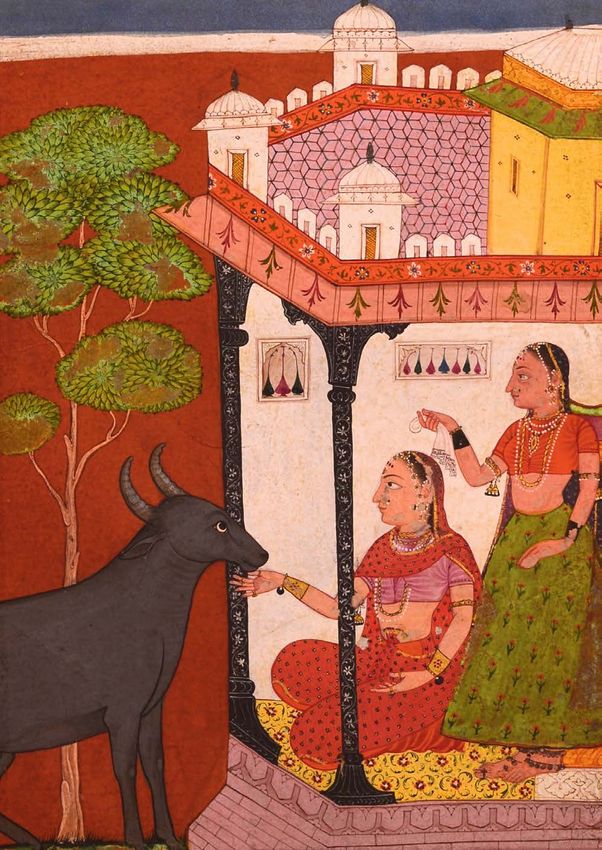
Landscape Of The Gods                                                                                                                                                 Email: r.dixit@indianminiatures.co.uk

2     Lord Rama Victorious                                                                                                                                  Meanwhile, the rejoicing monkeys run riot
                                                                                                                                                            using trees and boulders to force the demon
                                                                                                                                                            army to retreat. In touching detail, the painter
Opaque pigments with gold on paper
                                                                                                                                                            leads our eye to the uppermost left corner of
Size: 36.5cm x 28cm (image);
                                                                                                                                                            the painting where Sita the abducted queen,
37.5cm x 29cm (folio)
                                                                                                                                                            forlorn and dishevelled has yet to be given the
                                                                                                                                                            news of her husband’s victory.
Kangra or Guler, India
circa 1800
                                                                                                                                                            The origin of this painting is inconclusive.
                                                                                                                                                            Stylistically, it draws references from the well-
The Ramayana—“Rama’s journey”—is one of
                                                                                                                                                            documented 2nd Guler Ramayana series circa
India’s oldest stories, about the exile and return
                                                                                                                                                            1790, the later books having distinct blue and
of Rama, prince of Ayodhya. Valmiki’s epic
                                                                                                                                                            gold borders. The rendition of detail, however,
Sanskrit poem dates to around 400 AD, but the
                                                                                                                                                            would indicate a later Kangra Series (not the
stories are much older.
                                                                                                                                                            1780 Kangra series). For example, the Death of
                                                     Surasa the sea serpent and the giant fish who    Verse 34: “Rama, the delight of Dasaratha who had     Bali in the Toledo Museum of Art. Though the
The enduring message of the Ramayana is
                                                     help create the land bridge to the Island of     just killed his enemy and thus who was steadfast in   colours in this series are far livelier and less
the interconnectedness of living things, man,
                                                     Lanka.                                           his vows, ….stood surrounded on the battle-field by   subtle than in this painting. (See The Classical
nature and divinity. The poem is a botanists
                                                                                                      his own people and the army shone like Indra the      Tradition in Rajput Painting from the Paul F.
delight, rich with beautiful descriptions of
                                                     This dynamic painting takes its inspiration      lord of celestials”.                                  Walter Collection, New York, 1978, no.78).
forests, medicinal plants and herbs, rivers,
                                                     from the Book VI – the Yudda Kanda (Book
mountains and animal characters. (see
                                                     of War). The closing verses (chapter 108) of     Verse 22: Having lost his life, that king of demons   The size of the painting may suggest it is a
Nanditha Krishnan, Hinduism and Nature,
                                                     this epic work are captured by the artist with   for his part, who was endowed with terrible           single works executed with exquisite attention
2017. Penguin Books).
                                                     thrilling effect.                                swiftness and invested with great splendour, fell     to detail and knowledge of Valmiki’s verses.
                                                                                                      down from the chariot to the ground.                  Interestingly, an example of a Ramayana
In this painting, Lord Rama’s victory is
                                                     Rama stands triumphant in Indra’s celestial                                                            painting with similar dimensions portraying
honoured by all of creation – the earth and
                                                     chariot, the charioteer Matali portrayed in      There is joyous fanfare in the heavens above          Gods and celestials in celebration at Rama and
the heavens. The painting visually expresses
                                                     full armour. Rama is holding the “mystic         the battlefield. The kettle drum is played in the     Sita’s return though without the facial detailing
this with commanding and entertaining detail.
                                                     missile”, gifted by the God Brahma, and used     sky and the Gods (led by Indra on his elephant        of this painting, was attributed to Mandi. (see
Rama’s mission to rescue his queen, Sita could
                                                     to kill King Ravana, his demon foe. The two      mount), the celestial bards (charanas) and            A Painting from the Ramayana, Mandi, circa
only be secured with the help of the natural
                                                     kings: one the victor, the other vanquished,     spirits (gandharvas) rejoice. The Gods shower         1820, Christie's New York, lot 357, March 2017).
world: medicinal plants to stem the losses on
                                                     given equal yet contrasting prominence in the    Lord Rama with flowers in celebration.
the battlefield, the monkeys led by Hanuman
                                                     foreground of the scene.                                                                               http://www.valmikiramayan. net
and Sugreeva, the bears led by Jambhavan,
6                                                                                                                                                                                                               7
Landscape Of The Gods                                                                                 Email: r.dixit@indianminiatures.co.uk

3
      Son’s Of The Forest: Lord
                                                   cosmic order. Lakshmana stands shoulder to
      Rama And Prince Lakshmana
      In Battle With Ravana                        shoulder with his half-brother Lord Rama. He
                                                   is the embodiment of filial loyalty and shares
                                                   many adventures with the royal couple in their
Gouache and gold on paper                          exile.
Size: 23.3cm x 16.6cm
Guler, India                                       Nature symbols are used repeatedly to
circa 1840                                         symbolise the struggle between Rama and
                                                   Ravana as the triumph of good over evil.
The Ramayana story embodies the Hindu idea         After 14 years of exile in the forest, the Royal
of dharma – duty, behaving correctly according     brothers affinity with the natural world is
to one’s position and role in society. Thus Rama   depicted by their dress, their heads adorned
is portrayed as the ideal son and ruler, Sita as   with crowns made of leaves. By contrast, with
the devoted wife, Lakshmana as the dutiful         Ravana animal imagery is used to convey
brother. The blue-skinned Rama is identified as    deceit and trickery in the form of the deer. For
the seventh incarnation (avatar) of the Hindu      the deer was the demon Mareecha sent by
god Vishnu, the Preserver, who descends to         Ravana to lure Sita away from safety and to her
Earth whenever evil threatens to overturn          subsequent abduction.

8                                                                                                                                        9
The Landscape Of Dreams                                                                                                                                            Email: r.dixit@indianminiatures.co.uk

The Landscape Of Dreams:
                                                  The Royal Mewar Book written in Sanskrit               Of interest, is that many of the dispersed       example cited above see Painting 31, Domains
Three Folios From A Book Of
Dreams (Svapna Darshana)                          was a unique commission in ambition and                folios be they neshta e.g. cats (see below) or   of Wonder, B.N. Goswamy & Caron Smith, San
                                                  scale (100 folios – all widely dispersed). This        uttamam e.g. Lord Kubera (see below); and the    Diego Museum of Art 200).
                                                  catalogue brings together three of the folios.         winged elephants cited above appear to have
Provenance: Mewar Royal Collection
                                                                                                         had their folio numbers and dream “grade
Mewar, Udaipur, Rajasthan, India
                                                  Art Historian A. Topsfield writes: “For kings          ratings” removed (For the winged elephant
circa 1720
                                                  and subjects alike, the interpretation of dreams and
                                                  omens could be as much a guiding factor in their
Svapna is the word that refers to the state of
                                                  enterprises as the prescriptions of the astrologers.
dreaming and through it, to “seeing a vision
                                                  A cat crossing one's path might nullify plans for a
in a dream” (Art and Soul: Of Dreams and
                                                  journey. When still intact it must have had singular
Diverse Images, B.N Goswamy, the Tribune,
                                                  charm. In its textual headings omens are graded
India, February 2004). The history of dream
                                                  in progressive categories, 30 from evil (asubham;
interpretation and divination is an ancient one
                                                  e.g. a burgled house, families of dogs or monkeys)
in India with traditions in Buddism (Buddha’s
                                                  and undesirable (neshta; e.g. a poor man), to good
mother dreamt of a white elephant) and
                                                  (subham; e.g. cows in a byre), excellent (srestha;
Jainism (Mahavir’s mother had 14 auspicious
                                                  e.g. a yogi in a hermitage, a king enthroned), or
dreams).
                                                  the best of all (uttamam; e.g. winged elephant,
                                                  lions, a pride of lions). Most of these subjects are
The earliest Hindu reference to dreams can
                                                  drawn from everyday experience and rendered by
be found in the Rig Veda, the most ancient of
                                                  the Udaipur artists with an unaffected directness
texts. Descriptions of dreams signifying omens
                                                  of observation” (See Andrew Topsfield, Court
appear in the Upanishads (The Chhandogya
                                                  Painting at Udaipur (2002), p. 144).
Upanishad).

                                                  The Sanskrit in these folios is very easy to
Dreams were not deconstructed in such texts
                                                  follow, the texts illustrated beautifully for
to analyse a person’s state of mind or hidden
                                                  aristocratic readers – the complete work would
desire as in a Western scientific tradition.
                                                  have been an interesting read without being
Rather dream books or texts were used to
                                                  too taxing, akin to an exquisite coffee table
interpret, foretell and portend events (omens)
                                                  book rather than a hefty tome.
and often contained single images.

10                                                                                                                                                                                                    11
The Landscape Of Dreams                                                                                                                                   Email: r.dixit@indianminiatures.co.uk

4       The Cats: Neshta
                                                                                                    5        The Boar: Neshta

Opaque pigments on paper                          across the path of anyone deemed unfortunate      Opaque pigments on paper                    Exhibited:
Size: 25cm x 18.75cm (painting);                  enough to come across them.                       Size: 25.5cm x 21.6cm (folio)               Indian Miniature Paintings c.1590–c.1850,
25.8cm x 21.4cm (folio)                           The cats are adorned with gold collars and each                                               Amsterdam, 1 October–30 November 1987,
                                                  is depicted with charming attention.              Udaipur, Mewar, Rajasthan, India            no.23
Udaipur, Mewar, Rajasthan, India                                                                    circa 1720
circa 1720                                        The Sanskrit inscription reads:                                                               J. Bautze, Indian Miniature Paintings
                                                   Unpreventable obstructions, always, Pride        Provenance:                                 c.1590–c.1850, exhibition catalogue,
In Hindu, lore cats are often associated with           and futility, Sorrow and discord,           Christie’s London, 12th June 2018, lot 28   Amsterdam, 1987, no.23, p.61
deception and insincerity. The four felines are           All this is indicated by a cat.           Christie’s Amsterdam, 12 October 1993,
positioned against a green background laying                                                        lot 34                                      The Sanskrit inscription reads:
                                                                                                                                                 Loss of property, mental anguish, Death of
                                                                                                                                                sons, terrible fear, Death, sorrow, suffering:
                                                                                                                                                             A boar indicates all this.

Sincere thanks to Dr. Richard
 Williams, SOAS, London for                                                                                                                             Sincere thanks to Dr. Richard Williams,
     his analysis of the text and                                                                                                                       SOAS, for his analysis of the text and
               kind translation.                                                                                                                        kind translation.

12                                                                                                                                                                                               13
The Landscape Of Dreams                               Email: r.dixit@indianminiatures.co.uk

6
      Lord Kubera – God Of Wealth
      (Probably) Uttamam

Opaque pigments with gold on paper
Size: 25.5cm x 21.6cm (folio)

Udaipur, Mewar, Rajasthan, India
circa 1720

The Sanskrit inscription reads:

             Health and pleasure,
      A place of gathering for worship,
       The benefit of a son's birth and
                a life of comfort:
         The Lord of Wealth, Kubera,
               indicates all this.

According to the Puranas, Lord Kubera once
ruled Lanka, but was overthrown by his
demon half-brother Ravana, later settling in the
mythical city of Alaka in the Himalayas. Alaka
was situated near Mount Kailas, the heavenly
abode of Shiva. Kubera’s treasure houses
were located within the eight lesser peaks
surrounding Kailas.

Sincere thanks to Narmada Prasad Upadhyaya,
Indore, India for his kind translation of the text.

14                                                                                       15
Sacred Spaces: The Forest                                                                                                                                              Email: r.dixit@indianminiatures.co.uk

7
      The Ramayana – Rama And
                                                     having a hill and evoking a sweet (madhura)           The painting is from the Pahari region            (cherry plum), the Tilaka (cluster fig or ficus
      Sita Arrive In The Forest
                                                     rasa, with an air of purity and spirituality.         situated at the foothill of the Himalayas and     racemosa). The tapped tree resembles the Ficus
                                                     Inhabiting the forest are tribal peoples gifted       with distinct flora and fauna that one would      elastica (rubber tree) but is most likely to be a
Gouache with gold on paper                           with supernatural qualities. (See Environment         not find in a deciduous tropical forest like      stylized interpretation of a tree with medicinal
Size: 36cm x 25cm (painting)                         and Ecology in the Ramayana, Indian Journal           Chitrakoot. To the right is painted a Himalayan   properties.
                                                     of History of Science, Mira Roy, 2003)                Birch (the upright birch) with its catkins and
Kangra, India                                                                                              distinct leaning shape, a common sight across
circa 1820–30                                        The visual narrative is beautifully composed          the hillscapes of Himachal Pradesh. The
                                                     so that one’s eye travels in a circle starting from   central flowering tree could be any number
Provenance: Formerly in the collection of            the lower left and moves around the picture to        of flowering fruit trees, such as Myrobolan
publisher Tom Maschler                               finish up at the upper left. The main characters
                                                     (with the exception of Sita) appear more
Sotheby’s                                            than once within a single frame, a technique
Arts of the Islamic World                            B.N Goswamy calls “continuous pictorial
October 2019, lot 195                                rendering” (the Spirit of Indian painting,
                                                     Thames and Hudson, 2016). The technique
In Hindu lore, forests are places of refuge,         is employed by Indian painters to show the
and inspiration-places to be revered rather          passage of time.
than feared. Sacred spaces where the greatest
Vedic literature was revealed to sages and           The present unfolds in the centre of the
ascetics living in forest hermitages. In Valmiki’s   painting. One views the scene through the eyes
Ramayana, Lord Rama’s 14-year journey from           of Sumantra hiding behind the tree. One of
Ayodhya to Lanka was spent passing through           the forest dwellers is offering the royal couple
four different forests. This charming painting       what appears to be an insect repellent tapped
provides us with many visual clues as to where       from a forest tree. Lakshmana is arranging his
in his journey this scene may have taken place.      hair in a jata to begin the vanaprastha (forest
Lord Rama, Sita and Lakshmana are brought to         retirement). In the upper left corner, one sees
the forest by the royal courtier, Sumantra and       Sumantra in the royal carriage looking back at
spend the first phase of their exile in Chitrakoot   his royal charges – one last time, as he prepares
forest (modern-day location between Utter            to leave them. Back to the future, one sees the
Pradesh and Madhya Pradesh) besides the              two princes in meditation as they settle into
Mandakini river. Valmikis calls it the mahlivana     their new life in exile.
or great forest. The forest is described as

16                                                                                                                                                                                                               17
Sacred Spaces: The Forest                                                              Email: r.dixit@indianminiatures.co.uk

                            8
                                  A King Consults The
                                                                             The image represents an elegant blending
                                  Sage Narada
                                                                             of Indian visual traditions. In mainstream
                                                                             Hindu iconography, the tiger (representing
                                                                             royalty, majesty and strength) is the popular
                            Gouache and gold on paper
                                                                             mount for female deities such as Durga and
                            Size: 33cm x 28cm (painting)
                                                                             Parvati. In Kerala, southern India, the tiger
                                                                             is the mount for Lord Ayyappa, the son of
                            Inscribed verso in nasta'liq script.
                                                                             Shiva and Mohini, a forest ascetic and warrior-
                            The inscription reads sarandhim surghuk,
                                                                             sage. Interestingly, the “king seated upon a
                            vabuta narah ji srim
                                                                             tiger” theme is also popular in Indian folk
                                                                             art and oral story-telling. The Gazi Scrolls
                            Pahari,
                                                                             (Murshidabad, Bengal, c.1800), in the British
                            Probably Kangra, India
                                                                             Museum, were used as visual props in story-
                            circa 1830
                                                                             telling performances. The scroll painting tells
                                                                             the story of the 12th century Bengali Muslim
                            Narada is a vedic sage, famous in Hindu
                                                                             Saint, Gazi who was known for his power
                            traditions as a divine seer and counsellor of
                                                                             over dangerous animals such as the tiger
                            Kings such as Yudhishthira and Krishna in
                                                                             and snake. In the mangrove forests of the
                            the epic tale, the Mahabharata. He is credited
                                                                             Sundarbans, West Bengal, locals worshipped
                            with inventing the musical instrument, the
                                                                             Gazi and Hindu deities such as Dakshin Rai for
                            Vina, which he is shown carrying over his left
                                                                             protection from tigers.
                            shoulder. In this painting, Narada is shown in
                            dialogue with a King.
                                                                             One panel from the British Museum scrolls
                                                                             shows Gazi holding a snake and seated on a
                            This graceful painting is unusual in its
                                                                             tiger with its tail flamboyantly curled above his
                            portrayal of a king seated upon a bejewelled
                                                                             head. The tigers in both paintings are shown,
                            tiger. In paintings from the Punjab Hills, the
                                                                             content in their submission, with curled,
                            tiger is commonly the subject of royal hunting
                                                                             dramatic claws with their riders seated upon a
                            scenes (see, for example, an illustration from
                                                                             rich coverlet.
                            the Hamir Hath: Ala-uddin and Mahima
                            hunting, Punjab Hills, India, circa 1790,
                            Sotheby’s, lot 13 June 2012 & Pleasures of the
                            Hunt, Metropolitan Museum of Art, New York,
                            ca. 1800 North India, Punjab Hills).
18                                                                                                                             19
Sacred Spaces: The Grove Email: r.dixit@indianminiatures.co.uk
9
Painting Of The Musical Mode
association with that of tribal worship of nature
Asavari (Asavari Ragini)
spirits and local deities residing in trees, rocks
and animals.
Opaque pigments on paper In this charming painting, Asavari is
Size: 29cm x 22.2cm (painting) accompanied by a courtly retinue of female
musicians and servants, with a royal palace
Murshidabad, Bengal, India shown in the background, an overture perhaps
circa 1780, Mughal period to the much earlier influence of the imperial
Delhi style on Murshidabad painting.
Provenance:
Formerly in the Kelekian Collection, Of note, is the distinct curved horizon that can
New York. be seen from the late 1760s in Murshidabad
Joseph Soustiel, Paris painting (see J. Losty, Painting at Murshidabad
Alexis Renard, Paris 1750–1820’ in Murshidabad: Forgotten Capital
of Bengal, ed. Neeta Das and Rosie Llewellyn-
Ragamala (garland of melody) paintings Jones, Marg Foundation, Mumbai, pp.
combine art and music in a way that is 82–105). For another example of a Ragamala
unique to India. Essentially, painted melodies, painting with this distinct curved horizon see
Ragamala paintings convey the mood of the “Megha Raga: The Crowned and Garlanded
raga (or musical mode), through depictions of Krishna Stands Holding A Single Flower In
deities or lovers in varying states of union and A Landscape”, Murshidabad, c. 1760, British
separation. Ragas can be organised according Library (Bridgeman Art Library).
to the season and the time of the day they
should be played. The Raga Asavari is a late
morning Raga.
The emotion of the musical mode of Asavari
is metaphorically expressed as a solitary and
desolate tribal woman abandoned by her lover.
She is conventionally shown seated within a
rocky grove in communion with nature and the
snakes she charms. The sacred grove has a long
20 21Sacred Spaces For Lovers: The Well Email: r.dixit@indianminiatures.co.uk
10 Their First Encounter Sanskrit works. Stanza 40.7 describes how in
pursuit of a stag, Shahid comes upon a village
Forge & Brendon Lynch, Indian Painting
1600–1870, New York 2012 and Painting 91 in
Domains of Wonder, B.N Goswamy &
C. Smith, 2006).
where he is struck by the sight of village girls at
Opaque pigments with gold on paper a well. He is particularly struck by the beauty
Size: 28.2cm x 17.9cm (image); of Wafa, the daughter of the village headsman.
39.4cm x 25.5cm (album page) That night, the village is attacked by Afghan
raiders who capture Shahid and Wafa. The
Oudh, India poem ends well for the pair who are freed
Late 18th Century, Late Mughal Period and later married. (see. C. Shackle, Persian
Poetry and Qādirī Sufism in Later Mughal
Provenance: Private UK Collection India: Ghanīmat Kunjāhī and his Mathnawī-
yi Nayrang-i 'ishq, in The Heritage of Sufism:
Last Night I heard that love was on its way, Volume 3, Late Classical Persianate Sufism,
There is no better place than school. Boston, 1999). The ideal of “love at first sight”
is also a pan-European one expressed in the
Especially love-making’s school, tradition of the courtly poets of the
That place as fair as lovely Shahid middle ages.
Nayrang-I’Ishq In this painting, a beautiful maiden leans across
Ghanimat Kunjahi to offer the handsome stranger a drink from the
1685, India well. Neither appears abashed, and their eyes
fix upon each other as if a spell has been cast.
“The prince and the village girl share an Of note is the way their hands come together
amorous encounter at the well” was a popular around the vessel of water, though they do
theme for artists during the late Mughal not touch. The mono green background gives
period in centres such as Delhi, Lucknow, a prominence to this encounter, watched by
and Murshidabad. The theme derives from the other village girls. There are subtle details
a number of Persian literary sources, in that give context to the scene – the stranger’s
particular, the Nayrang-I’Ishq quoted above courtly attire and jewelled ruby dagger. His
(the Charm of Love), by Mughal Sufi poet, companion’s falcon hints at their noble status.
Ghanimat Kunjahi. Written during a period By contrast, the village girl’s sari is tied in the
of considerable Muslim-Hindu cultural style of a working women as she draws water
interaction, the poem was later absorbed into from the well. For notable examples, see Oliver
22 23Sacred Spaces For Lovers: The Pavilion Email: r.dixit@indianminiatures.co.uk
11 Meeting Of The Eyes verses became extremely popular because in
a tiny couplet he could paint the entire scene,
Sincere thanks to Dr. Richard Williams, SOAS,
for his kind assistance and translation.
feminine form, the insertion into the landscape
of little-globe like trees, and the imbuing of
often relying on the reader to imagine what is The painting, imbued with much meaning, is the feminine figures with a sinuous grace. (See
Gouache with gold on paper left unsaid. The perfect cue for painters. Such illustrative of the late 18th century Garhwal Archer introduction in The Faber Gallery of
Size: 26.4cm x 21.7cm (painting) literary texts would have been used in artist style, brought abruptly to an end with the Oriental Art, Garhwal Painting, 1957). For a
workshops as the basis for a commission. twin calamities of an earthquake in 1802 and comparative example, see “Krishna watching
Garhwal, India the invasion of the Gurkhas in 1803. In his Radha’s toilet”, Edwin Binney 3rd Collection,
circa 1790–1800 In this painting, the five couplets in verso read. analysis of Garhwal painting, W.G. Archer c.1795, San Diego Museum of Art).
Bihari Lal verse in verso notes the use of leafless branches to parallel the
She faces everyone, but in a moment, turns
Provenance: her back on them all. Her gaze, a
Maggs Bros., London, Oriental Miniatures, qibla-compass, stays fixed on him alone. (44)
Bulletin no. 5, April 1963, no. 105
He suggests, she refuses, he’s charmed,
Note of interest: A preliminary sketch she’s annoyed, they meet, she smiles,
of the same scene is in the Metropolitan embarrassed: when the house is full, they
Museum of Art, New York. Drawing for say all this with their eyes. (45)
an Illustration from a Sat Sai of Bihari Lal
Series: attributed to Fattu, 1785–90. This isn’t love! I have some affliction in my
eyes. I don’t understand how I’m always
In this classic Indian composition, the red oval thirsty when they’re always filled with
frame heightens the intensity of the unrequited water. (46)
passion between the lovers Krishna and Radha
who gaze longingly at one another through She stands, beautiful head to toe, but he
a pavilion space. In Garhwal, as elsewhere in longs to see her smile. The cunning one’s
the Punjab Hills, the romance of Radha and greedy eyes will not give up on their desire.
Krishna fascinated the Rajput nobility. (47)
The scene is an illustration to Bihari Lal’s She does not see honour or dishonour, she
Sat Sai, one of the masterpieces of Brajbhasa sees his dusky body. What to do? Filled up
literature. Bihari Lal was a 17th century court with greed, her nimble eye is roving. (48)
poet who worked at the court of Raja Jai Singh
(r. 1611–1667), at Amber, near Jaipur. His
24 25Sacred Spaces For Lovers: The Pavilion Email: r.dixit@indianminiatures.co.uk
12
The Kiss – Desakar Ragini:
a sense of passion and play. In delightful The Sirohi Ragamalas are characterised by Robert Skelton, Anna L. Dallapiccola,
An Illustration To A
contrast, an example of Desakar Ragini, in the an individualised iconography and a vibrant Ragamala paintings from India: From the
Ragamala Series
Victoria and Albert Museum, shows the couple palette, with the dominance of oranges, Claudio Moscatelli Collection, London: Philip
as Radha Krishna playing a game of pachis browns, reds and olive green. For further Wilson Publishers, 2011, pp. 13–14).
Opaque pigments on paper (Indian board game). discussion on Sirohi, see Catherine Glynn,
Size: 25.4cm x 19.7cm (folio)
Sirohi, Rajasthan, India
circa 1675–1700
The Kingdom of Sirohi was a small princely
state in southern Rajasthan. During the
seventeenth century a flourishing school of
painting was established under the patronage
of Akheyraj II (1620–73) and his grandson,
Bairisal (1676–97). Ragamalas were a popular
subject at Sirohi, which produced first
wall paintings of Ragamala subjects and
then painted sets of varying sizes. Sirohi
paintings from this period are important
for they represent the last examples of the
early Rajput style unadulterated by Mughal
influence. A style defined by flat backdrops
and their horizontal layering (see J. Losty,
Rajput Paintings from the Ludwig Habighorst
Collection, 2019 Francesca Galloway).
Desakar ragini is the pictorial image for ragas
appropriate to the rainy season (July and
August), a time of year traditionally associated
with fertility. Desakar ragini paintings usually,
though not exclusively depict an amorous
couple as in this intimate example, evoking
26 27The Garden Email: r.dixit@indianminiatures.co.uk
13 Ari Singh Enjoys Vaisakh
In refreshing contrast with much of the
number indicates that this painting is no. 23 of
category heading 30 for general literary texts
at Chittorgarh, the 14th century Mewar,
summer palace. Constructed by the wealthy,
formal portraiture from this period, this such as Ragamala, Sur Sargar and Rasikapriya. tanks served as water reservoirs in arid desert
Gouache with gold on paper delightful painting with distinct folkish environments and were used for planting, e.g.
Size: 27cm x 19cm (image); borders commissioned c.1770 presents the The central feature of the Rajput royal Garden, the water-lilies shown in the foreground of this
33cm x 25cm (folio) ruler at leisure with his ladies in a Rajput many still in existence today, is the stepwell or painting, for cooling gardens and for play as in
garden. The painting is from a Barahmasa tank (vav, or baoli/baori). An ornate example; this image. For example, the opulent royal bath
Provenance: Royal Mewar Collection series. In a similar way to ragamala paintings, the Raniji ki Vav constructed in 1699 at Bundi in Badi Mahal garden in Udaipur city palace.
Jotdan inventory numerals in verso with their visual representations of musical and a fabled example; Rani Padmini’s Garden
modes, the Barahmasa (meaning the twelve
Mewar, Udaipur, Rajasthan, India months) conveyed the joys of love and pangs of
circa 1770 separation experienced by couples within the
context of the changing seasons.
Maharana Ari Singh I I (r. 1761–1773) was
widely reputed to have gained the throne Vaisakh corresponds to the month of April,
to Mewar through unfair means and was one of the hottest months of the year, thereby
an unpopular monarch. Much of the art explaining the need for Ari Singh and his
depicting his reign, be they portraits or hunting consort to be sprayed with cold water. This
scenes show him in heroic pursuits, the able painting is one of a dispersed set from the
equestrian and noble hunter. (e.g. Maharana Mewar royal collection, another of which,
Ari Singh Hunting Wild Boar, 1764, Simon Ray, depicting the month of Magha (the 11th month,
2013). These idealised scenes, perhaps a far cry January & February), is in the National Gallery
from the stark reality facing Mewar at that time, of Victoria, Australia.
an insecure kingdom on the brink of a Maratha
invasion. The Mewar royal inventory number (from
the palace store or Jotdan) is written in red
Panoramic garden vistas were a subject of on the reverse: 30/23. These numbers date
painting during his reign. For a beautiful from the 19th century and correspond with
example see Maharana Ari Singh at Jag A. Topsfield’s inventory of paintings in the
Mandir, featured in “Palace Life” by Ramya Udaipur Jotdan (noted in his article “The royal
Shreenivasan in Anna Jackson and Amin Jaffer paintings inventory at Udaipur” in John Guy
ed. Maharaja: The Splendour of India’s Royal (ed.), Indian art and connoisseurship: Essays
Courts, London: V&A Publishing, 2009. in honour of Douglas Barret, 1995, p. 192). The
28 29The Garden Email: r.dixit@indianminiatures.co.uk
14
A Harem Garden With
planting beds filled with poppies, roses, own flamboyant interpretation of the European “Entertainment in a Harem Garden, c. 1765,
European Galleons
and an espaliered vine behind the marble perspective. For example, see “A dancer Sotheby’s 2011.
pavilion. The river, whilst a scenic backdrop balancing a flask of perfume on her head”,
was critical to where such gardens were built, Chester Beatty Library, Dublin (in L. Leach
Gouache with gold on paper for unlike Rajput tank gardens, Mughal tomb Mughal and Other Indian Paintings from the
Size: 33.3cm x 28.1cm (image); and pleasure gardens were designed around Chester Beatty Library, 1995, no.6.334, p.695);
44.1cm x 36cm (folio) irrigations systems, channels and water chutes
as shown in this painting.
Provincial Mughal, India
circa 1760–1770 The Princess being coiffured by her attendants
sit nestled within the seclusion of the harem,
The reverse with attribution in pencil with other courtly ladies at repose. A gentile
'From/Chester Beatty Colln.' and feminine ambience pervades the picture
that would in some ways sit at odds with the
Provenance: masculinity of the European galleons and
Formerly in the collection of the late trading ships. However, these are depicted as
Professor Donald Robertson of the Persian if in a sketch, ghostly, present but not intruding
Department, Cambridge University into the garden idyll.
Christie’s October 2018. Lot 182.
Bonhams, October 2009, lot 253. In his book, “A Second Paradise”, the historian,
Naveen Patnaik, (Doubleday, 1995) describes
In India, the classic Islamic garden developed the ambience of the harem garden: “Purdah
to a high degree of refinement. The garden was gave a special poetry to Indian architecture. The
an embodiment of paradise. The central feature desire to conceal women from view produced the
of the Mughal garden was the chahar bagh inner courtyards, the verandahs, the intricate lattice
(four quadrant) design organised in the form shutters of that private world. It was a domain unto
of a cross with a central pavilion or fountain. itself, and some harem festivities were of a
The four-square design derived from Koranic heart-stopping beauty”.
references to the four rivers of wine, water,
milk and honey. The painting is executed in the style of the
painter Faizullah of Faizabad, Oudh, who
This painting is a lovely illustration of the came to prominence with his lavish paintings
chahar bagh design within a harem, with of receding palace terraces and gardens in his
30 31The Garden Email: r.dixit@indianminiatures.co.uk
15
A Princess With A Terrace
At Dusk: The Apricot
Gouache and gold and paper
Size: 40.7cm x 27.5cm (abum page)
Late 18th century
Late Mughal period, probably Oudh, India
This ornate terrace scene depicts a hennaed
princess being offered a plate of apricots (hang
or mui) by her lady attendants. Seated upon a
marble terrace, underneath a gold canopy or
awning, the onset of dusk provides the perfect
time to enjoy a garden setting. For dusk is the
time when the heady scents from flowers such
as champaka (jasmine), gardenias, the moon
creeper convolvulvas, and stephanotis would
have been enjoyed from such garden terraces.
Of interest in this painting, is the gold plate
containing just two apricots. The first Mughal
emperor Barbur is credited with introducing
improved fruit varieties such as the apricot
from Kabul. Initially, from cuttings and later
with new grafting techniques. The apricot, like
other fruits such as Kabul melons, seedless
pomegranate, quinces and peaches were grown
in cooler environments such as Kashmir and
were very popular among the noble classes.
32 33The Garden Email: r.dixit@indianminiatures.co.uk
16
Sultan Abul’ Hasan Of
to the heavy ornamentation and gilding portraiture could be the subject of a separate
Golconda: The Rose
characteristic of later paintings. The reverse catalogue, suffice to say, the rose carries deep
of the album page is bound in green silk. symbolism in Hindu and Islamic traditions.
Deccan, India, possibly Hyderabad Another page from this album, bearing a
Late 18th century striking likeness to Abdullah Qutab Shah VII
(his predecessor with his trademark drooping
Gouache and gold on paper moustaches) was sold at Christie’s, New York in
Size: 22cm x 13.8cm (image); September 2003 (Lot 123).
32cm x 23.8cm (album page)
Such albums or sets containing portraits of
Provenance: past notables were likely to be the product of
Formerly in the Collection of Peter and the bazār studio, rather than court ateliers.
Evelyn Kraus, New York Such works were popular and collected by
Europeans and affluent individuals (see J.P
The 18th century heralded a deep sense of Losty, the Development of the Golconda Style
nostalgia that was very apparent in the types of in Indian Art and Connoisseurship: Essays in
paintings being commissioned, particularly at Honour of Douglas Barrett, Ed. J. Guy, IGNCA
the court of the Asif Jahi dynasty at Hyderabad. & Mapin, 1995).
In spite of the sorry end to the rule of the Qutb
Shahis, the Hyderabad court continued to Sultan Abul’ Hasan surrendered to
produce sumptuous portrait scenes of earlier Aurangzeb’s troops at the Siege of Golconda
rulers. Mark Zebrowskī writes, “the subject of in 1687 and died in captivity in Daultabad
portraiture are often given the stern profiling of fort. One would not imagine he had such an
Mughal Princes full of imperial purpose, but are ignominious end from his portraiture. Labelled
placed in such a dream world of exotic shapes and the “king of taste”, Abul’ Hasan’s physical
colours”. (Architecture and Art in the Deccan form and facial features are very distinct
Sultanate, Vol. I in Mitchell & Zebrowskī, and he is often portrayed in tasteful repose
1999). carrying a rose. See portrait, c. early 18th
century, Sotheby’s The Sven Gahlin Collection,
This sumptuous portrait is of the eighth and Lot 48 October 2015. Other examples are in
last Sultan of Golconda, Abul’ Hasan Qutb the Victoria and Albert Museum and the
Shah. It appears to be from a late 18th century Ashmolean Museum, Oxford. The significance
album or set of the Sultanate rulers, owing of the damask and musk rose in Mughal
34 35The Temple Garden Email: r.dixit@indianminiatures.co.uk
17
Twin Paintings Of Jain
Devotees In Prayer
Gouache on paper paintings. The pair are richly attired and of
Size: 30.8cm x 18.7cm (2) note is the receding style of the hairline of the
female devotee which one sometimes sees
Udaipur, Rajasthan, India in devotional Nathadwara paintings of this
circa 1840–1860 period.
Provenance: Jain and Hindu temples have sacred green
Formerly in the collection of the late spaces for prayer and contemplation. Such
Professor Donald Robertson of the Persian spaces located within temple enclosures often
Department, Cambridge University. include a shrine and many sacred trees with
ayurvedic properties. A wonderful example
This pair of paintings depicting male and is the 600-year-old Rayan tree (manilkara
female Jain devotees in prayer are delightfully hexandra) in the Jain temple of Ranakpur,
unique in their elegant pairing and the Rajasthan. Under this tree, devotees place
intriguing inscription – a blending of a dialect offerings to a footprint idol of Lord Rishbhdev
known as Kari boli and Rajasthani, written in (Adinath).
Devanagiri script. The couple are standing in
front of each other in prayer at the 15th century Sincere thanks to Narmada Prasad Upadhyaya,
Jain Temple of Rishabhdev, situated outside Indore, India for his kind reading and
Udaipur, metaphorically drinking in the nectar translation of the text.
of Jain teaching.
The inscription below the male devotee, named
as Parmesji states that he is standing in the
temple, which is described as the durbar or
court of Rishabhdev, the first Tirthankara or charmingly illustrated with a floral frieze to fulfils all their wishes and desires. The temple
spiritual teacher of Jainism. The inscription exemplify this point. is also known as Kesariyaji temple because
below the female devotee compares her of the tradition of worshipping the idol with
devotion to that of a bumblebee drinking Both Jains and Hindus have great respect for Kesar or saffron – an important detail in light
the nectar from a flower. Both paintings are this temple since they believe Lord Rishabhdev of the dominance of vivid yellow in both
36 37The Poets Email: r.dixit@indianminiatures.co.uk
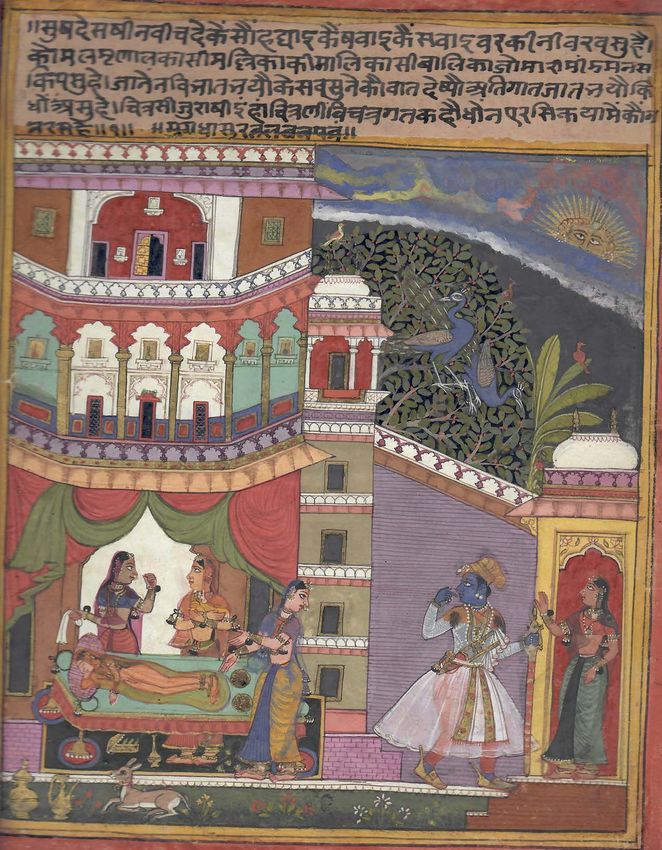
India’s sacred books: the Vedas (knowledge), the Itihasa (“that which happened), the Purnanas artist to Maharaja Jagat Singh of Mewar. He voice of a female companion, rebuking a man
(ancient texts), the Sutras (threads) and Kavya (poetry) tell us much about the natural world. The was charged with two almost simultaneous for the rough and insensitive way he slept with
Kama Sutra, for example, describes how viewing a garden can be a prelude to a royal seduction, an commissions of the Rasikapriya comprising an inexperienced woman (mugdhā).
enduring theme in miniature paintings. For garden historians, the Ramayana and the Mahabharata some 110 pages between 1630 and 1640, 21
are the most important texts. But much can be gleaned from the paintings themselves and how pages of which were in the Bikaner Royal The verse is replete with floral imagery to
artists employ visual tools to convey the hidden meaning of poets. Keshavdas was renowned for Collection. suggest her deflowering, the artist’s placing
using nature is his works as a metaphor, such as the fragrant grove, or a blossoming tree to suggest of a young deer in the garden outside the bed
amorous pleasures. Topsfield reveals that original Sahib Din chamber compounds the effect. Two male
works were duplicated by different hands in peacocks and the rising sun are painted with
the period 1640–1660, the tradition of copying coy humour, as the birds and the rising sun
18 The Brutish Encounter and imitation was common practice in artist
ateliers. Sahib Din appears to have made
watch the unfolding of events.
copies of his own works (the c.1630–35 series). The verse reads:
Gouache and gold on paper composed his masterpiece on the classification Topsfield references a series c.1660 carried out
Size: 30.7cm x 24.5cm (folio) of heroes and heroines (nayakas and nayikas) by a follower of Sahib Din. It is likely that this “You pleased her while she was with
in 1591. It is written in the elaborate riti painting is from this set. For another example her girlfriends, and made her make you
Mewar, Rajasthan, India (mannerist) style of Hindi literature and of a c.1660 folio, catalogued by J. Losty see promises, you drugged her and put her to
circa 1660 portrays the love between Radha and Krishna “A meeting of lovers in the dark”; Folio from sleep, and did it by force, my lord!
with much symbolic imagery and covert a Rasikapriya series Mewar, cat. 3 in J. Losty,
Provenance: eroticism. (See. Rasikapriya of Keshavadas, K.P Rajput Paintings from the Ludwig Habighorst This maiden is delicate like a lotus stem, a
Published in Rasikapriya, by Harsha V. Bahadur, Delhi 1972). Collection, 2019 Francesca Galloway). garland of jasmine flowers,
Dehejia, 2013, D.K Printworld (P) Ltd. The Rasikapriya was not a literary text However, the Indian Art Historian, Harsha V.
Page 153 meant for appreciation by the general public. Dehejia places this folio closer to 1680. In his yet you crushed her! Are you a man or a
Composed under royal patronage as an book aforementioned. beast? She does not know that dawn has
European Private Collection instruction to aspiring poets to appreciate the broken, Keshavdas says, listen to this:
rasika genre of poetry, the work presented The Brutish encounter deals with the subject
Formerly in the Royal Collection, Bikaner several challenges to the artist. Written in the of non-consensual, violent sex. The predatory just look at her worn-out body, what has
Bonhams, October 2016, lot 289. scholarly Braj bhasa, there would have to have male is being sternly rebuked for his actions by become of her spirit? This picture-perfect
been a scholarly intermediary to help them the women in yellow and blue – the speaker woman is now still like a painting,
This beautiful painting is an illustration to the grasp the literary nuances of the text. of the poem, as she gestures to his victim. He
Rasikapriya (Handbook of the Connoisseur) is reprimanded for being a novice lover (or tell me, then, novice lover, where is the
by Keshavdas, the celebrated court poet at the The text proved an ideal vehicle for the artistic nae rasika), ignorant when it comes to the artistry in all this?”
Kingdom of Orchha, Bundelkand. Keshavdas talents of Sahib Din, however, gifted court sophisticated science of love. The verse is in the
38 39The Poets Email: r.dixit@indianminiatures.co.uk
By today’s standards, the subject matter Reference:
here—non-consensual sex—is disturbing. The Topfield. A. Court Painting at Udaipur,
verse belongs in a longer series, which includes Artibus, ASIAE, 2002.
“women in their prime” and “mature women”
who have very different verses on lovemaking, Of Royal Patronage: Indian paintings from the
which contrast with this early instance…The 16th to 19th centuries. Carton Rochell Asian
poem might be read as an enjoinder to men to Art. New York. 2020
avoid violent, non-consensual sex, since true
connoisseurs consider it beastly rather than
sophisticated.
The wordplay around the themes of pictures
and paintings in the final line lends itself, of
course, to the visual artist. The speaker of the
poem is the woman in yellow and blue, who
is talking to the man over her shoulder while
gesturing to his victim. The crude lover has
been depicted with soiled armpits, suggesting
his physical exertions while manhandling
the woman, but also to mark him as lacking
the sophistication of a true lover-connoisseur
(rasika).
Sincere thanks to Dr. Richard Williams, SOAS,
London for his analysis of the text and kind
translation.
40 41The Poets Email: r.dixit@indianminiatures.co.uk
19
Krishna The Lover
The text begins with an invocation to one’s The horses are sensitively painted with a Sincere thanks to Narmada Prasad Upadhyaya,
Contemplates Leaving
forefathers: nobility and grandeur fitting for Lord Krishna. Indore, India and Dr. Richard Williams, SOAS
Lord Krishna is richly attired and towers above London, for their kind translation, and analysis
Opaque pigments on paper During this month the spirits of ancestors the retinue of ladies to his side. Important of this difficult text.
Size: 19.5cm x 13.5cm (image); come down to Earth to receive propitiations figures were conventionally painted like this in
20cm x 14cm (folio) from people on Earth. People worship the Rajasthani and central Indian paintings from
nine Durgas for success in life and salvation this period to denote their exalted status.
circa late 17th century beyond. Kings accompanied by pandits
Central India, possibly Malwa or a Mewar (religious advisors) set out on tour to see
sub-regional school, India their kingdoms.
This intriguing miniature painting is an The poet Keshavdas says the sky is clear
illustration to the Kavipriyā (Handbook for after the rainy season, the distressed earth
Poets, 1601) by Keshavdas, and describes the is adorned with water and lotuses are in
month of Kvar / kwānr (or Ashvin) in early bloom. The moon illuminates the clear
autumn (September–October). This verse is unclouded nights. Lord Vishnu and his
part of a barahmasa cycle, in which the beloved consort, Lakshmi dance a celestial dance. In
tries to persuade her lover to stay by her Kvar there is a wishing tree of lovemaking.
side by describing the monthly festivals and The nayika requests her lover not to leave
marvels he would miss out on if he left home. her.
Like any other inscription from this period, The painting is intriguing because the artist has
this verse has been written in an idiosyncratic focused on the Sanskrit etymology of Ashvin,
fashion: there are some small scribal errors “horse”, and has depicted Lord Krishna
and variations, and the top line of the verse is inspecting his horses (perhaps as he considers
missing, which make the reading of the poem leaving home). Whereas other artists, like the
quite difficult for scholars. Bundi painter of the British Museum series,
illustrate different aspects of the verse such
as the celestial dance and kings visiting their
kingdoms. (British Museum, the month of
Asoj, c.1675-1700 Bundi, accession number
1999,1202,0.5.4).
42 43The Poets Email: r.dixit@indianminiatures.co.uk
20 Vairati Ragini: Picturing
Sound
it as a woman and a companion enjoying the
cool draught of a fly whisk (hence the two
women combined with a representation of the
sound). In this scene, a seated noble woman is
Gouache, gold and silver on paper
stroking the chin of a gentle, and rather tame
Size: 24.8cm x 18.6cm (folio)
bull, who appears to have wandered into a
palace garden. Her companion stands behind
Bilaspur, India
her with a richly embroidered handkerchief
circa 1680–1690
for her friend to wipe her hands upon. Their
finery is exquisite and the detail gives us much
Provenance:
information on the adornment of noble ladies
Formerly in the Royal collection, Mandi.
at that time. For another Pahari version of this
inscription verso sri raga di vairati, cover
raga, see K. Ebeling, Ragamala Painting, 1973,
paper with a stamp of the Mandi Royal
p. 276, no. 311.
collection.
The execution of colour, the facial features and
This clear, crisp and orderly composed
the two-dimensionality of this painting are
painting derives from a dispersed ragamala
common features both of Bilaspur painting in
series produced c.1680–1690 in the Pahari Hill
its earliest phase at the end of the 17th century
Kingdom of Bilaspur. Ragamala paintings were
and this series. One sees common elements
especially popular here and artists appear to
with other folios, as with the distinct red
have interpreted the ragamala system with a
background, and the narrow bands of blue
good deal of license and fantasy. According to
and white for the sky. See Shankarabharana
the popular ragamala classification system laid
Ragaputra, Smithsonian’s National Museum of
out by the sixteenth century priest, Kshema
Asian Art. The Catherine Benkaim collection.
Karna, Vairati is the first wife of Sri Raga. His
For other examples from the series, see J. Dye,
complex “family” system of ragas comprised
Arts of India: Virginia Museum of Fine Arts,
six principal ragas Bhairava, Malakoshika,
2001, p. 338, no. 142; W. G. Archer, Indian
Hindola, Deepak, Shri, and Megha, their wives
Paintings from the Punjab Hills, London 1973,
(raginis) and sons (ragaputras).
Kahlur (Bilaspur), vol. I, p. 176; vol. II, p. 231.
no. 8.
The sound of Vairati is that of a water buffalo
(though here represented by the bull). Kshema
karna describes the visual image attached to
44 45Landscape Of The Gods CONTACT
Rita Dixit
Phone: +44 (0)771 325 4677
Email: r.dixit@indianminiatures.co.uk
FURTHER INFORMATION
Business Address:
By appointment only – Notting Hill, London
W2.
Thank you to Christina Chester for
production of this catalogue.
46You can also read


