ROADMAP TO CANNABIS BANKING & FINANCIAL SERVICES
←
→
Page content transcription
If your browser does not render page correctly, please read the page content below

ROADMAP TO
CANNABIS
BANKING &
FINANCIAL
SERVICES

COLORADO
DEPARTMENT OF
REGULATORY
AGENCIES
Current as of January 2020

WILDLY
IMPORTANT GOAL
Develop a roadmap to engage the financial services industry to

increase the number of financial service providers who serve

cannabis-related businesses by December 31, 2019 and implement a

plan to increase the number by 20 percent by June 30, 2020.

VISION
The Office of Governor Jared Polis and the Colorado Department of

Regulatory Agencies (DORA) is committed to creating a state

regulatory landscape for basic business opportunities, such as access

to banking and financial services, for cannabis-related businesses

through state regulatory clarity. The following roadmap outlines some

key strategies to:

   Create a regulatory landscape where banking and financial

   service opportunities can be cultivated and as accessible as those

   afforded to other industries;

   Explore emerging technologies and business models in the

   financial services industry;

   Identify opportunities for state legislative and regulatory clarity for

   state-chartered financial institutions, state-licensed money

   transmitters and state-regulated insurance companies that seek to

   serve cannabis-related businesses.

                                                                             Page 1
About the Department of
        Regulatory Agencies (DORA)

DORA is an umbrella state regulatory authority that consists of ten distinct divisions, including the

Division of Banking and the Division of Financial Services.

The Division of Banking is responsible for the regulation of state-chartered commercial banks, trust

companies, and state licensed money transmitters. The division holds charter and license application

hearings and issues rules and regulations affecting regulated institutions. As part of their charge, the

staff conducts examinations of state-chartered institutions and licensees within their jurisdiction. The

Division of Banking works closely with the Federal Reserve Bank and the Federal Deposit Insurance

Corporation in the regulation of commercial banks and is responsible for the enforcement of the

Public Deposit Protection Act to protect public entity deposits held by state and national banks.

The Division of Financial Services is responsible for the regulation of state-chartered credit unions,

savings and loan institutions and trust companies. As part of their charge, the staff conducts

examinations of state-chartered institutions within their jurisdiction. The division works closely with the

National Credit Union Administration in the regulation of credit unions and the Federal Deposit

Insurance Corporation in the regulation of savings and loan associations and is responsible for the

enforcement of the Public Deposit Protection Act to protect public entity deposits held by state and

federal savings and loan associations. Further, the division is responsible for the regulation of certain

financial activities of life care institutions.

                                                                                                         Page 2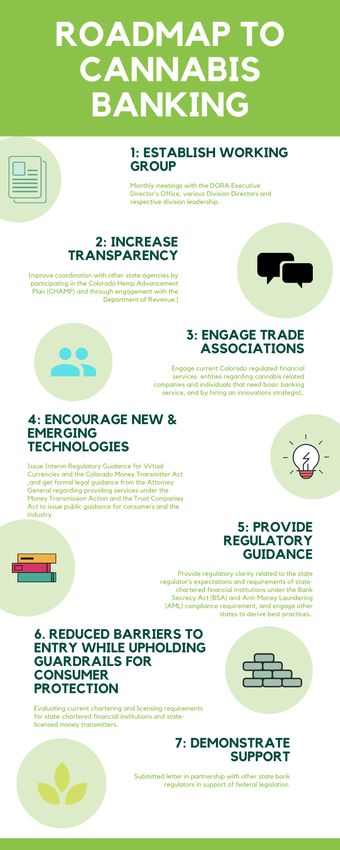
SCOPE OF ISSUE
Legal Cannabis

As of November 2019, thirty-three states and the District of Columbia

have passed laws broadly legalizing marijuana in some form.

Coloradans voted to make recreational marijuana available to adults

over the age of 21 in 2014. Since then, and as other states who have

legalized marijuana have experienced, access to banking services for

the legal marijuana industry is an on-going conundrum.

Similar banking challenges apply to those in the hemp industry. As of

December 20, 2018, hemp is no longer a controlled substance at the

federal level as the 2018 Farm Bill removed hemp from Schedule I of

the Controlled Substances Act. However, hemp may not yet be

produced lawfully under federal law unless it is produced under the

industrial hemp pilot provisions of the Agricultural Act of 2014 (2014

Farm Bill). For hemp production to be legal under federal law beyond

the 2014 Farm Bill pilot, the U.S. Department of Agriculture (USDA)

must first promulgate regulations and guidelines to implement the

hemp production provisions of the 2018 Farm Bill. Currently, the USDA

has promulgated an interim final rule, Establishment of a Domestic

Hemp Production Program, and has requested comment. Colorado

state agencies are engaged in a robust stakeholder process to

support that effort, which includes DORA's participation in the

Colorado Hemp Advancement and Management Plan (CHAMP)

sponsored by the Colorado Department of Agriculture.

A key distinction between marijuana and hemp, which are both genus Cannabis is that hemp, whether

growing or not, contains delta-9 tetrahydrocannabinol (THC) concentration of no more than three-tenths of

one percent (0.3%) on a dry weight basis.

                                                                                                            Page 3
Bank Secrecy Act and Anti-Money Laundering Compliance

While it is a credit union’s or bank’s business decision as to the types of permissible services and accounts to

offer, credit unions and banks must have a Bank Secrecy Act (BSA) and Anti-Money Laundering (AML)

compliance program commensurate with the level of complexity and risks involved.

Colorado state-chartered banks and credit unions have generally not provided services to the marijuana

industry due to the aforementioned legal and reputational risks and lack of federal clarity. As a result, there

are a substantial number of cannabis and cannabis-related businesses that do not have access to banking

services. Further, access to credit card processing systems for the marijuana industry is prohibited. Without

access to deposit or credit card services, the marijuana industry is highly reliant upon cash as a primary

payment method, which poses concerns for public safety.

In an attempt to provide some clarity regarding providing banking services to a growing volume of states that

legalized marijuana on the state level, in February 2014 the Financial Crimes Enforcement Network (FinCEN),

a division of the U.S. Treasury Department, in coordination with the Department of Justice (DOJ), issued

guidance for banks and credit unions that wish to serve the industry while meeting the Federal Bank Secrecy

Act (BSA) obligations. The guidance sought to clarify customer due diligence and suspicious activity reporting

(SAR) expectations for financial institutions providing services to marijuana-related businesses (MRB). Known

as "Marijuana Guidance," The Guidance: BSA Expectations Regarding Marijuana-Related Businesses, FIN-

2014-001 provides financial institutions general guidance for managing the risks associated with banking the

marijuana industry. In addition, James M. Cole, former Deputy Attorney General, U.S. Department of Justice,

issued a Memorandum for All United States Attorneys: Guidance Regarding Marijuana Enforcement" (August

29, 2013), known as the "Cole Memo." Also on February 14, 2014, the DOJ issued supplemental guidance

directing that prosecutors also consider eight enforcement priorities with respect to marijuana-related

financial crimes. Enforcement priorities included the following:

     E                    1. Preventing the distribution of marijuana to minors.

     N                    2. Preventing revenue from the sale of marijuana from going to criminal

                            enterprises, gangs, and cartels.

     F                    3. Preventing the diversion of marijuana from States where it is legal under

     O                      state law in some form to other states.

                          4. Preventing state-authorized marijuana activity from being used as a cover or

     R                      pretext for the trafficking of other illegal drugs or other illegal activity.

     C                    5. Preventing violence and the use of firearms in the cultivation and distribution

                            of marijuana.

     E                    6. Preventing drugged driving and the exacerbation of other adverse public

     M                      health consequences associated with marijuana use.

     E                    7. Preventing growing of marijuana on public lands and the attendant public

                            safety and environmental dangers posed by marijuana production on public

     N                      lands.

     T                    8. Preventing marijuana possession or use on federal property.

                                                                                                             Page 4
Banks and credit unions relied upon the two guidance documents to develop

                    risk management practices to provide banking services to the marijuana

                    industry. In addition, bank and credit union regulators, including the

                    Colorado Division of Banking and Colorado Division of Financial Services,

                    both within DORA, used the guidance documents to help assess the

                    effectiveness of a bank's policies, procedures, and practices when reviewing

                    a bank’s BSA program and responsibilities as it relates to banking the

                    marijuana industry. In general, the guidance documents were helpful.

                    However, on January 4, 2018, then Attorney General Jeff Sessions rescinded

                    the Cole Memo and directed U.S. Attorneys to follow established principles

                    when pursuing prosecutions related to marijuana activities. Despite the

                    rescission of the Cole Memo, Colorado banks continue to use the guidance

                    for its risk management program.

                    Given the considerations at the federal level, Colorado state-chartered

                    financial institutions seeking to serve state-licensed cannabis-related

                    businesses is a business decision that should be made on the institutions’

                    specific business objectives, an evaluation of risk, and the capacity to

                    manage effectively.

                    DORA is committed to providing regulatory clarity, advocating for legislative

                    action, and identifying other opportunities to make financial services as

                    accessible to the cannabis-related industry as those afforded to other

                    industries.

                                                                      Institution's
                                                                      specific
                                                                      business
Service to state-
                                                                      objective;
licensed,
                                                                      Evaluation of
cannabis-related
                                                                       risk;
businesses.
                                                                      Capacity to
                                                                      manage
                                                                      effectively
                                                                                             Page 5
Page 6
Page 7
KEY STRATEGIES TO
                    ACHIEVE GOAL
Goal: Create a regulatory landscape where banking and financial service

opportunities can be cultivated and as accessible as those afforded to

other industries.

       Strategies                        Policies/Actions                   Progress to Date

  Establish an internal           Monthly meetings with the DORA        Complete and ongoing

  working group consisting        Executive Director’s Office,          since January 2019

  of senior leadership from       various Division Directors and          The internal working

  the Divisions of Banking,       respective division leadership to       group meets monthly

  Financial Services,             discuss:                                and will continue

  Insurance and Real                 Current regulatory challenges        through June 2020 to

  Estate.                            Recent federal activity              share new information,

                                     Key state legislative and            and draft guidance.

                                     regulatory activity                  New members, such as

                                     Upcoming regulatory                  the Division of Real

                                     opportunities                        Estate, have been

                                     Upcoming conferences and             added.

                                     speaking engagements

                                     Stakeholder outreach

  Increase transparency of        Improve coordination with             On Track

  state information,              Governor's Office:                      Various members of DORA

  including improved                DORA Executive Director               are serving in leadership

  coordination with state           attends all industry stakeholder      and active roles in the

                                    meetings hosted by Governor           Colorado Hemp
  agencies to identify
                                    Polis, including for the cannabis     Advancement
  current barriers and
                                    industry in July 2019 and the
                                                                          Management Plan
  respective opportunities,
                                    hemp industry in September
                                                                          (CHAMP). The DORA
  particularly as it relates to
                                    2019.
                                                                          Executive Director serves
  access to information for
                                    Coordinate with Governor's
                                                                          on the Board; the division
  both regulators and the
                                    Office on in-person meetings in
                                                                          leadership of the Divisions
  financial services industry.      Washington D.C., emphasizing
                                                                          of Banking and Insurance
                                    DORA's commitment to assisting
                                                                          serve on the Executive
                                    the industry.
                                                                          Committee; and various

                                                                          other staff as serving as

                                                                          directors.

                                                                                                    Page 8
Improve coordination with other On Track
state agencies: Coordinate with the
Participate in the Colorado Hemp Department of Revenue
Advancement Plan (CHAMP) MED to survey regulated
initiative. entities on the
Attend MED stakeholder meetings accessibility of financial
with regulators, law enforcement, services available, and
industry and community members. attended stakeholder
meeting in Trinidad, CO.
Engage banking and Communicate with current On Track
credit union trade Colorado regulated financial As of November 2019,
associations to identify services entities regarding the Divisions of Banking
areas of opportunity. cannabis related companies and and Financial Services
individuals that need basic have engaged directly
with the three major
banking services, including in
trade associations in
person meetings, presentations,
Colorado regarding
etc.
cannabis topics a
minimum of 15 times
since January 2019.
Hire Stakeholder and Innovations Complete
Strategist to support the Division Strategist serves as a
of Banking and Division of primary point of
Financial Services in their efforts contact for the industry
to achieve statewide and serves as a
director for the CHAMP
engagement.
program, helping
facilitate conversations
specific to banking and
insurance.
Page 9Goal: Explore emerging technologies and business models in the
financial services industry.
Strategies Policies/Actions Progress to Date
Encourage innovative The Division of Banking issued Complete
technologies to enter its Interim Regulatory Guidance The Division of Banking
the Colorado market. for Virtual Currencies and the actively works with
blockchain and
Colorado Money Transmitter
innovative technology
Act.
companies wishing to
serve cannabis related
businesses in Colorado
through its money
transmitter licensing
process.
Get legal guidance from the Target: Spring 2020.
Attorney General regarding Currently doing an
providing services under the assessment of the
Money Transmission Action and specific issues that
the Trust Companies Act to need to be addressed
issue public guidance for based on feedback
consumers and the industry. from stakeholders.
Page 10This guidance is
Goal: Identify opportunities for state legislative and regulatory clarity and
posted on the Division
guidance for state-chartered financial institutions, state-licensed money
of Financial Services
transmitters and state-regulated insurance companies that seek
website forto serve
the public
to review.
cannabis-related businesses.
Strategies Policies/Actions Progress to Date
Provide guidance for Provide regulatory clarity Ongoing
state chartered banks related to the state regulator’s Provided to state
and credit unions expectations and requirements chartered credit unions
providing services to of state-chartered financial in April 2019. The
cannabis-related institutions under the Bank guidance reminds of
businesses. Secrecy Act (BSA) and Anti- the importance of all
Bank Secrecy Act (BSA)
Money Laundering (AML)
obligations when
compliance requirements.
providing services to
cannabis-related
businesses.
The Division of Banking
distributed an aid to
state-chartered banks
in August 2019 to
provide a roadmap of
regulatory matters that
are taken into
consideration.
Engage other state-level Ongoing
banking and financial services Leadership from the
regulators from states in which Division of Banking
marijuana is legal in some form and Division of
to identify best practices. Financial Services
have attended more
than a dozen
roundtables with other
state regulators to
discuss the challenges
and opportunities in
regulating cannabis-
related businesses
since January 2019.
Page 11Reduce barriers to entry Evaluating current chartering In Progress
while upholding and licensing requirements for The Divisions of
guardrails for consumer state-chartered financial Banking and Financial
protection institutions and state-licensed Services have
money transmitters. reviewed existing
Colorado statute and
rules and found no
chartering or licensing
requirements that are
significant
impediments to
regulated entities for
providing banking and
financial services to
the Colorado cannabis
industry.
Demonstrate support for Submitted letter in partnership Ongoing
a Federal solution with other state bank regulators The April 15, 2019 letter
in support of federal legislation. was signed by 25
state bank supervisors,
including Colorado.
Another letter was
sent to Congressional
leadership on
September 24, 2019,
in support of House Bill
1595.The House of
Representatives
passed the SAFE Act
on September 26,
2019. Ongoing support
is being
communicated to the
Colorado
Congressional
delegation.
Page 12You can also read


