Continuity of Essential Health and Nutrition Services during the COVID-19 pandemic - Dr. Anthony Adofo Ofosu Deputy Director-General Ghana Health ...
←
→
Page content transcription
If your browser does not render page correctly, please read the page content below
Continuity of Essential Health and
Nutrition Services during the COVID-19
pandemic
                          Dr. Anthony Adofo Ofosu
                         Deputy Director-General
                            Ghana Health Service
Introduction
WHO declared the novel Coronavirus (SARS-CoV2) outbreak as a Public
Health Emergency of International Concern in January 31, 2020 and
subsequently, a pandemic in March 11, 2020.
The first cases of COVID-19 in Ghana were reported on 12th March 2020
The pandemic has been challenging to health systems across the world.
Rapidly increasing demand for care of people with COVID-19, compounded
by fear, misinformation and limitations on the movement of people and
supplies has led to disruption of essential health services in most countries
including Ghana.Initial COVID-19 prevention interventions with service
delivery implications
• On Mar 16, all schools were closed
• A ban on all social gatherings was put in place.
• Starting on March 22 2020, all air, land and sea borders were closed
• Beginning on March 27 2020, a three-week partial lockdown was imposed in parts of
Greater Accra and Ashanti Regions.Disruption in essential health services-
The evidence
Following the lock down from March going into April 2020, there were
anecdotal evidence based on public complaints that access to essential
services have been compromised due to the pandemic.
A review of the routine health information data of Ghana extracted from
the District Health Information Management System for March and April
2020 using selected indicators from the Health Sector Medium Plan,
showed that essential services utilisation and coverage had reduced.Decline in trends of OPD attendance at the
health facilities in Ghana
from March-June 2020 compared to same
3000000 period in 2018 & 2019
2500000
OPD attendance
OPD 2000000
Attendance 1500000 Early-March: First case;
Mid-March: Restrictions
and Lockdown
Early-April: Lockdown
lifted and ease of
restrictions
1000000
500000
0
Jan Feb Mar Apr May Jun
Months
2018 2019 2020Decline in trends of Patient admissions at the
health facilities in Ghana
from March-June 2020 compared to same period
180000 in 2018 & 2019
Total 160000
Admissions 140000
120000
Patient Admitted
100000
80000
60000
40000
20000
0
Jan Feb Mar Apr May Jun
Months
2018 2019 2020Decline in trends of IPTp 3 Coverage at the
health facilities in Ghana
100% from March-June 2020 compared to Jan-
March 2020
90%
80%
Early-April: Lockdown
lifted and ease of
70% Early-March: First case;
Mid-March: Restrictions
restrictions
IPTp 3
and Lockdown
60%
%IPT3
Coverage 50%
40%
30%
20%
10%
0%
Jan Feb Mar Apr May Jun
Months
2018 2019 2020Decline in trends of Suspected Malaria Cases at the health
facilities in Ghana
from March-June 2020 compared to same period in 2018 &
2019
1200000
#Suspected Malaria Cases
1000000
Suspected 800000
Malaria Cases 600000 Early-March: First case;
Mid-March: Restrictions
Early-April: Lockdown
and Lockdown
lifted and ease of
restrictions
400000
200000
0
Jan Feb Mar Apr May Jun
Months
2018 2019 2020Increase in trends of Malaria Deaths (
Decline in trends of ANC Attendance at the health facilities
                                                       in Ghana
                               from March-May 2020 compared to same period in 2018 &
                                                         2019
             420000
    ANC      410000

Attendance   400000

             #ANC Attendance
             390000
             380000
             370000
             360000
                                                                                             Early-April: Lockdown

             350000
                                                                                         lifted and ease of restrictions
                                          Early-March: First case;
                                          Mid-March: Restrictions
                                              and Lockdown

             340000
             330000
             320000
                                 Jan          Feb                    Mar          Apr   May                  Jun
                                                                       Months

                                       2018                                2019                 2020
Slight decline in trends of ANC registrants at
the health facilities in Ghana
100000 from March-May 2020 compared to same
period in 2018 & 2019
90000
80000
70000
ANC
#ANC Registrants
60000
Registrants 50000 Early-March: First case;
Mid-March: Restrictions
and Lockdown
Early-April: Lockdown
lifted and ease of
restrictions
40000
30000
20000
10000
0
Jan Feb Mar Apr May Jun
Months
2018 2019 2020Decline in trends of children vaccinated in Penta 3 at the
health facilities in Ghana
from March-May 2020 compared to same period in 2018
& 2019
100000
98000
96000
Penta 3 94000
# of children vaccinated
92000
90000 Early-March: First case;
Mid-March: Restrictions
and Lockdown
88000 Early-April: Lockdown
lifted and ease of
restrictions
86000
84000
82000
80000
Jan Feb Mar Apr May Jun
Months
2018 2019 2020Reasons for the disruption- Anecdotal
Not available to supply service; reluctant
Fear - HCW
Non-patronizing of available service
Fear - Care
Givers/Patients
EPI, Routine surveillance compromised.
Re-alignment of Staff
Lockdown and Postponement of Planned activities
Movement Restrictions
Routine Data Review
Decline in KPIReasons for disruptions from rapid
assessment(IMPACT Malaria/GHS)
Reasons for disruption
%facilties reporting
Decline in seeking care by clients 80%
Inadequate PPEs supply 75%
Health workers and clients Fear of contracting COVID-19 70%
Reschedule of Clients (i.e. No space for social distancing) 60%
Difficult in assessing clients 55%
Reasons
Cancellation of elective care 48%
Shutdown of unit to be used as isolation centre 45%
Stock-out of commodities 40%
Some services not being provided owing to shutdown 30%
Exposure of some health workers 20%MNCH/FP/RH, HIV and Malaria Service Disruption
%facilities reporting disruption
Service Disruption
52%
(N=48) 54%
38%
31%
42% 42% 42%
42% 36% 35%
36%
21%
21%
13% 13% 13% 8% 13% 13% 8%
6% 4%
Services
Some SevereMNCH/FP/RH, HIV and Malaria Demand Services
%facilities reporting disruption
Demand 60%
Disruption (N=48)
52%
38%
38% 50% 40%
42% 35%
33%
36% 33%
17% 19% 16%
10% 6% 10% 8% 6% 10%
4% 4%
Services
Some SeverePPE Supply Problem
%facilities reporting disruption
PPE Supply 31%
27%
46%
(N=48) 31%
35% 31% 48%
52% 50%
31% 33%
15% 19% 10%
10%
4%
Face Mask N95 Gloves: Gloves: Gowns Face Shield Hand Soap &
Respirators Examination Surgical Sanitizer Water
PPEs
Some SevereResponse of the Health Sector
The Director-General of Ghana Health Service, assigned the Deputy Director-
General the task of overseeing the continuity of essential health services.
The Family Health Division of the Ghana Health Service, the division responsible for
reproductive and child health came out with the initial guidance document on ensuring
continuity of essential health service.
Malaria, HIV/AIDS and TB control programmes came up with similar guidance to facilitate
assess to essential health service for malaria, TB and HIV/AIDS. UNICEF and WHO
supported these initial processes of providing guidance in ensuring continuity of essential
services.
JPHIEGO supported some districts in Greater Accra and Ashanti Region the two regions
with the highest number of cases to facilitate access to essential health care services.Response of the Health Sector
The Ministry of Health issued a call to action to ensure
essential health service continuity. This was shared with all
stakeholders in the health sector including civil society
organisations in health as well as the development partners
in Ghana.
This call to action defined what needed to be done on both
the supply and demand side of service delivery as well as
the resources needed to ensure that essential health
services did not fall through the cracks in the midst of
tackling COVID 19Response of the Health Sector
The Health development partners in response to the call to action issued a statement pledging their support to
ensuring continuity of essential service.
Among some of the recommendations they made to the government were:
● Prepare a comprehensive guide on service continuity in general as well as program specific
continuity guides, which highlight how routine service should be delivered.
● Integrate existing activities being carried out to ensure gains in efficiency, including
outreach activities (immunization, surveillance, etc.). Use existing systems for intensive
COVID-19 response, like outreach activities, to deliver other services or vice versa
● Prepare a guide for re-initiation of community-based outreach services
● Adapt service delivery models to reduce the number of health facility visits (i.e., multi-
month dispensing for those needing long term treatment and use of telemedicine and other
digital technologies/innovations)Response of the Health Sector
The Health development partners in response to the call to action issued a statement pledging
their support to ensuring continuity of essential service.
Among some of the recommendations they made to the government were:
● Devise fast track services for clients with comorbidities to reduce risk of COVID-19 infection
● Provide necessary inputs and intensify adherence of infection IPC measures at all health
facilities at all levels
● Intensify social and behaviour change communication to the public to ensure continued
demand and utilization of services and sustain public trust in health services
● Explore options for harnessing the capacity of private providers to maintain essential
servicesResponse of the Health Sector
Global Financing Facility (GFF) provided a virtual training on how to use
the existing health data to track and make interventions to improve access
to essential health service for a team selected from service agencies by the
Ministry of Health.
Technical Assistants of expert public health physicians were provided for
each of the 16 region through support by
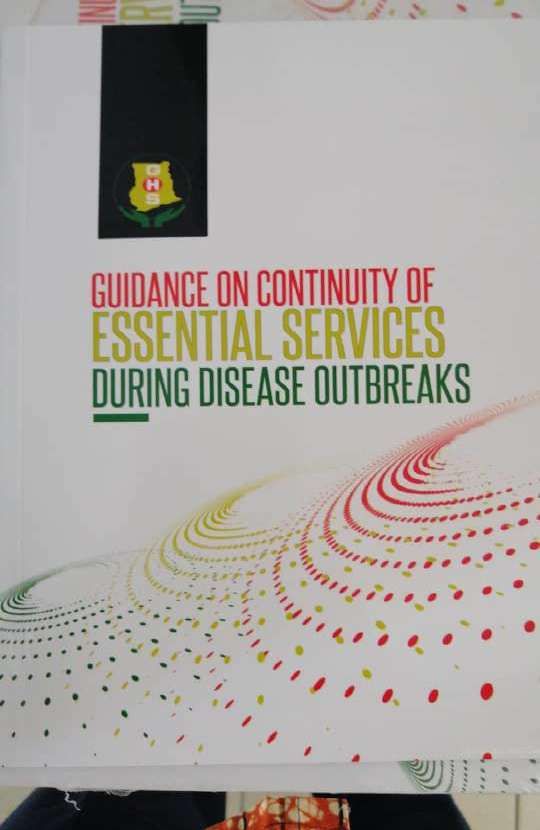
The WHO supported the development of a comprehensive guidance
document for essential service delivery.
This document was initially disseminated electronically to the Regions.
Hard copies have now been printed and distributed to all the regions for
distribution to health facilitiesGuidance Document
The general guidance captured in the document are:
•   Facility managers were tasked to ensure effective patient flow (screening, triage,
    and targeted referral) were established in each facility. All clients visiting a facility
    are screened and go through mandatory triage. If found to fit the case definition of
    COVID 19, the clients were held in a holding area and appropriately referred for
    testing and management.

•   Each facility was asked to comply with the established guidelines and protocols for
    attending to needs of clients who test positive for COVID 19 or are in quarantine as
    a result of being in contacts of positive cases to reduce the spread of the disease.

•   Allowing patients especially those with NCD to book for appointment to reduce the
    crowding at OPD.
The general guidance captured in the document are:
• Use of technology- Telemedicine -to reduce service providers/Client physical
interaction.
• Virtual management meetings to track service performance and make the needed
changes
• Sharing of Information with clients and the public on current arrangements in
facilities, through mass media announcements and discussions, social media,
posters, handbills etc. to promote continuous utilization of essential services.
• Provide Psychosocial support for staff, patients and relatives requiring such
services.Response of the Health Sector
Feedback on faltering service coverage were sent to Regions in May 2021
and Regions were tasked to draw plans to facilitate access to essential
health services
Virtual Senior Managers meetings were held with all Regional Health
Management Teams to discuss COVID 19 management and ensuring essential
health services.
Regional Directors also held virtual meetings with their District Health
Management Teams on COVID 19 response as well health service provision.
A virtual half year performance review meeting was held by Ghana Health
Service in July 2021, to assess the half year performance and come up with
plans to ensure that targets are achievedKey activities undertaken to address demand side
challenges
1. Behaviour change communication was launched using multiple
channels including social media to encourage use of facilities by
the public.
2. Providing avenue for patients with non-communicable diseases
to book appointment to visit health facilities.
3. Using technology like telemedicine to provide care for some
patients who re reluctant to come to health facilitiesKey activities undertaken to address Supply side
challenges
To help build staff confidence to offer care the following were done
1. Adequate Preventive Protective Equipment (PPE) were provided for all staff in
all facilities. The Ghana Logistic Management Information System was used to
provide visibility to the PPEs and ensure that shortages were promptly
addressed. The government supported some local industries to manufacture
face masks, coverall, face shields and alcohol hand rubs
2. Health workers underwent training on COVID 19 and Infection Prevention and
Control.
3. Supportive supervisions were done as a follow up to the training.Key activities undertaken to address Supply side challenges To help build staff confidence to offer care to the public the following were done 4. Provision of appropriate PPE for service delivery points. 5. Adequate functional hand washing/sanitizing facilities were made available for all clients and service providers at all entry and service delivery points. 6. Non-contact thermometer guns were procured and used in taking temperature of patients in all facilities.
Achievements
For most of the indicators, the decline in coverage was seen from the
period of lock down that occurred for the first three weeks in April 2020.
The greatest reduction in utilisation of services was seen during the first
reported cases through the lockdown period from March to April 2020
The early response and the interventions put into place led to recovery in
coverage of most of the key service indicators.
At the end of the year, with the exception of total OPD attendance and
admissions most of the other indicators have recovered from the decline.Achievements
Ghana Monthly Trend of Penta 3 Ghana Monthly Trend of coverage of
Coverage for 2018, 2018 and ANC registrants for 2018, 2019 and
2019 2020
100,000
120,000
90,000
80,000
100,000
70,000
80,000
60,000
60,000 50,000
40,000
40,000
30,000
20,000 20,000
10,000
0
Jan Feb Mar Apr May Jun Jul Aug Sep Oct Nov Dec 0
Jan Feb Mar Apr May Jun Jul Aug Sep Oct Nov Dec
2018 2019 2020 2018 2019 2020
Source of Data- District Health Information Management
System(DHIMS2)Achievements
Ghana Monthly Trend of Total Ghana monthly trend of Total OPD
Deliveries in facilities for attendance 2018,2019 and 2020
2018,2019 and 2020 3,500,000
80000
3,000,000
70000
60000 2,500,000
50000
2,000,000
40000
1,500,000
30000
1,000,000
20000
500,000
10000
0 0
Jan Feb Mar Apr May Jun Jul Aug Sep Oct Nov Dec Jan Feb Mar Apr May Jun Jul Aug Sep Oct Nov Dec
2018 2019 2020 2018 2019 2020
Source of Data- District Health Information Management
System(DHIMS2)Achievements
Ghana monthly trend of Total new Ghana Monthly trend of total new
Hypertension cases seen at th Diabetes Mellitus cases seen at
OPD ,2018,2019,2020 the OPD, 2018,2019 and 2020
70000 20000
18000
60000
16000
50000 14000
12000
40000
10000
30000
8000
20000 6000
4000
10000
2000
0 0
Jan Feb Mar Apr May Jun Jul Aug Sep Oct Nov Dec Jan Feb Mar Apr May Jun Jul Aug Sep Oct Nov Dec
2018 2019 2020 2018 2019 2020
Source of Data- District Health Information Management
System(DHIMS2)Achievements
Trend of Institutional Maternal Trend of Institutional Neonatal
Mortality Ratio in Ghana 2014- Mortality - 1000 live births
2020 2014-2020
160 9
151.1 147.3 8.4
140 144 141.9 8
7.7 7.8
127.3 7 7.2
120 117.5
106.5 6
100
5
80
4 3.8 3.8
3.6
60 3
40 2
20 1
0
0
2014 2015 2016 2017 2018 2019 2020
2014 2015 2016 2017 2018 2019 2020
Institutional Neonatal Mortality - 1000 live births
Institutional Maternal Mortality Ratio
Source of Data- District Health Information Management
System(DHIMS2)Lessons learnt
The health system of Ghana has shown surprisingly great resilience in handling
COVID 19 and facilitating access to essential health services at the same time.
Monitoring of key performance indicators is essential in recognising the declines
in utilisation early enough to make response and interventions useful.
Providing health workers with clear guidance on how to safely deliver essential
health services based on how the disease causing the outbreak is spread is
critical. It promotes confidence in the health workers who are providing the
care and reassures the public to utilise the health services being provided.Lessons learnt
Provision of PPEs is critical to getting essential services back on track
Maintaining communication between the leadership and service providers is
essential.
Building trust in the population by providing information on services available in
facilities and what is being done to guarantee their safety does facilitate
essential service utilisation.
Lock downs apart from its economic impacts has huge effect on utilisation of
essential health services. Arrangement for offering the population essential
health services should always be made if there is the need to go into lockdown
during a pandemic.Conclusion
The resilience of the health system is key to sustaining
essential health service delivery during outbreaks.
Putting into place a health system resilience assessment
surveillance system that will provide information on a
continuous basis on the state of the health system so
that an optimal performance is always assured will be
of great help in facilitating access to essential health
services during disease outbreaks.You can also read


