ROLE OF NCB INTERPOL-INDONESIA IN COMBATING TERRORISM - ROYAL THAI POLICE COLLEGE
←
→
Page content transcription
If your browser does not render page correctly, please read the page content below
ROYAL THAI POLICE COLLEGE

ROLE OF NCB INTERPOL- INDONESIA
    IN COMBATING TERRORISM

                      by:
        Albert Barita Sihombing / 144
       Command Course Advance 38th

           BANGKOK,         APRIL 2014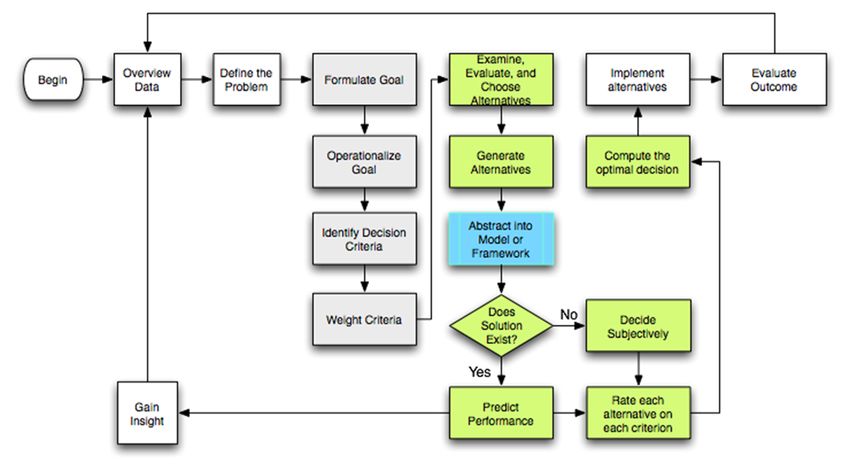
ABSTRACT
                                       ;
   “If information like a light, sharing information is the brightness of light”
                                                            (Albert Sihombing)

      Operationally, the front guard of law enforcement counter-terrorism
is carried out by the Special Detachment 88 Anti-Terrorism Indonesia
National Police assisted by other related elements. In terms of foreign
affairs, Detachment 88 is supported by the NCB-Interpol Indonesia which is
defined as the main gateway to deal with foreign relations and cooperation
between police to police and international organizations in the context of
trans-national crime prevention.

       The main role of NCB Interpol-Indonesia in combating trans-national
crime (especially terrorism) is providing assistance in facilitating,
investigating and coordinating cooperation between police to police and
international organizations.

      This working paper is presented in the form of administrative writing
containing information about the implementation of job descriptions base on
my experience in NCB Interpol, especially as a Head Certain Economic
Subsection Department of International Crime in charge of matters related
with terrorism.

      As a tool to analyze and find the logical thinking, SWOT and Rational
Planning Theory are presented as references in order to obtain the academic
significance that can be accounted for as an objective and measurable
scientific paper.

      Hopefully this paper can be utilized as a means of communication that
are both informative and corrective purposes, particularly the effectiveness
of the objective achievement. Finally, if information like a light, sharing
information is the brightness of light, then, to enhance sharing information,
posting INP personnel in Interpol and UNO headquarter is strongly
recommended after deepen this paper work.
                                                      Albert Barita Sihombing
CONTENTS
ABSTACT                                                                                               i

CHAPTER I: INTRODUCTION …………………………………………………………………..                                                  1

CHAPTER II: SIGNIFICANCE OF THIS TOPIC, MANAGEMENT, AND TERMINOLOGY…                                 2
1. The Significant of Paper …………………………………………………………………………                                             2
2. The Management of Writing ………………………………………………………………………                                             2
3. Terminology ……………………………………………………………………………………….                                                    3

CHAPTER III: ROLE OF NCB INTERPOL-INDONESIA IN COMBATING TERRORISM….. 5
4. Legal Basis in Combating Terrorism ………………………………………………………….. 5
5. Task of NCB-Interpol Indonesia in Handling Terrorism …………………………………….. 7
6. Profile of NCB Interpol Indonesia ……………………………………………………………... 7
7. Organization Structure …………………………………………………………………………. 13
8. Job Description of Head of Sub-section of Certain Economic Crime …………………………….
                                                                              15
9. Problems in Implementing the Task/Duty …………………………………………………..               19

CHAPTER IV: THEORY SWOT AND THE RATIONAL PLANNING MODEL ……………….. 20
10. Theory SWOT …………………………………………………………………………………… 20
11. The Rational Planning Model ………………………………………………………………….. 22

CHAPTER V: CONCLUSION……………………………………………………………………….. 25
12. Solution …………………………………………………………………………………………… 25
13. Recommendation ……………………………………………………………………………….. 26

APPENDIX ………………………………….............................................................................. 27

1. Law Foundation in Combating Terrorism …………………………………………………….. 27
    a. International Law …………………………………………………………………………… 27
    b. National Law ………………………………………………………………………………… 27
2. Guidance Books as an Attitude Reference …………………………………………………… 28
3. List of Tables as Guidance in Conducting Cooperation ……………………………………. 29
    a. Table 1: List of Countries that had Bilateral Agreement with INP …………………….. 29
    b. Table 2: List of Countries that had Extradition Agreement with INP …………………. 29
    c. Table 3: List of Countries that had Agreement in Mutual Legal Assistance ………… 30
4. Case Example in Handing Over (Pratheepan Thavarajah) ………………………………... 30
5. Reference ……………………………………………………………………………………….. 32
                                                    33
6. Curriculum Vitae ……………………………………………………………………………………….
CHAPTER 1
INTRODUCTION
Terror action in 2000-2014 happened in Indonesia due to the interpretation of
religion that still exists until now. The mentioned interpretation has motivated some
people in Indonesia to commit terror in the name of God, as a reflection of faith and
form of solidarity to defend Muslims around the world.
The trigger of terror actions are strongly related with terror chain which initially took
place at the global level that shifted to a regional one. The war history of Palestinian-
Israeli, the development of Middle East conflict and the dominance of western world
power maps often conflict with the Islamic world issues that strengthen Muslim
Brotherhood to join together in fight against America and its allies. While regional
influence occurs in the form of open access to make contact and cooperation based on
the spirit of the Muslim Brotherhood.
Contact and cooperation between JI (Jemaah Islamiyah) and al-Qaeda, for
example, occurred at the time of Afghanistan conflict in the form of sending JI
volunteers to Afghanistan to fight against the Soviet Union. On the other hand, Al-
Qaeda trained the volunteers to make bombs and sent funds to the volunteers when
they returned to Indonesia to get involved in terror action with the targets: U.S. interests,
the West and Christian symbols.
There are international connections, terrorist networking and the agenda of
international terrorist group that influence terror action in Indonesia. If it is not supported
by the international cooperation, the involvement of the terrorist international group
actors would not be revealed. Thus, to handle terrorism as extraordinary crime, sharing
information is needed as part of investigation to reveal terrorist networking more
comprehensively.
The purpose of this paper is to analyze the roles and the problems of NCB
Interpol-Indonesia in combating terrorism case especially in the perspective of the
Writer in conducting duty as an investigator, facilitator, and coordinator of the “project of
sharing information”.
Page 1 of 33CHAPTER 2
SIGNIFICANCE OF THIS TOPIC, MANAGEMENT, AND TERMINOLOGY
1. The significances of this paper are:
a. informing and explaining the job description, role and task of NCB Interpol-
Indonesia in combating terrorism especially in sharing information between
Police to Police and International Organization about the international activities
of terrorist suspect;
b. acquiring mastery of relevant theories in explaining more actual topic;
c. achieving deeper understanding about the topic more comprehensively, clearly,
and sharply;
d. enhancing the ability of making significant recommendations.
2. The management of writing consists of five chapters as follows:
a. Chapter I: Introduction
The first chapter is defining situation to introduce the topic and the
purpose of writing.
b. Chapter II: Significance of this Topic and Management
The second chapter is the goals of writing to explain the significance of
the topic in the form of an administrative writing based on job description and
the experience of the Writer in conducting task and duty as a staff of NCB
Interpol-Indonesia.
c. Chapter III: Role of NCB Interpol-Indonesia in Combating Terrorism
The third chapter is searching for alternatives to achieve the goals of
writing by getting relevant information related to the legal basic and task of
NCB Interpol-Indonesia in combating terrorism. Then to get comprehensive
understanding, the profile of NCB Interpol-Indonesia would provided with the
structure of organization as well as role of International crime department at
Page 2 of 33NCB-Interpol Indonesia, job descriptions of Certain Economic Crime Section
(that handles terrorist case) and the problem that may occur while conducting
task and duty.
d. Chapter IV: SWOT Analysis and Rational Planning Model
The fourth chapter is choosing the best alternatives to achieve the
specific goals of this writing related to the performance of conducting job
description and the procedure of making decision by getting relevant
information about SWOT analysis and Rational Planning Model. In this chapter,
the Writer would give some personal implemented experiences to deepen the
understanding about the topic.
e. Chapter V: Conclusion.
The fifth chapter is the conclusion. In this chapter the Writer would provide
some logical suggestions based on analytical thinking about the discussed
topics. Hoping those produced suggestions would be useful for enhancing the
contribution of NCB Interpol-Indonesia in combating terrorism case.
f. Appendix.
Enriching the content, any related Law and documentation are provided as
an integral part of this paper work, so that readers can evaluate and use them
as references in knowing the performance of job description of Certain
Economic Crime Section, at International Crime Department of NCB Interpol-
Indonesia in combating terrorism. Then, as a complementary, case example of
handing over, book’s reference and curriculum vitae of Writer would be added
as useful information as well.
3. Terminology
1. Terrorist1
1
Wikipedia, the free encyclopedia, definitions of terrorism. See: Sihombing, Albert Barita, 2013. The Radicalization of Terrorist
(A Criminological Study on The Motives of Terrorism in Indonesia), Thesis Foreign Affairs Police. Central Police University ROC
Taiwan. Page 2.
Page 3 of 33In 2004, United Nations Security Council Resolution 1566 condemned
terrorist acts as: “criminal acts, including against civilians, committed with the
intent to cause death or serious bodily injury, or taking of hostages, with the
purpose to provoke a state of terror in the general public or in a group of
persons or particular persons, intimidate a population or compel a government
or an international organization to do or to abstain from doing any act, which
constitute offences within the scope of and as defined in the international
conventions and protocols relating to terrorism, are under no circumstances
justifiable by considerations of a political, philosophical, ideological, racial,
ethnic, religious or other similar nature."
Regarding to Article 6 No. 15/2003 of Indonesian Law on Anti Terrorism
Crime, Terrorism is defined as intentional act using violence or threats of
violence that leads to an atmosphere of terror or a widespread fears or
causing mass casualties, by robbing the independence or eliminating life and
property of others or causing damage to and destruction of vital strategic
objects or environment or public facilities or international facilities.
2. Terrorism2
In a psychological perspective, terrorism is a purposeful human activity. In
a strictly political context, terrorism has become an emotive expression, a
pejorative label designed to produce a particular impact upon the person to
whom it is addressed and a certain impression about the person with
reference to whom it is used. Terrorism is a bad word and when conduct is
characterized in this way it is intended to reflect adversely, in the socio-political
scheme of things, upon the actor. Terrorism has come to mean something bad
that is done to people by other people, whether by individual acting alone or in
concert, or by governments.
3. Clandestine Groups3
A clandestine group, also known as a secret society, is a network of
individuals operating in secrecy in order to maintain the integrity of the group
and to conceal their plans, activities, and missions from those who are not part
of the group.
2Cooper, H.H.A. “What Is A Terrorist: A Psychological Perspective” Legal Medical Quarterly. 1977. Vol. 1 No. 1. See:
Sihombing, Albert Barita, 2013. The Radicalization of Terrorist (A Criminological Study on The Motives of Terrorism in Indonesia),
Thesis Foreign Affairs Police. Central Police University ROC Taiwan. Page 16.
3 Erickson, Bonnie H. “Secret Societies and Social Structure.” Social Forces. 1981. vol. 60, 1, p 189.
Page 4 of 33CHAPTER 3
ROLE OF NCB INTERPOL-INDONESIA IN COMBATING TERRORISM
4. Legal Basis in Combating Terrorism
The handling of terrorism cases in Indonesia is a series of action in the
achievements of the objectives that is conducted by the following basis:
1. The Philosophical Foundation
Philosophical foundation in handling terrorism is Pancasila (Five
Principles), as the official philosophical foundation of the Indonesian state. In
term of philosophical, Indonesia has independent people based on (1) Belief
in the divinity of God, (2) Just and civilized humanity, (3) The unity of
Indonesia, (4) Democracy guided by the inner wisdom in the unanimity arising
out of deliberations amongst representatives, (5) Social justice for all of the
people of Indonesia. Then any conflicting to basic state is considered against
the ideals of the nation.
2. The Law Foundation
Legally, the conception of counter-terrorism is equal distance concept
that is the eradication of terrorism that aims at:
1) protecting the sovereignty of the unitary State of the Republic Indonesia;
2) protecting human right of the citizens of Republic Indonesia, both
domestic and inhabitant who live in abroad;
3) also protecting human right of the suspect of terror criminal offense as
the universal human right that should not be ignored.4
3. The Sociological Foundation
Sociologically, terrorism is defined as severe human right violations, and
considered as the big enemy for the country. Terrorist crime is regarded as a
serious threat to the survival of the nation sustainability. This phenomenon is
4 Atmasasmita Romli, Masalah Pengaturan Terorisme dan Perspektif Indonesia, Jakarta, Badan Pembinaan Hukum Nasional
Departemen Kehakiman dan HAM RI, 2002, page 2.
Page 5 of 33the driving force factor of issued anti-terrorism Law as a lex specialist law
product.
The seriousness in combating terrorism crime is also proved by the
establishment of a special unit in terms of law enforcement against terrorism,
namely Special Detachment 88 Anti Terror Indonesia National Police (Densus
88 Anti-Teror). Furthermore, to better synergize and sharpen the concept of
the role of military intelligence and police with the other relevant agencies in
5
prevention, de-radicalization, prosecution, and preparation of national
preparedness, in 2010 BNPT 6 (National Agency for Combating Terrorism)
was formed as an institution that has task to coordinate all anti-terror activities
among ministries/institutions.
4. Operational Foundation
Operationally, the front guard of law enforcement counter-terrorism is
carried out by the Special Detachment 88 Anti-Terrorism (Densus 88 AT)
Indonesia National Police 7 assisted by other related elements. In terms of
5 The term radicalism comes from the word radical, which means root or base. As a noun of person, radical means a person who
holds or follows strong convictions or extreme principles. Radicalism means, the holding or following of radical or extreme views
or principles. De-Radicalism means, to reduce radicalism. http://dictionary.reference.com/browse/radicalism?s=b. See:
Sihombing, Albert Barita, 2013. The Radicalization of Terrorist (A Criminological Study on The Motives of Terrorism in Indonesia),
Thesis Foreign Affairs Police. Central Police University ROC Taiwan. Page 1
6 BNPT (National Agency for Combating Terrorism) is led by an officer whose rank is equal to 3 star-General with these following
main tasks:
a. formulating policies, strategies, and national programs in the field of counter-terrorism;
b. coordinating the relevant government agencies/institutions in the implementation of and implementing policies in the field
of counter-terrorism;
c. implementing policies in the field of counter-terrorism by forming a task force consisting of the elements of relevant
government agencies/institutions in accordance with their own duties, functions, and authorities.
Field jobs of counter-terrorism covers prevention, protection, de-radicalization, prosecution, and preparation for national
preparedness.
7
Detachment 88/AT is a special unit under the Indonesian National Police (formed on June 30, 2003) in charge of conducting
investigations and criminal investigations of terrorism in the context of law enforcement related to:
a. the existence and activities of every person / element / group / community / organization believed to be a network or
potential to be used as a terrorist network;
b. the crime with a nature of terror is any act which meets the elements of criminal offense in accordance with the provisions
in the law of eradication of terrorism;
c. Criminal act or other law violation that probably has terrorism motif, especially in cases with political nuances and cross
country.
Page 6 of 33foreign affairs, Detachment 88 is supported by the NCB-Interpol Indonesia
(Divhubinter Polri) defined as the main gateway to deal with foreign relations
and cooperation between police to police and international organizations in
the context of trans-national crime prevention.
5. Task of NCB-Interpol Indonesia in Handling Terrorism
In order to support counter-terrorism, the main tasks of NCB-Interpol
Indonesia are:
1) overseeing traffic as well as detecting the possibility of terrorists in obtaining
the explosives and weapons from abroad;
2) terminating the terrorist relationships with other criminal syndicates that exist
in foreign countries;
3) increasing the security of Indonesian international interests;
4) expanding the implementation of cooperation in investigation, prosecution
and extradition;
5) deploying power of the police in the bordering region to anticipate and
eliminate cross-border crime, among others by adding and strengthening the
Police Force and the existing checkpoints border or increasing water patrols
in an integrated system.
6. Profile of NCB Interpol Indonesia
a. History at Glance
Juridically, the establishment of National Central Bureau (NCB) in a
country is in accordance with chapter 22 of the ICPO-Interpol Constitution
which maintains that every member country must assign a body to function as
the National Central Bureau for assuring relationships between internal as
well as with the Secretary General of ICPO-Interpol.
In 1954, Indonesia was officially accepted as the member of ICPO-
Interpol. By the end 1954, by the issuance of the Decree of Prime Minister of
the Republic of Indonesia No. 245/PM/195 dated October 5, 1954, the
Page 7 of 33government of the Republic of Indonesia assigned the State Police Bureau as
NCB Interpol-Indonesia to represent Indonesian government in ICPO-Interpol
organization. At that time, the Chief of State Police was assigned as the Head
of NCB Indonesia to follow up on the Decree of Prime Minister of the Republic
of Indonesia.
b. Validation Organization of NCB Interpol Indonesia to be International
Relations Division (Divhubinter Polri)
International Relations Division is a sub organization under the
Indonesia National Police (INP). It is established based on Chief of INP
Decree No. 21, 2010 on Structural Organization and framework at the INP
Headquarters level. This organization is the result of validation carried out
within INP organization which previously was known as a Secretariat of NCB-
Interpol Indonesia. International Relations Division has been formally made
effective since September 2010 as an assistant chief of the INP in controlling
police international relations.
Position of Divhubinter Polri is an element of supervisor and a co-leader
in the field of international relations under the Chief of Indonesian National
Police. Divhubinter Polri is in charge of conducting tasks of National Central
Bureau (NCB)-INTERPOL in international cooperation to fight against
international/transnational crime, carrying out tasks of the international
mission in peace and humanitarian missions, development of human
resources (capacity building), as well as assisting legal protection for
Indonesian citizens in abroad.
c. Function of International Relations Division
This Division has functions as follows:
1) planning and developing personnel and logistic administrations, clerk
and internal affairs, financial service, and providing strategic review
and analysis on the implementation of police international cooperation;
Page 8 of 332) preparing overseas travelling administration for INP personnel, and
providing protocol coordination on the activities of official visit abroad
and representatives’ visit from international organizations;
3) undertaking inter-agency cooperation in the course of combating
international and transnational crime, exchanging information on
criminal intelligence, conducting international public services, giving
technical assistance and investigation tactics related to Extradition and
Mutual Legal Assistance (MLA);
4) exchanging information on international/transnational crime and other
information related to international events and international
cooperation through communication networking system of Interpol,
ASEANAPOL, DPKO (Department of Peacekeeping Operations) and
other information technology system;
5) providing coordination with other related institutions and facilitating
prepared police personnel, prior to their deploying in the peace
keeping and humanitarian missions;
6) providing coordination with other related institutions, especially police
forces and international organization (UN, ICPO-Interpol) and other
formal international institutions in the course of improving capacity
building of INP;
7) undertaking the placement of and supervising Indonesian Police
Attaches/Senior Liaison Officers (SLO) and Police Technical Staff/
Liaison Officer (LO) as well as the INP personnel on duty in overseas,
in international organization and at police offices in accredited country;
8) providing coordination with other police Attaché or Law Enforcement
LO of other countries in Indonesia, and also providing coordination and
communication with related institutions in the course of maintaining
security and law enforcement in border areas;
Page 9 of 339) providing relation for international cooperation in abroad including
cooperation in police matters, maintaining law enforcement and giving
protection for Indonesian citizens abroad.
d. Function of Secretariat of NCB-Interpol Indonesia
The International Relations Division of INP consists of two bureaus:
Secretariat of NCB-Interpol Indonesia and International Mission Bureau. The
Secretariat of NCB-Interpol Indonesia has function to set up international
products, address common crimes related to other countries, address the
special economic crime and terrorism associated with other countries, and
provide international legal assistance related to extradition, MLA, and the
search for the fugitive/the issuance of notice.
Secretariat of NCB-Interpol Indonesia has 4 departments as follows:
1) International Communication Department;8
2) International Convention Department;9
3) Liaison Officer (LO) and Border Department; 10 and
4) International Crime Department.
International Crime Department has function to conduct
cooperation between members of ICPO Interpol in preventing and
combating international/transnational crime by giving assistance on
investigation and implementation of international law. In undertaking the
task, International Crime Department conducts these following functions:
8
Function of International Communication Department is managing and developing information exchange system in preventing
and combating international/transnational crime through communication networking facility of INTERPOL, ASEANAPOL and
other means of communication. Moreover this department also collect information and data processing, publication and
documentation of activities undertaken by International Relations Division.
9 Function of International Convention Department is preparing upon the implementation of international agreements or treaties
and organizing international forums whether in the country or in abroad related to combating international/transnational crime
and improving capacity building of human resources and institution facilities.
10 Function of Liaison Officer (LO) and Border Department is maintaining Police Attaché/SLO and Police Technical Staff/LO
duties in abroad, as well as undertaking law enforcement cooperation at the boundaries area.
Page 10 of 33a. providing international product such as dissemination of
international DPO and warning related to various modus of operandi
as well as the making of country paper;
a. handling general crime, terrorism and certain economic crime
related to other countries;
b. giving international legal assistance (extradition, MLA and fugitive
search / publishing Notices);
Then, in managing the tasks, International Crime Section has
several sub-sections as follows:
a. Sub-section of General Crime11
b. Sub-section of International Criminal Products12
c. Sub-section of International Legal Assistance13 and
d. Sub-section of Certain Economic Crime
Sub-section of Certain Economic Crime serves to:
1) facilitate and coordinate counter-terrorism and certain
economic crime related to other countries;
2) implement correspondence through NCB-Interpol,
ASEANAPOL network system related to terrorism and certain
economic crime;
3) conduct coordination with territorial unit on issues requested
by both fellow member of NCB-INTERPOL countries and
territorial unit related to certain economic crime;
4) conduct coordination with the Special Detachment 88 on
terrorism issue.
11 Sub-section of General Crime serves to:
a. facilitating and coordinating the general crime prevention related to other countries;
b. carrying out correspondence through INTERPOL and ASEANAPOL network system;
c. conducting coordination with the territorial unit on the problems that both requested by fellow member of the NCB -
INTERPOL countries and territorial unit.
12 Sub-section of International Crime Product serves to:
a. preparing international products, such as the making of country papers, dissemination of international actual news about
piracy, narcotics and others;
b. implementing internal police meeting with relevant ministries in the preparation of RI delegates position paper;
c. carrying out an assessment and providing recommendations for Head of International Crime Section.
13 Sub-section of International Legal Assistance serves to:
a. facilitating and coordinating the implementation of Extradition tasks and MLA;
b. facilitating the issuance of the search list/wanted list (red notice);
c. conducting searching for fugitives at the request of fellow member of NCB- INTERPOL Countries.
Page 11 of 33e. Vision and Mission
1) The visions of the International Relations Division is:
a) realizing police cooperation, law enforcement and international
missions in combating transnational crime;
b) Providing protection and services for Indonesians/foreigners in the
country and abroad.
2) Mission
To achieve the visions, there are missions to be carried out:
a) implementing international cooperation with other governmental
and non-governmental organizations both in bilateral and
multilateral;
b) carrying out cooperation with the police forces of the member of
ICPO-INTERPOL and ASEANAPOL countries in an effort to
monitor, prevent and combat transnational and international crime;
c) assisting and cooperating with the representatives of the Republic
of Indonesia and relevant institutions in overseas to provide
protection and services to the Indonesian citizens;
d) carrying out international cooperation to participate in keeping world
peace;
e) implementing capacity building both human resources and
infrastructure/facilities;
f) implementing cooperation and coordination of security of border
area with the bordering country indirectly;
g) implementing the protocol and administration of official travel to
abroad;
h) carrying out international communication and information exchange
through utilization of the network of Interpol, ASEANAPOL and
other communication networks;
i) conducting international meeting and agreement both bilateral and
multilateral.
Page 12 of 337. Organization Structure
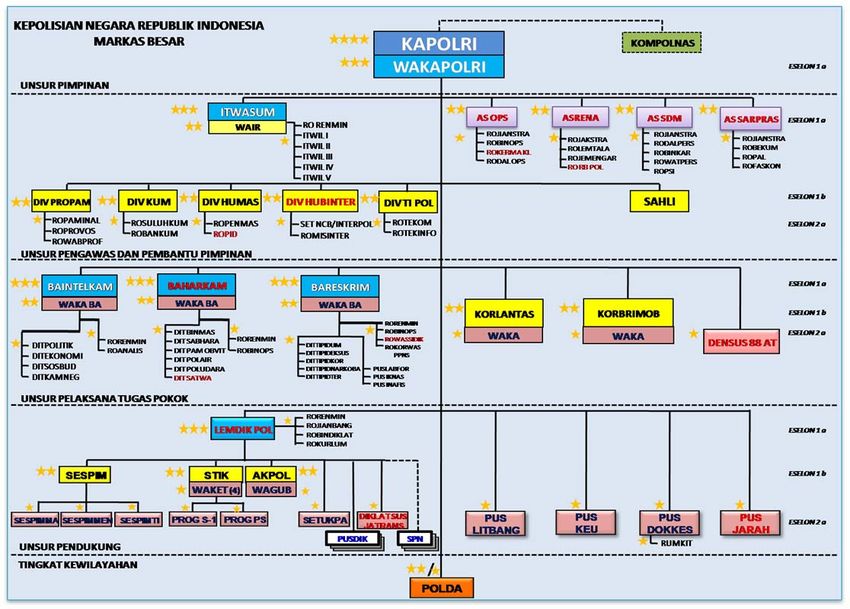
a. Structure of Indonesia National Police (INP)
Source: http://www.polri.go.id/organisasi/op/sop/ (accessed: 10 February 2014)
NOTES:
Kapolri = Chief of INP Wakapolri = Vice Chief of INP
Itwasum = General Inspector Kompolnas = National Police Commission
Asrena = Assistant of Planning & Development As Ops = Assistant of Operation
Asarpras = Assistant of Logistic As SDM = Assistant of Human Resource
Divkum = Division of Law Div Propam = Division Profession & Security
Divhubinter = Division of International Relation Div Humas = Division of Public Relation
Sahli = Expert Staff Div TI Pol = Division of Tech & Information
Baharkam = Guidance and Security Department Baintelkam = Intelligence and Security Department
Korlantas = Police Traffic Bareskrim = Criminal Investigation Department
Densus 88 AT = Special Detachment 88 Anti-Terror Korbrimob = Mobile Brigade
Sespim = Staff and Command School Lemdikpol = Education and Training Institution
Akpol = Police Academy STIK = Police Science High School
Puskeu = Finance Centre Puslitbang = Research and Development Centre
Pusjarah = History Centre Pusdokkes = Health and Medical Centre
Diklatsus Jatrans (Special Training Trans-Crime Setukpa = Police Officer School
Education) Polda = Police Region (33 Police Region).
Page 13 of 33
b. Structure of International Relation Division INP
DIRECTOR OF INTERNATIONAL RELATION DIVISION
LEADER ELEMENT
FINANCE ADMINISTRATION
ADMIN & PLANNING DEPT PROTOCOL DEPT
ADMIN ADMIN
HUMAN FUNCTION SERVICE FOR SERVICE FOR
SUUPORTING LEADER ELEMENTS AND EXECUTIVE STAFF PLANNING
RESOURCES DEVELOPMENT OFFICIAL DUTY OFFICIAL QUEST
NCB-INTERPOL INDONESIA NTERNATIONAL MISSION BUREAU
ADMIN ADMIN
INTERNATIONAL INTERNATIONAL INTERNATIONAL LIAISON OFFICER
PEACE KEEPING CAPACITY BUILDING
CRIME COMMUNICATION CONVENTION AND BORDER
ADMIN ADMIN ADMIN ADMIN ADMIN ADMIN
CERTAIN
MONITORING SUPPORTING
INTER GENERAL ECONOMIC INTER LEGAL COMM INFO & DOCU- AMERICA & ASIA PASIFIC INTER INTER ACTIVITIES TRAINNING ABROAD
LO BORDER & EDUCATION &
PRODUCT CRIMES CRIMES ASSISTANCE TECHNOLOGY DATA MENTATION EUROPE & AFRICA ORG’S AGREEMENT PLANNING LOGISTIC STUDY
EVALUATION TRAINNING
POLICE ATTACHE
INP TECHNICAL STAFF
MAIN EXCECUTIVE ELEMENTS INP LO
INP SLO
Notes: http://www.interpol.go.id/en/about-us/organizational-structure (accessed 2/2/2014)
c. Structure of International Crime of NCB-Interpol Indonesia
NCB-INTERPOL INDONESIA
INTERNATIONAL
CRIME
INTERNATIONAL CERTAIN ECOMONIC
GENERAL CRIME & TERRORISM INTERNATIONAL
PRODUCT CRIME ASSISTANCE
Notes: Data processed.
Page 14 of 338. Job Description of Head of Sub Section of Certain Economic Crime
a. The characteristic of Tasks
1) Planning:
a) assisting the Leader in preparing Work Plan/Activity;
b) assisting the Leader in setting goal achievement steps.
2) Organizing:
a) divide tasks and direct personnel’s to achieve the expected level of
performance;
b) oversee the implementation of tasks and the discipline of personnel
in Sub-section Certain Crime.
3) Actuating:
a) facilitator (facilitating cooperation among police to police and
international organization in handling cross jurisdictional in handing
over, fugitive deportation, extradition, and technical assistance such
as laboratory DNA, computer forensic, INAFIS (fingerprints), and
crime scene kit);
b) coordinator (managing joint investigation and procedure of Mutual
Legal Assistance with the foreign countries);
c) investigator (assisting transnational investigation of terrorism
especially with the foreign countries having bilateral agreement);
d) dynamist (organizing and enhancing production material and
spreading Interpol notice and relevant information.
4) Controlling:
a) making analysis and evaluation of the implementations of the tasks in
the form of intelligence writings;
b) assisting the Leader in evaluating the members working performance.
b. The elaborations of the Tasks of Head of Certain Economic Crime
1) Collecting criminal and intelligent data to be processed and analyzed to
become an official script to be submitted to the Secretariat of ICPO-
Page 15 of 33Interpol, NCB-Interpol of other countries and related institutions in the
country. Task include as follow:
a) making the concept of planned activities;
b) assigning staff/member to arrange work plan concept up to become
official script;
c) correcting and signing official script to be reported to Head of
Section;
d) making disposition of incoming letters as directed by Head of Section
to be followed up by the administrative officer;
e) analyzing criminal and intelligence information;
f) creating letter concept related to criminal/intelligence information;
g) assigning administrative officer to follow up the letter concept that
has been made to become official script;
h) correcting and proofread official script of criminal and intelligence
information to be proposed to Head of Section to get approval to be
forwarded to general secretariat of ICPO-Interpol, NCB-Interpol of
other countries and related agencies/institutions in the country;
i) supervising subordinate at all times in order to achieve the expected
level of performance;
j) reporting the results of the implementation of the tasks to the Leader.
2) Preparing report materials and advice to the Leader. Task include as
follow:
a) preparing the action plans for Certain Economic Crime;
b) instructing staff to make Sub-section action plans according to the
concept;
c) defining Sub-section Certain Economic Crime action plans;
d) together with the staff prepares a report materials, materials,
concepts as well as suggestions and opinions for the leader;
e) supervising the implementation of the tasks and discipline of
personnel in Certain Economic Crime Sub-section;
f) reporting the activities to the Leader.
3) Implementing cooperation and coordination with internal and external
executive officer of Indonesian National Police in the search/arrest and
prosecute perpetrators of international crimes/transnational. Task include
as follow:
Page 16 of 33a) preparing the concepts of action plans of Certain Economic Crime
Section;
b) instructing staff to create action plans in accordance with the concept
of Sub-section;
c) defining the action plans of Certain Economic Crime Section;
d) dividing personnel responsibility to carry out referred cooperation and
coordination task;
e) conducting coordination with the unit areas/agencies in implementing
their tasks/duties;
f) informing the requesting state police about the cooperation
development;
g) making analysis and evaluation of the implementation of the tasks;
h) reporting the results of the implementation of the tasks to the Leader.
4) Accompanying and helping other state police investigator for the smooth
execution of their duties in Indonesia. Task include as follow:
a) making concepts of guidance activities planes and assisting police
investigation of foreign countries;
b) instructing administrative officers to make action plans in accordance
with the concept;
c) defining action plans;
d) making coordination with foreign countries police through Interpol/
SLO of foreign countries;
e) dividing the personnel tasks related to the implementation of the
guiding and assisting investigation by foreign countries police
investigators;
f) making coordination with unit area/agency;
g) making analysis and evaluation of the implementation of the tasks;
h) reporting the results of implementations of the tasks to the Leader.
5) Conducting seminar assignments, supervision, meetings (Interpol Team
Coordination, ASEANAPOL, ICPO General Assembly etc) and foreign
and domestic visits by order of the Leader. Task include as follow:
a) studying/preparing stuff /materials to arrange action plans;
b) carrying out the tasks according to action plans;
c) reporting the results of the implementation of the tasks to the Leader.
Page 17 of 336) Periodical tasks. Carrying out periodical tasks on the orders of the leader
either through disposition or oral communication such as becoming the
committee of the Police Anniversary, NCB-Interpol Anniversary,
becoming the academic selection committee, etc, Things to be carried
out are:
a) studying/preparing stuff/materials to arrange action plans;
b) conducting the tasks in accordance with action plans;
c) reporting the results of implementation toward the Leader.
7) Other tasks. Carrying out other duties on the orders of the Leader either
through disposition or oral command such as teaching, becoming a
member of the Working Group, socialization and others. Things to be
done:
a) studying/preparing materials/materials to arrange action plans;
b) conducting task/duty in accordance with action plans;
c) reporting the results of the implementation of the tasks/duties to the
Leader.
8) In the implementation of duties, Head of Certain Economic Crime Section
is assisted by other staff related with:
a) the preparation of report materials, materials and concepts;
b) the implementation of administrative correspondence (distribution
and archiving);
c) the implementation of administrative implementation of cooperation
and coordination with Interpol coordination team and territorial units;
d) the preparation of administrative implementation of assisting
investigation of foreign countries police;
e) preparation of the Information for requesting state police about the
information on the development of cooperation and coordination with
internal and external Indonesia National Police in the investigation
related to the search / arrest of international/transnational crime
perpetrators;
f) report making and evaluating of the implementation of the
tasks/duties.
Page 18 of 339. Problems in Implementing the Task/Duty
In the implementation of the above tasks, the problems that we encounter are:
a. The members’ skill in conducting diplomacy supported by their ability to write
and speak a foreign language (such as English, French and Chinese) is still
limited so that the effectiveness of implementing the task is not yet to the
maximum
b. There is no Indonesian Police personnel who occupy a strategic position in
ICPO headquarters in Lyon, ICPO Bangkok, ICPO Singapore, and United
Nations Headquarters, so no one can be expected to encourage/boost the
participation of Indonesia in international forums.
c. Limited information which is mainly because of the existence of conflicts of
interests with other countries has made sharing of information or
implementation of cooperation/collaboration run less than the maximum.
d. The Coordination in handling the bordering region is still weak
e. The success of international cooperation depends on the legal system
adopted by each country. In the Common Law system, extradition focuses on
judicial procedure (judicial procedure) while the Civil Law legal system
focuses on administrative procedures (administrative procedure). Differences
of opinions resulted in the absence of harmonization of international
cooperation in extradition and mutual assistance in criminal matters between
the relevant countries.
Page 19 of 33CHAPTER 4
THEORY SWOT AND THE RATIONAL PLANNING MODEL
10. Theory SWOT (Strenghts, Weaknesses, Opportunities, and Threats)
Relating to the main roles, as part of defined situation in combating terrorism,
NCB Interpol-Indonesia has opportunities and threats as follows:
a. Strenghts:
1) has international assistance in the form of funds and high technology;
2) has good networking as member of ICPO-Interpol supported by e-24/7
(secure data base and electronic communication);
3) has good networking as member of ASEANAPOL supported by e-ADS
(secure data base and electronic communication);
4) has basic Law and political will from government to eradicate terrorism;
5) has organization’s vision and mission, HRD and experience;
6) has Interpol coordination team.14
14 The Interpol Coordination Team (established in 1992, by Chief of Indonesian National Police Order No. Pol.: Skep/203/V/1992)
is non structural activities under the coordination of the Secretary of NCB-Interpol Indonesia. Members of Interpol Coordination
Team that relate in handling terrorism case are: Central Bank, General Attorney, Ministry of Foreign Affairs, National Intelligence
Agency, PPATK, ASEAN Secretariat, and BNPT.
Notes:
a. Aims and Goals of Interpol Coordination Team is:
1) To assure the smooth running, expedite as well as strengthen cooperation and coordination of the components of the
Indonesian National Police and other agencies related to the duties of the NCB-Interpol Indonesia.
2) In order that requests for assistance by NCB of other country and the Secretary General of ICPO-Interpol can be
immediately, accurately and completely fulfilled.
3) In order that requests for assistance by the Indonesian National Police and other agencies’ components towards NCB
of other country and the Secretary General of ICPO-Interpol can be immediately and accurately fulfilled.
b. Duties of Interpol Coordination Team is:
1) Discuss and execute each request for assistance both by NCB of other country and internal one especially for those
outstanding issues that need the inter-sector collaboration and coordination.
2) Exchange of information on issues with international aspects.
c. Procedure of Interpol Coordination Team is:
1) Hold periodic meetings and or whenever in need for them arise.
2) Based on the results of the meeting, the Chairman of the Organizing Team would submit proposals and follow-up
action suggestions for resolving the very special problems to Chief of the Indonesian National Police who is the head of
the NCB-Interpol Indonesia.
3) Duties are carried out functionally in accordance with each one’s authority based on existing laws and regulations.
4) Further procedures, including the procedures for execution (if needed), will be established on the basis of the
agreements reached by the Interpol Coordination Team.
Page 20 of 33b. Weaknesses:
1) under staff and has weak human resources especialy in foreign
language;
2) there is no Indonesian Police personnel who occupy a strategic position
both in ICPO headquarters in Lyon or ICPO in Bangkok and in United
Nations Headquarters that actually is very useful to enhance
coordination;
3) limited Information;
4) conflicts of interests with other countries;
5) coordination in handling bordering region is still weak.
c. Opportunities;
1) political will and encouragment from UNO and ASEANAPOL;
2) external support (funds, technological advance and capacity building);
3) go international (placement of Indonesian National Police personnel at
ICPO-Interpol and UNO);
4) increased in capacity building;
5) increased in reputation that build diplomacy as well.
d. Threats:
1) security problem related to poverty and lack of education;
2) radicalization movement based on religious fanaticism;
3) spreading of Ideology and organizational recruitments through internet;
4) issue anti-USA both open or clandestine agitation, with the issues of
superiority, injustice, vulnerability, distrust and helplessness as driving
factor on radicalism to conduct terrorism;
5) the movement of the international terrorist group in Indonesia.
Base on SWOT analysis, both the hard approach (catch the perpetrator)
and the soft approach (prevent terrorism) are needed. International
cooperation is very crucial to reveal the involvement of international group
Page 21 of 33actors as well as to prevent terror action in Indonesia as integrated program
in handling terrorism crime in the vision and mission.
11. The Rational Planning Model
Relating to the implementation of POAC (Planning, Organizing, Actuating and
Controlling), to describe job description in making decision, the procedures of
decision making consist of series of process that concern with the Rational
Planning Model as a multi-step process for making logical sound decision that
aims at following the orderly path from problem identification to solution as well
shown by the schema bellow:
Schema 1:
The Rational Planning Model
Source: http://en.wikipedia.org/wiki/Rational_planning_model (accessed: 2 February 2014).
Notes:
The Rational Planning Model is the process of realizing a problem,
establishing and evaluating planning criteria, creating alternatives, implementing
alternatives, and monitoring progress of the alternatives. Here is the application of
Page 22 of 33the theory based on the understanding of the Writer when accompanying BNPT
chairman visit to Russia in 2010 (in order to realize MoU of Counter Terrorism
Cooperation between the two countries) as an example of explaining a series of
steps of Rational Planning Model:
a. Over Data (Define Situation)
The first step of tasks execution is to accept and understand the tasks
assigned by the Secretary of NCB-Interpol Indonesia. This step includes
reading the content of the disposition, recognizing the problem, defining an
initial solution, and starting primary analysis to solve the problem in an
effective manner/way.
b. Formulate Goal
The second step is to attend a meeting invitation from BNPT to receive
input regarding the formulation of a work plan or formulation of objectives to
be achieved. This activity is best done in groups, as different people may
contribute different ideas or alternative solutions to the problem. Gathering
information based on time-line of Indonesia-Russia relations is needed as
well as the description of the current situation and the prediction of the
consequences.
c. Examine, evaluate and choose alternatives/generate objective
assessment criteria
The third step is to make the assessment criteria by following every
meeting progress of Indonesia-Russia and the steps that have been and will
be achieved as the guideline of evaluation. After going through the process of
defining the problem, exploring for all the possible alternatives for the problem
and gathering information, this step says evaluate the information and the
possible options to anticipate the consequences of each and every possible
alternative that is thought of.
Page 23 of 33d. Implement alternatives and Evaluate Outcome
The fourth step is to make a task assignment report on the
implementation of the task and active participation in decision-making through
writing suggestions and opinions based on defining situation, formulated
goals, alternatives that was taken, the criteria of assessment and the analysis
done in the previous steps.
e. Monitor and Evaluate outcomes and results
The fifth step is to keep track on the development of activities carried out
by BNPT and Russia. This step contains the secondary and final monitoring
of the outcomes and results of the site. This step takes place over a long
period of time which is manifested in an intelligence research paper about the
benefits, results and the effectiveness of the work that has been done.
In this context, the Writer has been able to translate/interpret:
1) the strategic plan of the Ministry of Foreign Affairs especially in the field
of counter terrorism;
2) the development of the strategic environment related to terrorist case;
3) the consequences of the activity that has been done.
Page 24 of 33CHAPTER 5
CONCLUSION
12. Solution
In order to support counter-terrorism, the challenging tasks faced by the NCB-
Interpol Indonesia are:
a. the quantity and quality of terrorist threats (both spread out of ideology through
internet could contribute to the adding of the amount of potential terrorism
perpetrators and the utilization of technology development in implementing the
terror modus operandi);
b. cross jurisdiction case;
c. personnel skills (as facilitator, coordinator, investigator and dynamist);
d. there is no Indonesian Police personnel who occupies a strategic position in
ICPO headquarters Lyon, ICPO Bangkok, ICPO Singapore, and United
Nations Headquarters that could encourage the achievement of the vision and
mission in the international level;
e. coordination in handling the bordering region is still weak.
To overcome these challenging tasks, NCB Interpol Indonesia implements the
following strategies:
a. enhancing either formal or informal cooperation with other country in the area
of law enforcement on terrorism cooperation along with other trans-national
crimes. Collaborating with Australian Government, Indonesia has founded
JCLEC (Jakarta Centre for Law Enforcement Cooperation) as a center for
training and sharing of best practices in combating trans - national crimes for
law enforcement Officials in Asia Pacific region;
b. strengthening bilateral cooperation through implementation of conventions or
agreements between neighboring countries;
c. creating professional cooperation among countries at the level of police forces
to share information;
Page 25 of 33d. exploring the possibilities of cooperation to enhance existing cooperation;
e. exploring the possibilities to post Indonesian National Police personnel in the
strategic position in ICPO-Interpol and Police Advisor in UNO in New York;
f. capacity building (Bachelor, Master and PHD programs);
g. promoting de-radicalization and rehabilitation program for convicted terrorism
perpetrators as well as building partnerships with former inmates to help them
gain better lives, which in due course could decrease their radical thought
levels.
The above strategy in broad outline, in particular on issues related to terrorism
case can be accommodated and elaborated through job description of Subdivision
of Special Crime in charge of sharing information related to terrorism case.
13. Recommendation
In order of the effectiveness of goals achievement, we should add the
following matters as part of the International Relation Division of INP strategy:
a. exploring the possibilities of cooperation to enhance student exchange
programs between countries to attend the school of leadership;
b. exploring the possibilities of cooperation to enhance student exchange with
the Ministry of Foreign Affairs to attend the school of leadership / diplomacy;
c. exploring the possibilities of cooperation to enhance existing cooperation in
monitoring the border area;
d. exploring the possibilities of cooperation with a third party to hold an annual
workshop on terrorists prevention.
Page 26 of 33APPENDIX
1. Law Foundation in Combating Terrorism
a. International Law:
1) Vienna Convention 1986 On The Law Of Treaties Between States and
International Organization;
2) UNO charter, ASEAN charter and ASEAN Convention relate to MLA and
Counter Terrorism;
3) UNCS Resolution 1373 (2001), relate to freezing terrorist assets;
4) EU Council Framework Decision on Combating Terrorism (2002);
5) United Nations Conventions against Transnational Organized Crime, 2000,
6) International Convention (ratified by Indonesia):
a) 1963 Convention on Offences and Certain other Act Committed on
Board Aircraft;
b) 1970 Convention for the Suppression of Unlawful Seizure of Aircraft;
c) 1971 Convention for the Suppression of Unlawful Acts against Safety
of Civil Aviation;
d) 1980 Convention on the Physical Protection of Nuclear Material;
e) 1997 International Convention for the Suppression of Terrorist
Bombings;
f) 1999 International Convention for the Suppression of the Financing of
Terrorism;
g) Amendment to the Convention on the Physical Protection of Nuclear
Material (CPPNM) 1979.
b. National Law
1) Law No. 15 / 2003 on Stipulation of Government Regulation in Lieu of Law
No. 1 / 2002 on Combating Criminal Acts of Terrorism as Legislation;
2) Law No. 2 / 2002 on Indonesian National Police;
3) Penal Law;
Page 27 of 334) Law No 8 / 1981 on Criminal Procedure;
5) Law No 7 / 1992 on Banking; and Law No 15 / 2002 on Money Laundering;
6) Law No 12 / 1951 on Weapon and Explosive;
7) Law No 9 / 1992 on Immigration;
8) Law No 36 / 1999 on Telecommunication;
9) Law No 1 / 1979 on Extradition;
10) Law No. 1 / 2006 on Mutual Legal Assistance in Criminal Matters;
11) Law No 13 / 2006 on Protection of Witnesses and Victims.
12) Law No. 24 / 2002 on International Agreement
13) Law No. 37 / 1999 on Foreign Affairs
14) Government Regulation Republic of Indonesia No. 68 in 2008 about the
Procedures of implementation Relation and Police Cooperation
15) President Regulation No. 52 in 2010 about the Organizational Structure
and Working Procedures Indonesia National Police.
2. Guidance Books as an Attitude Reference
a. The Grand Strategy of INP (every 20 years)
b. The Plan Strategy of INP (every 5 year)
c. The Bureaucracy Reform of INP
d. The Annual Work Plan of INP
e. The Annual of Intelligence Estimate
f. The Work Plan Annual of International Relation Division of INP
g. The Organization and the Procedures of Work in NCB Interpol-Indonesia
h. The Conception and Strategic of BNPT on Counter Terrorism and The Work
Plan of BNPT in Combating Terrorism
i. The Work Plan Annual of Special Detachment 88 Anti-Terror
j. Vademinkum Annual of International Relation Division of INP
k. The Reflection and Projection International Relation Division of INP (annual)
l. The Financial Accountability within the Administration of INP.
Page 28 of 33You can also read


