IP Guide: Participating in Online E-Commerce Shopping Platforms in South East Asia - Indonesia - Rouse
←
→
Page content transcription
If your browser does not render page correctly, please read the page content below
IP Guide: Participating
in Online E-Commerce
Shopping Platforms
in South East Asia
Indonesia
Indonesia: Participating in Online E-Commerce Shopping Platforms in SEA

TABLE OF CONTENTS

1.    Status of online shopping platforms in Indonesia in 2020 ................................................................... 2
2.    Status of Korean companies on the shopping mall and sales status in Indonesia................................. 4
2.1    Okpopedia ...................................................................................................................................................4
2.2    Shopee ........................................................................................................................................................4
2.3    Bukalapak ....................................................................................................................................................5
2.4    Bblibli ..........................................................................................................................................................5
2.5    Lazada .........................................................................................................................................................6
3.    IP policies of major online shopping platforms in Indonesia ............................................................... 7
3.1    Tokopedia ...................................................................................................................................................7
3.2    Shopee ........................................................................................................................................................7
3.3    Bukalapak ....................................................................................................................................................8
3.4    Lazada (445 million) ....................................................................................................................................9
3.5    Blibli.......................................................................................................................................................... 10
4.    IP guide when opening and operating business on online shopping platforms .................................. 12
4.1    General business set up and operation rules .......................................................................................... 12
4.2    IP protection in Indonesia ........................................................................................................................ 13
4.3    Special rules for ecommerce trade. ......................................................................................................... 14
4.4    Ecommerce platform’s own rules for its merchants ............................................................................... 15
5.    IP guide to operating a business on online shopping platforms ........................................................ 18
5.1    Introduction to Indonesia’s IP related online rules. ................................................................................ 18
5.2    Summary of Indonesia’s 3 IP related online rules ................................................................................... 18
5.3    KOMINFO’s systems under the EIT law.................................................................................................... 19
5.4    The Minstry of Trade systems under the Trade Law ............................................................................... 20
5.5    KOMINFO/DGIP’s system under the Copyright law ................................................................................. 20
5.6    How IP holders use the three systems..................................................................................................... 21
5.7    Challenges and gaps in the current three systems .................................................................................. 22
6.    Major cases and precedents ............................................................................................................ 24

www.rouse.com                                                                                                                                                           1
Indonesia: Participating in Online E-Commerce Shopping Platforms in SEA

IP GUIDE: PARTICIPATING IN ONLINE
ECOMMERCE SHOPPING PLATFORMS IN SOUTH
EAST ASIA - INDONESIA

1.        Status of online shopping platforms in Indonesia in 2020

Indonesians are among the world’s most enthusiastic users of digital technology. The average Indonesian
spends four hours a day accessing the Internet on their mobile device — twice the US average.1 Increasing
digital technology enthusiasm has led to a huge growth in ecommerce growth in Indonesia.

Online sales in Indonesia are booming.2 30 million Indonesians today transact online, creating a market of at
least $8 billion today which could grow to $40 billion in the next five years.3 Indonesia has the largest
number of billion-dollar tech start-ups in Southeast Asia - including, most notably, Tokopedia, GO-JEK,
Traveloka and Bukalapak.4 In 2019, Tokopedia had around 75,502,688 monthly visitors.5

The current online ecommerce market consists of two main business models:

     •    e-commerce platforms such as Tokopedia, Shopee, and Lazada which offer an integrated B2C
          system. Electronics, fashion, health, and beauty products are the top three product categories for
          online ecommerce platforms and make up 70% of sales.6

     •    social commerce, which involves the buying and selling of physical goods through a social media
          platform such as BBM, Facebook, Instagram, Line, and WhatsApp. Under social commerce models,
          goods may be listed for sale, but payment and delivery are handled separately.7

60% of ecommerce sales are through online ecommerce platforms with the remainder through social
commerce.

1 https://www.mckinsey.com/spContent/digital_archipelago/index.html
2 https://www.statista.com/statistics/280925/e-commerce-revenue-forecast-in-indonesia/
3
  https://www.mckinsey.com/spContent/digital_archipelago/index.html
4 Idem
5 https://marketinginasia.com/wp-content/uploads/2020/03/2019-Year-End-Report-of-Map-of-E-commerce-iPrice-Group.pdf
6 Idem
7
  https://www.mckinsey.com/spContent/digital_archipelago/index.html

www.rouse.com                                                                                                         2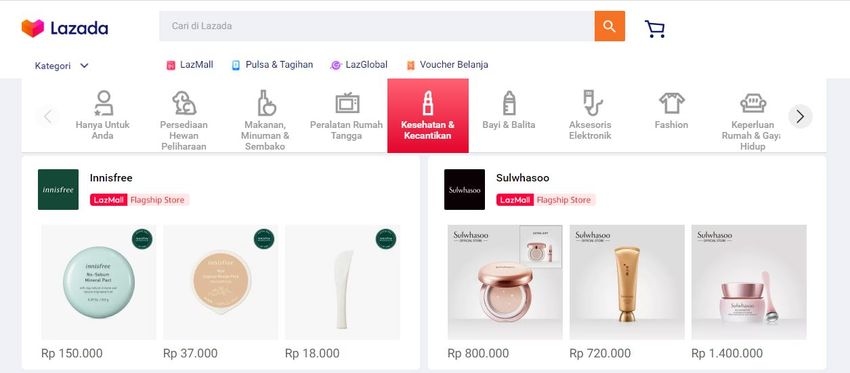
Indonesia: Participating in Online E-Commerce Shopping Platforms in SEA

     •    Indonesia top 10 most visited websites in 20198

           Merchant                  Monthly Traffic
                                                                                                            Shopee successfully
                                                                       Tokopedia
                                          75,502,688                                                        utilized peak sale
                                                                       dominated in three
                                                                                                            events like 11.11
                                                                       quarters and gets
                                          61,669,392                                                        and 12.12 to get the
                                                                       the highest traffic in
                                                                                                            highest web visits in
                                                                       2019
                                          53,862,335                                                        Q4

                                          28,722,575

                                          24,170,104
                                                                       E-commerce sites
                                                                       for specific needs,
                                          7,487,384
                                                                       such as Orami,                       5 out of the top 10
                                                                       Sociolla, Bhinneka                   most visited e-
                                          4,262,023
                                                                       and Zalora,                          commerce websites
                                                                       garnered a good                      are Indonesian sites.
                                          4,164,203                    number of web visits

                                          3,873,176

                                          3,046,010

     •    Indonesia Top 10 Most Used Mobile Apps in 2019 – Based on Monthly Active Users9
     •    App use is slightly below website use in terms of monthly visitors but increasing fast.

                                                                                               Mobile shopping apps with a
      Lazada, Shopee,                                 Product content
                                                                                               centralized product catalogue
      Bukalapak and Tokopedia                         diversity is the most
                                                                                               are most used; top 5 have
      share the top 4 spots. JD,                      used strategy to
                                                                                               integrated products from
      Blibli, and Zalora are the                      increase user activity
                                                                                               multiple categories.
      next tier.                                      in apps during 2019.

8 iPrice Group Year-End Report on Southeast Asia's Map of E-commerce 2019, https://marketinginasia.com/wp-content/uploads/2020/03/2019-Year-
End-Report-of-Map-of-E-commerce-iPrice-Group.pdf
9
  https://datareportal.com/reports/digital-2019-ecommerce-in-indonesia

www.rouse.com                                                                                                                             3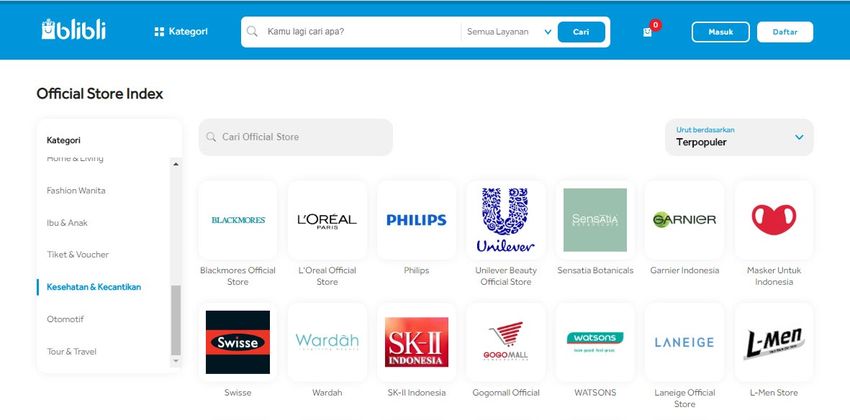
Indonesia: Participating in Online E-Commerce Shopping Platforms in SEA

2.           Status of Korean companies on the shopping mall and sales status
             in Indonesia

2.1          TOKOPEDIA10

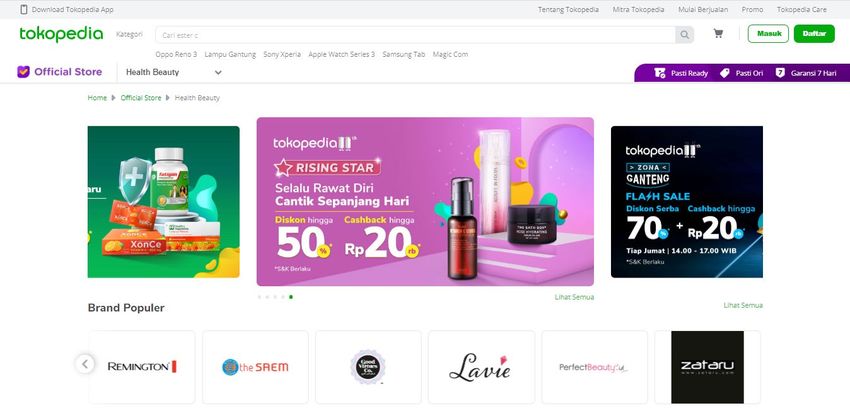
Tokopedia’s Official Store is a special platform provided for official brands or the rights holder of the brand
to sell their products online through the Tokopedia page or the app. It offers a wide range of categories
including beauty and wellness products. Korean beauty products are among the popular products sold in the
beauty & wellness product section. Some well-known Korean beauty products sold in Tokopedia official
store: theSAEM, Daeng Gi Meo Ri, Clio, Innisfree, Dr. Jart+, Holika Holika, and others.

2.2          SHOPEE11

10   https://www.tokopedia.com/official-store/cantik-sehat
11
     https://shopee.co.id/mall/Perawatan-Kecantikan-cat.14840

www.rouse.com                                                                                                 4
Indonesia: Participating in Online E-Commerce Shopping Platforms in SEA
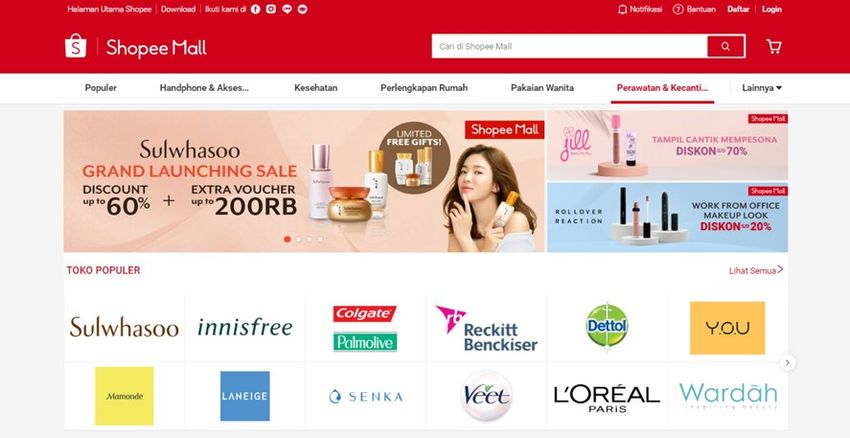
ShopeeMall is a storefront within Shopee for direct well-known brands or rights holders to sell authentic and
best quality products. It offers wide range of products including beauty products. Korean beauty products
are among the popular products sold in Shopeemall and can be seen placed in the first page of the beauty
section. Some well-known Korean beauty products sold in Shopeemall are Sulwhasoo, Innisfree, Mamonde,
Laneige, and others.
2.3 BUKALAPAK12
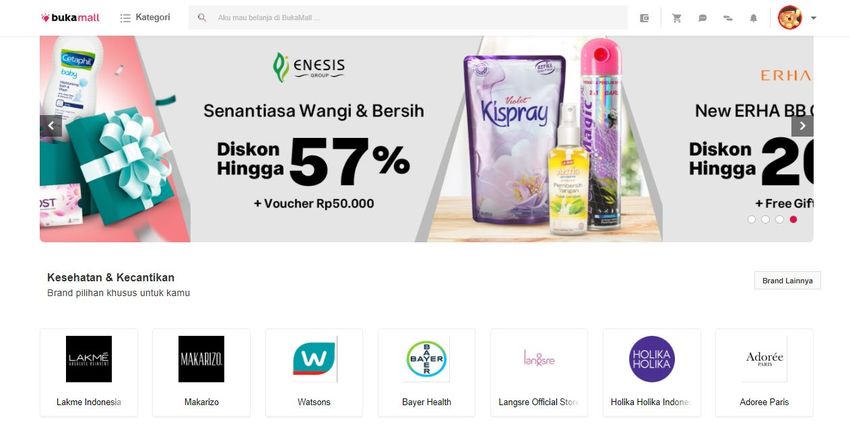
Buka Mall is Bukalapak 's official store platform that guarantees 100% original products. It offers a wide
range of products including beauty & wellness category. Some well-known Korean products are also sold in
here including Holika Holika, Daeng Gi Meo Ri and Nature Republic.
2.4 BLIBLI13
12 https://www.bukalapak.com/bukamall/catalog?category_id=32&keywords=
13
https://www.blibli.com/official-store/stores?sort=popularity%3Adesc&merchantName=&category=KK-1&appsWebview=true
www.rouse.com 5Indonesia: Participating in Online E-Commerce Shopping Platforms in SEA
Blibli Official Store is a page where all official owners of well-known brand or rights owners of the brand can
sell their products within Blibli. It offers wide range of product categories including beauty and wellness.
Korean beauty products are one of the most popular products sold in beauty & wellness category. Some
well-known Korean beauty products sold in Blibli are theSAEM, Laneige, Nature Republic, Holika Holika, and
others.
2.5 Lazada14
LazMall is a platform for flagship stores or official brand owners to sell their products in Lazada. It has a wide
range of product categories including beauty and wellness. Korean beauty products are also sold in this
category. Some of the well-known brands are: Innisfree and Sulwhasoo.
14
https://pages.lazada.co.id/wow/i/id/LandingPage/lazmall
www.rouse.com 6Indonesia: Participating in Online E-Commerce Shopping Platforms in SEA
3. IP policies of major online shopping platforms in Indonesia
The Top 5 ecommerce platforms as at 2020 are
• Tokopedia
• Shopee
• Bukalapak
• Lazada
• Blibli
In general most of the top platforms have terms and conditions for their merchants which cover IP
violations. Most ecommerce platforms are relatively modern businesses, with venture capital funding and
strong management teams. However the rules on what merchant terms must include are not compulsory so
there are variations. Generally the more mature, internationally funded and backed and large the platform is
the better the terms.
3.1 Tokopedia15
Tokopedia has specific IP provisions, which prohibit IP violations. They have an online form submission
process. Tokopedia is usually the fastest platform to remove infringing links.
In Tokopedia’s Terms & Conditions’ content section, IP issues are covered as below:
“6. When a User uploads to the Tokopedia Site with content or posts content, the User grants Tokopedia non-
exclusive rights, throughout the world, continuously, irrevocably, royalty-free, sublicensed (through several
levels) the right to exercise any and all copyright, publicity, trademark, database rights and intellectual
property rights that Users have in the content, in any media that is known now or in the future. Furthermore,
to be fully permitted by applicable law, you waive moral rights and promise not to sue those rights against
Tokopedia.
7. Users guarantee that they do not violate intellectual property rights in uploading User content to the
Tokopedia site. Each User is hereby personally responsible for infringing intellectual property rights in
uploading content on the Tokopedia Site.”
3.2 Shopee16
Shopee prohibits any activity that violates thirds party owned IP. It has a complaints procedure with
submissions through an online form. In Shopee’s terms and conditions, IP issues are covered as below:
TERMS OF SERVICE
6. REQUIREMENTS OF USE
6.2 You agree not to:
15 https://m.tokopedia.com/terms/konten
16
https://shopee.co.id/legaldoc/terms
www.rouse.com 7Indonesia: Participating in Online E-Commerce Shopping Platforms in SEA
(z) violates Shopee's rights, including any intellectual property rights and any passing off of said intellectual
property rights;
(bb) register items that violate the copyrights, trademarks or other intellectual property rights of third
parties or use the services in a manner that would infringe the intellectual property rights of others;
8. REPORTING A VIOLATION OF INTELLECTUAL PROPERTY RIGHTS
8.1 Users are independent individuals or businesses and they do not have a relationship with Shopee in any
way. Shopee is not an agent or representative of Users and does not hold and/or own the items listed on the
site.
8.2 If you are the owner of intellectual property rights ("IPR Owner") or an agent legally authorized by the
IPR Owner ("IPR Agent") and you believe that your rights or the rights of the party giving you authority have
been violated, please notify us in writing by e-mail to help@support.shopee.co.id and include
legal@shopee.com and provide us with the documents required below to support your claim. Please allow
time for us to process the information provided. Shopee will respond to your claim as soon as possible.
8.3 Claims under this Section 8 must be submitted in a form specified by Shopee, which can be updated from
time to time, and must include at least the following: (a) physical or electronic signature of the IPR Owner or
IP Agent (collectively called "Informant"); (b) an explanation of the types and nature of intellectual property
rights that are allegedly infringed; (c) details from the list of suspected violations; (d) sufficient information
to allow Shopee to contact the informant, such as the informant's physical address, telephone number and
e-mail address; (e) a statement from the Informant that the complaint was filed in good faith and that the
use of intellectual property rights as identified by the Informant is not permitted by the IPR Owner or the
law; (f) a statement by the Informant that the information in the notification is accurate, compensating us
for any losses suffered by us as a result of the information provided by and that the Informant has the
appropriate right or is authorized to act on behalf of the IPR Owner on the complaint.
29. THIRD PARTY CONTRIBUTIONS TO OUTSIDE SERVICES AND LINKS
29.2 In addition, the Services may contain links to third party products, websites, services and offers. These
third party links, products, websites and services are not owned or controlled by Shopee. Instead, all of them
are operated and owned by the respective third parties and may be protected by copyright or other
applicable intellectual property laws and treaties. Shopee has not reviewed and is not responsible for the
content, functionality, security, services, privacy policies or other practices of these third parties. You are
advised to read the terms and conditions published by such third parties on their websites or elsewhere. By
using the Service, you agree that Shopee will not be responsible in any way if you use or cannot use the
website or widget. You also acknowledge and agree that Shopee may disable your use or remove any third
party links, or applications on the Service if they violate these Terms of Service.
3.3 Bukalapak17
Bukalapak prohibits any activity that violates IP. It has a complaints procedure with submissions through an
online form. Bukalapak is typically slower to respond to complaints than other platforms. We understand
that their takedown volumes are increasing. On Bukalapak, IP issues are covered as below:
Bukalapak.com Terms of Use
Service
17
https://www.bukalapak.com/terms
www.rouse.com 8Indonesia: Participating in Online E-Commerce Shopping Platforms in SEA … 5. BukaBantuan/Bukalapak’s Help Assistance BukaBantuan is a service provided by Bukalapak to facilitate problem solving including but not limited to transaction problems between Buyers and Sellers, violations of Intellectual Property Rights, reporting of product violations, and others. Through the BukaBantuan service, users can ask and submit complaints about all matters related to transactions at Bukalapak that are related to Features/Products, payment methods, delivery services, how to return goods and others. Through the BukaBantuan service, users can directly contact Bukalapak Customer Service to get information needs and solve problems experienced, both related to transaction problems and those other than transaction problems. Users can use the BukaBantuan service as a means of complaint against violations of Intellectual Property Rights, duplication of products by other users, duplication of photos/descriptions. BukaBantuan is a customer service feature consisting of a list of references about the most frequently asked questions as well as omni channel information that can be selected, such as call center numbers, email services, to live chat so that customers can freely ask questions or complaints about products, payment methods, delivery services, how to return goods and so on. User, Account, Security, and Password Mandatory requirements for Users to access services on the Bukalapak Platform, including: ... 14. Users are required to be responsible for all risks that arise in the future for the information they provide to Bukalapak, including but not limited to matters related to Intellectual Property Rights, namely copyrights, trademarks, patents, trade secrets, industrial designs, and integrated circuit layout design of a product. Prohibited items Prohibited items are items that are prohibited from being traded on the Bukalapak Platform based on the laws and regulations in force in the Republic of Indonesia, Bukalapak's internal policies, and / or the Application Distribution Platform Policy. These items are goods and / or services that are classified as dangerous, violate the law, threaten, harass, insult, slander, intimidate, invade the privacy of others or other rights that violate the law in any way. Based on these matters, items that are prohibited from being traded on the Bukalapak Platform, include: ... 13. Items that violate the intellectual property rights (IPR) of other parties; … 3.4 Lazada (445 million)18 Lazada prohibits any activity that violates IP. It has a complaints procedure with submissions through an online form. IP issues are covered as below: LAZADA'S INTELLECTUAL PROPERTY RIGHTS VIOLATION POLICY 18https://sellercenter.lazada.co.id/seller/helpcenter/kebijakan-hak-kekayaan-intelektual-lazada.html https://pages.lazada.co.id/wow/i/id/LandingPage/IPR www.rouse.com 9
Indonesia: Participating in Online E-Commerce Shopping Platforms in SEA

Violation of intellectual property rights by Platform users ("Users") is strictly prohibited. Users who upload
content, list products or services, or use the Platform in any way that violates intellectual property rights will
be subject to steps in accordance with Lazada's policies - including but not limited to issuing non-compliance
points, suspension of User accounts, permanent termination from the Platform and/or any action deemed
necessary, including but not limited to initiation of civil or criminal proceedings by Lazada independently or
together with the rights owners;

A. The types of intellectual property rights violations prohibited on the Lazada Platform include, but are not
   limited to:

        I.         Registering fake products or services on the Platform;
        II.        Violating Content;
        III.       Other types of intellectual property infringement, including infringement of any other type of
                   intellectual property recognized under the laws of the country in which the notification of
                   infringement is made, including, but not limited to, infringement of patents or registered
                   designs, or any other recognized intellectual property rights by law or a final judgment by a court
                   of final level.

        B. Submitting infringement notifications to Lazada by:

Register an account on the IPP Platform through https://ipp.alibabagroup.com/register.htm. – The
platform helps Lazada to process deletion notifications quickly and effectively, and for complainant to
monitor, track and manage violation notifications, submit replies to responses to notifications and withdraw
complaints through the IPP Platform account.

If the notification of violation is approved, Lazada will delete the list of content or products or services from
the Platform and make appropriate efforts against the User based on policy. The efforts that will be made
against Users are confidential and cannot be disclosed to rights owners or third parties.

If the report is incorrect or fails, Lazada will not delete the list and will not take any action against the User.
The complainant will receive a message on the IPP Platform informing the rejection and its reasons;

(2) Submit infringement notification by electronic mail (e-mail) with the address Trust@lazada.com.
To file a notification of intellectual property infringement, one must own or hold an exclusive license for the
intellectual property that is the subject of the notification of infringement or be an agent with written power
signed by the right owner or exclusive license holder to file notification on his behalf.

Complainant are required to submit the required documents by electronic mail (e-mail) to
Trust@lazada.com.

3.5            Blibli19

Blibli prohibits IP violations. No formal IP complaint system exists, but IP complaints can be set to their legal
team. Their terms state:

12. INTELLECTUAL PROPERTY RIGHTS

19
     https://www.blibli.com/faq/tentang-blibli/syarat-ketentuan/

www.rouse.com                                                                                                      10
Indonesia: Participating in Online E-Commerce Shopping Platforms in SEA 12.1 We are the sole owner or legal holder of all rights to and content in the Blibli Site. The Blibli Site and its contents include intellectual property rights protected by copyright laws and laws that protect other intellectual property that apply throughout the world. All property rights and intellectual property rights of the Blibli Site and their contents remain with Us, its affiliates or license owners of the contents of the Blibli Site. All rights not included in this Agreement or by Us hereby protected by law. The Blibli Site, name and related icons and logos are registered trademarks in various jurisdictions and are protected by laws regarding copyright, trademark or other intellectual property rights. It is strictly forbidden to use, change, or install these brands on any media without our consent. www.rouse.com 11
Indonesia: Participating in Online E-Commerce Shopping Platforms in SEA

4.           IP guide when opening and operating business on online shopping
             platforms

This section is a guide for Korean companies on opening e-stores on ecommerce platforms. Opening an
ecommerce store on a third-party platform requires a businessperson to consider 3 aspects. The first is how
to operate as a business at a general level. The second is there are special rules for ecommerce trade. Thirdly
the ecommerce store’s own rules for its merchants. There are no special IP rules for ecommerce merchants
that differ from other businesses, so this guide sets out some of the general rules and explains how IP
applies.

4.1          General business set up and operation rules

A broad general checklist to operate a business in Indonesia is as follows:

First consider your business model. Foreign investment restrictions and costs may make it impractical to
open a full subsidiary company. Many, perhaps most, foreign products are imported and sold through
distributors in Indonesia. Some companies may have existing distribution, and the question comes whether a
current distributor is suitable to operate ecommerce stores or whether a further specialist distributor is
more desirable. Whilst the legal and technical aspects of operating may help guide this question, quite often
it is a financial question and a question of how the principal normally operates. There is an issue for foreign
merchants hoping to run virtual ecommerce shops in Indonesia without having trading companies in
Indonesia. Indonesia is taking various steps to tax and regulate this kind of virtual business. So, whilst it is
theoretically possible to operate a business outside Indonesia selling services especially (goods are harder to
import as they are taxed) to Indonesia it is getting more difficult.

The first step will be to check foreign investment sector regulations / restrictions (called the negative list20),
then decide how the business can operate in view of any restrictions. Indonesia operates a set of rules on
which sectors are open to the public and which are closed. This is run by the foreign investment board or
BKPM21. They can be contacted for specific queries. For example, online distribution and retail is a restricted
area, and depending on the product area there may be capital limits on ownership.

If you do decide to open a local company, there are many issues to consider. First the type of entity, which in
Indonesia for foreign investors can be one of two types. A trading company is called a PMA company, and it
can act in full, like a local company. An alternative is a non-trading Representative Office, which is a
marketing company that does not trade goods or services. These are rare but there is a specific new category
of Representative office for offshore ecommerce merchants trading in Indonesia. It will require decisions on
who the shareholders should be (depending who the investor(s) will be) as well as who should be the
directors and commissioners (officers in Indonesian companies which oversee the directors).

In almost every case there will need to be contracts to sell goods in Indonesia. You may need to appoint a
distributor, or if you open a company with investment there may be a shareholder agreement. Consult
Indonesian commercial lawyers to have these drawn up as there are special rules on what must go in a
contract with an Indonesian party. Often, they will have an IP component.

There are many practical issues in setting up a company. These include planning financial and tax issues for
the business, registering for tax; for all this a business should hire tax and financial advisors. Companies may
need to arrange banking, or hire other local agencies, especially for advertising or digital marketing. If you

20   https://www.indonesia-investments.com/upload/documents/Negative-Investment-List-May-2016-Indonesia-Investments.pdf
21
     https://www.bkpm.go.id/

www.rouse.com                                                                                                             12
Indonesia: Participating in Online E-Commerce Shopping Platforms in SEA
are operating as s foreign investor after all the approvals it will be necessary to secure contracts for assets,
utilities, equipment, supplies, office lease, insurance, and staff. For staff always carefully check your
employment agreements include IP protection clauses.
Next you need to check what permits or licenses the business needs to operate. There will be certain
operational permits (for the land or business operation which may be national or local). Beyond that there
may be specific product requirements. For example, personal care products require a license from the
Minstry of Health BPOM department22. Other products e.g. toys require Indonesian national standard
compliance. The Indonesian National Standard (abbreviated SNI) is the only national standard that applies in
Indonesia and affixing the SNI marking on the product is an indication that it meets the standard
requirements to allow it to be sold. Some of these product permits may require you to provide you own any
underlying IP for the products.
4.2 IP protection in Indonesia
It is critical to plan what Intellectual Property (trademark, copyright, trade secret, design, patent etc.) is
needed for your product. In many cases that will be dictated by rules from the IP owning company in Korea.
IP is registered at the IP office called the DGIP23. Foreign IP owners must file through an accredited
Indonesian P consultant. Indonesia operates a first to file system, which makes early registration of IP critical
(before you enter the market). Secondly Indonesia has a well-documented problem with unauthorized
registration by local entities of others’ IP, especially trademarks and previously copyrights. Thirdly there are
very limited unregistered IP rights (e.g. unfair competition rights) so registering is always the priority.
Korean trademark filings in Indonesia are rising as the following table shows:
Patents and designs are typically filed in
South Korea Trade Mark Applications accordance with timetables dictated by when they
Filed in 2017-2019 were created. However, IP owners often do not
extend patents and designs to Indonesia; this can
be a mistake if the products will one day be sold in
1215 Indonesia given its size as the largest market in SE
1500 1025
855 Asia.
1000
Trademarks need to be registered before your
500 start selling goods. There are several reasons for
this. One is that you may need to provide
0 evidence of at least application to import goods,
2017 2018 2019 secure the SNI or trade the goods. Secondly it
avoids conflicts if have already registered. It is
sometimes possible to start trading before a trademark has been registered if you have a good search
opinion that the mark will be registered, and you have made your application. It takes several years to obtain
a trademark registration due to delays at the IPO. Indonesia recently joined the Madrid system so
international registrations filed by Korean companies which designate Indonesia can be obtained.
Companies often register too few trademarks in Indonesia. Products often have a house mark, a product
name, a label, a tag line, and graphics. It may be necessary to file all of these in Indonesia to secure sufficient
protection for your product, to avoid conflicts with other parties and later stop counterfeit or copy products.
As said above there is very limited unregistered rights protection.
22 https://cekbpom.pom.go.id/
23 https://www.dgip.go.id/
www.rouse.com 13Indonesia: Participating in Online E-Commerce Shopping Platforms in SEA Other IP you may need to consider includes Copyright, which applies to graphics, logos, marketing collateral and other creative works. Take advice on what you need to protect and how. A challenge for foreign IP owners is whether to register licenses for IP. The law technically requires all licenses to be recorded at DGIP. Short form licenses can be sued for this so it is a simple process, but the volume of IPRs to record can make this a very substantial cost. In practice many companies do not do so. It is best to take specific advice on your situation. Digital handles including domain names, social media handles may be necessary to trade in Indonesia, or at least you may use Indonesian language versions of overseas sites. There is increasing pressure from the government to localize content. There are no special local social media or other content systems, but there are local domains you might want to secure such as .co.id or id. It is also worth considering your IT requirements. Of course, the business will have hardware and software needs, hosting, website and digital marketing contracts, cloud, and storage needs. However, 2 IP related areas are deeply connected to IT. The first is trade secrets. If there are important business secrets deployed in the business, they must be kept secret to enjoy legal protection. A key component of this is that the IT system be secured, therefore. The second technology related IP issue is data privacy. Indonesia does not have a clear set of data privacy rules that apply to businesses yet. A law was presented to Parliament in 2019 but has not yet passed. Various regulations provide protection for different components of data privacy, but the full unifying law is awaited now. Note that Indonesia as a member of ASEAN may follow ASEAN policy. The ASEAN Framework on Digital Data Governance is the structure under which the 10 ASEAN member states handle cooperation on data issues. Current proposals include a data classification framework and a cross-border data flow mechanism for ASEAN. 4.3 Special rules for ecommerce trade. The boom in ecommerce trade meant that until 2019 merchants themselves were largely unregulated. Anyone could and did sell goods online. However, over the years there have been several regulations enacted which apply to ecommerce merchants operating on platforms. The most important is Government Regulation No. 80 of 2019 on Trade Through Electronic System and implementing Ministerial Regulation 50 of 2020 on Business Licensing, Advertising, Guidance and Supervision of Businesses Trading Trade through Electronic Systems. These set out provisions on e- commerce practices in Indonesia. They implement provisions of the Trade Law 2014, which technically applied since then, but were not implemented or clarified until now. The new regulations have a transition period so existing traders have 2 years to comply, although new market entrants will need to comply immediately. Although they do not apply specifically to IP, several areas are critical to IP owners. First the sellers/merchants are now required to secure a business license through the governments new Online Single Submission (OSS) System. Platforms are prohibited from accepting sellers/merchants that do not do so. Foreign merchants that try to trade online in Indonesia must register with the Indonesian government and set up a representative office. This has a function to allow the government to identify traders but has the opposite effect of potentially (although it is not tried in practice yet), to allow IP owners to identify traders with whom they have IP disputes. Secondly another rule prioritizes use of Indonesian domain names. Thirdly there are rules on consumer protection including to allow consumer complaints (this is legal different from IP owner complaints but may overlap because a consumer may complain about an IP violation under the Consumer Protection law), which will involve merchant. Fourthly merchants must keep www.rouse.com 14
Indonesia: Participating in Online E-Commerce Shopping Platforms in SEA

data on their sales for long periods (typically 5 years). This data could be relevant to IP owners seeking
source or sales information. Fifth, there are rules on digital advertising which merchants must follow.

Another regulation which is peripherally relevant from an IP perspective is Government Regulation No. 71 of
2019 on the Implementation of Electronic Systems and Transactions. Again, it is not IP specific but contains
provisions of relevance to IP owners.

The first is that it ensures that online ecommerce trading platforms operate and keep data in Indonesia or at
least be open to supervision. So foreign merchants may no longer operate ecommerce entirely outside the
justification of Indonesia. This can apply to any form of digital traders. The intention is to ensure that the
laws of Indonesia apply, including tax collection to those selling goods and services online into Indonesia.
There were previously threats to the IP of companies not complying with this rule. Any merchant seeking to
operate in Indonesian without a local company should pay close attention to this regulation.

There are also a set of data privacy rules in this regulation which are now going to be replaced by the 2019
draft data privacy law. It is at present unclear how merchants are to comply with this regulation’s data rules
given the new draft law uses different rules. Advice on data privacy should be taken at the time of market
entry.

The main rules applying to IP for merchants are covered in section 4.

4.4          Ecommerce platform’s own rules for its merchants

Merchants operating on Indonesia’s ecommerce platforms must enter contracts with the platforms. These
will be on typically standard terms. However, some platforms have different systems for different merchant
categories.

4.4.1 Tokopedia24

Founded in 2009, Tokopedia is an online marketplace that has reached the unicorn status in Indonesia.
Tokopedia offers 3 (three) categories of merchants:

        •    Regular merchant;
        •    Power Merchant: A merchant membership that offers a variety of exclusive features to help increase
             sales and increase customer trust; and
        •    Official Merchant: A merchant service on Tokopedia intended for selected merchant to develop their
             business exclusively. I.e.: Owner of the Well-known brand, Official Distributors, chosen merchants
             with gold status for some period of time and has business license, Local sellers with business
             license.25
        •
        It assists merchants with specific guidance as follows:

        •    Further terms and conditions: https://www.tokopedia.com/terms#sell
        •    How to start selling: https://seller.tokopedia.com/edu/mulai-berjualan/
        •    Forbidden goods: https://seller.tokopedia.com/edu/produk-yang-dilarang/

24   https://seller.tokopedia.com/edu/mulai-berjualan/
25
     https://seller.tokopedia.com/edu/official-store/

www.rouse.com                                                                                                15
Indonesia: Participating in Online E-Commerce Shopping Platforms in SEA
4.4.2 Shopee26
Shopee entered the Indonesian market in December 2015 and is now one of the top marketplaces in
Indonesia. Shopee has 2 (two) categories of sellers:
• Indonesian Sellers27, sellers including regular merchants, official stores and Shopee mall.
• Seller Outside of Indonesia28
It assists merchants with specific guidance as follows:
• For the further terms and conditions: https://shopee.co.id/docs/3001
• How to start selling: https://seller.shopee.co.id/edu/article/464
• Forbidden goods: https://seller.shopee.co.id/edu/article/371
4.4.3 Bukalapak
Now an Indonesian unicorn and one of the largest e-commerce companies in Indonesia., it was founded in
2010. Bukalapak has unique merchant levels consisting of 9 (nine) stages of badges. Each merchant badge
will be given according to the number of positive feedbacks from sales transactions. The higher the badge
level, the better the reputation of the merchant which will boost their business.
It assists merchants with specific guidance as follows:
• For the further terms and conditions: https://www.bukalapak.com/terms#strict-terms
• How to start selling: https://www.bukalapak.com/bantuan/sebagai-pelapak/jual-barang/cara-
berjualan-di-bukalapak
• Forbidden goods: https://www.bukalapak.com/terms#strict-terms
4.4.4 Lazada29
Now owned by Alibaba, Lazada has 3 categories of sellers:
• Lazada Seller – If the seller is located in the territory of Indonesia;
• LazMall – If the seller is the official owner of the brand or the official distributor of the brand and has
offline store;
• LazGlobal – If the seller is located in China/Korea/Japan, has business that is officially registered and
can deliver the products to the Foreign Sort Center.
For the complete guidelines and terms and conditions of each categories:
https://sellercenter.lazada.co.id/seller/helpcenter/lazada-seller-policies/?spm=a2a14.helpcenter-psc.topics-
list.7.5f8614e3UWT583
26 https://www.blibli.com/pages/seller-center?utm_source=&utm_term=&utm_medium=&utm_content=
27 https://www.static-src.com/siva/coreasset/07_2020//1594616373332//TP_Deck_for_New_Seller_-_Aug_2020.pptx
28 https://www.static-src.com/siva/coreasset/07_2020//1596090078191//BLIBLI_GSP_Pitchdeck_Final.pdf
29
https://sellercenter.lazada.co.id/seller/register/registration_landing
www.rouse.com 16Indonesia: Participating in Online E-Commerce Shopping Platforms in SEA
4.4.5 Blibli
Founded in 2010, Blibli is operated by PT Global Digital Niaga which is a digital services subsidiary of Djarum,
an Indonesian conglomerate which started as a kretek cigarette manufacturer. Blibli divides its merchant
into Indonesian sellers and Sellers Outside Indonesia.30
It assists merchants with specific guidance as follows:
• Terms and conditions: https://www.blibli.com/faq/tentang-blibli/syarat-ketentuan/
• How to start selling:
a. Indonesian: https://www.static-
src.com/siva/coreasset/07_2020//1594616373332//TP_Deck_for_New_Seller_-_Aug_2020.pptx
b. Global Sellers: https://www.static-
src.com/siva/coreasset/07_2020//1596090078191//BLIBLI_GSP_Pitchdeck_Final.pdf
30
https://www.blibli.com/pages/seller-center
www.rouse.com 17Indonesia: Participating in Online E-Commerce Shopping Platforms in SEA
5. IP guide to operating a business on online shopping platforms
5.1 Introduction to Indonesia’s IP related online rules.
This section addresses the IP conflict rules on ecommerce platforms. Indonesia’s online enforcement rules
are complicated. There are 3 different laws that may apply to online infringement, each with their own
subordinate regulations. They are not consistent; they use different terms and definitions and can be used in
different ways. As a result, there is uncertainty over which law applies to a situation, who can make a
complaint and what are the precise legal remedies. No cases have been brought probably because of the
complexity.
IP owners typically need several solutions. First a clear simple system to require ISPs/Platforms to remove
infringing content. Secondly a way to sue ISPs/Platforms when the content is not removed, or when a
situation is new, or the ISP/Platform refuses, then to seek a court order/injunction setting out what to do.
Thirdly a way to take legal action against an infringing merchant/trader (including finding their identity/
business details to bring an action. Fourthly a way to deal with serious IP violations, whether repeat
infringers, or mass IP violation.
Indonesia does not define ecommerce platform and ISP liability in the same way as other countries. They do
not use the concepts of knowledge or safe harbor. Instead Indonesian laws impose a supervision obligation
on ISPs/platforms. Failure to supervise leads to responsibility for illegal acts on the ISPs/platforms’ system.
5.2 Summary of Indonesia’s 3 IP related online rules
The detailed table set out in Annex A sets out a summary of the different regimes and their functions. The
legal structure is as follows: there is a law, then under each law implementing regulations and subsidiary
legislation, which sets out different systems and remedies which can help IP owners.
Ministry of Law and Human Rights
Ministry in Minstry of Communications & Ministry of
Directorate of Intellectual Property (DGIP) +
charge Informatics (KOMINFO) Trade
KOMINFO
Electronic Information and
Transactions Law (11 of 2008 as Trade Law (7 of
Law Copyright Law (28 of 2014)
amended by law 19 of 2016) a.k.a. 2014)
EIT law
The sequence of laws and regulations is relevant. The EIT Law and its rules came first and are the most
established. Rules under the Trade law all came later. The Trade Law governs ecommerce transactions and
related trade and the EIT governs data, registration ISPs etc. IP issues appear mainly in the EIT, but the Trade
Law has relevance to two areas: a general requirement for ISPs to manage content legally and new
requirements about merchant identities on ISPs/Platforms.
www.rouse.com 18Indonesia: Participating in Online E-Commerce Shopping Platforms in SEA 5.3 KOMINFO’s systems under the EIT law The first system under KOMINFO (the Ministry of Communications and Informatics) operates under Electronic, Information and Transactions Law (EIT Law). The subsidiary rules are KOMINFO’s Circular Letter No. 5 of 2016 (“Circular”) on the Limitations and Responsibilities of Platform Providers and Merchants in E- Commerce Using User-Generated Content Platforms. This is a non-binding set of rules, which in practice ecommerce platforms tend to follow. They have never been challenged in court. In addition, there is Government Regulation No. 71 of 2019 Regarding Implementation of Electronic System and Transactions Article 25 of the EIT Law provides for IP protection by way of protecting electronic information and/or electronic documents that have been created into intellectual works. The Circular implements Articles 15 and 25 of the EIT Law and states the scope of responsibility for an Electronic System or a User-generated Content Platform (“Platform”) to implement its system and manage all content (“Content”) reliably, safely and responsibly. The Circular in its Part V (B) (1) (e) prohibits Content which infringes other parties' intellectual property rights. Further, Part V (C) (1) (a) of the Circular requires a Platform to set out terms and conditions for its operation and usage which should include: • obligations and rights of the Sellers/Merchants or Users in using the Platform services; • obligations and rights in implementing Platform business activities; • provisions regarding liability for Content uploaded. Under Part V (C) (1) (c), a Platform can take action on complaints by: • carrying out the removal and/or block prohibited content • sending a notice to the Merchant that the uploaded content is prohibited • providing a means for Merchants to rebut that the uploaded content is not prohibited • rejecting complaints and / or reporting if the content reported is not prohibited This in effect creates a structure within which a Notice and Takedown system can work, without specifying a precise Notice and Takedown system. The Circular has a broad definition of a Platform, including any e- commerce platforms like Tokopedia, Lazada etc., and social media including social commerce websites like Facebook, Instagram, and providers of streaming services, like Netflix or YouTube. The Circular also provides basic guidelines which create a quasi-safe harbor policy (but without specifically using the concept of safe harbor). To limit or exclude liability, Platforms should comply with the obligation to provide terms and conditions/Terms of Services, by clearly stipulating that users are responsible for their uploaded content. The Platforms may be further exempted from liability for failure to comply with the Circular or EIT Law in the event of force majeure, or errors or negligence on the part of the Seller/Merchant or the User. Article V (C) (1) (e) of the Circular requires active evaluation and / or monitoring of Merchant activities on the Platform but does not provide any clear rules on how a Platform can actively monitor uploaded content. Lastly the Circular Article V (D) (1) (a) also obliges merchants to provide complete and correct information relating to their contracts. It remains a problem for IP owners to identify traders from websites, since they often hide identity information, addresses, just using instant messenger or email. This provision in the Circular is not widely relied upon but could be. Contracts should after all law identify parties; therefore, IP owners could rely on this to ensure proper identification information is provided by Merchants. However, in practice the separate Ministry of Trade regulations may cover this more effectively. www.rouse.com 19
Indonesia: Participating in Online E-Commerce Shopping Platforms in SEA

A separate set of rules in Regulation 71/2019 (unrelated to Circular no 5 of 2016) allows the government to
ban prohibited Content. This includes IP, according to the Elucidation which accompanies the regulation. So,
in theory this gives anyone, including IP owners the ability to file administrative complaints to KOMINFO for
breach of Regulation 71/2019 – including against ISPs. But a further regulation (still in draft) is still required
for the complaint procedure. So, this remedy is still theoretical.

5.4     The Minstry of Trade systems under the Trade Law

Until recently, the Trade Law remedies were unused for IP issues. The Trade Law does not specifically refer
to IP; but it is covered by implication (because it refers to content ‘in compliance with all laws’). Government
Regulation No. 80 of 2019 on Commerce through Electronic Systems obliges ISPs to remove illegal content;
this should in theory include IP violations. However, this is aimed at the Consumer Protection law principally
and so without the specific mention of IP it is unclear if IP owners can benefit from these rules. Overall, the
Ministry of Trade rules appear to be aimed protect consumers and may potentially help identify merchants.

The Ministry of Trade issued Regulation No. 50 of 2020 on the Requirements regarding Business Licensing,
Advertising, Development, and Supervision of Businesses in Commerce through the Electronic Systems. This
regulation is an implementing regulation of Regulation No. 80 of 2019 to clarify unresolved issues in the E-
Commerce Regulation. Broadly, the new regulation regulates the appointment of representatives by foreign
e-commerce service providers and business licenses for local merchants, e-commerce service providers, and
intermediary service providers. Moreover, it also elaborates the requirements for electronic advertisements
and the obligation to prioritize local products and services.

Consumer protection complaints, that is complaints by consumers under the Consumer Protection law are
governed here; with ISPs/Platforms required to have complaint and takedown systems. This overlaps with IP
rules, although the IP holder itself cannot make a complaint as IP holders are not classed as consumers. But a
consumer could complain about IP violations (e.g. that they have been sold counterfeit goods) through this
system.

A second issue is the requirement that identification details, business licenses etc. be held by ISPs/Platforms.
IP Holders are keen to have access to these and secure cooperation from platforms for legal actions against
merchants, who currently often hide their identities so that they cannot be pursued by IP owners. Platforms
will not disclose merchant details to IP owners for fear or data privacy breach. This new regulation has 2
years to take effect: new parties must observe it immediately, but existing businesses have 2 years. So, it is
unclear whether it will result in easy identification of infringing traders so that IP owners can identity and
take legal action against them.

Aggrieved persons can file administrative complaints to the Ministry of Trade; this is probably limited to
consumer complaints. Criminal remedies under Regulation 80 are not to possible. Civil complaints for losses
appear to be limited to the parties i.e. a consumer and merchant or ISP.

5.5     KOMINFO/DGIP’s system under the Copyright law

Under Articles 55-56 of the Copyright Law, copyright and related rights infringement on the internet is
covered. The law provides a system for reporting copyright violations and blocking of internet access to
infringing sites by the KOMINFO. It is further regulated by a Joint Regulation of the Ministry of Law and
Human Rights and Ministry of Communication and Informatics No. 14 of 2015 / No. 26 of 2015 that
implements content or website blocking and/or user’s access right that infringes copyrights and/or related
rights in the electronic system. Complaints are reported first to DGIP.

www.rouse.com                                                                                                   20
Indonesia: Participating in Online E-Commerce Shopping Platforms in SEA

This system, however, does not differentiate small scale/single infringements and large-scale infringements.
It empowers DGIP to decide cases (not courts) and KOMINFO to execute them. DGIP complaints can be time
consuming and IP holders have expressed concerns about delays and too few officers It has been
successfully used for some large-scale infringements but is too complex and impractical for small ones. And it
only covers copyright. There are also criticisms that infringers just domain hop after they have been blocked
and change the domain so reopen next day on a new one.

5.6        How IP holders use the three systems

IP holders can currently use these three systems in different ways.

5.6.1      Complaints by IP owners to platforms. IP owners send Notices of IP infringements and request
           takedowns under the EIT Law’s Circular no 5 of 2016 system. ISPs/Platforms usually comply under
           their merchant terms and complaints systems. IP owners must review ISP/Platform terms that cover
           the situation. This will set out a detailed complaint procedure and may allow the merchant to issue a
           counter notice. Thereafter the ISP/Platform terms will determine what action should be taken.
           Although Indonesia does not use the common global standard terms - ISP/platform ‘knowledge’ and
           ‘safe harbor’, the position is in practice similar. Although rules do not require ISPs/platforms to have
           ‘knowledge’, failure to take a complaint and deal with it creates liability. There are various levels of
           sophistication of different ISPs/Platforms, so IP owners have different levels of confidence in the
           different ISPs/Platforms. In general, most Notice complaints are successfully dealt with.

5.6.2      Legal actions by IP owners against ISPs/platforms. Technically legal action could be filed by an IP
           owner against a platform. This would depend on the underlaying legal breach complained of. The EIT
           Law and its regulations contain the most references to IP. The Trade Law contains only general
           provisions about how platforms must contain legal content. No case has ever been brought by an IP
           owner against a platform. The EIT law contains administrative (compliant to the KOMINFO Ministry),
           criminal or civil options, but not all the implementing rules are in place. It is too early to say whether
           the new Ministry of Trade rules provide any right of action for IP owners. There is no current ISP
           Injunction system in the civil courts, which other countries typically use to help decide IP
           owners/IPS/platform disputes, including new issues. In any event there is limited business
           confidence in the courts of Indonesia31. Whilst IP cases are often more reliable than general cases,
           Ecommerce disputes would (if there were any) be heard in the general courts.

5.6.3      Disputes between IP and merchants. When an IP owner wishes to take action against a merchant it
           has to first identify them. It can do this itself, through investigations, making trap purchases etc.
           However, this does not always lead to an identifiable business. Then it is possible that IP owners
           have remedies under the Minstry of Trade’s Trade law and its regulations. The regulations do
           provide potentially a way to identify infringing merchants which IP owners need, to support their
           own legal actions against infringing merchants. These are new and have not been used yet. Once
           identified an IP owner can bring an ordinary complaint under the relevant IP law. This can be a civil
           infringement lawsuit filed in the District Courts. Or a criminal complaint can be filed through the
           Police or the DGIP office investigation team called the PPNS. After a criminal investigation, the police
           an instigate a criminal prosecution in the criminal courts.

5.6.4      Large scale complaints by IP owners of significant volumes of IP infringements of copyright only, or
           websites with major copyright infringements can be reported through the DGIP and KOMINFO
           system under the copyright law. This leads to site blocking. Examples are known about, although
           cases are not public. Some years ago, the music industry filed complaints about available pirated

31
     https://www.doingbusiness.org/content/dam/doingBusiness/country/i/indonesia/IDN.pdf

www.rouse.com                                                                                                     21
Indonesia: Participating in Online E-Commerce Shopping Platforms in SEA
music links which they removed. More recently a complaint was actioned concerning a pirated
movie website32. Although a no-fault site blocking or content link removal system can be effective
for many infringements, it does not extend to trademark infringements, and it does not lead to any
criminal action against the infringer. The lack of any actual cases against IP infringers is indicative of
a non-deterrent criminal IP system.
5.7 Challenges and gaps in the current three systems
There are clearly legal gaps between Indonesia’s rules and how other countries approach it. Some of the
areas that are unclear are as follows.
a. IP owners cannot compel release of data from ISPs/platforms to enable them to act against the
merchant. ISPs/platforms view this as a data privacy risk. There is a new data privacy draft law in
Parliament, so it is unclear whether here will be any exceptions for law enformcenet purposes. The
new Ministry of Trade rules in Regulation No. 50 of 2020 may help, but it will take time to know if
that will be the case.
b. Repeat infringement or gross infringement is treated no different from a single infringement. There
are no requirements for ISPs/Platforms to have a three-strike rule, expel/blacklist the trader or deny
access to services (e.g. payment systems) to repeat infringer traders or traders that sell high volumes
of infringing products online.
c. Infringers can just re-list or adopt a new identity, at least until the arrival of the new regulation on
having a business license in 2019. It is not clear if this will lead to increased/more serious action from
ISPs/platforms when they know it is the same infringer.
d. The lack of civil ISP injunctions to help IP owners seek judicial guidance on new situations and
recalcitrant ISPs/Platforms is a problem. It also means ISPs cannot seek non infringement
declarations to protect themselves.
e. The lack of clarity about whether the Trade law rules apply to or provide remedies to IP owners.
f. The different definitions in the three laws and lack of consistency about which IP laws apply
(especially the KOMINFO/DGIP no fault site blocking system does not apply to trademarks).
g. Payments systems and advertising networks – it is not at all clear whether they have liability as
supporting actors, for assisting counterfeit/pirated product sales online. It is unclear if they come
under the various definitions of ISPs/Platforms.
h. The legal remedies against ISPs/e-commerce platforms in the Trade Law, EIT Law and the Copyright
Law are not the same (the Trademark law has no remedy). At present the laws refer to criminal, civil,
and administrative remedies, which are too unclear and complicated. A single legal remedy is
needed to solve IP owner and ISP/e-commerce platform disputes. Most countries choose the civil
court system against ISPs/e-commerce platforms (not criminal or administrative). If the civil court
system is chosen a Supreme Court regulation is needed to create an ISP injunction system – so
ISPs/e-commerce platforms can be ordered to stop, take down, block or remove content/items as
well as other legal remedies – damages, costs of taking action (if blocking is expensive). The civil
courts can then decide complex disputes about knowledge, safe harbor etc. like they do in other
32
https://ipkomododragon.blogspot.com/2020/01/major-se-asian-piracy-site-shuts-and.html
www.rouse.com 22You can also read


