SANS Institute Information Security Reading Room
←
→
Page content transcription
If your browser does not render page correctly, please read the page content below
SANS Institute
Information Security Reading Room

The Poisoned Postman:
Detecting Manipulation of
Compliance Features in a
Microsoft Exchange Online
Environment
______________________________
Rebel Powell

Copyright SANS Institute 2020. Author Retains Full Rights.

This paper is from the SANS Institute Reading Room site. Reposting is not permitted without express
written permission.
ts
                                                                                               gh
                                                                                           Ri
                 The Poisoned Postman: Detecting Manipulation of
                   Compliance Features in a Microsoft Exchange

                                                                                        ll
                                                                                   Fu
                              Online Environment

                                                                             ns
                                                                          ai
                                                                      et
                                        GIAC GCIH Gold Certification

                                                                 rR
                                   Author: Rebel Powell, rebelpowell@gmail.com

                                                            ho
                                              Advisor: Lenny Zeltser

                                                        ut
                                                   ,A
                                             Accepted: August 23, 2020
                                                te
                                           itu

                                                      Abstract
                                       st
                                    In

               Modern attack techniques frequently target valuable information stored on enterprise
                             NS

               communications systems, including those hosted in cloud environments. Adversaries
               often look for ways to abuse tools and features in such systems to avoid introducing
                        SA

               malicious software, which could alert defenders to their presence (Crowdstrike, 2020).
               While on-premise detection strategies have evolved to address this threat, cloud-based
                     e

               detection has not yet matched the adoption pace of cloud-based services (MITRE, 2020).
                Th

               This research examines how adversaries can perform feature attacks on organizations that
               use Microsoft Office 365's Exchange Online by exploring recent advanced persistent
          20

               threat tactics in Exchange on-premise environments and applying variations of them to
     20

               Exchange Online's Compliance and Discovery features. It also analyzes detection
               strategies and mitigations that businesses can apply to their systems to prevent such
 ©

               attacks.

© 2020 The SANS Institute                                                                      Author retains full rights.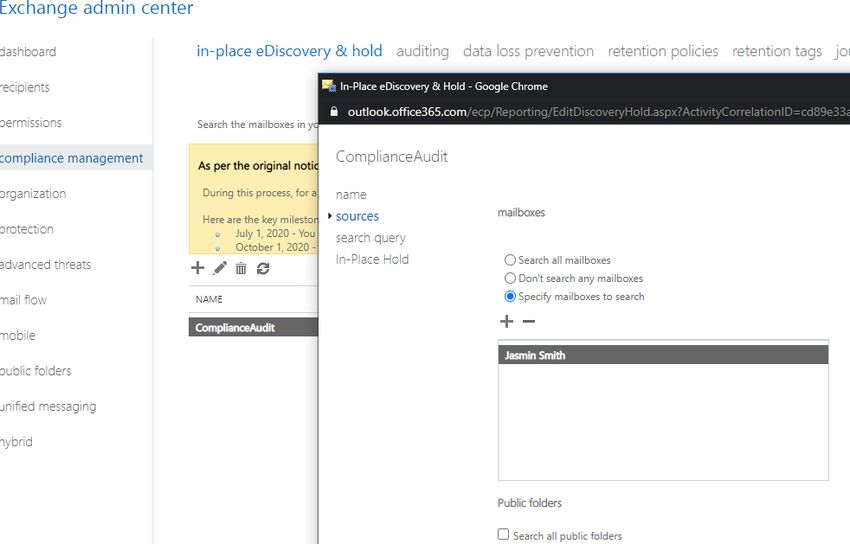
ts
                                                                              The Poisoned Postman 2

                                                                                                   gh
                                                                                               Ri
               1. Microsoft Exchange and Exchange Online – A

                                                                                            ll
                  Strategic Target

                                                                                       Fu
                      Though business communication platforms continue to innovate with

                                                                                 ns
               technologies like instant messaging and chat services, no method dominates the

                                                                             ai
               professional communication spectrum more than email. In a four-year communications

                                                                         et
               study from 2016-2020, the technology market research firm The RadiCati Group

                                                                    rR
               identified that 64% of businesses still use email as a primary form of communication, and

                                                              ho
               the group projected a 4.3% growth in the trend in 2021 (The RadiCati Group Inc, 2020).

                                                          ut
               Email services are used to communicate sensitive business data, including strategies,

                                                     ,A
               private data, and intellectual property. Many small and medium-sized businesses have
                                                 te
               also moved this vital function to cloud-hosted environments like Microsoft's Exchange
                                            itu

               Online to increase availability and reduce costs. In their 2019 Cloud Adoption report,
                                         st

               Cloud Access Service Broker BitGlass highlighted the exponential adoption of one
                                     In

               particular environment - Microsoft's Office 365 Productivity Suite (including Exchange
                              NS

               Online in the Enterprise Licensing Tier) which accounted for a 79% market share,
                        SA

               overtaking Google's G-Suite after a three-year adoption battle (BitGlass, 2019).

                      Advanced Persistent Threat (APT) groups have long recognized the strategic
                     e
                Th

               value of obtaining covert access to these business email communication systems to
               enable long-term objectives and have increased their capabilities and tactics to address
          20

               the cloud-adoption trend of potential victims. These groups, differentiated from
     20

               traditional attackers by their resources and specialized tooling (Leydon, 2020), value
 ©

               strategic operations such as the collection of communications instead of hit-and-run
               styled malware attacks targeting immediate monetary gain. One particularly aggressive
               growth trend observed in APT on-premise cyber collection operations is that of utilizing
               native functionality and system tools to achieve tactical objectives, reducing the attackers'
               footprint while increasing the difficulty of detection by victims. Dubbed living-off-the-
               land (LOL) tactics, these attacks accounted for 40% of compromises observed in
               Crowdstrike's 2019 Global Threat Report, and at least 15% of the LOL attacks targeted
               email systems (Crowdstrike, 2019). This style of tactic has also been modified for cloud
               environments where instead of using native executable files on operating systems,

               Rebel Powell, rebelpowell@gmail.com
© 2020 The SANS Institute                                                                           Author retains full rights.
ts
The Poisoned Postman 3
gh
Ri
attackers manipulate built-in features and application programming interfaces (APIs)
ll
exposed by providers, reducing their footprint in a cloud-based intrusion. While feature
Fu
abuse tactic reporting on cloud-specific incidents is often rare due to attribution fears by
ns
businesses (FBI iC3, 2016), two published on-premise APT incidents give example
ai
insights into how capable and advanced Microsoft Exchange native exploitation threat
et
tactics are.
rR
In 2019, ESET researchers exposed APT28's LIGHTNEURON backdoor which
ho
used rootkits and steganography to communicate over compromised Microsoft Exchange
ut
Mail Transfer Agents (MTAs) while it abused native-Exchange rule functionality to
,A
exfiltrate, redirect, or alter victim emails based on specific criteria in on-premise and
te
hybrid-cloud Microsoft Exchange environments (Faou, 2019). The backdoor itself may
itu
not have been a native feature abuse capability, but the rules it applied to MTAs made it
st
particularly challenging to detect for victims who were often not auditing the native MTA
In
element of their email systems and are a textbook example of living off the land. This
NS
same type of native email server functionality exploitation was also observed by
SA
FireEye's 2018 analysis of APT35, who created malicious email forwarding rules abusing
Exchange PowerShell functionality in attacks in both on-premise and cloud-hosted
e
Microsoft environments in the financial sector (FireEye, 2018).
Th
A significant risk consideration for small- and medium-businesses who adopt
20
Microsoft Exchange Online environments for business communications relates to their
20
email system's defensibility and audibility. While adversary attacks, tooling, and interest
©
in Exchange environments are undeniable, very little public guidance or standards exist
to detect or defeat adversaries in this space. MITRE's specific Microsoft Office 365
ATT&CK matrix, for example, only includes one recognized technique (Email
Collection) with three sub-techniques (local collection, remote collection, and email
forwarding rules) and provides only generic log review suggestions to combat them
(MITRE, 2020). This lack of defensive strategies is attributable to an absence of
reporting by victims of adversary tactics but also by a lack of administrator visibility and
knowledge of Microsoft Exchange Online environments. A LogicWorks 2020 Survey
identified that 86% of respondents identified that cloud engineers' lack of vendor-specific
Rebel Powell, rebelpowell@gmail.com
© 2020 The SANS Institute Author retains full rights.ts
The Poisoned Postman 4
gh
Ri
cloud knowledge would significantly impact their cloud-hosted environment adoption
ll
(LogicWorks, 2020). Business adopters and administrators can better protect crucial data
Fu
that resides in and flows through their email systems and reduce the overall risk of
ns
compromise in a quantitatively demonstrable manner by becoming more aware of
ai
adversary interests and intent to exploit them.
et
rR
2. Exchange Online in Action
ho
2.1. Office 365 License and Tool Considerations
ut
Microsoft's Enterprise Office 365 license tiering is available in three offerings – E1,
,A
E3, and E5, with costs per-user and features available increasing as the offering's number
te
does. This work considered an E3 and E5 tenet for threat modeling due to the advanced
itu
Microsoft Compliance Center and associated tools only being available to those tier-
st
levels. It ultimately proceeded with the E5 tier as it was the only option that included
In
Advanced Compliance features (including eDiscovery 2.0). Small- and medium-sized
NS
businesses should similarly identify their needs and choose a tier that meets their minimal
SA
compliance and regulatory requirements but should bear in mind that defensive tools and
advanced logging are usually only provided in higher license tiers.
e
Th
Included in the E5 tier are two critical features for adversaries to capitalize upon and
for defenders to configure and audit to prevent their success:
20
• Litigation Hold
20
• Advanced eDiscovery
©
Both features are explored in detail in Section 2.3.2. Each features' native functionalities
are to enable administrators to collect emails and data from mailboxes that may be
involved in legal proceedings where evidence collection and preservation are crucial to
investigation and discovery. As APT28 and APT35 have demonstrated, however, they are
powerful tools that can also be co-opted to collect data on target victims or entire
organizations. Both features and the myriad of other tools available to administrators in
Exchange Online are available via a web GUI or a PowerShell add-on applet.
Rebel Powell, rebelpowell@gmail.com
© 2020 The SANS Institute Author retains full rights.ts
The Poisoned Postman 5
gh
Ri
2.2. SANS Swell Sodas Inc.
ll
To fully explore defensive scenarios involving the manipulation of compliance
Fu
features in an Exchange Online environment, and to qualitatively and quantitatively
ns
measure the results of countermeasures put in place, a representative (yet fictional)
ai
medium-sized business was created and replicated in a fully functional Microsoft Office
et
365 E5 Tenet to facilitate the remainder of this research. This entity, SANS Swell Sodas,
rR
Inc., represents the more than 79% of businesses that employ between 100-500 users and
ho
who are the heaviest users of the Microsoft Office 365 platform (Cole, 2016). Of that
ut
group of businesses, 61% list Microsoft Exchange Online as the primary application they
,A
use on the Office 365 platform, second only to the file storage service OneDrive.
te
Exchange Online mirrors this trend for the business and provides SANS Swell Sodas
itu
their primary communication channel both internally and for contact with external
st
organizations, making it a crucial asset to secure in their cybersecurity plan.
In
Like 70% of small- and medium-sized businesses, SANS Swell Sodas hosts their
NS
most sensitive data in their Microsoft Exchange Online tenet (Proofpoint, 2015). Much of
this data storage is unintentional, often resulting from executives or employees emailing
SA
each other attachments or documents containing proprietary or competitively valuable
e
information and being unaware of the data being retained in the cloud indefinitely.
Th
Further exposing the business to risk, while the email is encrypted in transit via TLS,
20
SANS Swell Sodas has opted not to utilize the data classification and loss prevention
20
capabilities of their Office 365 E5 tenet. This choice mirrors 88% of the small- and
©
medium-size businesses industry who have the same configuration (Cole, 2016). This
setup potentially exposes SANS Swell Sodas' most valuable piece of intellectual property
– their prize-winning soda recipe, to an attacker whose goal is to capitalize on these
weaknesses and exfiltrate the proprietary data for nefarious use.
A final consideration for the SANS Swell Sodas Exchange Online ecosystem is the
human element of risk involved. In addition to traditional user email threats like phishing
and financial whaling, which must be defended, SANS Swell Sodas only employs five
administrators to administer their Exchange Online tenet. These administrators have the
cloud-specific knowledge gaps addressed in Section 1, but more importantly, they also
represent the more than 64% of Office 365 administrators who have other business-
Rebel Powell, rebelpowell@gmail.com
© 2020 The SANS Institute Author retains full rights.ts
The Poisoned Postman 6
gh
Ri
critical IT duties that do not include administering the email tenet full-time. This demand
ll
is reflected in the administrators' schedule, which only allows them to log in to the tenet a
Fu
few times a week to troubleshoot major issues or to collect logs when required by
ns
regulatory necessity.
ai
With the SANS Swell Sodas Inc. Exchange Online environment and its
et
vulnerabilities defined, the business is ready to analyze potential native feature abuse
rR
tactics in the environment and to identify qualitative and quantitative controls that can be
ho
enacted to reduce the effectiveness of those tactics. Two likely attack paths will be
ut
explored to facilitate this implementation, first in the environment using the default
,A
configuration of Exchange Online and then with compensating controls enacted. After
impact is measured from the controls, they will be aligned to a more extensive continuous
te
itu
monitoring program that is usable by a small- to medium-sized business while
considering challenges such as the lack of dedicated administrator resources they have
st
In
available.
NS
2.3. Attacking SANS Swell Sodas, Inc. – Default Artifacts
SA
With adversary intent, likely targeted attack paths, and a “victim” medium-sized
business environment all being developed, analysis of the attacks was conducted and
e
Th
measured for an organization in two differing security postures. The ultimate goal of this
study was to develop an effective and repeatable framework to detect and defeat an
20
attacker in an Exchange Online Environment using feature abuse tactics.
20
2.3.1. The Scenario
©
Email traffic was generated to act as a collection target for the simulated attacker to
create a realistic environment that would act as a baseline for the measurements of
defensibility and detectability of an adversary operating in the Exchange Online
environment manipulating Compliance features. Using the SANS Swell Soda Inc. E5
tenet described above and the Microsoft Exchange REST API, 543 emails were sent
between fifteen employees created in the Office 365 tenet. A significant majority of these
messages (71%) contained simulated traditional employee-to-employee daily
communications that would have limited value if collected by an adversary. These emails
were randomly generated by utilizing a business word dictionary and a Python utility,
Rebel Powell, rebelpowell@gmail.com
© 2020 The SANS Institute Author retains full rights.ts
The Poisoned Postman 7
gh
Ri
Faker (Faraglia, 2020), which outputted random combinations of words from the
ll
dictionary to form the body of the messages. The remaining 29% of manually-created
Fu
emails contained detailed information that SANS Swell Sodas would want to keep out of
ns
competitor's hands to maintain their competitive advantage (financial data, PII, etc.), but
ai
only three emails held their most valuable intellectual property – their soda's secret
et
recipe.
rR
From the business detection perspective, Exchange Online's default logging settings
ho
were utilized with no additional configuration being applied, representing the adoption
ut
settings of those in the previously mentioned Skyhigh Networks report. While Microsoft
,A
notes that default logging actions are always being updated, changed, and rolled out to E5
tenets (Microsoft 2020), in general, default logging of mailboxes includes basic mail flow
te
itu
data, ownership changes of the mailbox, permanent deletion of messages, and delegation
(using the “Send As” feature). An exact listing of audited default functionality during the
st
In
analysis period was retrieved with various versions of the following PowerShell
NS
commandlet:
Get-Mailbox | Format-List DefaultAuditSet
SA
External access logs (those representing connection source IPs to the Office 365 tenet)
e
were also left with the default configuration enabled.
Th
To create a simulated administrator-level target for the attack, one account (Richard
20
Augustus) was created with the highest privilege level – Global Administrator. This role,
20
which has full administrative purview over Exchange Online and the SANS Swell Sodas
Inc. Office 365 E5 tenet has many options and tools available that are not enabled for
©
regular users. Most of these features and privileges exceed the needs of this research;
however, two are particularly relevant – Compliance/Discovery Management and
Organization Management. When combined, these roles present the Global Administrator
the ability to view and download log-files, change or bypass audit logging requirements,
and emplace Litigation and Advanced eDiscovery-type holds for all employees of SANS
Swell Sodas.
While Microsoft recommends tightly restricting control to these accounts and
enforcing security best practices such as multi-factor authentication to access them,
multiple 2019 Compromise Analysis Reports from the US Department of Homeland
Rebel Powell, rebelpowell@gmail.com
© 2020 The SANS Institute Author retains full rights.ts
The Poisoned Postman 8
gh
Ri
Security repeatedly underscore that these features are not commonly enabled in victim
ll
organizations (DHS, 2019). DHS does not provide exact statistics on the prevalence of
Fu
the configuration issues with third-party organizations aided in incident response as a
ns
privacy consideration, but they do note an “...increasing mix of configurations which
ai
have lowered several organizations' cloud security postures.” (DHS, 2019).
et
For the analysis scenario, an adversary was assumed to have compromised the
rR
Global Administrator account because of this type of misconfiguration. This compromise
ho
was assumed to come as the result of credential stuffing, where a compromise of a third-
ut
party service reveals a legitimate password, which is then reused by the Global
,A
Administrator for the Office 365 tenet. A 2019 SANS Spotlight, co-sponsored by
Microsoft, highlights this type of compromise as one of the most common in Office 365
te
itu
Instances (Bromiley, 2019). A crucial point to also highlight is that the compromiser in
this analysis was an APT-styled adversary, rather than a casual attacker. This changed the
st
In
goal of the attacker's perspective post-compromise to persistence and continued strategic
NS
access instead of a desire exfiltrate data quickly. This persistence is usually achieved in
the span of months to years versus hit-and-run style attacks, which operate in times from
SA
days to weeks (Crowdstrike, 2020) and focused the attacker's goal on using the
e
Compliance Features to obtain strategic information.
Th
2.3.2. Default Configuration Results – Limited Visibility and Traceability
20
As emails were sent throughout the Exchange Online instance, manipulation of the
20
two compliance features (Litigation Hold and Advanced eDiscovery) occurred via the
©
compromised Global Administrator account from the adversary perspective. After each
of the features was manipulated, a forensic collection on the tenet was taken via
PowerShell or via the Exchange Online web GUI (whichever exposed the logs in the
most user-friendly method) from the defender perspective to account for the SANS Swell
Sodas Administrator's busy schedule and lack of complete knowledge of the Office 365
E5 tenet.
Feature 1: Litigation Hold
As one of the original legal-discovery features introduced in Microsoft Exchange
2007, Litigation Hold (sometimes expanded to include a similar feature known as In-
Rebel Powell, rebelpowell@gmail.com
© 2020 The SANS Institute Author retains full rights.ts
The Poisoned Postman 9
gh
Ri
Place Hold) represents one of the earliest Exchange-specific tools to address litigation
ll
requirements. Throughout the feature's evolution, Microsoft has added increasing abilities
Fu
to select and export entire inboxes, specific emails, or particular message traits to prevent
ns
them from being deleted by a user whose mail might be involved in a legal proceeding,
ai
preserving evidence for the duration of an investigation. This feature is also one of the
et
most commonly deployed legal retention strategies, with over 56% of businesses having
rR
used the tool in either an on-premise Exchange or hosted Exchange Online Environment
ho
(Fraizer and Zohlen, 2017). This long-term use of Litigation Hold can be attributed to the
ut
age of the feature and use by email administrators for many years and is still supported
,A
today in Office 365 tenets. As filtered emails or inboxes which have had Litigation Holds
applied are transported or deleted, Exchange creates an immutable version of the email
te
itu
for export to an external Outlook file format – a PST file. This file is then downloaded
from the Exchange server to an external storage medium and preserved until the In-Place
st
In
hold has been deleted. A Microsoft diagram explains this logic in more detail in Figure 1.
NS
SA
e
Th
20
20
©
Figure 1. Litigation Hold Preservation/Storage Process (Microsoft, 2019)
From an adversary perspective, Litigation Hold represents a reliable capability to
search for and store strategic emails of interest for later export without maintaining an
interactive command-and-control of a compromised Exchange server or environment,
Rebel Powell, rebelpowell@gmail.com
© 2020 The SANS Institute Author retains full rights.ts
The Poisoned Postman 10
gh
Ri
which is especially attractive for adversaries. With a one-time compromise and
ll
emplacement of the hold, collection can occur for an infinite period, only requiring an
Fu
adversary to return to collect the final product. This attack reduces the victim detection
ns
capability to viewing only audit logs if their tenet was configured to collect them.
ai
Combined with the 90-day default log retention period highlighted in Section 1,
et
compromised Litigation Hold makes detection by a victim with a limited security staff
rR
extremely challenging.
ho
In the first quarter of 2020, Microsoft announced the retirement of the Litigation
ut
Hold feature in Exchange Online in favor of the more Advanced eDiscovery suite of
,A
compliance tools (Microsoft. 2020). However, this research highlights Litigation Hold as
te
still an unusually highly usable abuse tactic because of its phase-out methodology. After
itu
July 1, 2020, new Litigation Holds are no longer creatable via the web GUI or Exchange
st
PowerShell. After October 1, 2020, only deleting Litigation Holds from the Exchange
In
PowerShell is possible. This time window of opportunity presents the adversary an ideal
NS
LOL scenario where they could enable a Litigation Hold before the July 1 date in a
SA
compromised tenet, have it become graphically undetectable by a GUI-focused victim
administrator, and only become discoverable after October via PowerShell analysis if the
e
log retention was appropriately configured. This phase-out offers Litigation Hold as a
Th
very likely exploitation opportunity by an adversary with a uniquely created blind-spot
20
for victims who may be unaware of the tactic and deprecation timeline.
20
Feature 1 Key Observations
©
Key observations from the Litigation Hold forensic collection in the default
configuration of Exchange Online call attention to the extreme difficulty of detecting an
attacker compromise where this living off the land attack is utilized. To simulate the
adversary living off the land with this feature, a Litigation Hold was created with the
search query “recipe” and applied to all mailboxes on the SANS Swell Sodas tenet. This
resulted in another employee (Jasmin Smith) being discovered as the only worker with an
email containing the keyword and allowed a subsequent targeted Litigation Hold to be
placed on her mailbox (see Figure 2). Visually, the only administrator indication of the
hold was a single text entry in the Litigation and In-Place Hold sub-menu of the
Rebel Powell, rebelpowell@gmail.com
© 2020 The SANS Institute Author retains full rights.ts
The Poisoned Postman 11
gh
Ri
Exchange Online Control Panel (requiring eight clicks to discover). This artifact was also
ll
able to be queried via the following PowerShell commandlet:
Fu
Get-Mailbox | LitigationHold*
ns
In both cases, only a single line entry explaining the hold (which was filled in with an
ai
innocuous comment from the attacker) provided information about the hold.
et
rR
ho
ut
,A
te
itu
st
In
NS
SA
e
Th
Figure 2: Targeted Litigation Hold via the GUI
20
20
With the default logging configuration enabled, only six log artifacts related to the
Litigation Hold tactic were discoverable via examination of two logs. These logs, which
©
had analysis complicated by unintelligible GUIDs and SIDS generated by the Exchange
Tenet itself, showed that the compromised administrator had accessed the victim's
mailbox and created a Litigation Hold. Details regarding the filters used or result
achieved were not noted in the logs examined with the default configuration enabled,
meaning discovery without further interviewing the staff involved to note the discrepancy
would prove perplexing. An example audit log is shown in Figure 3 for further review.
Rebel Powell, rebelpowell@gmail.com
© 2020 The SANS Institute Author retains full rights.ts
The Poisoned Postman 12
gh
Ri
ll
Fu
ns
ai
et
rR
Figure 3: In-Place Litigation Hold Trace Log
ho
ut
The tactic was also effective for the adversary's goal, quickly locating the one email
,A
in the entire tenet meeting the search criteria. This email was transparently archived
te
based on the Litigation Hold's disposition with no indication to the recipient. Exfiltration
itu
of the resulting 56KB PST archive took less than two minutes. It resulted in only one
st
additional export log event being created in the Exchange Administrator Audit log,
In
making the Litigation Hold tactic a high-impact and low-traceable one in SANS Swell
NS
Sodas' default configured E5 tenet.
SA
Feature 2: Advanced eDiscovery
e
The Advanced eDiscovery (sometimes known as strictly eDiscovery 2.0) is the
Th
improved litigation and compliance solution, which will fully replace Litigation Hold in
20
Exchange Online tenets in 2020 (Microsoft, 2020). As a component of the overall
20
Microsoft Compliance ecosystem of tools, Advanced Discovery targets the entire
©
corporate litigation workflow of tenet data rather than just the technical email artifacts.
Improvements include better indexing features for searchability, document tagging,
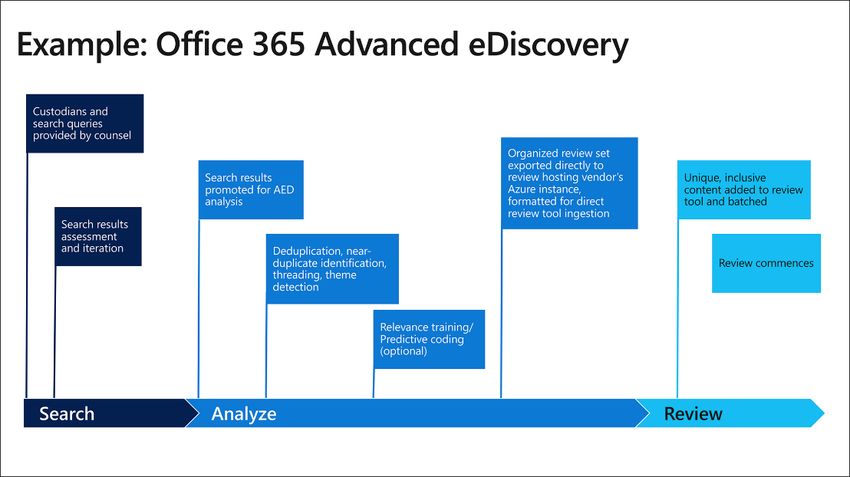
visible dashboards, and a case-centered view of investigation(s) in progress. An example
use of this ligation workflow is shown in Figure 4.
Rebel Powell, rebelpowell@gmail.com
© 2020 The SANS Institute Author retains full rights.ts
The Poisoned Postman 13
gh
Ri
ll
Fu
ns
ai
et
rR
ho
ut
,A
te
itu
Figure 4. Advanced eDiscovery Litigation Workflow (Microsoft, 2019)
st
In
With these advanced feature introductions come an increased attack surface for
NS
potential adversaries looking to live off the land in Exchange Online. In their 2020
SA
Microsoft Office 365 License Optimization Report, SaaS Provider CoreView discovered
that of companies using E5 licensed tenets, 38% could reduce their license to the E1 tiers
e
Th
based on their lack of use of the E5 feature set. However, many of these companies
cannot do so because they adopt E5 tenets for specific features only available at that
20
license level, such as the Microsoft Advanced Threat Protection (ATP) security program
20
(Coreview, 2020). Companies in this adoption pattern lack knowledge or necessity to
©
utilize extra features available to them. This “no-person's-land” of unused features is
where attackers gain another likely Exchange Online native feature abuse tactic.
By utilizing new indexing features available in Advanced eDiscovery against
Exchange Online tenets, attackers can more tightly focus data selection for exfiltration
from a compromised victim while maintaining a much smaller footprint in the
organization. The adversary data collection net has also been expanded to include file
metadata, email importance level, and even conversations from Skype for Business and
Microsoft Teams (which are stored in Exchange Online). As a final challenge for
detection during the exfiltration stage, cases from Advanced eDiscovery are exportable to
Rebel Powell, rebelpowell@gmail.com
© 2020 The SANS Institute Author retains full rights.ts
The Poisoned Postman 14
gh
Ri
the victim's Azure Cloud storage tenet or an adversary procured Azure storage blob
ll
(Microsoft, 2020) for download, further obfuscating potential infrastructure involved
Fu
without additional logging being enabled pre-compromise. More attack surfaces are also
ns
exposed for the small- or medium business' larger Office 365 tenet by Advanced
ai
eDiscovery, but these scenarios exceed the scope of this research. The Future
et
Implications section and Microsoft's own Advanced Security Reference best outline
rR
further threat modeling potential.
ho
Feature 2 Key Observations
ut
The Advanced eDiscovery abuse tactic proved equally effective against the
,A
default Exchange Online logging configuration. After beginning the attack on a separate
te
day to minimize cross-logging contamination from the Litigation Hold (Microsoft does
itu
not allow clearing of the Exchange Online log entirely), a similar search was conducted
st
on SANS Swell Sodas' tenet. However, this tactic was enabled via a separate and more
In
detailed GUI – the Microsoft Compliance Center, which is a separate component from
NS
the Exchange Online Control Panel. While the results were much more visible
SA
graphically to the victim in the Compliance Center (showing as a large “1” in the Number
of Cases), there were no visual indicators created in the Exchange Online Control Panel
e
Th
concerning the search, requiring the SANS Swell Sodas Administrators to be looking at a
different interface to detect the intrusion.
20
When combined with the previously discussed lack of administrator knowledge
20
presented by LogicWorks, SANS Swell Sodas faces a high likelihood that this tactic
©
would go undetected. Specifically, detection of the Advanced eDiscovery presented key
challenges, requiring both:
• An administrator to have a specific need to check the Compliance Center
during the attack.
• Knowledge of Auditing/Compliance Logs and Compliance Center Logging
Locations.
Exfiltration from the Compliance Center was also more complicated when compared to
the Litigation Hold from an adversary perspective, but because it utilized Microsoft
native features via Azure storage blobs, it also became much more complicated to detect
Rebel Powell, rebelpowell@gmail.com
© 2020 The SANS Institute Author retains full rights.ts
The Poisoned Postman 15
gh
Ri
(requiring knowledge of Blob ID ownership to fully trace). With less than half the
ll
artifacts of the Litigation Hold tactic and the additional difficulty in acquiring them, the
Fu
Advanced eDiscovery tactic proved extremely efficient and difficult to detect or prevent
ns
with default configurations enabled.
ai
Feature Manipulation Results – Default Configuration
et
In summary, both the Litigation Hold and Advanced eDiscovery feature abuse tactics
rR
proved effective for the medium-sized business lacking dedicated Exchange Online
ho
resources to detect or prevent in an Exchange Online E5 tenet with a default
ut
configuration applied. The table below summarizes and scores critical elements from
each tactic. They include:
,A
te
• The number of artifacts generated
itu
• The ease of accessing these artifacts
st
• The likelihood that the artifact would lead to the successful detection of the
In
tactic
NS
Scores are scaled from one to five, with one being the easiest to access and five being the
SA
most difficult. For detection, one represents the easiest to detect, and five is the least
likely to be detected. A final observation for this phase is the score of the Advanced
e
Th
eDiscovery on Likelihood of Detection – this score is adjusted to address that if SANS
Swell Sodas were able to locate the Compliance logging, they would be highly likely to
20
discover that the tactic was deployed.
20
©
Tactic Artifacts Created Accessibility of Artifacts Likelihood of Detection
Litigation Hold 6 3 2
Advanced eDiscovery 3 5 3
Figure 5: Detection Success Matrix in Default Configuration
Rebel Powell, rebelpowell@gmail.com
© 2020 The SANS Institute Author retains full rights.ts
The Poisoned Postman 16
gh
Ri
3. Protecting the Secret Recipe – Improving Detection
ll
Fu
With the viability of two adversary potential attack paths demonstrated and the
difficulty of administrator detection being made evident, the second phase of the
ns
analysis shifted focus to increasing the likelihood of detection and prevention by
ai
increasing the victim administrator's knowledge of features available in E5 tenets.
et
rR
By aiding potential victims to use the same living off the land methodologies in
Exchange Online from a defensive perspective, this phase determined two effective
ho
techniques that can be enacted to combat an attackers' ability to operate stealthily
ut
in their environment. Given the increasing availability of tools in the Office 365
,A
ecosystem, advanced study of each tool's effectiveness would not be practical.
te
However, the techniques chosen demonstrate low-difficulty to implement and high-
itu
impact countermeasures that small and medium-sized businesses can deploy
st
quickly to increase visibility.
In
NS
3.1. Logging Architecture and Artifacts
SA
As adoption of Office 365 by organizations with strict compliance and reporting
requirements has increased, so too have Microsoft's auditing capabilities, especially those
e
of privileged accounts. The bulk of this research will examine two particular logs for
Th
artifacts: the Exchange Trace Logs and the Audit Log in the Security and Compliance
20
Center. Both logs include multiple indicators of an administrator or potential adversary
20
activity when examined by a business, especially when their Office 365 hosted tenet is
©
configured with advanced logging capabilities enabled. This is a recommendation
discussed in Section 4. A detailed overview of the logging infrastructure and its
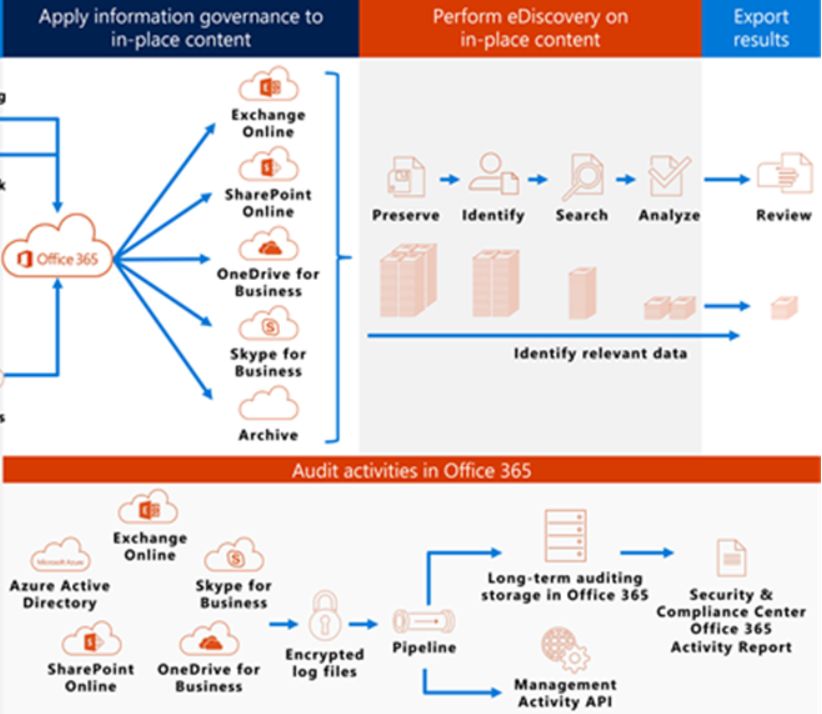
positioning within the Microsoft Office 365 and Exchange Online ecosystem is illustrated
in Figure 6 below.
Rebel Powell, rebelpowell@gmail.com
© 2020 The SANS Institute Author retains full rights.ts
The Poisoned Postman 17
gh
Ri
ll
Fu
ns
ai
et
rR
ho
ut
,A
te
itu
st
In
NS
Figure 6. Audit Activities and Governance in Office 365 (Microsoft, 2019)
SA
Email inboxes or individual messages manipulated by the Litigation Hold or
e
Th
eDiscovery features are selected from the mail stream based on rules designed by
administrators via the GUI or management PowerShell and are held in resulting
20
mailboxes. These rules can be as simple as “select all emails to and from
20
rrositas@sansswellsodas.com” or much more specific based on content such as “hold any
©
email with an attachment file that is a docx file with a filename containing recipe.” This
wide variety of filtering enables organizations to minimize over-selecting emails, which
could have fiscal implications for increased storage requirements or liability implications
for potential violations of reasonable privacy expectations. To aid in repudiation and
chain-of-custody questions on what rules were enacted by which administrator, detailed
audit trails are written to logs stored in Office 365 and accessed via the Management
Activity API.
Logging in Office 365 is critical to a business defending against adversaries
attacking using native features. However, a critical knowledge requirement for
Rebel Powell, rebelpowell@gmail.com
© 2020 The SANS Institute Author retains full rights.ts
The Poisoned Postman 18
gh
Ri
administrators and adopters is that logs are sometimes limited or nonexistent based on
ll
where features are accessed. An example of this can be seen in the eDiscovery Audit
Fu
Log, which only includes tasks configured from the Compliance Center. If performed
ns
from the Exchange Online Portal, those same activities would NOT be logged in the
ai
Audit Log (Microsoft, 2020). Additionally, logging is not enabled by default for most
et
Office 365 features, and log retention is by default set to 90 days maximum. Microsoft
rR
has indicated plans to address this lack of logging threat but has not set a firm timeline
ho
for implementation.
ut
Mitigation 1: Advanced Logging and Unified Log Review
,A
Logging is one of the most fundamental elements required to investigate an intrusion
te
involving a potential adversary compromise. Properly configured logs enable an analysis
itu
of campaign timelines, artifacts left by the attacker, successful exploitations of
st
misconfigurations, and provide insight into the ultimately targeted information. In
In
Exchange Online and Microsoft Office 365, however, logging is configured by default to
NS
consider fiscal implications on storage space rather than from a defensive perspective
SA
(Microsoft, 2020). Though Microsoft continues to improve their logging default settings
for Office 365, depending on the year a tenet was purchased or migrated to, disparate
e
Th
settings may be encountered. An example of this can be seen in the Mailbox Auditing
examined in Section 3's artifact samples. Since January 2019, Mailbox Auditing has been
20
enabled by default in new Microsoft Office 365 E5 tenets. However, tenets purchased
20
before this date may have lower Mailbox Auditing verbosity enabled or even no Mailbox
©
Auditing at all enabled.
To combat potential verbosity issues with Mailbox Auditing logging or allowing
non-standard logging configurations like those analyzed by DHS from being operated,
businesses should enable logging to the best level of verbosity available while still
respecting their cloud storage budget (DHS, 2019). While this quota will be different for
each organization, Microsoft and DHS both recommend ensuring verbose Mailbox
Auditing for all mailboxes in the organization is enabled. To apply this recommendation
to the analysis of SANS Swell Sodas Inc., the following DHS recommended PowerShell
commandlet was issued:
Rebel Powell, rebelpowell@gmail.com
© 2020 The SANS Institute Author retains full rights.ts
The Poisoned Postman 19
gh
Ri
ll
Get-Mailbox -ResultSize Unlimited | Set-Mailbox -
Fu
AuditEnabled $true -AuditOwner
MailboxLogin,HardDelete,SoftDelete,Update,Move -
ns
AuditDelegate SendOnBehalf,MoveToDeletedItems,Move -
AuditAdmin Copy,MessageBind
ai
et
Mitigation 1 Key Observations
rR
This command resulted in a more coherent and detailed audit log, which allowed
ho
Litigation Hold-type feature attacks to drastically increase the number of artifacts created
ut
on all mailboxes in the SANS Swell Soda tenet and increased the speed of log analysis by
,A
investigators while only increasing storage utilization by 11%. A marked improvement in
te
the analysis investigation occurred with the increased verbosity enabled. Details relating
itu
to each time a Litigation Hold query was run against the organization were logged, and
st
each mailbox noted a “non-owner mailbox accessed” event in the new logs. With the
In
same attacker queries from the first phase of the analysis, this created 45 events in two
NS
minutes, significantly improving the likelihood a victim administrator would recognize
SA
automated reconnaissance against their tenet in a log review. A full list of all audit logs
enabled via this command is available in the Appendix.
e
Th
A final pair of considerations for logging to combat adversary native feature attacks
in a small- to medium-sized business Exchange Online environment is both the retention
20
time and log review policy enacted by the organization. As mentioned in Section 2,
20
Microsoft's default setting for log retention is 90 days (Microsoft, 2020). This retention
©
covers a basic level of logging (including Mailbox auditing) but also excludes relevant
invents in an attacker compromise (such as access to the Azure tenant from Exchange
Online used to select victim mailboxes to query with Compliance features). By creating a
new retention policy that mirrors most organizations' on-site one-year requirement
(Proofpoint, 2015), potential victims increase their opportunity of detection timeline and
their ability to remove an emplaced adversary in their infrastructure by having the ability
to review each action taken by the attacker after the initial compromise. Logs can now
also be reviewed in the Unified Log application in the Microsoft Compliance and Trust
Center (Figure 7). This log review process alleviated two difficulties highlighted in the
Rebel Powell, rebelpowell@gmail.com
© 2020 The SANS Institute Author retains full rights.ts
The Poisoned Postman 20
gh
Ri
Advanced eDiscovery tactic from Section 3 – a lack of log location knowledge and the
ll
detail contained within the log. This Unified Audit Log shows a much more
Fu
understandable chain of events from the attacker's reapplied tactics after the settings were
ns
enabled.
ai
et
rR
ho
ut
,A
te
itu
st
In
NS
SA
e
Th
20
20
Figure 7: Unified Audit Log Review
©
By enabling these advanced logging settings, SANS Swell Soda Inc.'s Microsoft Office
365 gained critical visibility into adversary activity and simplified the time and difficulty
involved in administrative log reviews.
Mitigation 2: Policy Templates
Another valuable tool in an Office 365 E5 tenant administrator's toolbox is
Microsoft's included Data Loss Prevention (DLP) suite. While the capability's
applicability to intellectual property is large enough to form its own separate analysis,
one fundamental building block of DLP, the policy template, can be quickly implemented
Rebel Powell, rebelpowell@gmail.com
© 2020 The SANS Institute Author retains full rights.ts
The Poisoned Postman 21
gh
Ri
and used by administrators to gain visibility into key intellectual property as a logging
ll
mechanism.
Fu
Office 365 and Exchange Online include several pre-built content searches (called
ns
Policy Templates) to be utilized through the Compliance and Trust Center to track and
ai
prevent unintended disclosures of sensitive information. By integrating these templates
et
with native Office 365 transport functionality, Microsoft enables administrators to both
rR
track and analyze the movement of information covered by the content policy. At a tenet
ho
level, the policy decides if the movement should be allowed, should present a warning to
ut
the sending user, or should be prevented entirely. Over 90% of the included templates
,A
relate to the active defense of fiscal or international regulatory compliance (such as PCI
policy templates preventing emails containing over four potential credit card numbers
te
itu
from being emailed). Still, custom templates can be created within minutes to apply in an
audit-only configuration to track sensitive content. The allowance of the custom policy's
st
In
disposition to “alert” without actively interfering with the transfers (and potentially
NS
introducing false positive work stoppages) presents small- and medium-sized businesses
a built-in potential early warning sensor of an intrusion as the attacker both searches for
SA
and attempts to exfiltrate the data.
e
To apply this countermeasure to the SANS Swell Soda Inc. analysis tenet, a basic
Th
custom Policy Template was developed (Figure 8). The template's goal was to detect the
20
movement of data that contained keyword ingredients in the Secret Recipe (Caramel
20
Soda, Citric Acid, and SANS Soda Extract), and if these contents were discovered, to
raise an event and send an email to the tenet administrator. The template was created and
©
emplaced in three minutes and was deployed to the tenet and began acting in less than
twenty minutes.
Rebel Powell, rebelpowell@gmail.com
© 2020 The SANS Institute Author retains full rights.ts
The Poisoned Postman 22
gh
Ri
ll
Fu
ns
ai
et
rR
ho
ut
,A
te
itu
st
In
Figure 8: SANS Swell Soda DLP Policy Template for Secret Ingredients
NS
After the template was installed, search results from the Advanced eDiscovery case were
SA
exported to the SANS Swell Soda's Azure Storage blob. While the export was still
e
successful (the template's policy was only designed to alert), an email was also instantly
Th
dispatched to the Global Administrator alerting to both the source and destination of the
20
exfiltration, the content being shipped, and the names of the file that was attached to the
20
email containing the template's keywords. Several logging artifacts were also entered into
©
the Unified Log interface highlighted in the Advanced Logging section. When combined
with the extended retention policy created, SANS Swell Sodas would have an almost
complete attack timeline even if the live alert was missed.
Mitigation 2 Key Observations
The simplicity of installation and high-level organizational visibility gained by
installing a Policy Template makes it a force multiplier, especially in small- to medium-
sized businesses who may lack dedicated resources and knowledge on advanced Office
365 compliance and auditing features. Additionally, with the ability to avoid false
Rebel Powell, rebelpowell@gmail.com
© 2020 The SANS Institute Author retains full rights.ts
The Poisoned Postman 23
gh
Ri
positives actually impacting the business's workflow, Policy Templates provide a rare
ll
intrusion detection system in a cloud environment that is included as part of the E5 tenet.
Fu
3.2. Attacking SANS Swell Sodas, Inc. – Improved Defenses
ns
The two living off the land defensive countermeasures analyzed in Section 3.1 were
ai
applied in a combined manner to the SANS Swell Sodas E5 tenet before the initial set of
et
rR
tactics from Section 2 were re-executed. Tests were again conducted on a different day of
the week to minimize log contamination from previous observations, and only the
ho
Unified Log was viewed to attempt to identify the presence of the attacker and the tactics
ut
in use. Figure 9 presents the same view of the artifacts from Section 3 with the potential
detection controls applied.
,A
te
itu
Tactic Artifacts Created Accessibility of Artifacts Likelihood of Detection
st
Litigation Hold 49 2 2
In
Advanced eDiscovery 15 1 1
NS
SA
Figure 9: Detection Success Matrix in Enhanced Configuration
e
The countermeasures implemented had a drastic impact on the Global
Th
Administrator and business' ability to detect these attack tactics by producing clear and
20
concise logs that detailed exact actions taken by the adversary on their targets and greatly
20
increased the ability to either instantly respond to the tactics being utilized. These
controls required little additional knowledge or time commitment by the implementing
©
organization and additionally had no potential to cause business interruption as the
controls were enacted.
4. Conclusion and Future Implications
By implementing two native countermeasures that increased visibility into
administrator and employee actions in an Exchange Online hosted environment in
Microsoft Office 365, both quantifiable and qualifiable impact was demonstrated in a
small- to medium-sized business' ability to track an adversary using living off the land
tactics in a compromised organization. These countermeasures came at no additional
Rebel Powell, rebelpowell@gmail.com
© 2020 The SANS Institute Author retains full rights.ts
The Poisoned Postman 24
gh
Ri
licensing cost to the implementing business as both were included in the current license
ll
tier already being paid for, and both required little time investment from administrators
Fu
who did not monitor the Exchange tenet at all times. These critical countermeasures
ns
were:
ai
• Enabling Advanced Logging tenet-wide and reviewing Unified Logs
et
• Creating basic Data Loss Templates to monitor data movement
rR
During the course of this research, multiple opportunities for improving the detection
ho
methodologies outlined here to allow them to be applied in a more active nature were
ut
observed. While this may not be feasible for limited-resourced businesses, the use of
,A
Office 365 native Compliance Features to defend organizations against adversaries using
te
living off the land cloud-tactics is a worthwhile investment of research efforts and
itu
documentation work to enable defense of the larger community. Additionally, mapping
st
both offensive and defensive tactics to community standards such as MITRE's ATT&CK
In
Framework and the CIS Critical Cloud Security Controls framework as part of an
NS
ongoing continuous monitoring program will even more efficiently allow defenders to
prepare for this increasing attack opportunity.
SA
Small- and medium-sized businesses continue to increase the potential for
e
compromise of their most critical and sensitive communications systems by migrating
Th
them to cloud instances. By applying the techniques outlined by this research and
20
continuing to stay informed on adversary tactics, they can shrink their attack surface and
20
become better postured to fend off modern threats operating in these environments.
©
Rebel Powell, rebelpowell@gmail.com
© 2020 The SANS Institute Author retains full rights.ts
The Poisoned Postman 25
gh
Ri
5. References
ll
Fu
BitGlass Inc. (2019, November 5). 2019 BitGlass Cloud Adoption Report - A is for
ns
Adoption. A Is for Adoption. https://pages.bitglass.com/rs/418-ZAL-
ai
815/images/Bitglass_AforAdoption.pdf
et
Coles, C., 2016. Office 365 Adoption Rate, Stats, And Usage. [online] Available at:
rR
[Accessed 21 May 2020].
,A
Coreview, 2020. Office 365 License Optimization Report - Coreview. [online]
te
CoreView. Available at:
itu
st
[Accessed 21 May 2020].
NS
Crowdstrike Inc. “2019 CrowdStrike Global Threat Report.” Crowdstrike.com, April 13.
SA
2020, www.crowdstrike.com/resources/reports/2019-crowdstrike-global-threat-
e
Th
report/.
20
Department of Homeland Security (CISA), 2019. Microsoft Office 365 Security
20
Observations. [online] Us-cert.cisa.gov. Available at: [Accessed 26 May 2020].
Faou, M., 2019. [online] TURLA LIGHTNEURON One email away from remote code
execution. Available at: [Accessed 19 May 2020].
Faraglia, D. (2020). Faker (Version 4.11) [Computer software]. Retrieved April/May,
2020, from https://github.com/joke2k/faker
Rebel Powell, rebelpowell@gmail.com
© 2020 The SANS Institute Author retains full rights.ts
The Poisoned Postman 26
gh
Ri
FBI iC3, 2016. 2016 Internet Crime Report. [online] Internet Crime Complaint Center.
ll
Available at: [Accessed 21 April
Fu
2020].
ns
ai
Fraizer, J. and Zohlen, C., 2017. 5 Ways Legal And Compliance Teams Can Benefit
et
From Office 365 Migration | Corporate Counsel. [online] Corporate Counsel.
rR
Available at:
,A
[Accessed 25 April 2020]. te
Halfin, D., 2020. Search For Ediscovery Activities In The Audit Log - Microsoft 365
itu
Compliance. [online] Microsoft Technet. Available at:
st
In
[Accessed 5 May
SA
2020].
e
Th
Leydon, J. (2020, March 13). Interview – Corelight's Richard Bejtlich on cyber warfare
and the origin of the term 'APT'. The Daily Swig . Retrieved May 5, 2020, from
20
20
https://portswigger.net/daily-swig/interview-corelights-richard-bejtlich-on-cyber-
©
warfare-and-the-origin-of-the-term-apt
LogicWorks, 2020. 2020 Survey Report: Challenges In AWS Transformation. [online]
2020 Survey Report. Available at: [Accessed 19 May 2020].
Mandiant, 2018. Mandiant MTRENDS 2018. [online] FireEye.com. Available at:
[Accessed 19 May 2020].
Rebel Powell, rebelpowell@gmail.com
© 2020 The SANS Institute Author retains full rights.ts
The Poisoned Postman 27
gh
Ri
Microsoft Inc, 2019. Office 365 meets evolving eDiscovery challenges in a cloud-first
ll
world. [online] Microsoft.com. Available at: [Accessed 5 May 2020].
et
MITRE, 2020. Email Collection, Technique T1114 - Enterprise | MITRE ATT&CK®.
rR
[online] MITRE ATT&CK Office 365. Available at:
ho
ut
[Accessed 21 May 2020].
,A
Proofpoint Inc, 2015. Proofpoint's Role In Office 365 Security. [online] Available at:
te
[Accessed 18 April 2020].
st
In
The RadiCati Group, Inc., 2020. Email Statistics Report, 2020-2024. [online]
NS
Radicati.com. Available at: [Accessed 13 April 2020].
SANS Institute and Microsoft Inc., 2019. Bye Bye Passwords: New Ways To
20
20
Authenticate. [online] Query.prod.cms.rt.microsoft.com. Available at:
©
[Accessed 21 April 2020].
Rebel Powell, rebelpowell@gmail.com
© 2020 The SANS Institute Author retains full rights.ts
The Poisoned Postman 28
gh
Ri
Appendix
ll
Logs Enabled by Full Auditing
Fu
ns
ai
et
rR
ho
ut
,A
te
itu
st
In
NS
SA
e
Th
20
20
©
Rebel Powell, rebelpowell@gmail.com
© 2020 The SANS Institute Author retains full rights.Last Updated: October 12th, 2020
Upcoming SANS Training
Click here to view a list of all SANS Courses
SANS Community CTF , Oct 15, 2020 - Oct 16, 2020 Self Paced
SANS Sydney 2020 Sydney, AU Nov 02, 2020 - Nov 14, 2020 Live Event
SANS Secure Thailand Bangkok, TH Nov 09, 2020 - Nov 14, 2020 Live Event
APAC ICS Summit & Training 2020 Singapore, SG Nov 13, 2020 - Nov 28, 2020 Live Event
SANS FOR508 Rome 2020 (in Italian) Rome, IT Nov 16, 2020 - Nov 21, 2020 Live Event
SANS Community CTF , Nov 19, 2020 - Nov 20, 2020 Self Paced
SANS Local: Oslo November 2020 Oslo, NO Nov 23, 2020 - Nov 28, 2020 Live Event
SANS Wellington 2020 Wellington, NZ Nov 30, 2020 - Dec 12, 2020 Live Event
SANS OnDemand OnlineUS Anytime Self Paced
SANS SelfStudy Books & MP3s OnlyUS Anytime Self PacedYou can also read


